
Chapter 5 Momentum a measure of motion Force
- Slides: 9
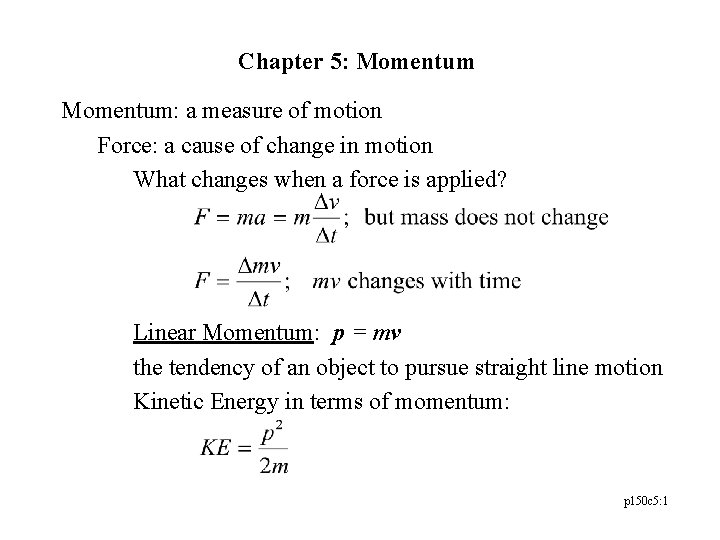
Chapter 5: Momentum: a measure of motion Force: a cause of change in motion What changes when a force is applied? Linear Momentum: p = mv the tendency of an object to pursue straight line motion Kinetic Energy in terms of momentum: p 150 c 5: 1
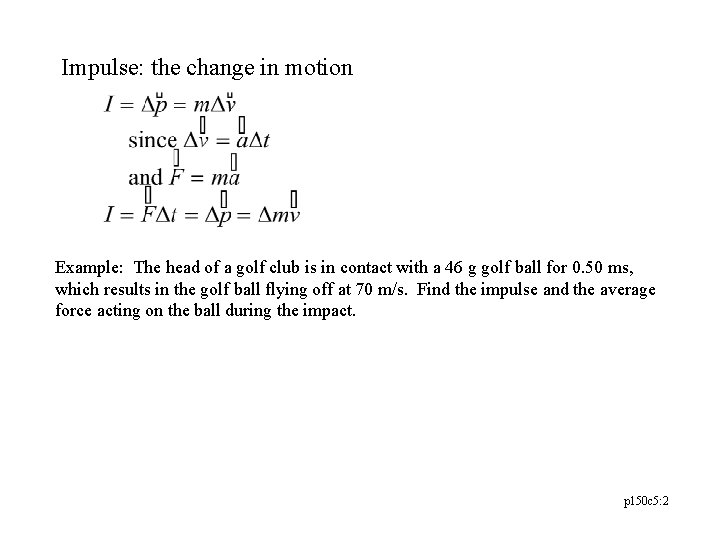
Impulse: the change in motion Example: The head of a golf club is in contact with a 46 g golf ball for 0. 50 ms, which results in the golf ball flying off at 70 m/s. Find the impulse and the average force acting on the ball during the impact. p 150 c 5: 2
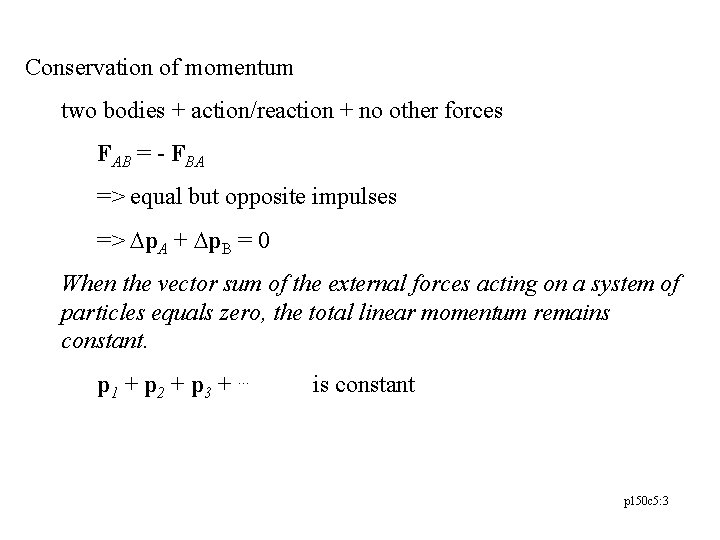
Conservation of momentum two bodies + action/reaction + no other forces FAB = - FBA => equal but opposite impulses => Dp. A + Dp. B = 0 When the vector sum of the external forces acting on a system of particles equals zero, the total linear momentum remains constant. p 1 + p 2 + p 3 +. . . is constant p 150 c 5: 3
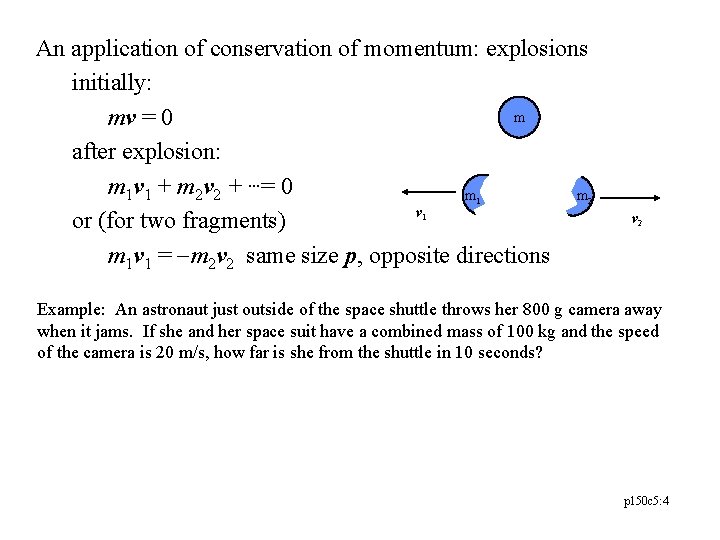
An application of conservation of momentum: explosions initially: m mv = 0 after explosion: m 1 v 1 + m 2 v 2 +. . . = 0 m m v or (for two fragments) m 1 v 1 = -m 2 v 2 same size p, opposite directions 1 1 2 v 2 Example: An astronaut just outside of the space shuttle throws her 800 g camera away when it jams. If she and her space suit have a combined mass of 100 kg and the speed of the camera is 20 m/s, how far is she from the shuttle in 10 seconds? p 150 c 5: 4
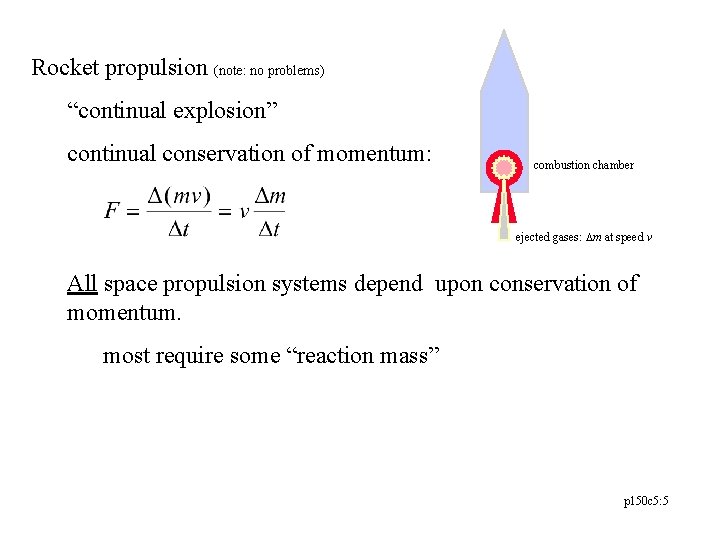
Rocket propulsion (note: no problems) “continual explosion” continual conservation of momentum: combustion chamber ejected gases: Dm at speed v All space propulsion systems depend upon conservation of momentum. most require some “reaction mass” p 150 c 5: 5
Collisions Elastic Collisions conserve KE (total KE is same before and after collision) Inelastic Collisions some KE is lost during collision (heat, sound, etc. ) Completely Inelastic Collisions objects stick together maximum possible loss of KE In all collisions, the total momentum is conserved! p 150 c 5: 6
Example 5. 4 A 5. 0 kg lump of clay that is moving at 10 m/s to the left strikes a 6. 0 kg lump of clay moving 12 m/s to the right. The two lumps stick together after they collide. Find the final speed of the composite lump of clay and the kinetic energy lost during the collisions. Example 5. 5 (discussion only) A 60 kg man sliding east on a frictionless surface of a frozen pond at a velocity of. 50 m/s is struck by a 1 kg snowball whose velocity is 20 m/s towards the north. If the snowball sticks to the man, what is his final velocity? p 150 c 5: 7
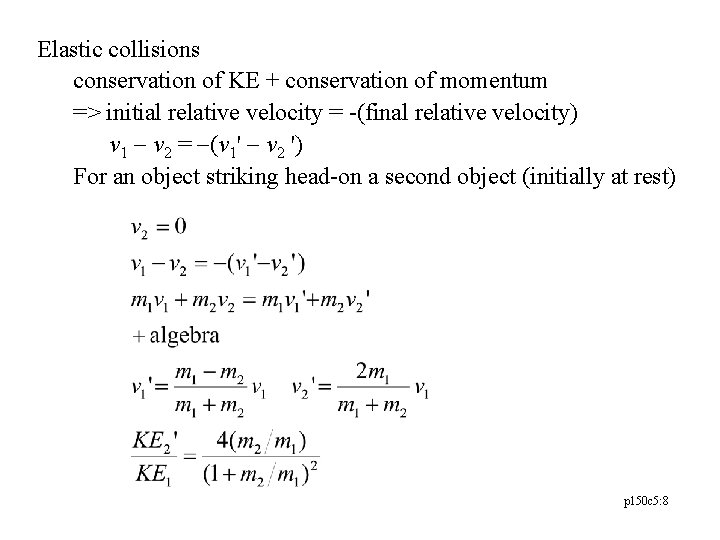
Elastic collisions conservation of KE + conservation of momentum => initial relative velocity = -(final relative velocity) v 1 - v 2 = -(v 1' - v 2 ') For an object striking head-on a second object (initially at rest) p 150 c 5: 8
Example: A 5. 0 Kg mass moving at 10 m/s collides elastically head-on with a stationary 10 Kg mass. What are the final velocities of both masses? What is the initial KE of the 5. 0 kg mass? What is the final KE of the 10 kg mass? Example: A 10 Kg mass moving at 10 m/s collides elastically head-on with a stationary 5. 0 Kg mass. What are the final velocities of both masses? What is the initial KE of the 10 kg mass? What is the final KE of the 5. 0 kg mass? p 150 c 5: 9