
Chapter 5 Mental and Emotional Health Chapter 5
- Slides: 50
Chapter 5 Mental and Emotional Health
Chapter 5 Vocabulary • Behavior Modification – Techniques used to reward desirable behavior • Defense Mechanisms – Techniques used to protect oneself from being hurt • Emotions – Feelings in response to an activity or an experience • Mental Health – Meeting the demands of life • Environmental Planning – Rearranging the environment to reduce your fear
Chapter 5 Vocabulary • Psychoanalysis – Techniques used to examine unresolved conflicts from the past • Self-talk – Saying things to yourself in order to view the fear more realistically • Self-concept – Self-image • Self-esteem – Feeling good about yourself and the things you do • Self-ideal – A realistic image to strive for
Chapter 5 Vocabulary • Anxiety disorder – A condition in which fear or anxiety prevents someone from enjoying life and completing everyday tasks • Personality disorder – An emotional condition in which a person’s patterns of behavior negatively affect that person’s ability to get along with others • Organic disorders – Mental and emotional disorders resulting from a physical cause • Mood disorder – A condition in which one mood is experienced almost to the exclusion of other feelings
Chapter 5 Vocabulary • Dissociative disorder – A condition in which someone’s personality changes to the point that the person believes he or she is someone else • Somatoform disorder – An emotional condition in which there are physical symptoms but no identifiable disease or injury. The physical symptoms are caused by psychological factors
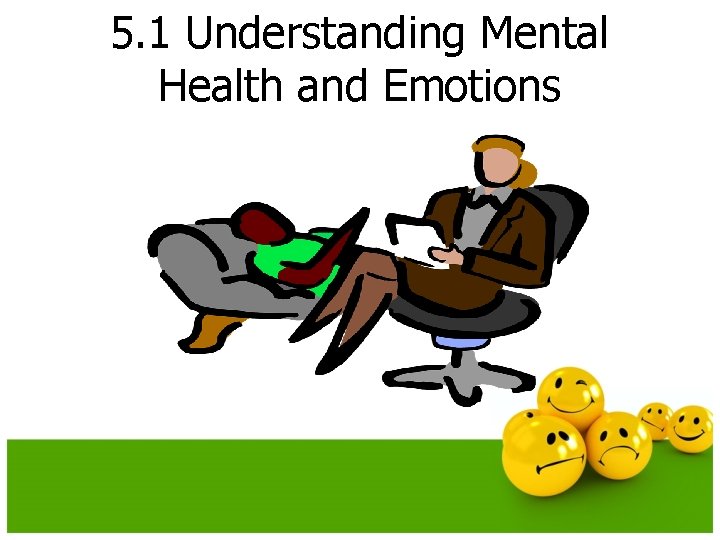
5. 1 Understanding Mental Health and Emotions
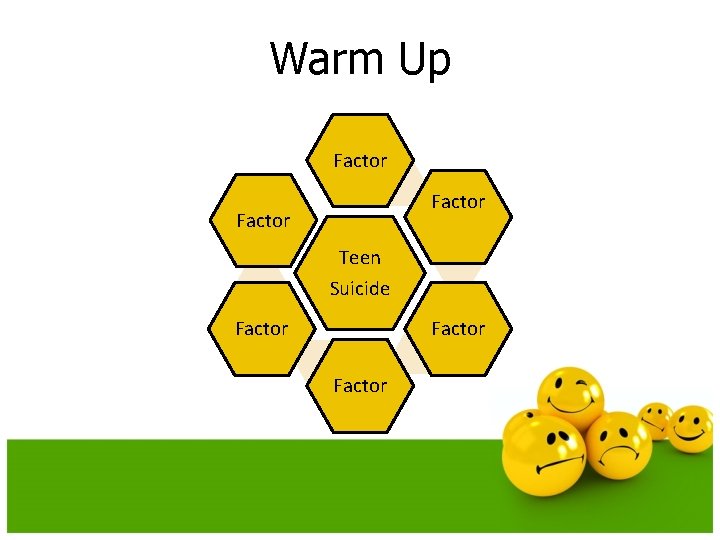
Warm Up Factor Teen Suicide Factor
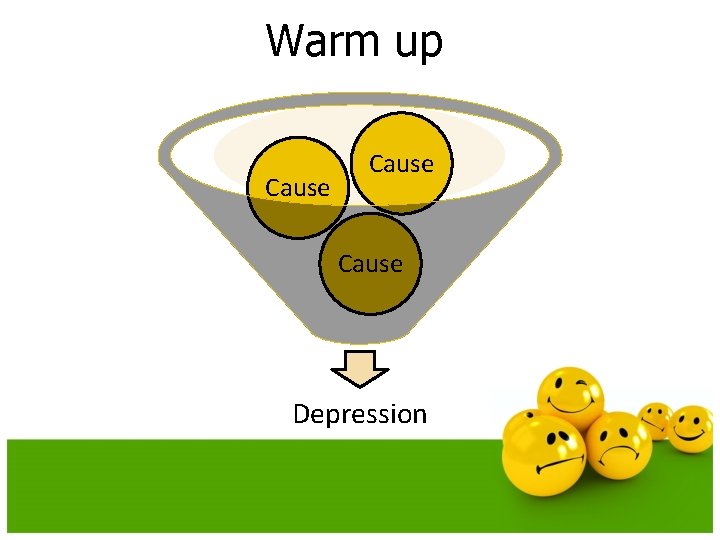
Warm up Cause Depression
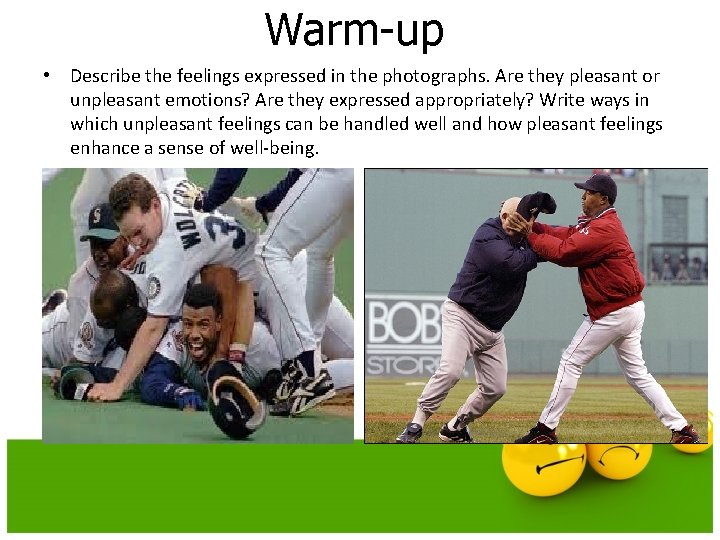
Warm-up • Describe the feelings expressed in the photographs. Are they pleasant or unpleasant emotions? Are they expressed appropriately? Write ways in which unpleasant feelings can be handled well and how pleasant feelings enhance a sense of well-being.
Warm up • A ______ is an illness of the mind that can affect the thoughts, feelings, and behavior of a person, preventing him from leading a happy, healthful, and productive life. People with _____ try to avoid situations that make them feel anxious or fearful. People with _____ such as stealing, lying, and truancy, engage in patterns of behavior in which the rights of others or basic social rules are violated. A _______ is a mark of shame or disapproval that results in an individual being shunned or rejected by others. An illness that involves mood extremes that interfere with everyday living is a ______. Word Bank Mental disorder, stigma, anxiety disorder, mood disorder, conduct disorder
5. 1 Understanding Mental Health and Emotions • People once thought mental health was the absence of mental illness • Positive terms refers to mental health as how you use the various aspects of health to achieve positive feelings about yourself and improve your ability to deal with problems • Questions to determine if you are mentally healthy: – Do you feel good about yourself and the things you do? – Can you cope with problems effectively? – Do you have close friendships? – Can you work through problems with your friends?
5. 1 Understanding Mental Health and Emotions • A yes to the previous questions most of the time means you are probably mentally healthy • Times will occur when you don’t feel good about yourself and when you have difficulty solving problems • Having problems is normal, but you can develop skills that will enable you to be more effective in dealing with problems • Good mental health as described by the National Association for Mental Health: – Feels comfortable with himself – Has good relationships with others – Meets the demands of life
5. 1 Understanding Anxiety • To be constantly afraid of things you should not fear is not normal • Constant fear can prevent you from participating in many aspects of normal life • You can harm yourself physically. Your body experiences a number of changes – Heart rate increases, you perspire, and your blood pressure increase
5. 1 Anxiety Disorders • A condition in which real or imagined fears are hard to control • Phobias are the most well-known anxiety disorders • A fear of flying, fear of germs on objects others have touched, or leaving the house is a real fear to someone with an anxiety disorder • Anxiety disorders are the most common mental and emotional disorders • Affect more women than men • Exs. Obsessive-compulsive disorder, panic disorder, post traumatic stress disorder
5. 1 Kinds of Emotions • Depression – Feeling of anxiety, loneliness, and despair – Can interfere with daily activities – Symptoms of depression: • Sleeping too much or too little • Feeling tired throughout the day • Lack of interest or lack of ability to concentrate • Loss of appetite • Loss of energy or withdrawal from a group – Everyone feels sad or depressed occasionally, but extended depression may indicate a need for professional help – Serious depression can lead to suicide
5. 1 Kinds of Emotions • Three types of depression: – Major depression – intense and can last for weeks or months – Mild depression – less severe symptoms, but can last for years – Adjustment disorder – a reaction to specific life event
5. 1 Kinds of Emotions • Several factors are linked to the development of depression – Family history - hereditary – Major life stresses – neglect, abuse, or separation – Physical illness – Psychological cause – Substance abuse – Alcoholics and abusers of other drugs – Gender – most likely to occur in women • Treatment for Depression – Try to identify when you feel the way you do. This allows you to put things in perspective – Medication – Environmental Changes – Psychotherapy
5. 1 Emotions are Normal • Emotions are feelings in response to an activity or an experience • Understanding emotions and expressing them effectively are important parts of being mentally healthy • Emotions make you feel good or bad • Emotions aren’t good or bad, the way you express them can be positive or negative • Your body is changing rapidly, your hormones can cause mood swings and dramatic changes in your emotions • Drugs and other substances can have a profound effect on mood
5. 1 Expressing Emotions • You learn to express emotions based on past experiences • Experiences include what you learned from your interactions and how others react • It’s important to express your emotions in a positive way • Learning how to do this is a continual process • One valuable skill in expressing emotions positively is to think of a particular emotion and rehearse what you will do when it occurs
Optimism Exercise • Is optimism part of your range of emotions? • Do the following to find out • **Notebook check** • Write down all the positive things you expect will happen to you in the future. Then list any of the bad things that you think could happen in the future as well. Now look at your lists. Have you described more positive things or more negative things? How could you revise your lists to look at each negative event with optimism?
5. 2 Types of Mental and Emotional Disorders
5. 2 Types of Mental and Emotional Disorders • We face a variety of challenges • Most of the time we can face challenges, learn from them and move forward • When we can’t that may be an indication of a mental or emotional disorder • Each year 57. 7 million people in the US are affected by some form of mental disorder • Many do not seek treatment because they feel embarrassed, ashamed, or worry about the stigma associated with mental health
5. 2 Impulse Control Disorder • People with impulse control disorder cannot resist the urge to hurt themselves or others • This may begin in childhood or the teen years • Person may cause physical and financial harm to themselves and others • http: //www. youtube. com/watch? v=Ud. L 4 n. EBZELQ Action Definition Kleptomania Unplanned theft of objects Cutting Repetitive cutting on parts of the body Gambling Continuing to gamble despite heavy losses Compulsive Shopping Spending money you can’t afford and don’t need
5. 2 Eating Disorders • You will about Anorexia and Bulimia in personal fitness • They are mentioned in this chapter because of their increasing frequency among teens • The cure for these disorders requires psychiatric treatment • Severe depression and some forms of sexual abuse are often associated with eating disorders
5. 2 Mood Disorders • Mood disorder – An illness that involves mood extremes that interfere with everyday living • Mood disorders usually last a long time and interrupts a person’s ability to complete daily activities • Most common mood disorder is depression • Another example is bipolar disorder (manic-depression)
5. 2 Schizophrenia • A severe mental disorder in which a person loses contact with reality • Symptoms include: delusions, hallucinations, and thought disorders • Only about one percent of the population • Schizophrenia can be treated with medication • http: //www. youtube. com/watch? v=KBRAC 4 acr 70 • http: //www. youtube. com/watch? v=LWYwck. Frksg
5. 2 Dissociative Disorders • Dissociative disorder – a condition in which someone’s personality changes dramatically • Person believes that he or she is really someone else • They separate themselves from their real personality • Occur infrequently • May be the minds way of avoiding the pain associated with a very traumatic experience • May result from severe sexual, physical, or emotional abuse in childhood • Ex. amnesia and multiple personality disorders • http: //www. youtube. com/watch? v=0 t. ITz. Dj. Pf 4 g
5. 2 Personality Disorders • Personality disorder – traits that negatively affect a person’s ability to get along with others • May affect a person’s work, relationships, and sense of satisfaction with life • This disorder is hard to treat because one’s personality is difficult to change • Examples: Antisocial behavior, paranoia (consistently mistrusts other people), aggressive behavior
5. 2 Somatoform Disorders • People with physical symptoms caused by emotional problems • Person with a somatoform disorder has no actual physical illness • Example: Hypochondriasis or a hypochondriac – believe they are ill even though their physical symptoms are caused by psychological factors • Schizophrenia – Impaired perceptions, thinking processes, emotional health, and physical activity
5. 3 Suicide Prevention
5. 3 Knowing the Facts About Suicide - Stress can cause alienation, feeling isolated and separated from everyone else - Suicide is the act of intentionally taking one’s own life - Two risk factors - More than 90% of people who commit suicide suffer from depression or another mental disorder - They may have a history of abusing alcohol or other drugs
5. 3 Knowing the Facts About Suicide • Risk factors of suicide: – Stressful situation or loss – Previous suicide attempts – Family history of mental disorders, substance abuse, or suicide – Access to guns • Cluster suicides is a series of suicides occurring within a short period of time and involving several people in the same school or community – Exposure to other teens who have died by suicide is a risk factor that may lead to cluster suicides – Cluster suicides account for about 5 percent of all teen suicides – May result from pacts made among peers
5. 3 Suicide Prevention • How you can help – Initiate a meaningful conversation: show interest, compassion, patience and understanding – Show support and ask questions: Remind person that all problems have solutions – Try to persuade the person to seek help – Seek adult assistance
Assignment • Group Work: Suicide Prevention • Read figure 5. 7 page 124 Recognizing the Warning Signs of Suicide • Create a poster describing the warning signs of suicide and describing how you can help someone who is thinking about suicide – Use color – Make someone want to look at your poster – Look up places that people can go for help in your area
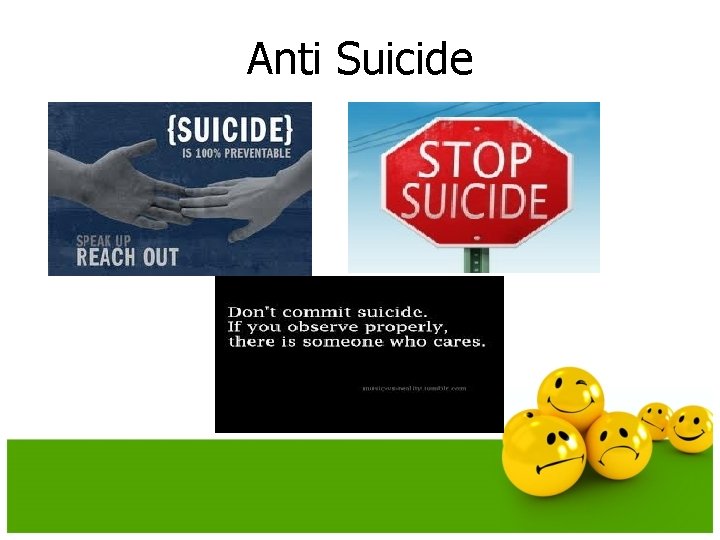
Anti Suicide
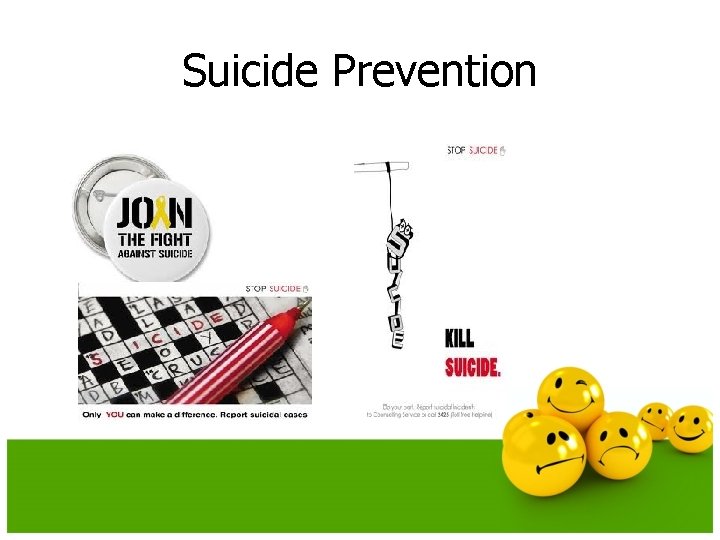
Suicide Prevention
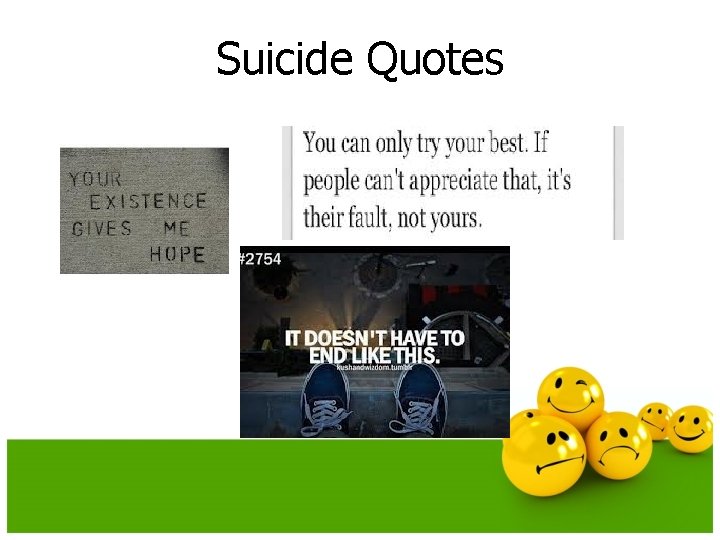
Suicide Quotes
Assignment • Group Work: Cooperative Learning Strategies • Your group has been given a card that has side A and side B. As a group you will read the short passage and complete the activity for both sides • You will write this out in the form of a report – A report has researched information listed (You may use your smartphone) • List references – A summary of what your group found (paragraph form) – Activity B: Be sure to write out #3 in paragraph form and remember how we write: • We do not write how we text • Do not start sentences with conjunctions ( and, but) • Do not use contractions (ex. Don’t, won’t) • Do not use “a lot” in your writing • Do not use etc. when you write
Assignment: Eye on the Media • Creating Positive Media Influence: – You will be given a sheet of paper with instructions. Read the passage and activity. Your assignment is to design a positive media campaign that will accomplish the following: encourage people to seek help when faced with mental or emotional problems: Convey empathy for people who suffer from mental or emotional problems: and teach the public that people with mental illnesses should be treated fairly. – You will: • Develop a slogan 25 pts • A direct mail marketing piece 25 pts • A billboard 25 pta • A print ad for a newspaper or magazine 25 pts
5. 4 Seeking Help
Warm up • Considering what you have learned so far throughout chapter 5 – What are some examples of mental and emotional problems that teens may have? – Why do some people choose not to seek help for their mental and/or emotional problems?
5. 4 Seeking Help • Many teens with mental health problems do not recognize the seriousness of their condition, or understand that help is available • Usually outside help is not required • Sometimes you may need to ask for help from parents, friends, and relatives • Other times professional help is needed • That’s when you need the help of a mental health specialist
5. 4 When to Seek Help for Mental & Emotional problems • You may need to obtain professional help with your problems if you experience any of the following characteristics – A prolonged feeling of depression and hopelessness – A feeling that life is out of control – Feel trapped or worry all the time – Difficulty getting along with family and friends – Become involved with alcohol – Persistent difficulty sleeping – Emotional problems coping with an physical illness
5. 4 Mental and Emotional Health Services • If you or someone you know need help contact a person you • • • trust. i. e. parent, teacher, school counselor, school nurse Don’t wait Most communities provide mental and emotional health services for people who cannot afford to pay for help These services may be offered through community mental health centers, local hospitals, and other agencies Listings in local phonebook, Google, yahoo, etc. Look under: hospitals, social workers, psychologists, mental health information, and treatment centers
5. 4 Mental Health Professionals Counselor – Professional who handles personal and educational matters Psychiatrist – Physician who diagnoses and treats mental disorders and prescribe medications School psychologist – professional who specializes in the assessment of learning, emotional, and behavioral problems of school children
5. 4 Mental and Emotional Health Therapies Mental health specialists help people For types of mental health specialists, see the Career Appendix Goal of therapy is to help a person through difficulties Different therapies may be used Psychotherapy – an ongoing dialogue between a patient and a mental health professional • Cognitive therapy – a treatment method designed to identify and correct distorted thinking patterns that can lead to feelings and behaviors that may be troublesome, self-defeating, or self-destructive • Family therapy – helping the family function in more positive and constructive ways by exploring patterns in communication and providing support and education • • •
5. 4 Mental and Emotional Health Therapies • Behavioral Therapy – focuses on the patient’s behavior rather than on the underlying causes – The therapists helps the patient discover rewards for desirable behaviors and punishments for undesirable behaviors – This process is behavior modification – Behavior modification programs help patients learn new ways to respond to situations
5. 4 Mental and Emotional Health Therapies • Group Therapy – People with similar problems meet with a therapist to discuss their problems – Therapist and the group members suggest solutions, the idea being that the exchange of ideas and input from group members is more helpful than hearing only one perspective from a therapist • Drug Therapy – The use of drugs to treat mental and emotional disorders – Drugs are prescribed to help control some symptoms of a disorder such as aggressiveness, or to correct an imbalance of chemicals in the brain
5. 4 Mental and Emotional Health Therapies that can cause disorders like depression – Some drugs have serious side effects – Ex. Antidepressant may work well in controlling depression in one patient while causing violent or suicidal behavior in someone else – This is often caused by a misdiagnosis or inappropriate used of a drug – The use of chemical-therapy drugs should be closely monitored for serious side effects
Finally…. . Any Questions?