
Chapter 5 Membranes Copyright The Mc GrawHill Companies
Chapter 5 Membranes Copyright © The Mc. Graw-Hill Companies, Inc. Permission required for reproduction or display.
Membrane Structure • Phospholipids arranged in a bilayer • Globular proteins inserted in the lipid bilayer • Fluid mosaic model – mosaic of proteins floats in or on the fluid lipid bilayer like boats on a pond 2
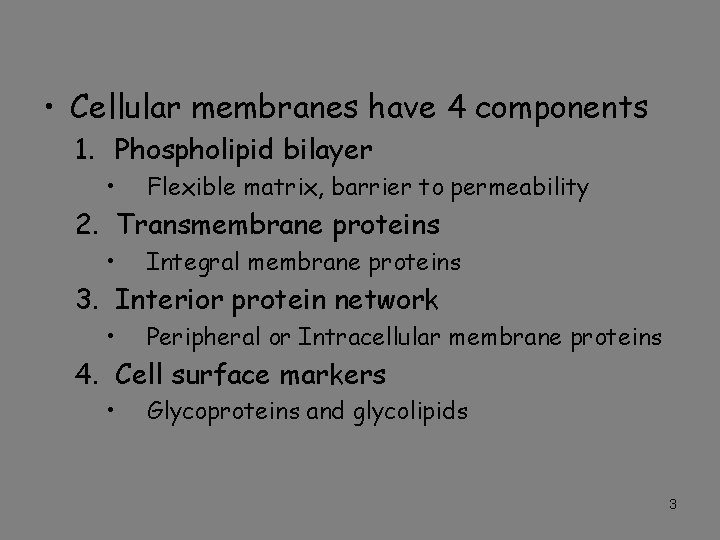
• Cellular membranes have 4 components 1. Phospholipid bilayer • Flexible matrix, barrier to permeability 2. Transmembrane proteins • Integral membrane proteins 3. Interior protein network • Peripheral or Intracellular membrane proteins 4. Cell surface markers • Glycoproteins and glycolipids 3
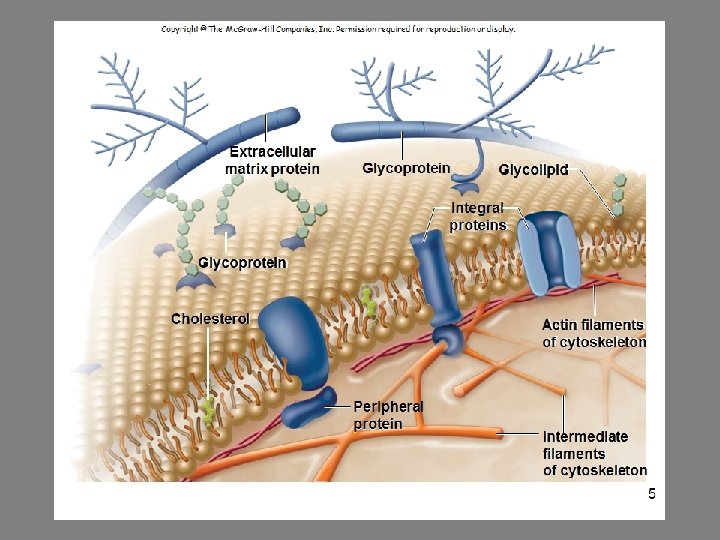
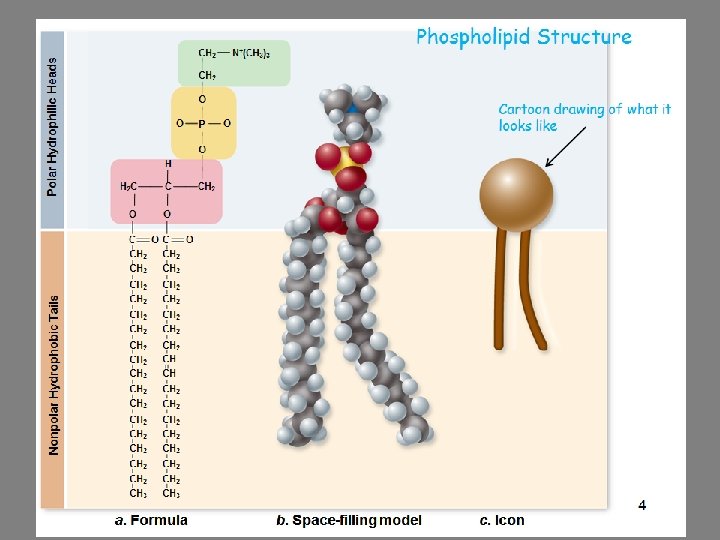
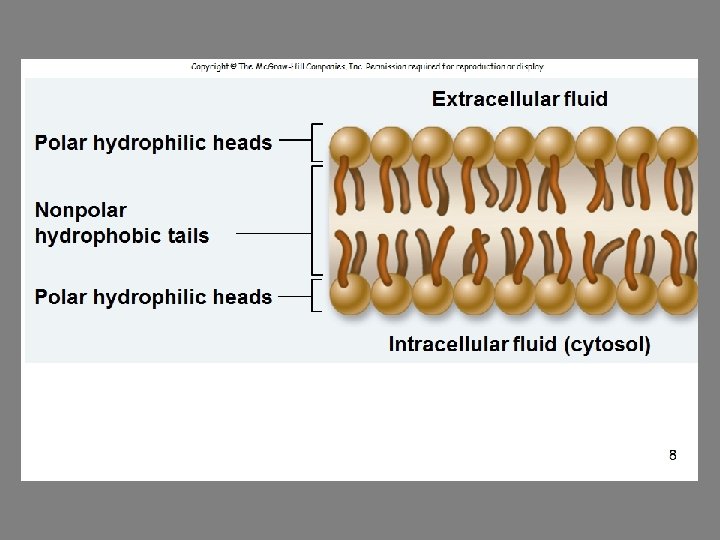
Phospholipids • Structure consists of – Glycerol – a 3 -carbon polyalcohol – 2 fatty acids attached to the glycerol • Nonpolar and hydrophobic (“water-fearing”) – Phosphate group attached to the glycerol • Polar and hydrophilic (“water-loving”) • Spontaneously forms a bilayer – Fatty acids are on the inside – Phosphate groups are on both surfaces 5
• Environmental influences on fluidity – Saturated fatty acids make the membrane less fluid than unsaturated fatty acids • “Kinks” introduced by the double bonds keep them from packing tightly • Most membranes also contain sterols such as cholesterol, which can either increase or decrease membrane fluidity, depending on the temperature – Warm temperatures make the membrane more fluid than cold temperatures • Cold tolerance in bacteria due to fatty acid desaturases 8
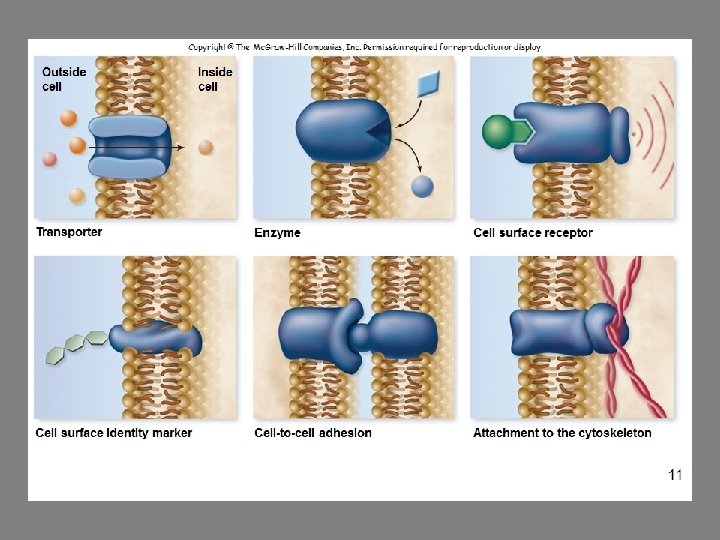
Membrane Proteins • Various functions: 1. Transporters – Helps things enter in and out of cell 2. Enzymes – Help with reactions at cell surface 3. Cell-surface receptors – For example - detects hormones 4. Cell-surface identity markers – Allows one cell type to distinguish from another cell type 5. Cell-to-cell adhesion proteins – Helps cells adhere together 6. Attachments to the cytoskeleton 9
Structure relates to function • Diverse functions arise from the diverse structures of membrane proteins • Have common structural features related to their role as membrane proteins • Peripheral proteins – Anchoring molecules attach membrane protein to surface 11

• Anchoring molecules are modified lipids with 1. Nonpolar regions that insert into the internal portion of the lipid bilayer 2. Chemical bonding domains that link directly to proteins Copyright © The Mc. Graw-Hill Companies, Inc. Permission required for reproduction or display. Protein anchored to phospholipid 12
Membrane Proteins • Integral membrane proteins – Span the lipid bilayer (transmembrane proteins) • Nonpolar regions of the protein are embedded in the interior of the bilayer • Polar regions of the protein protrude from both sides of the bilayer – Transmembrane domain • Spans the lipid bilayer • Hydrophobic amino acids arranged in α helices 13
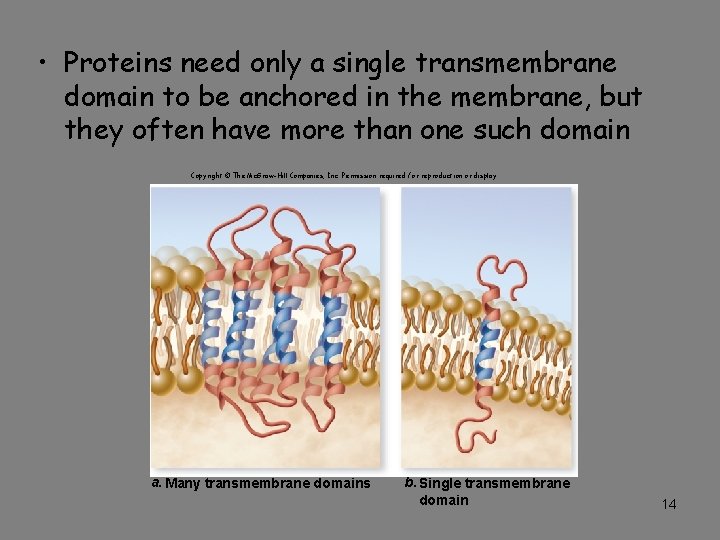
• Proteins need only a single transmembrane domain to be anchored in the membrane, but they often have more than one such domain Copyright © The Mc. Graw-Hill Companies, Inc. Permission required for reproduction or display. a. Many transmembrane domains b. Single transmembrane domain 14

• Pores – Extensive nonpolar regions within a transmembrane protein can create a pore through the membrane – Cylinder of sheets in the protein secondary structure called a -barrel • Interior is polar and allows water and small polar molecules to pass through the membrane 15
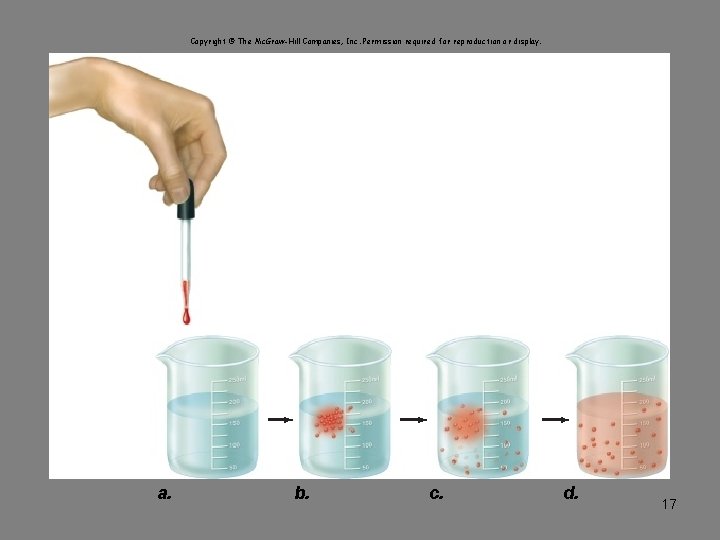
Passive Transport • Passive transport is movement of molecules through the membrane in which – No energy is required – Molecules move in response to a concentration gradient • Diffusion is movement of molecules from high concentration to low concentration – Will continue until the concentration is the same in all regions – Osmosis is the diffusion of water across a semi-permeable membrane (like a cell membrane) 16
Copyright © The Mc. Graw-Hill Companies, Inc. Permission required for reproduction or display. a. b. c. d. 17
• Major barrier to crossing a biological membrane is the hydrophobic interior that repels polar molecules but nonpolar molecules – Nonpolar molecules will move until the concentration is equal on both sides – Limited permeability to small polar molecules – Very limited permeability to larger polar molecules and ions 18
• Facilitated diffusion – Molecules that cannot cross membrane easily may move through proteins – Move from higher to lower concentration – Channel proteins • Hydrophilic channel when open – Carrier proteins • Bind specifically to molecules they assist • Membrane is selectively permeable 19
Channel proteins • Ion channels – Allow the passage of ions – Gated channels – open or close in response to stimulus (chemical or electrical) – 3 conditions determine direction • Relative concentration on either side of membrane • Voltage differences across membrane • Gated channels – channel open or closed 20
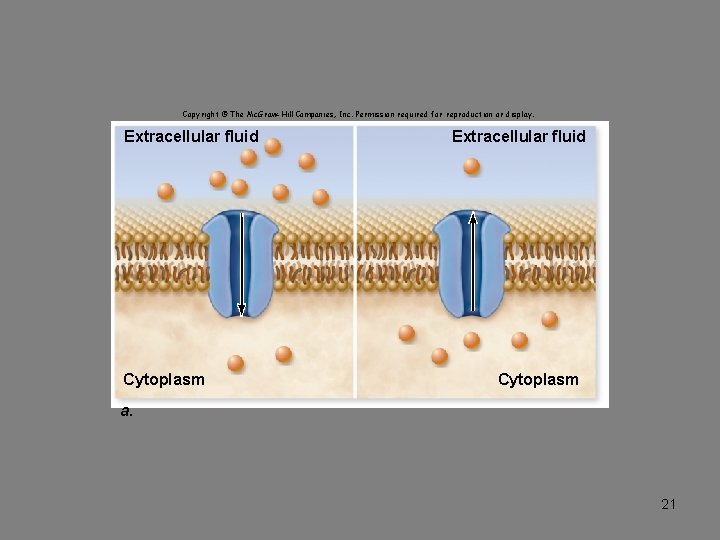
Copyright © The Mc. Graw-Hill Companies, Inc. Permission required for reproduction or display. Extracellular fluid Cytoplasm a. 21
Carrier proteins • Can help transport both ions and other solutes, such as some sugars and amino acids • Requires a concentration difference across the membrane • Must bind to the molecule they transport – Saturation – rate of transport limited by number of transporters 22
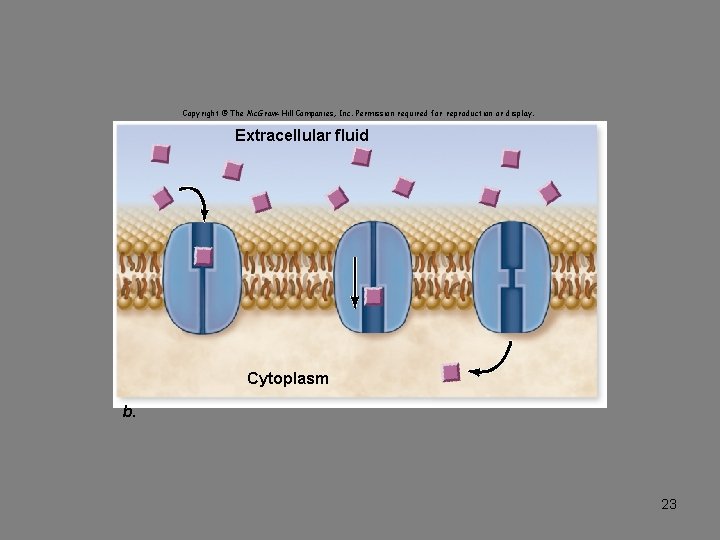
Copyright © The Mc. Graw-Hill Companies, Inc. Permission required for reproduction or display. Extracellular fluid Cytoplasm b. 23
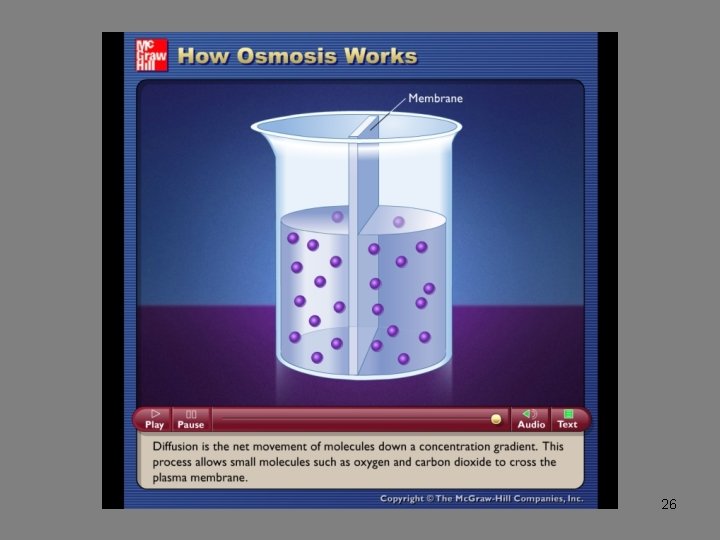
Osmosis • Cytoplasm of the cell is an aqueous solution – Water is solvent – Dissolved substances are solutes • Osmosis – net diffusion of water across a membrane toward a higher solute concentration 24
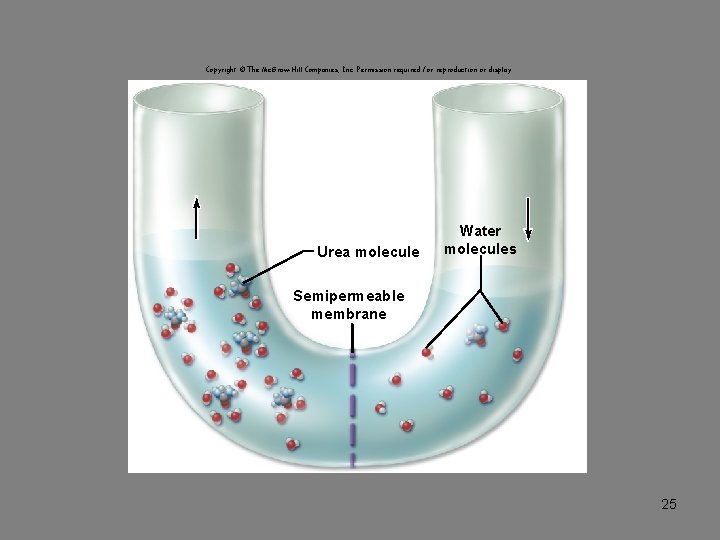
Copyright © The Mc. Graw-Hill Companies, Inc. Permission required for reproduction or display. Urea molecule Water molecules Semipermeable membrane 25
Please note that due to differing operating systems, some animations will not appear until the presentation is viewed in Presentation Mode (Slide Show view). You may see blank slides in the “Normal” or “Slide Sorter” views. All animations will appear after viewing in Presentation Mode and playing each animation. Most animations will require the latest version of the Flash Player, which is available at http: //get. adobe. com/flashplayer. 26
Osmotic concentration • When 2 solutions have different osmotic concentrations – Hypertonic solution has a higher solute concentration – Hypotonic solution has a lower solute concentration • When two solutions have the same osmotic concentration, the solutions are isotonic • Aquaporins facilitate osmosis 27
Osmotic pressure • Force needed to stop osmotic flow • Cell in a hypotonic solution gains water causing cell to swell – creates pressure • If membrane strong enough, cell reaches counterbalance of osmotic pressure driving water in with hydrostatic pressure driving water out – Cell wall of prokaryotes, fungi, plants, protists • If membrane is not strong, may burst – Animal cells must be in isotonic environments 28
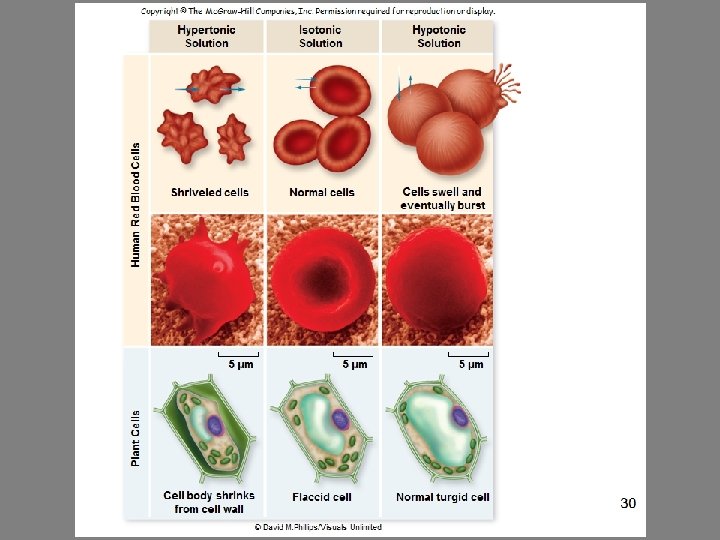
Maintaining osmotic balance • Some cells use extrusion in which water is ejected through contractile vacuoles • Isosmotic regulation involves keeping cells isotonic with their environment – Marine organisms adjust internal concentration to match sea water – Terrestrial animals circulate isotonic fluid • Plant cells use turgor pressure to push the cell membrane against the cell wall and keep the cell rigid 30
Active Transport • Requires energy – ATP is used directly or indirectly to fuel active transport • Moves substances from low to high concentration • Requires the use of highly selective carrier proteins 31
• Carrier proteins used in active transport include – Uniporters – move one molecule at a time – Symporters – move two molecules in the same direction – Antiporters – move two molecules in opposite directions – Terms can also be used to describe facilitated diffusion carriers 32
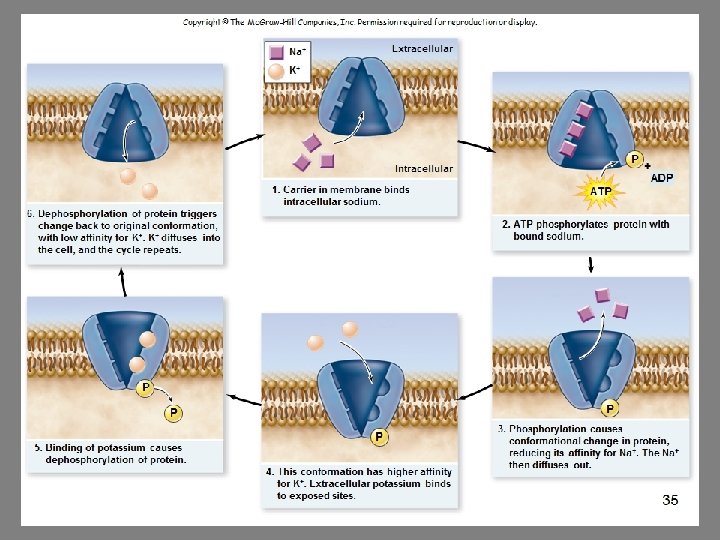
Sodium–potassium (Na+–K+) pump Active Transport Example • Direct use of ATP for active transport • Uses an antiporter to move 3 Na+ out of the cell and 2 K+ into the cell – Against their concentration gradient • ATP energy is used to change the conformation of the carrier protein • Affinity of the carrier protein for either Na+ or K+ changes so the ions can be carried across the membrane • Since the ions are being moved into an area of higher concentration, causes there to be potential energy 33
Coupled transport • Uses ATP indirectly • ATP jump starts the sodium/potassium pump and creates a gradient with potential energy • Glucose then used that potential energy to enter into the cell • Uses the energy released when a molecule moves by diffusion to supply energy to active transport of a different molecule • Symporter is used • Glucose–Na+ symporter captures the energy from Na+ diffusion to move glucose against a concentration gradient 35
• Why do cells need ion channels and change concentration of ions? • Ca++ - muscle cells rely on increase in intracellular calcium for muscle contraction; calcium increases also increases exocytosis which is important in nerve synapses allowing nerve signal to go from one neuron to the next • Conduction of electrical impulse along neuron needs the correct opening and closing of sodium, potassium, and calcium channels 36
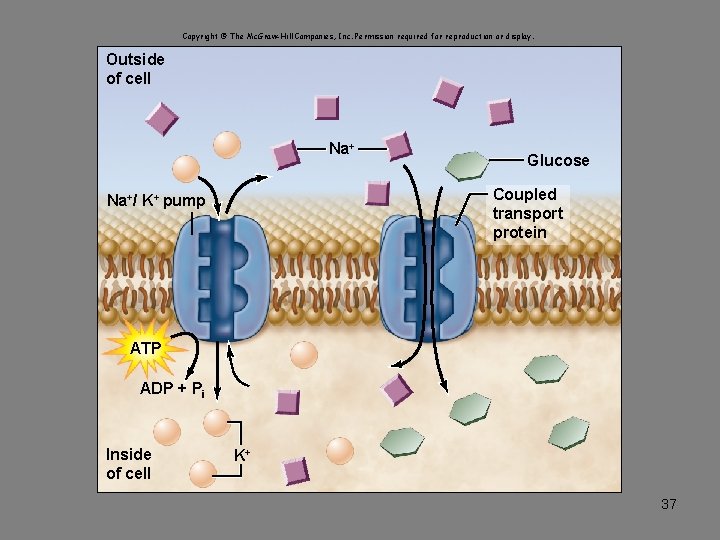
Copyright © The Mc. Graw-Hill Companies, Inc. Permission required for reproduction or display. Outside of cell Na+ Glucose Coupled transport protein Na+/ K+ pump ATP ADP + Pi Inside of cell K+ 37
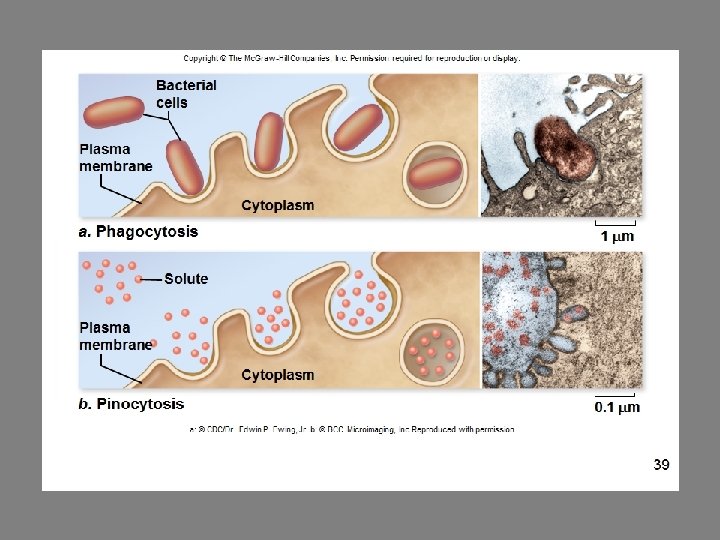
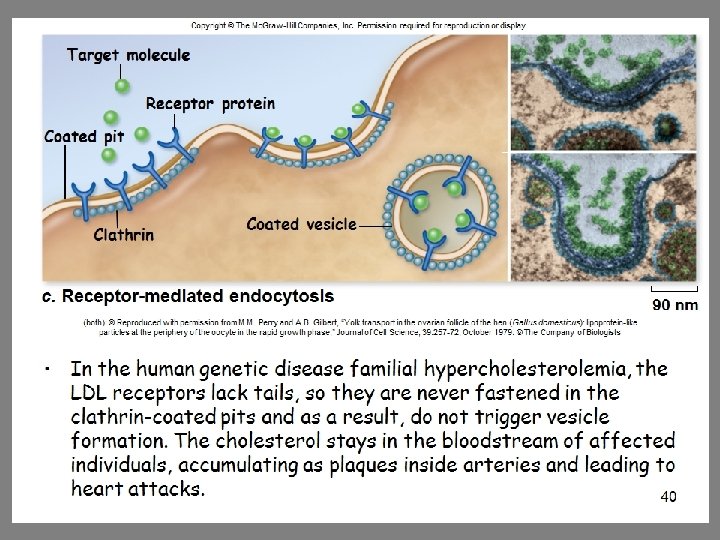
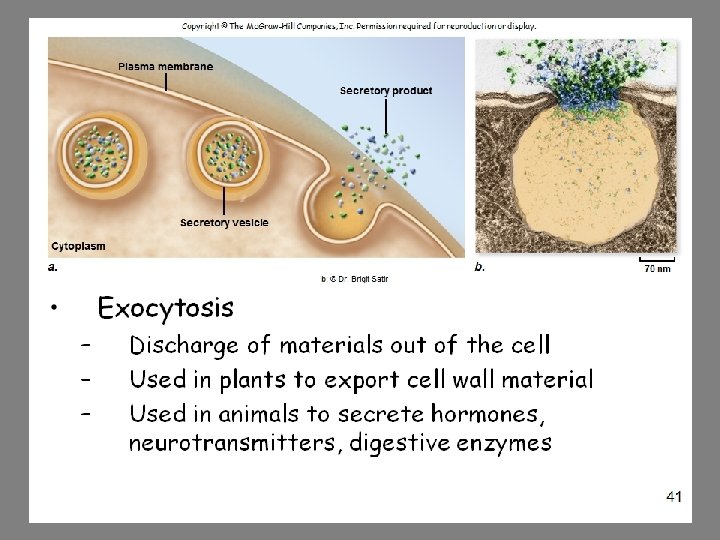
Bulk Transport • Endocytosis – – • Movement of substances into the cell Phagocytosis – cell takes in particulate matter Pinocytosis – cell takes in only fluid Receptor-mediated endocytosis – specific molecules are taken in after they bind to a receptor Exocytosis – – Movement of substances out of cell Requires energy 38
- Slides: 41