
Chapter 5 Market Your Business 5 1 Develop
Chapter 5 Market Your Business 5. 1 Develop the Marketing Plan 5. 2 The Marketing Mix─Product 5. 3 The Marketing Mix─Price Entrepreneurship: Ideas in Action 5 e © 2011 Cengage Learning. All rights reserved. May not be scanned, copied or duplicated, or posted to a publicly accessible website, in whole or in part.
Lesson 5. 1 Developing the Marketing Plan Goals n Explain the importance of marketing a business. n Discuss how to develop a marketing strategy for a business. n Describe what information is included in a marketing plan. Chapter 5 Slide 2 Entrepreneurship: Ideas in Action 5 e © 2011 Cengage Learning. All rights reserved. May not be scanned, copied or duplicated, or posted to a publicly accessible website, in whole or in part.
Vocabulary n n n marketing concept marketing mix marketing strategy marketing plan Chapter 5 Slide 3 Entrepreneurship: Ideas in Action 5 e © 2011 Cengage Learning. All rights reserved. May not be scanned, copied or duplicated, or posted to a publicly accessible website, in whole or in part.
What is Marketing? n marketing n all of the processes used to determine and satisfy the needs of customers and the company n n n Chapter 5 Slide 4 planning pricing promoting distributing selling Entrepreneurship: Ideas in Action 5 e © 2011 Cengage Learning. All rights reserved. May not be scanned, copied or duplicated, or posted to a publicly accessible website, in whole or in part.
n marketing concept n Uses the needs of customers as the primary focus of a product or service during: n n Chapter 5 Slide 5 planning production distribution promotion Entrepreneurship: Ideas in Action 5 e © 2011 Cengage Learning. All rights reserved. May not be scanned, copied or duplicated, or posted to a publicly accessible website, in whole or in part.
n A successful marketing concept will: n Identify what will satisfy the customers’ needs and wants n Develop and market products or services that customers consider better than other choices n Operate profitably Chapter 5 Slide 6 Entrepreneurship: Ideas in Action 5 e © 2011 Cengage Learning. All rights reserved. May not be scanned, copied or duplicated, or posted to a publicly accessible website, in whole or in part.
n marketing mix n reaching the target market through a blend of: n n Chapter 5 Slide 7 product price distribution promotion Entrepreneurship: Ideas in Action 5 e © 2011 Cengage Learning. All rights reserved. May not be scanned, copied or duplicated, or posted to a publicly accessible website, in whole or in part.
Why is marketing important to a business? Chapter 1 Slide 8 Entrepreneurship: Ideas in Action 5 e © 2011 Cengage Learning. All rights reserved. May not be scanned, copied or duplicated, or posted to a publicly accessible website, in whole or in part.
The Marketing Strategy n marketing strategy n a plan that identifies how business goals will be achieved through marketing efforts n n n Chapter 5 Slide 9 product introduction or innovation pricing distribution promotion sales or market share projected profitability Entrepreneurship: Ideas in Action 5 e © 2011 Cengage Learning. All rights reserved. May not be scanned, copied or duplicated, or posted to a publicly accessible website, in whole or in part.
n marketing goals should: n be achievable with your available resources n be written following the SMART guidelines n reflect short, medium and long-term goals Chapter 5 Slide 10 Entrepreneurship: Ideas in Action 5 e © 2011 Cengage Learning. All rights reserved. May not be scanned, copied or duplicated, or posted to a publicly accessible website, in whole or in part.
Short-Term Goals n Achievements for the next year are the focus of short-term goals. n number of customers n level of sales n level of profits Chapter 5 Slide 11 Entrepreneurship: Ideas in Action 5 e © 2011 Cengage Learning. All rights reserved. May not be scanned, copied or duplicated, or posted to a publicly accessible website, in whole or in part.
Medium-Term Goals n Achievements for the next two to five years are the focus of medium-term goals. n Make sure your marketing strategy facilitates achievement of medium-term goals. Chapter 5 Slide 12 Entrepreneurship: Ideas in Action 5 e © 2011 Cengage Learning. All rights reserved. May not be scanned, copied or duplicated, or posted to a publicly accessible website, in whole or in part.
Long-Term Goals n Achievements for a 5, 10, or 20 year time horizon are the focus of long-term goals. n Long-term goals can help define current marketing plans. Chapter 5 Slide 13 Entrepreneurship: Ideas in Action 5 e © 2011 Cengage Learning. All rights reserved. May not be scanned, copied or duplicated, or posted to a publicly accessible website, in whole or in part.
Why is goal setting important when developing a marketing strategy? Chapter 1 Slide 14 Entrepreneurship: Ideas in Action 5 e © 2011 Cengage Learning. All rights reserved. May not be scanned, copied or duplicated, or posted to a publicly accessible website, in whole or in part.
Write Your Marketing Plan n marketing plan n defines your market n identifies your customers and competitors n outlines a strategy for attracting and keeping customers n anticipates changes Chapter 5 Slide 15 Entrepreneurship: Ideas in Action 5 e © 2011 Cengage Learning. All rights reserved. May not be scanned, copied or duplicated, or posted to a publicly accessible website, in whole or in part.
n The marketing plan should include the following information: 1. 2. 3. 4. 5. 6. 7. 8. Chapter 5 Slide 16 Product or Service Target Market Competition Marketing Budget Business Location Pricing Strategy Promotional Strategy Distribution Strategy Entrepreneurship: Ideas in Action 5 e © 2011 Cengage Learning. All rights reserved. May not be scanned, copied or duplicated, or posted to a publicly accessible website, in whole or in part.
n Marketing plans should include performance standards that are measurable. n Actual results should be compared to performance standards quarterly. Chapter 5 Slide 17 Entrepreneurship: Ideas in Action 5 e © 2011 Cengage Learning. All rights reserved. May not be scanned, copied or duplicated, or posted to a publicly accessible website, in whole or in part.
Why is it important to put your marketing plan in writing? Chapter 1 Slide 18 Entrepreneurship: Ideas in Action 5 e © 2011 Cengage Learning. All rights reserved. May not be scanned, copied or duplicated, or posted to a publicly accessible website, in whole or in part.
Lesson 5. 2 The Marketing Mix─Product Goals n Explain how the marketing concept affects decisions regarding the product mix. n Define and describe the importance of product management. Chapter 5 Slide 19 Entrepreneurship: Ideas in Action 5 e © 2011 Cengage Learning. All rights reserved. May not be scanned, copied or duplicated, or posted to a publicly accessible website, in whole or in part.
Vocabulary n n product mix features brand positioning Chapter 5 Slide 20 Entrepreneurship: Ideas in Action 5 e © 2011 Cengage Learning. All rights reserved. May not be scanned, copied or duplicated, or posted to a publicly accessible website, in whole or in part.
The Marketing Concept and the Product n If you can convince your customers that your products satisfy their needs better than any competitor’s products, then your products become a marketing tool for your business. Chapter 5 Slide 21 Entrepreneurship: Ideas in Action 5 e © 2011 Cengage Learning. All rights reserved. May not be scanned, copied or duplicated, or posted to a publicly accessible website, in whole or in part.
Consumer-Driven Market n The wants and needs of customers are the most important consideration when developing any product or marketing effort. n The U. S. has changed from a productdriven market to a consumer-driven market. n Consumers are more educated. n Competition includes the global market. Chapter 1 Slide 22 Entrepreneurship: Ideas in Action 5 e © 2011 Cengage Learning. All rights reserved. May not be scanned, copied or duplicated, or posted to a publicly accessible website, in whole or in part.
Product Mix n product mix n the different products and services a business sells n Entrepreneurs may carry some products that are not profitable just to please customers. n A small percentage of the product selection often makes up the majority of sales revenue. Chapter 5 Slide 23 Entrepreneurship: Ideas in Action 5 e © 2011 Cengage Learning. All rights reserved. May not be scanned, copied or duplicated, or posted to a publicly accessible website, in whole or in part.
How does the marketing concept affect decisions made about the product mix? Chapter 1 Slide 24 Entrepreneurship: Ideas in Action 5 e © 2011 Cengage Learning. All rights reserved. May not be scanned, copied or duplicated, or posted to a publicly accessible website, in whole or in part.
Product Management n There is more to a product than consumers may realize. n n n Chapter 5 Slide 25 features branding packaging labeling positioning Entrepreneurship: Ideas in Action 5 e © 2011 Cengage Learning. All rights reserved. May not be scanned, copied or duplicated, or posted to a publicly accessible website, in whole or in part.
Select Product Features n features n product characteristics that will satisfy customer needs n The target market should be considered when selecting product features. Chapter 5 Slide 26 Entrepreneurship: Ideas in Action 5 e © 2011 Cengage Learning. All rights reserved. May not be scanned, copied or duplicated, or posted to a publicly accessible website, in whole or in part.
Consider Branding, Packaging, and Labeling n brand n the name, symbol, or design used to identify your product n package n the box, container, or wrapper in which the product is placed Chapter 5 Slide 27 Entrepreneurship: Ideas in Action 5 e © 2011 Cengage Learning. All rights reserved. May not be scanned, copied or duplicated, or posted to a publicly accessible website, in whole or in part.
n label n where information about the product is given on the package n The brand, package, and label that you choose for a product help differentiate it from others on the market. Chapter 5 Slide 28 Entrepreneurship: Ideas in Action 5 e © 2011 Cengage Learning. All rights reserved. May not be scanned, copied or duplicated, or posted to a publicly accessible website, in whole or in part.
Position Your Products or Services n Different products and services within the same category serve different customer needs. n positioning n creating an image for the product in the customer’s mind Chapter 5 Slide 29 Entrepreneurship: Ideas in Action 5 e © 2011 Cengage Learning. All rights reserved. May not be scanned, copied or duplicated, or posted to a publicly accessible website, in whole or in part.
Why is product management important? Chapter 1 Slide 30 Entrepreneurship: Ideas in Action 5 e © 2011 Cengage Learning. All rights reserved. May not be scanned, copied or duplicated, or posted to a publicly accessible website, in whole or in part.
Lesson 5. 3 The Marketing Mix─Price Goals n Identify pricing objectives for a business. n Calculate the price for products using various methods. n Discuss factors to consider when pricing services. n List and describe various pricing strategies. Chapter 5 Slide 31 Entrepreneurship: Ideas in Action 5 e © 2011 Cengage Learning. All rights reserved. May not be scanned, copied or duplicated, or posted to a publicly accessible website, in whole or in part.
Vocabulary n n n n return on investment market share demand-based pricing cost-based pricing competition-based pricing psychological pricing discount pricing Chapter 5 Slide 32 Entrepreneurship: Ideas in Action 5 e © 2011 Cengage Learning. All rights reserved. May not be scanned, copied or duplicated, or posted to a publicly accessible website, in whole or in part.
Set Pricing Objectives n price n the amount a customer pays for a product or service n needs to be low enough that customers buy from you n needs to be high enough so revenues exceed expenses Chapter 5 Slide 33 Entrepreneurship: Ideas in Action 5 e © 2011 Cengage Learning. All rights reserved. May not be scanned, copied or duplicated, or posted to a publicly accessible website, in whole or in part.
n Price objectives might include: n n n Chapter 5 Slide 34 maximize sales discourage competition establish an image increase profits attract customers Entrepreneurship: Ideas in Action 5 e © 2011 Cengage Learning. All rights reserved. May not be scanned, copied or duplicated, or posted to a publicly accessible website, in whole or in part.
Return on Investment n investment n the costs of making and marketing a product n return on investment (ROI) n amount earned as a result of the investment n usually expressed as a percentage Chapter 5 Slide 35 Entrepreneurship: Ideas in Action 5 e © 2011 Cengage Learning. All rights reserved. May not be scanned, copied or duplicated, or posted to a publicly accessible website, in whole or in part.
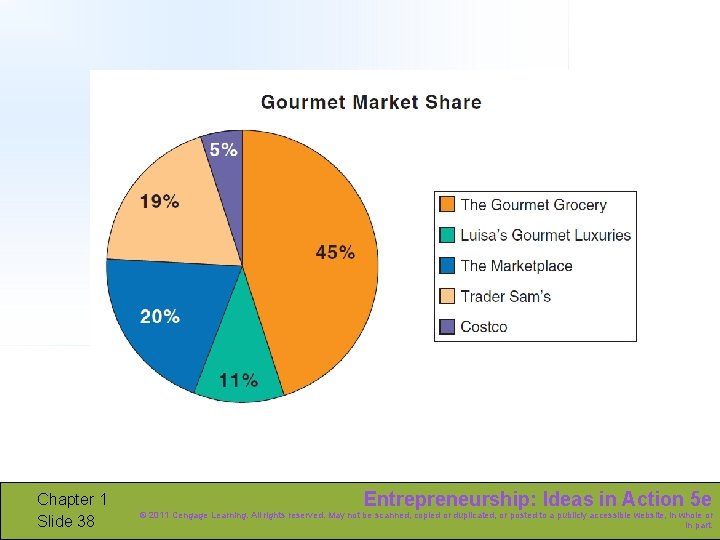
Market Share n market share n a business’s percentage of the total sales generated by all companies in the same market n The total market for a product must be known in order for market share to be determined. Chapter 5 Slide 36 Entrepreneurship: Ideas in Action 5 e © 2011 Cengage Learning. All rights reserved. May not be scanned, copied or duplicated, or posted to a publicly accessible website, in whole or in part.
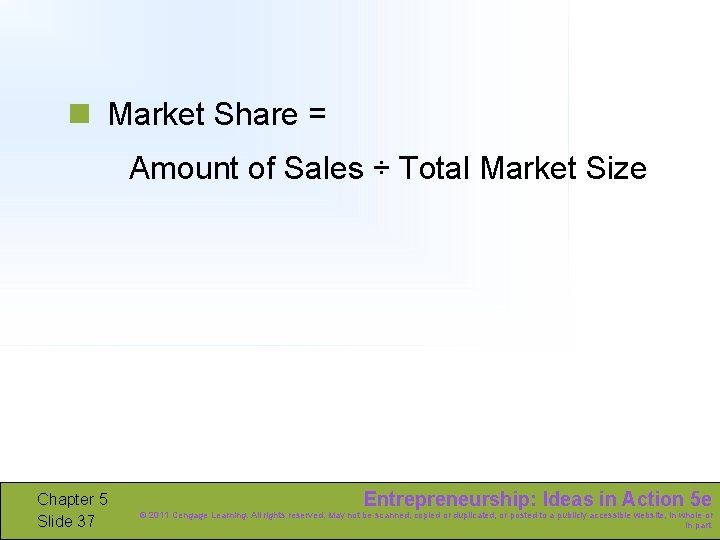
n Market Share = Amount of Sales ÷ Total Market Size Chapter 5 Slide 37 Entrepreneurship: Ideas in Action 5 e © 2011 Cengage Learning. All rights reserved. May not be scanned, copied or duplicated, or posted to a publicly accessible website, in whole or in part.
Chapter 1 Slide 38 Entrepreneurship: Ideas in Action 5 e © 2011 Cengage Learning. All rights reserved. May not be scanned, copied or duplicated, or posted to a publicly accessible website, in whole or in part.
n There are multiple ways to increase market share including: n lowering prices n advertising and promotion n networking with potential customers Chapter 5 Slide 39 Entrepreneurship: Ideas in Action 5 e © 2011 Cengage Learning. All rights reserved. May not be scanned, copied or duplicated, or posted to a publicly accessible website, in whole or in part.
Why is it important to determine pricing objectives before pricing goods and services? Chapter 1 Slide 40 Entrepreneurship: Ideas in Action 5 e © 2011 Cengage Learning. All rights reserved. May not be scanned, copied or duplicated, or posted to a publicly accessible website, in whole or in part.
Determine a Price for a Product n There is usually more than one price that can be charged for a product. Chapter 5 Slide 41 Entrepreneurship: Ideas in Action 5 e © 2011 Cengage Learning. All rights reserved. May not be scanned, copied or duplicated, or posted to a publicly accessible website, in whole or in part.
Demand-Based Pricing n demand-based pricing n pricing that is determined by how much customers are willing to pay for a product or service n Survey potential customers to determine what they would be willing to pay for a product. n The highest price identified is the maximum price that can be charged. Chapter 5 Slide 42 Entrepreneurship: Ideas in Action 5 e © 2011 Cengage Learning. All rights reserved. May not be scanned, copied or duplicated, or posted to a publicly accessible website, in whole or in part.
Cost-Based Pricing n cost-based pricing n determined by using the wholesale cost of an item as the basis for the price charged n markup price n determined by adding a percentage amount to the wholesale cost of an item Chapter 5 Slide 43 Entrepreneurship: Ideas in Action 5 e © 2011 Cengage Learning. All rights reserved. May not be scanned, copied or duplicated, or posted to a publicly accessible website, in whole or in part.
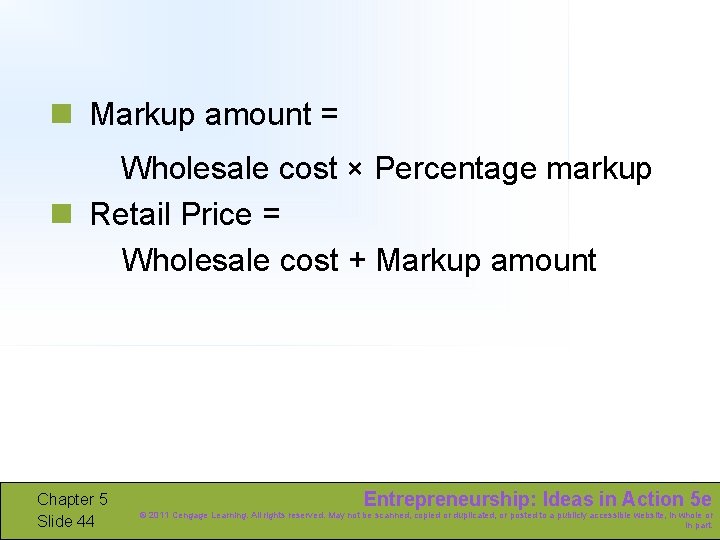
n Markup amount = Wholesale cost × Percentage markup n Retail Price = Wholesale cost + Markup amount Chapter 5 Slide 44 Entrepreneurship: Ideas in Action 5 e © 2011 Cengage Learning. All rights reserved. May not be scanned, copied or duplicated, or posted to a publicly accessible website, in whole or in part.
n markdown price n determined by subtracting a percentage amount from the retail price Chapter 5 Slide 45 Entrepreneurship: Ideas in Action 5 e © 2011 Cengage Learning. All rights reserved. May not be scanned, copied or duplicated, or posted to a publicly accessible website, in whole or in part.
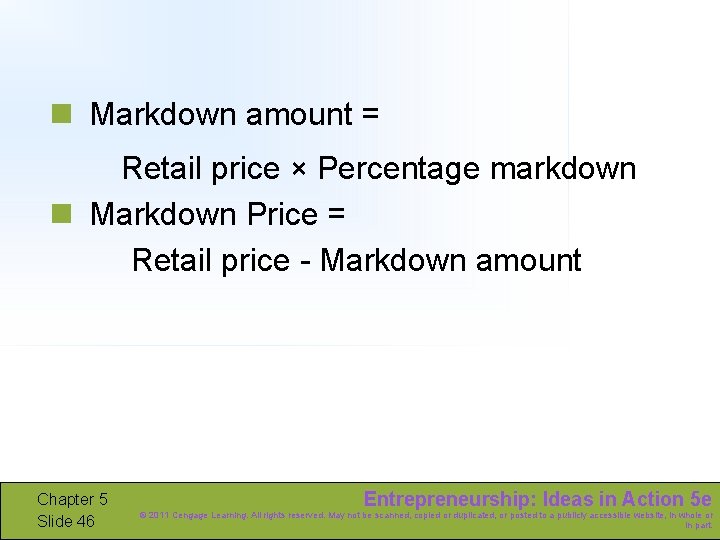
n Markdown amount = Retail price × Percentage markdown n Markdown Price = Retail price - Markdown amount Chapter 5 Slide 46 Entrepreneurship: Ideas in Action 5 e © 2011 Cengage Learning. All rights reserved. May not be scanned, copied or duplicated, or posted to a publicly accessible website, in whole or in part.
Competition-Based Pricing n competition-based pricing n pricing that is determined by considering what competitors charge for the same good or service Chapter 5 Slide 47 Entrepreneurship: Ideas in Action 5 e © 2011 Cengage Learning. All rights reserved. May not be scanned, copied or duplicated, or posted to a publicly accessible website, in whole or in part.
List three methods for determining the price to charge for a product. Chapter 1 Slide 48 Entrepreneurship: Ideas in Action 5 e © 2011 Cengage Learning. All rights reserved. May not be scanned, copied or duplicated, or posted to a publicly accessible website, in whole or in part.
Price a Service or an Idea n To set a price for a service, consider the following: n the cost of items used in providing the service n the amount of time required to produce the service Chapter 5 Slide 49 Entrepreneurship: Ideas in Action 5 e © 2011 Cengage Learning. All rights reserved. May not be scanned, copied or duplicated, or posted to a publicly accessible website, in whole or in part.
Time-Based Pricing n The amount of time it takes to complete a service will be the basis for determining the price of the service. n Providers must decide whether the cost of materials will be: n included in the price n listed as a separate charge Chapter 5 Slide 50 Entrepreneurship: Ideas in Action 5 e © 2011 Cengage Learning. All rights reserved. May not be scanned, copied or duplicated, or posted to a publicly accessible website, in whole or in part.
Bundling n bundled pricing n when all services are combined under one charge Chapter 5 Slide 51 Entrepreneurship: Ideas in Action 5 e © 2011 Cengage Learning. All rights reserved. May not be scanned, copied or duplicated, or posted to a publicly accessible website, in whole or in part.
Pricing an Idea n You can sell your ideas by n working as a consultant n licensing n selling your idea to a company for the development and launch of a new product n licensing payments can occur through n up-front payment n royalties n annual minimum Chapter 1 Slide 52 Entrepreneurship: Ideas in Action 5 e © 2011 Cengage Learning. All rights reserved. May not be scanned, copied or duplicated, or posted to a publicly accessible website, in whole or in part.
Which method would be the best for a housepainter to use to price services? Why? Chapter 1 Slide 53 Entrepreneurship: Ideas in Action 5 e © 2011 Cengage Learning. All rights reserved. May not be scanned, copied or duplicated, or posted to a publicly accessible website, in whole or in part.
Pricing Strategies n Pricing can make or break a business. n Pricing techniques may change over time. Chapter 5 Slide 54 Entrepreneurship: Ideas in Action 5 e © 2011 Cengage Learning. All rights reserved. May not be scanned, copied or duplicated, or posted to a publicly accessible website, in whole or in part.
Introductory Pricing n price skimming n used for products that are new and unique n a high price is charged to cover product development costs n penetration pricing n a low introductory price is charged to build a strong customer base n discourages competition Chapter 5 Slide 55 Entrepreneurship: Ideas in Action 5 e © 2011 Cengage Learning. All rights reserved. May not be scanned, copied or duplicated, or posted to a publicly accessible website, in whole or in part.
Psychological Pricing n psychological pricing n certain prices have an impact on how customers perceive a product n used most commonly in retail Chapter 5 Slide 56 Entrepreneurship: Ideas in Action 5 e © 2011 Cengage Learning. All rights reserved. May not be scanned, copied or duplicated, or posted to a publicly accessible website, in whole or in part.
n Techniques used in psychological pricing include the following: n prestige pricing n a high price to create a feeling of superiority n odd/even pricing n prices ending in odd numbers are perceived to be bargains n prices ending in even numbers suggest higher quality Chapter 5 Slide 57 Entrepreneurship: Ideas in Action 5 e © 2011 Cengage Learning. All rights reserved. May not be scanned, copied or duplicated, or posted to a publicly accessible website, in whole or in part.
n price lining n for a specific category of products n offering different prices n based on specific features and qualities n promotional pricing n temporarily offering lower prices to increase sales n multiple-unit pricing n pricing items in multiples n consumers buy more units if they perceive a bargain Chapter 5 Slide 58 Entrepreneurship: Ideas in Action 5 e © 2011 Cengage Learning. All rights reserved. May not be scanned, copied or duplicated, or posted to a publicly accessible website, in whole or in part.
Discount Pricing n discount pricing n offers customers a reduced price n encourages purchases Chapter 5 Slide 59 Entrepreneurship: Ideas in Action 5 e © 2011 Cengage Learning. All rights reserved. May not be scanned, copied or duplicated, or posted to a publicly accessible website, in whole or in part.
n Techniques used in discount pricing include the following: n cash discounts n encourages early payment of invoices n quantity discounts (volume discounts) n offers lower prices based on the purchase of a large quantity Chapter 5 Slide 60 Entrepreneurship: Ideas in Action 5 e © 2011 Cengage Learning. All rights reserved. May not be scanned, copied or duplicated, or posted to a publicly accessible website, in whole or in part.
n trade discount n price reductions granted by a manufacturer or wholesaler to buyers in the same trade n seasonal discounts n used to sell seasonal merchandise out of season Chapter 5 Slide 61 Entrepreneurship: Ideas in Action 5 e © 2011 Cengage Learning. All rights reserved. May not be scanned, copied or duplicated, or posted to a publicly accessible website, in whole or in part.
Name two strategies used in introductory pricing and provide an example of each. Chapter 1 Slide 62 Entrepreneurship: Ideas in Action 5 e © 2011 Cengage Learning. All rights reserved. May not be scanned, copied or duplicated, or posted to a publicly accessible website, in whole or in part.
PERFORMANCE INDICATORS n Demonstrate knowledge and understanding of management and international business concepts n Communicate research in a clear and concise manner, both orally and in writing Chapter 5 Slide 63 Entrepreneurship: Ideas in Action 5 e © 2011 Cengage Learning. All rights reserved. May not be scanned, copied or duplicated, or posted to a publicly accessible website, in whole or in part.
n Demonstrate teamwork skills needed to function in a global marketing environment n Demonstrate successful price selection methods n Demonstrate effective persuasive and informative communication and presentation skills Chapter 5 Slide 64 Entrepreneurship: Ideas in Action 5 e © 2011 Cengage Learning. All rights reserved. May not be scanned, copied or duplicated, or posted to a publicly accessible website, in whole or in part.
THINK CRITICALLY 1. Why is the packaging so important for fresh -cut flowers? 2. Why is it important for the product to clear customs? 3. Why must Flower Power understand customs (cultural traditions) in other countries? 4. Why is it important to have a reasonablypriced package in this case? Chapter 5 Slide 65 Entrepreneurship: Ideas in Action 5 e © 2011 Cengage Learning. All rights reserved. May not be scanned, copied or duplicated, or posted to a publicly accessible website, in whole or in part.
- Slides: 65