
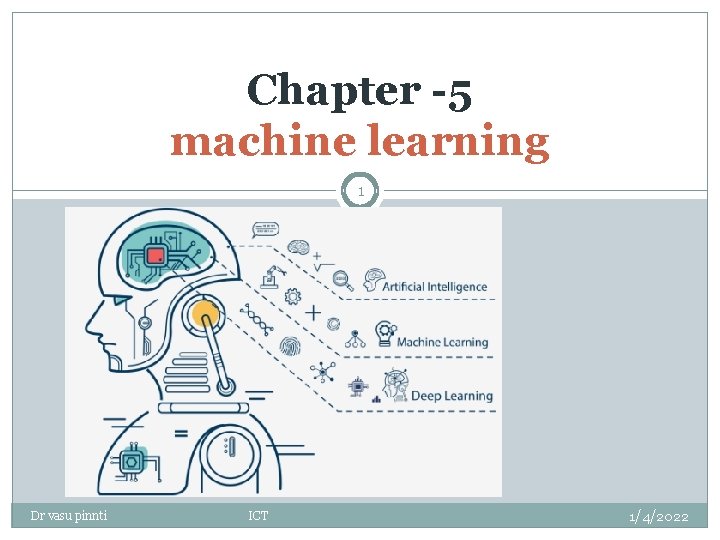
Chapter 5 machine learning 1 Dr vasu pinnti
- Slides: 27
Chapter -5 machine learning 1 Dr vasu pinnti ICT 1/4/2022
contents 2 �What is machine learning �Types of machine learning �Applications of machine learning �Supervised learning(classification) Decision tree algorithm Bayesian classification algorithm �Unsupervised learning(clustering) K-means clustering algorithm Dr vasu pinnti ICT 1/4/2022
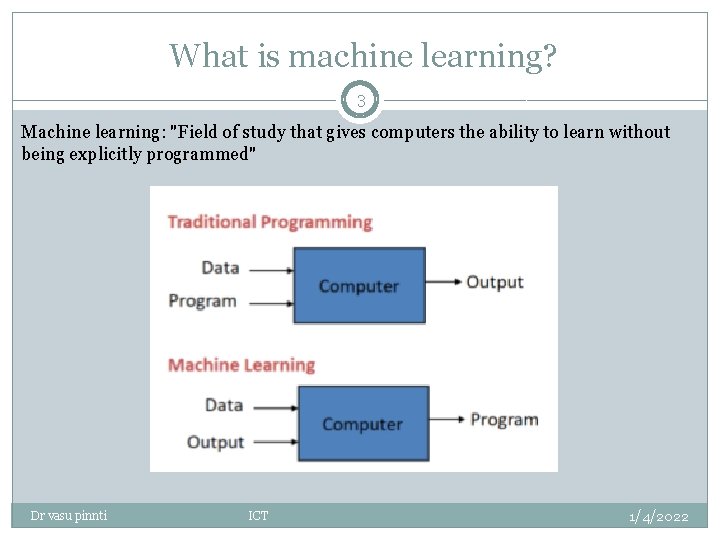
What is machine learning? 3 Machine learning: "Field of study that gives computers the ability to learn without being explicitly programmed" Dr vasu pinnti ICT 1/4/2022
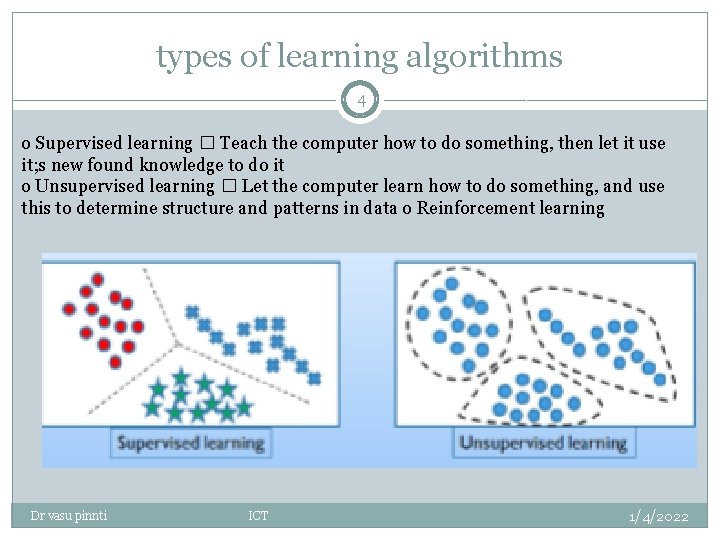
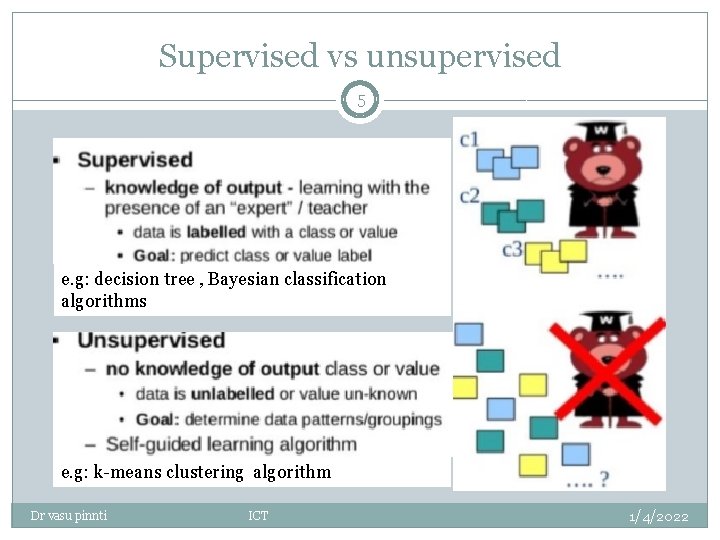
types of learning algorithms 4 o Supervised learning � Teach the computer how to do something, then let it use it; s new found knowledge to do it o Unsupervised learning � Let the computer learn how to do something, and use this to determine structure and patterns in data o Reinforcement learning Dr vasu pinnti ICT 1/4/2022
Supervised vs unsupervised 5 e. g: decision tree , Bayesian classification algorithms e. g: k-means clustering algorithm Dr vasu pinnti ICT 1/4/2022
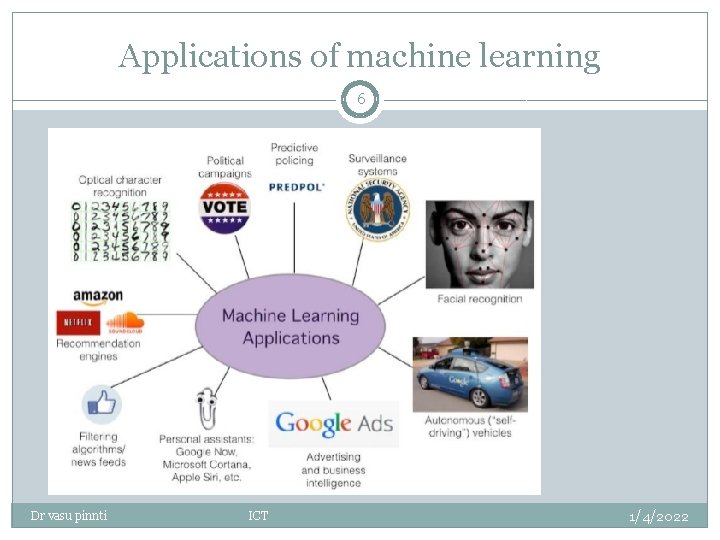
Applications of machine learning 6 Dr vasu pinnti ICT 1/4/2022
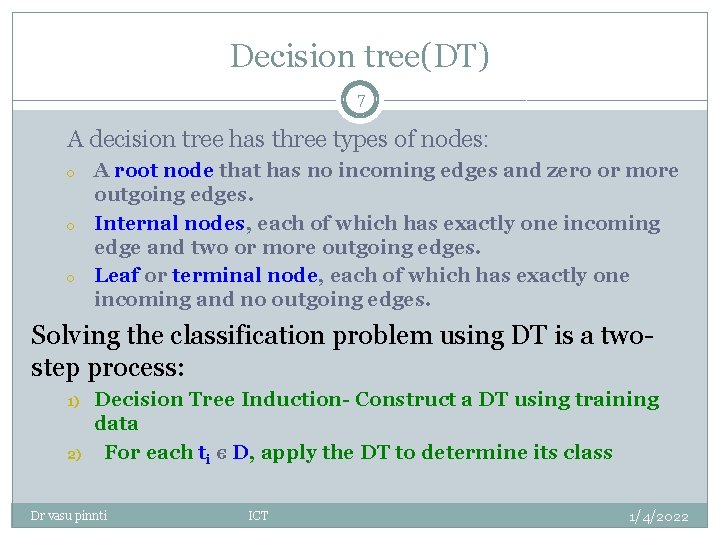
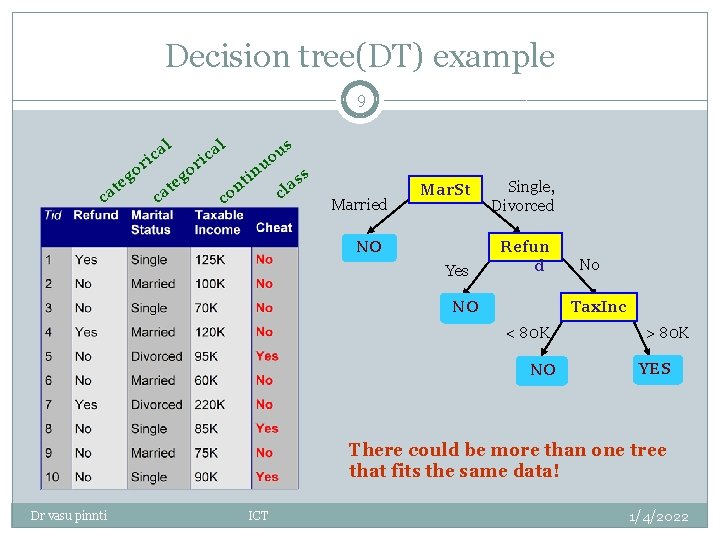
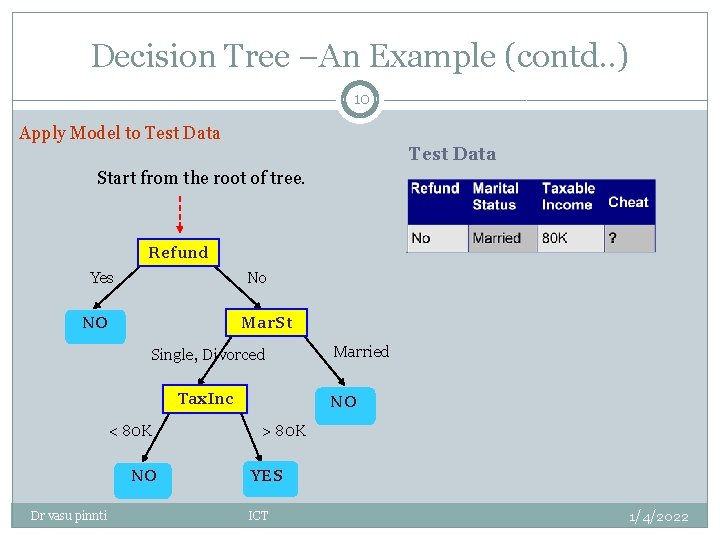
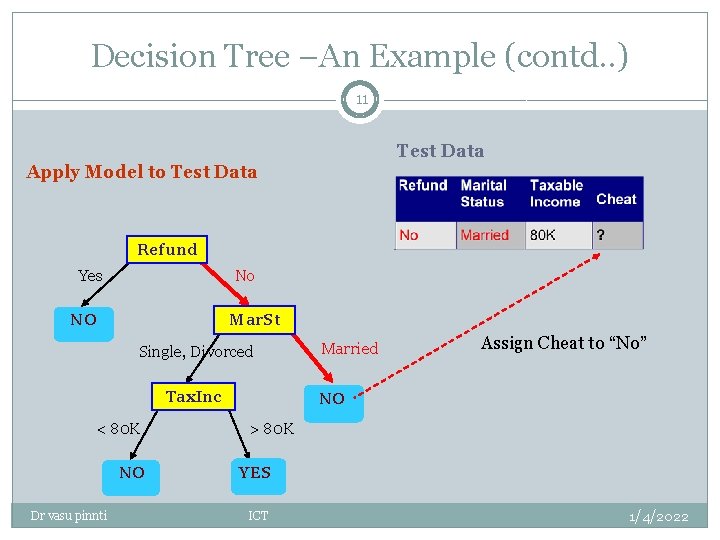
Decision tree(DT) 7 A decision tree has three types of nodes: o o o A root node that has no incoming edges and zero or more outgoing edges. Internal nodes, each of which has exactly one incoming edge and two or more outgoing edges. Leaf or terminal node, each of which has exactly one incoming and no outgoing edges. Solving the classification problem using DT is a twostep process: 1) 2) Decision Tree Induction- Construct a DT using training data For each ti є D, apply the DT to determine its class Dr vasu pinnti ICT 1/4/2022
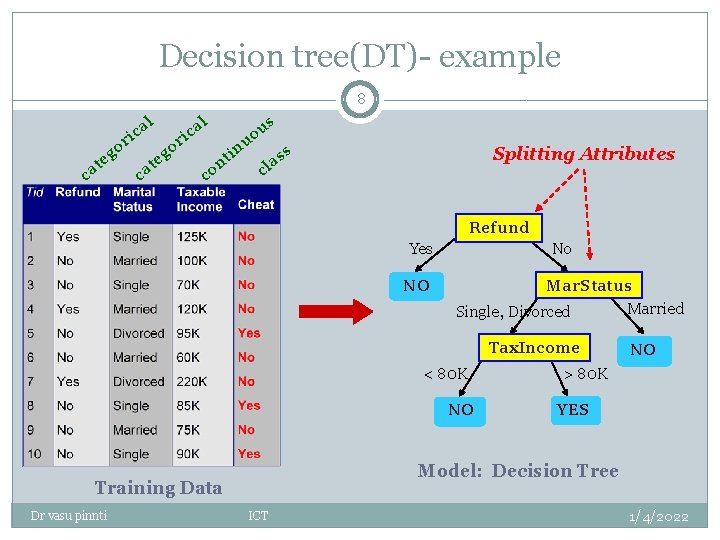
Decision tree(DT)- example 8 l l a ic r o eg at c c r o eg at a ic s u o u in t n co ss Splitting Attributes a cl Refund Yes NO No Mar. Status Married Single, Divorced Tax. Income < 80 K NO > 80 K YES Model: Decision Tree Training Data Dr vasu pinnti NO ICT 1/4/2022
Decision tree(DT) example 9 l t eg ca ca i or t ca o eg r al c i s u uo n i ss t a n cl co Married Mar. St NO Yes Single, Divorced Refun d NO No Tax. Inc < 80 K NO > 80 K YES There could be more than one tree that fits the same data! Dr vasu pinnti ICT 1/4/2022
Decision Tree –An Example (contd. . ) 10 Apply Model to Test Data Start from the root of tree. Refund Yes No NO Mar. St Single, Divorced Tax. Inc < 80 K NO Dr vasu pinnti Married NO > 80 K YES ICT 1/4/2022
Decision Tree –An Example (contd. . ) 11 Test Data Apply Model to Test Data Refund Yes No NO Mar. St Single, Divorced Tax. Inc < 80 K NO Dr vasu pinnti Married Assign Cheat to “No” NO > 80 K YES ICT 1/4/2022
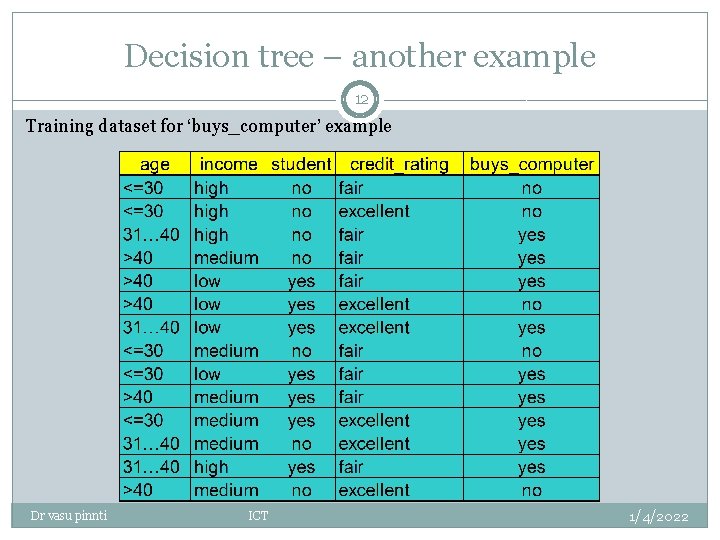
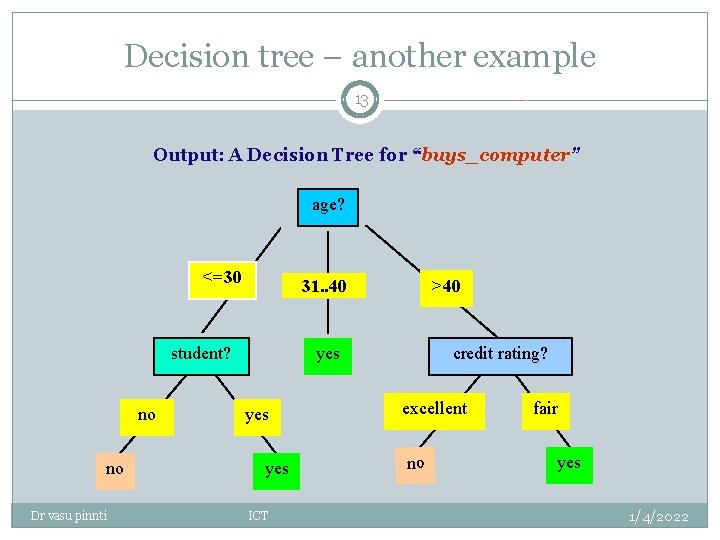
Decision tree – another example 12 Training dataset for ‘buys_computer’ example Dr vasu pinnti ICT 1/4/2022
Decision tree – another example 13 Output: A Decision Tree for “buys_computer” age? <=30 overcast 31. . 40 student? no no Dr vasu pinnti >40 credit rating? yes yes ICT excellent no fair yes 1/4/2022
Decision tree induction algorithms 14 • Many Algorithms: – Hunt’s Algorithm (one of the earliest) – ID 3(Induction Decision Tree ver. 3), – C 4. 5, C 5. 0 by Ross Quinlan et. al. – CART (Classification And Regression Tree) – CHAID (Chi-square Automatic Interaction Detection) Dr vasu pinnti ICT 1/4/2022
Decision tree induction algorithms 15 Dr vasu pinnti ICT 1/4/2022
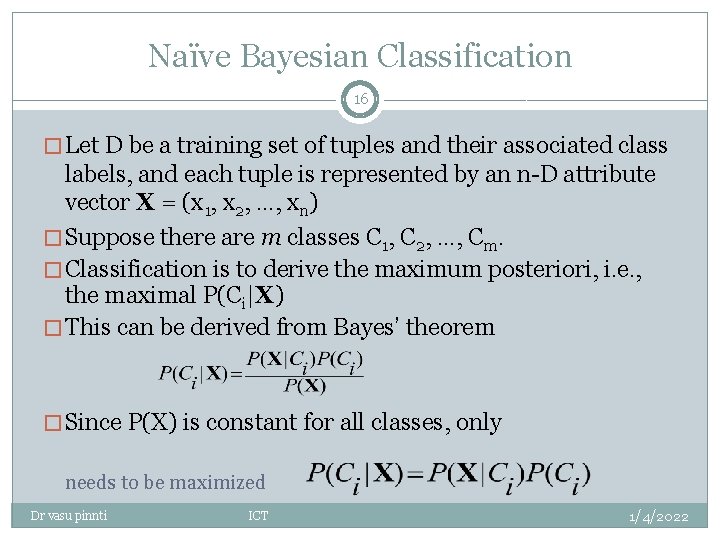
Naïve Bayesian Classification 16 � Let D be a training set of tuples and their associated class labels, and each tuple is represented by an n-D attribute vector X = (x 1, x 2, …, xn) � Suppose there are m classes C 1, C 2, …, Cm. � Classification is to derive the maximum posteriori, i. e. , the maximal P(Ci|X) � This can be derived from Bayes’ theorem � Since P(X) is constant for all classes, only needs to be maximized Dr vasu pinnti ICT 1/4/2022
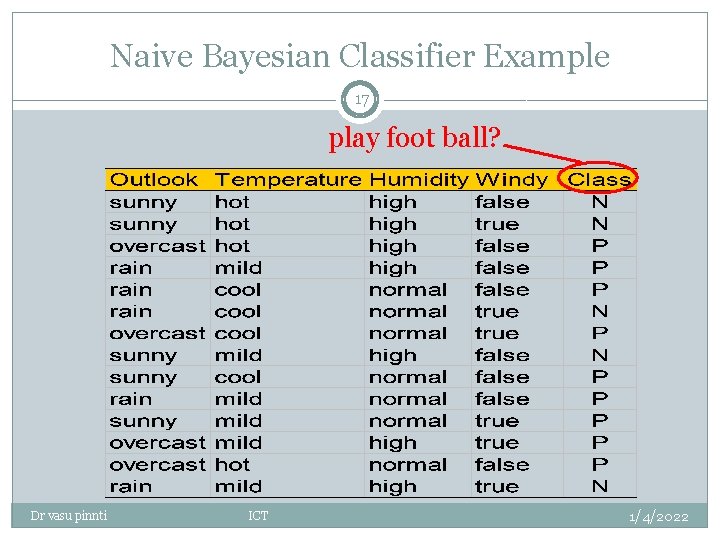
Naive Bayesian Classifier Example 17 play foot ball? Dr vasu pinnti ICT 1/4/2022
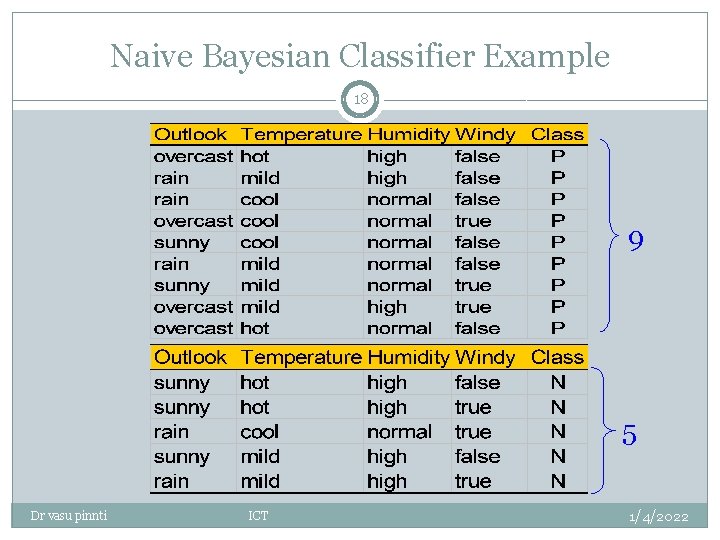
Naive Bayesian Classifier Example 18 9 5 Dr vasu pinnti ICT 1/4/2022
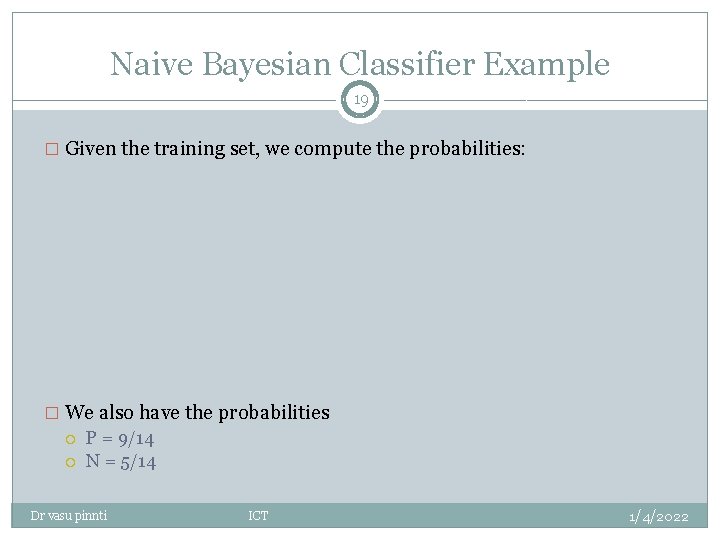
Naive Bayesian Classifier Example 19 � Given the training set, we compute the probabilities: � We also have the probabilities P = 9/14 N = 5/14 Dr vasu pinnti ICT 1/4/2022
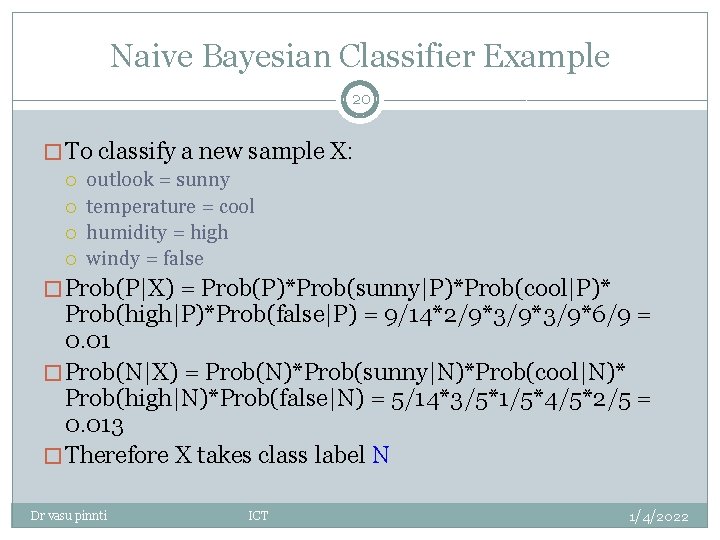
Naive Bayesian Classifier Example 20 � To classify a new sample X: outlook = sunny temperature = cool humidity = high windy = false � Prob(P|X) = Prob(P)*Prob(sunny|P)*Prob(cool|P)* Prob(high|P)*Prob(false|P) = 9/14*2/9*3/9*6/9 = 0. 01 � Prob(N|X) = Prob(N)*Prob(sunny|N)*Prob(cool|N)* Prob(high|N)*Prob(false|N) = 5/14*3/5*1/5*4/5*2/5 = 0. 013 � Therefore X takes class label N Dr vasu pinnti ICT 1/4/2022
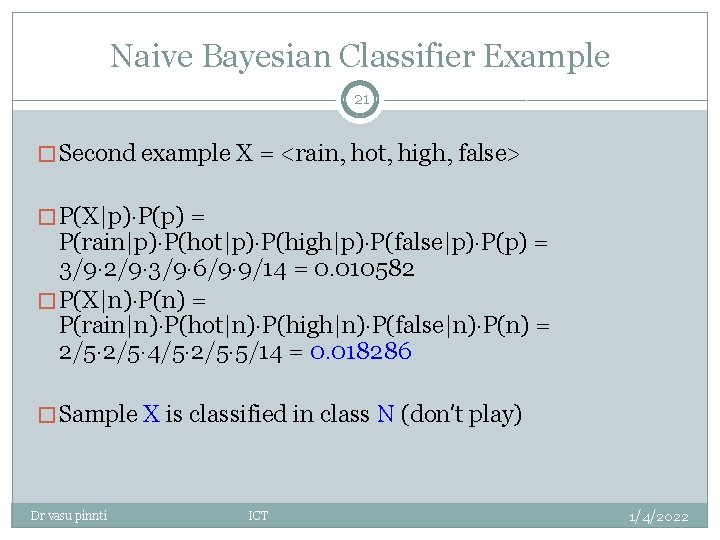
Naive Bayesian Classifier Example 21 � Second example X = <rain, hot, high, false> � P(X|p)·P(p) = P(rain|p)·P(hot|p)·P(high|p)·P(false|p)·P(p) = 3/9· 2/9· 3/9· 6/9· 9/14 = 0. 010582 � P(X|n)·P(n) = P(rain|n)·P(hot|n)·P(high|n)·P(false|n)·P(n) = 2/5· 4/5· 2/5· 5/14 = 0. 018286 � Sample X is classified in class N (don’t play) Dr vasu pinnti ICT 1/4/2022
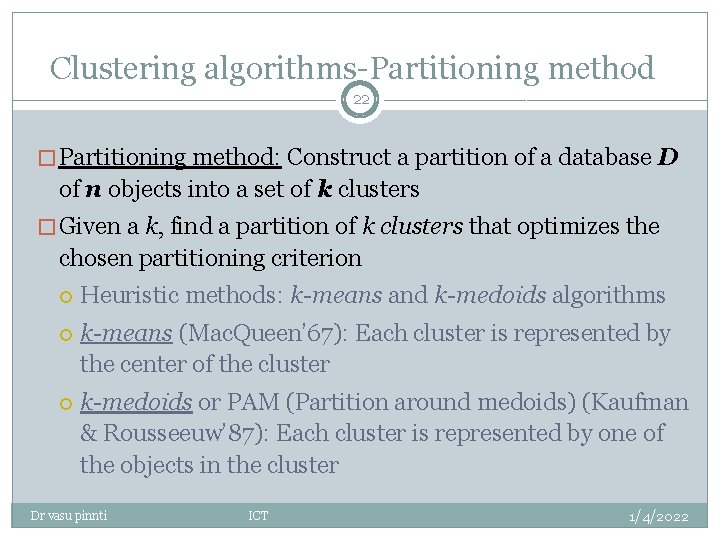
Clustering algorithms-Partitioning method 22 � Partitioning method: Construct a partition of a database D of n objects into a set of k clusters � Given a k, find a partition of k clusters that optimizes the chosen partitioning criterion Heuristic methods: k-means and k-medoids algorithms k-means (Mac. Queen’ 67): Each cluster is represented by the center of the cluster k-medoids or PAM (Partition around medoids) (Kaufman & Rousseeuw’ 87): Each cluster is represented by one of the objects in the cluster Dr vasu pinnti ICT 1/4/2022
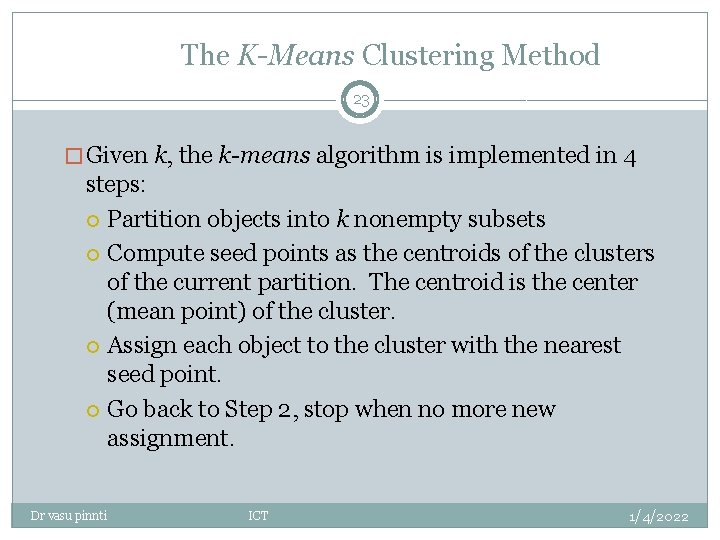
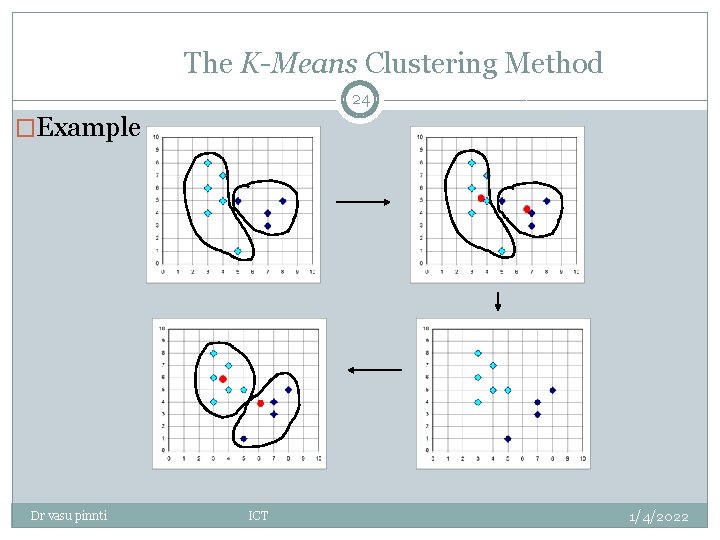
The K-Means Clustering Method 23 � Given k, the k-means algorithm is implemented in 4 steps: Partition objects into k nonempty subsets Compute seed points as the centroids of the clusters of the current partition. The centroid is the center (mean point) of the cluster. Assign each object to the cluster with the nearest seed point. Go back to Step 2, stop when no more new assignment. Dr vasu pinnti ICT 1/4/2022
The K-Means Clustering Method 24 �Example Dr vasu pinnti ICT 1/4/2022
APACHE MAHOUT 25 Dr vasu pinnti ICT 1/4/2022
SPARK MLib 26 Dr vasu pinnti ICT 1/4/2022
Introduction to HADOOP 27 ANY QUESTIONS / DOUBTS ? ? ? Dr vasu pinnti ICT 1/4/2022