
Chapter 5 Loops Liang Introduction to Java Programming
- Slides: 20
Chapter 5 Loops Liang, Introduction to Java Programming, Eleventh Edition, (c) 2018 Pearson Education, Ltd. All rights reserved. 1
Objectives § To write programs for executing statements repeatedly using a while loop (§ 5. 2). § To follow the loop design strategy to develop loops (§§ 5. 2. 1– 5. 2. 3). § To control a loop with a sentinel value (§ 5. 2. 4). § To obtain large input from a file using input redirection rather than typing from the keyboard (§ 5. 2. 5). § To write loops using do-while statements (§ 5. 3). § To write loops using for statements (§ 5. 4). § To discover the similarities and differences of three types of loop statements (§ 5. 5). § To write nested loops (§ 5. 6). § To learn the techniques for minimizing numerical errors (§ 5. 7). § To learn loops from a variety of examples (GCD, Future. Tuition, Dec 2 Hex) (§ 5. 8). § To implement program control with break and continue (§ 5. 9). § To write a program that displays prime numbers (§ 5. 11). Liang, Introduction to Java Programming, Eleventh Edition, (c) 2018 Pearson Education, Ltd. All rights reserved. 2
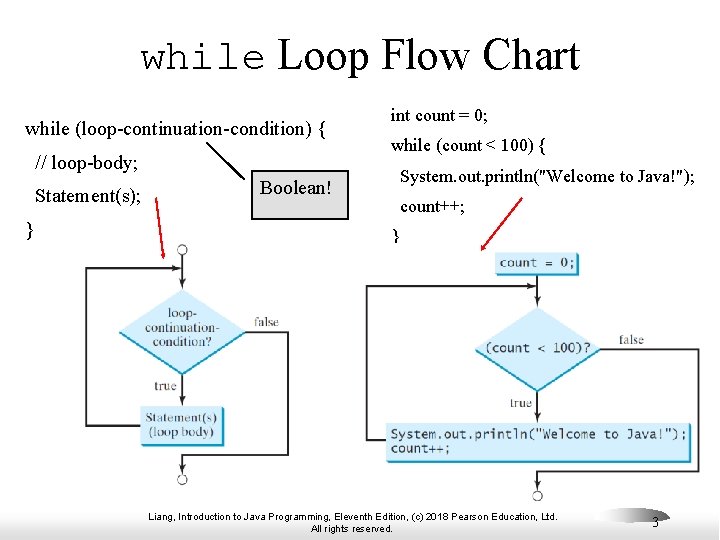
while Loop Flow Chart while (loop-continuation-condition) { // loop-body; Statement(s); } int count = 0; while (count < 100) { System. out. println("Welcome to Java!"); Boolean! count++; } Liang, Introduction to Java Programming, Eleventh Edition, (c) 2018 Pearson Education, Ltd. All rights reserved. 3
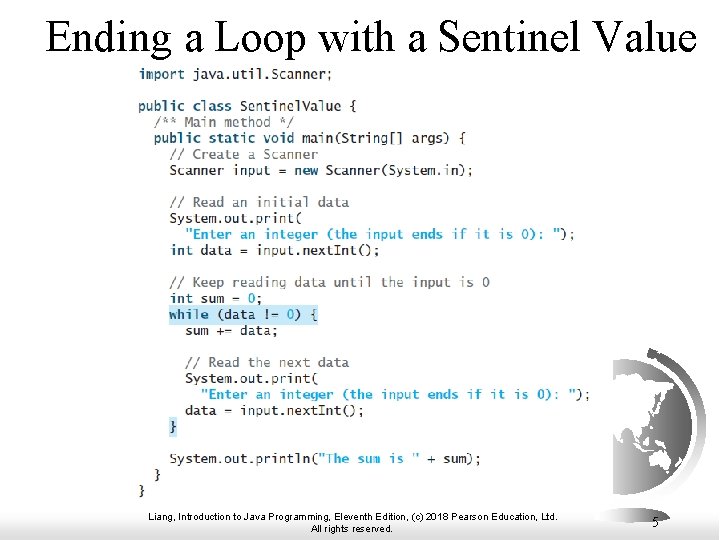
Ending a Loop with a Sentinel Value Often the number of times a loop is executed is not predetermined. You may use an input value to signify the end of the loop. Such a value is known as a sentinel value. Write a program that reads and calculates the sum of an unspecified number of integers. The input 0 signifies the end of the input. Liang, Introduction to Java Programming, Eleventh Edition, (c) 2018 Pearson Education, Ltd. All rights reserved. 4
Ending a Loop with a Sentinel Value Liang, Introduction to Java Programming, Eleventh Edition, (c) 2018 Pearson Education, Ltd. All rights reserved. 5
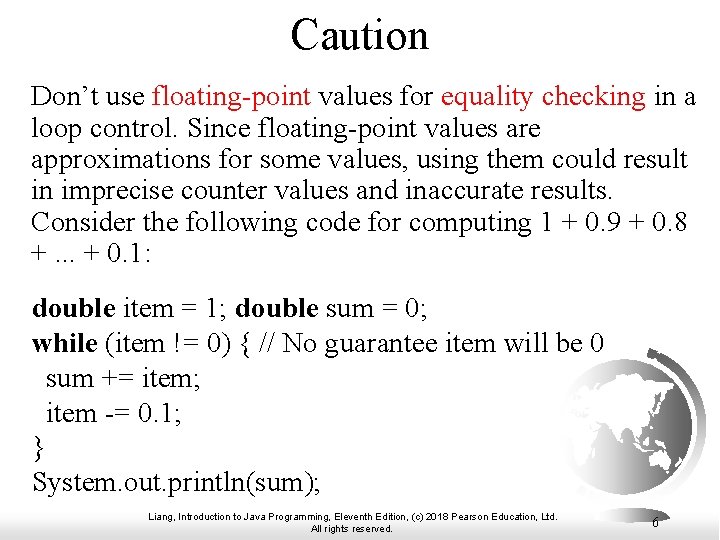
Caution Don’t use floating-point values for equality checking in a loop control. Since floating-point values are approximations for some values, using them could result in imprecise counter values and inaccurate results. Consider the following code for computing 1 + 0. 9 + 0. 8 +. . . + 0. 1: double item = 1; double sum = 0; while (item != 0) { // No guarantee item will be 0 sum += item; item -= 0. 1; } System. out. println(sum); Liang, Introduction to Java Programming, Eleventh Edition, (c) 2018 Pearson Education, Ltd. All rights reserved. 6
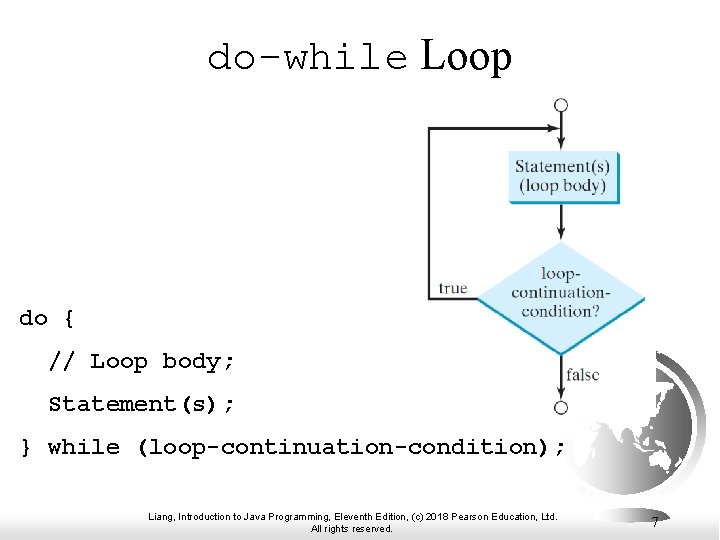
do-while Loop do { // Loop body; Statement(s); } while (loop-continuation-condition); Liang, Introduction to Java Programming, Eleventh Edition, (c) 2018 Pearson Education, Ltd. All rights reserved. 7
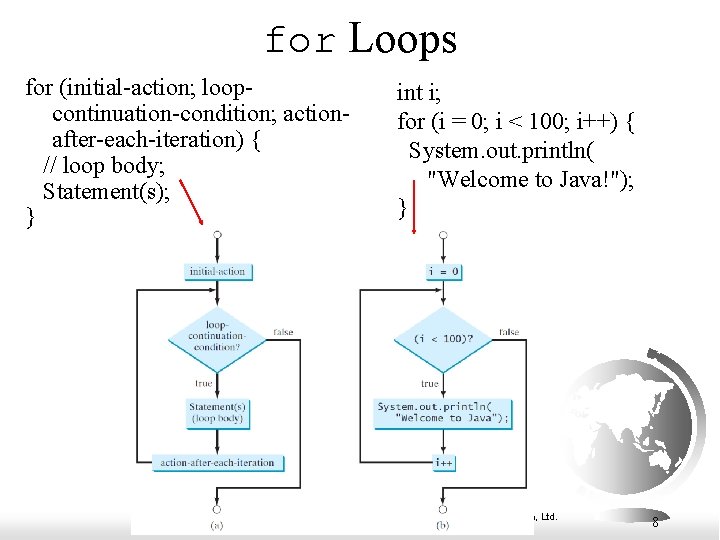
for Loops for (initial-action; loopcontinuation-condition; actionafter-each-iteration) { // loop body; Statement(s); } int i; for (i = 0; i < 100; i++) { System. out. println( "Welcome to Java!"); } Liang, Introduction to Java Programming, Eleventh Edition, (c) 2018 Pearson Education, Ltd. All rights reserved. 8
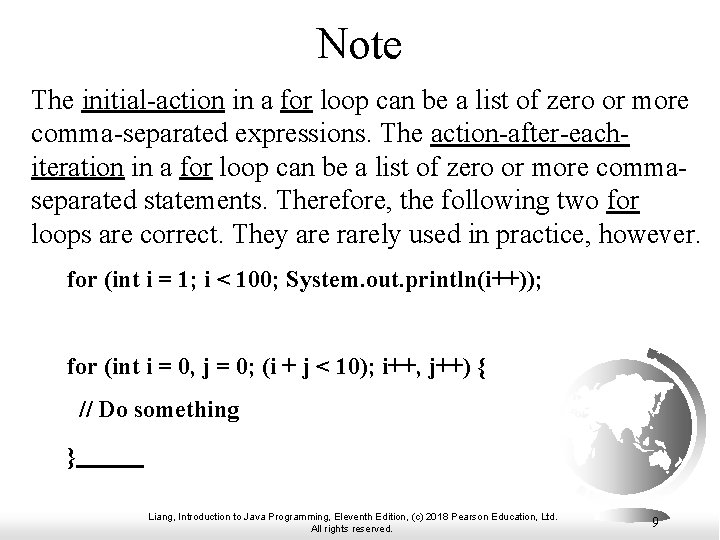
Note The initial-action in a for loop can be a list of zero or more comma-separated expressions. The action-after-eachiteration in a for loop can be a list of zero or more commaseparated statements. Therefore, the following two for loops are correct. They are rarely used in practice, however. for (int i = 1; i < 100; System. out. println(i++)); for (int i = 0, j = 0; (i + j < 10); i++, j++) { // Do something } Liang, Introduction to Java Programming, Eleventh Edition, (c) 2018 Pearson Education, Ltd. All rights reserved. 9
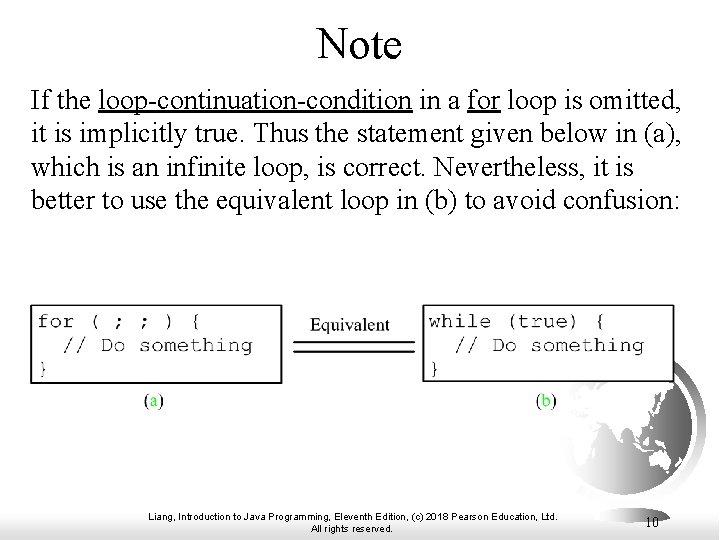
Note If the loop-continuation-condition in a for loop is omitted, it is implicitly true. Thus the statement given below in (a), which is an infinite loop, is correct. Nevertheless, it is better to use the equivalent loop in (b) to avoid confusion: Liang, Introduction to Java Programming, Eleventh Edition, (c) 2018 Pearson Education, Ltd. All rights reserved. 10
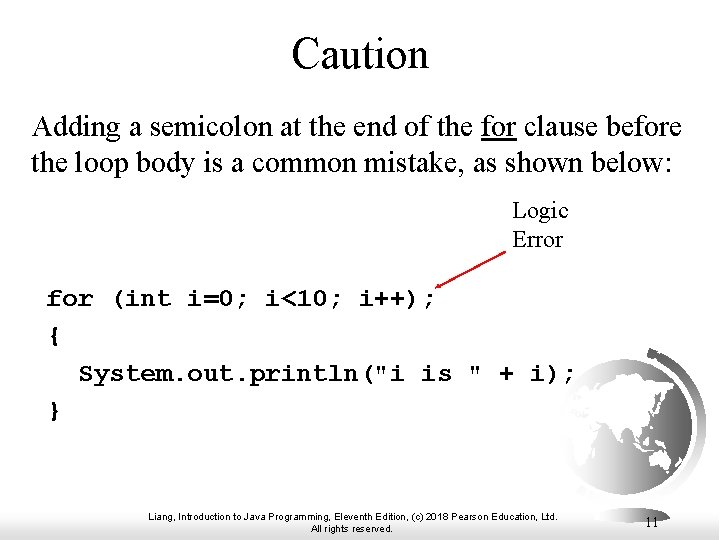
Caution Adding a semicolon at the end of the for clause before the loop body is a common mistake, as shown below: Logic Error for (int i=0; i<10; i++); { System. out. println("i is " + i); } Liang, Introduction to Java Programming, Eleventh Edition, (c) 2018 Pearson Education, Ltd. All rights reserved. 11
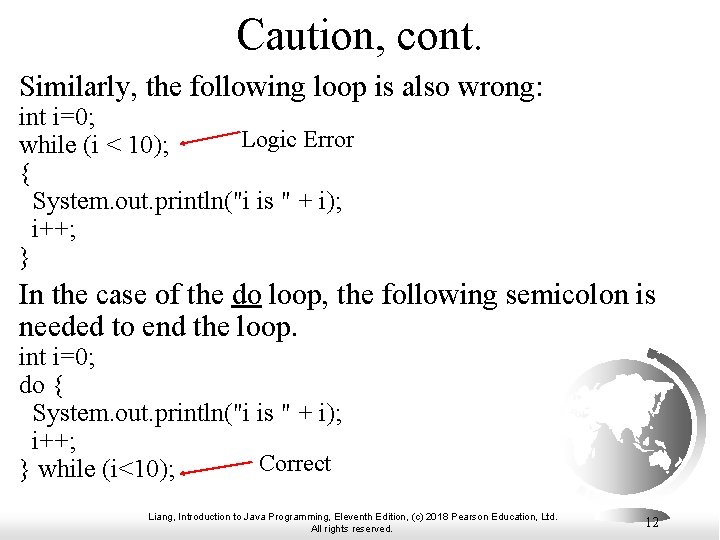
Caution, cont. Similarly, the following loop is also wrong: int i=0; Logic Error while (i < 10); { System. out. println("i is " + i); i++; } In the case of the do loop, the following semicolon is needed to end the loop. int i=0; do { System. out. println("i is " + i); i++; Correct } while (i<10); Liang, Introduction to Java Programming, Eleventh Edition, (c) 2018 Pearson Education, Ltd. All rights reserved. 12
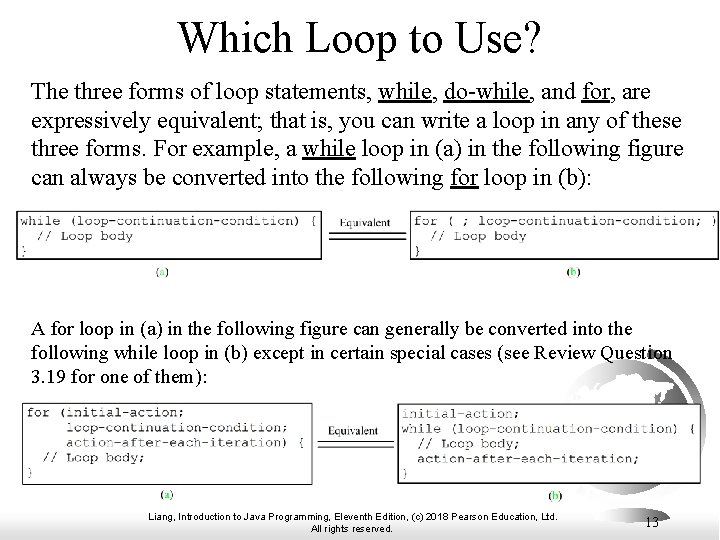
Which Loop to Use? The three forms of loop statements, while, do-while, and for, are expressively equivalent; that is, you can write a loop in any of these three forms. For example, a while loop in (a) in the following figure can always be converted into the following for loop in (b): A for loop in (a) in the following figure can generally be converted into the following while loop in (b) except in certain special cases (see Review Question 3. 19 for one of them): Liang, Introduction to Java Programming, Eleventh Edition, (c) 2018 Pearson Education, Ltd. All rights reserved. 13
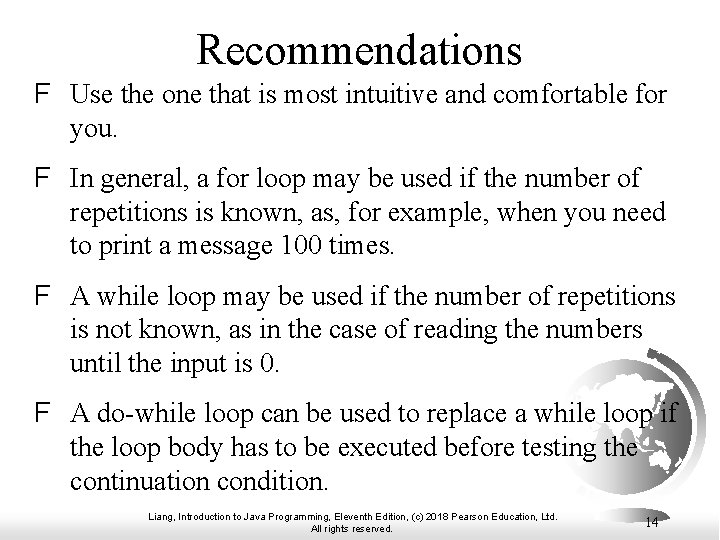
Recommendations F Use the one that is most intuitive and comfortable for you. F In general, a for loop may be used if the number of repetitions is known, as, for example, when you need to print a message 100 times. F A while loop may be used if the number of repetitions is not known, as in the case of reading the numbers until the input is 0. F A do-while loop can be used to replace a while loop if the loop body has to be executed before testing the continuation condition. Liang, Introduction to Java Programming, Eleventh Edition, (c) 2018 Pearson Education, Ltd. All rights reserved. 14
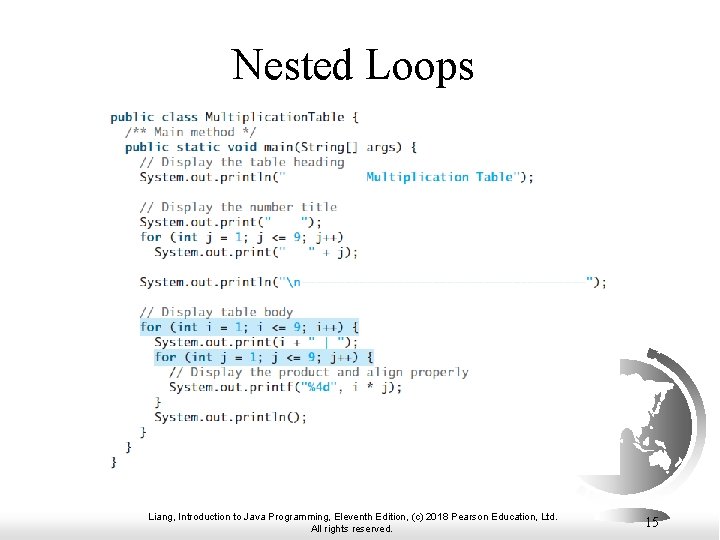
Nested Loops Liang, Introduction to Java Programming, Eleventh Edition, (c) 2018 Pearson Education, Ltd. All rights reserved. 15
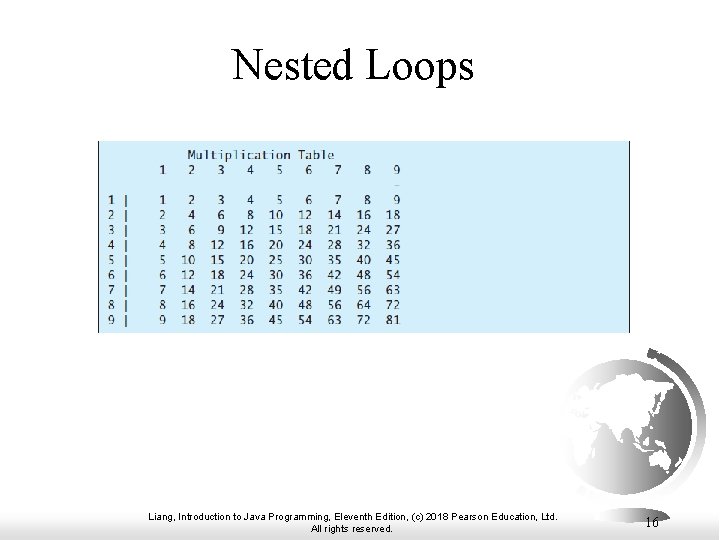
Nested Loops Liang, Introduction to Java Programming, Eleventh Edition, (c) 2018 Pearson Education, Ltd. All rights reserved. 16
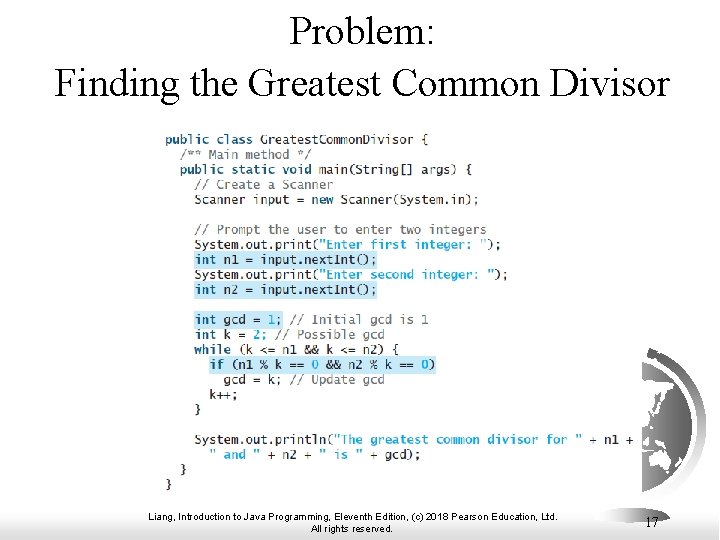
Problem: Finding the Greatest Common Divisor Liang, Introduction to Java Programming, Eleventh Edition, (c) 2018 Pearson Education, Ltd. All rights reserved. 17
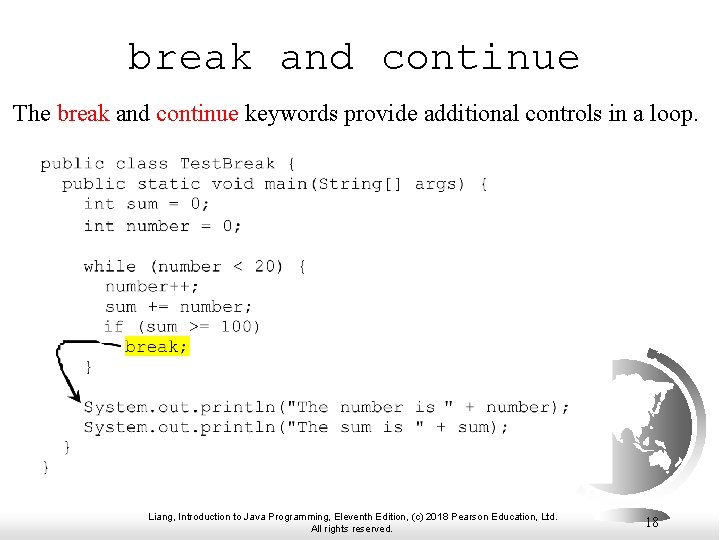
break and continue The break and continue keywords provide additional controls in a loop. Liang, Introduction to Java Programming, Eleventh Edition, (c) 2018 Pearson Education, Ltd. All rights reserved. 18
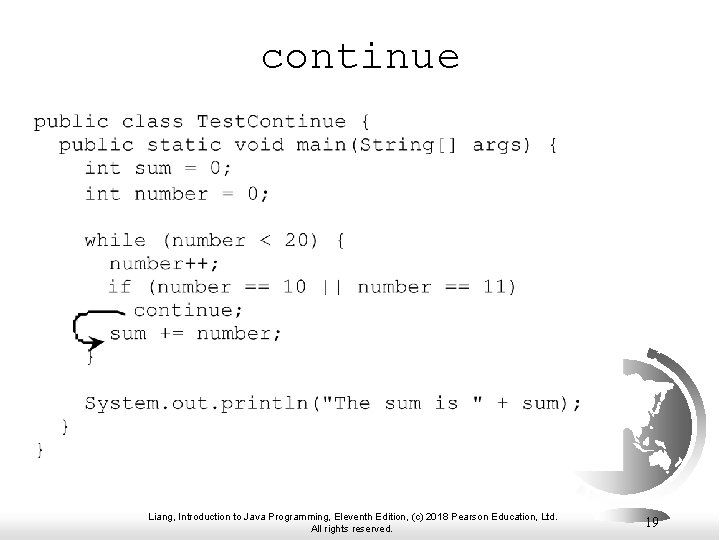
continue Liang, Introduction to Java Programming, Eleventh Edition, (c) 2018 Pearson Education, Ltd. All rights reserved. 19
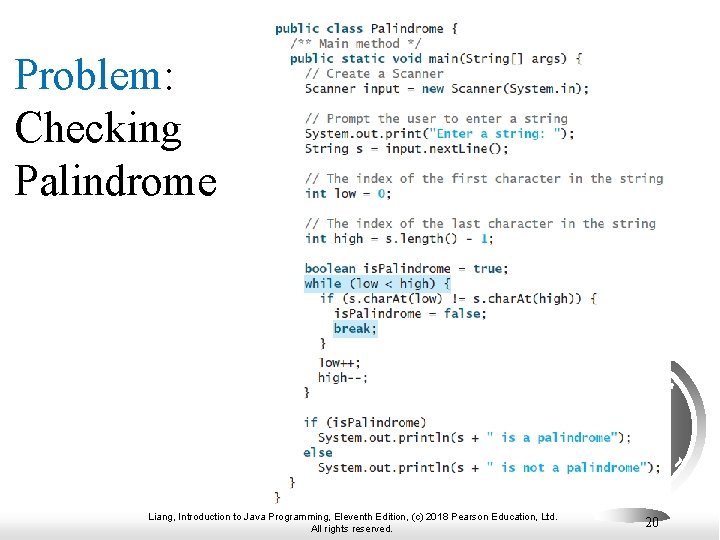
Problem: Checking Palindrome Liang, Introduction to Java Programming, Eleventh Edition, (c) 2018 Pearson Education, Ltd. All rights reserved. 20