
Chapter 5 Loops Liang Introduction to Java Programming
- Slides: 51
Chapter 5 Loops Liang, Introduction to Java Programming, Eleventh Edition, (c) 2018 Pearson Education, Ltd. All rights reserved. 1
Motivations Suppose that you need to print a string (e. g. , "Welcome to Java!") a hundred times. u It would be tedious to have to write the following statement a hundred times: u System. out. println("Welcome to Java!"); example So, how do you solve this problem? solution Liang, Introduction to Java Programming, Eleventh Edition, (c) 2018 Pearson Education, Ltd. All rights reserved. 2
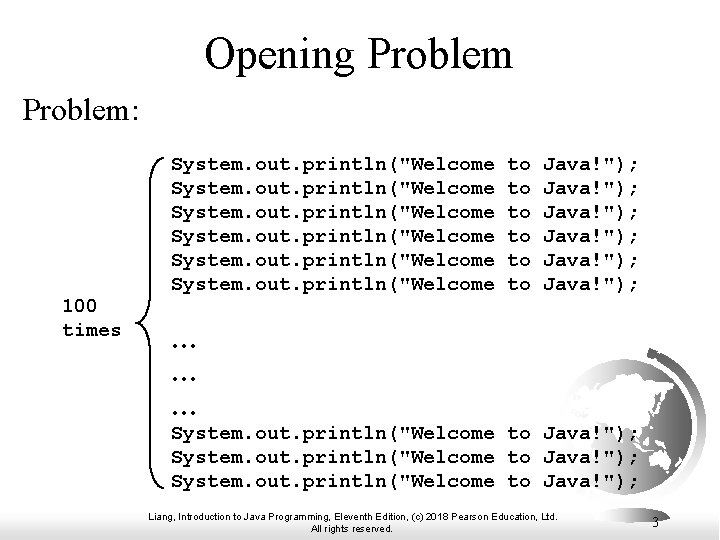
Opening Problem: 100 times System. out. println("Welcome to to to Java!"); Java!"); … … … System. out. println("Welcome to Java!"); Liang, Introduction to Java Programming, Eleventh Edition, (c) 2018 Pearson Education, Ltd. All rights reserved. 3
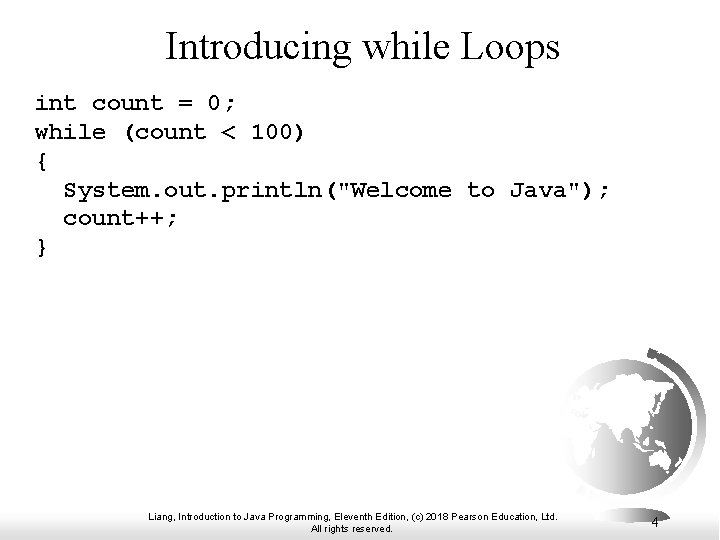
Introducing while Loops int count = 0; while (count < 100) { System. out. println("Welcome to Java"); count++; } Liang, Introduction to Java Programming, Eleventh Edition, (c) 2018 Pearson Education, Ltd. All rights reserved. 4
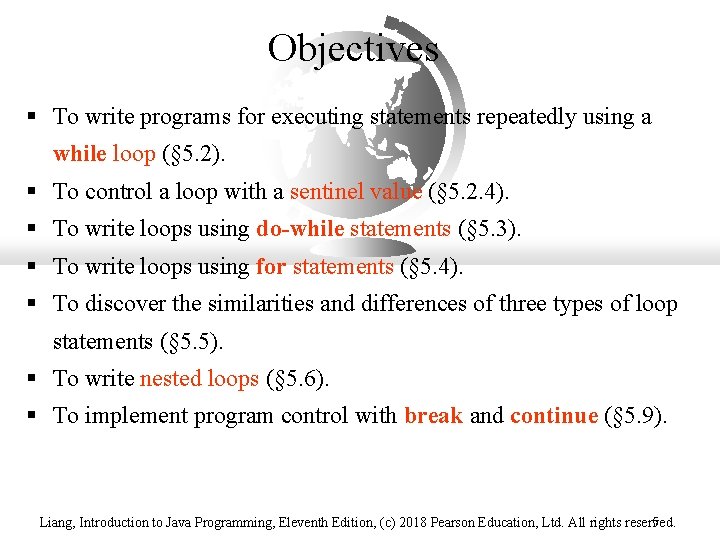
Objectives § To write programs for executing statements repeatedly using a while loop (§ 5. 2). § To control a loop with a sentinel value (§ 5. 2. 4). § To write loops using do-while statements (§ 5. 3). § To write loops using for statements (§ 5. 4). § To discover the similarities and differences of three types of loop statements (§ 5. 5). § To write nested loops (§ 5. 6). § To implement program control with break and continue (§ 5. 9). Liang, Introduction to Java Programming, Eleventh Edition, (c) 2018 Pearson Education, Ltd. All rights reserved. 5
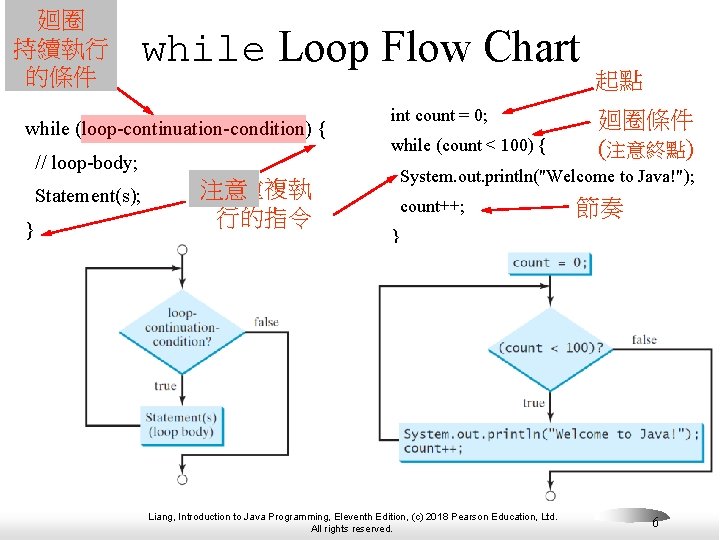
廻圈 持續執行 的條件 while Loop Flow Chart while (loop-continuation-condition) { // loop-body; Statement(s); } 被重複執 注意 行的指令 int count = 0; while (count < 100) { 起點 廻圈條件 (注意終點) System. out. println("Welcome to Java!"); count++; 節奏 } Liang, Introduction to Java Programming, Eleventh Edition, (c) 2018 Pearson Education, Ltd. All rights reserved. 6
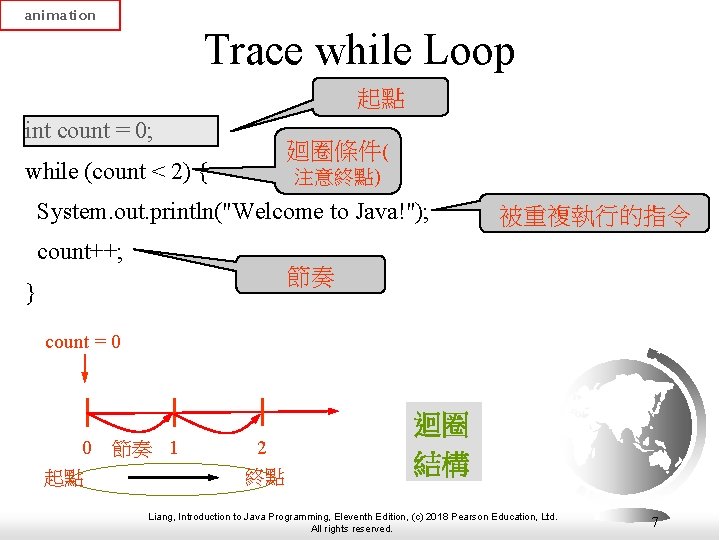
animation Trace while Loop 起點 int count = 0; 廻圈條件( while (count < 2) { 注意終點) System. out. println("Welcome to Java!"); 被重複執行的指令 count++; 節奏 } count = 0 0 起點 節奏 1 2 終點 迴圈 結構 Liang, Introduction to Java Programming, Eleventh Edition, (c) 2018 Pearson Education, Ltd. All rights reserved. 7
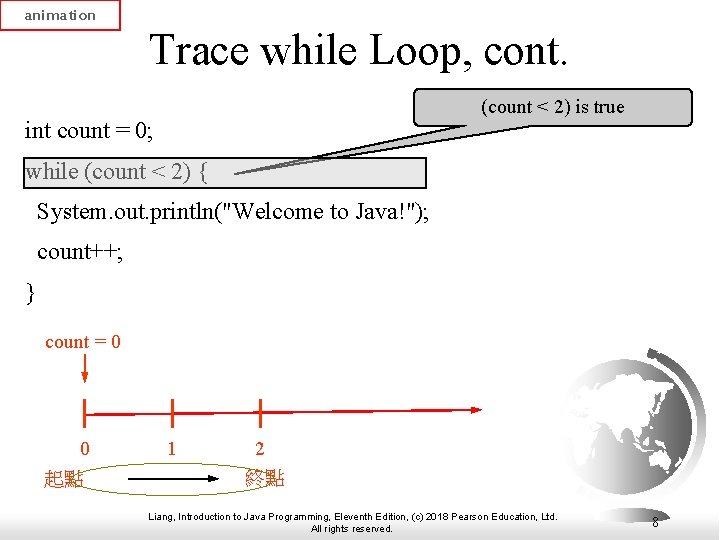
animation Trace while Loop, cont. (count < 2) is true int count = 0; while (count < 2) { System. out. println("Welcome to Java!"); count++; } count = 0 0 起點 1 2 終點 Liang, Introduction to Java Programming, Eleventh Edition, (c) 2018 Pearson Education, Ltd. All rights reserved. 8
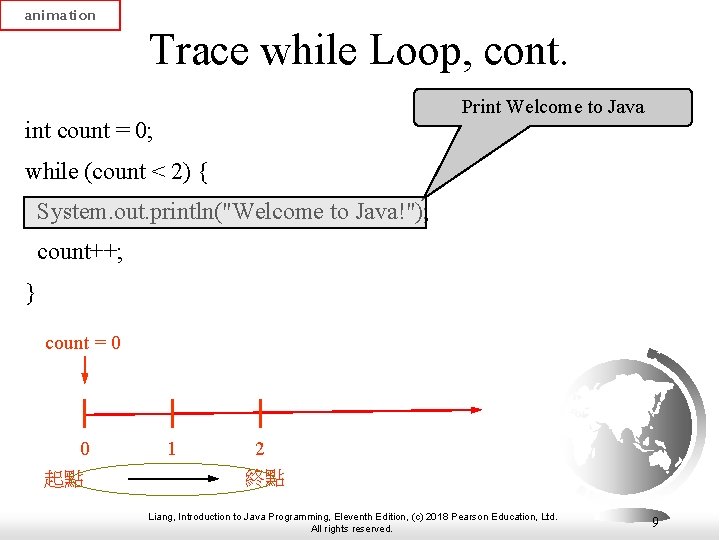
animation Trace while Loop, cont. Print Welcome to Java int count = 0; while (count < 2) { System. out. println("Welcome to Java!"); count++; } count = 0 0 起點 1 2 終點 Liang, Introduction to Java Programming, Eleventh Edition, (c) 2018 Pearson Education, Ltd. All rights reserved. 9
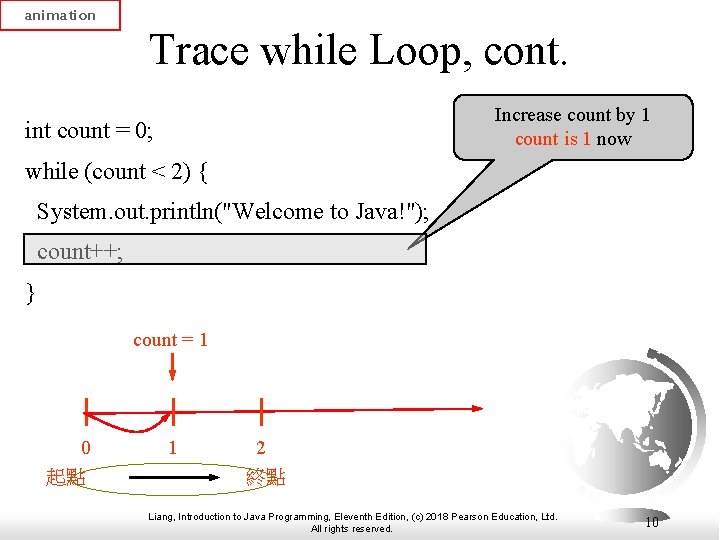
animation Trace while Loop, cont. Increase count by 1 count is 1 now int count = 0; while (count < 2) { System. out. println("Welcome to Java!"); count++; } count = 1 0 起點 1 2 終點 Liang, Introduction to Java Programming, Eleventh Edition, (c) 2018 Pearson Education, Ltd. All rights reserved. 10
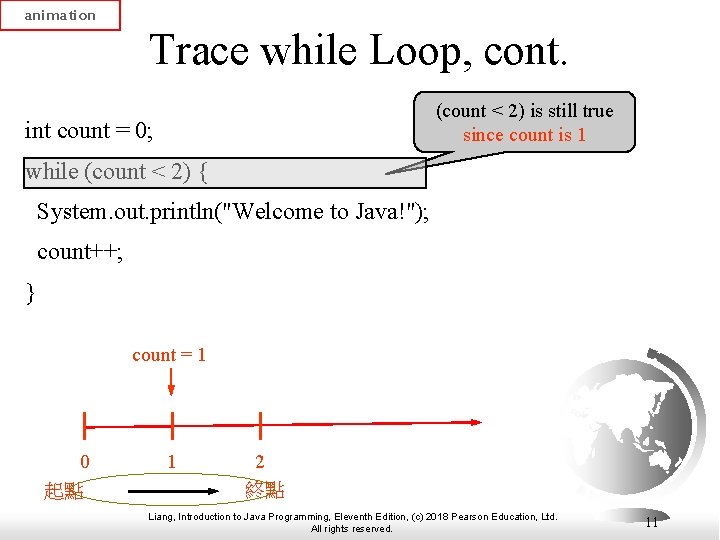
animation Trace while Loop, cont. (count < 2) is still true since count is 1 int count = 0; while (count < 2) { System. out. println("Welcome to Java!"); count++; } count = 1 0 起點 1 2 終點 Liang, Introduction to Java Programming, Eleventh Edition, (c) 2018 Pearson Education, Ltd. All rights reserved. 11
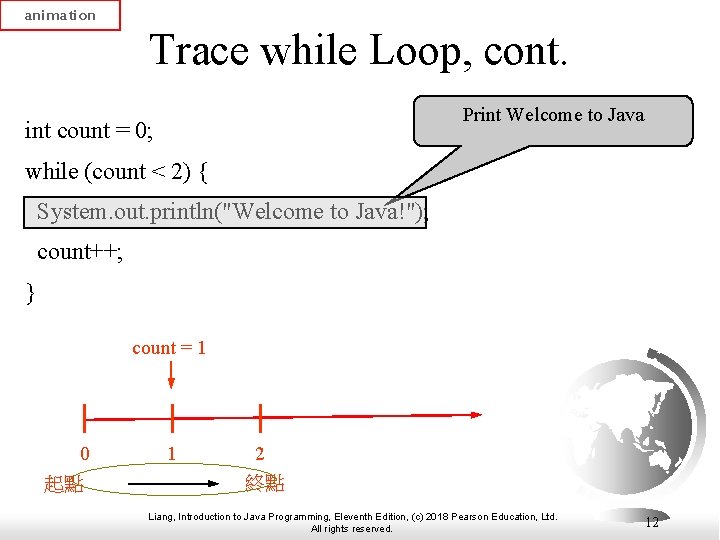
animation Trace while Loop, cont. Print Welcome to Java int count = 0; while (count < 2) { System. out. println("Welcome to Java!"); count++; } count = 1 0 起點 1 2 終點 Liang, Introduction to Java Programming, Eleventh Edition, (c) 2018 Pearson Education, Ltd. All rights reserved. 12
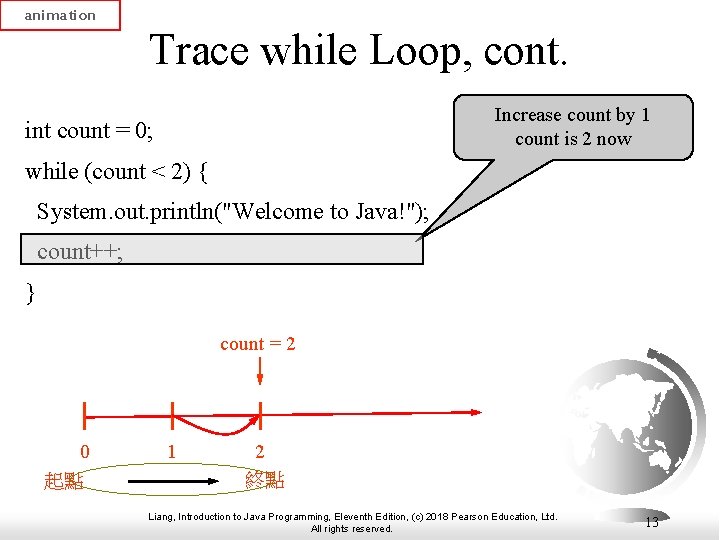
animation Trace while Loop, cont. Increase count by 1 count is 2 now int count = 0; while (count < 2) { System. out. println("Welcome to Java!"); count++; } count = 2 0 起點 1 2 終點 Liang, Introduction to Java Programming, Eleventh Edition, (c) 2018 Pearson Education, Ltd. All rights reserved. 13
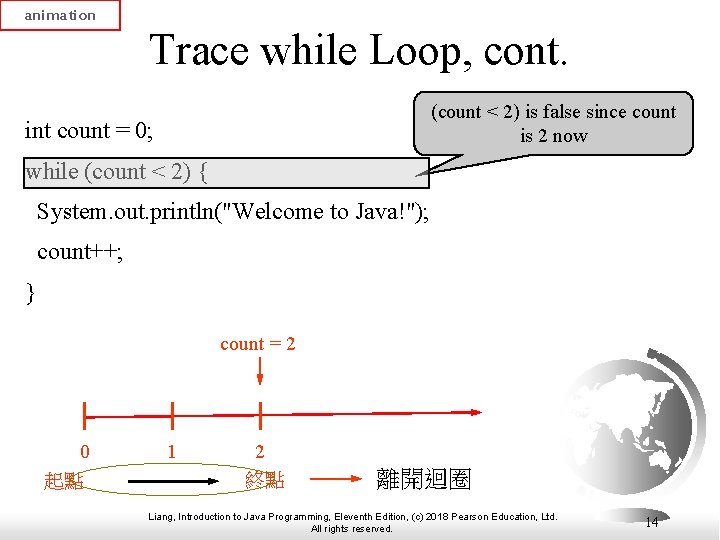
animation Trace while Loop, cont. (count < 2) is false since count is 2 now int count = 0; while (count < 2) { System. out. println("Welcome to Java!"); count++; } count = 2 0 起點 1 2 終點 離開迴圈 Liang, Introduction to Java Programming, Eleventh Edition, (c) 2018 Pearson Education, Ltd. All rights reserved. 14
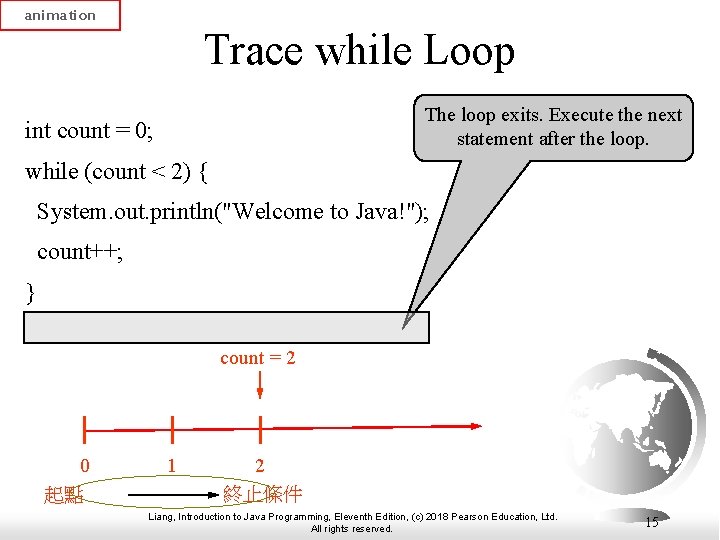
animation Trace while Loop The loop exits. Execute the next statement after the loop. int count = 0; while (count < 2) { System. out. println("Welcome to Java!"); count++; } count = 2 0 起點 1 2 終止條件 Liang, Introduction to Java Programming, Eleventh Edition, (c) 2018 Pearson Education, Ltd. All rights reserved. 15
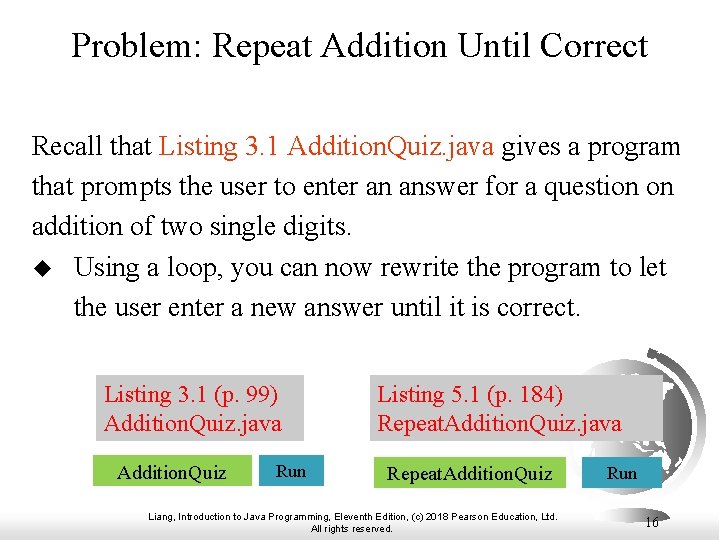
Problem: Repeat Addition Until Correct Recall that Listing 3. 1 Addition. Quiz. java gives a program that prompts the user to enter an answer for a question on addition of two single digits. u Using a loop, you can now rewrite the program to let the user enter a new answer until it is correct. Listing 3. 1 (p. 99) Addition. Quiz. java Addition. Quiz Run Listing 5. 1 (p. 184) Repeat. Addition. Quiz. java Repeat. Addition. Quiz Liang, Introduction to Java Programming, Eleventh Edition, (c) 2018 Pearson Education, Ltd. All rights reserved. Run 16
Problem: Guessing Numbers Write a program that randomly generates an integer between 0 and 100, inclusive. u The program prompts the user to enter a number continuously until the number matches the randomly generated number. u For each user input, the program tells the user whether the input is too low or too high, so the user can choose the next input intelligently. Here is a sample run: Listing 5. 2 (p. 186) Guess. Number. One. Time. java Listing 5. 3 (p. 187) Guess. Number. java Guess. Number. One. Time Run Guess. Number Run Liang, Introduction to Java Programming, Eleventh Edition, (c) 2018 Pearson Education, Ltd. All rights reserved. 17
Problem: An Advanced Math Learning Tool The Math subtraction learning tool program generates just one question for each run. u You can use a loop to generate questions repeatedly. u This example gives a program that u generates five questions, and u reports the number of the correct answers after a student answers all five questions. Listing 3. 3 (p. 109) Subtraction. Quiz. java Subtraction. Quiz Run Listing 5. 4 (p. 188) Subtraction. Quiz. Loop. java Subtraction. Quiz. Loop Liang, Introduction to Java Programming, Eleventh Edition, (c) 2018 Pearson Education, Ltd. All rights reserved. Run 18
Ending a Loop with a Sentinel Value Often the number of times a loop is executed is not predetermined. u You may use an input value to signify the end of the loop. Such a value is known as a sentinel value (哨兵值). u Write a program that reads and calculates the sum of an unspecified number of integers. u The input 0 signifies the end of the input. Listing 5. 5 (p. 190) Sentinel. Value. java Sentinel. Value Run Liang, Introduction to Java Programming, Eleventh Edition, (c) 2018 Pearson Education, Ltd. All rights reserved. 19
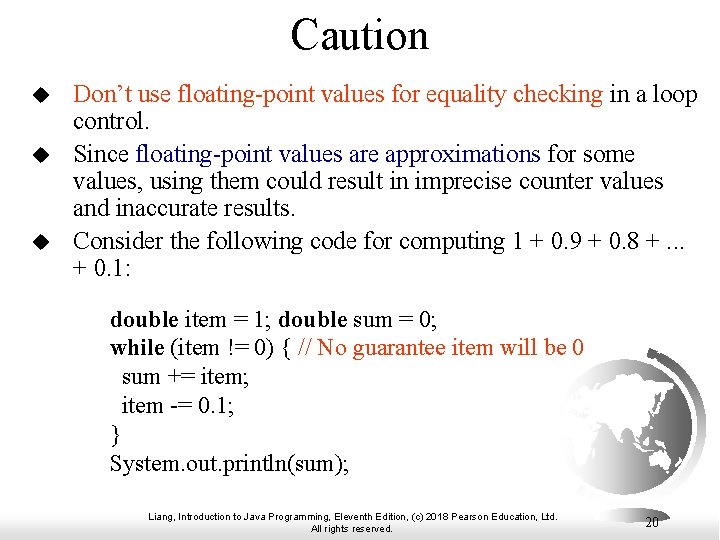
Caution u u u Don’t use floating-point values for equality checking in a loop control. Since floating-point values are approximations for some values, using them could result in imprecise counter values and inaccurate results. Consider the following code for computing 1 + 0. 9 + 0. 8 +. . . + 0. 1: double item = 1; double sum = 0; while (item != 0) { // No guarantee item will be 0 sum += item; item -= 0. 1; } System. out. println(sum); Liang, Introduction to Java Programming, Eleventh Edition, (c) 2018 Pearson Education, Ltd. All rights reserved. 20
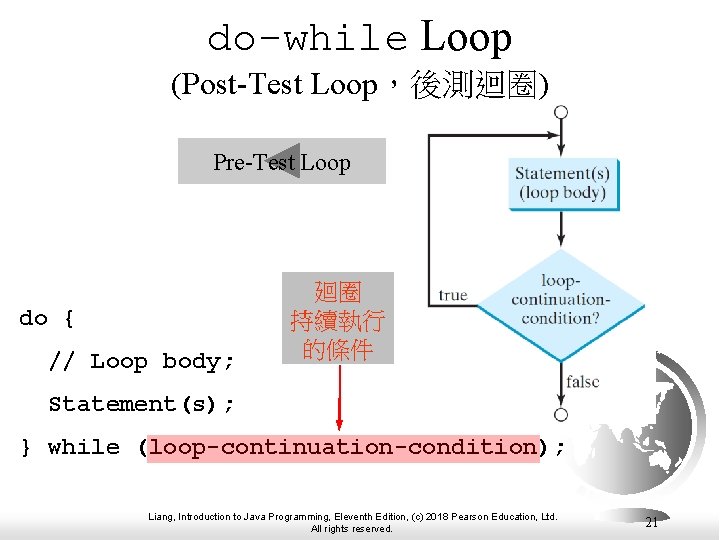
do-while Loop (Post-Test Loop,後測迴圈) Pre-Test Loop do { // Loop body; 廻圈 持續執行 的條件 Statement(s); } while (loop-continuation-condition); Liang, Introduction to Java Programming, Eleventh Edition, (c) 2018 Pearson Education, Ltd. All rights reserved. 21
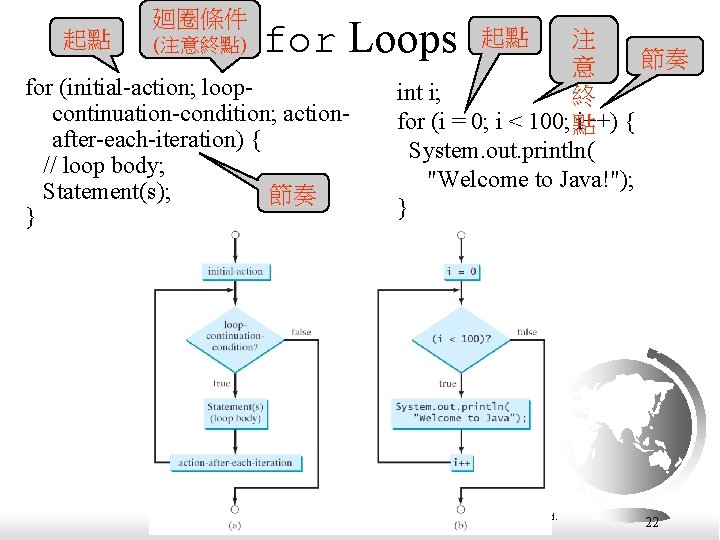
起點 廻圈條件 (注意終點) for Loops for (initial-action; loopcontinuation-condition; actionafter-each-iteration) { // loop body; Statement(s); 節奏 } 起點 注 節奏 意 int i; 終 for (i = 0; i < 100; 點 i++) { System. out. println( "Welcome to Java!"); } Liang, Introduction to Java Programming, Eleventh Edition, (c) 2018 Pearson Education, Ltd. All rights reserved. 22
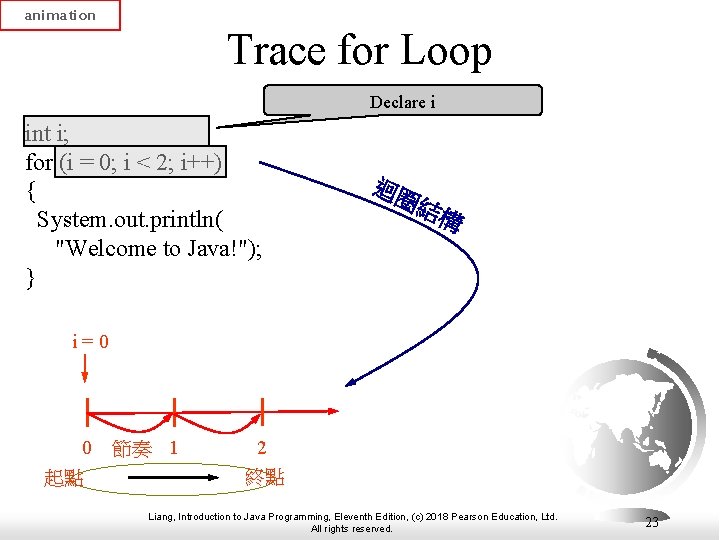
animation Trace for Loop Declare i int i; for (i = 0; i < 2; i++) { System. out. println( "Welcome to Java!"); } 迴圈 結構 i=0 0 起點 節奏 1 2 終點 Liang, Introduction to Java Programming, Eleventh Edition, (c) 2018 Pearson Education, Ltd. All rights reserved. 23
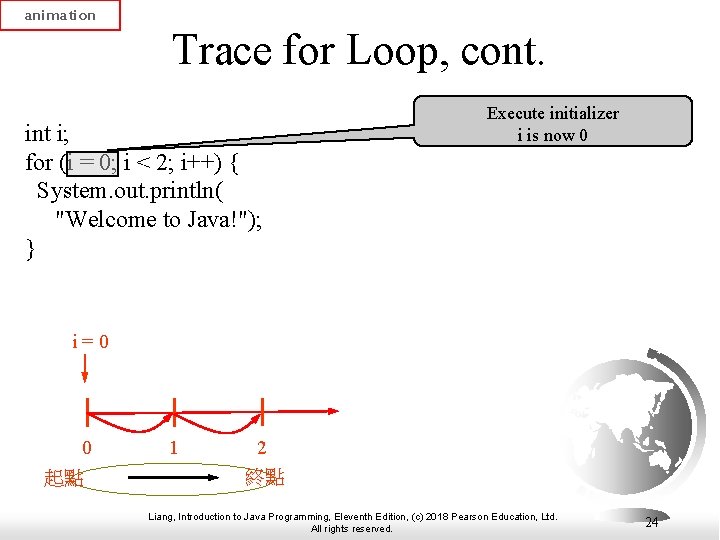
animation Trace for Loop, cont. int i; for (i = 0; i < 2; i++) { System. out. println( "Welcome to Java!"); } Execute initializer i is now 0 i=0 0 起點 1 2 終點 Liang, Introduction to Java Programming, Eleventh Edition, (c) 2018 Pearson Education, Ltd. All rights reserved. 24
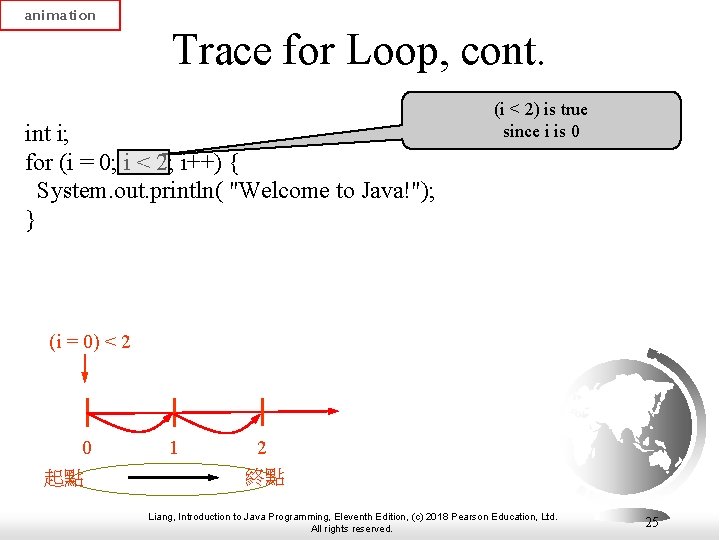
animation Trace for Loop, cont. int i; for (i = 0; i < 2; i++) { System. out. println( "Welcome to Java!"); } (i < 2) is true since i is 0 (i = 0) < 2 0 起點 1 2 終點 Liang, Introduction to Java Programming, Eleventh Edition, (c) 2018 Pearson Education, Ltd. All rights reserved. 25
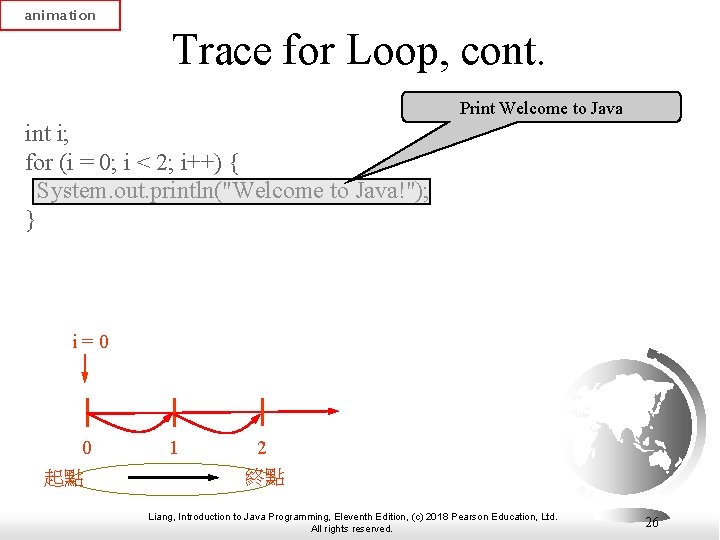
animation Trace for Loop, cont. Print Welcome to Java int i; for (i = 0; i < 2; i++) { System. out. println("Welcome to Java!"); } i=0 0 起點 1 2 終點 Liang, Introduction to Java Programming, Eleventh Edition, (c) 2018 Pearson Education, Ltd. All rights reserved. 26
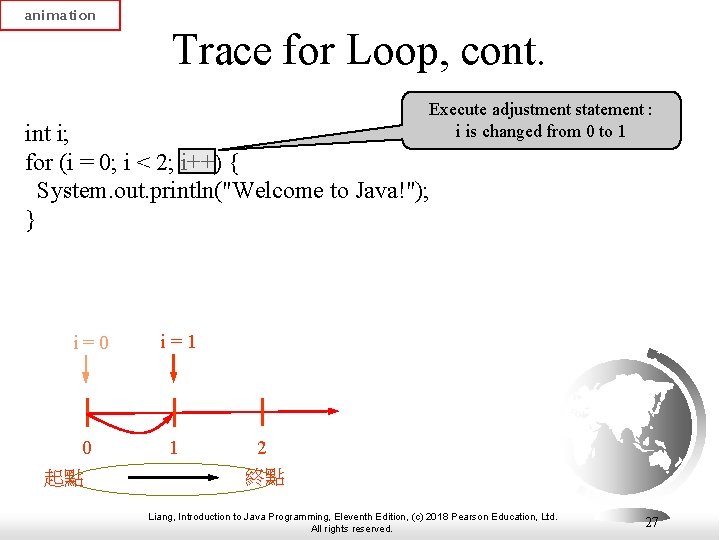
animation Trace for Loop, cont. Execute adjustment statement : i is changed from 0 to 1 int i; for (i = 0; i < 2; i++) { System. out. println("Welcome to Java!"); } i=0 0 起點 i=1 1 2 終點 Liang, Introduction to Java Programming, Eleventh Edition, (c) 2018 Pearson Education, Ltd. All rights reserved. 27
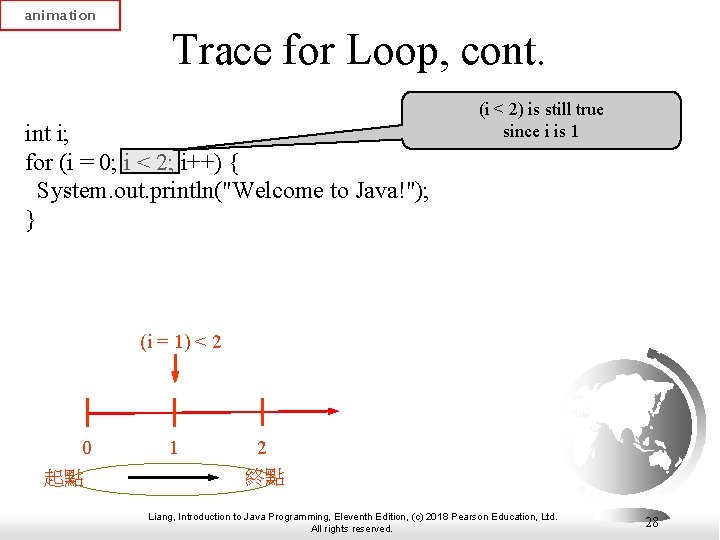
animation Trace for Loop, cont. int i; for (i = 0; i < 2; i++) { System. out. println("Welcome to Java!"); } (i < 2) is still true since i is 1 (i =i =1)1< 2 0 起點 1 2 終點 Liang, Introduction to Java Programming, Eleventh Edition, (c) 2018 Pearson Education, Ltd. All rights reserved. 28
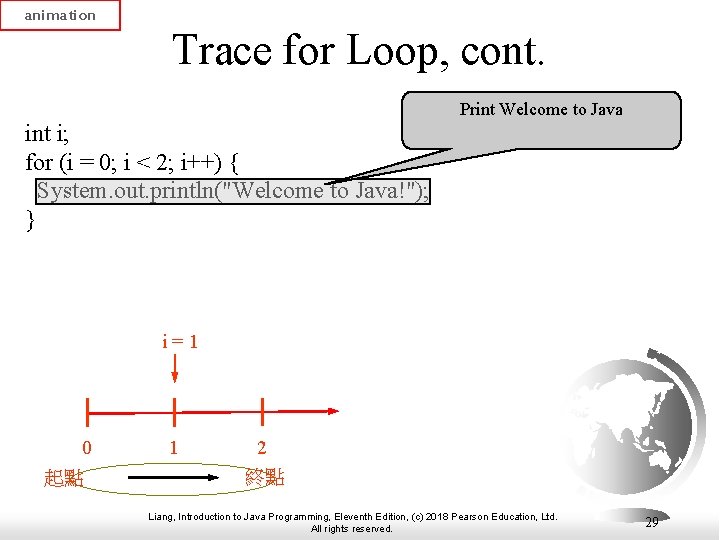
animation Trace for Loop, cont. Print Welcome to Java int i; for (i = 0; i < 2; i++) { System. out. println("Welcome to Java!"); } i=1 0 起點 1 2 終點 Liang, Introduction to Java Programming, Eleventh Edition, (c) 2018 Pearson Education, Ltd. All rights reserved. 29
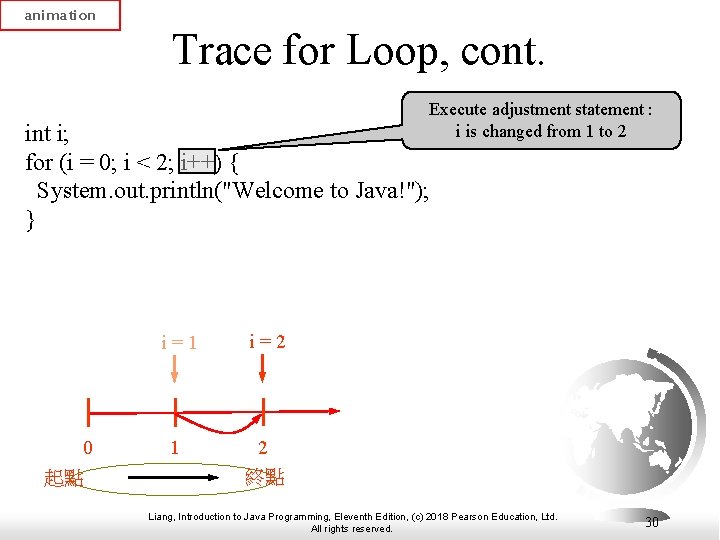
animation Trace for Loop, cont. Execute adjustment statement : i is changed from 1 to 2 int i; for (i = 0; i < 2; i++) { System. out. println("Welcome to Java!"); } 0 起點 i=1 i=2 1 2 終點 Liang, Introduction to Java Programming, Eleventh Edition, (c) 2018 Pearson Education, Ltd. All rights reserved. 30
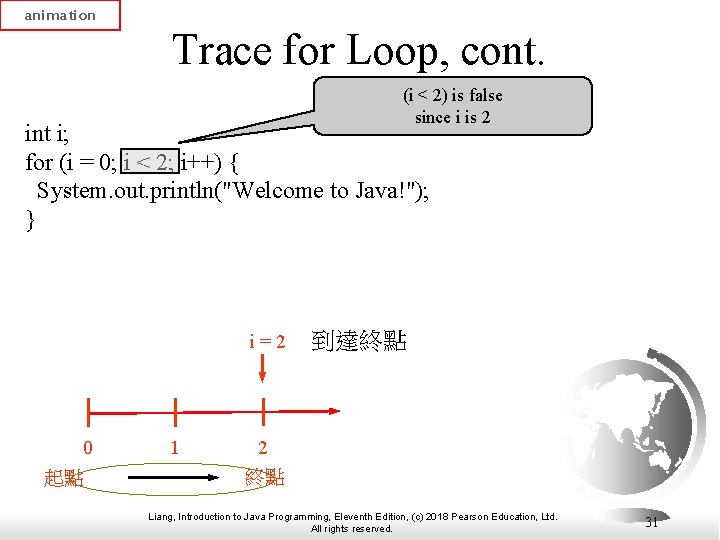
animation Trace for Loop, cont. (i < 2) is false since i is 2 int i; for (i = 0; i < 2; i++) { System. out. println("Welcome to Java!"); } i=2 0 起點 1 到達終點 2 終點 Liang, Introduction to Java Programming, Eleventh Edition, (c) 2018 Pearson Education, Ltd. All rights reserved. 31
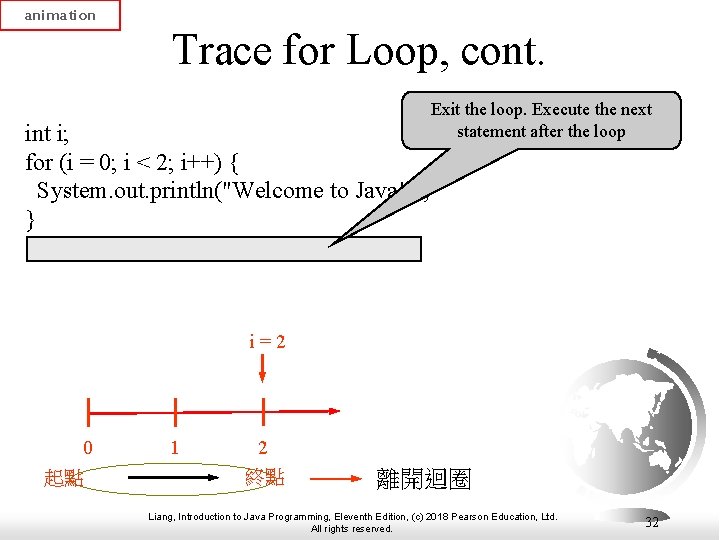
animation Trace for Loop, cont. int i; for (i = 0; i < 2; i++) { System. out. println("Welcome to Java!"); } Exit the loop. Execute the next statement after the loop i=2 0 起點 1 2 終點 離開迴圈 Liang, Introduction to Java Programming, Eleventh Edition, (c) 2018 Pearson Education, Ltd. All rights reserved. 32
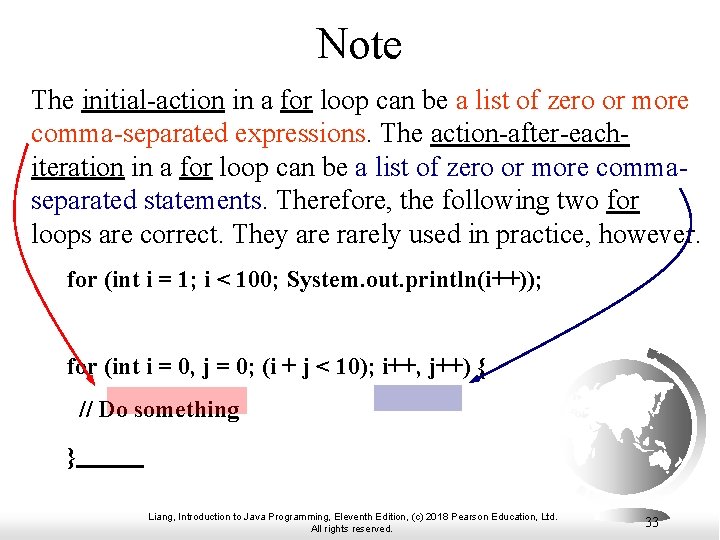
Note The initial-action in a for loop can be a list of zero or more comma-separated expressions. The action-after-eachiteration in a for loop can be a list of zero or more commaseparated statements. Therefore, the following two for loops are correct. They are rarely used in practice, however. for (int i = 1; i < 100; System. out. println(i++)); for (int i = 0, j = 0; (i + j < 10); i++, j++) { // Do something } Liang, Introduction to Java Programming, Eleventh Edition, (c) 2018 Pearson Education, Ltd. All rights reserved. 33
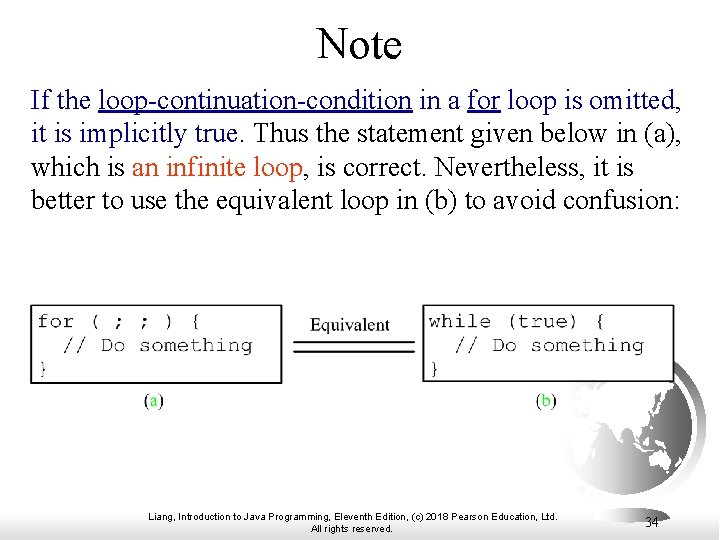
Note If the loop-continuation-condition in a for loop is omitted, it is implicitly true. Thus the statement given below in (a), which is an infinite loop, is correct. Nevertheless, it is better to use the equivalent loop in (b) to avoid confusion: Liang, Introduction to Java Programming, Eleventh Edition, (c) 2018 Pearson Education, Ltd. All rights reserved. 34
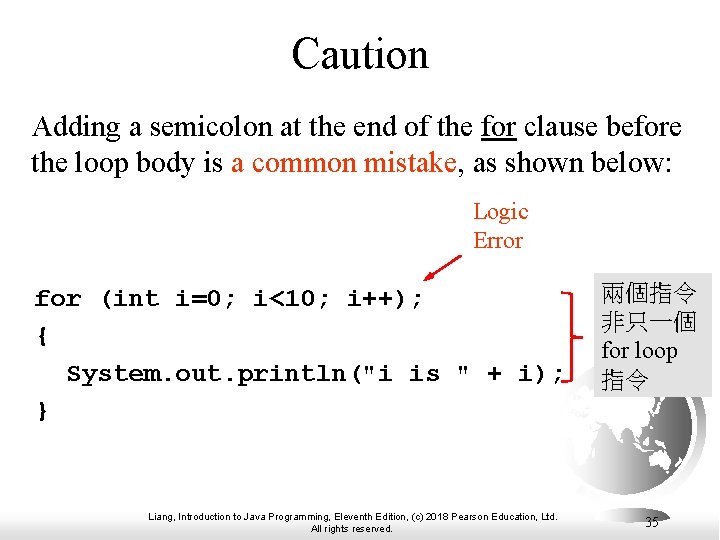
Caution Adding a semicolon at the end of the for clause before the loop body is a common mistake, as shown below: Logic Error for (int i=0; i<10; i++); { System. out. println("i is " + i); } Liang, Introduction to Java Programming, Eleventh Edition, (c) 2018 Pearson Education, Ltd. All rights reserved. 兩個指令 非只一個 for loop 指令 35
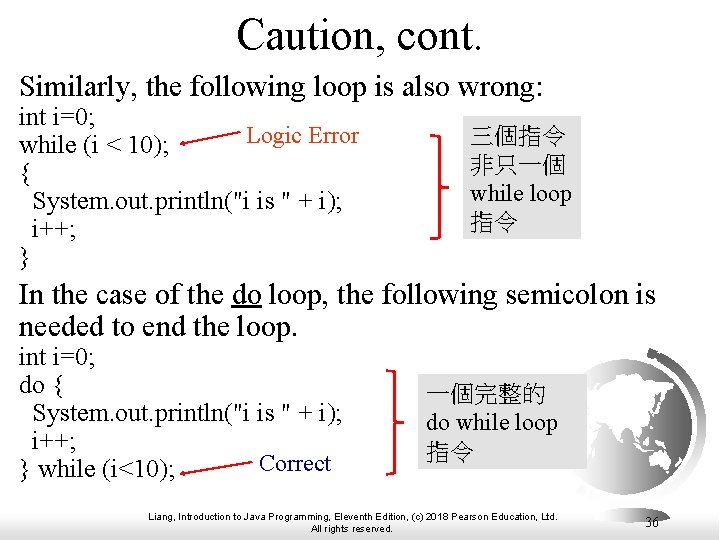
Caution, cont. Similarly, the following loop is also wrong: int i=0; Logic Error while (i < 10); { System. out. println("i is " + i); i++; } 三個指令 非只一個 while loop 指令 In the case of the do loop, the following semicolon is needed to end the loop. int i=0; do { System. out. println("i is " + i); i++; Correct } while (i<10); 一個完整的 do while loop 指令 Liang, Introduction to Java Programming, Eleventh Edition, (c) 2018 Pearson Education, Ltd. All rights reserved. 36
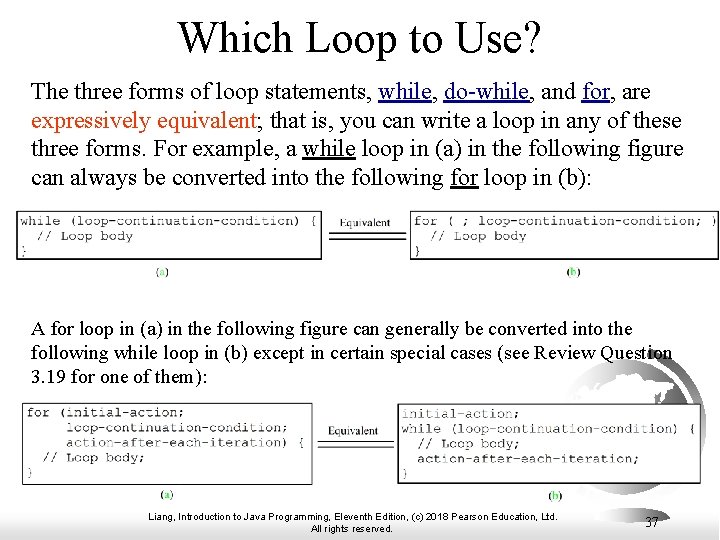
Which Loop to Use? The three forms of loop statements, while, do-while, and for, are expressively equivalent; that is, you can write a loop in any of these three forms. For example, a while loop in (a) in the following figure can always be converted into the following for loop in (b): A for loop in (a) in the following figure can generally be converted into the following while loop in (b) except in certain special cases (see Review Question 3. 19 for one of them): Liang, Introduction to Java Programming, Eleventh Edition, (c) 2018 Pearson Education, Ltd. All rights reserved. 37
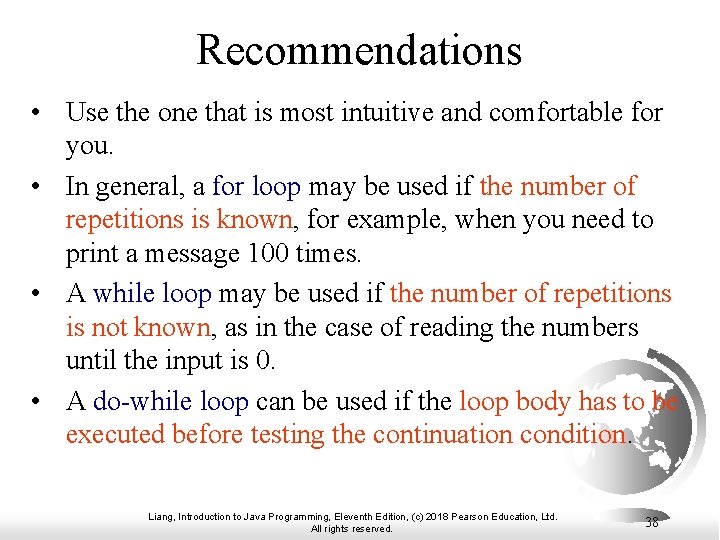
Recommendations • Use the one that is most intuitive and comfortable for you. • In general, a for loop may be used if the number of repetitions is known, for example, when you need to print a message 100 times. • A while loop may be used if the number of repetitions is not known, as in the case of reading the numbers until the input is 0. • A do-while loop can be used if the loop body has to be executed before testing the continuation condition. Liang, Introduction to Java Programming, Eleventh Edition, (c) 2018 Pearson Education, Ltd. All rights reserved. 38
Nested Loops Problem: Write a program that uses nested for loops to print a multiplication table. Listing 5. 7 (p. 200) Multiplication. Table. java Multiplication. Table Run Liang, Introduction to Java Programming, Eleventh Edition, (c) 2018 Pearson Education, Ltd. All rights reserved. 39
Problem: Finding the Greatest Common Divisor Problem: Write a program that prompts the user to enter two positive integers and finds their greatest common divisor (GCD). Solution: l Suppose you enter two integers 4 and 2, their GCD is 2. l Suppose you enter two integers 16 and 24, their GCD is 8. l So, How to find the greatest common divisor? l Let the two input integers be n 1 and n 2. You know number 1 is a common divisor, but it may not be the greatest commons divisor. l We can check whether k (for k = 2, 3, 4, and so on) is a common divisor for n 1 and n 2, until k is greater than n 1 or n 2. Listing 5. 9 (p. 204) Greatest. Common. Divisor. java Greatest. Common. Divisor Liang, Introduction to Java Programming, Eleventh Edition, (c) 2018 Pearson Education, Ltd. All rights reserved. Run 40
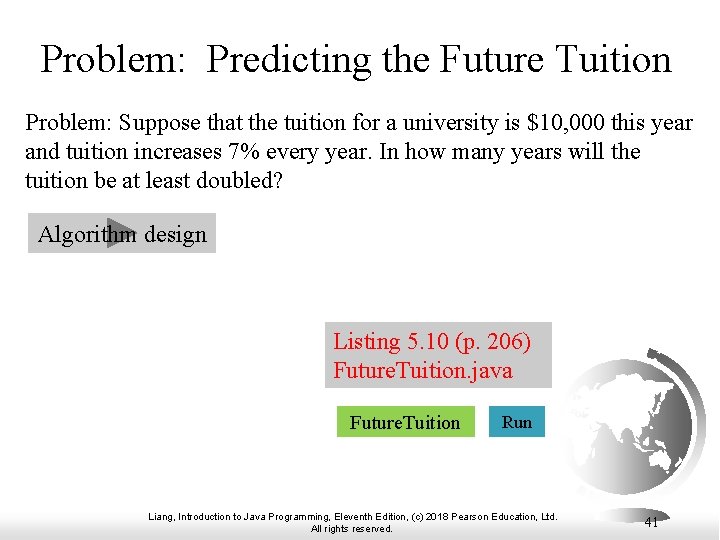
Problem: Predicting the Future Tuition Problem: Suppose that the tuition for a university is $10, 000 this year and tuition increases 7% every year. In how many years will the tuition be at least doubled? Algorithm design Listing 5. 10 (p. 206) Future. Tuition. java Future. Tuition Run Liang, Introduction to Java Programming, Eleventh Edition, (c) 2018 Pearson Education, Ltd. All rights reserved. 41
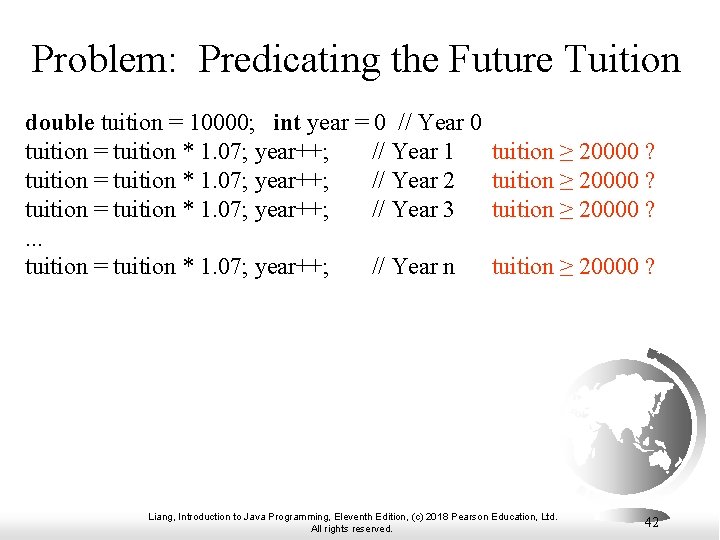
Problem: Predicating the Future Tuition double tuition = 10000; int year = 0 // Year 0 tuition = tuition * 1. 07; year++; // Year 1 tuition = tuition * 1. 07; year++; // Year 2 tuition = tuition * 1. 07; year++; // Year 3. . . tuition = tuition * 1. 07; year++; // Year n tuition ≥ 20000 ? Liang, Introduction to Java Programming, Eleventh Edition, (c) 2018 Pearson Education, Ltd. All rights reserved. 42
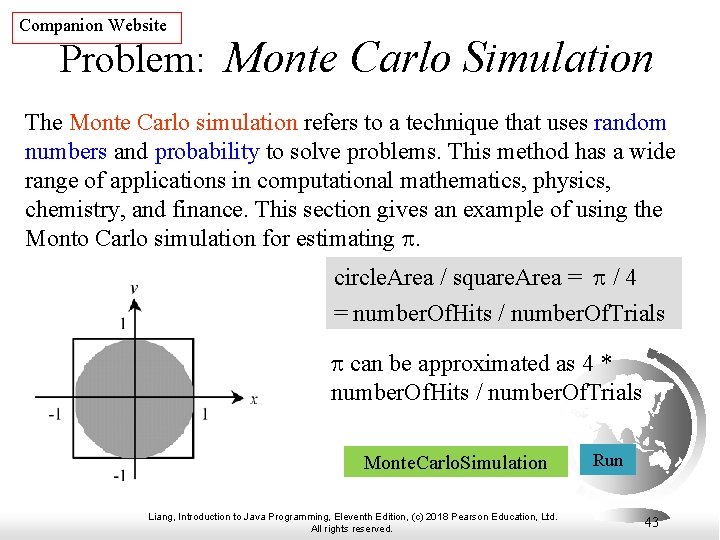
Companion Website Problem: Monte Carlo Simulation The Monte Carlo simulation refers to a technique that uses random numbers and probability to solve problems. This method has a wide range of applications in computational mathematics, physics, chemistry, and finance. This section gives an example of using the Monto Carlo simulation for estimating . circle. Area / square. Area = / 4 = number. Of. Hits / number. Of. Trials can be approximated as 4 * number. Of. Hits / number. Of. Trials Monte. Carlo. Simulation Liang, Introduction to Java Programming, Eleventh Edition, (c) 2018 Pearson Education, Ltd. All rights reserved. Run 43
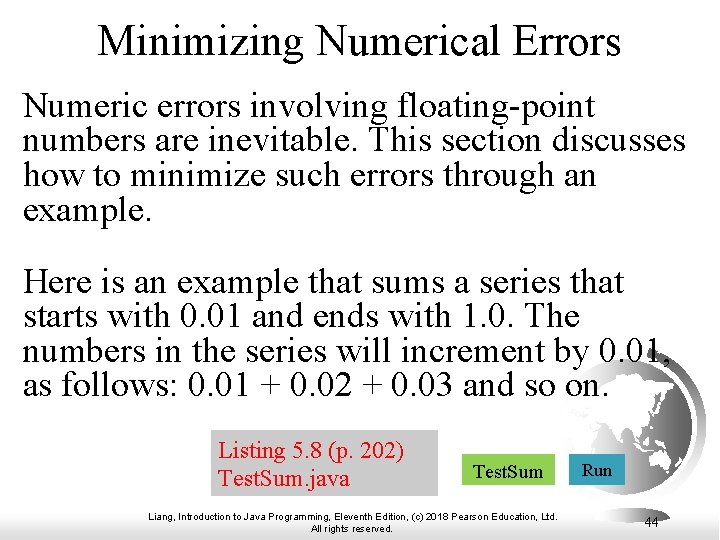
Minimizing Numerical Errors Numeric errors involving floating-point numbers are inevitable. This section discusses how to minimize such errors through an example. Here is an example that sums a series that starts with 0. 01 and ends with 1. 0. The numbers in the series will increment by 0. 01, as follows: 0. 01 + 0. 02 + 0. 03 and so on. Listing 5. 8 (p. 202) Test. Sum. java Test. Sum Liang, Introduction to Java Programming, Eleventh Edition, (c) 2018 Pearson Education, Ltd. All rights reserved. Run 44
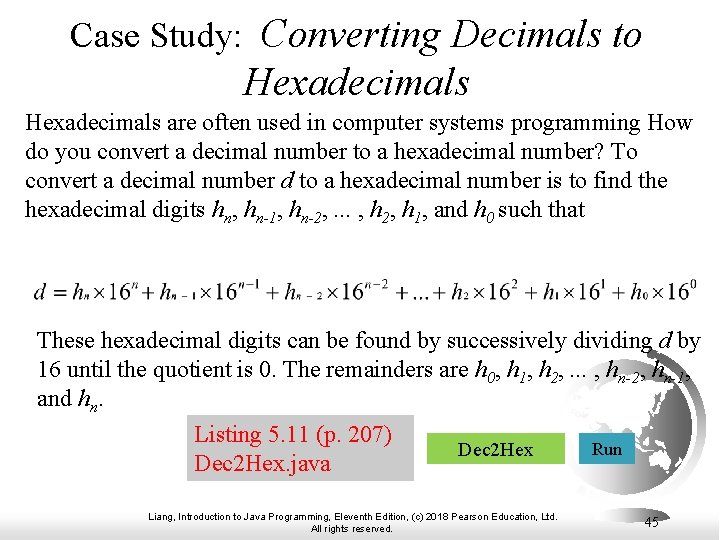
Case Study: Converting Decimals to Hexadecimals are often used in computer systems programming How do you convert a decimal number to a hexadecimal number? To convert a decimal number d to a hexadecimal number is to find the hexadecimal digits hn, hn-1, hn-2, . . . , h 2, h 1, and h 0 such that These hexadecimal digits can be found by successively dividing d by 16 until the quotient is 0. The remainders are h 0, h 1, h 2, . . . , hn-2, hn-1, and hn. Listing 5. 11 (p. 207) Dec 2 Hex. java Dec 2 Hex Liang, Introduction to Java Programming, Eleventh Edition, (c) 2018 Pearson Education, Ltd. All rights reserved. Run 45
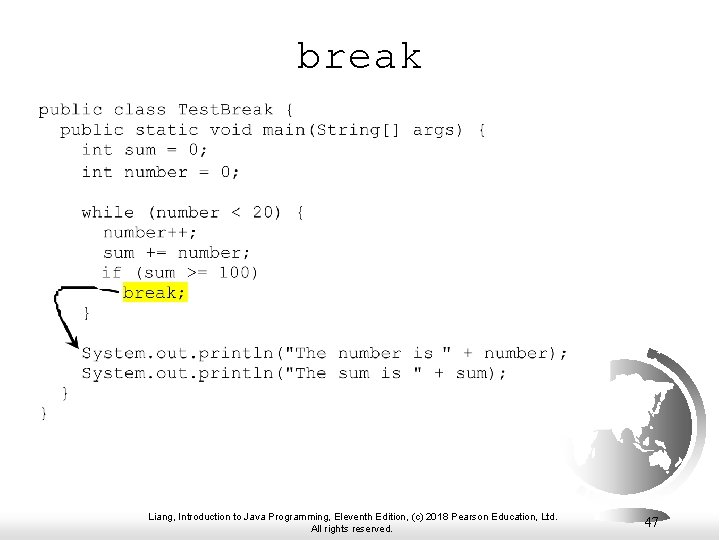
Using break l When a break statement is encountered, the program ends the loop and program control goes out of the loop body and starts the statement next to the loop. l Test. Break. java Test. Break Run Listing 5. 12 (p. 208) Test. Break. java program Liang, Introduction to Java Programming, Eleventh Edition, (c) 2018 Pearson Education, Ltd. All rights reserved. 46
break Liang, Introduction to Java Programming, Eleventh Edition, (c) 2018 Pearson Education, Ltd. All rights reserved. 47
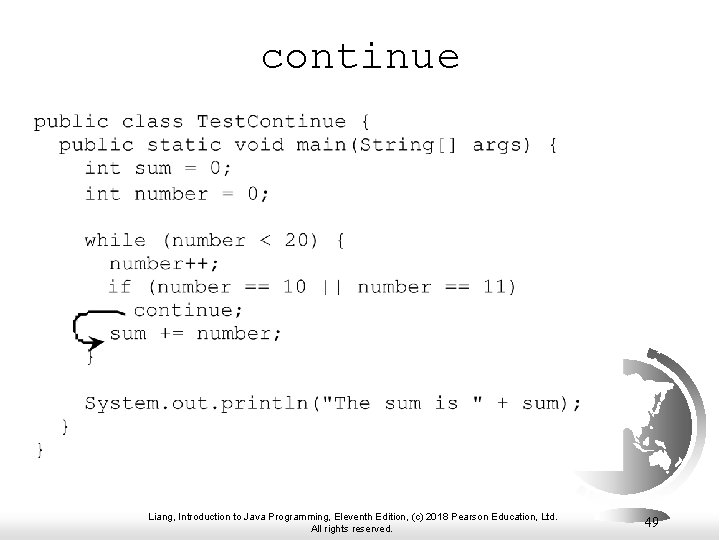
Using continue When a continue statement is encountered, l the program ends the current iteration and l program control goes to the end of the loop body to starts the next loop iteration. l Test. Continue. java Test. Continue Run Listing 5. 13 (p. 209) Test. Continue. java program Liang, Introduction to Java Programming, Eleventh Edition, (c) 2018 Pearson Education, Ltd. All rights reserved. 48
continue Liang, Introduction to Java Programming, Eleventh Edition, (c) 2018 Pearson Education, Ltd. All rights reserved. 49
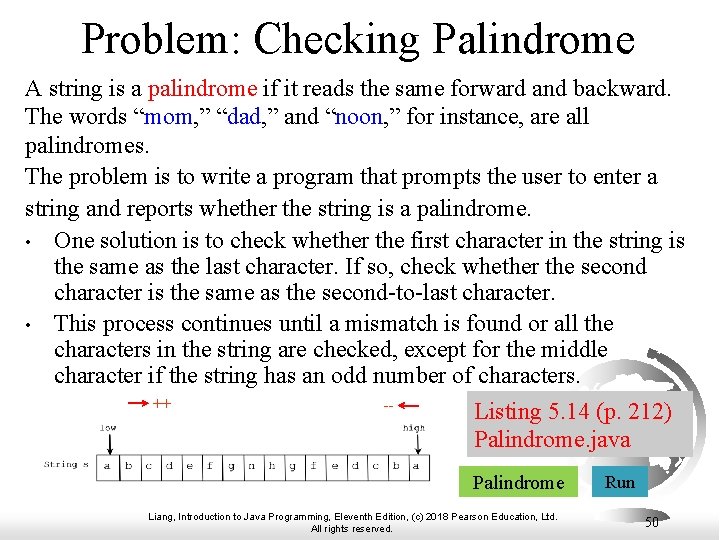
Problem: Checking Palindrome A string is a palindrome if it reads the same forward and backward. The words “mom, ” “dad, ” and “noon, ” for instance, are all palindromes. The problem is to write a program that prompts the user to enter a string and reports whether the string is a palindrome. • One solution is to check whether the first character in the string is the same as the last character. If so, check whether the second character is the same as the second-to-last character. • This process continues until a mismatch is found or all the characters in the string are checked, except for the middle character if the string has an odd number of characters. ++ -Listing 5. 14 (p. 212) Palindrome. java Palindrome Liang, Introduction to Java Programming, Eleventh Edition, (c) 2018 Pearson Education, Ltd. All rights reserved. Run 50
Problem: Displaying Prime Numbers Problem: Write a program that displays the first 50 prime numbers in five lines, each of which contains 10 numbers. An integer greater than 1 is prime if its only positive divisor is 1 or itself. For example, 2, 3, 5, and 7 are prime numbers, but 4, 6, 8, and 9 are not. Solution: The problem can be broken into the following tasks: l For number = 2, 3, 4, 5, 6, . . . , test whether the number is prime. l Determine whether a given number is prime. l Count the prime numbers. l Print each prime number, and print 10 numbers per line. Prime. Number Run Liang, Introduction to Java Programming, Eleventh Edition, (c) 2018 Pearson Education, Ltd. All rights reserved. 51