
Chapter 5 Link Layer and LANs Computer Networking
- Slides: 28
Chapter 5 Link Layer and LANs Computer Networking: A Top Down Approach 5 th edition. Jim Kurose, Keith Ross Addison-Wesley, April 2009. The lecture notes are based on the lecture notes provided by Jim Kurose and Keith Ross with some modifications. 5: Data. Link Layer 5 -1
Chapter 5: The Data Link Layer Our goals: r understand principles behind data link layer services: m m error detection, correction sharing a broadcast channel: multiple access link layer addressing reliable data transfer, flow control: done! r instantiation and implementation of various link layer technologies 5: Data. Link Layer 5 -2
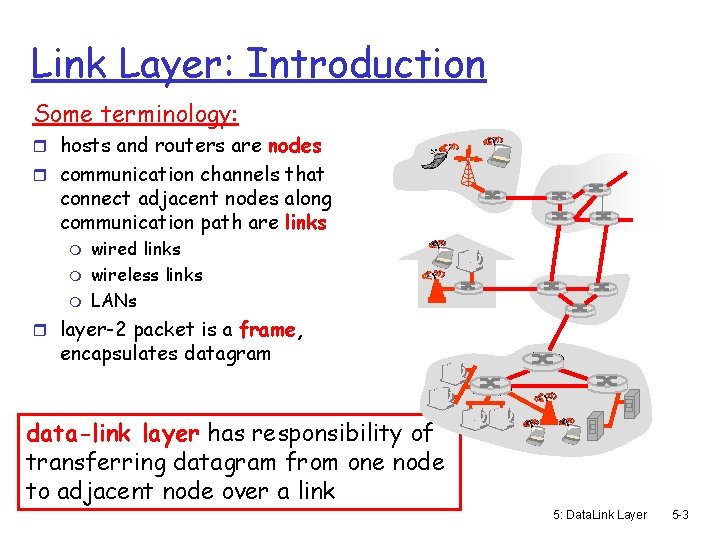
Link Layer: Introduction Some terminology: r hosts and routers are nodes r communication channels that connect adjacent nodes along communication path are links m m m wired links wireless links LANs r layer-2 packet is a frame, encapsulates datagram data-link layer has responsibility of transferring datagram from one node to adjacent node over a link 5: Data. Link Layer 5 -3
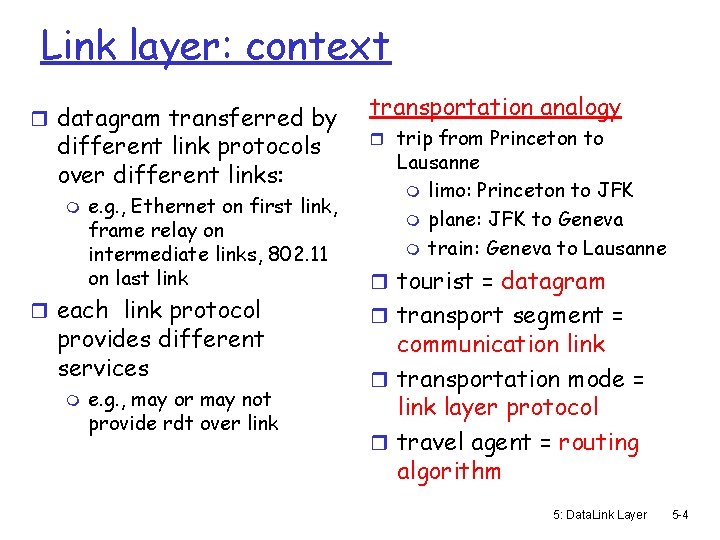
Link layer: context r datagram transferred by different link protocols over different links: m e. g. , Ethernet on first link, frame relay on intermediate links, 802. 11 on last link r each link protocol provides different services m e. g. , may or may not provide rdt over link transportation analogy r trip from Princeton to Lausanne m limo: Princeton to JFK m plane: JFK to Geneva m train: Geneva to Lausanne r tourist = datagram r transport segment = communication link r transportation mode = link layer protocol r travel agent = routing algorithm 5: Data. Link Layer 5 -4
Link Layer Services r framing, link access: m encapsulate datagram into frame, adding header, trailer m channel access if shared medium m “MAC” addresses used in frame headers to identify source, dest • different from IP address! r reliable delivery between adjacent nodes m we learned how to do this already (chapter 3)! m seldom used on low bit-error link (fiber, some twisted pair) m wireless links: high error rates • Q: why both link-level and end-end reliability? 5: Data. Link Layer 5 -5
Multiple Access protocols r single shared broadcast channel r two or more simultaneous transmissions by nodes: interference m collision if node receives two or more signals at the same time multiple access protocol r distributed algorithm that determines how nodes share channel, i. e. , determine when node can transmit r communication about channel sharing must use channel itself! m no out-of-band channel for coordination 5: Data. Link Layer 5 -6
Ideal Multiple Access Protocol Broadcast channel of rate R bps 1. when one node wants to transmit, it can send at rate R. 2. when M nodes want to transmit, each can send at average rate R/M 3. fully decentralized: m m no special node to coordinate transmissions no synchronization of clocks, slots 4. simple 5: Data. Link Layer 5 -7
MAC Protocols: a taxonomy Three broad classes: r Channel Partitioning m m divide channel into smaller “pieces” (time slots, frequency, code) allocate piece to node for exclusive use r Random Access m channel not divided, allow collisions m “recover” from collisions r “Taking turns” m nodes take turns, but nodes with more to send can take longer turns 5: Data. Link Layer 5 -8
Random Access Protocols r When node has packet to send m transmit at full channel data rate R. m no a priori coordination among nodes r two or more transmitting nodes ➜ “collision”, r random access MAC protocol specifies: m how to detect collisions m how to recover from collisions (e. g. , via delayed retransmissions) r Examples of random access MAC protocols: m slotted ALOHA m CSMA, CSMA/CD 5: Data. Link Layer 5 -9
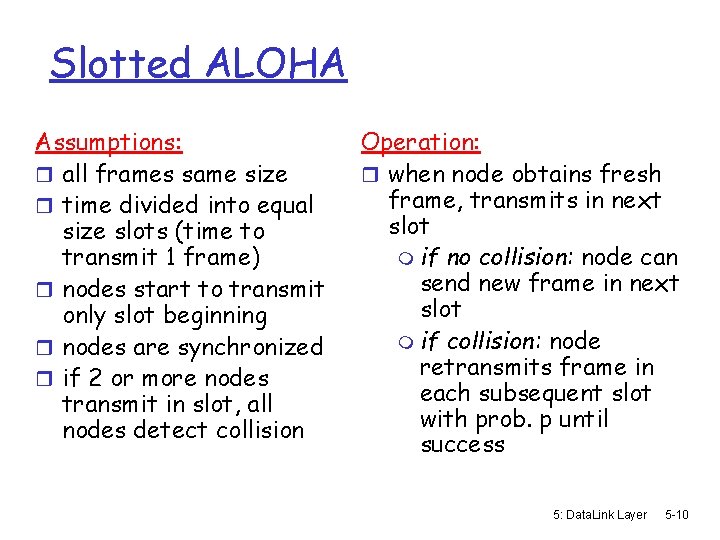
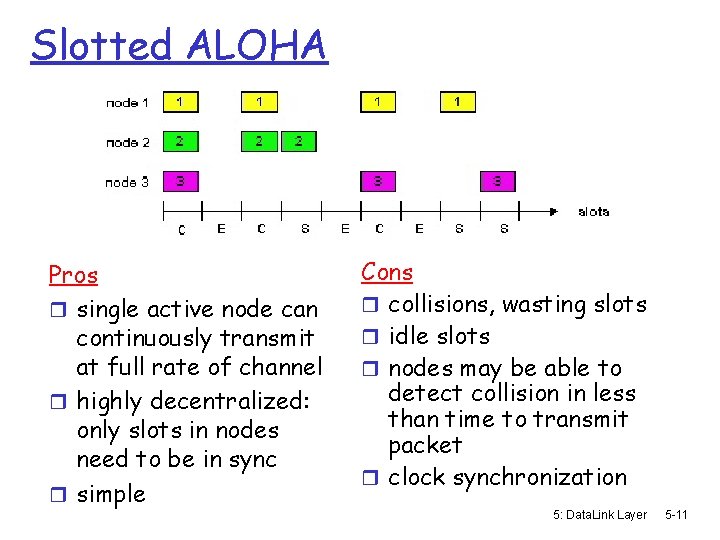
Slotted ALOHA Assumptions: r all frames same size r time divided into equal size slots (time to transmit 1 frame) r nodes start to transmit only slot beginning r nodes are synchronized r if 2 or more nodes transmit in slot, all nodes detect collision Operation: r when node obtains fresh frame, transmits in next slot m if no collision: node can send new frame in next slot m if collision: node retransmits frame in each subsequent slot with prob. p until success 5: Data. Link Layer 5 -10
Slotted ALOHA Pros r single active node can continuously transmit at full rate of channel r highly decentralized: only slots in nodes need to be in sync r simple Cons r collisions, wasting slots r idle slots r nodes may be able to detect collision in less than time to transmit packet r clock synchronization 5: Data. Link Layer 5 -11
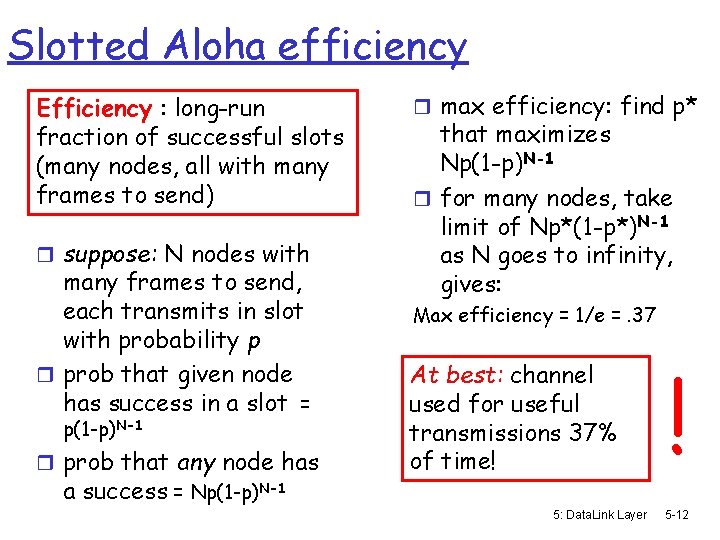
Slotted Aloha efficiency Efficiency : long-run fraction of successful slots (many nodes, all with many frames to send) r suppose: N nodes with many frames to send, each transmits in slot with probability p r prob that given node has success in a slot = p(1 -p)N-1 r prob that any node has a success = Np(1 -p)N-1 r max efficiency: find p* that maximizes Np(1 -p)N-1 r for many nodes, take limit of Np*(1 -p*)N-1 as N goes to infinity, gives: Max efficiency = 1/e =. 37 At best: channel used for useful transmissions 37% of time! 5: Data. Link Layer ! 5 -12
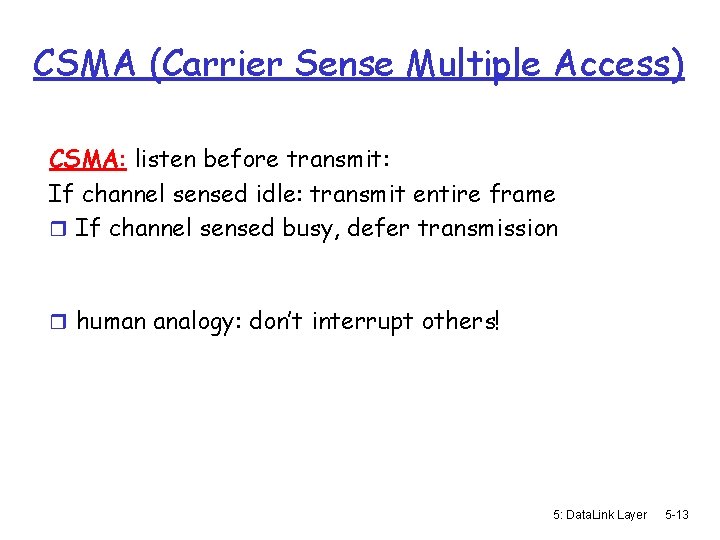
CSMA (Carrier Sense Multiple Access) CSMA: listen before transmit: If channel sensed idle: transmit entire frame r If channel sensed busy, defer transmission r human analogy: don’t interrupt others! 5: Data. Link Layer 5 -13
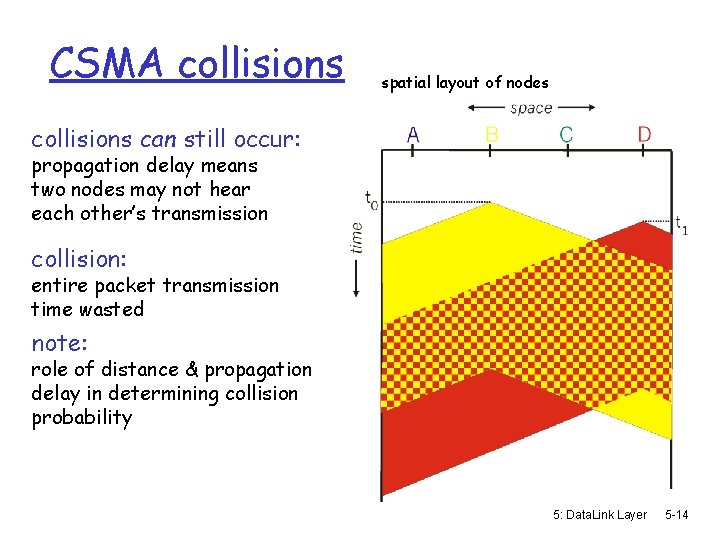
CSMA collisions spatial layout of nodes collisions can still occur: propagation delay means two nodes may not hear each other’s transmission collision: entire packet transmission time wasted note: role of distance & propagation delay in determining collision probability 5: Data. Link Layer 5 -14
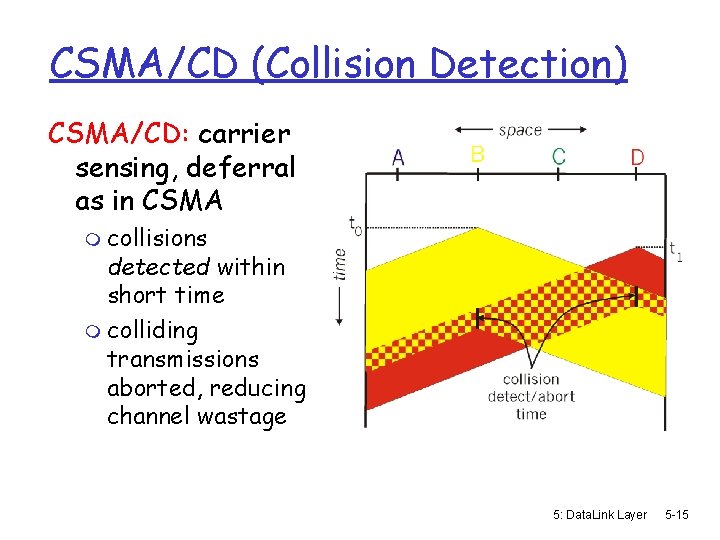
CSMA/CD (Collision Detection) CSMA/CD: carrier sensing, deferral as in CSMA m collisions detected within short time m colliding transmissions aborted, reducing channel wastage 5: Data. Link Layer 5 -15
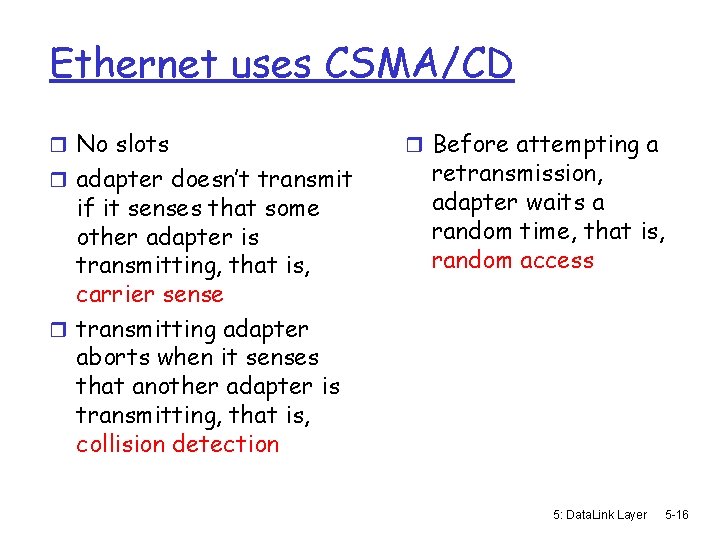
Ethernet uses CSMA/CD r No slots r adapter doesn’t transmit if it senses that some other adapter is transmitting, that is, carrier sense r transmitting adapter aborts when it senses that another adapter is transmitting, that is, collision detection r Before attempting a retransmission, adapter waits a random time, that is, random access 5: Data. Link Layer 5 -16
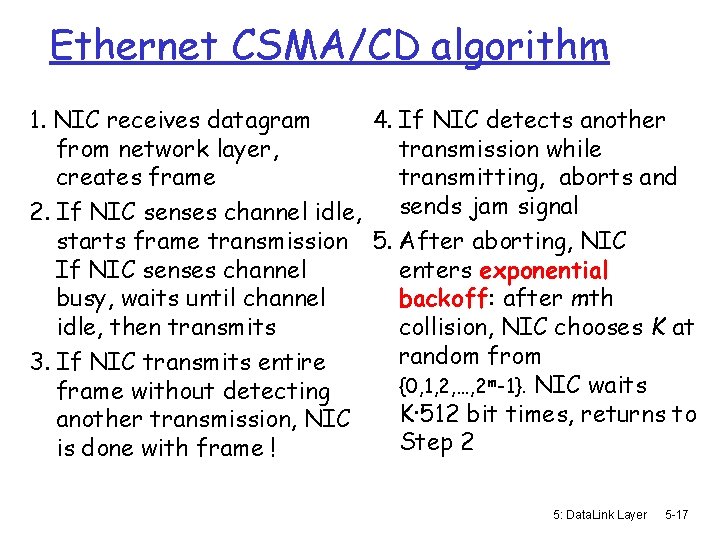
Ethernet CSMA/CD algorithm 1. NIC receives datagram 4. If NIC detects another from network layer, transmission while creates frame transmitting, aborts and sends jam signal 2. If NIC senses channel idle, starts frame transmission 5. After aborting, NIC If NIC senses channel enters exponential busy, waits until channel backoff: after mth idle, then transmits collision, NIC chooses K at random from 3. If NIC transmits entire {0, 1, 2, …, 2 m-1}. NIC waits frame without detecting K·512 bit times, returns to another transmission, NIC Step 2 is done with frame ! 5: Data. Link Layer 5 -17
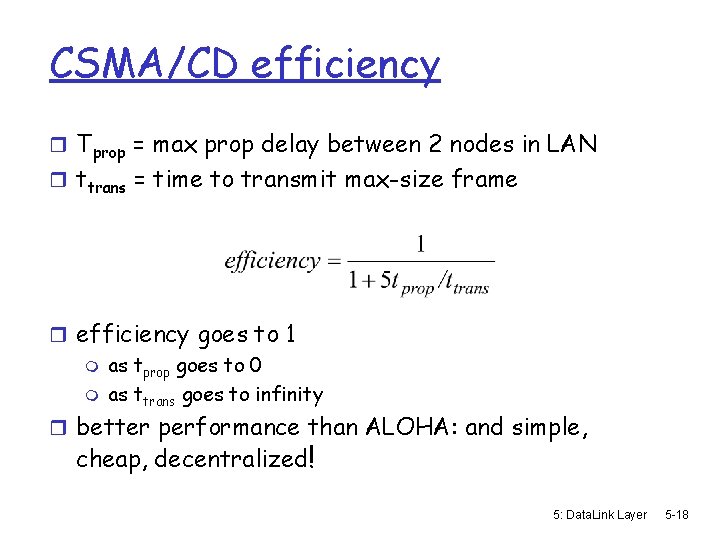
CSMA/CD efficiency r Tprop = max prop delay between 2 nodes in LAN r ttrans = time to transmit max-size frame r efficiency goes to 1 m as tprop goes to 0 m as ttrans goes to infinity r better performance than ALOHA: and simple, cheap, decentralized! 5: Data. Link Layer 5 -18
“Taking Turns” MAC protocols channel partitioning MAC protocols: m share channel efficiently and fairly at high load m inefficient at low load: delay in channel access, 1/N bandwidth allocated even if only 1 active node! Random access MAC protocols m efficient at low load: single node can fully utilize channel m high load: collision overhead “taking turns” protocols look for best of both worlds! 5: Data. Link Layer 5 -19
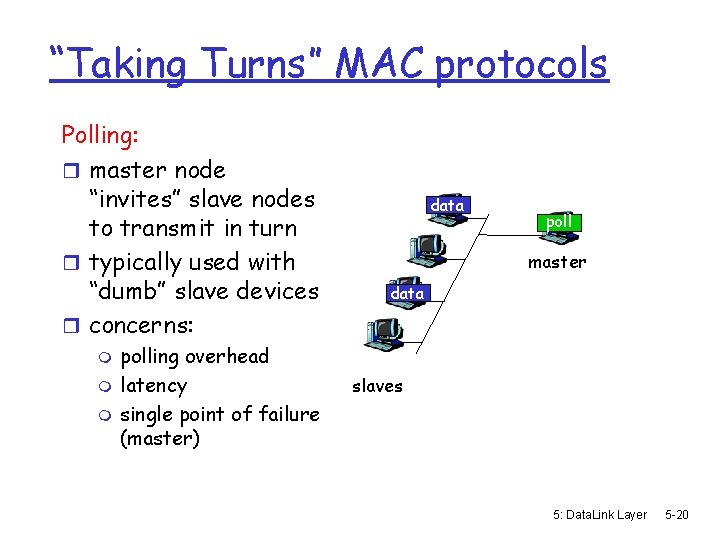
“Taking Turns” MAC protocols Polling: r master node “invites” slave nodes to transmit in turn r typically used with “dumb” slave devices r concerns: m m m polling overhead latency single point of failure (master) data poll master data slaves 5: Data. Link Layer 5 -20
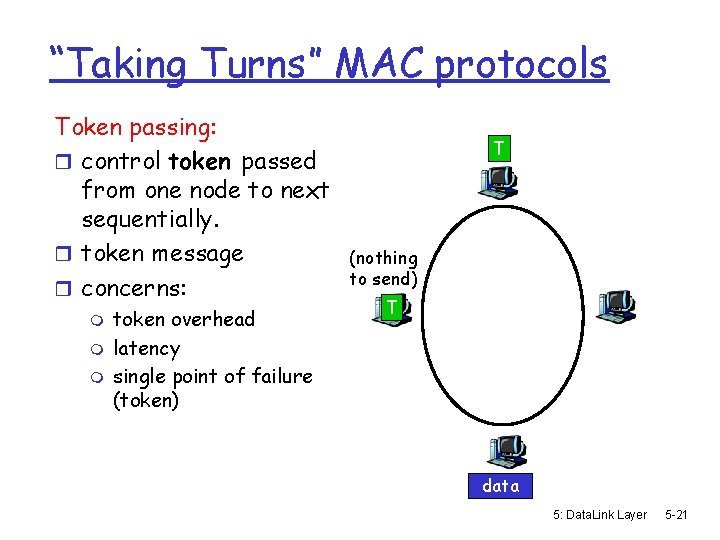
“Taking Turns” MAC protocols Token passing: r control token passed from one node to next sequentially. r token message r concerns: m m m token overhead latency single point of failure (token) T (nothing to send) T data 5: Data. Link Layer 5 -21
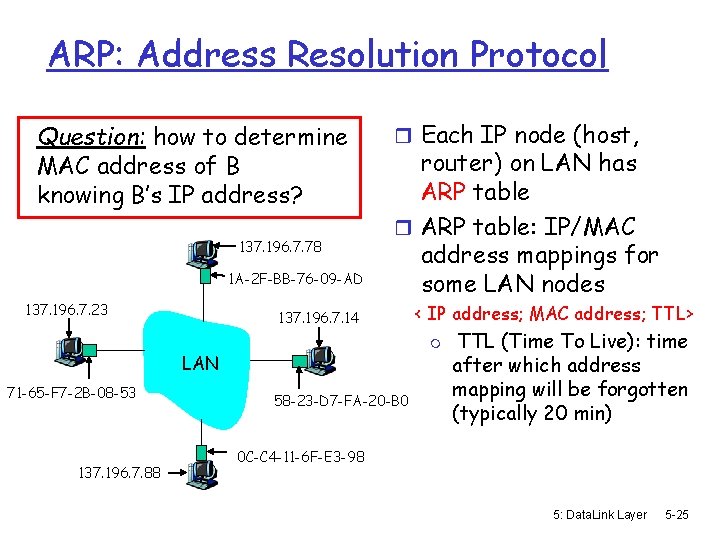
MAC Addresses and ARP r 32 -bit IP address: m network-layer address m used to get datagram to destination IP subnet r MAC (or LAN or physical or Ethernet) address: m function: get frame from one interface to another physically-connected interface (same network) m 48 bit MAC address (for most LANs) • burned in NIC ROM, also sometimes software settable 5: Data. Link Layer 5 -22
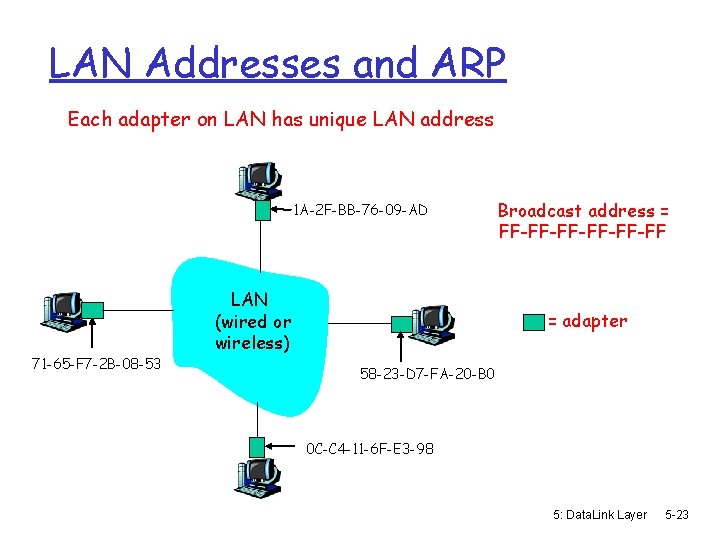
LAN Addresses and ARP Each adapter on LAN has unique LAN address 1 A-2 F-BB-76 -09 -AD 71 -65 -F 7 -2 B-08 -53 LAN (wired or wireless) Broadcast address = FF-FF-FF-FF = adapter 58 -23 -D 7 -FA-20 -B 0 0 C-C 4 -11 -6 F-E 3 -98 5: Data. Link Layer 5 -23
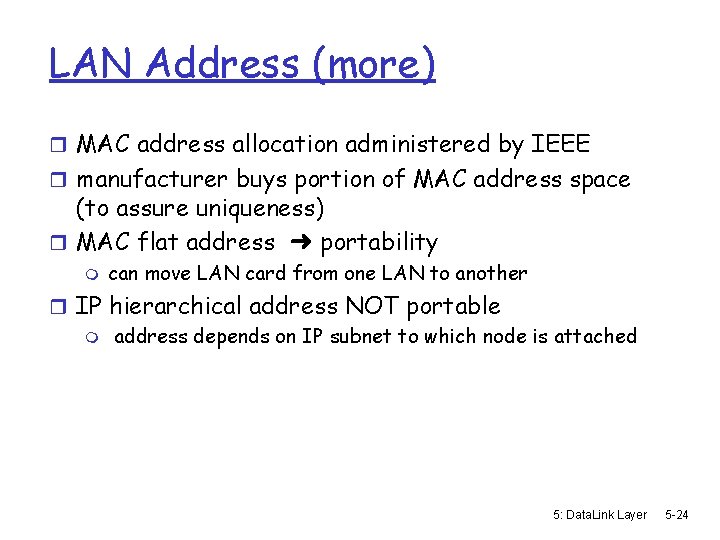
LAN Address (more) r MAC address allocation administered by IEEE r manufacturer buys portion of MAC address space (to assure uniqueness) r MAC flat address ➜ portability m can move LAN card from one LAN to another r IP hierarchical address NOT portable m address depends on IP subnet to which node is attached 5: Data. Link Layer 5 -24
ARP: Address Resolution Protocol Question: how to determine MAC address of B knowing B’s IP address? 137. 196. 7. 78 1 A-2 F-BB-76 -09 -AD 137. 196. 7. 23 r Each IP node (host, router) on LAN has ARP table r ARP table: IP/MAC address mappings for some LAN nodes 137. 196. 7. 14 m LAN 71 -65 -F 7 -2 B-08 -53 137. 196. 7. 88 < IP address; MAC address; TTL> 58 -23 -D 7 -FA-20 -B 0 TTL (Time To Live): time after which address mapping will be forgotten (typically 20 min) 0 C-C 4 -11 -6 F-E 3 -98 5: Data. Link Layer 5 -25
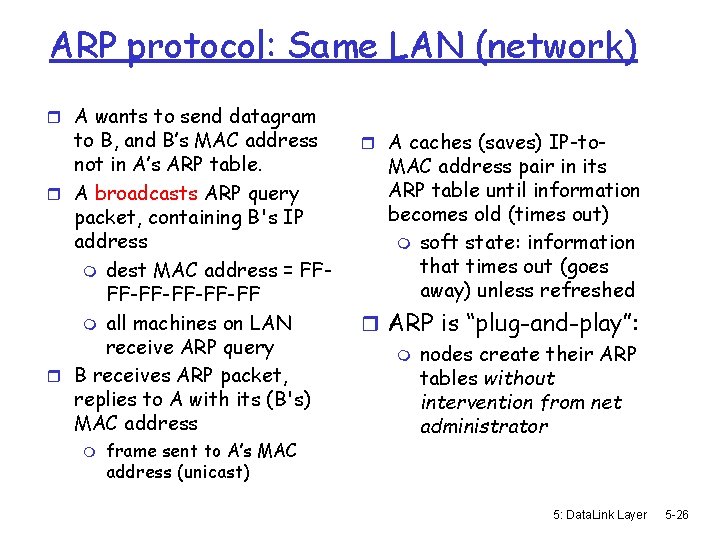
ARP protocol: Same LAN (network) r A wants to send datagram to B, and B’s MAC address not in A’s ARP table. r A broadcasts ARP query packet, containing B's IP address m dest MAC address = FFFF-FF-FF m all machines on LAN receive ARP query r B receives ARP packet, replies to A with its (B's) MAC address m frame sent to A’s MAC address (unicast) r A caches (saves) IP-to- MAC address pair in its ARP table until information becomes old (times out) m soft state: information that times out (goes away) unless refreshed r ARP is “plug-and-play”: m nodes create their ARP tables without intervention from net administrator 5: Data. Link Layer 5 -26
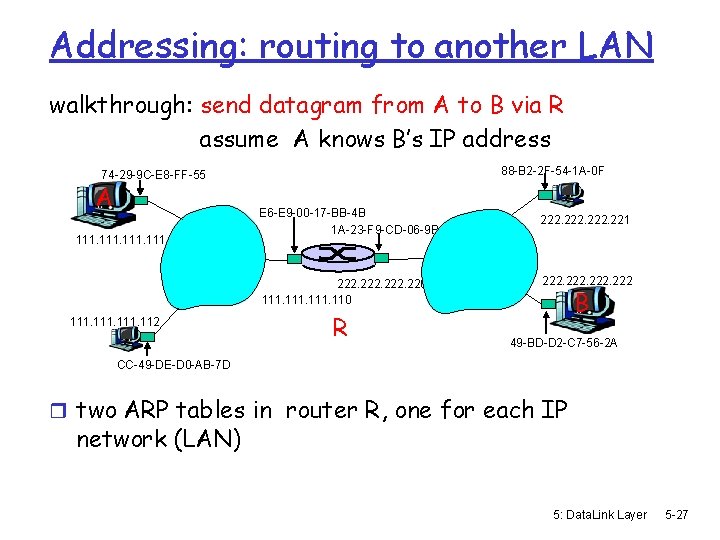
Addressing: routing to another LAN walkthrough: send datagram from A to B via R assume A knows B’s IP address 88 -B 2 -2 F-54 -1 A-0 F 74 -29 -9 C-E 8 -FF-55 A 111 E 6 -E 9 -00 -17 -BB-4 B 1 A-23 -F 9 -CD-06 -9 B 222. 220 111. 112 R 222. 221 222 B 49 -BD-D 2 -C 7 -56 -2 A CC-49 -DE-D 0 -AB-7 D r two ARP tables in router R, one for each IP network (LAN) 5: Data. Link Layer 5 -27
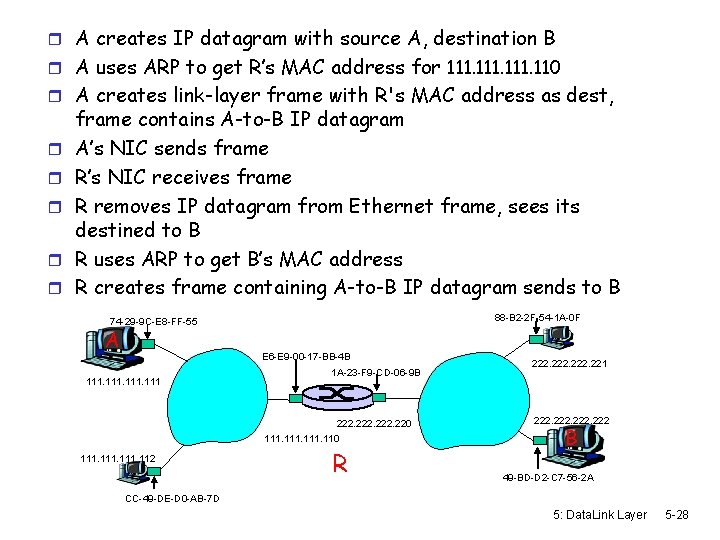
r A creates IP datagram with source A, destination B r A uses ARP to get R’s MAC address for 111. 110 r A creates link-layer frame with R's MAC address as dest, r r r frame contains A-to-B IP datagram A’s NIC sends frame R’s NIC receives frame R removes IP datagram from Ethernet frame, sees its destined to B R uses ARP to get B’s MAC address R creates frame containing A-to-B IP datagram sends to B 88 -B 2 -2 F-54 -1 A-0 F 74 -29 -9 C-E 8 -FF-55 A E 6 -E 9 -00 -17 -BB-4 B 111 1 A-23 -F 9 -CD-06 -9 B 222. 220 111. 112 R 222. 221 222 B 49 -BD-D 2 -C 7 -56 -2 A CC-49 -DE-D 0 -AB-7 D 5: Data. Link Layer 5 -28