
Chapter 5 Link Layer A note on the
![Cable access network cable headend MAP frame for Interval [t 1, t 2] Downstream](https://slidetodoc.com/presentation_image_h/222fad029b3d1d5992bc4ac5b9c201ac/image-13.jpg "Cable access network cable headend MAP frame for Interval [t 1, t 2] Downstream")
- Slides: 14
Chapter 5 Link Layer A note on the use of these ppt slides: We’re making these slides freely available to all (faculty, students, readers). They’re in Power. Point form so you see the animations; and can add, modify, and delete slides (including this one) and slide content to suit your needs. They obviously represent a lot of work on our part. In return for use, we only ask the following: v v If you use these slides (e. g. , in a class) that you mention their source (after all, we’d like people to use our book!) If you post any slides on a www site, that you note that they are adapted from (or perhaps identical to) our slides, and note our copyright of this material. Thanks and enjoy! JFK/KWR All material copyright 1996 -2012 J. F Kurose and K. W. Ross, All Rights Reserved The course notes are adapted for Bucknell’s CSCI 363 Xiannong Meng Spring 2016 Computer Networking: A Top Down Approach 6 th edition Jim Kurose, Keith Ross Addison-Wesley March 2012 Link Layer 5 -1
CSMA (carrier sense multiple access) CSMA: listen before transmit: if channel sensed idle: transmit entire frame v if channel sensed busy, defer transmission v human analogy: don’t interrupt others! Link Layer 5 -2
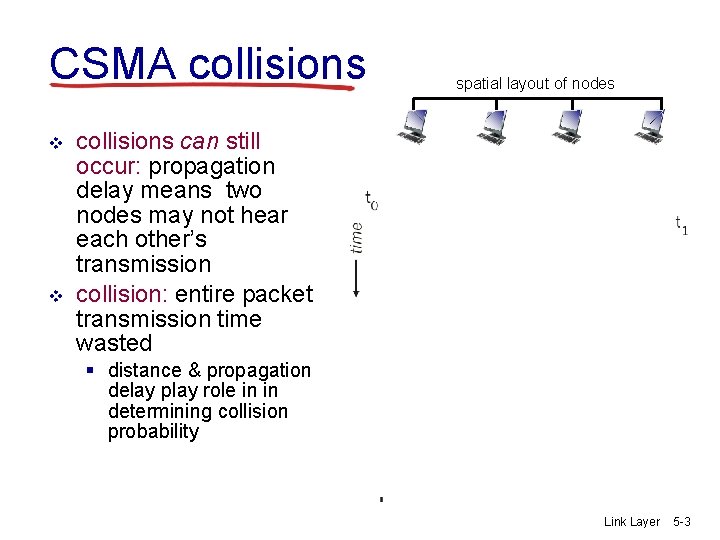
CSMA collisions v v spatial layout of nodes collisions can still occur: propagation delay means two nodes may not hear each other’s transmission collision: entire packet transmission time wasted § distance & propagation delay play role in in determining collision probability Link Layer 5 -3
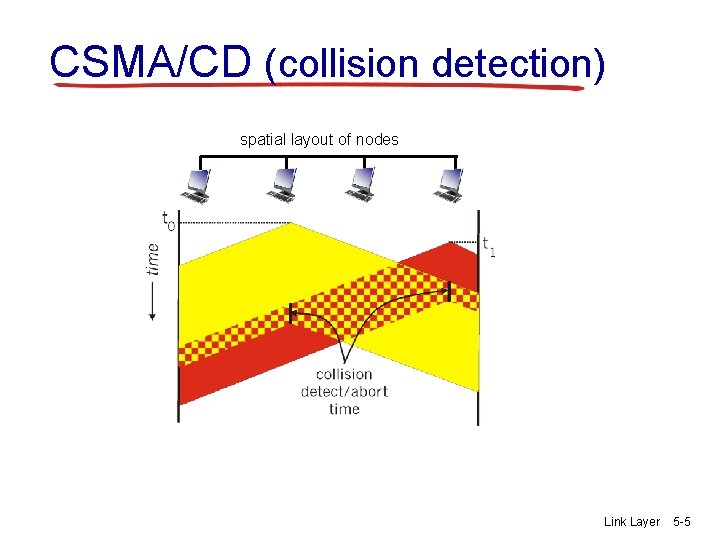
CSMA/CD (collision detection) CSMA/CD: carrier sensing, deferral as in CSMA § collisions detected within short time § colliding transmissions aborted, reducing channel wastage v collision detection: § easy in wired LANs: measure signal strengths, compare transmitted, received signals § difficult in wireless LANs: received signal strength overwhelmed by local transmission strength v human analogy: the polite conversationalist Link Layer 5 -4
CSMA/CD (collision detection) spatial layout of nodes Link Layer 5 -5
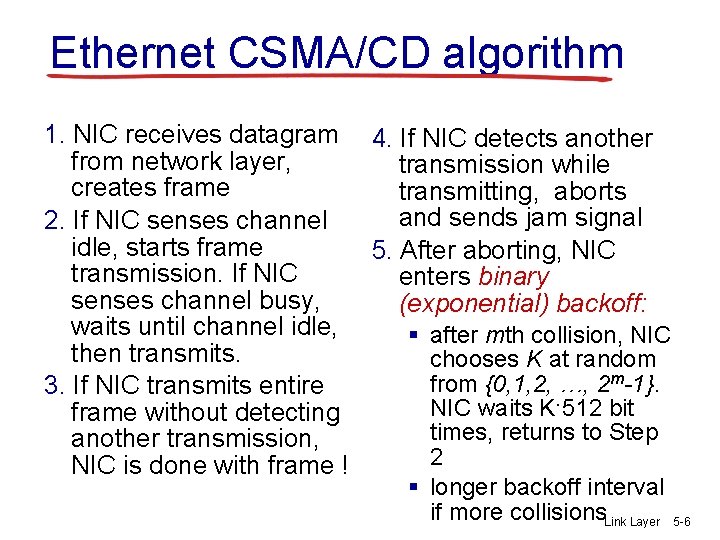
Ethernet CSMA/CD algorithm 1. NIC receives datagram 4. If NIC detects another from network layer, transmission while creates frame transmitting, aborts and sends jam signal 2. If NIC senses channel idle, starts frame 5. After aborting, NIC transmission. If NIC enters binary senses channel busy, (exponential) backoff: waits until channel idle, § after mth collision, NIC then transmits. chooses K at random from {0, 1, 2, …, 2 m-1}. 3. If NIC transmits entire NIC waits K·512 bit frame without detecting times, returns to Step another transmission, 2 NIC is done with frame ! § longer backoff interval if more collisions. Link Layer 5 -6
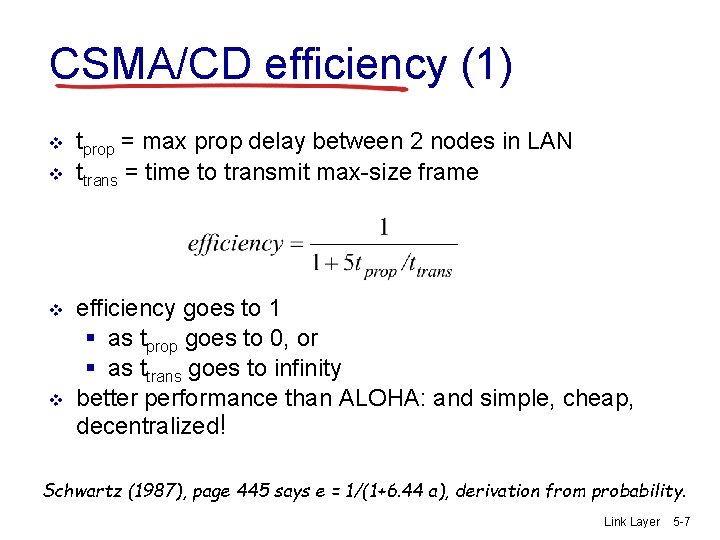
CSMA/CD efficiency (1) v v tprop = max prop delay between 2 nodes in LAN ttrans = time to transmit max-size frame efficiency goes to 1 § as tprop goes to 0, or § as ttrans goes to infinity better performance than ALOHA: and simple, cheap, decentralized! Schwartz (1987), page 445 says e = 1/(1+6. 44 a), derivation from probability. Link Layer 5 -7
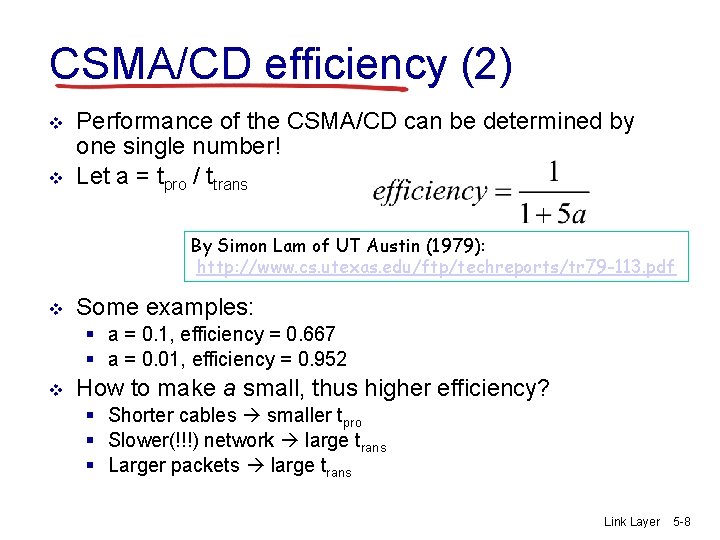
CSMA/CD efficiency (2) v v Performance of the CSMA/CD can be determined by one single number! Let a = tpro / ttrans By Simon Lam of UT Austin (1979): http: //www. cs. utexas. edu/ftp/techreports/tr 79 -113. pdf v Some examples: § a = 0. 1, efficiency = 0. 667 § a = 0. 01, efficiency = 0. 952 v How to make a small, thus higher efficiency? § Shorter cables smaller tpro § Slower(!!!) network large trans § Larger packets large trans Link Layer 5 -8
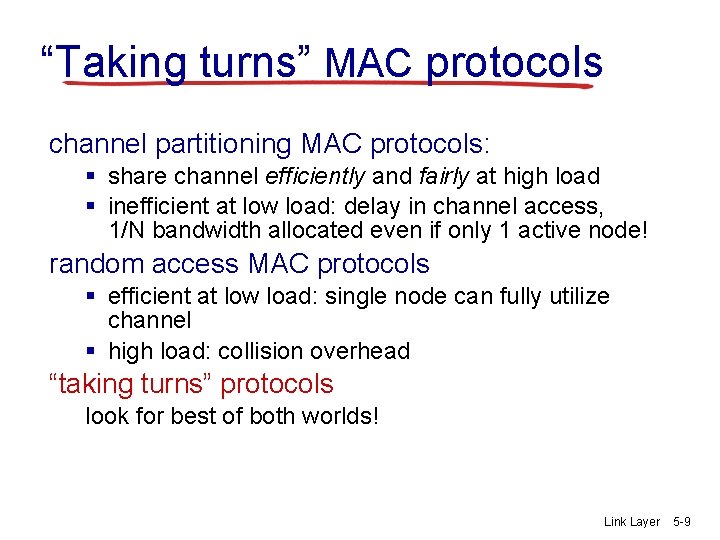
“Taking turns” MAC protocols channel partitioning MAC protocols: § share channel efficiently and fairly at high load § inefficient at low load: delay in channel access, 1/N bandwidth allocated even if only 1 active node! random access MAC protocols § efficient at low load: single node can fully utilize channel § high load: collision overhead “taking turns” protocols look for best of both worlds! Link Layer 5 -9
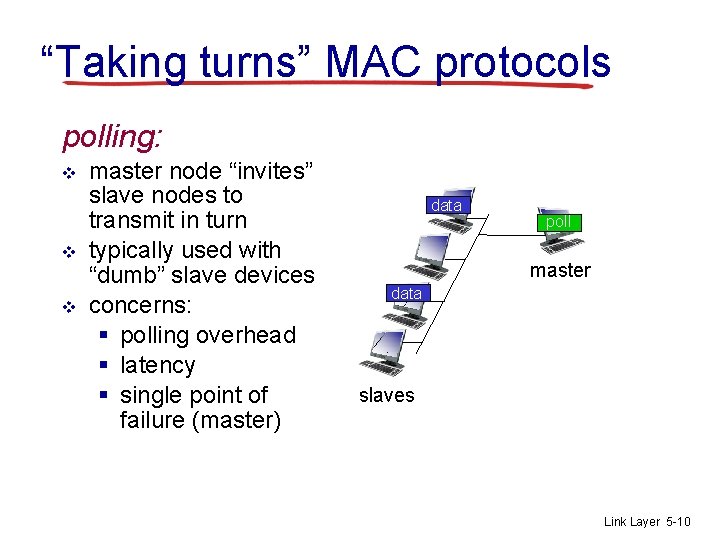
“Taking turns” MAC protocols polling: v v v master node “invites” slave nodes to transmit in turn typically used with “dumb” slave devices concerns: § polling overhead § latency § single point of failure (master) data poll master data slaves Link Layer 5 -10
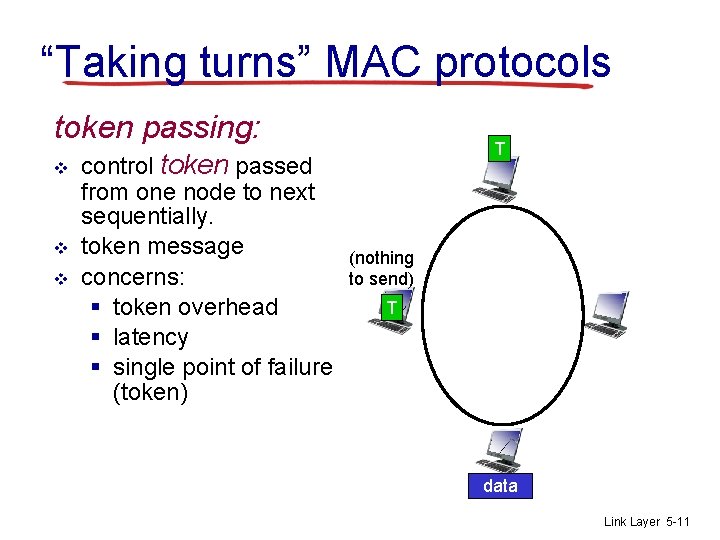
“Taking turns” MAC protocols token passing: v v v control token passed from one node to next sequentially. token message concerns: § token overhead § latency § single point of failure (token) T (nothing to send) T data Link Layer 5 -11
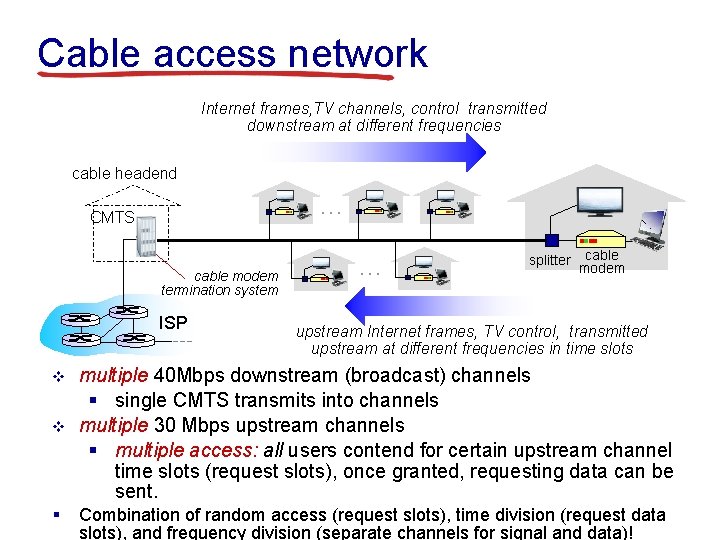
Cable access network Internet frames, TV channels, control transmitted downstream at different frequencies cable headend … CMTS cable modem termination system ISP v v § … splitter cable modem upstream Internet frames, TV control, transmitted upstream at different frequencies in time slots multiple 40 Mbps downstream (broadcast) channels § single CMTS transmits into channels multiple 30 Mbps upstream channels § multiple access: all users contend for certain upstream channel time slots (request slots), once granted, requesting data can be sent. Combination of random access (request slots), time division (request data slots), and frequency division (separate channels for signal and data)!
Cable access network cable headend MAP frame for Interval [t 1, t 2] Downstream channel i CMTS Upstream channel j t 1 Minislots containing minislots request frames t 2 Residences with cable modems Assigned minislots containing cable modem upstream data frames DOCSIS: data over cable service interface spec v v FDM over upstream, downstream frequency channels TDM upstream: some slots assigned, some have contention § downstream MAP frame: assigns upstream slots § request for upstream slots (and data) transmitted random access (binary backoff) in selected Link slots Layer 5 -13
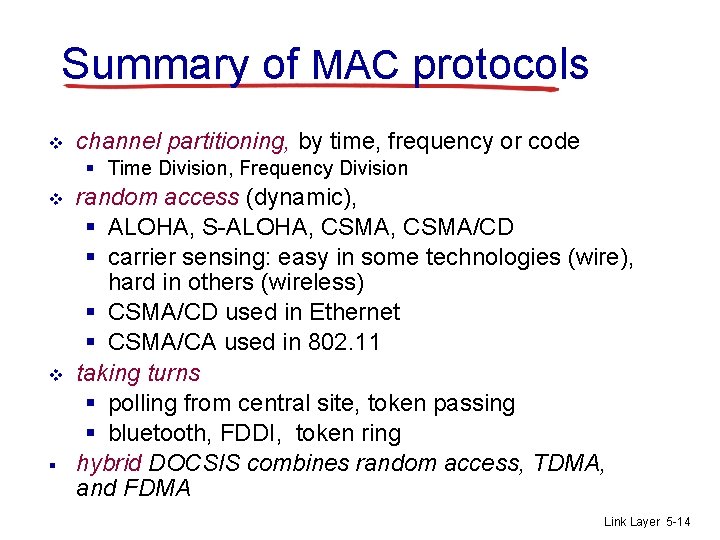
Summary of MAC protocols v channel partitioning, by time, frequency or code § Time Division, Frequency Division v v § random access (dynamic), § ALOHA, S-ALOHA, CSMA/CD § carrier sensing: easy in some technologies (wire), hard in others (wireless) § CSMA/CD used in Ethernet § CSMA/CA used in 802. 11 taking turns § polling from central site, token passing § bluetooth, FDDI, token ring hybrid DOCSIS combines random access, TDMA, and FDMA Link Layer 5 -14