
Chapter 5 Lecture Outline Leaves Copyright The Mc

- Slides: 32
Chapter 5 Lecture Outline Leaves Copyright © The Mc. Graw-Hill Companies, Inc. Permission required for reproduction or display.
Outline v Introduction v Leaf Arrangements and Types v Internal Structure of Leaves v Stomata v Mesophyll and Veins v Specialized Leaves v Autumnal Changes in Leaf Color v Abscission v Human and Ecological Relevance of Leaves
Introduction v All leaves originate as primordia in buds. v At maturity, most leaves have: • Stalk = petiole – Leaves sessile if lacking petiole (monocots) • Flattened blade = lamina • Network of veins = vascular bundles • Stipules at base of petiole v Leaves of flowering plants associated with leaf gaps and have axillary buds at base.
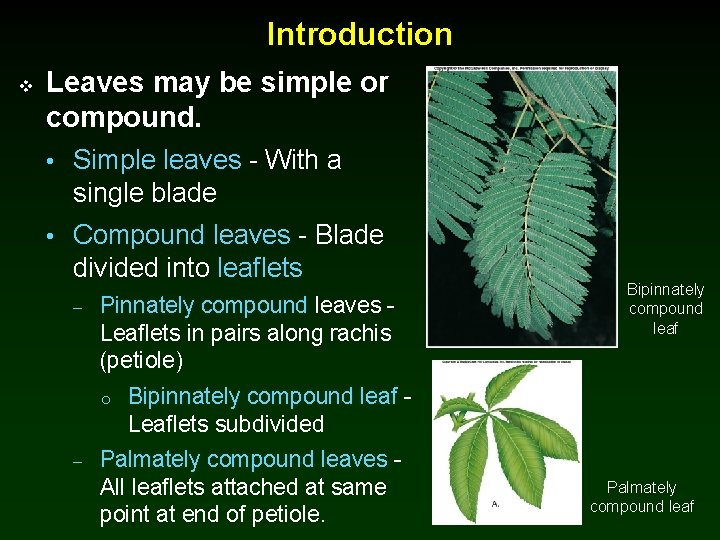
Introduction v Leaves may be simple or compound. • Simple leaves - With a single blade • Compound leaves - Blade divided into leaflets – Pinnately compound leaves Leaflets in pairs along rachis (petiole) o – Bipinnately compound leaf Leaflets subdivided Palmately compound leaves All leaflets attached at same point at end of petiole. Palmately compound leaf
Introduction v Green leaves capture light energy by means of photosynthesis. • Photosynthesis - Trapping and storing of energy in sugar molecules that are constructed from water and carbon dioxide v Stomata - Tiny pores on lower surfaces of leaves • Allow carbon dioxide to enter and oxygen to diffuse out • Water vapor also escapes via stomata. – Guard Cells control water loss by opening or closing pore of stomatal apparatus.
Introduction v Other functions of leaves: • Wastes from metabolic processes accumulate in leaves and are disposed of when leaves are shed. • Play major role in movement of water absorbed by roots – Transpiration occurs when water evaporates from leaf surface. – Guttation - Root pressure forces water out hydathodes at tips of leaf veins in some plants.
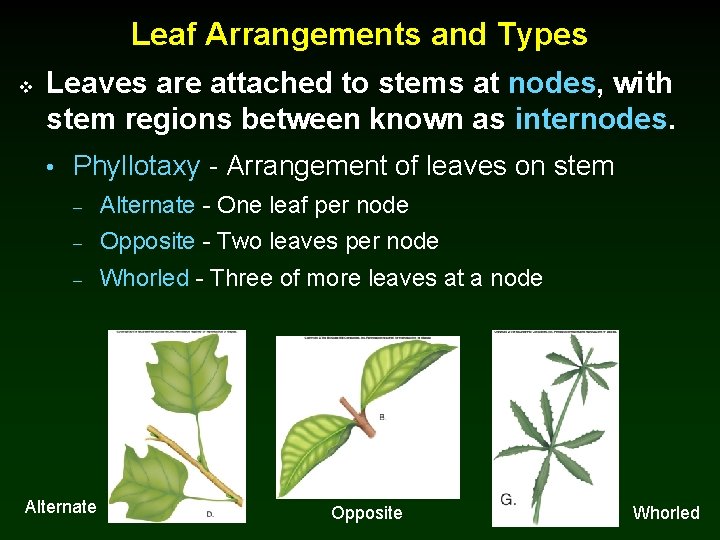
Leaf Arrangements and Types v Leaves are attached to stems at nodes, with stem regions between known as internodes. • Phyllotaxy - Arrangement of leaves on stem – Alternate - One leaf per node – Opposite - Two leaves per node – Whorled - Three of more leaves at a node Alternate Opposite Whorled
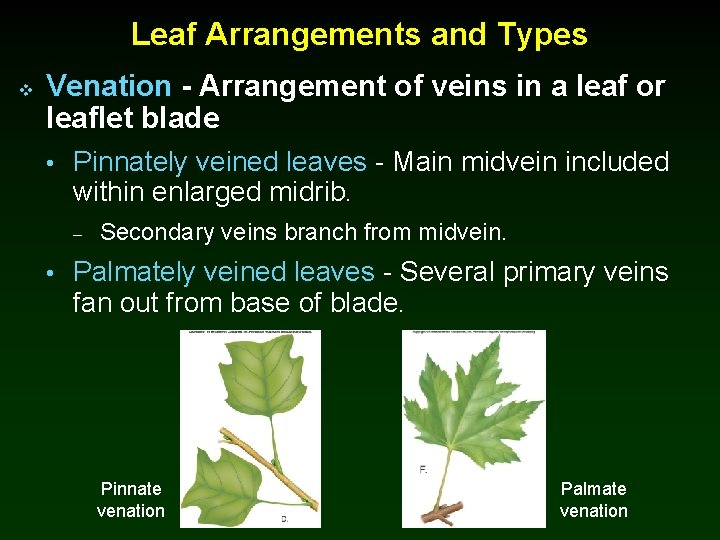
Leaf Arrangements and Types v Venation - Arrangement of veins in a leaf or leaflet blade • Pinnately veined leaves - Main midvein included within enlarged midrib. – Secondary veins branch from midvein. • Palmately veined leaves - Several primary veins fan out from base of blade. Pinnate venation Palmate venation
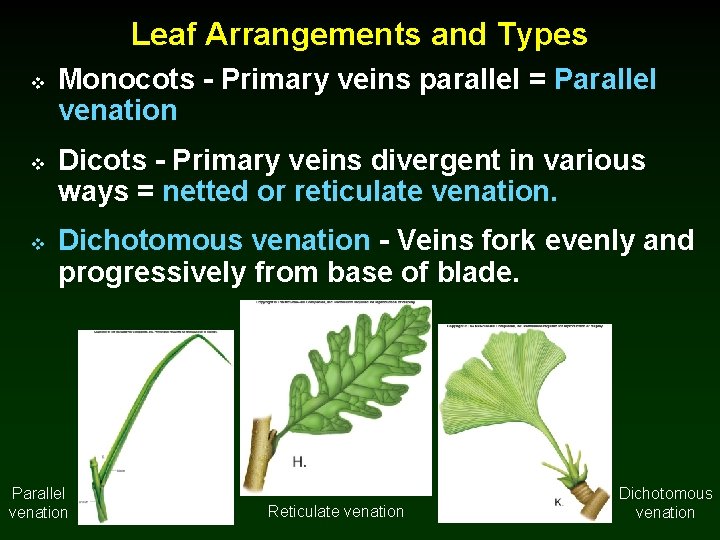
Leaf Arrangements and Types v v v Monocots - Primary veins parallel = Parallel venation Dicots - Primary veins divergent in various ways = netted or reticulate venation. Dichotomous venation - Veins fork evenly and progressively from base of blade. Parallel venation Reticulate venation Dichotomous venation
Internal Structure of Leaves v v Three regions: Epidermis, mesophyll, veins (vascular bundles) Epidermis - Single layer of cells covering the entire surface of the leaf • Devoid of chloroplasts • Coated with cuticle (with cutin) • Functions to protect tissues inside leaves • Waste materials may accumulate in epidermal cells. • Different types of glands may also be present in the epidermis.
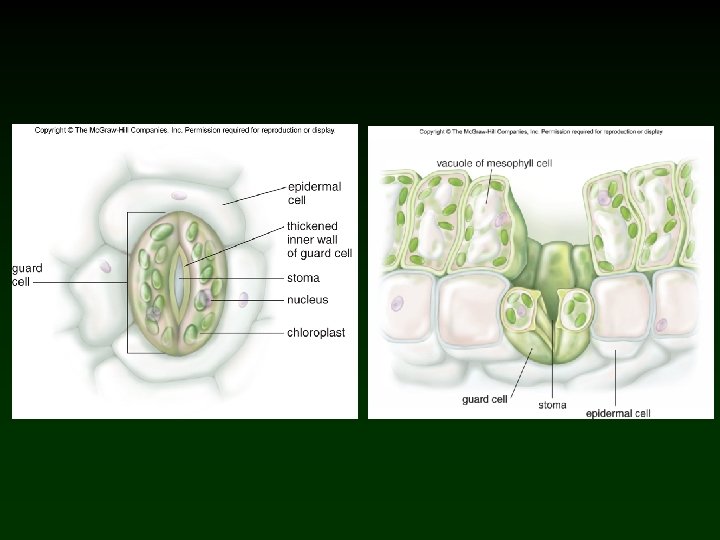
Stomata v Lower epidermis typically has thinner layer of cutin and is perforated by numerous stomata. • Stomata bordered by two guard cells. – Guard cells originate from the same parent cell, and contain chloroplasts. o Primary functions: « Regulate gas exchange between leaf interior and atmosphere « Regulate evaporation of water o Changes in amount of water in guard cells cause them to inflate or deflate. « Inflate - Stomata open « Deflate - Stomata close
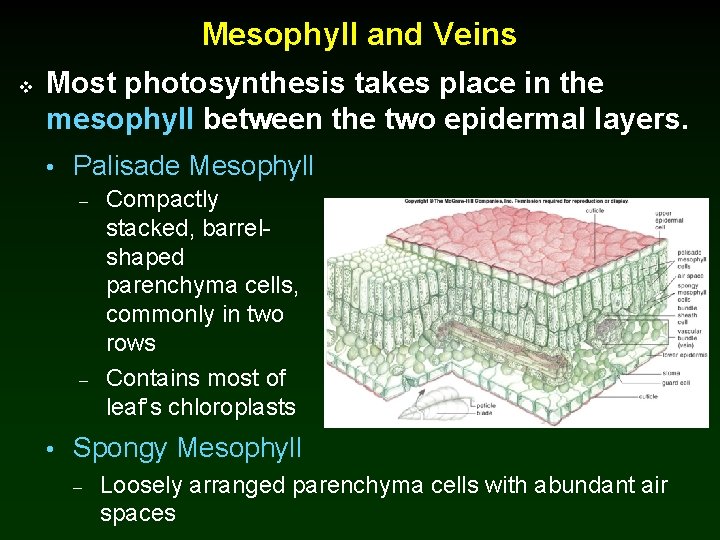
Mesophyll and Veins v Most photosynthesis takes place in the mesophyll between the two epidermal layers. • Palisade Mesophyll – Compactly stacked, barrelshaped parenchyma cells, commonly in two rows – Contains most of leaf’s chloroplasts • Spongy Mesophyll – Loosely arranged parenchyma cells with abundant air spaces
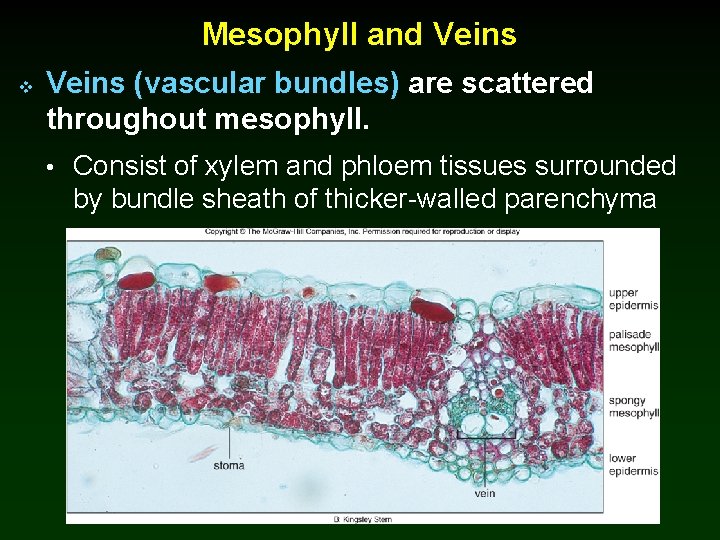
Mesophyll and Veins v Veins (vascular bundles) are scattered throughout mesophyll. • Consist of xylem and phloem tissues surrounded by bundle sheath of thicker-walled parenchyma
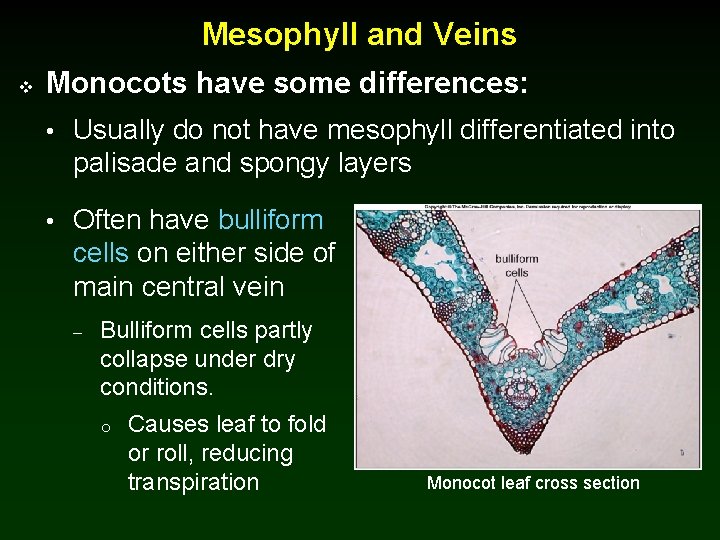
Mesophyll and Veins v Monocots have some differences: • Usually do not have mesophyll differentiated into palisade and spongy layers • Often have bulliform cells on either side of main central vein – Bulliform cells partly collapse under dry conditions. o Causes leaf to fold or roll, reducing transpiration Monocot leaf cross section
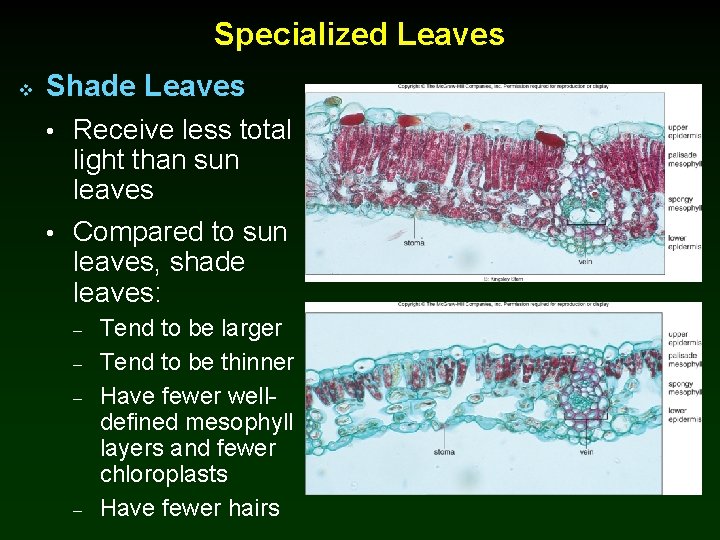
Specialized Leaves v Shade Leaves • Receive less total light than sun leaves • Compared to sun leaves, shade leaves: – – Tend to be larger Tend to be thinner Have fewer welldefined mesophyll layers and fewer chloroplasts Have fewer hairs
Specialized Leaves v Leaves of Arid Regions • Arid regions have limited availability of water, wide temperature ranges, and high light intensities. • Leaves reduce loss of water by: – – v Thick, leathery leaves Fewer stomata or sunken stomata Succulent, water-retaining leaves, or no leaves Dense, hairy coverings Leaves of Aquatic Areas • Less xylem and phloem • Mesophyll not differentiated into palisade and spongy layers. • Large air spaces
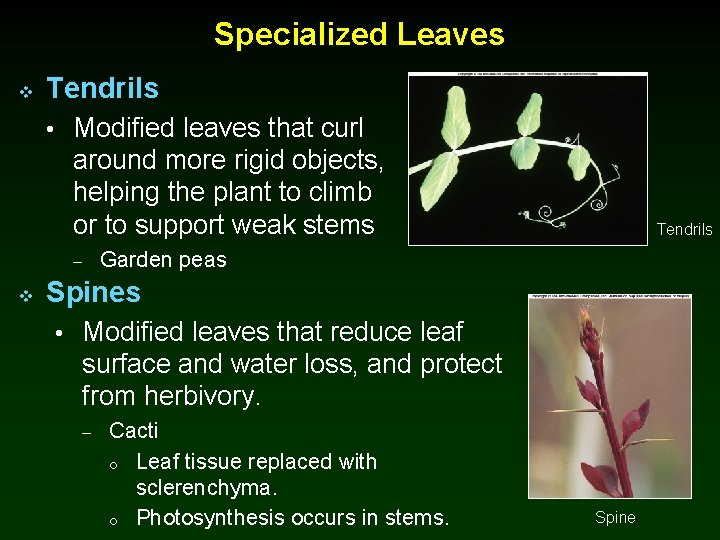
Specialized Leaves v Tendrils • Modified leaves that curl around more rigid objects, helping the plant to climb or to support weak stems Garden peas – v Tendrils Spines • Modified leaves that reduce leaf surface and water loss, and protect from herbivory. – Cacti o Leaf tissue replaced with sclerenchyma. o Photosynthesis occurs in stems. Spine
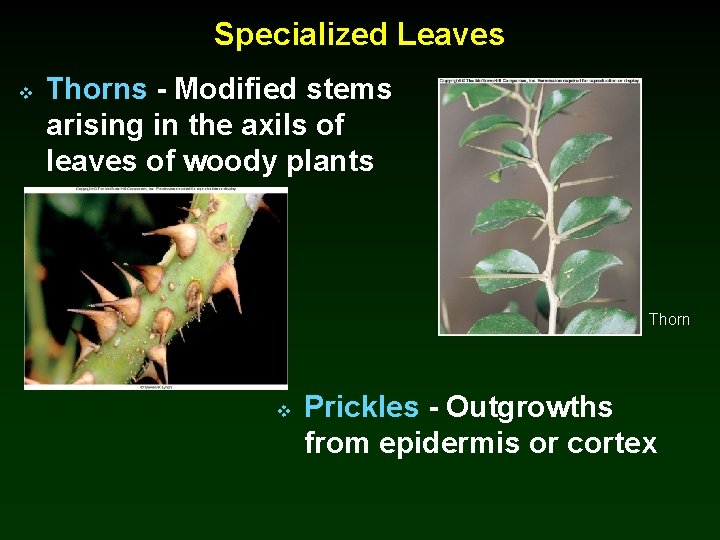
Specialized Leaves v Thorns - Modified stems arising in the axils of leaves of woody plants Thorn v Prickles - Outgrowths from epidermis or cortex
Specialized Leaves v Storage leaves • Succulent leaves are modified for water storage. – Have parenchyma cells with large vacuoles – Many desert plants • Fleshy leaves store carbohydrates. – Onions, lily
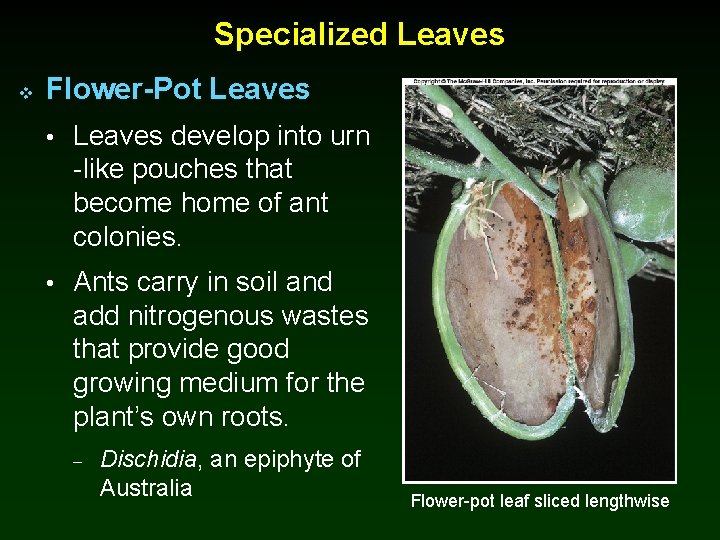
Specialized Leaves v Flower-Pot Leaves • Leaves develop into urn -like pouches that become home of ant colonies. • Ants carry in soil and add nitrogenous wastes that provide good growing medium for the plant’s own roots. – Dischidia, an epiphyte of Australia Flower-pot leaf sliced lengthwise
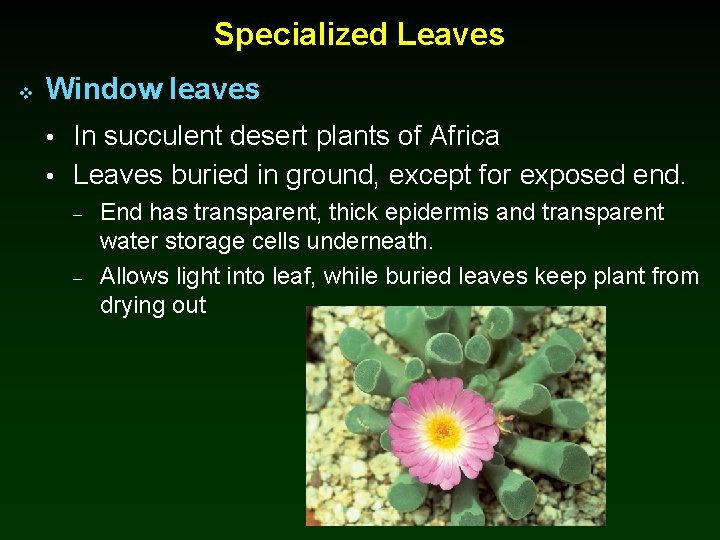
Specialized Leaves v Window leaves • In succulent desert plants of Africa • Leaves buried in ground, except for exposed end. – End has transparent, thick epidermis and transparent water storage cells underneath. – Allows light into leaf, while buried leaves keep plant from drying out
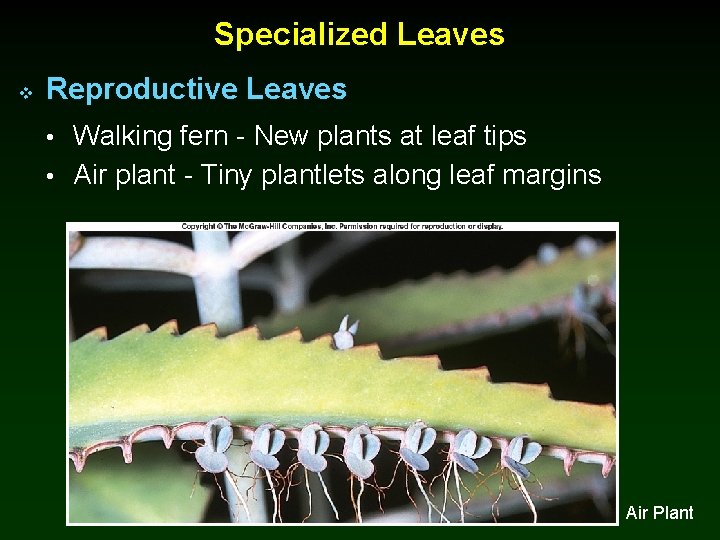
Specialized Leaves v Reproductive Leaves • Walking fern - New plants at leaf tips • Air plant - Tiny plantlets along leaf margins Air Plant
Specialized Leaves v Floral Leaves (bracts) • At bases of flowers or flower stalks • Poinsettia - Flowers do not have petals, instead brightly colored bracts surround flowers. • Clary’s sage - Colorful bracts are at top of flowering stalks above flowers. Poinsettia Clary’s sage
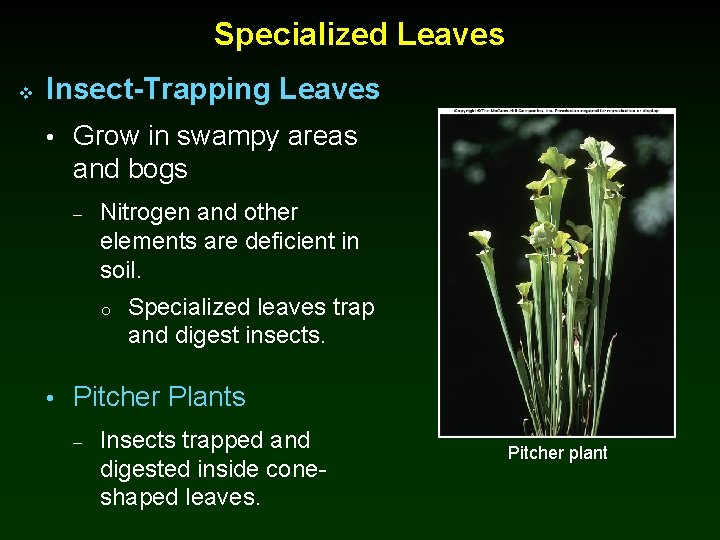
Specialized Leaves v Insect-Trapping Leaves • Grow in swampy areas and bogs – Nitrogen and other elements are deficient in soil. o Specialized leaves trap and digest insects. • Pitcher Plants – Insects trapped and digested inside coneshaped leaves. Pitcher plant
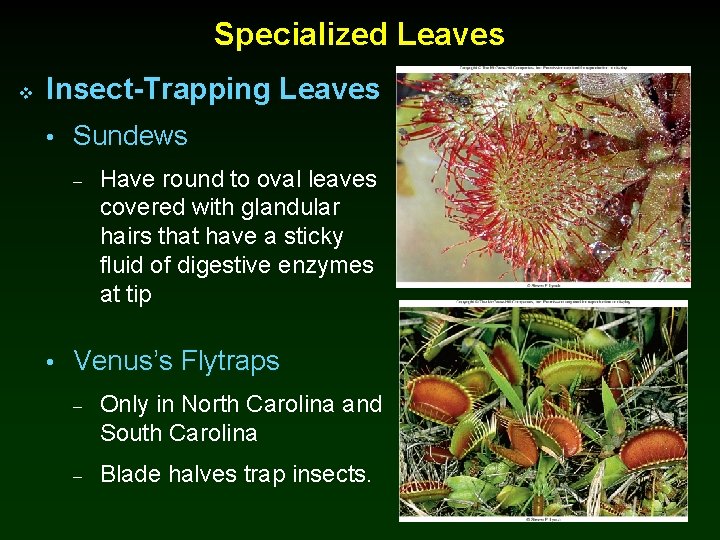
Specialized Leaves v Insect-Trapping Leaves • Sundews – Have round to oval leaves covered with glandular hairs that have a sticky fluid of digestive enzymes at tip • Venus’s Flytraps – Only in North Carolina and South Carolina – Blade halves trap insects.
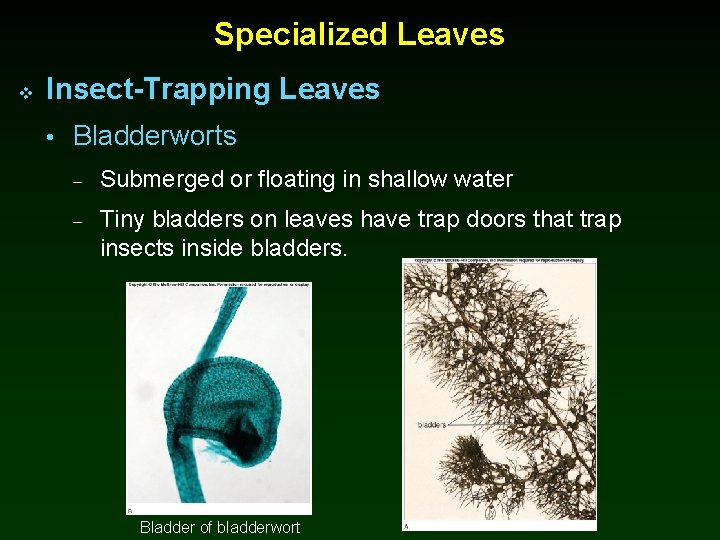
Specialized Leaves v Insect-Trapping Leaves • Bladderworts – Submerged or floating in shallow water – Tiny bladders on leaves have trap doors that trap insects inside bladders. Bladder of bladderwort
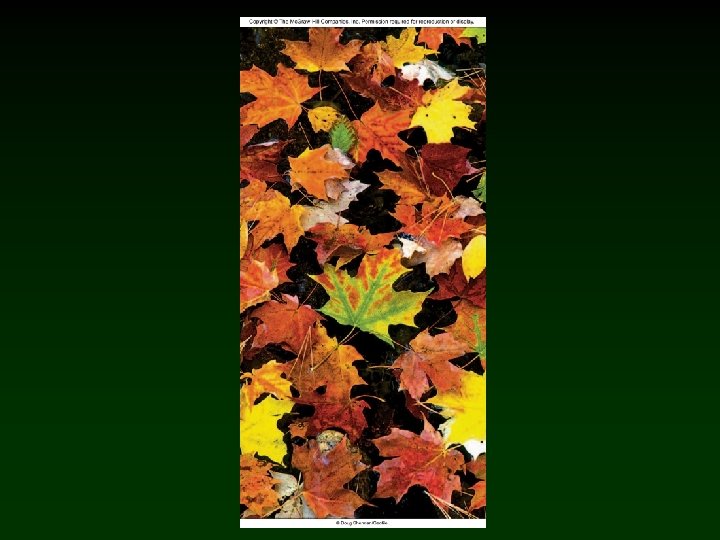
Autumnal Changes in Leaf Color v Chloroplasts of mature leaves contain several groups of pigments: • Chlorophylls - Green • Carotenoids - Yellows • In fall, chlorophylls break down and other colors are revealed. v Water soluble anthocyanins (red or blue) and betacyanins (red) may also be present in the vacuole.
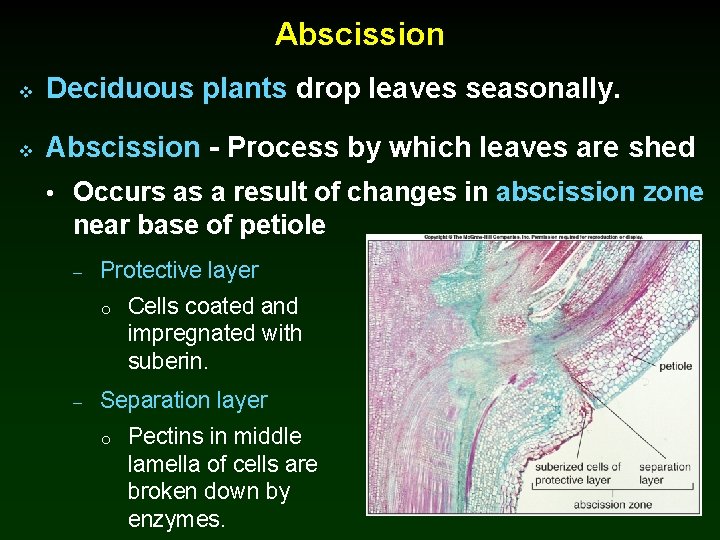
Abscission v Deciduous plants drop leaves seasonally. v Abscission - Process by which leaves are shed • Occurs as a result of changes in abscission zone near base of petiole – Protective layer o – Cells coated and impregnated with suberin. Separation layer o Pectins in middle lamella of cells are broken down by enzymes.
Human and Ecological Relevance of Leaves v Landscaping - Shade trees v Food - Cabbage, lettuce, celery petioles, spices v Dyes v Perfumes - Oils of orange tree, lavender v Ropes and Twine - Agave, hemp fibers v Drugs - Narcotics, tobacco, marijuana v Beverages - Tea, tequila (agave leaves) v Insecticides - Rotenone v Waxes - Carnauba and caussu waxes v Aesthetics - Floral arrangements, gardens
Review v Introduction v Leaf Arrangements and Types v Internal Structure of Leaves v Stomata v Mesophyll and Veins v Specialized Leaves v Autumnal Changes in Leaf Color v Abscission v Human and Ecological Relevance of Leaves