
Chapter 5 Interest Rates and Bond Valuation Mc
Chapter 5 Interest Rates and Bond Valuation Mc. Graw-Hill/Irwin Copyright © 2007 by The Mc. Graw-Hill Companies, Inc. All rights reserved.
Key Concepts and Skills Know the important bond features and bond types o Understand bond values and why they fluctuate o Understand bond ratings and what they mean o Understand the impact of inflation on interest rates o Understand the term structure of interest rates and the determinants of bond yields o Mc. Graw-Hill/Irwin Copyright © 2007 by The Mc. Graw-Hill Companies, Inc. All rights reserved.
Chapter Outline 5. 1 5. 2 5. 3 5. 4 5. 5 5. 6 5. 7 Mc. Graw-Hill/Irwin Bonds and Bond Valuation More on Bond Features Bond Ratings Some Different Types of Bonds Bond Markets Inflation and Interest Rates Determinants of Bond Yields Copyright © 2007 by The Mc. Graw-Hill Companies, Inc. All rights reserved.
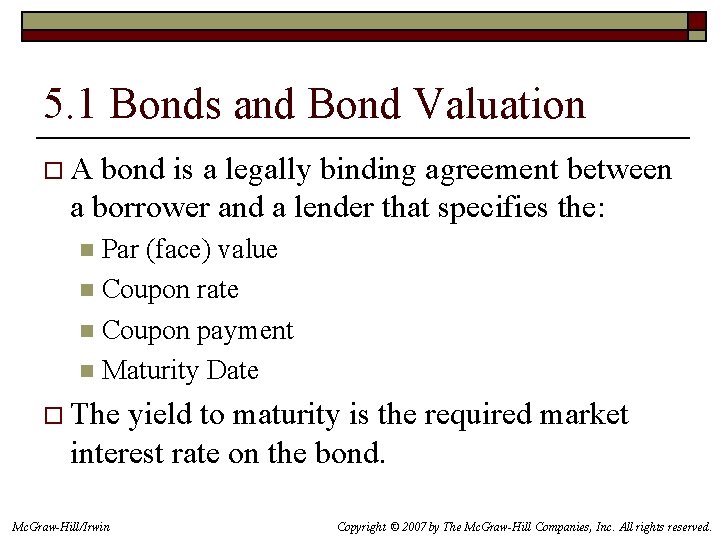
5. 1 Bonds and Bond Valuation o. A bond is a legally binding agreement between a borrower and a lender that specifies the: Par (face) value n Coupon rate n Coupon payment n Maturity Date n o The yield to maturity is the required market interest rate on the bond. Mc. Graw-Hill/Irwin Copyright © 2007 by The Mc. Graw-Hill Companies, Inc. All rights reserved.
Bond Valuation o Primary n Principle: Value of financial securities = PV of expected future cash flows o Bond value is, therefore, determined by the present value of the coupon payments and par value. o Interest rates are inversely related to present (i. e. , bond) values. Mc. Graw-Hill/Irwin Copyright © 2007 by The Mc. Graw-Hill Companies, Inc. All rights reserved.
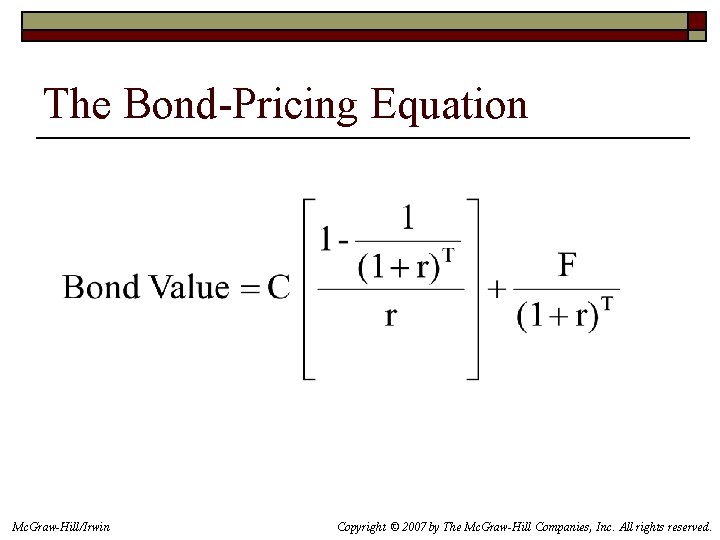
The Bond-Pricing Equation Mc. Graw-Hill/Irwin Copyright © 2007 by The Mc. Graw-Hill Companies, Inc. All rights reserved.
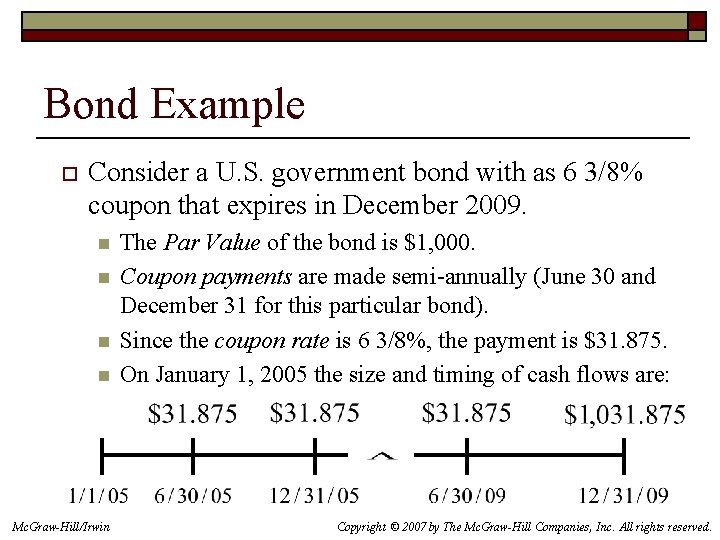
Bond Example o Consider a U. S. government bond with as 6 3/8% coupon that expires in December 2009. n n Mc. Graw-Hill/Irwin The Par Value of the bond is $1, 000. Coupon payments are made semi-annually (June 30 and December 31 for this particular bond). Since the coupon rate is 6 3/8%, the payment is $31. 875. On January 1, 2005 the size and timing of cash flows are: Copyright © 2007 by The Mc. Graw-Hill Companies, Inc. All rights reserved.
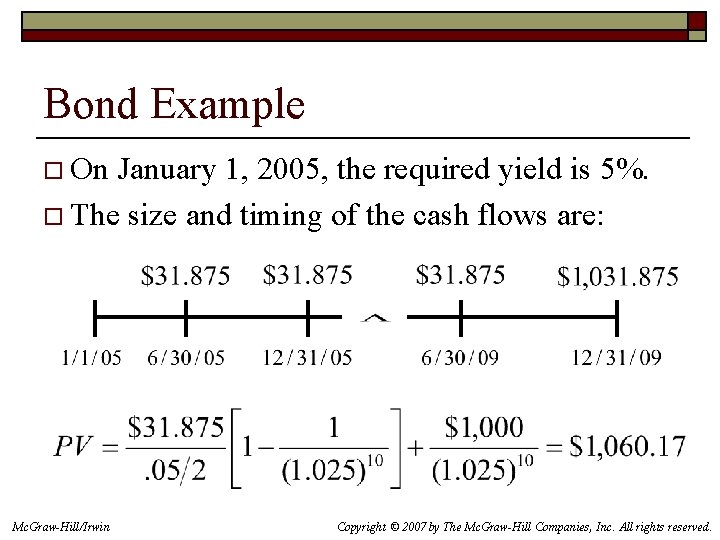
Bond Example o On January 1, 2005, the required yield is 5%. o The size and timing of the cash flows are: Mc. Graw-Hill/Irwin Copyright © 2007 by The Mc. Graw-Hill Companies, Inc. All rights reserved.
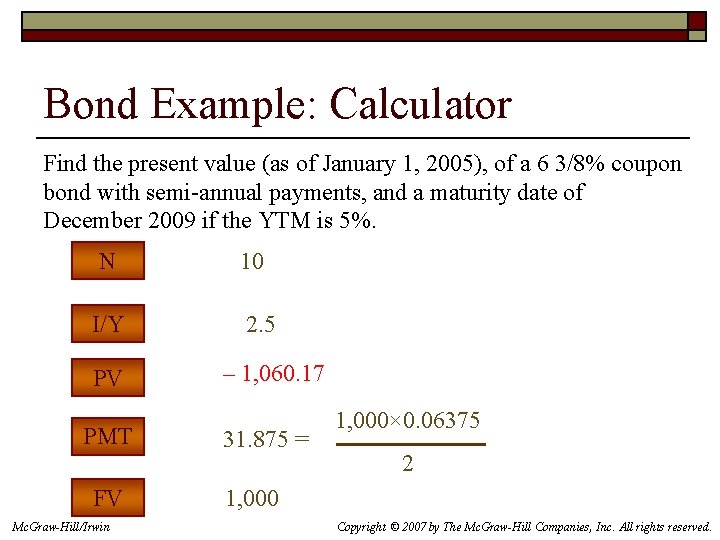
Bond Example: Calculator Find the present value (as of January 1, 2005), of a 6 3/8% coupon bond with semi-annual payments, and a maturity date of December 2009 if the YTM is 5%. N I/Y PV PMT FV Mc. Graw-Hill/Irwin 10 2. 5 – 1, 060. 17 31. 875 = 1, 000× 0. 06375 2 1, 000 Copyright © 2007 by The Mc. Graw-Hill Companies, Inc. All rights reserved.
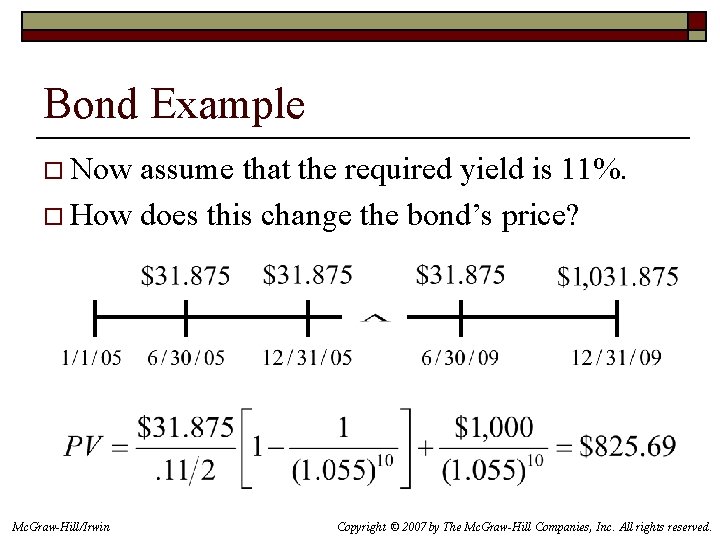
Bond Example o Now assume that the required yield is 11%. o How does this change the bond’s price? Mc. Graw-Hill/Irwin Copyright © 2007 by The Mc. Graw-Hill Companies, Inc. All rights reserved.
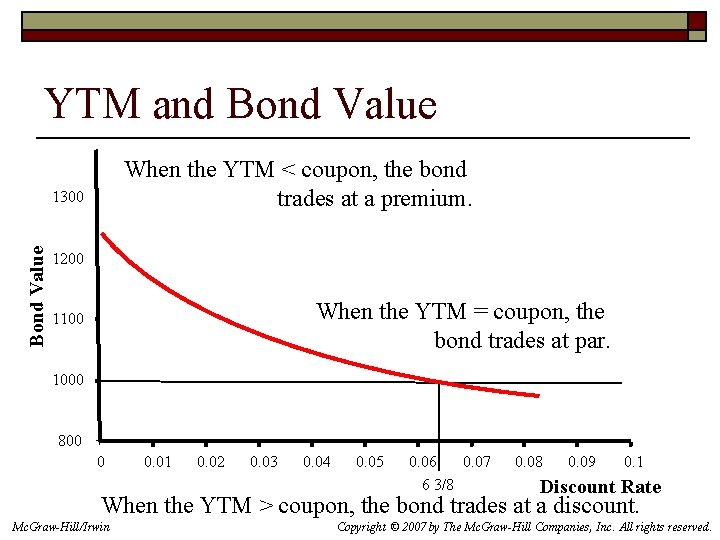
YTM and Bond Value When the YTM < coupon, the bond trades at a premium. Bond Value 1300 1200 When the YTM = coupon, the bond trades at par. 1100 1000 800 0 0. 01 0. 02 0. 03 0. 04 0. 05 0. 06 0. 07 6 3/8 0. 09 0. 1 Discount Rate When the YTM > coupon, the bond trades at a discount. Mc. Graw-Hill/Irwin Copyright © 2007 by The Mc. Graw-Hill Companies, Inc. All rights reserved.
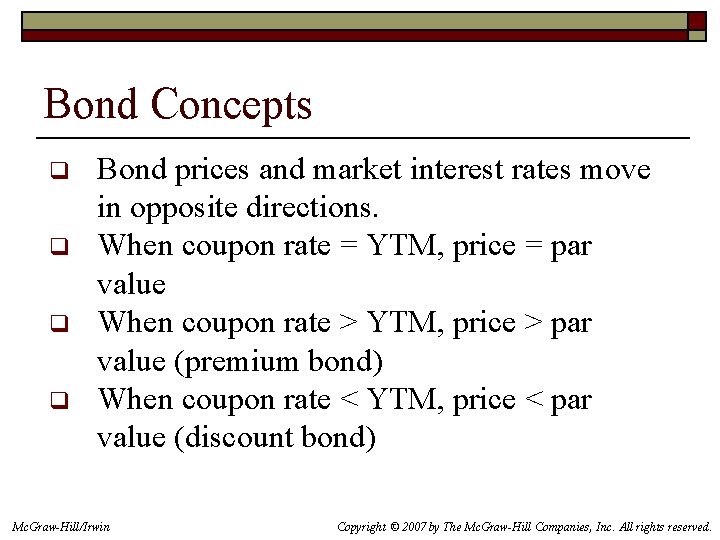
Bond Concepts q q Bond prices and market interest rates move in opposite directions. When coupon rate = YTM, price = par value When coupon rate > YTM, price > par value (premium bond) When coupon rate < YTM, price < par value (discount bond) Mc. Graw-Hill/Irwin Copyright © 2007 by The Mc. Graw-Hill Companies, Inc. All rights reserved.
Interest Rate Risk o Price Risk n n n o Change in price due to changes in interest rates Long-term bonds have more price risk than short-term bonds Low coupon rate bonds have more price risk than high coupon rate bonds. Reinvestment Rate Risk n n n Uncertainty concerning rates at which cash flows can be reinvested Short-term bonds have more reinvestment rate risk than long-term bonds. High coupon rate bonds have more reinvestment rate risk than low coupon rate bonds. Mc. Graw-Hill/Irwin Copyright © 2007 by The Mc. Graw-Hill Companies, Inc. All rights reserved.
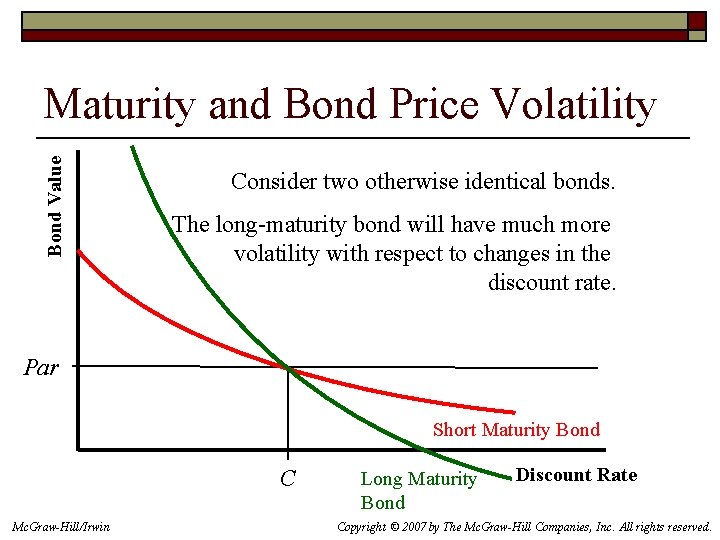
Bond Value Maturity and Bond Price Volatility Consider two otherwise identical bonds. The long-maturity bond will have much more volatility with respect to changes in the discount rate. Par Short Maturity Bond C Mc. Graw-Hill/Irwin Long Maturity Bond Discount Rate Copyright © 2007 by The Mc. Graw-Hill Companies, Inc. All rights reserved.
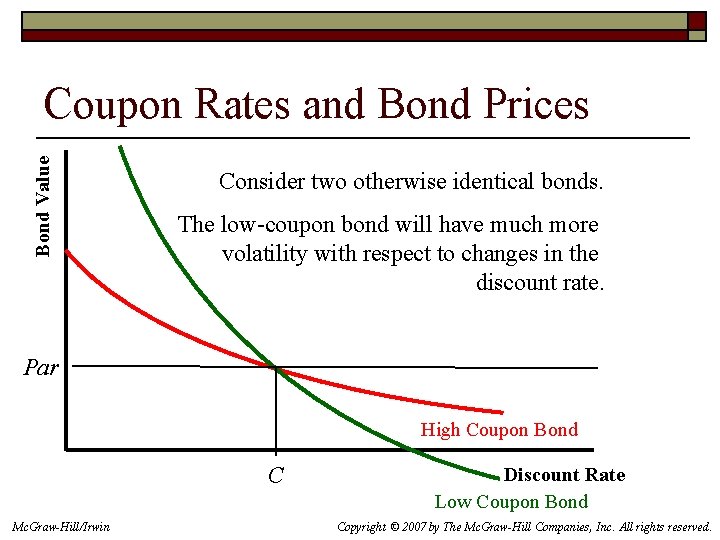
Bond Value Coupon Rates and Bond Prices Consider two otherwise identical bonds. The low-coupon bond will have much more volatility with respect to changes in the discount rate. Par High Coupon Bond C Mc. Graw-Hill/Irwin Discount Rate Low Coupon Bond Copyright © 2007 by The Mc. Graw-Hill Companies, Inc. All rights reserved.
Computing Yield to Maturity o Yield-to-maturity is the rate implied by the current bond price. o Finding the YTM requires trial and error if you do not have a financial calculator and is similar to the process for finding r with an annuity. o If you have a financial calculator, enter N, PV, PMT, and FV, remembering the sign convention (PMT and FV need to have the same sign, PV the opposite sign). Mc. Graw-Hill/Irwin Copyright © 2007 by The Mc. Graw-Hill Companies, Inc. All rights reserved.
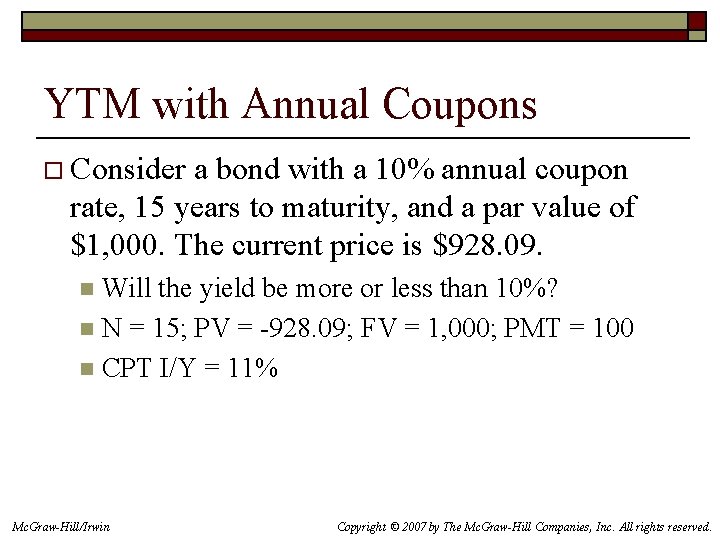
YTM with Annual Coupons o Consider a bond with a 10% annual coupon rate, 15 years to maturity, and a par value of $1, 000. The current price is $928. 09. Will the yield be more or less than 10%? n N = 15; PV = -928. 09; FV = 1, 000; PMT = 100 n CPT I/Y = 11% n Mc. Graw-Hill/Irwin Copyright © 2007 by The Mc. Graw-Hill Companies, Inc. All rights reserved.
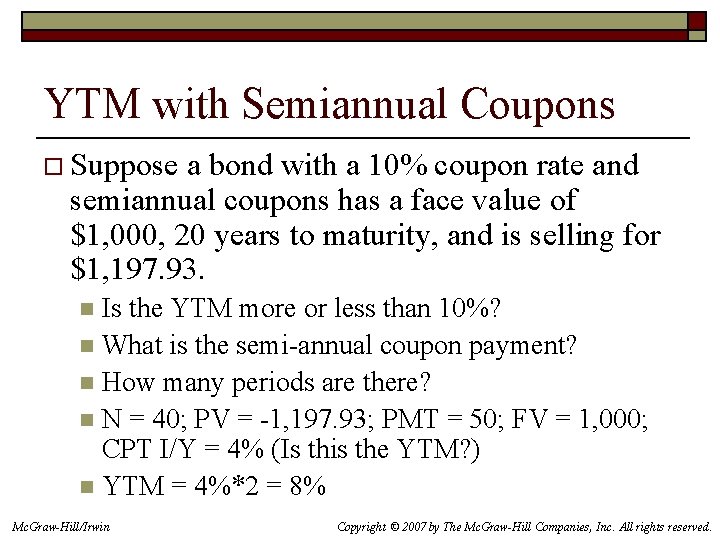
YTM with Semiannual Coupons o Suppose a bond with a 10% coupon rate and semiannual coupons has a face value of $1, 000, 20 years to maturity, and is selling for $1, 197. 93. Is the YTM more or less than 10%? n What is the semi-annual coupon payment? n How many periods are there? n N = 40; PV = -1, 197. 93; PMT = 50; FV = 1, 000; CPT I/Y = 4% (Is this the YTM? ) n YTM = 4%*2 = 8% n Mc. Graw-Hill/Irwin Copyright © 2007 by The Mc. Graw-Hill Companies, Inc. All rights reserved.
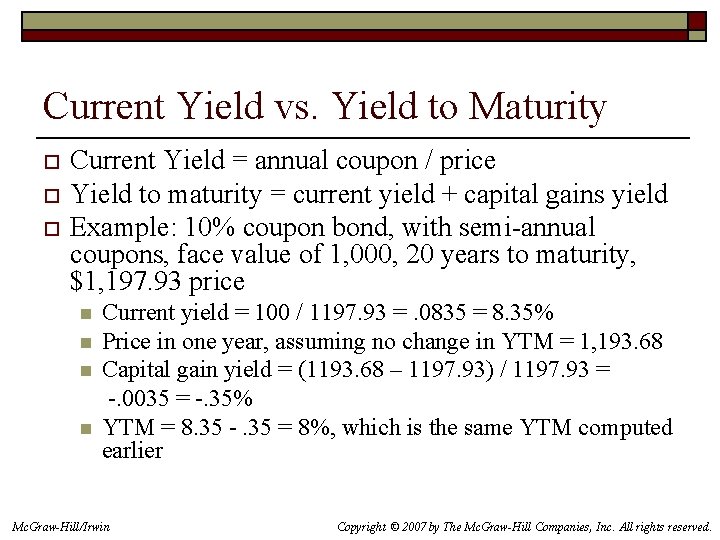
Current Yield vs. Yield to Maturity o o o Current Yield = annual coupon / price Yield to maturity = current yield + capital gains yield Example: 10% coupon bond, with semi-annual coupons, face value of 1, 000, 20 years to maturity, $1, 197. 93 price n n Current yield = 100 / 1197. 93 =. 0835 = 8. 35% Price in one year, assuming no change in YTM = 1, 193. 68 Capital gain yield = (1193. 68 – 1197. 93) / 1197. 93 = -. 0035 = -. 35% YTM = 8. 35 -. 35 = 8%, which is the same YTM computed earlier Mc. Graw-Hill/Irwin Copyright © 2007 by The Mc. Graw-Hill Companies, Inc. All rights reserved.
Bond Pricing Theorems o Bonds of similar risk (and maturity) will be priced to yield about the same return, regardless of the coupon rate. o If you know the price of one bond, you can estimate its YTM and use that to find the price of the second bond. o This is a useful concept that can be transferred to valuing assets other than bonds. Mc. Graw-Hill/Irwin Copyright © 2007 by The Mc. Graw-Hill Companies, Inc. All rights reserved.
Bond Pricing with a Spreadsheet o There are specific formulas for finding bond prices and yields on a spreadsheet. n n PRICE(Settlement, Maturity, Rate, Yld, Redemption, Frequency, Basis) YIELD(Settlement, Maturity, Rate, Pr, Redemption, Frequency, Basis) Settlement and maturity need to be actual dates The redemption and Pr need to given as % of par value o Click Mc. Graw-Hill/Irwin on the Excel icon for an example. Copyright © 2007 by The Mc. Graw-Hill Companies, Inc. All rights reserved.
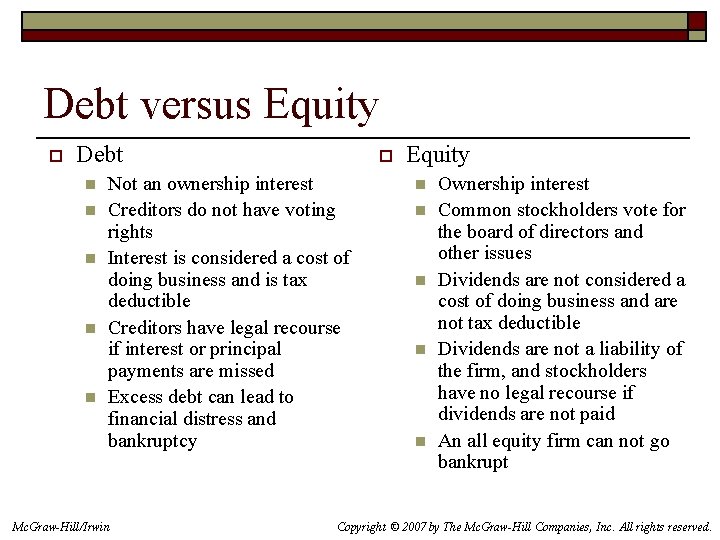
Debt versus Equity o Debt n n n o Not an ownership interest Creditors do not have voting rights Interest is considered a cost of doing business and is tax deductible Creditors have legal recourse if interest or principal payments are missed Excess debt can lead to financial distress and bankruptcy Mc. Graw-Hill/Irwin Equity n n n Ownership interest Common stockholders vote for the board of directors and other issues Dividends are not considered a cost of doing business and are not tax deductible Dividends are not a liability of the firm, and stockholders have no legal recourse if dividends are not paid An all equity firm can not go bankrupt Copyright © 2007 by The Mc. Graw-Hill Companies, Inc. All rights reserved.
The Bond Indenture o Contract between the company and the bondholders that includes: The basic terms of the bonds n The total amount of bonds issued n A description of property used as security, if applicable n Sinking fund provisions n Call provisions n Details of protective covenants n Mc. Graw-Hill/Irwin Copyright © 2007 by The Mc. Graw-Hill Companies, Inc. All rights reserved.
Bond Classifications o Registered vs. Bearer Forms o Security Collateral – secured by financial securities n Mortgage – secured by real property, normally land or buildings n Debentures – unsecured n Notes – unsecured debt with original maturity less than 10 years n o Seniority Mc. Graw-Hill/Irwin Copyright © 2007 by The Mc. Graw-Hill Companies, Inc. All rights reserved.
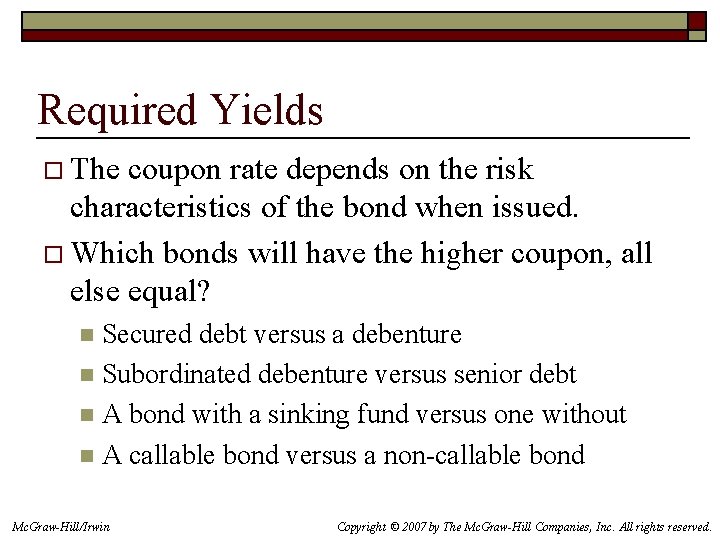
Required Yields o The coupon rate depends on the risk characteristics of the bond when issued. o Which bonds will have the higher coupon, all else equal? Secured debt versus a debenture n Subordinated debenture versus senior debt n A bond with a sinking fund versus one without n A callable bond versus a non-callable bond n Mc. Graw-Hill/Irwin Copyright © 2007 by The Mc. Graw-Hill Companies, Inc. All rights reserved.
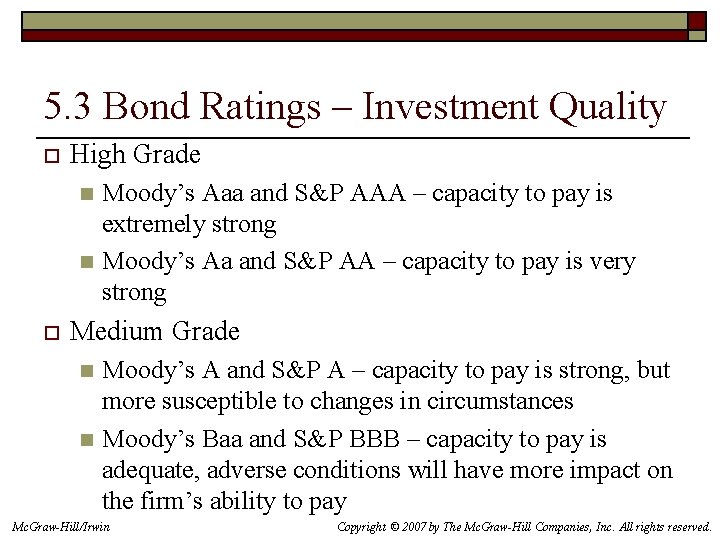
5. 3 Bond Ratings – Investment Quality o High Grade Moody’s Aaa and S&P AAA – capacity to pay is extremely strong n Moody’s Aa and S&P AA – capacity to pay is very strong n o Medium Grade Moody’s A and S&P A – capacity to pay is strong, but more susceptible to changes in circumstances n Moody’s Baa and S&P BBB – capacity to pay is adequate, adverse conditions will have more impact on the firm’s ability to pay n Mc. Graw-Hill/Irwin Copyright © 2007 by The Mc. Graw-Hill Companies, Inc. All rights reserved.
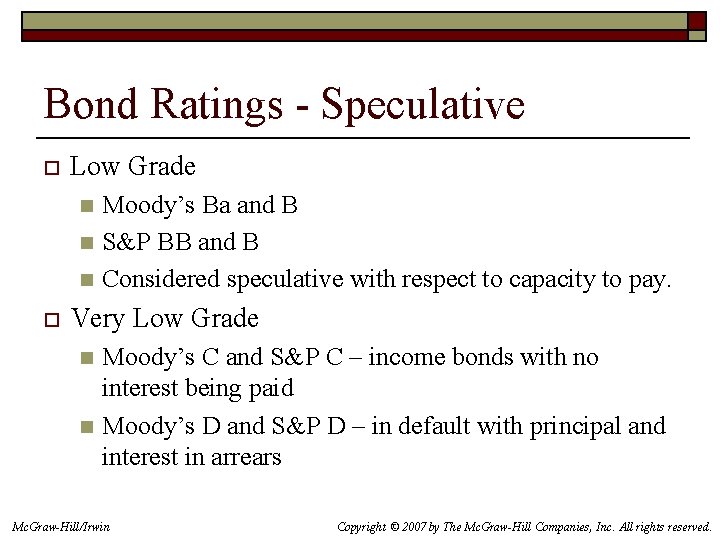
Bond Ratings - Speculative o Low Grade Moody’s Ba and B n S&P BB and B n Considered speculative with respect to capacity to pay. n o Very Low Grade Moody’s C and S&P C – income bonds with no interest being paid n Moody’s D and S&P D – in default with principal and interest in arrears n Mc. Graw-Hill/Irwin Copyright © 2007 by The Mc. Graw-Hill Companies, Inc. All rights reserved.
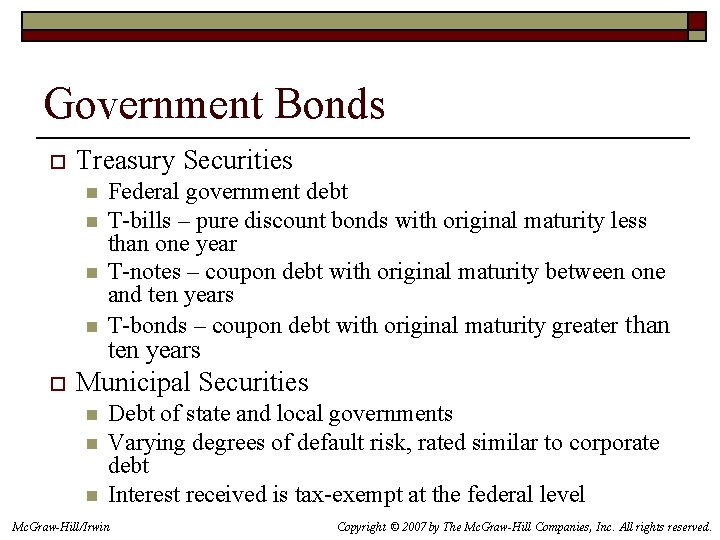
Government Bonds o Treasury Securities n n o Federal government debt T-bills – pure discount bonds with original maturity less than one year T-notes – coupon debt with original maturity between one and ten years T-bonds – coupon debt with original maturity greater than ten years Municipal Securities n n n Debt of state and local governments Varying degrees of default risk, rated similar to corporate debt Interest received is tax-exempt at the federal level Mc. Graw-Hill/Irwin Copyright © 2007 by The Mc. Graw-Hill Companies, Inc. All rights reserved.
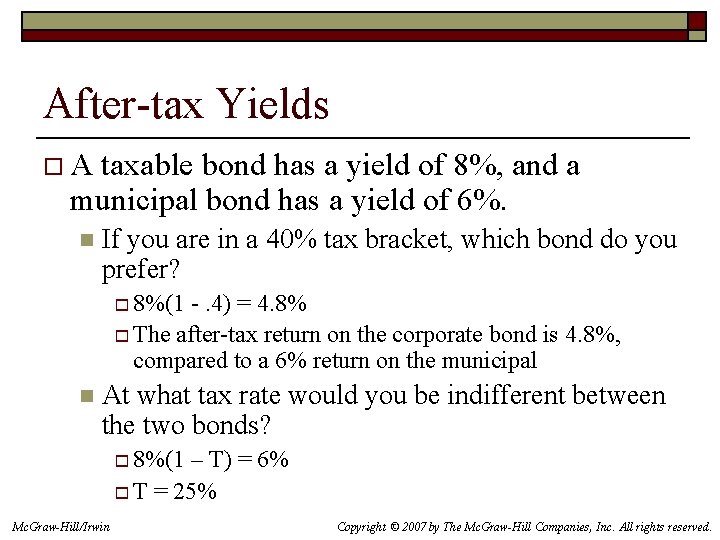
After-tax Yields o. A taxable bond has a yield of 8%, and a municipal bond has a yield of 6%. n If you are in a 40% tax bracket, which bond do you prefer? o 8%(1 -. 4) = 4. 8% o The after-tax return on the corporate bond is 4. 8%, compared to a 6% return on the municipal n At what tax rate would you be indifferent between the two bonds? o 8%(1 – T) = 6% o T = 25% Mc. Graw-Hill/Irwin Copyright © 2007 by The Mc. Graw-Hill Companies, Inc. All rights reserved.
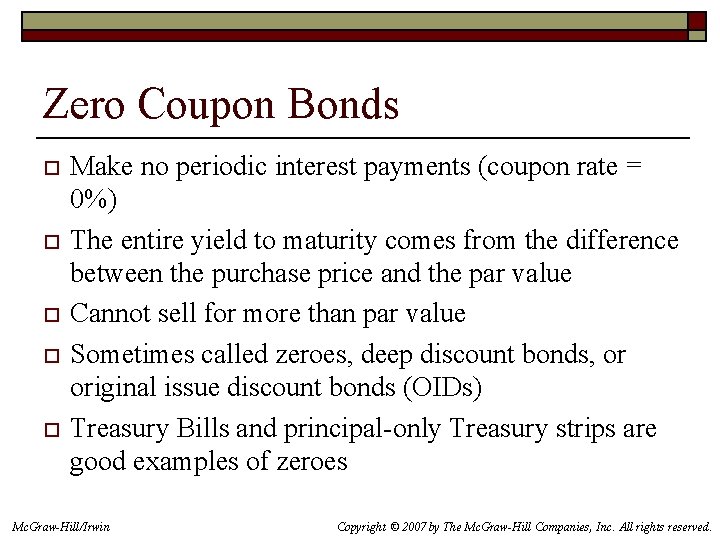
Zero Coupon Bonds o o o Make no periodic interest payments (coupon rate = 0%) The entire yield to maturity comes from the difference between the purchase price and the par value Cannot sell for more than par value Sometimes called zeroes, deep discount bonds, or original issue discount bonds (OIDs) Treasury Bills and principal-only Treasury strips are good examples of zeroes Mc. Graw-Hill/Irwin Copyright © 2007 by The Mc. Graw-Hill Companies, Inc. All rights reserved.
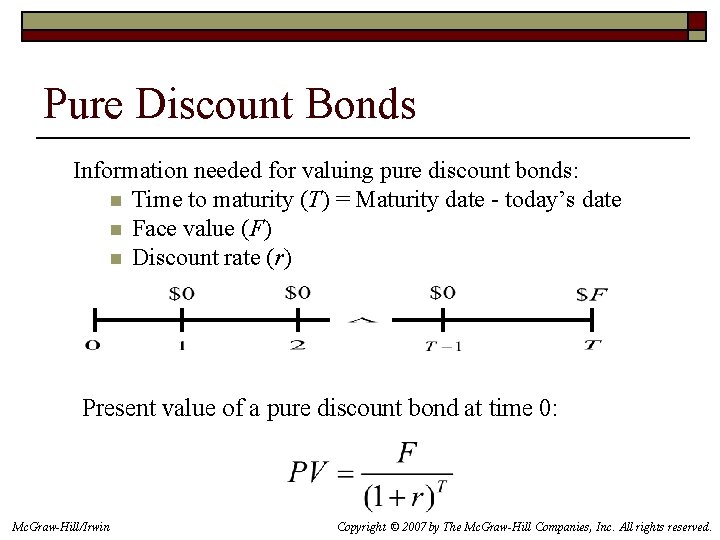
Pure Discount Bonds Information needed for valuing pure discount bonds: n Time to maturity (T) = Maturity date - today’s date n Face value (F) n Discount rate (r) Present value of a pure discount bond at time 0: Mc. Graw-Hill/Irwin Copyright © 2007 by The Mc. Graw-Hill Companies, Inc. All rights reserved.
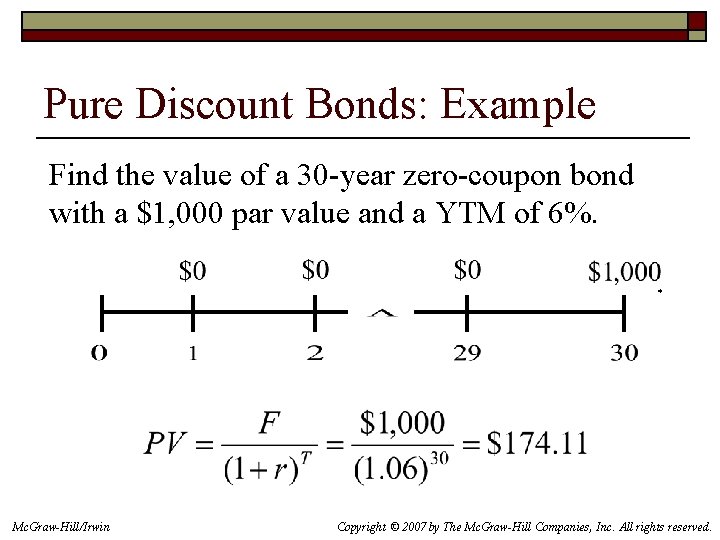
Pure Discount Bonds: Example Find the value of a 30 -year zero-coupon bond with a $1, 000 par value and a YTM of 6%. Mc. Graw-Hill/Irwin Copyright © 2007 by The Mc. Graw-Hill Companies, Inc. All rights reserved.
Floating Rate Bonds o o o Coupon rate floats depending on some index value Examples – adjustable rate mortgages and inflationlinked Treasuries There is less price risk with floating rate bonds. n o The coupon floats, so it is less likely to differ substantially from the yield to maturity. Coupons may have a “collar” – the rate cannot go above a specified “ceiling” or below a specified “floor. ” Mc. Graw-Hill/Irwin Copyright © 2007 by The Mc. Graw-Hill Companies, Inc. All rights reserved.
Other Bond Types o Income bonds o Convertible bonds o Put bonds o There are many other types of provisions that can be added to a bond, and many bonds have several provisions – it is important to recognize how these provisions affect required returns. Mc. Graw-Hill/Irwin Copyright © 2007 by The Mc. Graw-Hill Companies, Inc. All rights reserved.
5. 5 Bond Markets o Primarily over-the-counter transactions with dealers connected electronically o Extremely large number of bond issues, but generally low daily volume in single issues o Makes getting up-to-date prices difficult, particularly on a small company or municipal issues o Treasury securities are an exception Mc. Graw-Hill/Irwin Copyright © 2007 by The Mc. Graw-Hill Companies, Inc. All rights reserved.
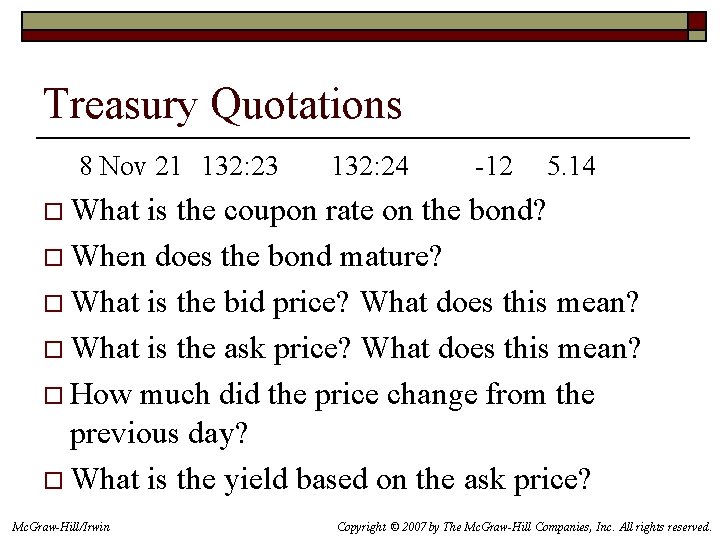
Treasury Quotations 8 Nov 21 132: 23 132: 24 -12 5. 14 o What is the coupon rate on the bond? o When does the bond mature? o What is the bid price? What does this mean? o What is the ask price? What does this mean? o How much did the price change from the previous day? o What is the yield based on the ask price? Mc. Graw-Hill/Irwin Copyright © 2007 by The Mc. Graw-Hill Companies, Inc. All rights reserved.
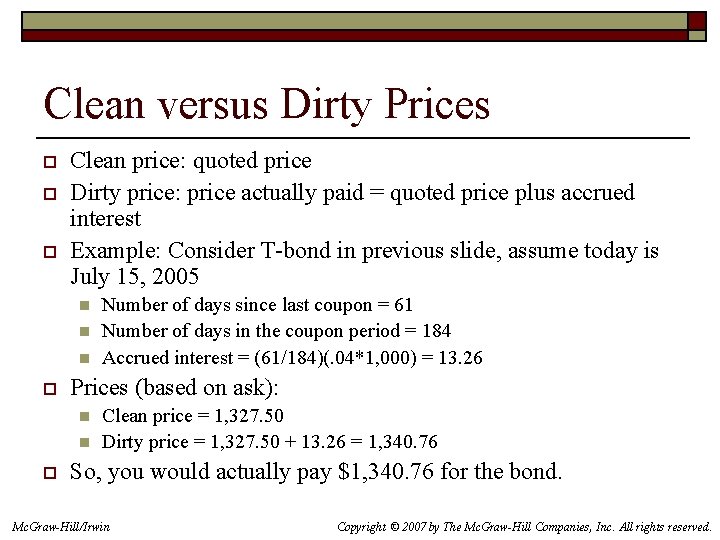
Clean versus Dirty Prices o o o Clean price: quoted price Dirty price: price actually paid = quoted price plus accrued interest Example: Consider T-bond in previous slide, assume today is July 15, 2005 n n n o Prices (based on ask): n n o Number of days since last coupon = 61 Number of days in the coupon period = 184 Accrued interest = (61/184)(. 04*1, 000) = 13. 26 Clean price = 1, 327. 50 Dirty price = 1, 327. 50 + 13. 26 = 1, 340. 76 So, you would actually pay $1, 340. 76 for the bond. Mc. Graw-Hill/Irwin Copyright © 2007 by The Mc. Graw-Hill Companies, Inc. All rights reserved.
5. 6 Inflation and Interest Rates o Real rate of interest – change in purchasing power o Nominal rate of interest – quoted rate of interest, change in purchasing power and inflation o The ex ante nominal rate of interest includes our desired real rate of return plus an adjustment for expected inflation. Mc. Graw-Hill/Irwin Copyright © 2007 by The Mc. Graw-Hill Companies, Inc. All rights reserved.
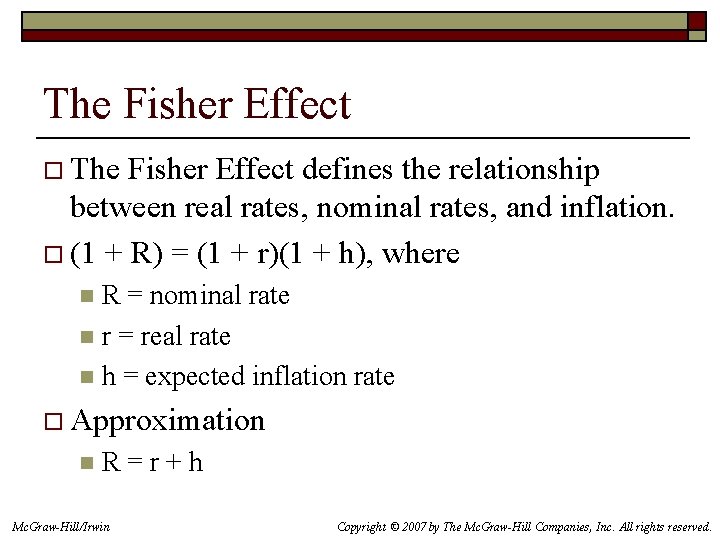
The Fisher Effect o The Fisher Effect defines the relationship between real rates, nominal rates, and inflation. o (1 + R) = (1 + r)(1 + h), where R = nominal rate n r = real rate n h = expected inflation rate n o Approximation n R=r+h Mc. Graw-Hill/Irwin Copyright © 2007 by The Mc. Graw-Hill Companies, Inc. All rights reserved.
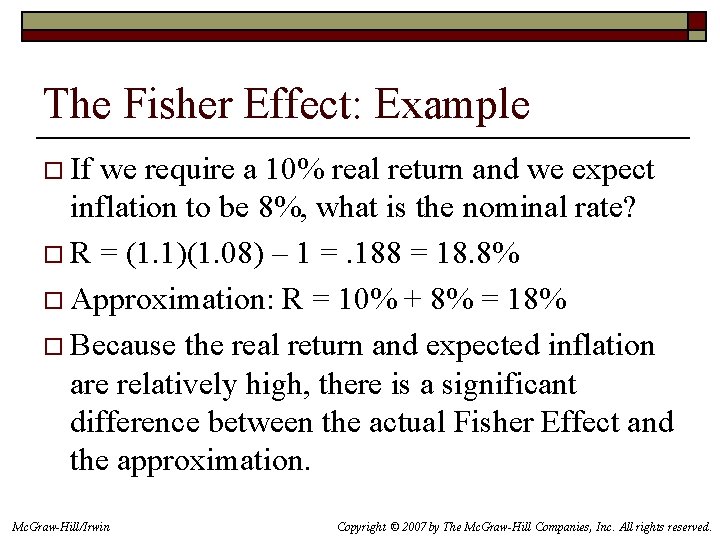
The Fisher Effect: Example o If we require a 10% real return and we expect inflation to be 8%, what is the nominal rate? o R = (1. 1)(1. 08) – 1 =. 188 = 18. 8% o Approximation: R = 10% + 8% = 18% o Because the real return and expected inflation are relatively high, there is a significant difference between the actual Fisher Effect and the approximation. Mc. Graw-Hill/Irwin Copyright © 2007 by The Mc. Graw-Hill Companies, Inc. All rights reserved.
5. 7 Determinants of Bond Yields o Term structure is the relationship between time to maturity and yields, all else equal. o It is important to recognize that we pull out the effect of default risk, different coupons, etc. o Yield curve – graphical representation of the term structure Normal – upward-sloping, long-term yields are higher than short-term yields n Inverted – downward-sloping, long-term yields are lower than short-term yields n Mc. Graw-Hill/Irwin Copyright © 2007 by The Mc. Graw-Hill Companies, Inc. All rights reserved.
Factors Affecting Required Return o Default risk premium – remember bond ratings o Taxability premium – remember municipal versus taxable o Liquidity premium – bonds that have more frequent trading will generally have lower required returns o Anything else that affects the risk of the cash flows to the bondholders will affect the required returns. Mc. Graw-Hill/Irwin Copyright © 2007 by The Mc. Graw-Hill Companies, Inc. All rights reserved.
Quick Quiz o o o How do you find the value of a bond, and why do bond prices change? What is a bond indenture, and what are some of the important features? What are bond ratings, and why are they important? How does inflation affect interest rates? What is the term structure of interest rates? What factors determine the required return on bonds? Mc. Graw-Hill/Irwin Copyright © 2007 by The Mc. Graw-Hill Companies, Inc. All rights reserved.
- Slides: 43