
Chapter 5 InitialValue Problems for Ordinary Differential Equations
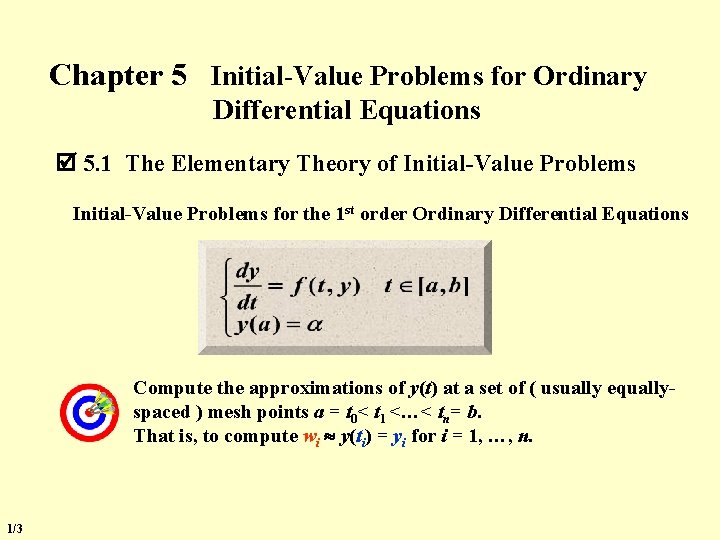
Chapter 5 Initial-Value Problems for Ordinary Differential Equations 5. 1 The Elementary Theory of Initial-Value Problems for the 1 st order Ordinary Differential Equations Compute the approximations of y(t) at a set of ( usually equallyspaced ) mesh points a = t 0< t 1 <…< tn= b. That is, to compute wi y(ti) = yi for i = 1, …, n. 1/3
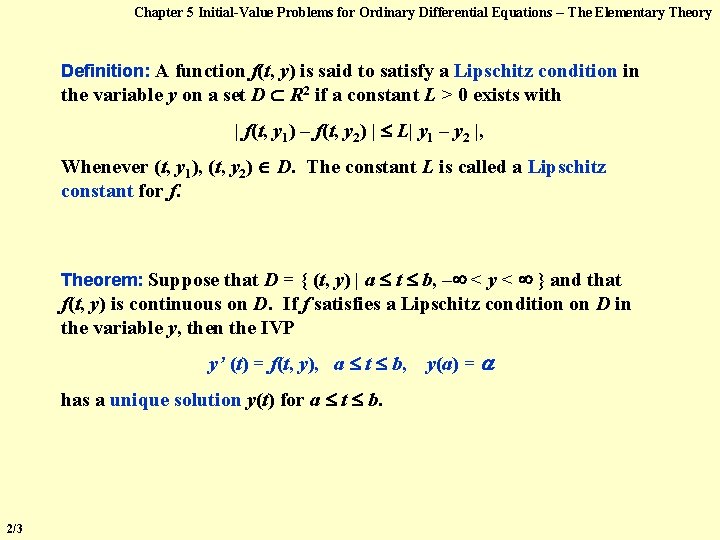
Chapter 5 Initial-Value Problems for Ordinary Differential Equations -- The Elementary Theory Definition: A function f(t, y) is said to satisfy a Lipschitz condition in the variable y on a set D R 2 if a constant L > 0 exists with | f(t, y 1) – f(t, y 2) | L| y 1 – y 2 |, Whenever (t, y 1), (t, y 2) D. The constant L is called a Lipschitz constant for f. Theorem: Suppose that D = { (t, y) | a t b, – < y < } and that f(t, y) is continuous on D. If f satisfies a Lipschitz condition on D in the variable y, then the IVP y’ (t) = f(t, y), a t b, has a unique solution y(t) for a t b. 2/3 y(a) =

Chapter 5 Initial-Value Problems for Ordinary Differential Equations -- The Elementary Theory Definition: The initial-value problem y’(t) = f(t, y), a t b, y(a) = is said to be a well-posed problem if: 1. A unique solution, y(t), to the problem exists; 2. For any > 0, there exists a positive constant k( ), such that whenever | 0 | < and (t) is continuous with | (t) | < on [a, b], a unique solution, z(t), to 3. 4. z’(t) = f(t, z) + (t), a t b, z(a) = + 0 /* perturbed problem*/ exists with | z(t) – y(t) | < k( ) , for all a t b. Theorem: Suppose that D = { (t, y) | a t b, – < y < } and that f(t, y) is continuous on D. If f satisfies a Lipschitz condition on D in the variable y, then the IVP y’ (t) = f(t, y), a t b, is well-posed. 3/3 y(a) =
- Slides: 3