
Chapter 5 Infancy Module 2 Cognitive Development in


















- Slides: 71
Chapter 5: Infancy Module 2 Cognitive Development in Infancy Discovering the Lifespan - Robert S. Feldman Copyright © 2009 Pearson Education, Inc. , Upper Saddle River, NJ 07458. All rights reserved.
PIAGET’S APPROACH TO COGNITIVE DEVELOPMENT Discovering the Lifespan - Robert S. Feldman Copyright © 2009 Pearson Education, Inc. , Upper Saddle River, NJ 07458. All rights reserved.
Key Elements of Piaget’s Theory • Action = Knowledge • Four universal stages in fixed order • Development = physical maturation and exposure to relevant experiences • Schemes adapt and change 107 Discovering the Lifespan - Robert S. Feldman Copyright © 2009 Pearson Education, Inc. , Upper Saddle River, NJ 07458. All rights reserved.
At each stage, child’s mind develops in a new way from simple to complex Organization: tendency to create increasingly complex cognitive structures (system of knowledge; ways of thinking that incorporate more and more accurate images of reality Schemas: organized patterns of behavior that a person uses to think about and act in a situation. Discovering the Lifespan - Robert S. Feldman Copyright © 2009 Pearson Education, Inc. , Upper Saddle River, NJ 07458. All rights reserved.
What principles underlie this cognitive growth? • Assimilation • Accommodation 108 Discovering the Lifespan - Robert S. Feldman Copyright © 2009 Pearson Education, Inc. , Upper Saddle River, NJ 07458. All rights reserved.
Adaptation: how children handle new information in light of what they already know Assimilation: taking new information and incorporating it into existing cognitive structures (sucking on sippie cup versus breats) Accommodation: adjusting one’s cognitive structures to fit new information (sipping from cup/glass, changes how uses tongue/mouth) Discovering the Lifespan - Robert S. Feldman Copyright © 2009 Pearson Education, Inc. , Upper Saddle River, NJ 07458. All rights reserved.
Earliest Stage of Cognitive Growth Sensorimotor Period • Invariant order of stages • Individual differences in rate • Transitions include characteristics of both stages 108 Discovering the Lifespan - Robert S. Feldman Copyright © 2009 Pearson Education, Inc. , Upper Saddle River, NJ 07458. All rights reserved.
A Closer Look • Substage 1: Simple Reflexes First month of life – Various various inborn reflexes • At center of a baby’s physical and cognitive life • Determine nature of infant’s interactions with world – At the same time, some of reflexes begin to accommodate the infant’s experiences 109 Discovering the Lifespan - Robert S. Feldman Copyright © 2009 Pearson Education, Inc. , Upper Saddle River, NJ 07458. All rights reserved.
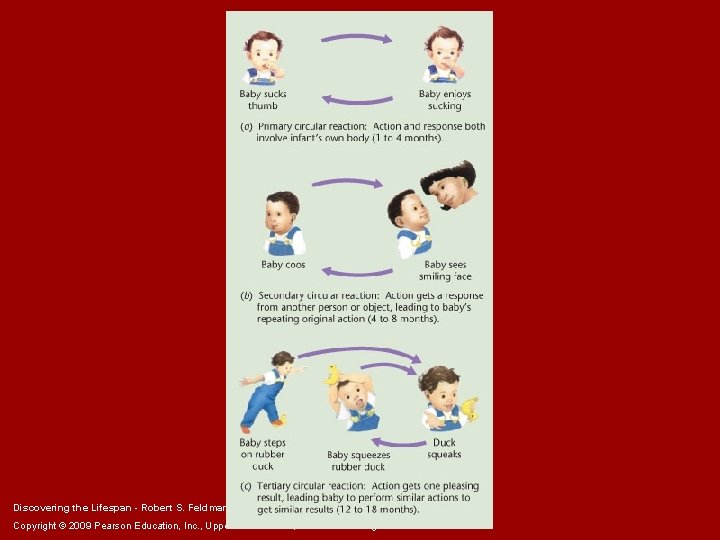
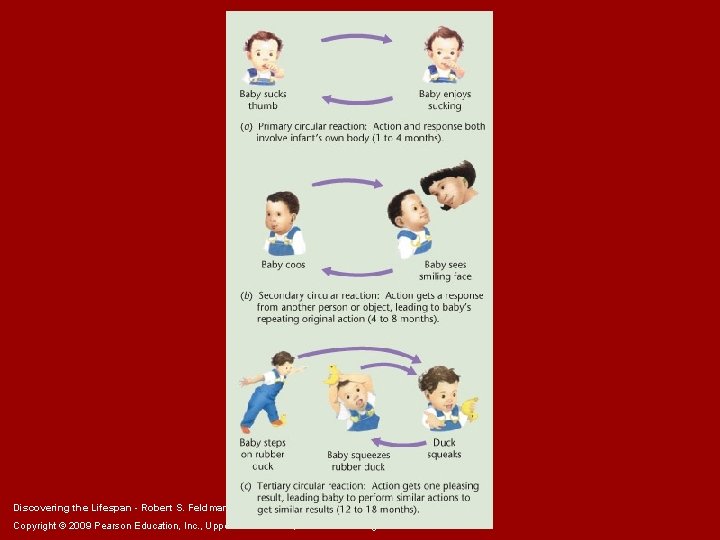
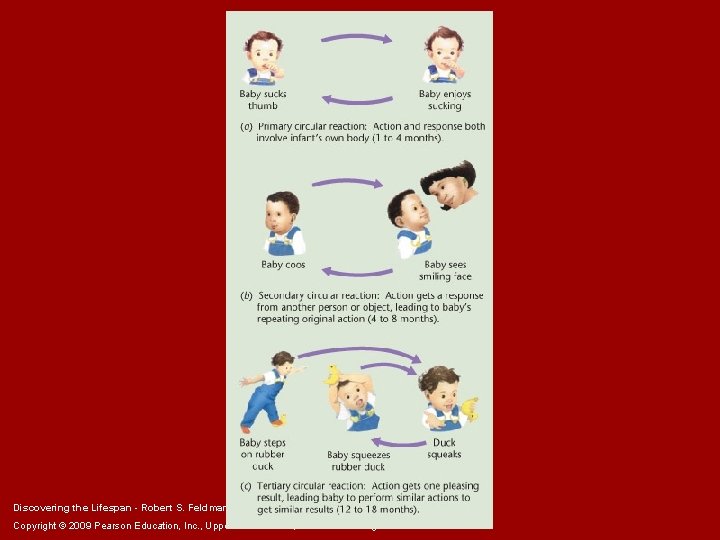
A Closer Look Substage 2: First Habits and Primary Circular Reactions 1 to 4 months of age • Beginning of coordination of what were separate actions into single, integrated activities. • Activities that engage baby’s interests are repeated simply for sake of continuing to experience it – Circular reaction – Primary circular reaction 109 Discovering the Lifespan - Robert S. Feldman Copyright © 2009 Pearson Education, Inc. , Upper Saddle River, NJ 07458. All rights reserved.
Discovering the Lifespan - Robert S. Feldman Copyright © 2009 Pearson Education, Inc. , Upper Saddle River, NJ 07458. All rights reserved.
A Closer Look Substage 3: Secondary Circular Reactions 4 to 8 months of age • Child begins to act upon outside world • Infants now seek to repeat enjoyable events in their environments that are produced through chance activities • Secondary circular reactions 110 Discovering the Lifespan - Robert S. Feldman Copyright © 2009 Pearson Education, Inc. , Upper Saddle River, NJ 07458. All rights reserved.
Discovering the Lifespan - Robert S. Feldman Copyright © 2009 Pearson Education, Inc. , Upper Saddle River, NJ 07458. All rights reserved.
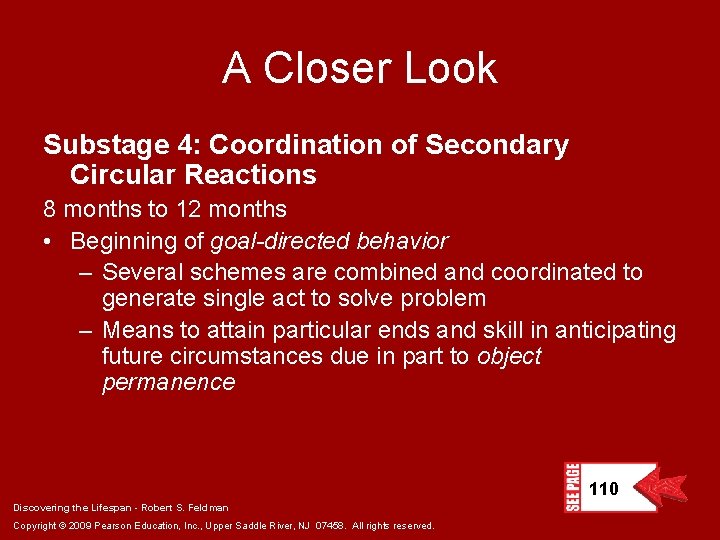
A Closer Look Substage 4: Coordination of Secondary Circular Reactions 8 months to 12 months • Beginning of goal-directed behavior – Several schemes are combined and coordinated to generate single act to solve problem – Means to attain particular ends and skill in anticipating future circumstances due in part to object permanence 110 Discovering the Lifespan - Robert S. Feldman Copyright © 2009 Pearson Education, Inc. , Upper Saddle River, NJ 07458. All rights reserved.
Come out, come out, wherever you are! Discovering the Lifespan - Robert S. Feldman Copyright © 2009 Pearson Education, Inc. , Upper Saddle River, NJ 07458. All rights reserved.
Object Permanence 111 Discovering the Lifespan - Robert S. Feldman Copyright © 2009 Pearson Education, Inc. , Upper Saddle River, NJ 07458. All rights reserved.
A Closer Look Substage 5: Tertiary Circular Reactions 12 to 18 months • Development of schemes regarding deliberate variation of actions that bring desirable consequences • Carrying out miniature experiments to observe consequences 110 Discovering the Lifespan - Robert S. Feldman Copyright © 2009 Pearson Education, Inc. , Upper Saddle River, NJ 07458. All rights reserved.
Discovering the Lifespan - Robert S. Feldman Copyright © 2009 Pearson Education, Inc. , Upper Saddle River, NJ 07458. All rights reserved.
A Closer Look Substage 6: Beginnings of Thought 18 months to 2 years • Capacity for mental representation or symbolic thought – Mental representation – Understanding causality – Ability to pretend – Deferred imitation 111 Discovering the Lifespan - Robert S. Feldman Copyright © 2009 Pearson Education, Inc. , Upper Saddle River, NJ 07458. All rights reserved.
Assessing Piagetian Theory PROS CONS • Descriptions of child cognitive development accurate in many ways • Substantial disagreement over validity of theory and many of its specific predictions – Piaget was pioneering figure in field of development – Children learn by acting on environment – Broad outlines of sequence of cognitive development and increasing cognitive accomplishments are generally accurate – Stage conception questioned – Connection between motor development and cognitive development exaggerated – Object permanence can occur earlier under certain conditions – Onset of age of imitation questioned – Cultural variations not considered 111 Discovering the Lifespan - Robert S. Feldman Copyright © 2009 Pearson Education, Inc. , Upper Saddle River, NJ 07458. All rights reserved.
Review and Apply REVIEW • Piaget’s theory of human cognitive development involves a succession of stages through which children progress from birth to adolescence. • As infants move from one stage to another, the way they understand the world changes. Discovering the Lifespan - Robert S. Feldman Copyright © 2009 Pearson Education, Inc. , Upper Saddle River, NJ 07458. All rights reserved. 113
Review and Apply REVIEW • The sensorimotor stage, from birth to about 2 years, involves a gradual progression through simple reflexes, single coordinated activities, interest in the outside world, purposeful combinations of activities, manipulation of actions to produce desired outcomes, and symbolic thought. The sensorimotor stage has six substages. Discovering the Lifespan - Robert S. Feldman Copyright © 2009 Pearson Education, Inc. , Upper Saddle River, NJ 07458. All rights reserved. 113
Review and Apply APPLY • Think of a common young children’s toy with which you are familiar. How might its use be affected by the principles of assimilation and accommodation? Discovering the Lifespan - Robert S. Feldman Copyright © 2009 Pearson Education, Inc. , Upper Saddle River, NJ 07458. All rights reserved. 113
INFORMATION-PROCESSING APPROACHES TO COGNITIVE DEVELOPMENT Discovering the Lifespan - Robert S. Feldman Copyright © 2009 Pearson Education, Inc. , Upper Saddle River, NJ 07458. All rights reserved.
What is information-processing? • Identifies the way that individuals take in, store, and use information • Involves quantitative changes in ability to organize and manipulate information • Increases sophistication, speed, and capacity in information processing characterizes cognitive growth • Focuses on types of “mental programs” used when seeking to solve problems 113 Discovering the Lifespan - Robert S. Feldman Copyright © 2009 Pearson Education, Inc. , Upper Saddle River, NJ 07458. All rights reserved.
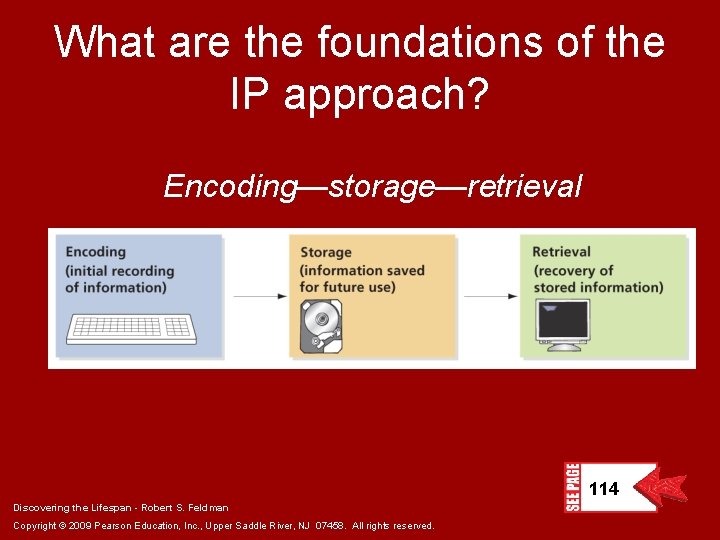
What are the foundations of the IP approach? Encoding—storage—retrieval 114 Discovering the Lifespan - Robert S. Feldman Copyright © 2009 Pearson Education, Inc. , Upper Saddle River, NJ 07458. All rights reserved.
How does cognition compute? • Encoding • Storage • Retrieval 114 Discovering the Lifespan - Robert S. Feldman Copyright © 2009 Pearson Education, Inc. , Upper Saddle River, NJ 07458. All rights reserved.
What automatic processes are being engaged as you listen to this lecture? Discovering the Lifespan - Robert S. Feldman Copyright © 2009 Pearson Education, Inc. , Upper Saddle River, NJ 07458. All rights reserved.
Automatization • Degree to which activity requires attention • Helps with initial encounters with stimuli through easy and automatic information processing 114 Discovering the Lifespan - Robert S. Feldman Copyright © 2009 Pearson Education, Inc. , Upper Saddle River, NJ 07458. All rights reserved.
What do you think? Infants cannot remember Discovering the Lifespan - Robert S. Feldman Copyright © 2009 Pearson Education, Inc. , Upper Saddle River, NJ 07458. All rights reserved.
Memory Capabilities in Infancy Getting a kick out of that! • Kicking research demonstrates increase with age in memory capacities 115 Discovering the Lifespan - Robert S. Feldman Copyright © 2009 Pearson Education, Inc. , Upper Saddle River, NJ 07458. All rights reserved.
How long do memories last? • Researchers disagree on the age from which memories can be retrieved – Early studies infantile amnesia – Myers clear evidence of early memory • Physical trace of a memory in brain appears to be relatively permanent – Memories may not be easily, or accurately, retrieved 115 Discovering the Lifespan - Robert S. Feldman Copyright © 2009 Pearson Education, Inc. , Upper Saddle River, NJ 07458. All rights reserved.
What role does language play in determining the way early memories are recalled? Discovering the Lifespan - Robert S. Feldman Copyright © 2009 Pearson Education, Inc. , Upper Saddle River, NJ 07458. All rights reserved.
So…do infants remember? • Theoretical possibility for interfered memories to remain intact from a very young • Most cases memories of personal experiences in infancy do not last into adulthood • Memories of personal experience seem not to become accurate before age 18 to 24 months 115 Discovering the Lifespan - Robert S. Feldman Copyright © 2009 Pearson Education, Inc. , Upper Saddle River, NJ 07458. All rights reserved.
Individual Differences in Intelligence Information-Processing Approaches • Infant information-processing speed may correlate most strongly with later intelligence 116 Discovering the Lifespan - Robert S. Feldman Copyright © 2009 Pearson Education, Inc. , Upper Saddle River, NJ 07458. All rights reserved.
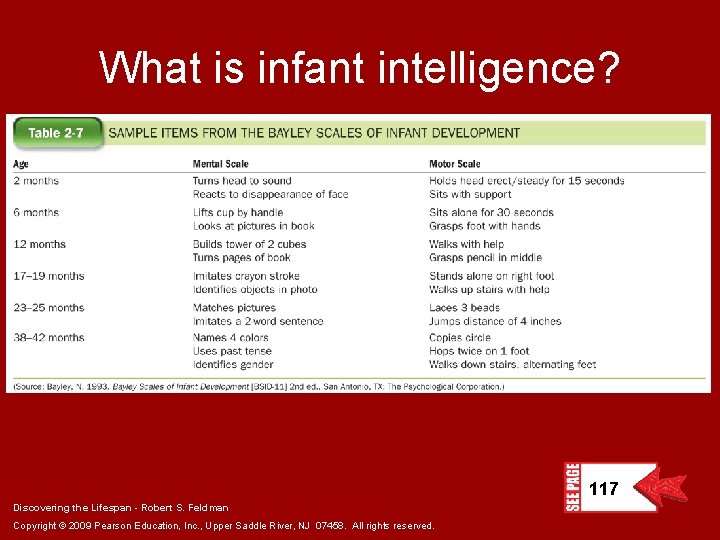
What is infant intelligence? 117 Discovering the Lifespan - Robert S. Feldman Copyright © 2009 Pearson Education, Inc. , Upper Saddle River, NJ 07458. All rights reserved.
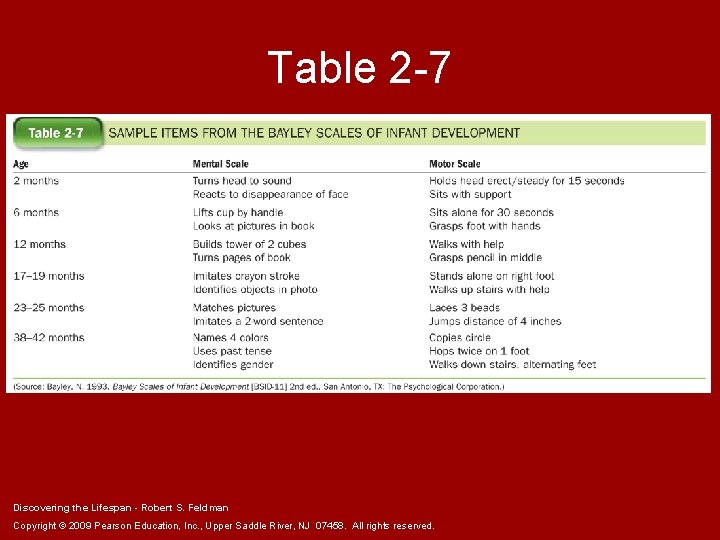
Do, Re, Me…. . Intelligence! Developmental Scales • Gesell: – Developmental quotient – Performance compared at different ages for significant variation from norms of given age – Four domains: motor skills, language use, adaptive behavior, personal-social 117 Discovering the Lifespan - Robert S. Feldman Copyright © 2009 Pearson Education, Inc. , Upper Saddle River, NJ 07458. All rights reserved.
Table 2 -7 Discovering the Lifespan - Robert S. Feldman Copyright © 2009 Pearson Education, Inc. , Upper Saddle River, NJ 07458. All rights reserved.
Are developmental scales useful? YES NO • Provide a good snapshot of current developmental level • Provide objective assessment of behavior relative to norms • Do not provide good prediction for future development 117 Discovering the Lifespan - Robert S. Feldman Copyright © 2009 Pearson Education, Inc. , Upper Saddle River, NJ 07458. All rights reserved.
What characterizes a “fast” baby? Discovering the Lifespan - Robert S. Feldman Copyright © 2009 Pearson Education, Inc. , Upper Saddle River, NJ 07458. All rights reserved.
And so…what does IP research reveal? • Relationship between information processing efficiency and cognitive abilities – Correlate moderately well with later measures of intelligence – More efficient information processing during the 6 months following birth is related to higher intelligence scores between 2 and 12 years of age and other measures of cognitive competence 118 Discovering the Lifespan - Robert S. Feldman Copyright © 2009 Pearson Education, Inc. , Upper Saddle River, NJ 07458. All rights reserved.
Assessing the IP Approach PROS CONS • Often uses more precise measures of cognitive ability • Critical in providing information about infant cognition • Precision makes it more difficult to get overall sense of cognitive development 118 Discovering the Lifespan - Robert S. Feldman Copyright © 2009 Pearson Education, Inc. , Upper Saddle River, NJ 07458. All rights reserved.
From Research to Practice Taking the Einstein Out of Baby Einstein • Kaiser Family Foundation Report – Marketing of educational media for infants is far outpaced by research on its effectiveness – Correlational studies – Company reluctance to test claims 119 Discovering the Lifespan - Robert S. Feldman Copyright © 2009 Pearson Education, Inc. , Upper Saddle River, NJ 07458. All rights reserved.
Beyond (or creating) Teletubbies! What does the research reveal? • Effect on language learning – Infants do not learn language from rote repetition; social interaction and context needed 119 Discovering the Lifespan - Robert S. Feldman Copyright © 2009 Pearson Education, Inc. , Upper Saddle River, NJ 07458. All rights reserved.
What constitutes appropriate use of educational media for infants? Discovering the Lifespan - Robert S. Feldman Copyright © 2009 Pearson Education, Inc. , Upper Saddle River, NJ 07458. All rights reserved.
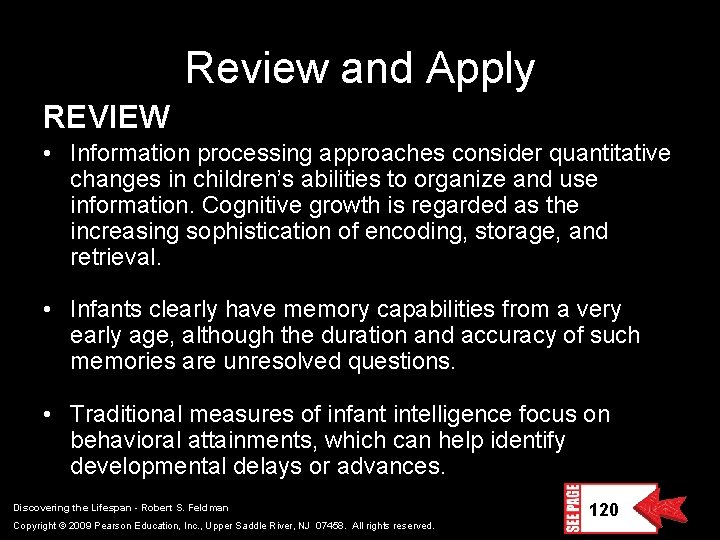
Review and Apply REVIEW • Information processing approaches consider quantitative changes in children’s abilities to organize and use information. Cognitive growth is regarded as the increasing sophistication of encoding, storage, and retrieval. • Infants clearly have memory capabilities from a very early age, although the duration and accuracy of such memories are unresolved questions. • Traditional measures of infant intelligence focus on behavioral attainments, which can help identify developmental delays or advances. Discovering the Lifespan - Robert S. Feldman Copyright © 2009 Pearson Education, Inc. , Upper Saddle River, NJ 07458. All rights reserved. 120
Review and Apply APPLY • What information from this module could you use to refute the claims of books or educational programs that promise to help parents increase their babies’ intelligence or instill advanced intellectual skills in infants? Based on valid research, what approaches would you use for intellectual development of infants? 120 Discovering the Lifespan - Robert S. Feldman Copyright © 2009 Pearson Education, Inc. , Upper Saddle River, NJ 07458. All rights reserved.
THE ROOTS OF LANGUAGE Discovering the Lifespan - Robert S. Feldman Copyright © 2009 Pearson Education, Inc. , Upper Saddle River, NJ 07458. All rights reserved.
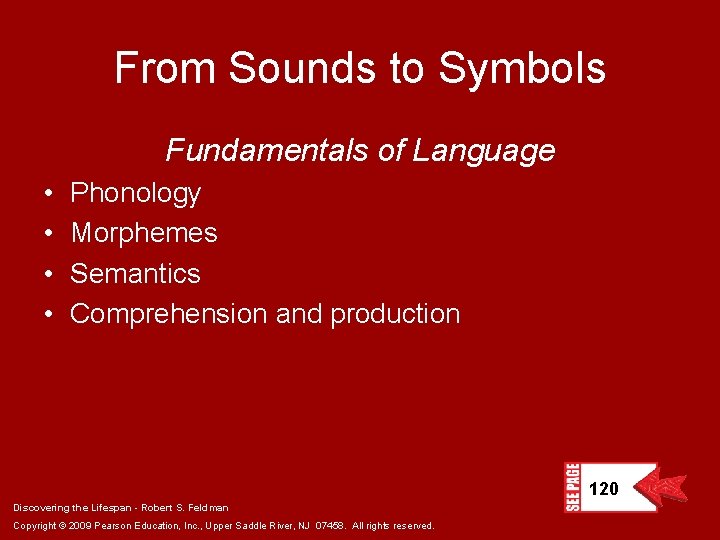
From Sounds to Symbols Fundamentals of Language • • Phonology Morphemes Semantics Comprehension and production 120 Discovering the Lifespan - Robert S. Feldman Copyright © 2009 Pearson Education, Inc. , Upper Saddle River, NJ 07458. All rights reserved.
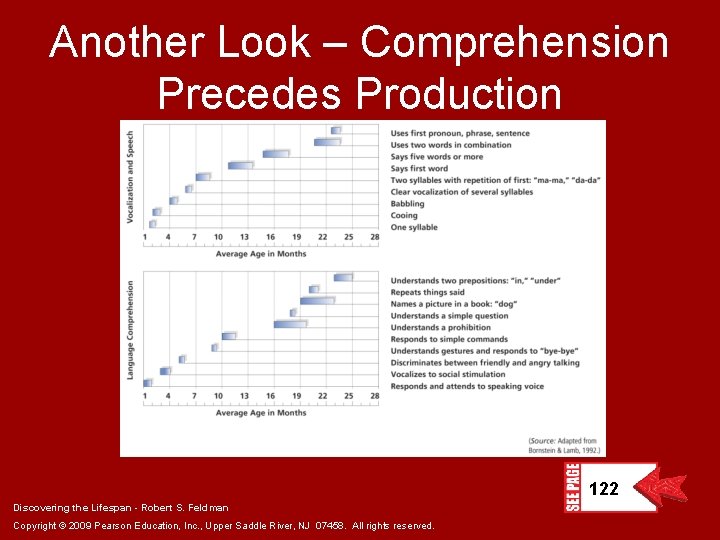
Another Look – Comprehension Precedes Production 122 Discovering the Lifespan - Robert S. Feldman Copyright © 2009 Pearson Education, Inc. , Upper Saddle River, NJ 07458. All rights reserved.
Early Sounds and Communication Prelinguistic Communication • Babbling – Universal – Repetition of sounds 121 Discovering the Lifespan - Robert S. Feldman Copyright © 2009 Pearson Education, Inc. , Upper Saddle River, NJ 07458. All rights reserved.
See what I say… Infants with hearing impairments • Babble with hands instead of voices • Gestural and verbal babbling activate same neural centers 121 Discovering the Lifespan - Robert S. Feldman Copyright © 2009 Pearson Education, Inc. , Upper Saddle River, NJ 07458. All rights reserved.
What comes after “ba-ba-ba-ba”? Progression from Simple to Complex • Exposure to speech sounds of particular language initially do not influence babbling – At 6 months babbling reflects of language of culture – Distinguishable from other language babbling • Combinations of sounds and gestures used to communicate 121 Discovering the Lifespan - Robert S. Feldman Copyright © 2009 Pearson Education, Inc. , Upper Saddle River, NJ 07458. All rights reserved.
First Words • Increase at rapid rate – 10 to 14 months = first word – 15 months = 10 words – 18 months = one-word stage ends – 16 to 24 months = language explosion equally 50 to 400 words 122 Discovering the Lifespan - Robert S. Feldman Copyright © 2009 Pearson Education, Inc. , Upper Saddle River, NJ 07458. All rights reserved.
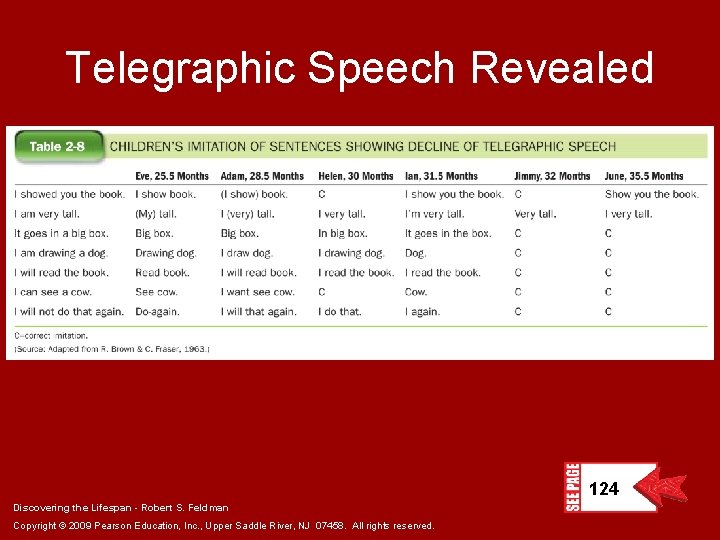
First Sentences • First sentences created around 8 to 12 months after first words • Indicate understanding of labels and relationships between these • Often observations rather than demands • Use order similar to adult speech with missing words – Telegraphic speech 123 Discovering the Lifespan - Robert S. Feldman Copyright © 2009 Pearson Education, Inc. , Upper Saddle River, NJ 07458. All rights reserved.
Telegraphic Speech Revealed 124 Discovering the Lifespan - Robert S. Feldman Copyright © 2009 Pearson Education, Inc. , Upper Saddle River, NJ 07458. All rights reserved.
How does proficiency in language occur? Discovering the Lifespan - Robert S. Feldman Copyright © 2009 Pearson Education, Inc. , Upper Saddle River, NJ 07458. All rights reserved.
Origins of Language Development Learning Theory Approaches: Language as a Learned Skill • Language acquisition follows the basic laws of reinforcement and conditioning • Through the process of shaping, language becomes more and more similar to adult speech 124 Discovering the Lifespan - Robert S. Feldman Copyright © 2009 Pearson Education, Inc. , Upper Saddle River, NJ 07458. All rights reserved.
Counter-Arguments to Learning Theory Approach • Does not adequately explain how children readily learn rules of language • Does not account for how children move beyond specific heard utterances to produce novel phrases, sentences and constructions • Does not explain how young children can apply linguistic rules to nonsense words 124 Discovering the Lifespan - Robert S. Feldman Copyright © 2009 Pearson Education, Inc. , Upper Saddle River, NJ 07458. All rights reserved.
Origins of Language Development Nativist Approaches: Language as an Innate Skill • Genetically determined, innate mechanism that directs the development of language • Children are born with innate capacity to use language, which emerges, more or less automatically, due to maturation. – Chomsky’s universal grammar and LAD Discovering the Lifespan - Robert S. Feldman Copyright © 2009 Pearson Education, Inc. , Upper Saddle River, NJ 07458. All rights reserved. 125
Assessing Chomsky’s Approach PRO • Specific gene related to speech production identified • Language processing in infant brain structures similar to those in adult speech processing 125 Discovering the Lifespan - Robert S. Feldman Copyright © 2009 Pearson Education, Inc. , Upper Saddle River, NJ 07458. All rights reserved.
Assessing Chomsky’s Approach CON • Uniqueness of speech countered by primate researchers • Even with genetic priming, language use still requires significant social experience to be used effectively 125 Discovering the Lifespan - Robert S. Feldman Copyright © 2009 Pearson Education, Inc. , Upper Saddle River, NJ 07458. All rights reserved.
Origins of Language Development Interactionist Approaches: Language as a Social Device • Specific course of language development is determined by the language to which children are exposed and reinforcement they receive for using language in particular ways • Social factors are key to development 125 Discovering the Lifespan - Robert S. Feldman Copyright © 2009 Pearson Education, Inc. , Upper Saddle River, NJ 07458. All rights reserved.
Let’s Pretend Turn to a classmate. One of you is a 8 -month-old infant; the other is a parent. As the parent, ask your “infant” classmate: “Would you like a cookie? ” Discovering the Lifespan - Robert S. Feldman Copyright © 2009 Pearson Education, Inc. , Upper Saddle River, NJ 07458. All rights reserved.
How does this speech change? • Infant-directed speech changes as children become older – Around the end of the first year, takes on more adultlike qualities – Sentences become longer and more complex, although individual words are still spoken slowly and deliberately – Pitch used to focus attention on important words 126 Discovering the Lifespan - Robert S. Feldman Copyright © 2009 Pearson Education, Inc. , Upper Saddle River, NJ 07458. All rights reserved.
Does Cootsy-Coo Work? Infant-directed speech plays an important role in infants’ acquisition of language – Occurs all over the world, though there are cultural variations – Preferred by newborns – Babies who are exposed to a infant-directed speech early in life seem to begin to use words and exhibit other forms of linguistic competence earlier 126 Discovering the Lifespan - Robert S. Feldman Copyright © 2009 Pearson Education, Inc. , Upper Saddle River, NJ 07458. All rights reserved.
Developmental Diversity Do people everywhere say “ba-ba-boo” to their infants? • Words differ but ways spoken are similar • Basic similarities across cultures and in some facets of language specific to particular types of interactions • Quantity of speech differ by cultures 127 Discovering the Lifespan - Robert S. Feldman Copyright © 2009 Pearson Education, Inc. , Upper Saddle River, NJ 07458. All rights reserved.
What then do these similarities in infant-directed speech mean? Discovering the Lifespan - Robert S. Feldman Copyright © 2009 Pearson Education, Inc. , Upper Saddle River, NJ 07458. All rights reserved.
Becoming an Informed Consumer of Development Based upon findings of developmental researchers, infant cognitive development may be promoted by: • Providing infants the opportunity to explore the world • Being responsive to infants on both a verbal and a nonverbal level • Asking questions, listening to their responses, and providing further communication • Reading to infants • Keeping in mind that you don’t have to be with an infant 24 hours a day • Not pushing infants and don’t expect too much too soon 127 Discovering the Lifespan - Robert S. Feldman Copyright © 2009 Pearson Education, Inc. , Upper Saddle River, NJ 07458. All rights reserved.
Review and Apply REVIEW • Before they speak, infants understand many adult utterances and engage in several forms of prelinguistic communication. • Children typically produce their first words between 10 and 14 months, and rapidly increase their vocabularies from that point on, especially during a spurt at about 18 months. 128 Discovering the Lifespan - Robert S. Feldman Copyright © 2009 Pearson Education, Inc. , Upper Saddle River, NJ 07458. All rights reserved.
Review and Apply REVIEW • Learning theorists believe that basic learning processes account for language development, whereas nativists like Noam Chomsky and his followers argue that humans have an innate language capacity. The interactionists suggest that language is a consequence of both environmental and innate factors. 128 Discovering the Lifespan - Robert S. Feldman Copyright © 2009 Pearson Education, Inc. , Upper Saddle River, NJ 07458. All rights reserved.
Review and Apply APPLY • What are some ways in which children’s linguistic development reflects their acquisition of new ways of interpreting and dealing with their world? 128 Discovering the Lifespan - Robert S. Feldman Copyright © 2009 Pearson Education, Inc. , Upper Saddle River, NJ 07458. All rights reserved.