
Chapter 5 Individual Decision Making and Creativity Power






- Slides: 24
Chapter 5 Individual Decision Making and Creativity Power. Point Presentation by Charlie Cook Copyright © 2005 South-Western. All rights reserved.
Learning Objectives After reading and studying this chapter and doing the exercises, you should be able to: 1. Work through the classical/behavioral decision-making model when faced with a major decision. 2. Identify and describe factors that influence the effectiveness of decision making. 3. Understand the nature of creative decision making in organizations. 4. Enhance your creative problem-solving ability. 2
Decisions • Decision defined Ø What takes place when a person chooses among two or more alternative responses or courses of action. • Problem Ø A discrepancy between the ideal and the real that requires a decision about which alternative should be chosen to remedy the discrepancy. 3
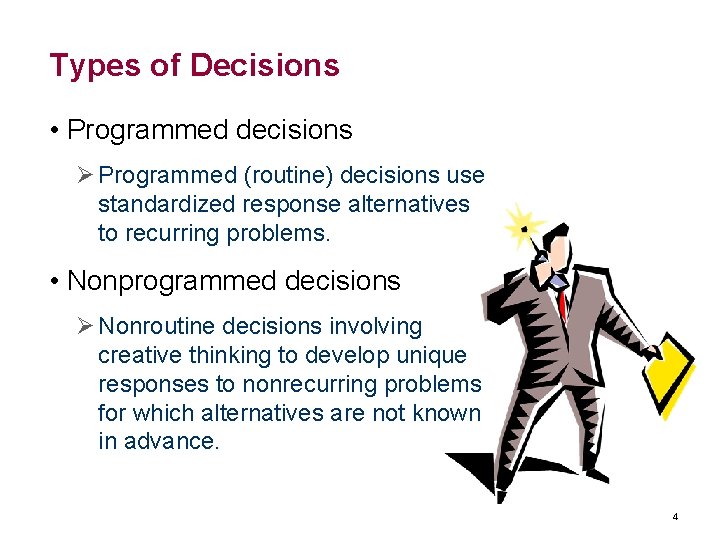
Types of Decisions • Programmed decisions Ø Programmed (routine) decisions use standardized response alternatives to recurring problems. • Nonprogrammed decisions Ø Nonroutine decisions involving creative thinking to develop unique responses to nonrecurring problems for which alternatives are not known in advance. 4
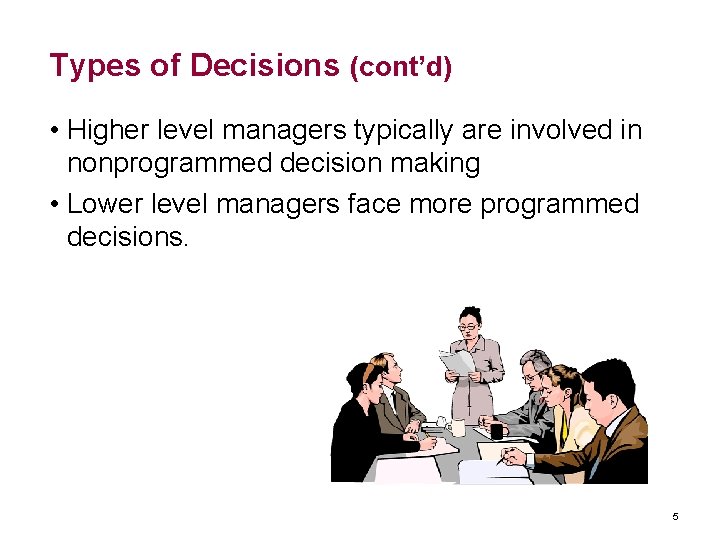
Types of Decisions (cont’d) • Higher level managers typically are involved in nonprogrammed decision making • Lower level managers face more programmed decisions. 5
Degree of Risk and Uncertainty Associated with Decisions Certainty Risk Uncertainty Facts are well known. Facts are unknown. Alternatives are known and outcomes can be predicted accurately. Alternatives are less clearly defined. Few alternatives are known. The probability of outcomes is predicted from experience. The probability of outcomes cannot be predicted accurately. Usually involves lowerlevel issues Low Degree of Risk and Uncertainty High 6
Risk and Uncertainty • Prospect theory Ø The economic model of the idea that the most people have an aversion to loss and depending upon depends upon whether the person frames the decision in terms of winning or losing. v If decision risk is framed in terms of winning, managers are more likely to take a chance on an outcome of potential value. v If decision risk is framed negatively, managers are less likely to take the risk. 7
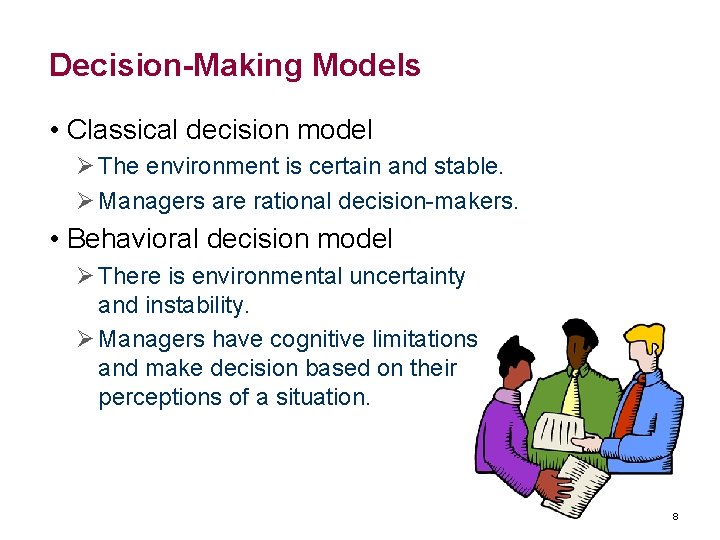
Decision-Making Models • Classical decision model Ø The environment is certain and stable. Ø Managers are rational decision-makers. • Behavioral decision model Ø There is environmental uncertainty and instability. Ø Managers have cognitive limitations and make decision based on their perceptions of a situation. 8
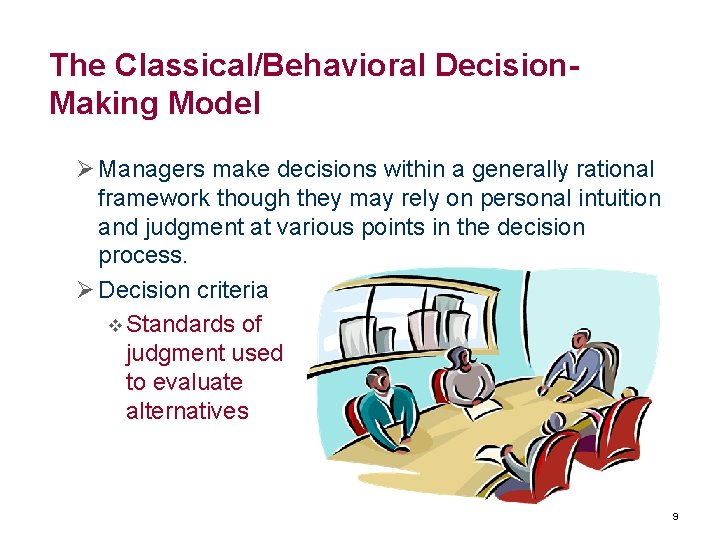
The Classical/Behavioral Decision. Making Model Ø Managers make decisions within a generally rational framework though they may rely on personal intuition and judgment at various points in the decision process. Ø Decision criteria v Standards of judgment used to evaluate alternatives 9
The Decision-Making Process EXHIBIT 5 -1 10
Bounded Rationality and Influences on Decision Making Bounded rationality (Herbert Simon) Ø The rationality of decisions is limited by: v The extent of the decision maker’s metal abilities. v External influences over which the decision maker has little or no control. v Satisficing decisions: when the first sufficient alternative that is adequate, acceptable, or passable is chosen. v Heuristics: simplified strategies (rules of thumb) for decision making. 11
Influences on Decision Making Contributing to Bounded Rationality EXHIBIT 5 -2 12
Influences on Bounded Rationality • Intuition Ø An experience-based way of knowing or reasoning in which weighing and balancing evidence are done automatically without using a step-by-step logical process. • Self-efficacy Ø The feeling of being an effective and competent person with respect to a task. • Procrastination Ø Delaying taking action without a valid reason results in indecisiveness and inaction. 13
The Nature of Creativity: Ø Is the process of developing good ideas that can be put into action. Ø Is essential to dealing with nonprogrammed decisions. Approaches to understanding creativity: Ø Steps in the creative process Ø Characteristics of creative people Ø Conditions necessary for creativity 14
Steps in the Creative Process 1. 2. 3. 4. 5. Opportunity or problem recognition Immersion Incubation Insight Verification and application 15
Steps in the Creative Process EXHIBIT 5 -3 16
Characteristics of Creative People • Knowledge Ø Have acquired a broad background of facts and information needed to support creative problem solving when combining ideas and things in new and different ways. 17
Characteristics of Creative People (cont’d) • Intellectual abilities Ø Are bright but not brilliant; possessing creative intelligence. Ø Are good at generating and choosing alternatives (thinking divergently/convergently). Ø Are youthfully curious and empathetic. Ø Creatively use both fluid (processing) and crystallized (accumulated intelligence). 18
Characteristics of Creative People (cont’d) • Personality Ø Have a positive self-image; not blindly self-confident. Ø Able to cope with criticism of their ideas. Ø Can tolerate the isolation necessary for developing ideas. Ø Are frequently nonconformists and do not need strong approval from the group. Ø Are persistent in carrying through on an idea. Ø Can deal with ambiguity and chaos. 19
Conditions Necessary for Creativity • Internal factors affecting creativity: Ø Expertise v The necessary knowledge to put facts together. Ø Creative-thinking skills v The flexibility and imagination with which individuals approach problems. Ø Internal (intrinsic) motivation v A fascination with or passion for the task – The experience of flow : a total absorption and intense concentration (being “in the zone”) make the task worth doing regardless of the consequences. 20
Conditions Necessary for Creativity (cont’d) • External factors affecting creativity: Ø An environmental need that stimulates goal setting v “Necessity is the mother of invention. ” Ø Conflict and tension that put people on edge v Creating situations that require flexibility and imagination in the way in which individuals approach problems. Ø Encouragement from others v Establishing a permissive non-punitive environment that welcomes new ideas and original thinking. 21
Enhancing and Improving Creativity • Creative problem solving requires: Ø Overcoming traditional ways of thinking by breaking down the rigid thinking that blocks new ideas. Ø Encouraging creative persons to “think outside the box. ” 22
Techniques for Enhancing Creativity • Brainstorming: Ø Use groups of five to seven people. Ø Encourage spontaneous expression of ideas. Ø Gather the largest quantity and variety of of ideas to increase the likelihood of a breakthrough. Ø Encourage combination and improvement of ideas. Ø Keep a record of ideas by writing them down. Ø Do not overstructure the session by following the rules to rigidly. 23
Techniques for Enhancing Creativity (cont’d) • Idea quotas Ø Demand that employees come up with new ideas on a regular basis. • Heterogeneous group Ø Form professionally and culturally diverse groups for a variety of viewpoints • Financial incentives Ø Offer monetary rewards for suggestions and implemented ideas. • Architecture and physical layout Ø Remove structural barriers to communication and interaction to foster creative thinking. • Inspiration Ø Inspire workers to think creatively through managerial leadership. 24