
CHAPTER 5 INCIDENT INVESTIGATION AND REPORTING BWU 10302
CHAPTER 5 INCIDENT INVESTIGATION AND REPORTING BWU 10302 Occupational Safety & Health 1
Incident Prevention 2

Learning Objectives � � To define what is incident To explain the causes of incident & role of management control To explain 3 theory on accident causation To list the cost involved in an incident Copyright@NIOSH 2005/1 3
Scope � Principles � Causes of loss prevention of incidents � Incidents � Approach and productivity to loss prevention Copyright@NIOSH 2005/1 4
Principles of Incident Prevention 1. Incident prevention is good management 2. Management and workers must fully cooperate 3. Top management must lead Copyright@NIOSH 2005/1 5
Principles of Incident Prevention 4. There must be an OSH policy 5. Must have organisation and resources to implement the OSH policy 6. Best available information and technology must be applied Copyright@NIOSH 2005/1 6
What Is An Incident? � An incident is: ◦ An unexpected, unplanned event in a sequence of events ◦ That occurs through a combination of causes ◦ Which result in: �Physical harm (injury, ill-health or disease) to an individual, �Damage to property, �A near-miss, �Any combination of these effects. Copyright@NIOSH 2005/1 7
Why Prevent Incidents? � Legal � Human Rights � Business Copyright@NIOSH 2005/1 8
Causes Of Incidents Copyright@NIOSH 2005/1 9

Types of Incidents � Cause immediate injury or damage to equipment or property: ◦ A forklift dropping a load ◦ Someone falling off a ladder � That occur over an extended period: ◦ Hearing loss ◦ Illness resulting from exposure to chemicals Copyright@NIOSH 2005/1 10
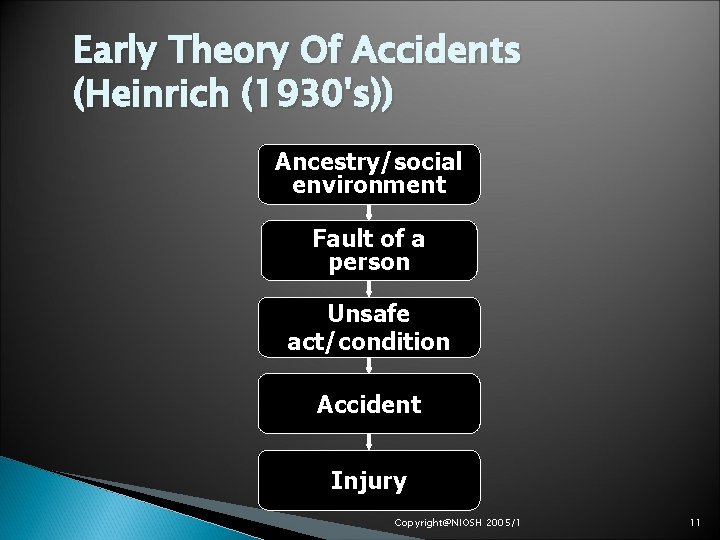
Early Theory Of Accidents (Heinrich (1930's)) Ancestry/social environment Fault of a person Unsafe act/condition Accident Injury Copyright@NIOSH 2005/1 11

Heinrich’s Five Stage Sequence Ancestry/social environment Fault of a person Unsafe act/condition Accident Injury Copyright@NIOSH 2005/1 12

Accident Causation Model (1974) Copyright@NIOSH 2005/1 13
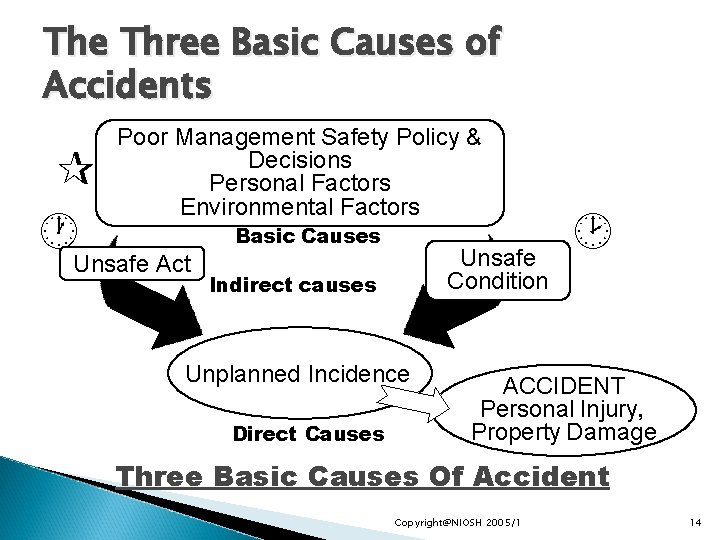
The Three Basic Causes of Accidents Poor Management Safety Policy & Decisions Personal Factors Environmental Factors Unsafe Act Basic Causes Unsafe Condition Indirect causes Unplanned Incidence Direct Causes ACCIDENT Personal Injury, Property Damage Three Basic Causes Of Accident Copyright@NIOSH 2005/1 14

Contributing Factors To Accidents – Immediate Causes (Symptoms) The unsafe acts and unsafe conditions can be categorised as follows: 1. Human behaviour 2. Design of equipment and plant 3. Systems & procedures including use of materials 4. Environmental surroundings Copyright@NIOSH 2005/1 15
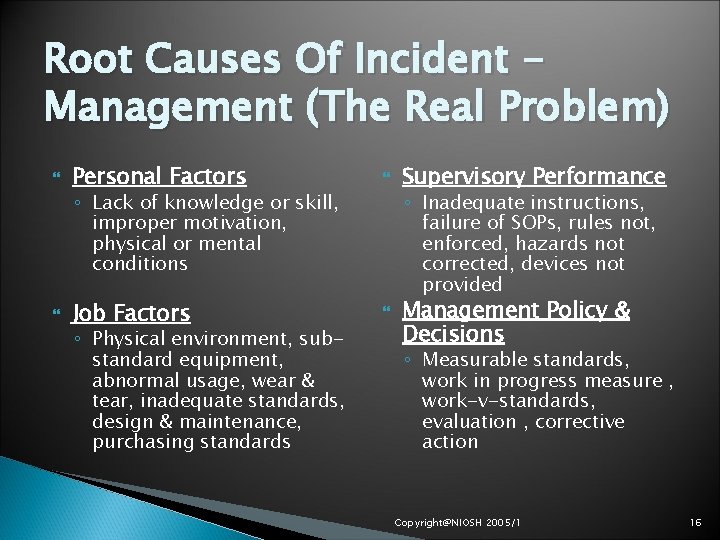
Root Causes Of Incident Management (The Real Problem) Personal Factors Job Factors ◦ Lack of knowledge or skill, improper motivation, physical or mental conditions ◦ Physical environment, substandard equipment, abnormal usage, wear & tear, inadequate standards, design & maintenance, purchasing standards Supervisory Performance ◦ Inadequate instructions, failure of SOPs, rules not, enforced, hazards not corrected, devices not provided Management Policy & Decisions ◦ Measurable standards, work in progress measure , work-v-standards, evaluation , corrective action Copyright@NIOSH 2005/1 16
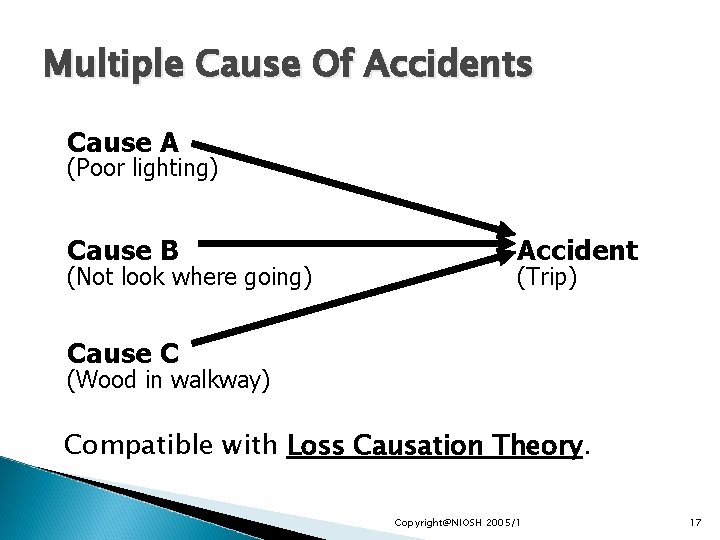
Multiple Cause Of Accidents Cause A (Poor lighting) Cause B (Not look where going) Accident (Trip) Cause C (Wood in walkway) Compatible with Loss Causation Theory. Copyright@NIOSH 2005/1 17

Fall From a Defective Ladder ◦ Why was the defective ladder not found during normal inspection? ◦ Why did the supervisor allow its use? ◦ Didn't the injured employee know it should not be used? Copyright@NIOSH 2005/1 18

Fall From a Defective Ladder ◦ Was the employee properly trained? ◦ Was the employee reminded not to use the ladder? ◦ Did the superior examine the job first? Copyright@NIOSH 2005/1 19

The Accident Pyramid 1 3 50 80 Fatal / Serious injury Lost days First aid Property 400 Near misses TYE/PEARSON/BIRD 1969 -1975 Copyright@NIOSH 2005/1 20
Accepted Accident Theory � Multiple Causation Theory ◦ A single unsafe act or condition may or may not cause an accident but both are caused by lack of management control. � Bird Loss Causation Model ◦ In line with Schewhart(1930’s) theory of quality control. Copyright@NIOSH 2005/1 21
Accepted Accident Theory � Heinrich’s theory is weak and negative ◦ Blaming victim and lack system thinking, continual improvements, upstream control and worker participation. Copyright@NIOSH 2005/1 22
Productivity Aspect Of OSH Copyright@NIOSH 2005/1 23

Direct Vs. Indirect Incident Cost Iceberg Direct Costs Indirect Costs It is estimated that for every $1 in direct incident costs, there anywhere from $4 to $11 in indirect or “hidden” costs. Copyright@NIOSH 2005/1 24
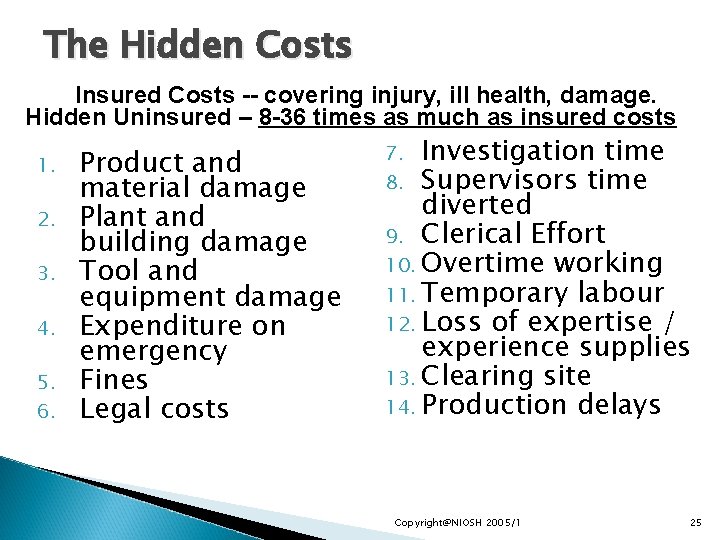
The Hidden Costs Insured Costs -- covering injury, ill health, damage. Hidden Uninsured – 8 -36 times as much as insured costs 1. 2. 3. 4. 5. 6. Product and material damage Plant and building damage Tool and equipment damage Expenditure on emergency Fines Legal costs Investigation time Supervisors time diverted 9. Clerical Effort 10. Overtime working 11. Temporary labour 12. Loss of expertise / experience supplies 13. Clearing site 14. Production delays 7. 8. Copyright@NIOSH 2005/1 25
Incident Prevention Costs � DESIGN COSTS (e. g to install machine guards) � OPERATIONAL etc. ) COSTS (training costs, PPE, � SAFE GUARDING THE FUTURE COSTS (health surveillance, audits etc) Copyright@NIOSH 2005/1 26
Cost- Benefit Analysis Of Control Measures � Compare specific incident costs with cost of specific improvement being suggested. Copyright@NIOSH 2005/1 27
What is An Incident Investigation �A management tool by which: ◦ Work-related injuries, ill health, diseases and incidents are systematically studied so that their root causes and contributing factors can be identified ◦ The organisation’s Occupational Safety And Health management system can be continually improved Copyright@NIOSH 2005/1 28
Why Investigate an Incident � To prevent repetition of the same workrelated injuries, ill health, diseases and incidents � Legal Requirement Copyright@NIOSH 2005/1 29
Why Investigate an Incident � Accurate record (for insurance, legal prosecution, public enquiries) � Organisation’s reasons own policy and business Copyright@NIOSH 2005/1 30
Who Should Investigate? Depends On Severity Of The Incident � Internal Investigation team ◦ Individuals involved ◦ Supervisor, Safety officer ◦ Upper management ◦ external consultants ◦ Members of the Safety and Health Committee Copyright@NIOSH 2005/1 31
Who Should Investigate? Depends On Severity Of The Incident � External agency involvement ◦ DOSH and / or DOE, Police, etc. Copyright@NIOSH 2005/1 32
What & When to Investigate � All serious and long-term incidents & near misses � As soon as possible to prevent: ◦ Scene interference ◦ Deterioration of evidence ◦ Losing people’s recollection of the incidence Copyright@NIOSH 2005/1 33
Principles Of Incident Investigation Copyright@NIOSH 2005/1 34
Principles of Investigation � Carried out according to procedure: ◦ For all incidents ◦ By competent persons with participation of workers. Copyright@NIOSH 2005/1 35
Principles of Investigation � Should: ◦ Be systematic and documented ◦ Be treated as urgent (to prevent productivity loss and deterioration of evidence) ◦ Be objective (fact finding only) ◦ Find the underlying (root) cause(s) ◦ Identify failures in OSH management system ◦ Implement corrective action Copyright@NIOSH 2005/1 36
Principles of Investigation � The results should: ◦ Be communicated to the Safety and Health Committee who should make appropriate recommendations ◦ Include external investigation reports such as DOSH and SOCSO ◦ Be communicated to appropriate persons for corrective action ◦ Included in management review Copyright@NIOSH 2005/1 37
Be Prepared – Before The Incident � Identify who has the authority to investigate and carry out mitigation action and corrective action to completion � Have a system for notification and recording of all incidents and injuries Copyright@NIOSH 2005/1 38
Be Prepared – Before The Incident � Designated investigator trained and competent ◦ Only be responsible for investigating Copyright@NIOSH 2005/1 39
How Much to Prepare Dependent on: ◦ The number and type of workplaces ◦ The equipment required to conduct the investigation ◦ Ability for investigator to reach an investigation site as soon as possible ◦ Geographical location ◦ Reliable transportation requirements Copyright@NIOSH 2005/1 40
Notification Procedure � Notification: ◦ To management after an incident ◦ Initiated by the person involved ◦ Should be to his immediate superior ◦ To visitors and contractors ◦ Recorded � Automatic system to notify investigator � Include members of Safety and Health Committee (if any) Copyright@NIOSH 2005/1 41
Investigation Procedure 1. 2. For recording evidence For observation and recording of fragile, perishable or transient evidence e. g. Instrument readings, control panel settings, weather & other environmental conditions, chemical spills, stains, skid marks Copyright@NIOSH 2005/1 42
Investigation Kit Preparation Camera & Video Camera Cassette Tape Recorder Flash and Batteries Mobile Telephone / Walkie-Talkie Clipboard, Preprinted Forms PPE Containers for Taking and Storing Samples Barrier Tape Copyright@NIOSH 2005/1 43
Responsibilities � Employee ◦ Record in incident book (supervisor checks) � Supervisor / Manager ◦ Initiate risk control response: first-aid, fence area, etc. other preventive action ◦ Inform SHO Copyright@NIOSH 2005/1 44
Responsibilities SHO �Organise camera, tape and report form �Check line management report �Investigate if incident is serious and require to notify authorities such as DOSH, DOE, Police, etc. �Complete incident record form �Summary report to Safety and Health Committee Copyright@NIOSH 2005/1 45
Responsibilities Investigator � Visit and survey incident scene � Eliminate the hazards: ◦ ◦ ◦ Control of chemicals De-energise De-pressurise Light it up Shore it up Ventilate Copyright@NIOSH 2005/1 46
On-Site Investigation Strategy Copyright@NIOSH 2005/1 47
Steps In Incident Investigation 1. Gather information 2. Search for and establish facts 3. Isolate essential contributing factors 4. Determine the causes & root cause Copyright@NIOSH 2005/1 48

Steps In Incident Investigation 5. Determine corrective actions 6. Report, review the findings 7. Analyze incidents 8. Implement corrective actions Copyright@NIOSH 2005/1 49
Incident Investigation Report � Clear, complete description and accurate information of events leading up to the accident � Clear, complete and correct identification of all causal factors � Recommendations � Supporting documentation � Proper review and sign off Copyright@NIOSH 2005/1 50
Implementing Corrective And Preventive Action � Must be based on root causes � Appropriate to the problem at hand � Reviewed through risk assessment process to ensure that the correction will not introduce a new hazard � Strict time table for implementation established � Follow up conducted 51
Summary � Aim of investigation is to find root causes. � Purpose is so that similar incident will not be repeated. � Prepare organisation, procedure and equipment in anticipation of incidents. � Corrective and preventive action should be carried out for incidents and management system non-conformances. 52
- Slides: 52