
Chapter 5 Identifying Supporting Details and Transitions Essential

- Slides: 16
Chapter 5: Identifying Supporting Details and Transitions Essential Reading Skills, 2/e Kathleen Mc. Whorter © 2005 Pearson Education, Inc. publishing as Longman Publishers.
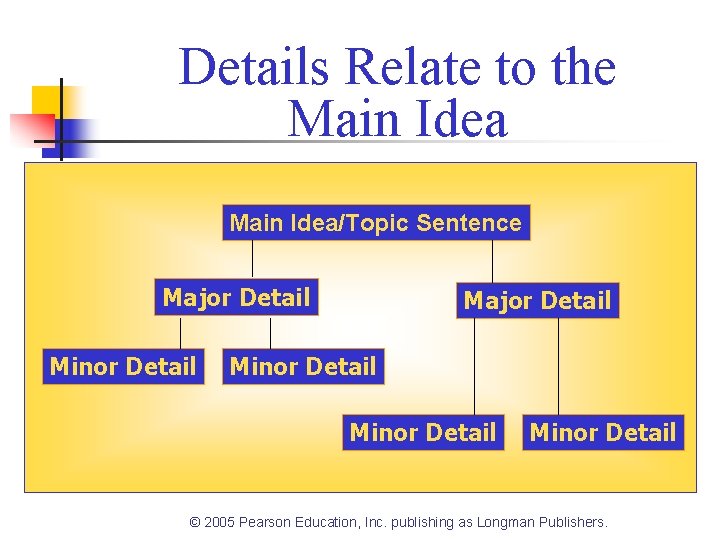
What Are Supporting Details? Supporting details are those facts and ideas that prove or explain the main idea of a paragraph. © 2005 Pearson Education, Inc. publishing as Longman Publishers.
Major Details Major details are the most important details that directly explain the main idea. © 2005 Pearson Education, Inc. publishing as Longman Publishers.
Minor Details Minor details provide additional information, offer an example, or further explain one of the key details. © 2005 Pearson Education, Inc. publishing as Longman Publishers.
Details Relate to the Main Idea/Topic Sentence Major Detail Minor Detail © 2005 Pearson Education, Inc. publishing as Longman Publishers.
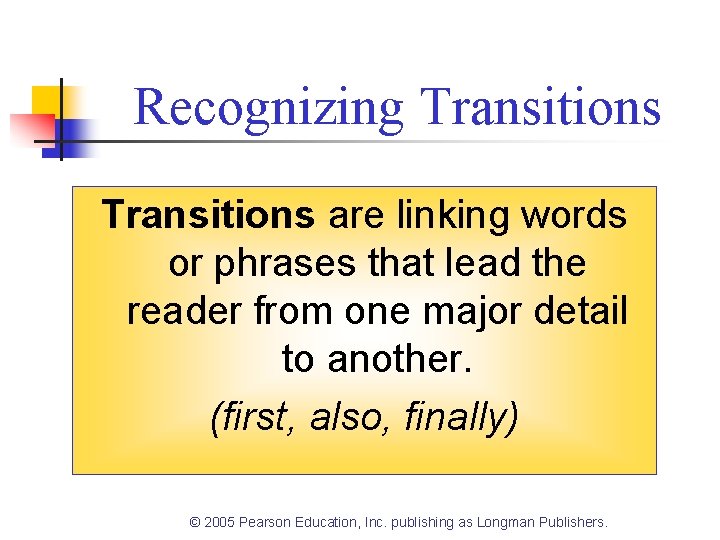
Recognizing Transitions are linking words or phrases that lead the reader from one major detail to another. (first, also, finally) © 2005 Pearson Education, Inc. publishing as Longman Publishers.
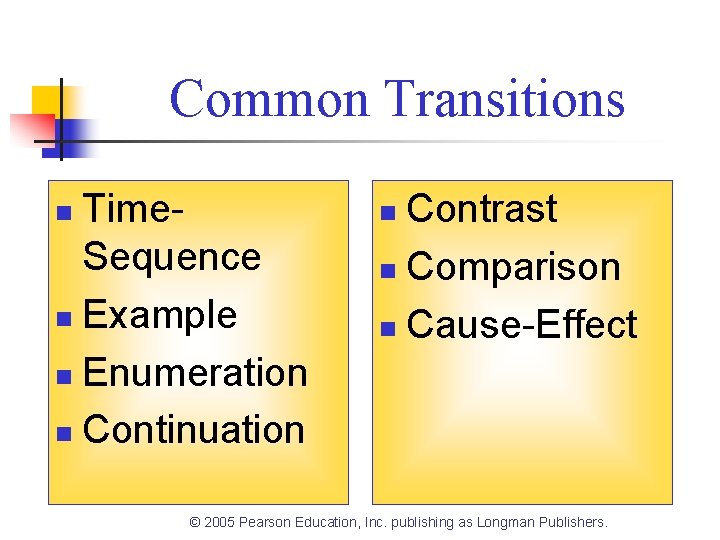
Common Transitions Time. Sequence n Example n Enumeration n Continuation n Contrast n Comparison n Cause-Effect n © 2005 Pearson Education, Inc. publishing as Longman Publishers.
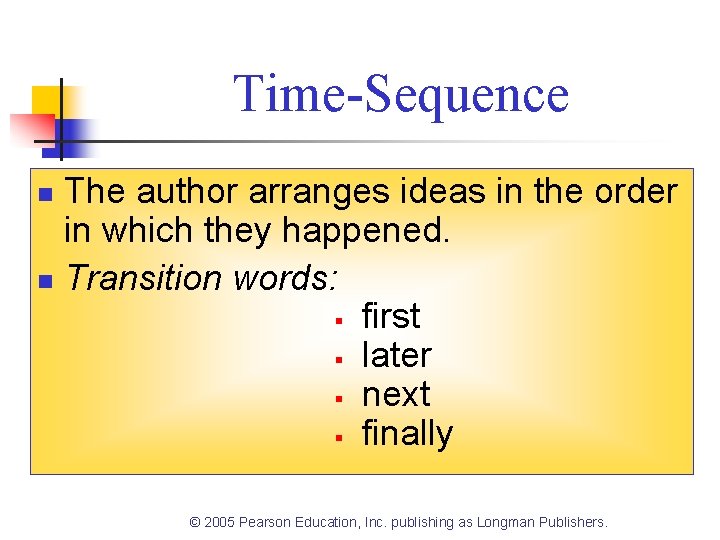
Time-Sequence The author arranges ideas in the order in which they happened. n Transition words: § first § later § next § finally n © 2005 Pearson Education, Inc. publishing as Longman Publishers.
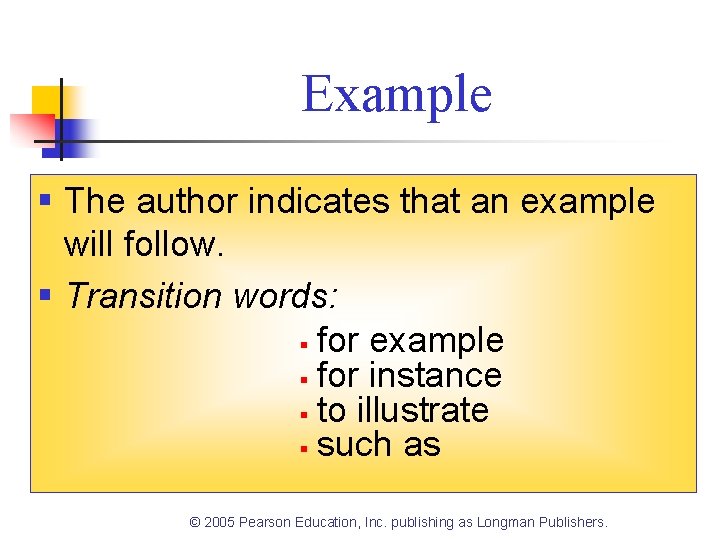
Example § The author indicates that an example will follow. § Transition words: § for example § for instance § to illustrate § such as © 2005 Pearson Education, Inc. publishing as Longman Publishers.
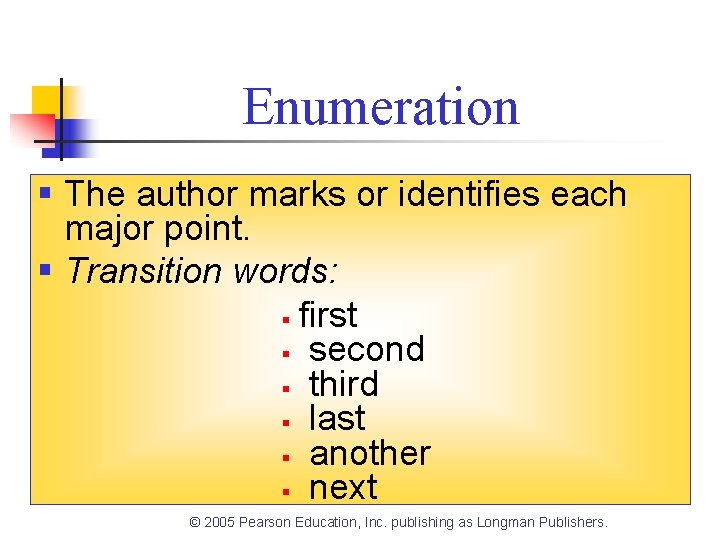
Enumeration § The author marks or identifies each major point. § Transition words: § first § second § third § last § another § next © 2005 Pearson Education, Inc. publishing as Longman Publishers.
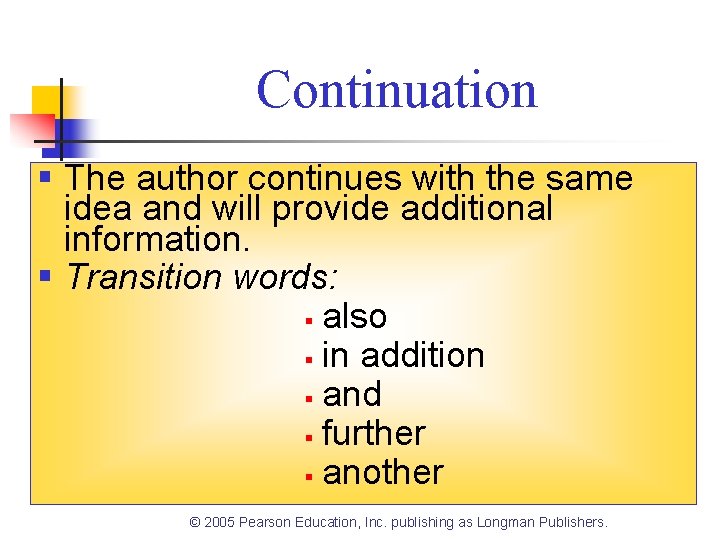
Continuation § The author continues with the same idea and will provide additional information. § Transition words: § also § in addition § and § further § another © 2005 Pearson Education, Inc. publishing as Longman Publishers.
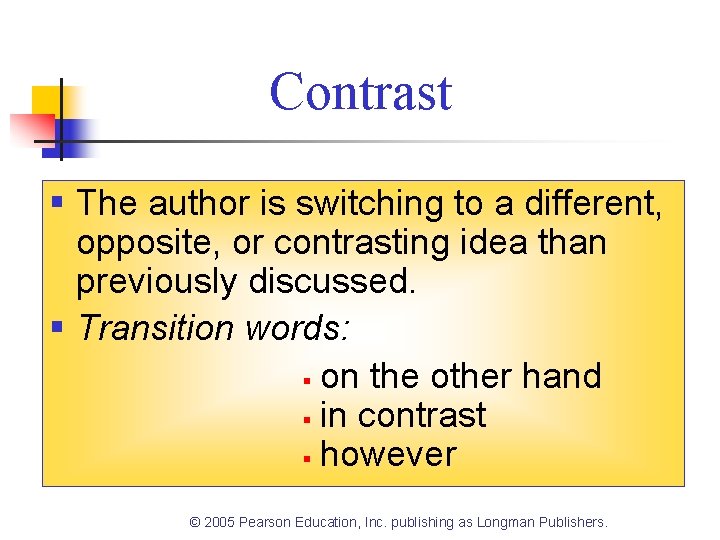
Contrast § The author is switching to a different, opposite, or contrasting idea than previously discussed. § Transition words: § on the other hand § in contrast § however © 2005 Pearson Education, Inc. publishing as Longman Publishers.
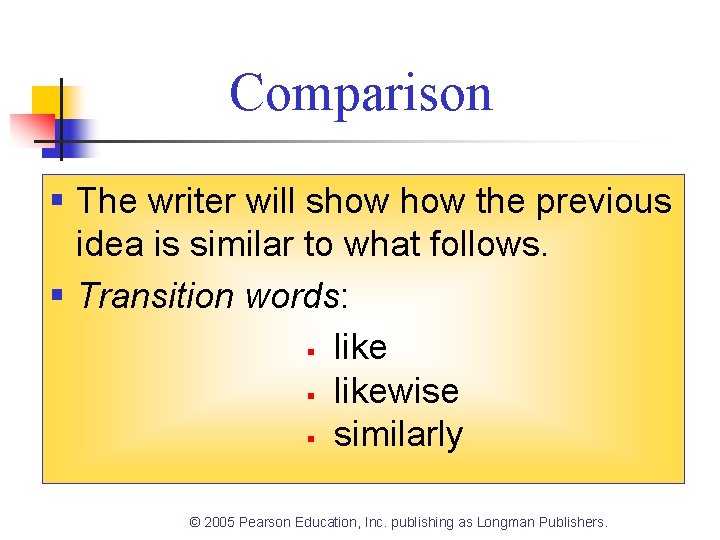
Comparison § The writer will show the previous idea is similar to what follows. § Transition words: § likewise § similarly © 2005 Pearson Education, Inc. publishing as Longman Publishers.
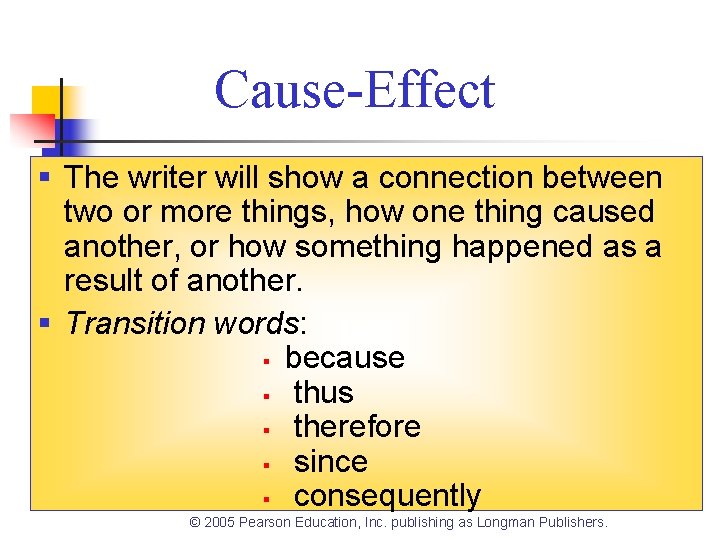
Cause-Effect § The writer will show a connection between two or more things, how one thing caused another, or how something happened as a result of another. § Transition words: § because § thus § therefore § since § consequently © 2005 Pearson Education, Inc. publishing as Longman Publishers.
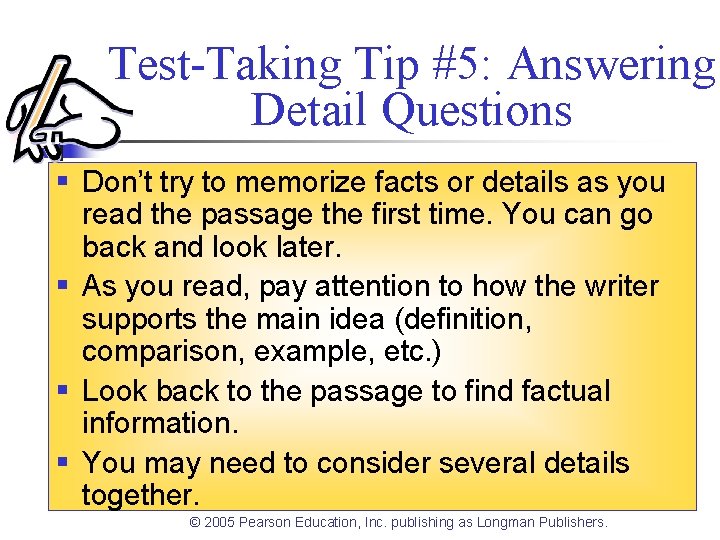
Test-Taking Tip #5: Answering Detail Questions § Don’t try to memorize facts or details as you read the passage the first time. You can go back and look later. § As you read, pay attention to how the writer supports the main idea (definition, comparison, example, etc. ) § Look back to the passage to find factual information. § You may need to consider several details together. © 2005 Pearson Education, Inc. publishing as Longman Publishers.
Visit the Companion Website http: //www. ablongman. com/mcwhorter © 2005 Pearson Education, Inc. publishing as Longman Publishers.