
Chapter 5 Human Resource Development Training 5 1
- Slides: 22
Chapter 5 Human Resource Development : Training 5. 1 On-the-job-Training 5. 2 Cost and Benefit 5. 3 Type of Training 5. 4 Training investment 5. 5 General Training 5. 6 Specific Training
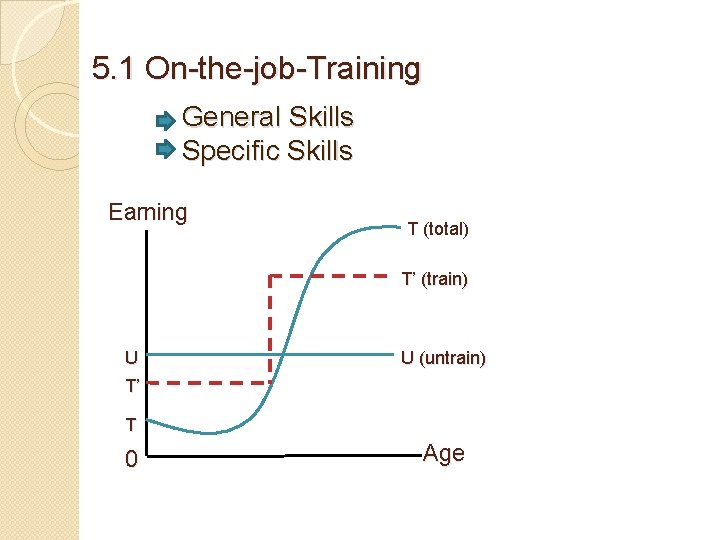
5. 1 On-the-job-Training General Skills Specific Skills Earning T (total) T’ (train) U U (untrain) T’ T 0 Age
Training has an important effect on the relation between earning and age. UU is an untrained persons received the same earning regardless of age. T’T’ is trained person who received lower earning during the training period because training is paid for at that time, and higher earning at later ages because the return is collected then. TT is the combined effect of paying for and collecting the return from training in this way would be to make the age-earning curve of trained person.
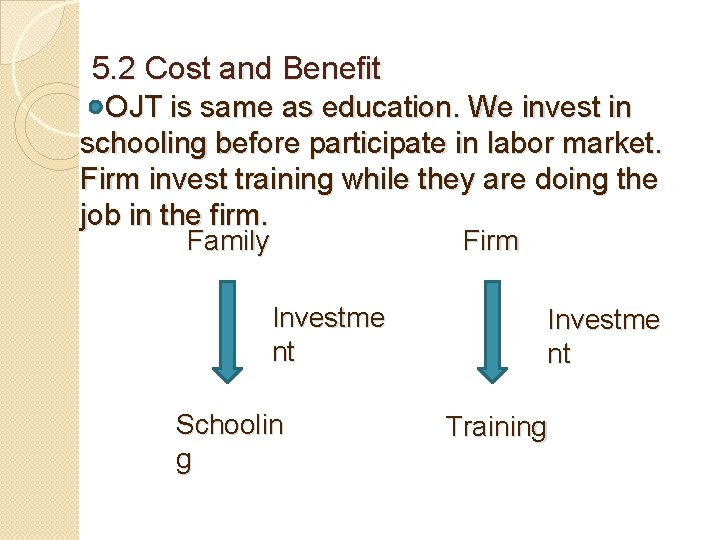
5. 2 Cost and Benefit OJT is same as education. We invest in schooling before participate in labor market. Firm invest training while they are doing the job in the firm. Family Firm Investme nt Schoolin g Investme nt Training
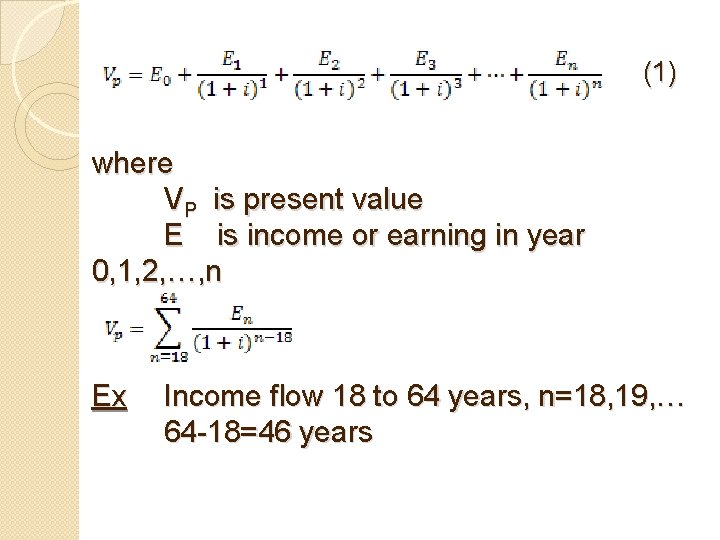
(1) where VP is present value E is income or earning in year 0, 1, 2, …, n Ex Income flow 18 to 64 years, n=18, 19, … 64 -18=46 years
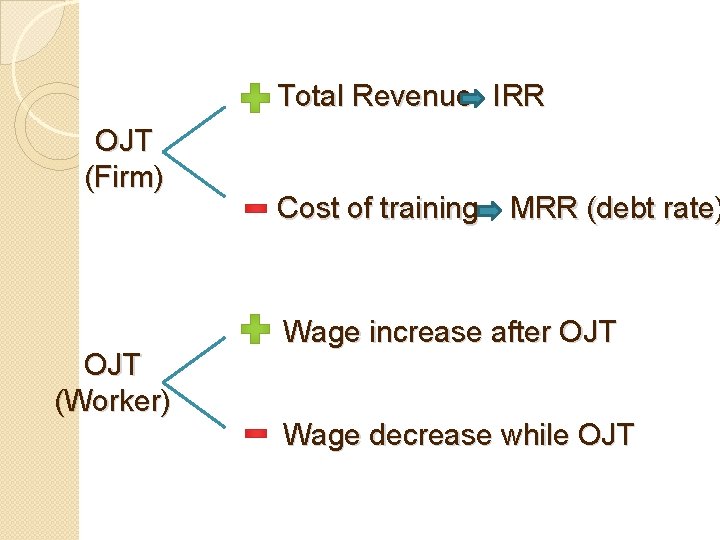
Total Revenue IRR OJT (Firm) OJT (Worker) Cost of training MRR (debt rate) Wage increase after OJT Wage decrease while OJT
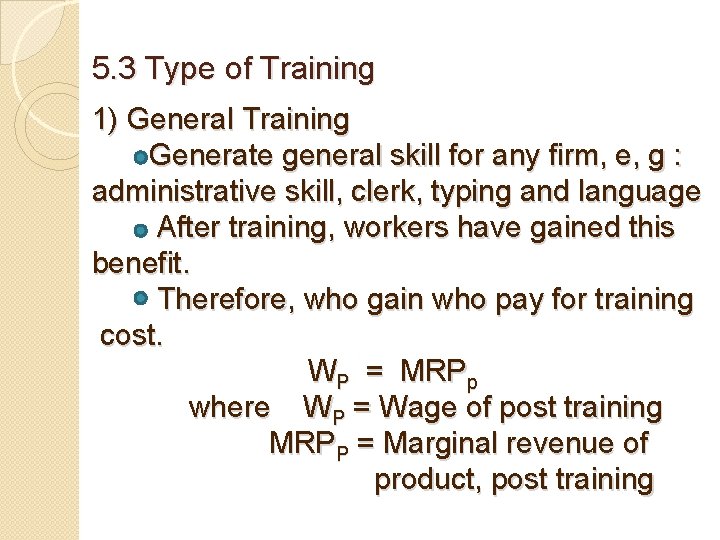
5. 3 Type of Training 1) General Training Generate general skill for any firm, e, g : administrative skill, clerk, typing and language After training, workers have gained this benefit. Therefore, who gain who pay for training cost. WP = MRPp where WP = Wage of post training MRPP = Marginal revenue of product, post training
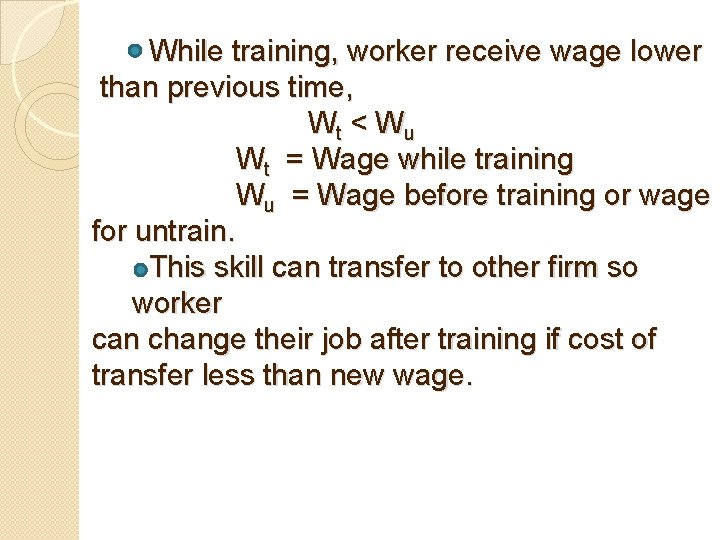
While training, worker receive wage lower than previous time, Wt < W u Wt = Wage while training Wu = Wage before training or wage for untrain. This skill can transfer to other firm so worker can change their job after training if cost of transfer less than new wage.
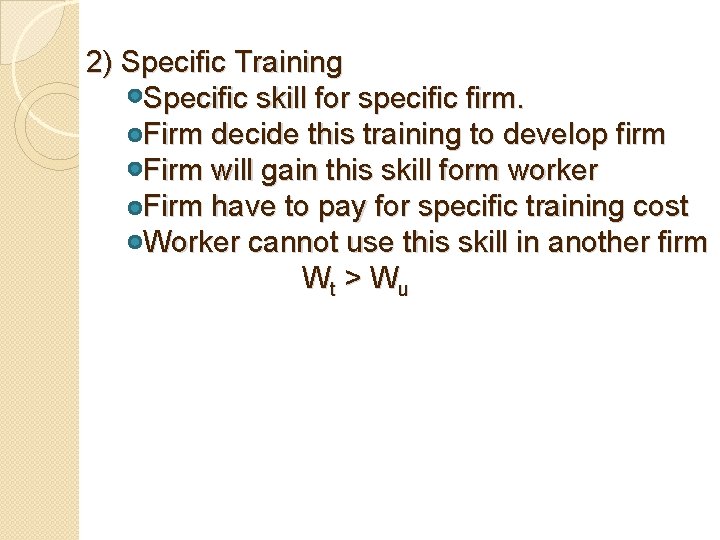
2) Specific Training Specific skill for specific firm. Firm decide this training to develop firm Firm will gain this skill form worker Firm have to pay for specific training cost Worker cannot use this skill in another firm Wt > W u
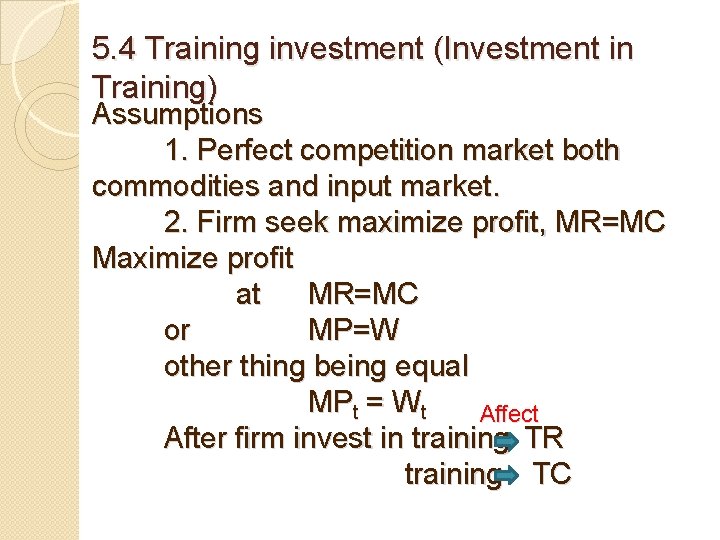
5. 4 Training investment (Investment in Training) Assumptions 1. Perfect competition market both commodities and input market. 2. Firm seek maximize profit, MR=MC Maximize profit at MR=MC or MP=W other thing being equal MPt = Wt Affect After firm invest in training TR training TC
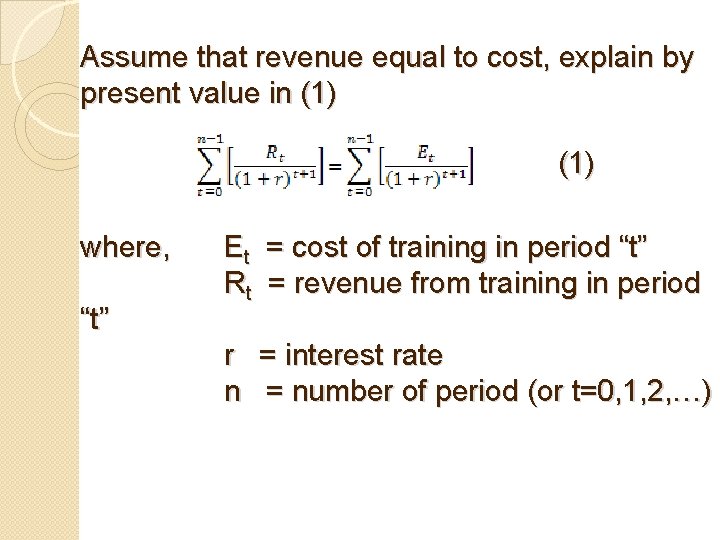
Assume that revenue equal to cost, explain by present value in (1) where, “t” Et = cost of training in period “t” Rt = revenue from training in period r = interest rate n = number of period (or t=0, 1, 2, …)
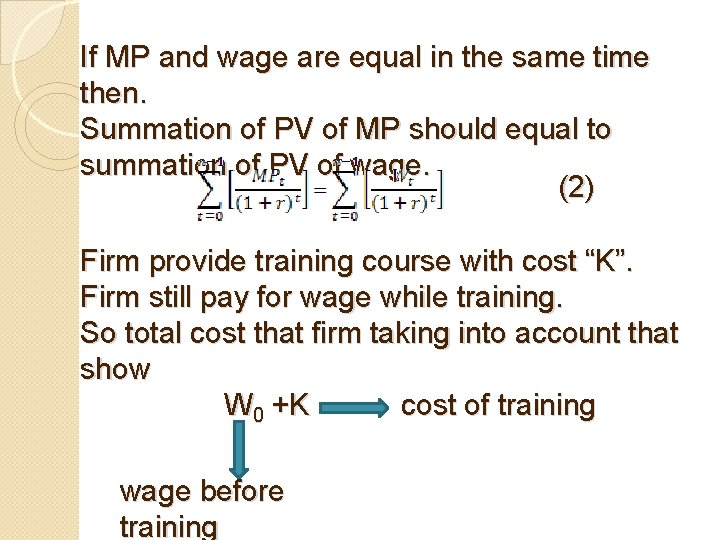
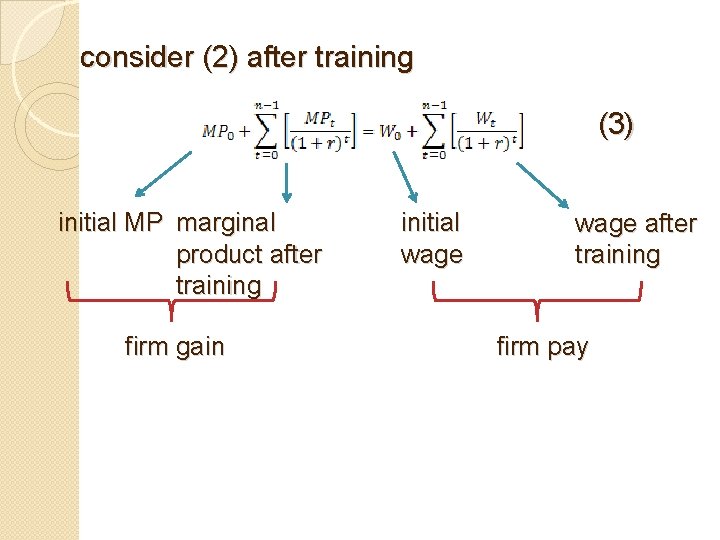
If MP and wage are equal in the same time then. Summation of PV of MP should equal to summation of PV of wage. (2) Firm provide training course with cost “K”. Firm still pay for wage while training. So total cost that firm taking into account that show W 0 +K cost of training wage before training
consider (2) after training (3) initial MP marginal product after training firm gain initial wage after training firm pay
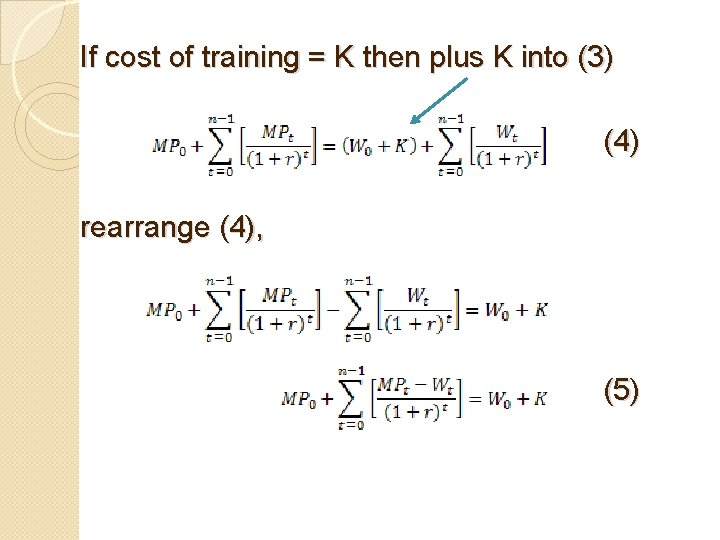
If cost of training = K then plus K into (3) (4) rearrange (4), (5)
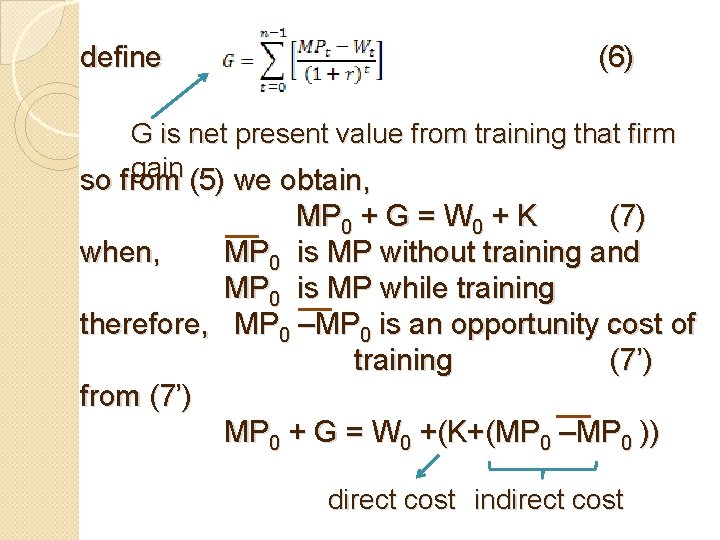
define (6) G is net present value from training that firm gain (5) we obtain, so from MP 0 + G = W 0 + K (7) when, MP 0 is MP without training and MP 0 is MP while training therefore, MP 0 –MP 0 is an opportunity cost of training (7’) from (7’) MP 0 + G = W 0 +(K+(MP 0 –MP 0 )) direct cost indirect cost
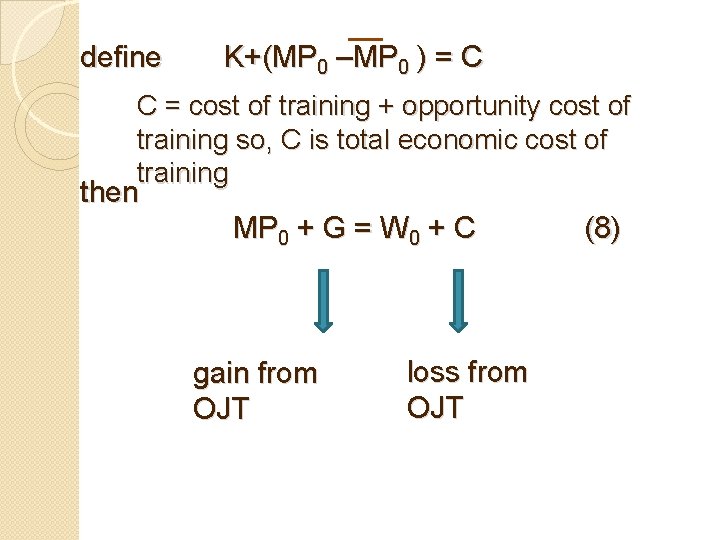
define K+(MP 0 –MP 0 ) = C C = cost of training + opportunity cost of training so, C is total economic cost of training then MP 0 + G = W 0 + C gain from OJT loss from OJT (8)
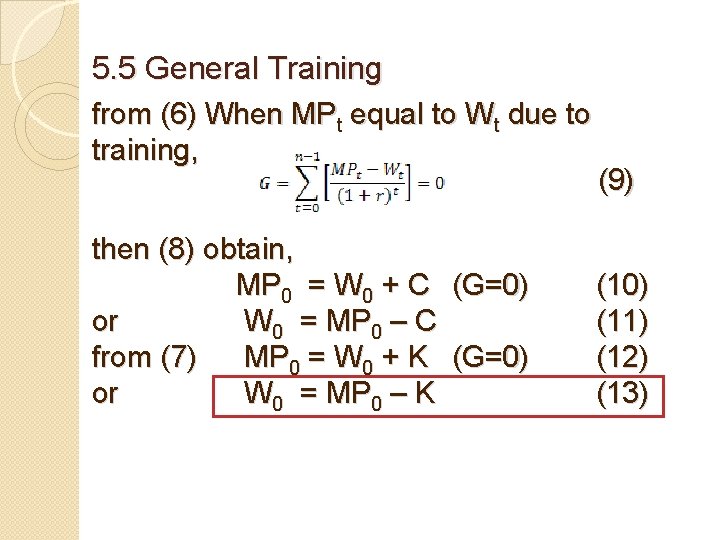
5. 5 General Training from (6) When MPt equal to Wt due to training, then (8) obtain, MP 0 = W 0 + C or W 0 = MP 0 – C from (7) MP 0 = W 0 + K or W 0 = MP 0 – K (G=0) (9) (10) (11) (12) (13)
Wage after training less than marginal product due to worker have to pay for general training. Firm will not pay for this training because general training will provide benefit to worker directly not benefit to firm. Worker can employ their skill (general skill) to any firm. Worker have to pay by themselves.
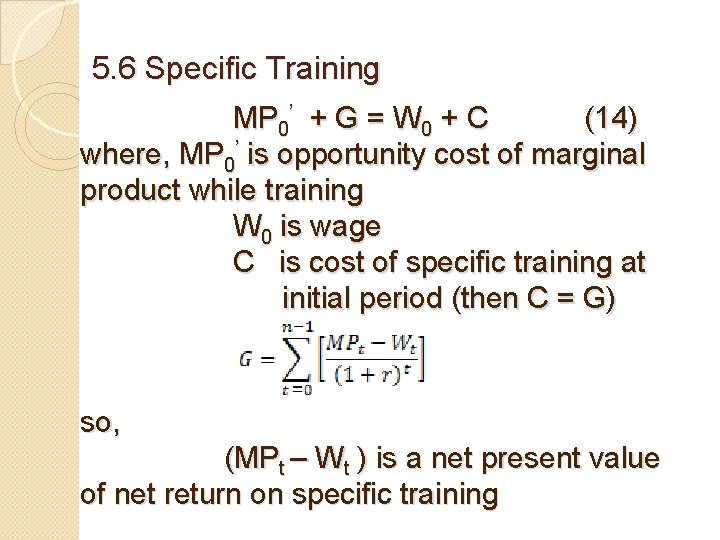
5. 6 Specific Training MP 0’ + G = W 0 + C (14) where, MP 0’ is opportunity cost of marginal product while training W 0 is wage C is cost of specific training at initial period (then C = G) so, (MPt – Wt ) is a net present value of net return on specific training
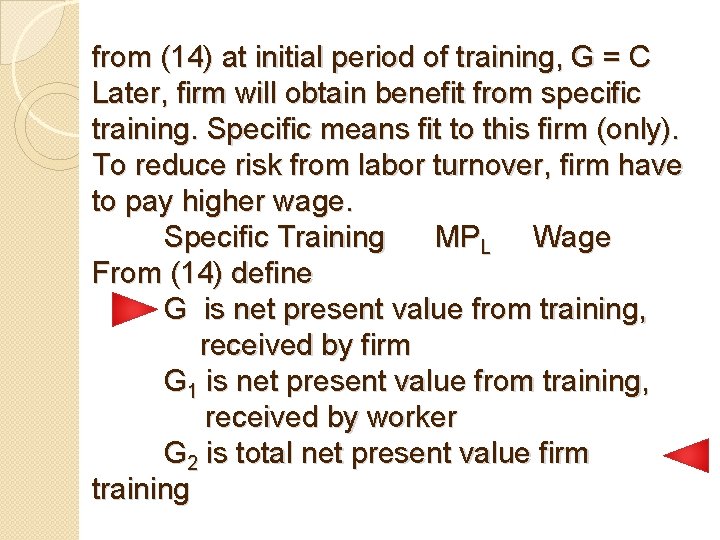
from (14) at initial period of training, G = C Later, firm will obtain benefit from specific training. Specific means fit to this firm (only). To reduce risk from labor turnover, firm have to pay higher wage. Specific Training MPL Wage From (14) define G is net present value from training, received by firm G 1 is net present value from training, received by worker G 2 is total net present value firm training
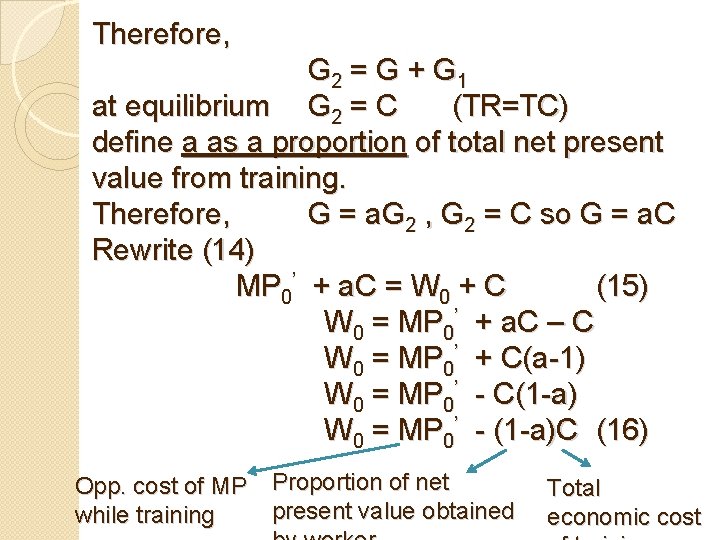
Therefore, G 2 = G + G 1 at equilibrium G 2 = C (TR=TC) define a as a proportion of total net present value from training. Therefore, G = a. G 2 , G 2 = C so G = a. C Rewrite (14) MP 0’ + a. C = W 0 + C (15) W 0 = MP 0’ + a. C – C W 0 = MP 0’ + C(a-1) W 0 = MP 0’ - C(1 -a) W 0 = MP 0’ - (1 -a)C (16) Opp. cost of MP while training Proportion of net present value obtained Total economic cost
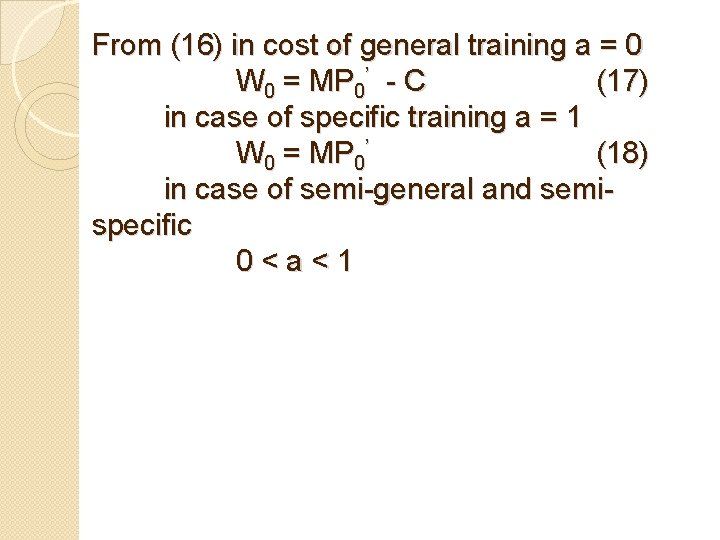
From (16) in cost of general training a = 0 W 0 = MP 0’ - C (17) in case of specific training a = 1 W 0 = MP 0’ (18) in case of semi-general and semispecific 0<a<1