
Chapter 5 How do we Compare Virtual reality
- Slides: 22
Chapter 5 How do we Compare: • Virtual reality (VR) • Augmented Reality (AR) • Mixed reality (MR)
Comparison… • Virtual Reality (VR) encompasses immersive experiences and content via a VR headset or HMD (head-mounted display). • The content is 100% digital and computer-generated. • The current reality is replaced with a new 3 D digital environment in which the user is isolated from the real world.
Comparison… Some VR headsets manufacturers include technology giants such as: • Facebook (through their acquisition of Oculus), • Google (with a series of Daydream headsets), HTC (VIVE), • Samsung (Gear VR), and • Windows (who have named their range of devices Windows Mixed Reality, even though a number is VR-only enabled. )
Comparison… There are three types of VR devices available these are: • Tethered, • Stand-alone, and • Smartphone VR
Augmented reality (AR) • Overlays computer-generated content on top of the real world. • It can superficially interact with the environment in real-time. • Is primarily experienced via a wearable glass device or through smartphone applications
Augmented reality (AR)… • Augmented content doesn’t recognize or interact with the physical objects within a real-world environment, however, it does enhance the user’s experience
Augmented reality (AR)… • Some of the categories of AR products are wearable AR glass (smart glass), smartphone AR and other AR headsets
Mixed reality (MR) Combines several technologies into one wearable device. • Immersive media, • spatial computing, and • hybrid reality intertwine digital content while interacting with a user’s real-world environment. • It allows for digital content to integrate, enrich and interact with the user’s realworld environment. • MR lenses or headsets present an overlay of digital content that interacts with objects in the real world in real-time. • The products are, in most cases, in the research and development phase, but MR is viewed through transparent wearable glasses
Mixed reality (MR)… • Mixed Reality removes the boundaries between real and virtual worlds using occlusion: the computer-generated objects can be visibly obscured by objects in the physical environment from the user’s point of view • Some of MR products are Microsoft's hololens, magic leaps and other MR devices
DIFFERENCES BETWEEN VR, AND MR • Virtual Reality: VR is content which is 100% digital and can be enjoyed in a fully immersive environment. • Augmented Reality: AR overlays digital content on top of the realworld. • Mixed Reality: MR is a digital overlay that allows interactive virtual elements to integrate and interact with the real-world environment.
DIFFERENCES… • AR is a variation of the more known concept of Virtual Reality Technology (VR), which is often defined as “the use of real-time digital computers and other special hardware and software to generate a simulation of an alternate world or environment, which is believable as real or true by the users”. • VR technology creates an environment in which the user feels and seems to be moving inside a computer-created virtual world in the same way people move inside the natural environment; while immersed in the virtual world, the user cannot perceive the real one which still surrounds him. • On the contrary, AR allows the user to see the real world, augmenting it with superimposed virtual objects. • In other words, while VR replaces reality, AR supplements it, creating an environment in which real and virtual objects harmonically coexist. • AR exploits users’ perceptual-motor skills in the real world, creating a special type of humanmachine interaction
Relation between AR and Telepresence • In telepresence, the fundamental purpose is to extend the operator’s sensory-motor facilities and problem-solving abilities to a remote environment. • Virtual reality aims to achieve the illusion of presence within a computer simulation whereas telepresence aims to achieve the illusion of presence at a remote location. • AR can be considered a technology between VR and Telepresence. • In VR the environment is completely synthetic • In Telepresence it is completely real, • In AR the user sees the real world augmented with virtual objects.
The architecture of AR systems • Scene Generator • Tracking System • Display
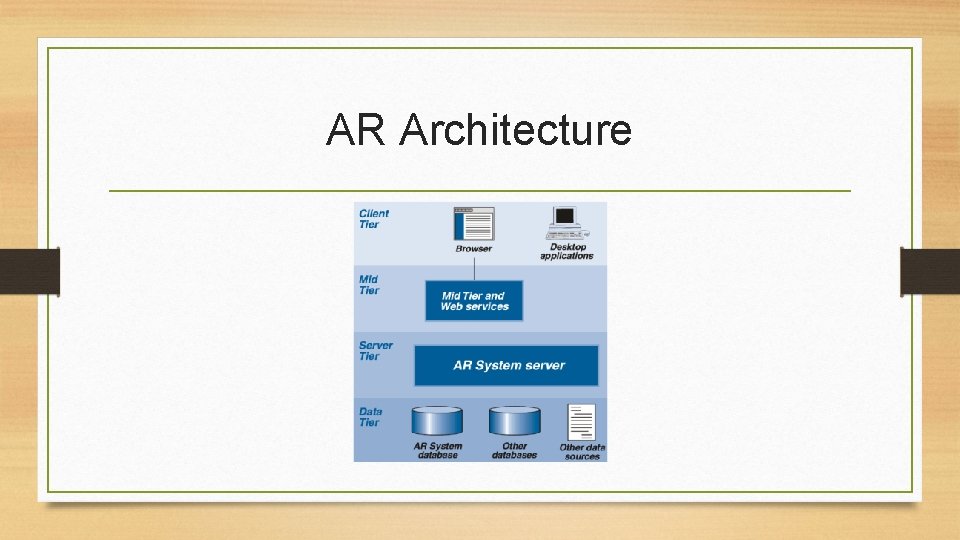
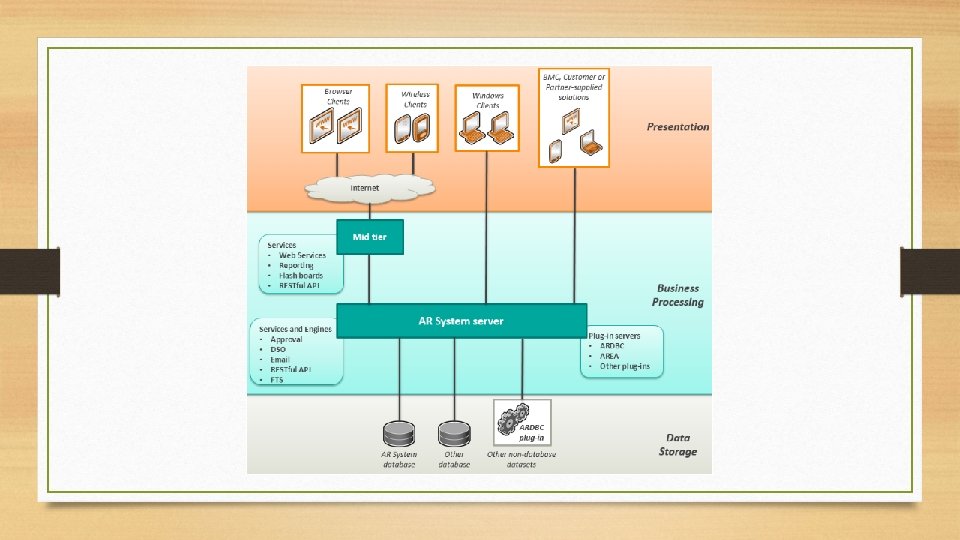
AR Architecture
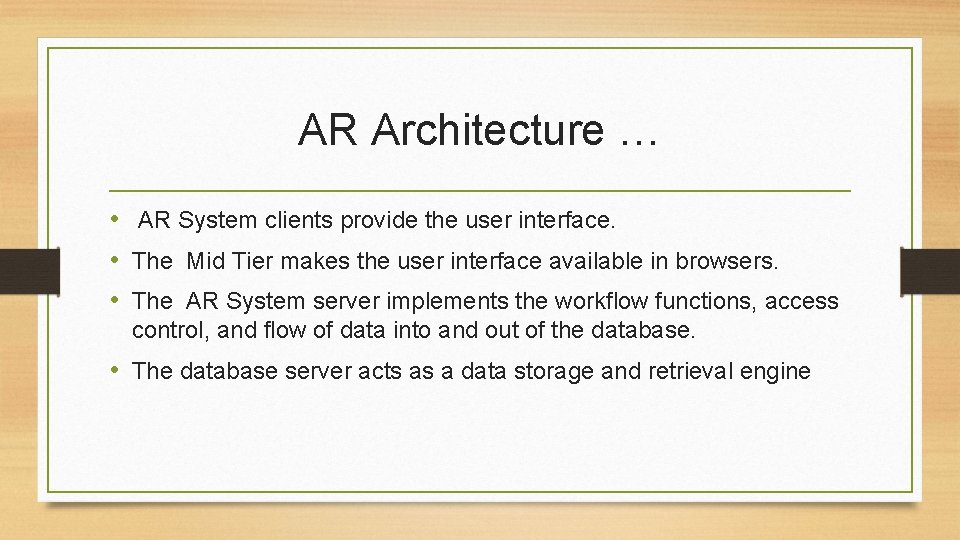
AR Architecture … • AR System clients provide the user interface. • The Mid Tier makes the user interface available in browsers. • The AR System server implements the workflow functions, access control, and flow of data into and out of the database. • The database server acts as a data storage and retrieval engine
Functionally the AR System consists of three environments • Presentation • Business Processing • Data Storage
AR System clients can be broadly divided into • user client and • developer clients
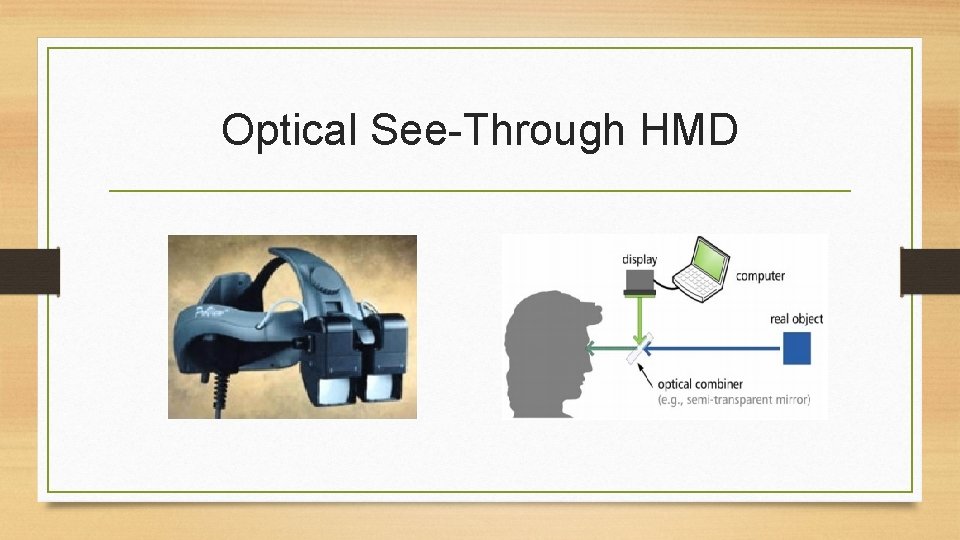
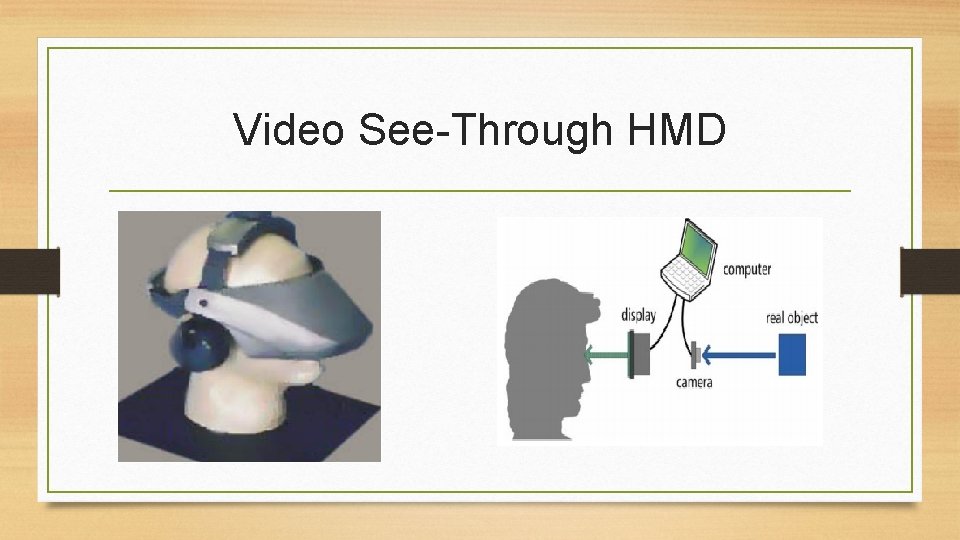
Four major classes of AR distinguished by their display type • • Optical See. Through, Virtual Retinal Systems, Video See-Through, Monitor Based AR and Projector Based AR
Optical See-Through HMD
Video See-Through HMD
Application of AR systems • • Education, Medical, Assistance, Entertainment