
Chapter 5 How and Why Drugs Work Intended
- Slides: 25
Chapter 5 How and Why Drugs Work
Intended and Unintended Effects of Drugs • Intended responses: - Reason for using the drug • Unintended responses: - Side effects • The main distinction between intended responses and side effects depends on therapeutic objective.
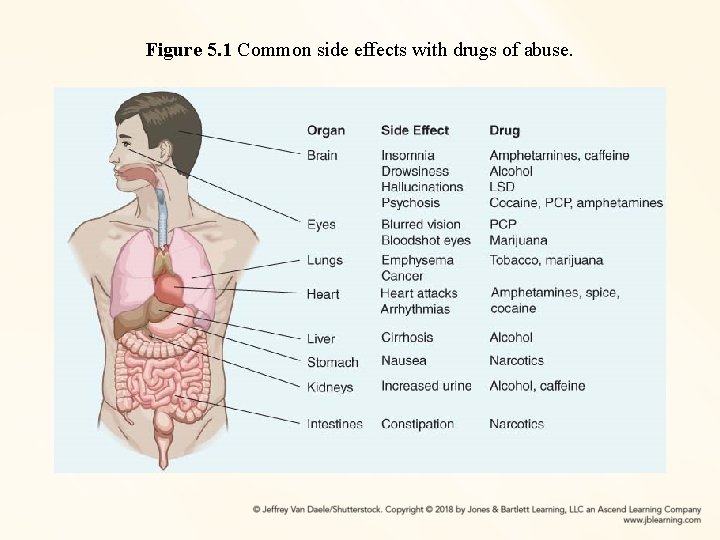
Common Side Effects of Drugs • Nausea or vomiting • Changes in mental alertness • Dependence - Withdrawal • Allergic reactions • Changes in cardiovascular activity
Figure 5. 1 Common side effects with drugs of abuse.
Dose-Response (1 of 2) • Many factors can affect the way an individual responds to a drug, including the following: - Dose - Tolerance - Potency
Dose-Response (2 of 2) • Additional factors - Pharmacokinetic properties: • Rate of absorption • Manner distributed throughout the body • Rate metabolized and eliminated - Form of the drug - Manner in which the drug is administered
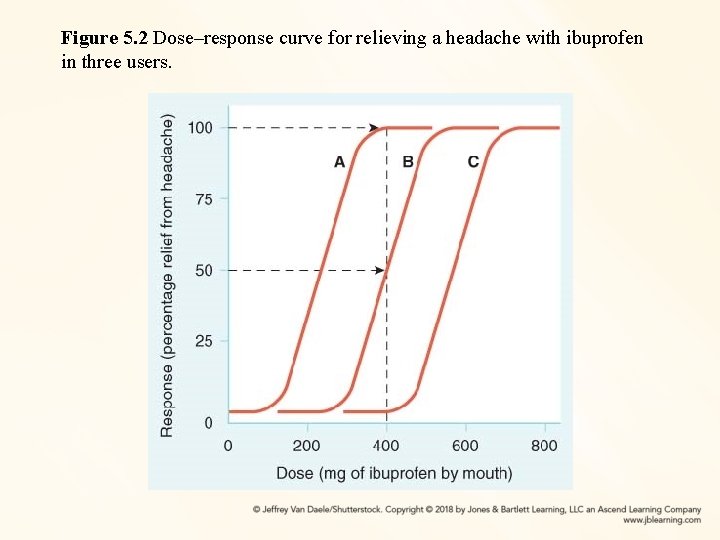
Figure 5. 2 Dose–response curve for relieving a headache with ibuprofen in three users.
Margin of Safety • The range in dose between the amount of drug necessary to cause a therapeutic effect and a toxic effect
Potency vs. Toxicity • Potency: The amount of drug necessary to cause an effect • Toxicity: The capacity of a drug to do damage or cause adverse effects in the body
Drug Interaction • Additive effects - Summation of effects of drugs taken concurrently • Antagonistic (inhibitory) effects - One drug cancels or blocks effects of another • Potentiative (synergistic) effects - Effect of a drug is enhanced by another drug or substance
Pharmacokinetic Factors That Influence Drug Effects • • • Administration Absorption Distribution Inactivation Biotransformation and elimination
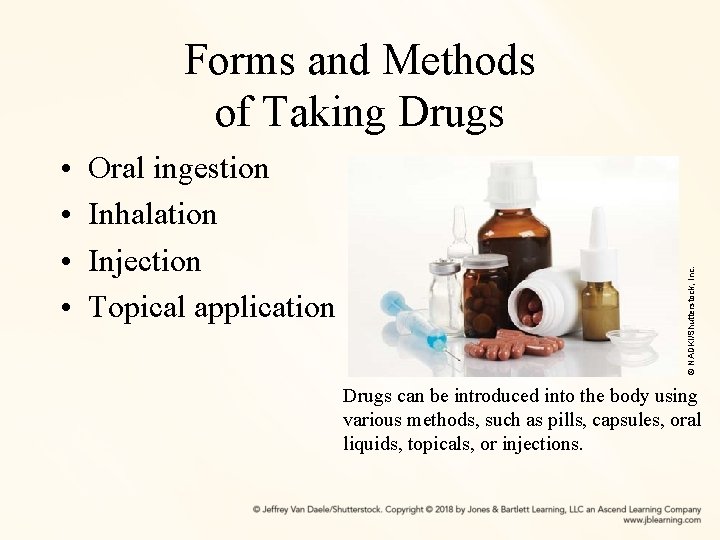
• • Oral ingestion Inhalation Injection Topical application © NADKI/Shutterstock, Inc. Forms and Methods of Taking Drugs can be introduced into the body using various methods, such as pills, capsules, oral liquids, topicals, or injections.
Distribution • Most drugs are distributed throughout the body in the blood. • It takes approximately 1 minute for a drug to circulate throughout the body after it enters the bloodstream. • Drugs have different patterns of distribution depending on their chemical properties.
Required Doses for Effects • Threshold dose: The minimum amount of a drug necessary to have an effect • Plateau effect: The maximum effect a drug can have regardless of the dose • Cumulative effect: The buildup of drug concentration in the body due to multiple doses taken within short intervals
Time-Response Factors • The closer a drug is placed to the target area, the faster the onset of action. • Acute drug response: - Immediate or short-term effects after a single drug dose • Chronic drug response: - Long-term effects after a single dose
Biotransformation • Biotransformation: The process of changing the chemical or pharmacological properties of a drug by metabolism • The liver is the major organ that metabolizes drugs in the body. • The kidney is the next most important organ for drug elimination.
Physiological Variables That Modify Drug Effects • Age • Gender • Pregnancy
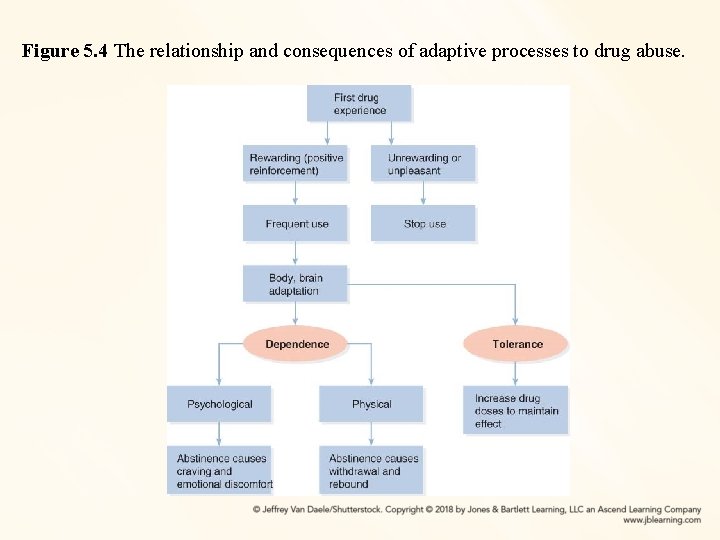
Adaptive Processes • Tolerance: Changes causing decreased response to a set dose of a drug • Dependence: The physiological and psychological changes or adaptations that occur in response to the frequent administration of a drug • Withdrawal
Figure 5. 4 The relationship and consequences of adaptive processes to drug abuse.
Tolerance • Reverse tolerance (sensitization): Enhanced response to a given drug dose; opposite of tolerance • Cross-tolerance: Development of tolerance to one drug causes tolerance to related drugs
Drug Dependence • Physical Dependence - (e. g. , withdrawal and rebound) • Psychological Dependence - (e. g. , craving)
Psychological Factors Affecting Drug Effect • Individual’s mental set • Placebo effects
Addiction and Abuse (1 of 3) • The use of the term addiction is sometimes confusing. It is often used interchangeably with dependence, either physiological or psychological in nature. Other times, it is used synonymously with the term drug abuse. More recently the term “substance use disorder” has been used. A common definition for all of these terms is the compulsive drug use despite negative consequences.
Addiction and Abuse (2 of 3) • Factors affecting variability in dependence/addiction: - Hereditary factors (genetic variants); responsible for 40%– 60% vulnerability - Drug craving
Addiction and Abuse (3 of 3) • Other factors contributing to drug use patterns: - Positive versus negative effects of drug Peer pressure Home, school, and work environment Mental state