
Chapter 5 Hazards of Liquids Objectives After Studying
Chapter 5 Hazards of Liquids Objectives After Studying this chapter, the student will be able to: • Describe the physical and health hazards associated with liquids. • Describe the physical and health hazards associated with solvents. • Describe the safety precautions used when spray-painting is in progress. • Describe the hazards associated with paints and adhesives. • Compare and contrast acids and caustics. • Explain the PPE used in handling acids and caustics. 1
Chapter 5 Hazards of Liquids Key Terms • Acute Effect – an immediate adverse effect on biological tissue. • Bulk containers – have a rated design for liquids of 119 or more gallons, 882 pounds for solids, and a water capacity greater than 1, 000 pounds for gases. • Chemtrec – the Chemical Transportation Emergency Center provides information on chemicals around the clock. It is a service of the Chemical Manufacturers Association and can be reached by calling 1 -800 -424 -9300. • Chronic effect – a slow-developing adverse effect (cancer) that may take 10 to 20 years to appear. Typically results after long-term exposure to a chemical. 2
Chapter 5 Hazards of Liquids Key Terms • Flammable liquid – has a flashpoint below 100°F (37°C) • Flashpoint – the lowest temperature at which a flammable liquid will produce a rich enough vapor concentration to ignite in the presence of an ignition source. • Hematopoietic system – a term applied to the blood-forming system in the human body. • Hepatotoxin – a chemical suspected of causing liver damage. • Liquefied petroleum gas (LPG) – a liquid, gas mixture that has a gauge pressure of 40 psig at 70°F (21°C). • N. O. S. – not otherwise specified. • Nephrotoxin – a chemical suspected of causing kidney damage. 3
Chapter 5 Hazards of Liquids Key Terms • Neurotoxin – a chemical suspected of causing nerve damage; some links exist between this chemical type and behavioral and emotional abnormalities. • Non-bulk containers – have rated capacities for liquids (119 gallons or less), solids (882 pounds or less or total capacity of 119 gallons), and gases (a water capacity of 1, 000 pounds or less). • Primary hazard – the hazard classification of the material with the greatest risk percentage component being shipped. See 172. 101 table for CFR. (The Code of Federal Regulations [CFR] contains all of the permanent rules and regulations of OSHA and is produced in paperback format once a year. • Subsidiary hazard – material other than primary hazard. • Target organ toxin – a chemical that selectively targets a specific organ in the body. 4
Chapter 5 Hazards of Liquids Introduction to the Hazards of Liquids Safely handling, storing, and transporting chemicals is an essential element of a chemical technician’s role. Special procedures and equipment are used to limit the hazards associated with these liquids. The hazards associated with liquids are physical, chemical or biological. 5
Chapter 5 Hazards of Liquids Introduction to the Hazards of Liquids Physical hazards – for liquids are described as combustible liquid, compressed liquid, explosive, flammable liquid, organic peroxide, oxidizer, pyrophoric, unstable, and water reactive. 6
Chapter 5 Hazards of Liquids Introduction to the Hazards of Liquids Chemical hazards – for liquids include carcinogens, mutagens, teratogens, reproductive toxins, asphyxiation, anesthetic, neurotoxic, allergic response, irritants, sensitizers, corrosives, toxic, highly toxic, and those that target organ effects • Many process liquids have very high and low p. H levels that make them caustic or acidic • Acids and bases are chemical hazards that require special procedures, equipment and PPE • Solvents, paints, and light-ends have characteristics that make them both chemical and physical hazards. 7
Chapter 5 Hazards of Liquids Introduction to the Hazards of Liquids Biological hazards – are associated with liquids that contain any living organism capable of causing disease in humans • These include insects, bacteria, fungi, and molds • Industrial water is one of the primary liquids where biological hazards can be found. • Wastewater treatment, environmental control units, cooling water systems, and steam generation systems may expose a technician to biological hazards. 8
Chapter 5 Hazards of Liquids Safely Handle, Store, and Transport Hazardous Chemicals Safely handling, storing, and transporting chemicals requires that process technicians understand the systems, equipment, and technology they are working with. • Use available information to access hazards (MSDS) etc. • Proper labeling, signs, and tags usage. • Site-specific training is a critical part of transporting, handling, and storing chemicals. 9

Chapter 5 Hazards of Liquids Physical Hazards Associated with Liquids The characteristics associated with physical hazards in liquids include: • combustible liquid – has a flashpoint between 100⁰F and 200⁰F • flammable liquid – has a flashpoint below 100⁰F • organic peroxide – explodes when temperature exceed a specified point 10
Chapter 5 Hazards of Liquids Physical Hazards Associated with Liquids The characteristics associated with physical hazards in liquids include: • pyrophoric – a chemical that ignites spontaneously with air at temperatures below 130 ⁰F • unstable – a chemical that will react (condense, decompose, polymerize, or become self-reactive) when it is exposed to temperature, pressure, or shock. • water reactive – a chemical that reacts with water to form a flammable or hazardous gas 11
Chapter 5 Hazards of Liquids Health Hazards Associated with Liquids The health hazards associated with gases are very similar to the health hazards associated with liquids the list includes: carcinogens, mutagens, tetatogens, reproductive toxins, asphyxiation, anesthetic, neurotoxic, allergic response, irritant, sensitizer, corrosive, toxic, highly toxic, and those that target organs (p. 75) 12
Chapter 5 Hazards of Liquids Pressure and Pressurized Equipment The primary variables a process technician works with are: • temperature • flow • level • analytical • pressure 1990 chemical plant explosion (ARCO), Houston, Texas • caused by a small pressure gauge that was blocked in. 13
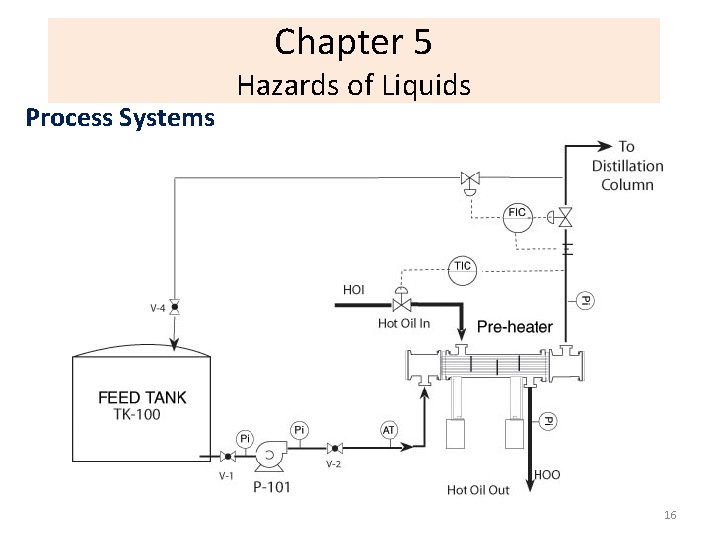
Chapter 5 Hazards of Liquids Process Systems A process system is a collection of equipment that works together to perform a specific function A distillation process is a collection of systems that are used together to separate the components in a mixture by their boiling points. Separating these components requires a variety of heating and cooling systems. 14
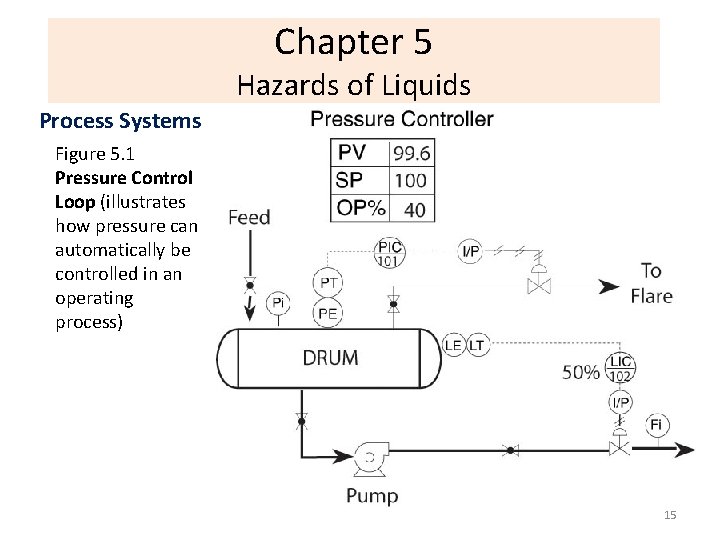
Chapter 5 Hazards of Liquids Process Systems Figure 5. 1 Pressure Control Loop (illustrates how pressure can automatically be controlled in an operating process) 15
Chapter 5 Process Systems Hazards of Liquids 16
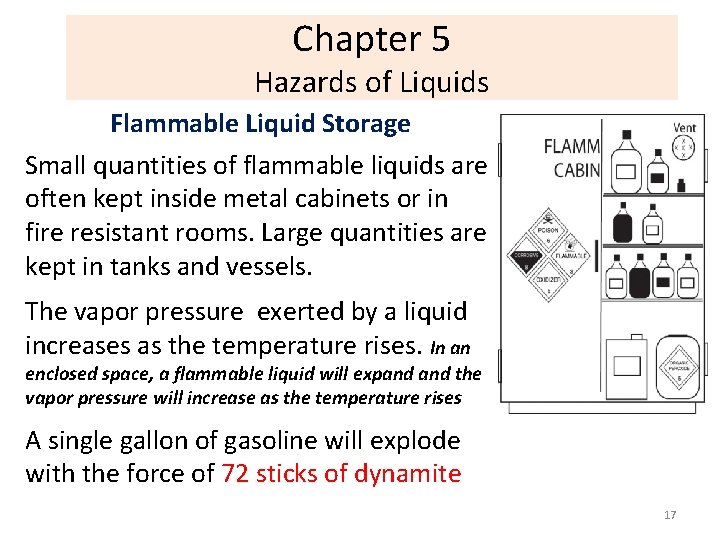
Chapter 5 Hazards of Liquids Flammable Liquid Storage Small quantities of flammable liquids are often kept inside metal cabinets or in fire resistant rooms. Large quantities are kept in tanks and vessels. The vapor pressure exerted by a liquid increases as the temperature rises. In an enclosed space, a flammable liquid will expand the vapor pressure will increase as the temperature rises A single gallon of gasoline will explode with the force of 72 sticks of dynamite 17
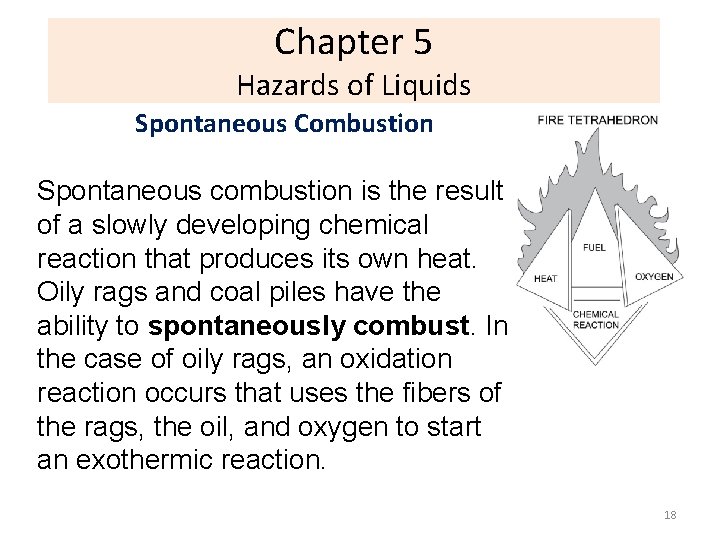
Chapter 5 Hazards of Liquids Spontaneous Combustion Spontaneous combustion is the result of a slowly developing chemical reaction that produces its own heat. Oily rags and coal piles have the ability to spontaneously combust. In the case of oily rags, an oxidation reaction occurs that uses the fibers of the rags, the oil, and oxygen to start an exothermic reaction. 18
Chapter 5 Hazards of Liquids Oxidizers An oxidizer is described as a substance that enhances the ability of oxygen to combine with fuel Under these conditions very little heat is needed to initiate a combustion reaction; in some cases, room temperature is adequate. • Common oxidizers include ammonium nitrate, chlorine, potassium nitrate, and pure oxygen. • Common combustibles items (petroleum grease, oils) react violently, ignites and occasionally explode when they come in contact with an oxidizer. • Common mistake is to grease or lubricate threads, gauges and valves on an oxygen cylinders or store oxygen cylinders with 19 acetylene cylinders
Chapter 5 Hazards of Liquids Hazards of Steam generation and application is the single largest utility in a plant. The most common hazards associated with steam include: • physical exposure to live steam, • contact with heated equipment, • non-uniform heat transfer, and • equipment over-pressuring High-pressure steam discharged from a small opening has enough energy to cut through solid materials (note: you can’t see super heated steam) 20
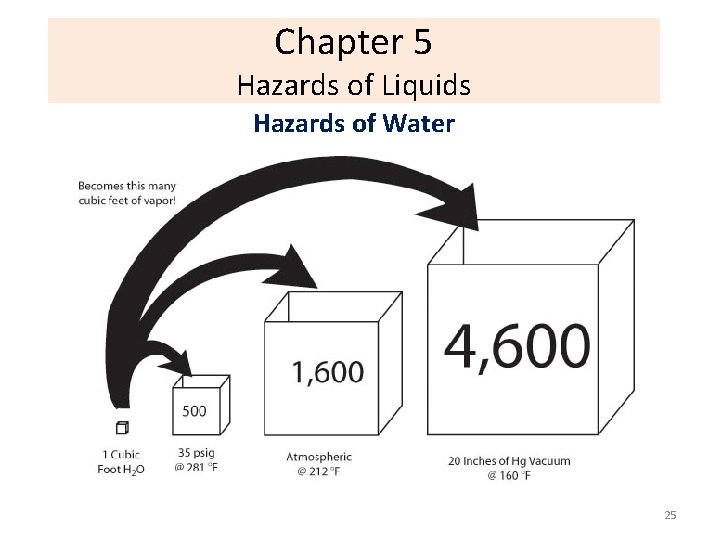
Chapter 5 Hazards of Liquids Hazards of Water The widespread use and application of water in the chemical processing industry creates a number of potential hazards When water flashes to steam at 100°C, it expands 1, 500 to 1, 600 times its original size One gallon of water can produce 1, 600 gallons of steam Hazards associated with water are typically associated with uncontrolled mixing; however, a number of other areas can be identified 21
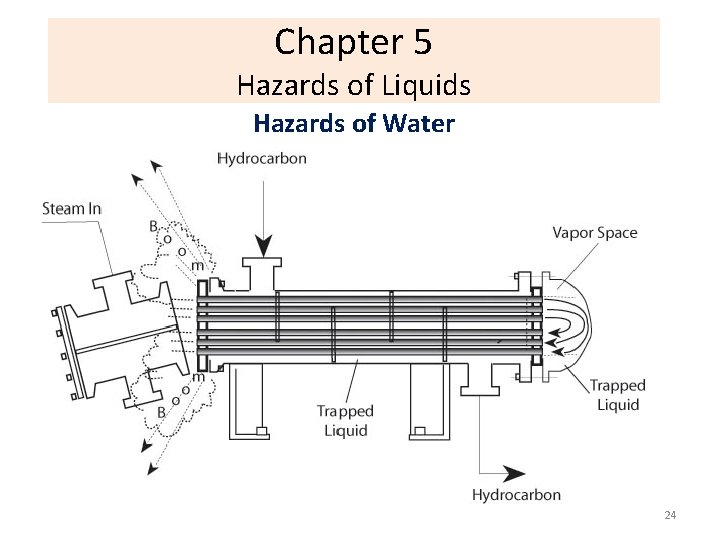
Chapter 5 Hazards of Liquids Hazards of Water Hazards associated with water are typically associated with uncontrolled mixing. When water flashes into steam, it can rupture pipes and vessels. Other hazards of water includes: • Foamover – when water vaporizes under heavy oil or asphalt. Can expand 20 – 30 times the original volume • Water and acid – does not respond well to each other. You can pour acid into water; never pour water into acid • Water Flashing – when water flashes or vaporizes into steam, it expand many times its original volume. 22
Chapter 5 Hazards of Liquids Hazards of Water • Vacuum – Vacuum towers operating below atmospheric pressure. Volume expansion is much greater in low-pressure situation. Water expands 5000 times at 1600 and 20 inches of mercury. • Static Generation – can occur when petroleum products pumped through pipeline. Based on velocity of product being pumped and the amount of water present. Petroleum products should be kept free of water to avoid hazardous condition. • Environmental Issues – Rapid temperature shifts can affect process instrumentation. Rains can overwhelm sewer systems. • Displacement – When water used to flush systems, oxygen can be pushed into hydrocarbon systems. When this happens, an explosive situation may be created. 23
Chapter 5 Hazards of Liquids Hazards of Water 24
Chapter 5 Hazards of Liquids Hazards of Water 25
Chapter 5 Hazards of Liquids Hazards of Light - Ends Light-ends are hydrocarbons that are heavier than air and will quickly evaporate at room temperature and pressure. They typically have low boiling points and a Reid vapor pressure (RVP) of 18 psi or higher. The explosive characteristics of light-ends are very violent. Light ends are often handled and stored as liquids. 26
Chapter 5 Hazards of Liquids Hazards of Light - Ends Examples of light-ends include: • methane, propane, butane, and pentane. A common liquid mixture of propane and butane is often referred to as liquefied petroleum gas or LPG • Light-ends have low viscosity and density characteristics • To keep in a liquid state pressure is added and in some cases temperatures are lowered 27
Chapter 5 Hazards of Liquids Hazards of Light - Ends The explosive characteristics of light-ends are very violent. Other Characteristics of Light-ends: Viscosity – measure of flow Frostbite – very cold. Thermal Expansion – 20% vapor space allowed for expansion. Filled containers should be refrigerated or kept in the shade. Hazards of Air – Air is to be eliminated from process equipment containing light-ends before start-up. Steam or inert gas (N 2) is used to purge vessels. One gallon of propane transferred into a 10, 000 gal drum containing 600 F at atmospheric pressure is equivalent to 13 pounds of TNT. 28
Chapter 5 Hazards of Liquids Acids and Caustics Acids and caustics are typically referred to as chemical opposites since they are used to neutralize each other. Acid and caustics have a wide range of application in the chemical processing units (cooling towers, boiler feed water, wastewater treatment and others). When acids and caustics come into contact with human tissue, they tend to dissolve or eat away any exposed area. • Mists and vapors inhaled by the respiratory system will cause chemical burns and destroy soft throat and lung tissue. • An acid produces H 3 O+ (hydronium) ions in an aqueous solution, while a base produces OH—(hydroxyl) ions in an aqueous solution. • Acid will turn blue litmus paper red. Base will turn red litmus paper blue. 29
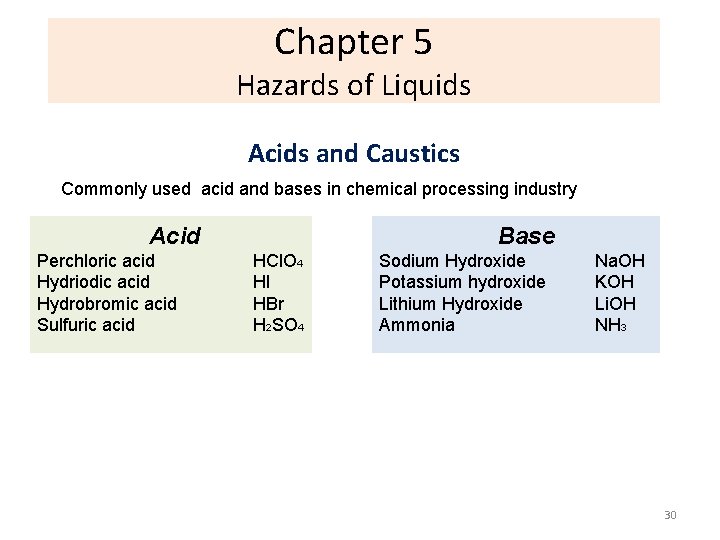
Chapter 5 Hazards of Liquids Acids and Caustics Commonly used acid and bases in chemical processing industry Acid Perchloric acid Hydriodic acid Hydrobromic acid Sulfuric acid Base HCl. O 4 Hl HBr H 2 SO 4 Sodium Hydroxide Potassium hydroxide Lithium Hydroxide Ammonia Na. OH KOH Li. OH NH 3 30
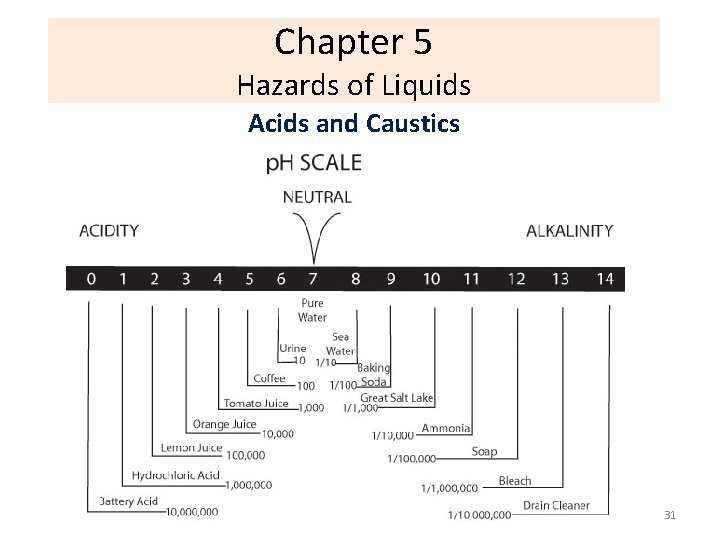
Chapter 5 Hazards of Liquids Acids and Caustics 31
Chapter 5 Hazards of Liquids Solvents are flammable, volatile, highly toxic, and produce large volumes of vapor. Most solvents have varying toxic effects. They each appear to attack specific organs in the human body and are often irreversible. Many industrial applications frequently use paints and adhesives in preventive maintenance programs and new construction 32
Chapter 5 Hazards of Liquids Paints and Adhesives Acrylic paints, oil-based paints, and epoxy paints contain a variety of hazardous components including: propellants in spray cans, chromates, alkaline chemical, lead, toluene and xylene. Adhesives contain chemicals such as toluene and xylene that can cause permanent damage when inhaled in sufficient quantities. Two important safety procedures 1. Adequate ventilation 2. Use of respiratory and PPE 33
Chapter 5 Hazards of Liquids Hematopoietic System Toxins, Hepatotoxic Agents and Other Harmful Agents There a number of toxic agents that acts on different areas of the human body. Hematopoietic system toxins acts on blood cells or the bone marrow. Examples includes benzene, nitrites, nitrobenzene, and toluidine. Hepatotoxic agents like carbon tetrachloride, nitrosamines, and tetrachlororethane cause liver damage. Neurotoxic agents can damage the nervous system. Example includes carbon disulfide, methyl mercury, manganese, tetraethyl lead. Nephrotoxic agents like halogenated hydrocarbons and uranium compounds damage the kidneys. Pulmonary toxics targets the pulmonary tissues of the lungs and trigger fibrotic changes. Coal dust, cotton dust, and wood dust. Fibrotic changes 34 can be triggered by asbestos and free silica.
- Slides: 34