
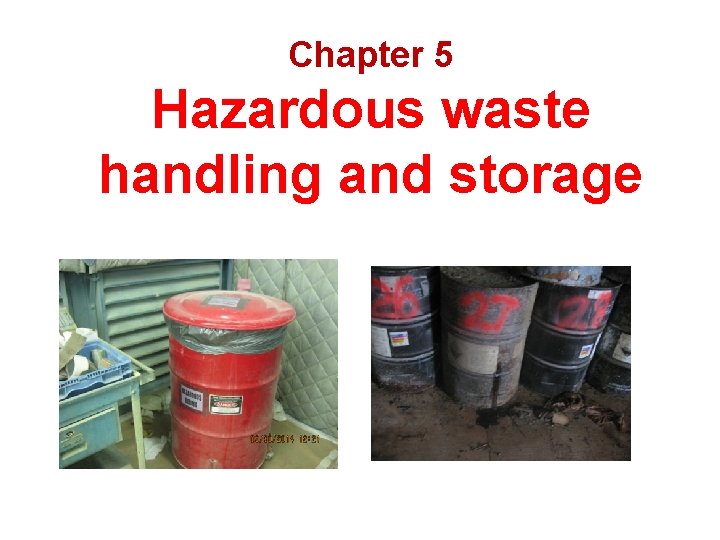
Chapter 5 Hazardous waste handling and storage Which
- Slides: 95
Chapter 5 Hazardous waste handling and storage
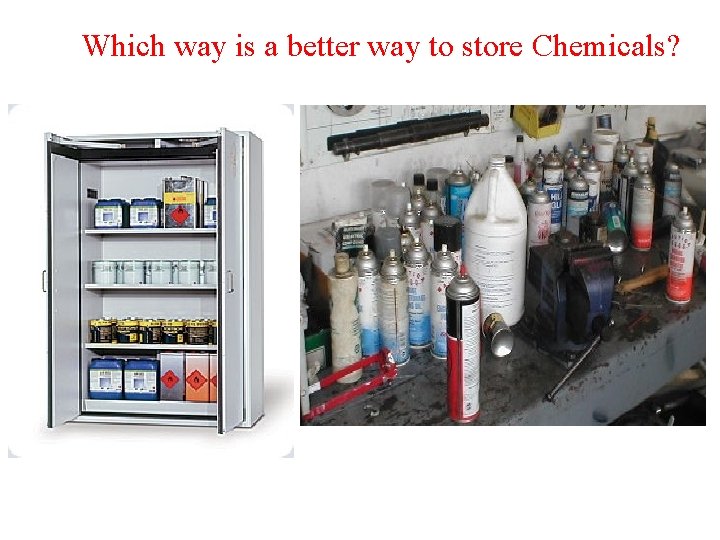
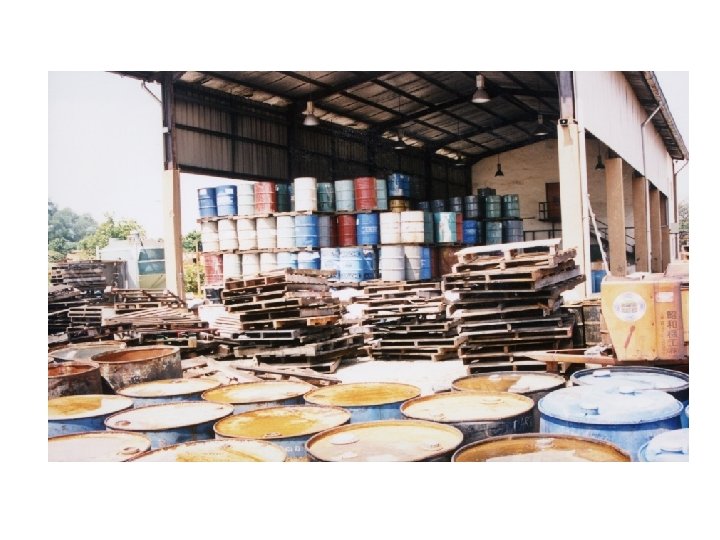
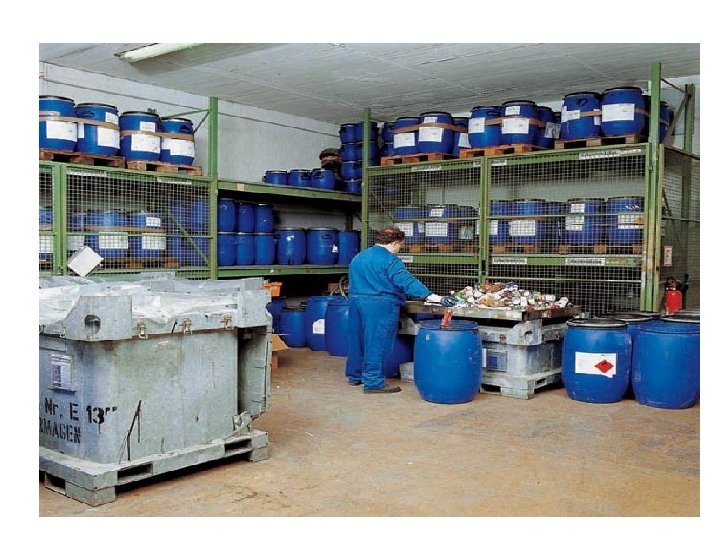
Which way is a better way to store Chemicals?
Waste handling and storage Ø The correct handling, marking and storage of hazardous wastes is vital ﺣﻴﻮﻱ to protect personnel and to limit the chance of accidental harm to the environment and wider human health. Ø This chapter gives an overview of the key issues to be considered in the storage and handling of hazardous wastes. Ø The understanding and awareness of these practical issues is one of the key factors to achieving improved management of hazardous wastes. TRP Chapter 5. 1 3
Ø The way wastes are stored and handled on-site and off-site has a major impact on the success or failure of a hazardous waste management program. Ø Proper planning is necessary to ensure success. Ø Some storage decisions ﻗﺮﺍﺭﺍﺕ are directly dependent on the volume of hazardous wastes being generated and on the availability of treatment or disposal facilities near the generation point. Ø This chapter provides information on the selection criteria for appropriate storage of hazardous wastes. TRP Chapter 5. 1 4
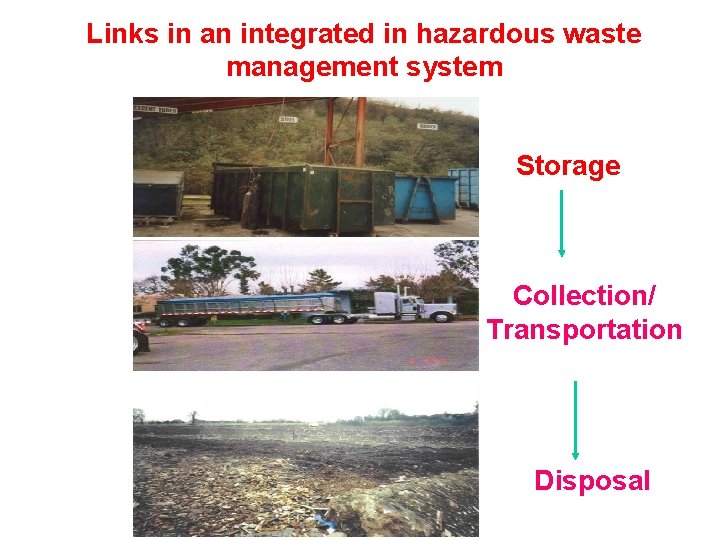
Links in an integrated in hazardous waste management system Storage Collection/ Transportation Disposal
Links in an integrated hazardous waste management system There is a need for an infrastructure of proper hazardous waste management system which begins as soon as the waste has been generated and continues through all subsequent stages to final treatment and disposal. In the simplest form, a hazardous waste management system comprises ﻳﺘﺄﻠﻒ three units: 1 - Storage upon generation. 2 - Collection and transportation. 3 - Final treatment and disposal.
Handling and storage: Ø Handling and storage are both important factors in all of these management stages, from cradle to grave. Ø Different materials have to be handled in different ways, and may have special storage requirements. Ø For this reason proper identification and labelling of materials is essential, and is likely to represent the difference between a safe hazardous waste management system and a dangerous one.
Ø Correct handling, storage, packaging and labelling are vital if accidents are to be avoided and the environment is to be protected. Ø The hazardous waste management system consists of a series of actions to control and contain the waste. Ø This must be coordinated so that the various persons and groups of persons involved at the different stages are aware of their role and how that role fits within the larger structure. Ø This is particularly true of handling and storage procedures. TRP Chapter 5. 1 8
Storage Fundamentals Ø Identify incompatible chemicals: check the Material Safety Data Sheet (MSDS) or (SDS). Ø Isolate and separate incompatible materials. – Isolate by storing in another area or room. – Degree of isolation depends on quantities, chemical properties and packaging. – Separate by storing in same area or room, but apart from each other.
Storage site selection Ø Hazardous waste materials must be stored somewhere. Ø Ideally the storage should be near the place where the hazardous wastes were generated. Ø However, storage can be managed on-site or off-site. On-site storage: within the premises of the waste generator. Requirements: • Not subject to flooding. ﻻ ﺗﺨﻀﻊ ﻟﻠﻔﻴﻀﺎﻧﺎﺕ • Away from manufacturing/processing areas. • Away from employee activities.
Off-site storage: off-site storage – outside the premises of the waste generator. May be, for example, at waste collection or transfer stations, pending ﻗﻴﺪ ﺍﻻﻧﺘﻈﺎﺭ final treatment and disposal. Requirements: • Not subject to flooding. • Away from residential area (at least 200 metres). • Ideally in industrial area. • Good access to public infrastructure eg roads, emergency services. • Compatible with surrounding land use. TRP Chapter 5. 1 11
Storage site design criteria 1 Whether it is stored on-site or off, any hazardous waste storage areas must be designed to minimise: The possibility of an explosion or any unplanned sudden or gradual release of hazardous waste to air, water or soil. The following design criteria should be observed: Waste compatibility: different hazardous wastes should be stored in separate compatibility areas. Distances from boundary and traffic: hazardous waste should be stored away from traffic, including both vehicular and foot traffic. Ignitable and reactive wastes should be stored at least 15 m from the facility’s boundary, if possible - on small sites this may not be possible.
Base material : an impermeable base should used for the area where containers may be stored, to prevent any leaks or spills, or accumulated precipitation, from seeping ﺗﺴﺮﺏ into the ground. Leak and spill containment: Ø The storage area must be designed and operated to contain any leaks and spills e. g. with bunds ﺳﺎﻧﺪﺍﺕ. Ø For outdoor storage facilities, the maximum probable quantity of runoff ﺟﺮﻳﺎﻥ ﺍﻟﻤﻴﺎﻩ must also be considered. Ø Regulatory agencies, such as fire departments, may specify certain containment requirements. TRP Chapter 5. 1 13
Safe Storage of Chemicals • Video TRP Chapter 5. 1 15
HW safety Management • Video TRP Chapter 5. 1 16
Secondary Containment • Video TRP Chapter 5. 1 17
Storage • Video TRP Chapter 5. 1 18
Outdoor Storage Drums • Video TRP Chapter 5. 1 19
Storage site design criteria 2 Climate and environment: Ø Weather conditions can frequently be an important factor in determining storage conditions. Ø Heat, cold, moisture, and wind can adversely affect storage of all chemicals. Ø If waste materials must be stored outside, they should always be covered by a roof or tarpaulin ﺍﺳﻘﻒ ﻭﺍﻗﻴﺔ , and be kept away from direct sunlight. Ventilation: Ø Adequate ventilation should be provided to prevent build-up of gases. Ø Any area used for storage of chemical wastes or any other hazardous material should be well ventilated.
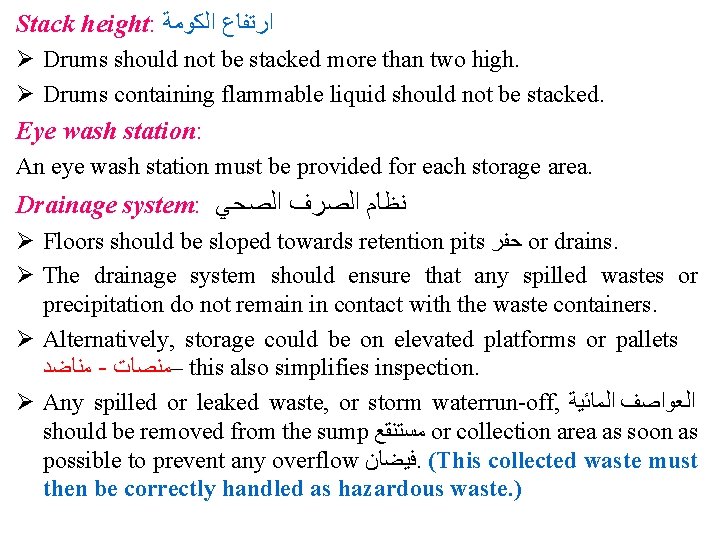
Stack height: ﺍﺭﺗﻔﺎﻉ ﺍﻟﻜﻮﻣﺔ Ø Drums should not be stacked more than two high. Ø Drums containing flammable liquid should not be stacked. Eye wash station: An eye wash station must be provided for each storage area. Drainage system: ﻧﻈﺎﻡ ﺍﻟﺼﺮﻑ ﺍﻟﺼﺤﻲ Ø Floors should be sloped towards retention pits ﺣﻔﺮ or drains. Ø The drainage system should ensure that any spilled wastes or precipitation do not remain in contact with the waste containers. Ø Alternatively, storage could be on elevated platforms or pallets ﻣﻨﺎﺿﺪ - –ﻣﻨﺼﺎﺕ this also simplifies inspection. Ø Any spilled or leaked waste, or storm waterrun-off, ﺍﻟﻌﻮﺍﺻﻒ ﺍﻟﻤﺎﺋﻴﺔ should be removed from the sump ﻣﺴﺘﻨﻘﻊ or collection area as soon as possible to prevent any overflow ﻓﻴﻀﺎﻥ. (This collected waste must then be correctly handled as hazardous waste. ) TRP Chapter 5. 1 21
Earthing: ﺍﻟﺘﺄﺮﻳﺾ When pumping waste or emptying and filling containers, it is necessary to earth the process. Adsorbent material: Should always be present to clean up spills immediately A separate repackaging room: Any items which are seen to be incorrectly or inadequately packaged can be taken here. Agency requirements: Government agencies, such as the fire department, should be contacted prior to the design and building of a storage structure to incorporate any other specific requirements they may have. TRP Chapter 5. 1 22
Spill Management • Video TRP Chapter 5. 1 23
Spill Management • Video TRP Chapter 5. 1 24
Spill Management • Video TRP Chapter 5. 1 25
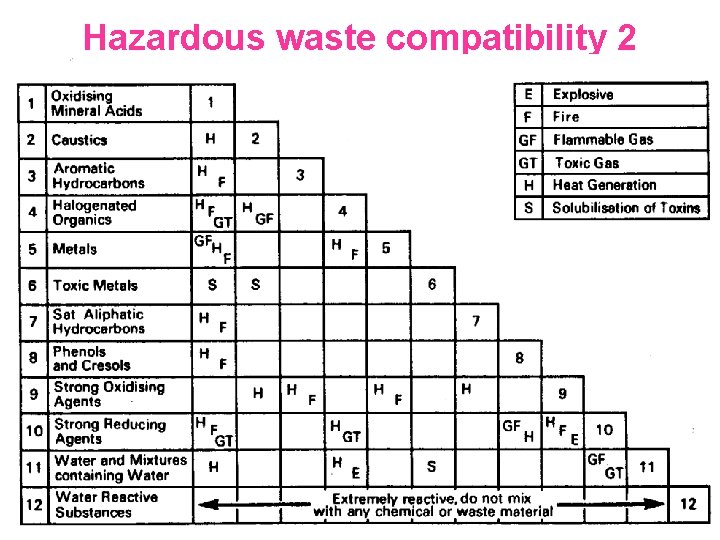
Hazardous waste compatibility 1 Compatibility: The ability of two or more materials to exist in close association with each other without the formation of harmful chemical or physical reactions. The concept of compatibility, when applied to hazardous waste, refers to: Ø The way chemicals react when in contact with each other. Ø Chemicals’ compatibility with the containers in which they are stored, otherwise there is a risk of container failure resulting in environmental damage or personal injury. For example, acid should not be stored in steel drums, or pressurised materials in weak containers.
Ø Compatibility with nearby materials and equipment. For example, containers of flammable materials should be stored with proper consideration of proximity to heat, electrical sources and open flames. All flammable containers 20 litre or larger should be earthed. Ø Compatibility with the environment itself. Storing many waste materials outside may be practical, but storing drums of highly flammable material in dark drums in open sunlight can be extremely dangerous. TRP Chapter 5. 1 27
Ø Incompatibility between two chemical substances can result in one of a number of reactions. For examples: v. Acid + cyanide solution = cyanide gas v. Bleach + ammonia = chlorine gas v TRP Chapter 5. 1 28
Hazardous waste compatibility 2
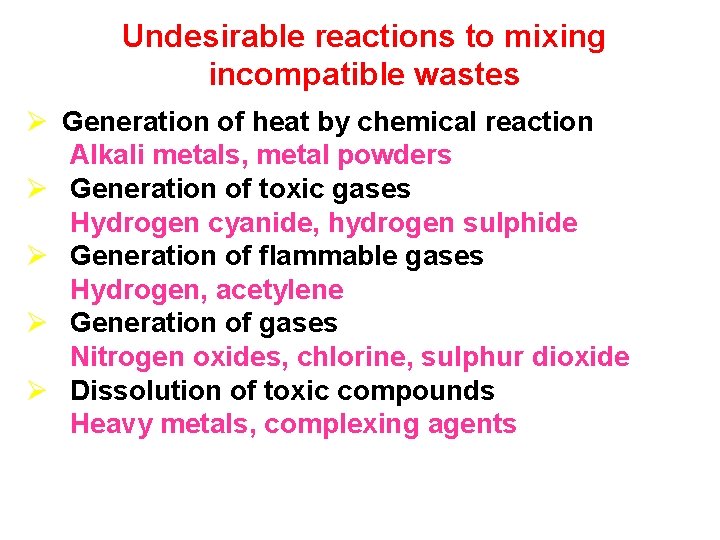
Undesirable reactions to mixing incompatible wastes Ø Generation of heat by chemical reaction Alkali metals, metal powders Ø Generation of toxic gases Hydrogen cyanide, hydrogen sulphide Ø Generation of flammable gases Hydrogen, acetylene Ø Generation of gases Nitrogen oxides, chlorine, sulphur dioxide Ø Dissolution of toxic compounds Heavy metals, complexing agents
Incompatibility • video TRP Chapter 5. 1 31
Incompatibility • video TRP Chapter 5. 1 32
Duration of hazardous waste storage Ø Storage should be for as brief a period as possible: To avoid leakage or spill, or decay of containment. Short Term Storage: should ideally be for the short term Ø Permitted temporary storage duration varies from country to country: Depends on the availability of treatment and disposal facilities (providing the regulations on storage design and management are met). ØWestern Europe: Typically 28 or 90 days ØUSA: Up to 90 days for large quantity generators. Up to 180 days for small quantity generators. ØSome European countries and Far East: Indefinite period allowed
Long term storage Ø For longer term storage, different controls needed. Ø If storage may be indefinite, controls should be similar to those for final disposal facilities. Ø Long term storage may be a practical solution to the problem of a shortage of hazardous waste treatment and disposal facilities. An example of inappropriate long term storage of wastes: The stockpiling of obsolete pesticides ﺗﺨﺰﻳﻦ ﺍﻟﻤﺒﻴﺪﺍﺕ ﺍﻟﻤﺘﻘﺎﺩﻣﺔ in some countries. Because the conditions were not properly controlled, drums have corroded or buckled ﺗﻨﺒﻌﺞ , and storage areas have flooded ﺗﻐﺮﻕ.
• In some parts of Europe, such as Portugal, and in the Far East, hazardous wastes may be stored indefinitely ﻳﻤﻜﻦ ﺗﺨﺰﻳﻦ ، ﻭﻓﻲ ﺍﻟﺸﺮﻕ ﺍﻷﻘﺼﻰ ، ﻣﺜﻞ ﺍﻟﺒﺮﺗﻐﺎﻝ ، ﻓﻲ ﺑﻌﺾ ﺃﺠﺰﺍﺀ ﺃﻮﺭﻭﺑﺎ . ﺍﻟﻨﻔﺎﻳﺎﺕ ﺍﻟﺨﻄﺮﺓ ﺇﻟﻰ ﺃﺠﻞ ﻏﻴﺮ ﻣﺴﻤﻰ This is a practical solution to the severe shortage of hazardous waste facilities. . ﻭﻫﺬﺍ ﺣﻞ ﻋﻤﻠﻲ ﻟﻠﻨﻘﺺ ﺍﻟﺸﺪﻳﺪ ﻓﻲ ﻣﺮﺍﻓﻖ ﺍﻟﻨﻔﺎﻳﺎﺕ ﺍﻟﺨﻄﺮﺓ • As treatment and disposal facilities become available in developing economies ﺍﻻﻗﺘﺼﺎﺩﻳﺎﺕ ﺍﻟﻨﺎﻣﻴﺔ , there is an opportunity to tighten ﻟﺘﺸﺪﻳﺪ regulations on storage duration. However, in the meantime the stored wastes are kept containerized, and the facilities are licensed and controlled. TRP Chapter 5. 1 35
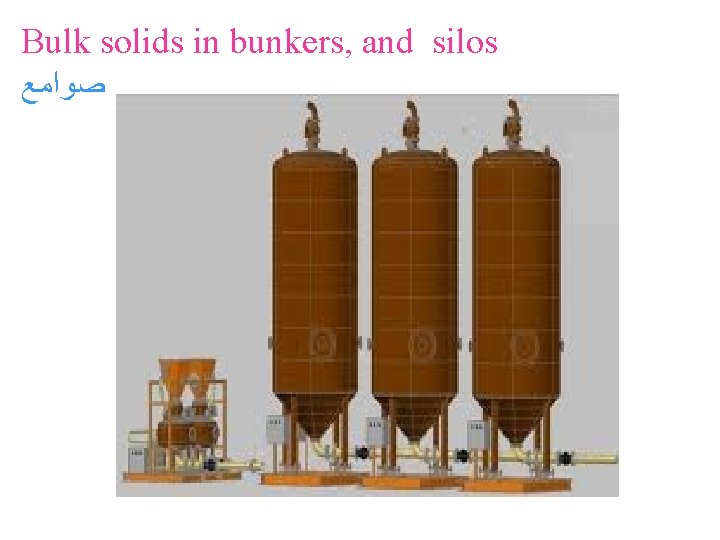
Types of storage The type of storage must be matched to the waste material, in relation to its physical form as well as its characteristics. The later treatment and disposal options may also influence the storage decisions. • Small amounts are containerized. • Bulk liquids in tanks. • Bulk solids in bunkers, silos, skips.
TRP Chapter 5. 1 37
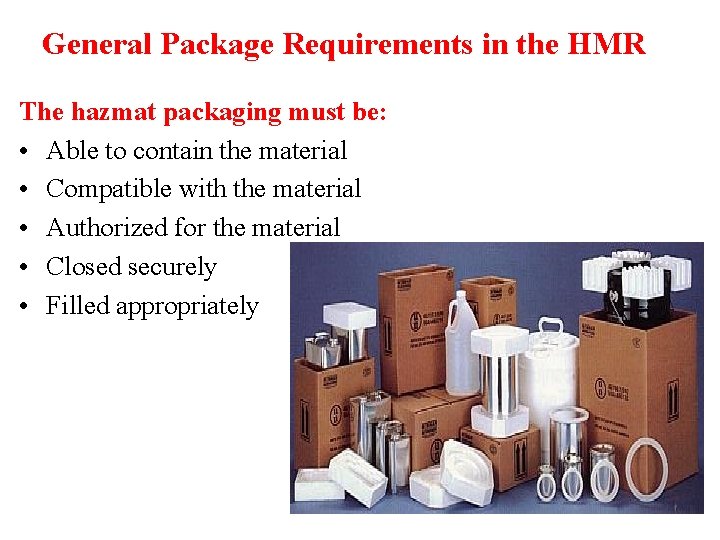
General Package Requirements in the HMR The hazmat packaging must be: • Able to contain the material • Compatible with the material • Authorized for the material • Closed securely • Filled appropriately
Packaging materials • A wide variety of packaging materials are available for handling and storage of hazardous waste, most of which have two basic characteristics. • Must be inert and not react with the hazardous waste. • Must be able to absorb impact in case the container is bumped or dropped. Materials which can be used include: • Steel • Aluminium • Natural Wood • Plywood ﺧﺸﺐ ﺭﻗﺎﺋﻘﻲ • Reconstituted wood ﺍﻟﺨﺸﺐ ﺍﻟﻤﻌﺎﺩ ﺗﺸﻜﻴﻠﻪ • Fibreboard ﻟﻴﻔﻴﺔ • Plastic material ﻣﻮﺍﺩ ﺑﻼﺳﺘﻴﻜﻴﺔ • Textile ﻣﻨﺴﻮﺟﺎﺕ • Metal (other than steel or aluminium) • Glass or stoneware ﻓﺨﺎﺭ
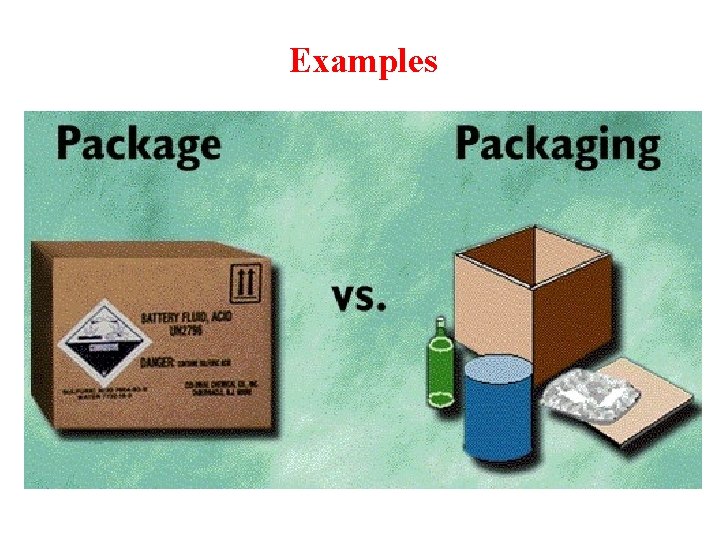
Examples
The choice of material used will depend on various factors, including: Ø The hazardous waste type (for example, plastic containers should not be used to store solvent wastes). Ø The physical form of the hazardous waste (e. g. paper is no use for liquids). Ø The type of container (e. g. drums need to be of rigid material). The ease with which packaged waste can be handled is also an important consideration. TRP Chapter 5. 1 41
Types of containers Ø Hazardous materials being moved or stored need to be contained in some way. Ø The kind of container reflects the type of waste to be stored, and the handling method in use. For example: some containers are more suitable for filling by pumping, and some more suited to filling by shovelling ﺑﺎﻟﺠﺎﺭﻭﻑ. Ø Often there is no correlation between the color of the drum and the possible contents. Ø There are many types of packages available for different types of wastes, including: TRP Chapter 5. 1 42
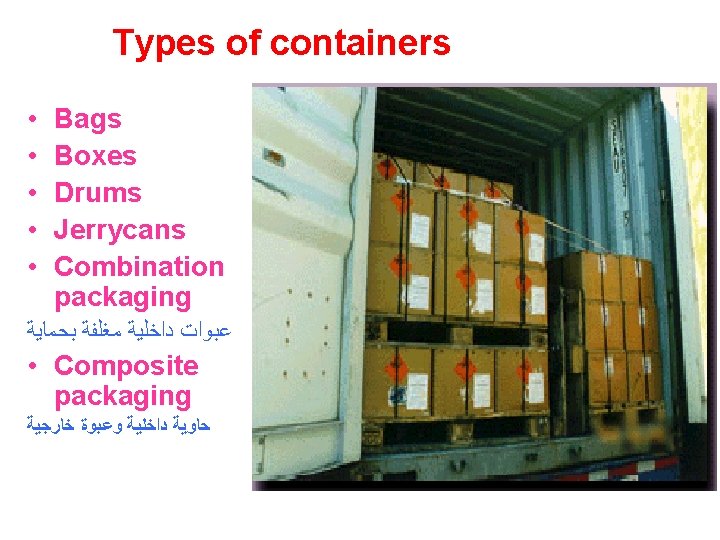
Types of containers • • • Bags Boxes Drums Jerrycans Combination packaging ﻋﺒﻮﺍﺕ ﺩﺍﺧﻠﻴﺔ ﻣﻐﻠﻔﺔ ﺑﺤﻤﺎﻳﺔ • Composite packaging ﺣﺎﻭﻳﺔ ﺩﺍﺧﻠﻴﺔ ﻭﻋﺒﻮﺓ ﺧﺎﺭﺟﻴﺔ
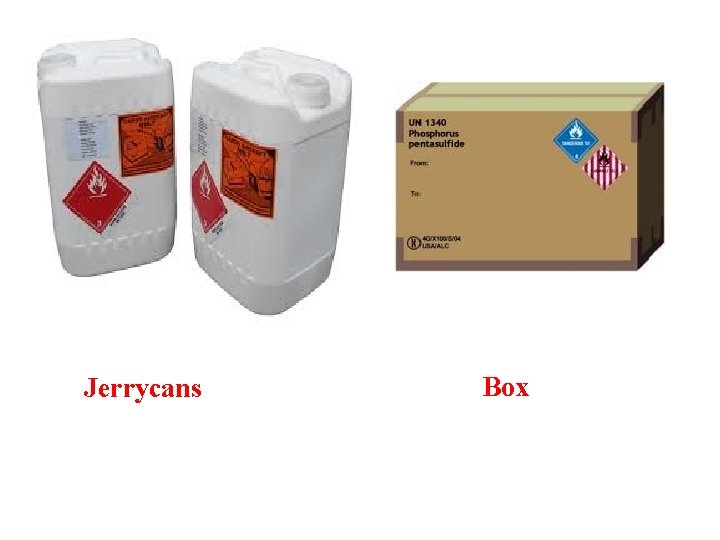
Bags: flexible packs made of paper, plastic film, textiles, woven or other materials. Boxes: packaging with complete rectangular or polygonal faces, made of metal, wood, plywood, reconstituted wood, fibreboard, plastic or other suitable material. Drums: flat-ended or convex-ended cylindrical containers made of metal, fibreboard, plastic, plywood or other suitable materials. Jerrycans: metal or plastic containers of rectangular or polygonal cross-section. Combination packaging: Some containers are multi-material, e. g. a plastic bag inside a metal drum, or multi-layer e. g. plastic coated paper. Composite packaging: Some storage containers may combine or more inner packs secured inside an outer packaging. TRP Chapter 5. 1 44
Suggested containers: Ø Waste oils and solvents: may be best suited ﻣﻨﺎﺳﺐ to storage in 200 litre steel bung drums or tanks. Ø Solid or semi-solid organic wastes: may be best suited to 200 litre steel clamp lid drums. Ø Inorganic liquid wastes: may be best in plastic cans or polyethylene tanks of 30, 45 or 200 litre capacity. Ø Inorganic solids and sludge: might be stored in 200 litre steel or plastic clamp lid drums. TRP Chapter 5. 1 45
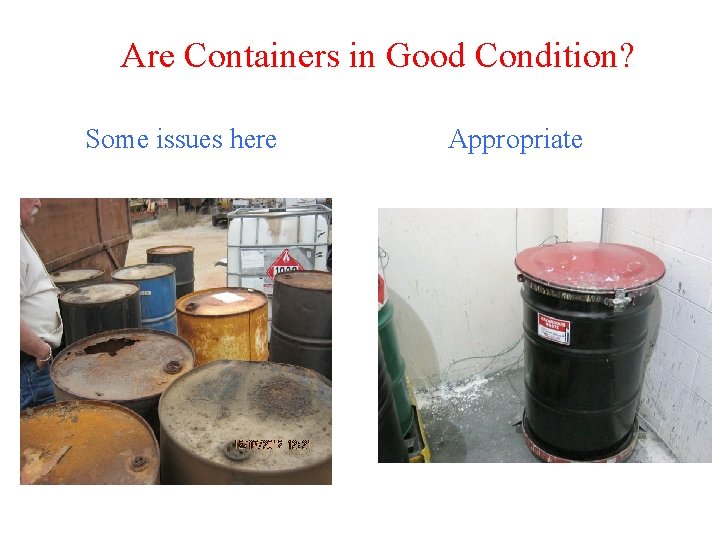
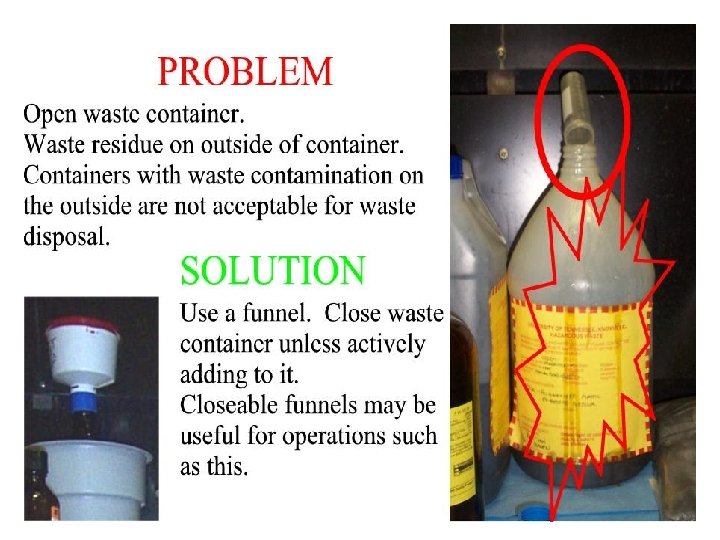
Container selection criteria The selection of suitable materials and container types for hazardous wastes should be made based on the requirements of each storage and handling application. Inert: will not react with the hazardous waste, impervious to attack by their contents and must not form other dangerous substances when in contact with the contents. Robust: able to absorb impact , in case they are bumped or dropped. Good condition: free of leaks, structural defects or rust, clean. The outside must be clean and without holes, bulges or cracks. Able to be kept closed: except when waste material being added or removed. Contents will not escape: in normal handling. Suitable: for quantity/volume of wastes - not over filled.
Well-made and robust: For example if a vessel has a resealable closure or plug, that closure must be able to bear repeated use without sustaining damage, which could allow the contents to escape. Could be reused: This saves money and reduces wastage, and is acceptable providing the container was not contaminated during its previous use (compatibility of the wastes with the container material and any residues of the raw material or it must first be triple-washed). Suitable Volume: Containers should not be over-filled: for example, drums should never be filled more than 90%. TRP Chapter 5. 1 47
Are Containers in Good Condition? Some issues here Appropriate
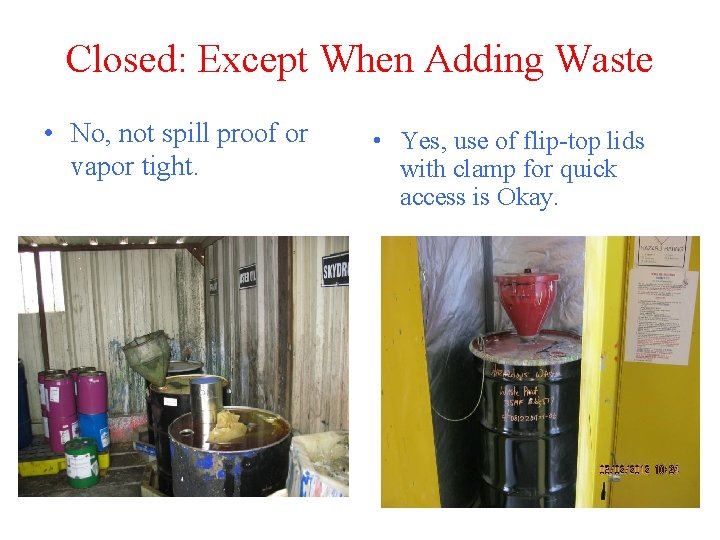
Closed: Except When Adding Waste • No, not spill proof or vapor tight. • Yes, use of flip-top lids with clamp for quick access is Okay.
Accumulation Start Date • Regulations require storage date. • Containers being filled could be a satellite container and not require date. • Containers could be a storage container and require a date the minute one drop goes into the drum. • Understand how you wish to manage containers at your facility. Satellite, or storage?
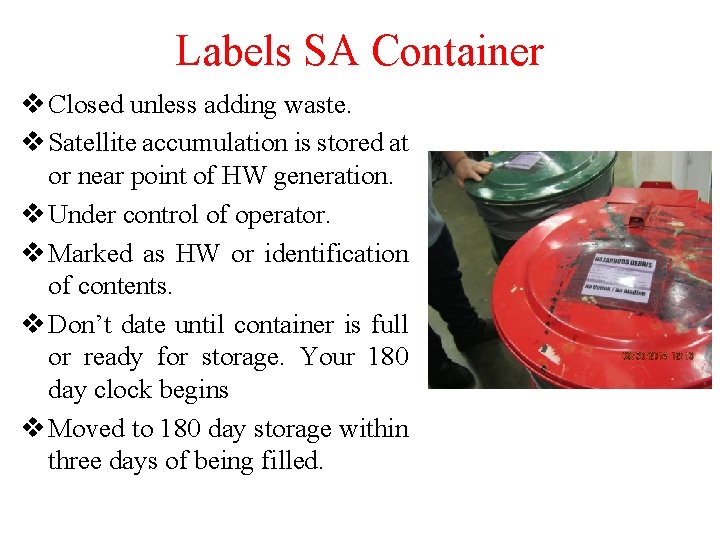
Labels SA Container v Closed unless adding waste. v Satellite accumulation is stored at or near point of HW generation. v Under control of operator. v Marked as HW or identification of contents. v Don’t date until container is full or ready for storage. Your 180 day clock begins v Moved to 180 day storage within three days of being filled.
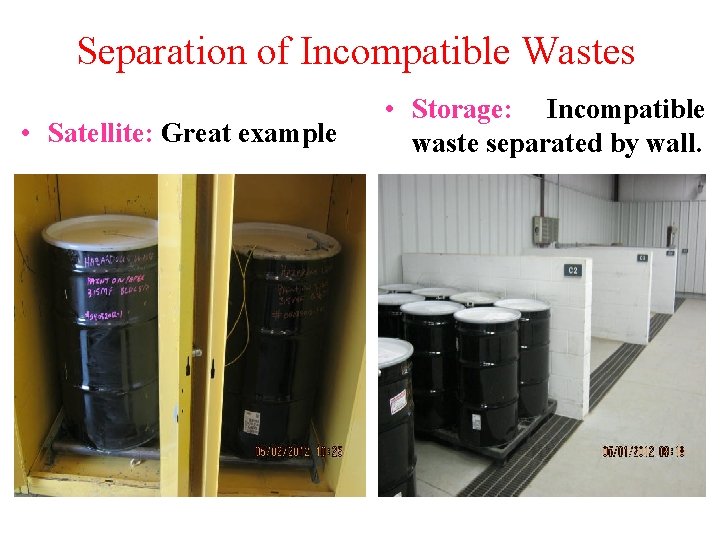
Separation of Incompatible Wastes • Satellite: Great example • Storage: Incompatible waste separated by wall.
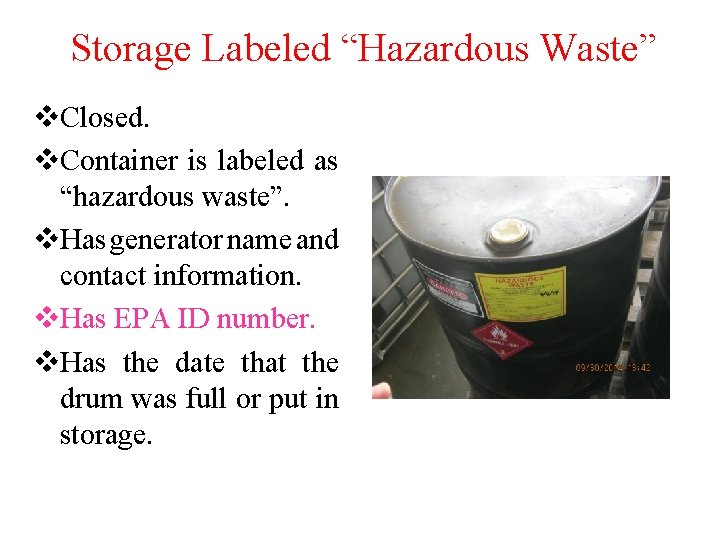
Storage Labeled “Hazardous Waste” v. Closed. v. Container is labeled as “hazardous waste”. v. Has generator name and contact information. v. Has EPA ID number. v. Has the date that the drum was full or put in storage.
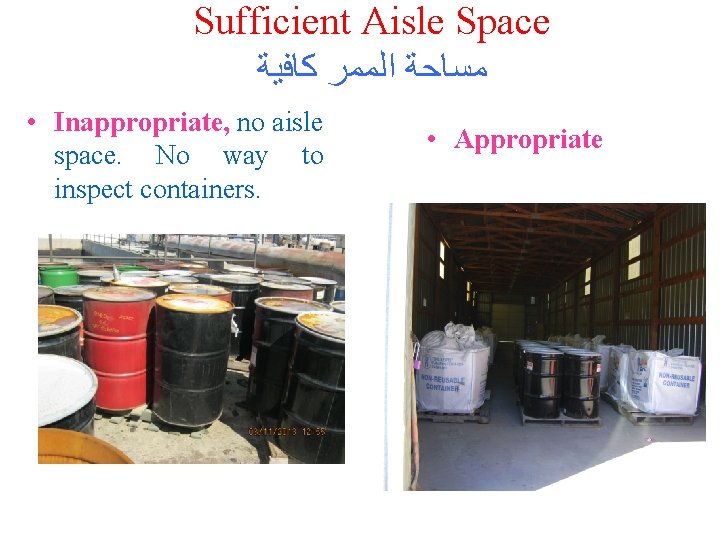
Sufficient Aisle Space ﻣﺴﺎﺣﺔ ﺍﻟﻤﻤﺮ ﻛﺎﻓﻴﺔ • Inappropriate, no aisle space. No way to inspect containers. • Appropriate
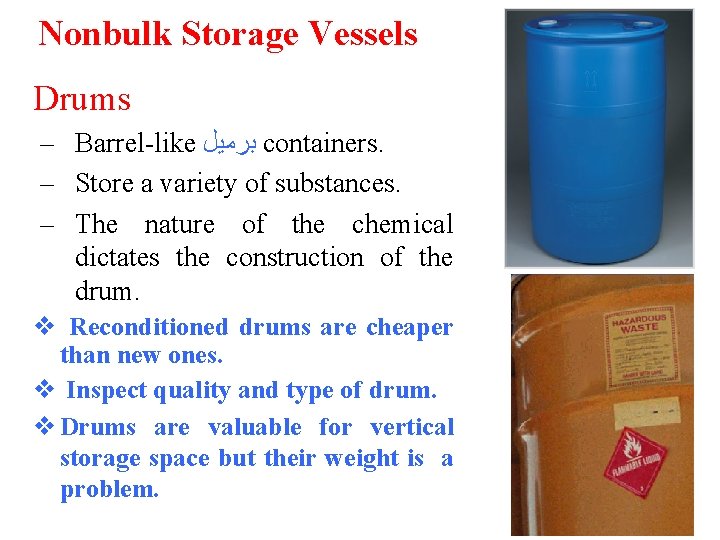
Nonbulk Storage Vessels Drums – Barrel-like ﺑﺮﻣﻴﻞ containers. – Store a variety of substances. – The nature of the chemical dictates the construction of the drum. v Reconditioned drums are cheaper than new ones. v Inspect quality and type of drum. v Drums are valuable for vertical storage space but their weight is a problem.
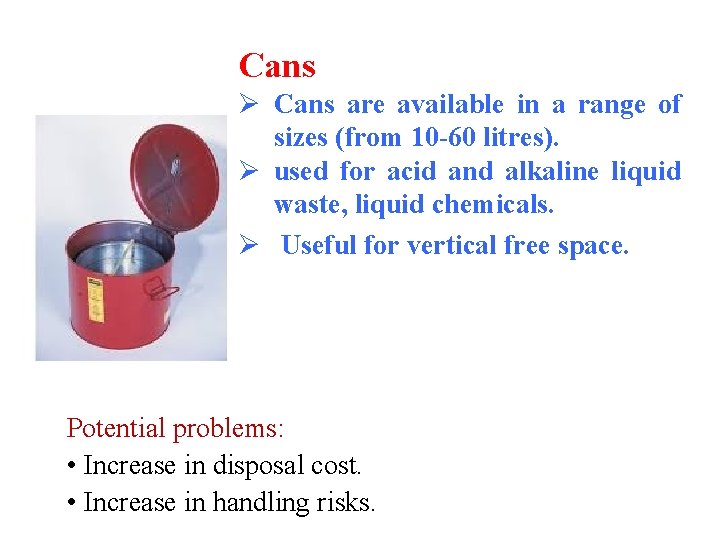
Cans Ø Cans are available in a range of sizes (from 10 -60 litres). Ø used for acid and alkaline liquid waste, liquid chemicals. Ø Useful for vertical free space. Potential problems: • Increase in disposal cost. • Increase in handling risks.
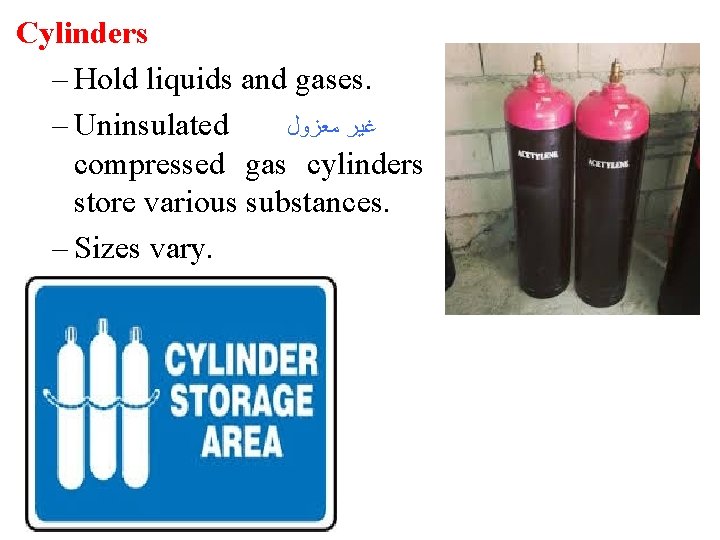
Cylinders – Hold liquids and gases. – Uninsulated ﻏﻴﺮ ﻣﻌﺰﻭﻝ compressed gas cylinders store various substances. – Sizes vary.
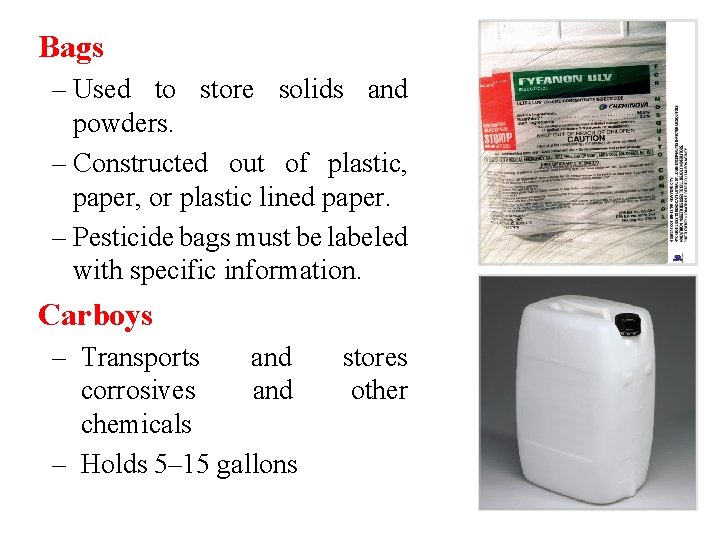
Bags – Used to store solids and powders. – Constructed out of plastic, paper, or plastic lined paper. – Pesticide bags must be labeled with specific information. Carboys – Transports and corrosives and chemicals – Holds 5– 15 gallons stores other
Jerrycans Box TRP Chapter 5. 1 59
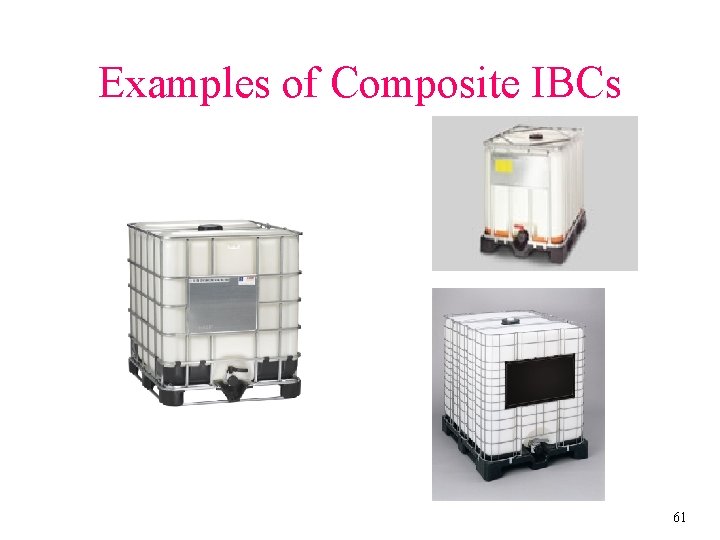
Intermediate Bulk Containers (IBCs) • Some are flexible IBCs • Others are all metal or all plastic (rigid) • Some are “Composite IBCs” : Bottle-in-a-Cage • Typically 260 – 300 gallons • DOT has separate rules for IBCs 60
Examples of Composite IBCs 61
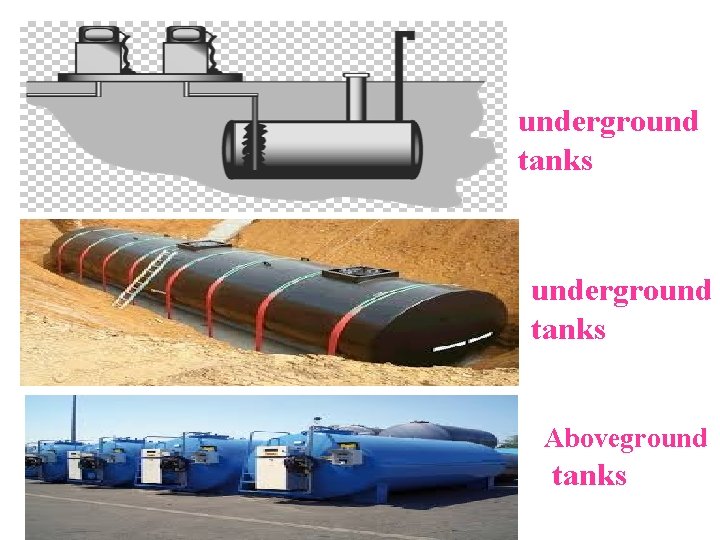
Bulk Storage Vessels • Found in buildings that rely on ﻳﻌﺘﻤﺪ ﻋﻠﻰ and need to store a large amount of a particular chemical. • Secondary containment is a method to control spills. Large volume horizontal tanks – Above-ground storage tanks. – Underground storage tanks. – Can hold a few hundred gallons to several million gallons of product.
underground tanks Aboveground tanks
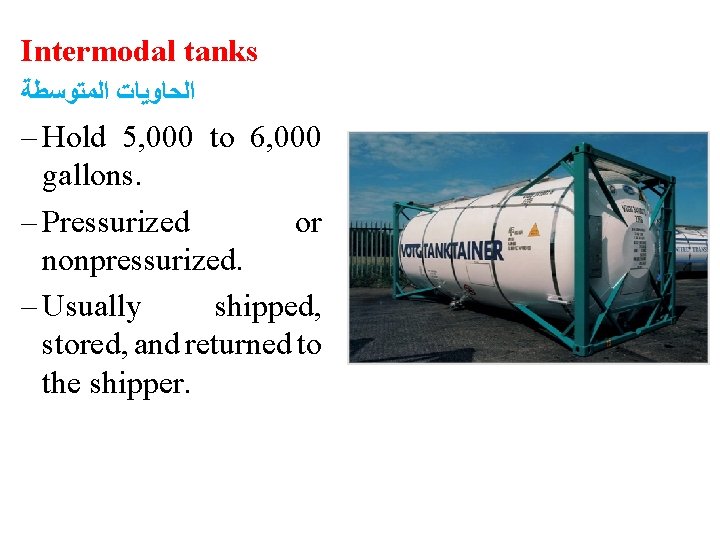
Intermodal tanks ﺍﻟﺤﺎﻭﻳﺎﺕ ﺍﻟﻤﺘﻮﺳﻄﺔ – Hold 5, 000 to 6, 000 gallons. – Pressurized or nonpressurized. – Usually shipped, stored, and returned to the shipper.
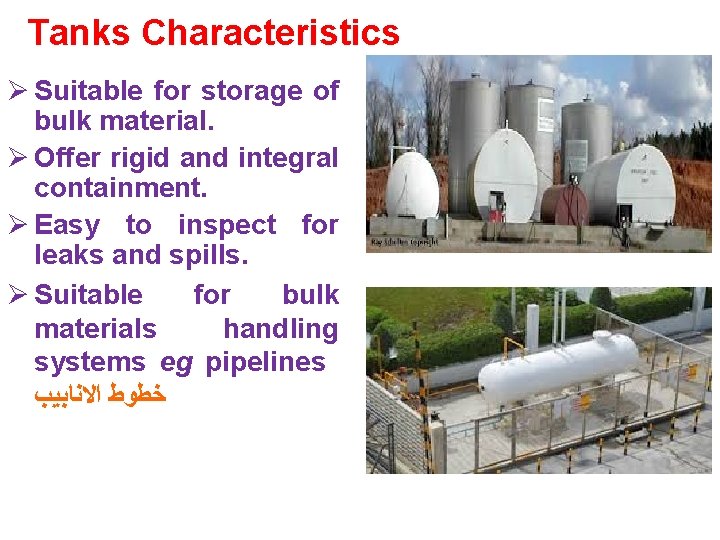
Tanks Characteristics Ø Suitable for storage of bulk material. Ø Offer rigid and integral containment. Ø Easy to inspect for leaks and spills. Ø Suitable for bulk materials handling systems eg pipelines ﺧﻄﻮﻁ ﺍﻻﻧﺎﺑﻴﺐ
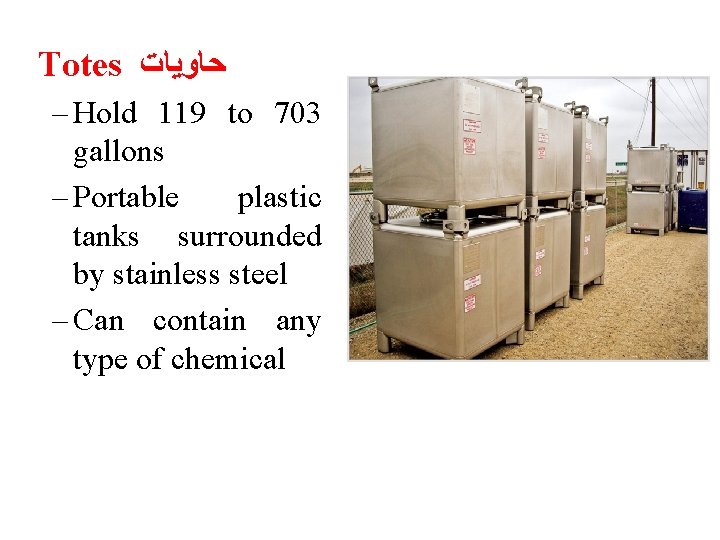
Totes ﺣﺎﻭﻳﺎﺕ – Hold 119 to 703 gallons – Portable plastic tanks surrounded by stainless steel – Can contain any type of chemical
Bulk solids in bunkers, and silos ﺻﻮﺍﻣﻊ TRP Chapter 5. 1 67
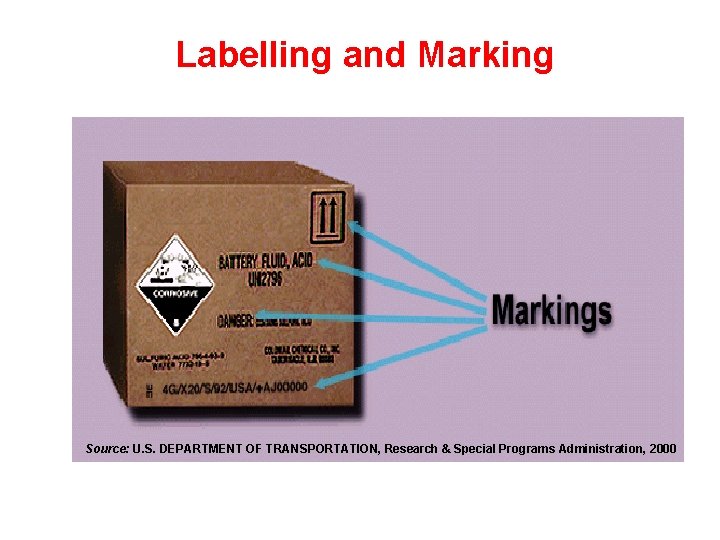
Marking and labelling The minimum information needed for on-site storage of hazardous wastes is: Ø Waste type. Ø Physical state of the waste at a given temperature. Ø Waste composition. Ø Necessary information on health protection. Ø Necessary information for fire protection. TRP Chapter 5. 1 68
Labelling and Marking Source: U. S. DEPARTMENT OF TRANSPORTATION, Research & Special Programs Administration, 2000
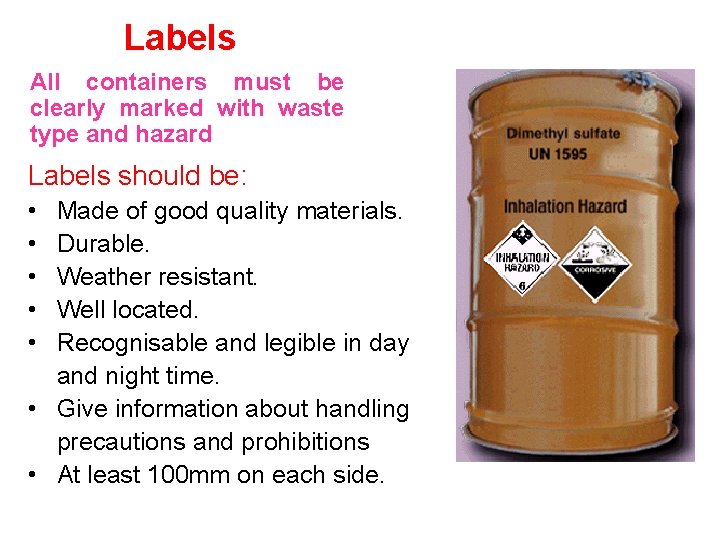
Labels All containers must be clearly marked with waste type and hazard Labels should be: • • • Made of good quality materials. Durable. Weather resistant. Well located. Recognisable and legible in day and night time. • Give information about handling precautions and prohibitions • At least 100 mm on each side.
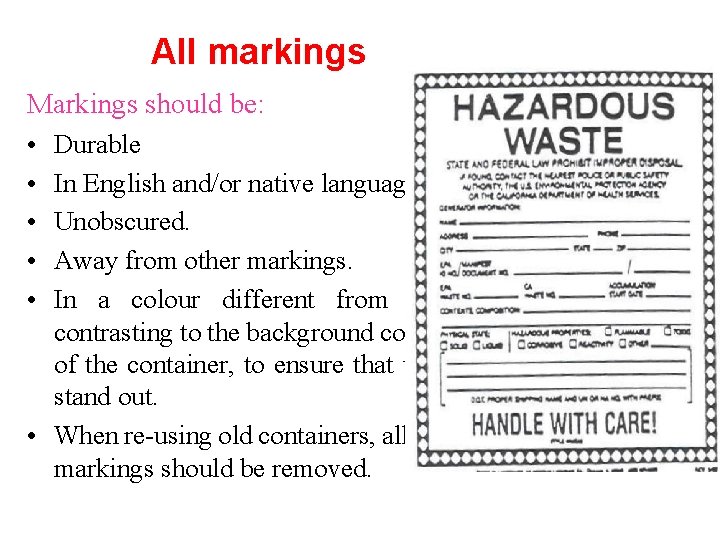
All markings Markings should be: • • • Durable In English and/or native language. Unobscured. Away from other markings. In a colour different from and contrasting to the background colour of the container, to ensure that they stand out. • When re-using old containers, all old markings should be removed.
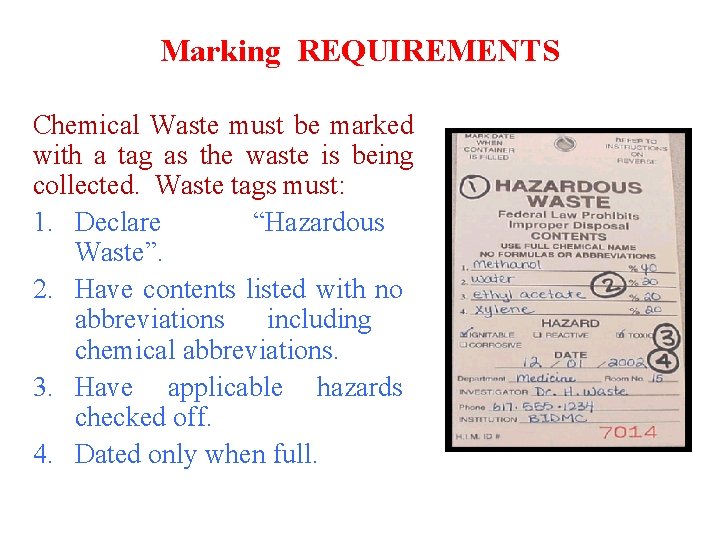
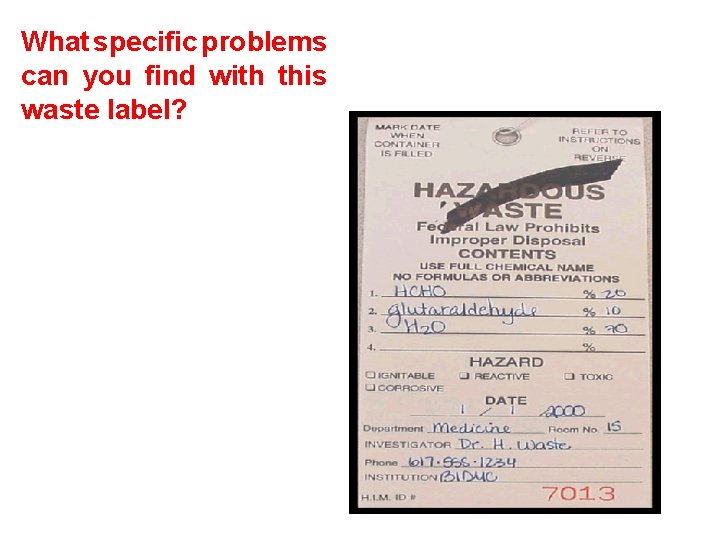
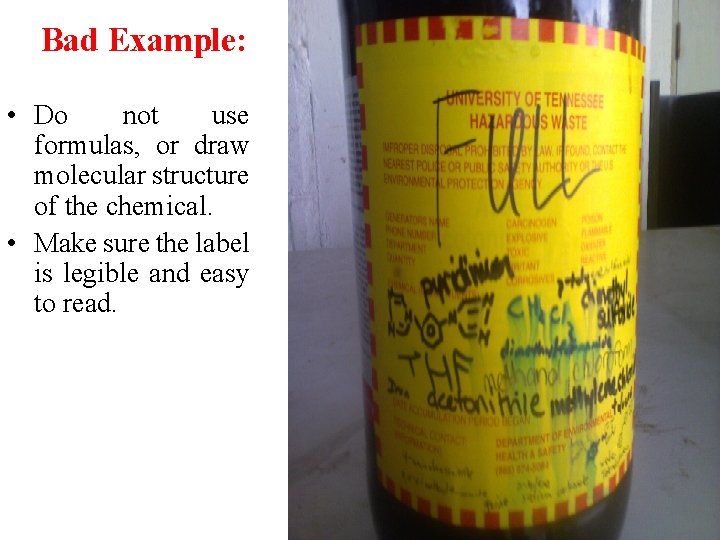
Marking REQUIREMENTS Chemical Waste must be marked with a tag as the waste is being collected. Waste tags must: 1. Declare “Hazardous Waste”. 2. Have contents listed with no abbreviations including chemical abbreviations. 3. Have applicable hazards checked off. 4. Dated only when full.
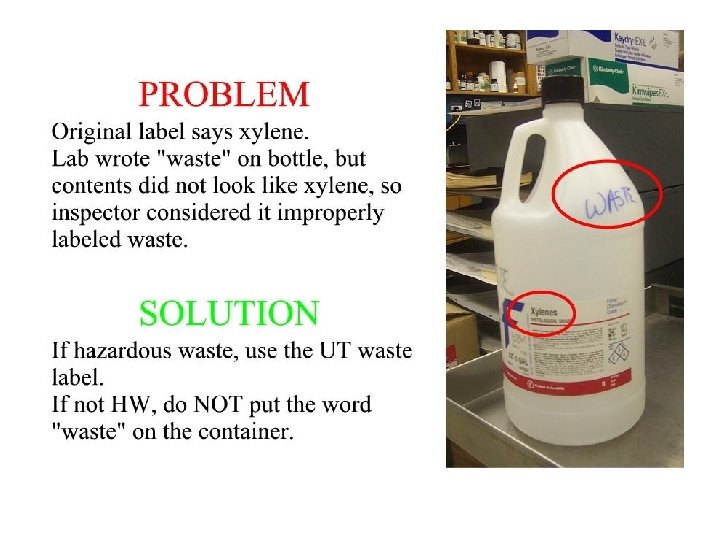
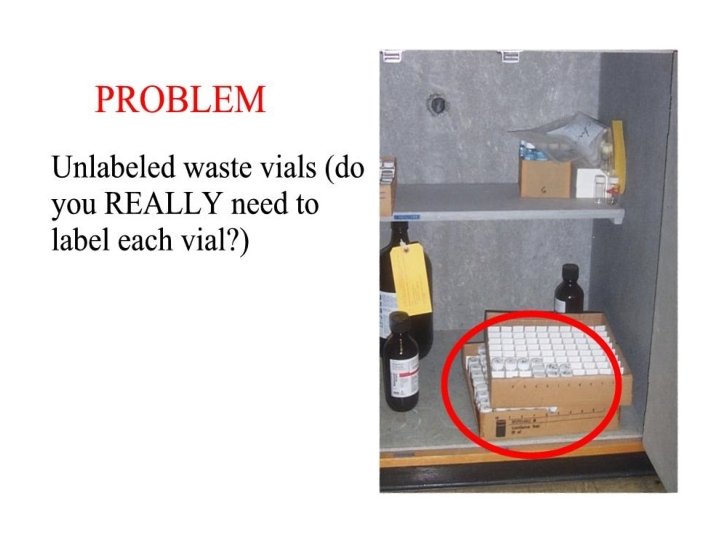
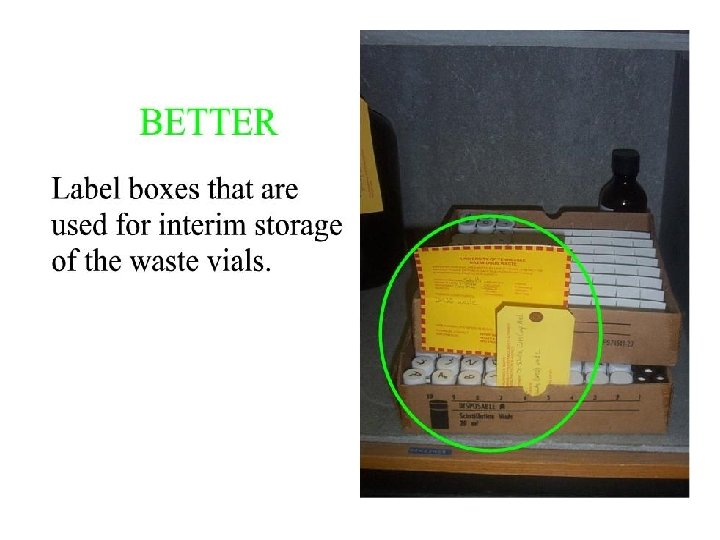
What specific problems can you find with this waste label?
Bad Example: • Do not use formulas, or draw molecular structure of the chemical. • Make sure the label is legible and easy to read.
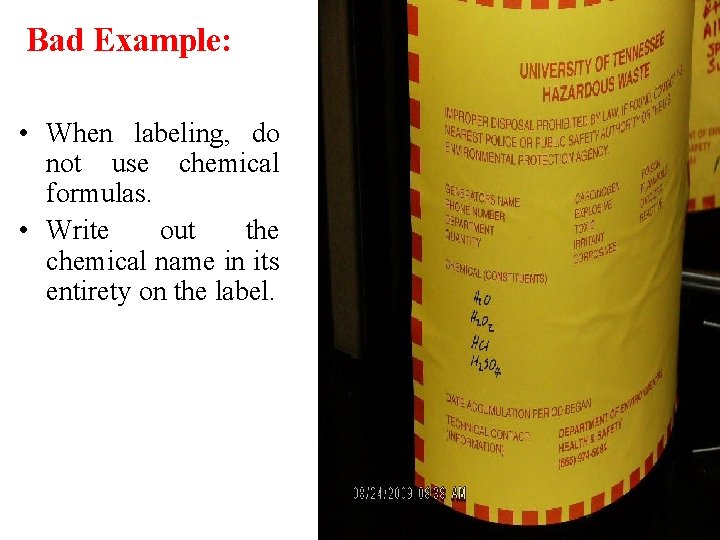
Bad Example: • When labeling, do not use chemical formulas. • Write out the chemical name in its entirety on the label.
Hazardous Waste
Hazardous Waste
Hazardous Waste
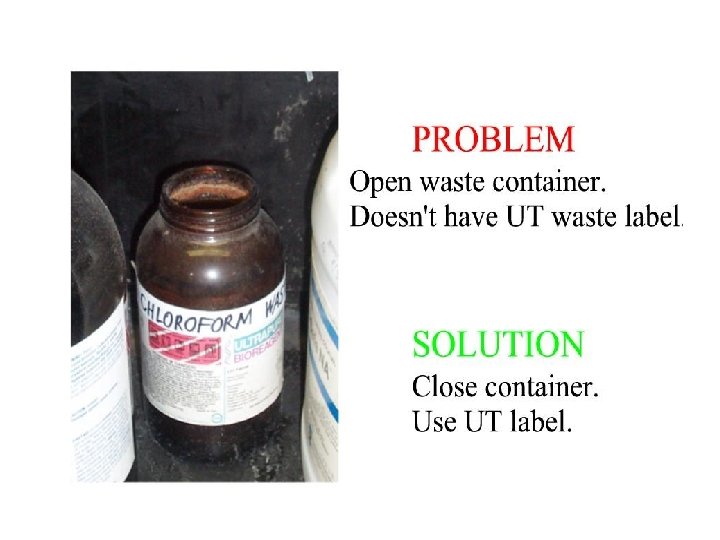
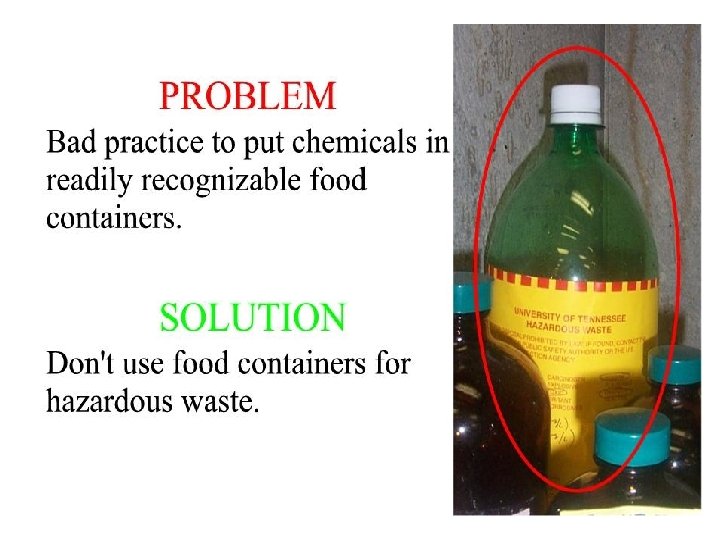
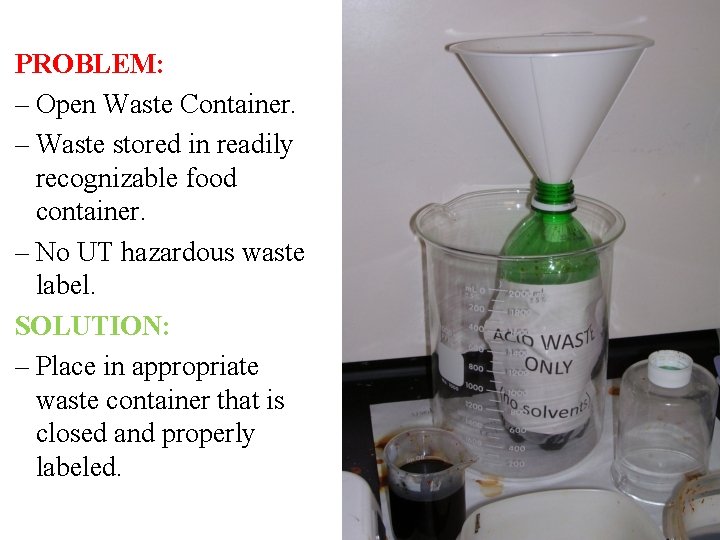
PROBLEM: – Open Waste Container. – Waste stored in readily recognizable food container. – No UT hazardous waste label. SOLUTION: – Place in appropriate waste container that is closed and properly labeled.
Types of labels Hazard labels: • In the shape of a square set at 45º • Required for most dangerous goods except for magnetised materials. Handling labels: • In various rectangular shapes. • Required either alone or in addition of hazard labels for some dangerous goods.
Record keeping and inspection Inspection: • To ensure proper handling and storage. • To check integrity of storage. Record keeping: • To provide a record of waste generation and movement. • To inform a subsequent disposal option. • To serve as “chain of custody” document. • To comply with regulations. • To ensure duty of care.
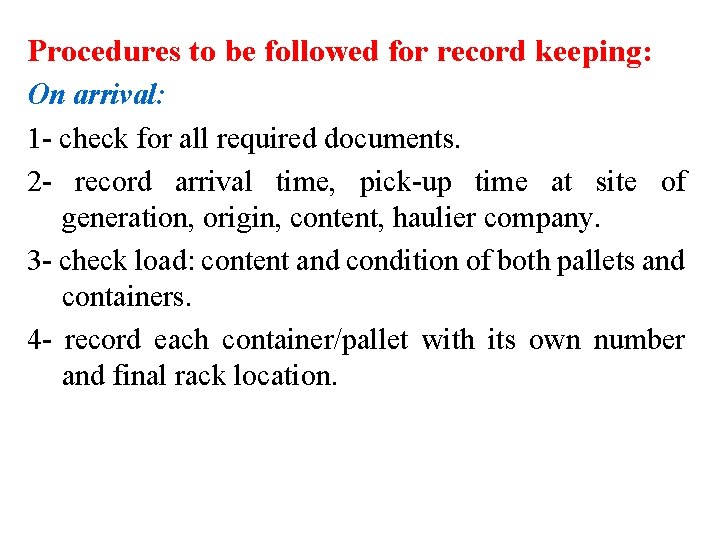
Procedures to be followed for record keeping: On arrival: 1 - check for all required documents. 2 - record arrival time, pick-up time at site of generation, origin, content, haulier company. 3 - check load: content and condition of both pallets and containers. 4 - record each container/pallet with its own number and final rack location. TRP Chapter 5. 1 85
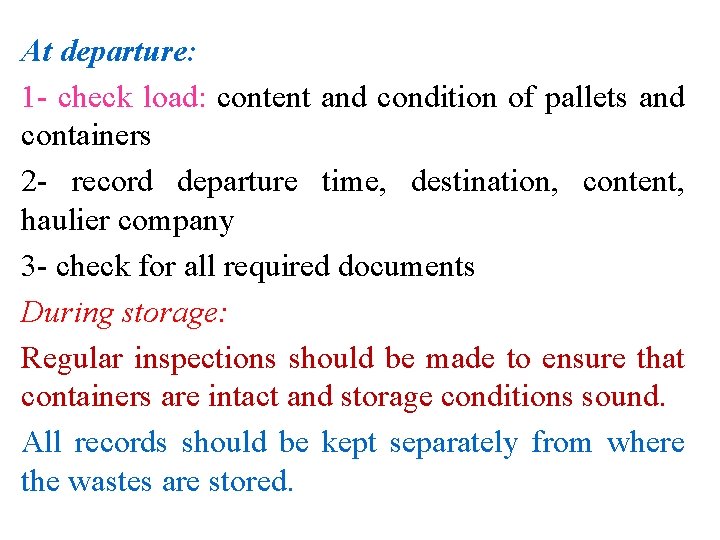
At departure: 1 - check load: content and condition of pallets and containers 2 - record departure time, destination, content, haulier company 3 - check for all required documents During storage: Regular inspections should be made to ensure that containers are intact and storage conditions sound. All records should be kept separately from where the wastes are stored. TRP Chapter 5. 1 86
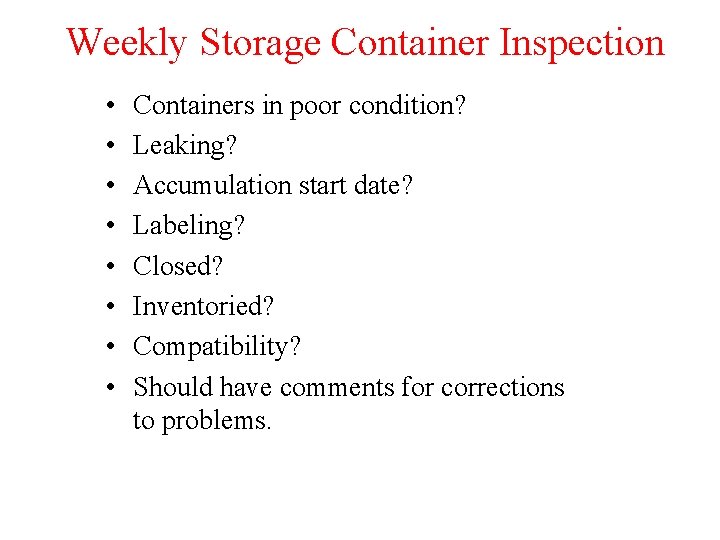
Weekly Storage Container Inspection • • Containers in poor condition? Leaking? Accumulation start date? Labeling? Closed? Inventoried? Compatibility? Should have comments for corrections to problems.
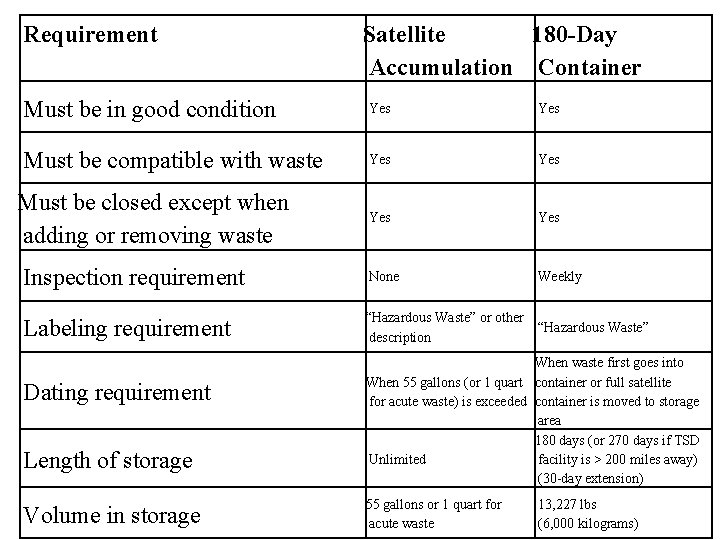
Requirement Satellite 180 -Day Accumulation Container Must be in good condition Yes Must be compatible with waste Yes Yes Inspection requirement None Weekly Labeling requirement “Hazardous Waste” or other description “Hazardous Waste” Must be closed except when adding or removing waste Dating requirement Length of storage Volume in storage When waste first goes into When 55 gallons (or 1 quart container or full satellite for acute waste) is exceeded container is moved to storage area 180 days (or 270 days if TSD facility is > 200 miles away) Unlimited (30 -day extension) 55 gallons or 1 quart for acute waste 13, 227 lbs TRP Chapter 5. 1 88 (6, 000 kilograms)
Handling and storage hazards for personnel A number of hazards associated with waste handling, these include: Physical hazards: Such as Ø Accidental injury from equipment, or from containers falling. Ø Explosions and fires, from improperly stored wastes. Ø Respiratory illness and skin disorders due to exposure to biological hazards. TRP Chapter 5. 1 89
Chemical hazards: Include various kinds of skin, eye and respiratory problems. Systemic effects: Nausea ﻏﺜﻴﺎﻥ - headaches ﺻﺪﺍﻉ - cancers ﺳﺮﻃﺎﻥ. Correct handling and storage of hazardous wastes is therefore not simply necessary to demonstrate compliance with regulations, or to facilitate subsequent treatment and disposal, but also to protect health and the environment. Personnel Training on: - Manual and mechanical handling systems. - Pumping equipment. TRP Chapter 5. 1 90
Handling and storage are part of an integrated system - need to: Ø Choose/design storage site carefully. Ø Ensure waste compatibility. Ø Consider storage duration and types of storage. Ø Select appropriate packaging materials and containers. Ø Ensure proper marking and labeling. Ø Keep accurate inspections. records and make regular Ø Consider hazards for personnel. TRP Chapter 5. 1 91
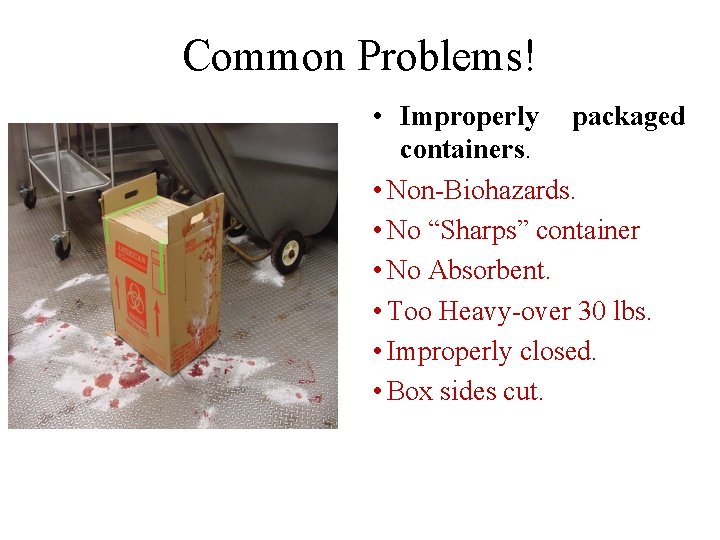
Common Problems! • Improperly packaged containers. • Non-Biohazards. • No “Sharps” container • No Absorbent. • Too Heavy-over 30 lbs. • Improperly closed. • Box sides cut.
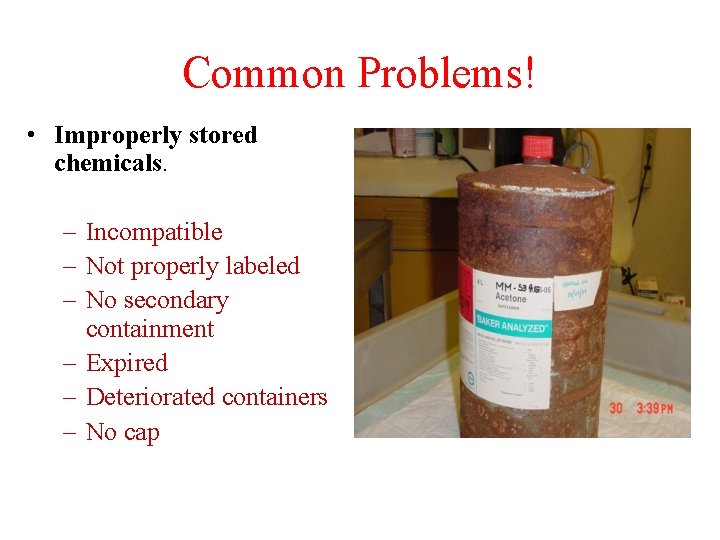
Common Problems! • Improperly stored chemicals. – Incompatible – Not properly labeled – No secondary containment – Expired – Deteriorated containers – No cap
Incompatible Wastes Ø Elemental Metals/Hydrides and Acids/Alcohols Ø Cyanides and Acids Ø Sulfides and Acids Ø Oxidizers and Flammables Ø Acids and Bases Ø Acids and Flammables
COMMON SOLUTIONS: • Proper Supervision • Daily Inspections • Continuous Training – By lab, - By Safety Office • Use Reference Materials – SDS, - Safety Handbooks – Container labels – Knowledgeable Co-workers • Use Common Sense – Ask Questions – Be Aware – Safety First Think before you THROW & Ask If you don’t KNOW!