
Chapter 5 growth development of beef animals 5
Chapter 5: growth & development of beef animals 5. 1. Defining growth and development 5. 2. Compensatory growth 5. 3. Factors affecting growth curve and development 5. 4. Hormonal control of growth 5. 5 Growth-promoting agents
5. 1. Defining growth and development Growth is a dynamic process, continues throughout life § Growth is an increase in mass – Tissues • Bone • Internal organs • Muscle • Fat § True Growth? Everything except Fat § Growth is the increase in weight until mature size is reached.
• Development is a gradual progression from a lower to a higher stage of complexity in association with a gradual expansion in size. • It implies the production of new biochemical units brought about by cell division; cell enlargement.
§ Development is a cell division & cellular differentiation to generate the different tissue types of a fully functional complex organism until maturity is reached. § It involves growth of cellular differentiation & changes in body shape & form.
Chronological & physiological growth 1) Physiological Age Development of the animal relative to maturity 2) Chronological Age Actual Age in days Fat Tissue Deposits: (order) 1) Subcutaneous Fat ~ Backfat (3 rd) 2) Internal Fat ~ Kidney Knob Chanel Fat (KKCF) (1 st) 3) Intermuscular Fat ~ Seam fat (2 nd) 4) Intramuscular Fat ~ Marbling (4 th)
5. 2. Compensatory growth § It is known as catch-up growth & compensatory gain § It is an accelerated growth of an organism following a period of slowed development, particularly as a result of nutrient deprivation. § It is faster than normal rate of gain after a period of feed restriction. § It is typically occurs in cattle that have been previously restricted or maintained on a low plane of nutrition.
§ The severity & duration of feed restriction affects an animal’s ability to compensate § Compensatory gain occurs when nutrient intakes return to sufficient levels § Therefore, it is important to provide both adequate quantities of forages & feeds to cattle & to make sure that these feedstuffs contain sufficient nutrient levels (are of acceptable quality).
1) Hyperplasia Increase in cell number Occurs during prenatal growth 2) Hypertrophy Increase in cell size after birth
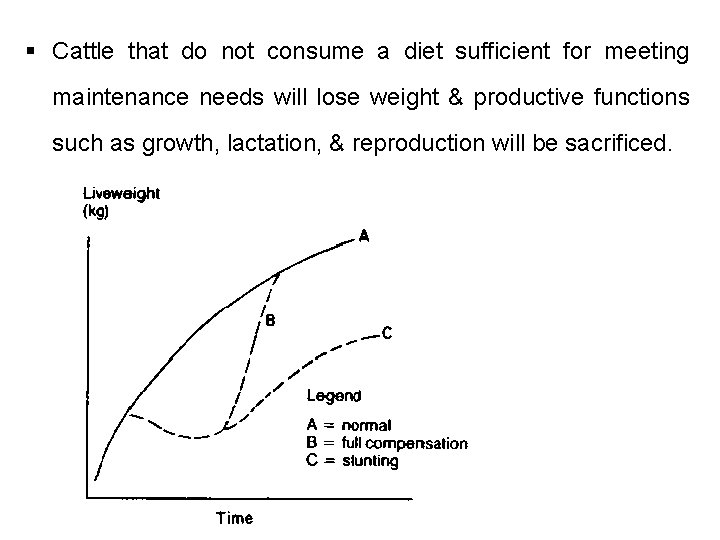
§ Cattle that do not consume a diet sufficient for meeting maintenance needs will lose weight & productive functions such as growth, lactation, & reproduction will be sacrificed.
Measurement of growth • Measuring growth depends on the intended use of animals • Indication of the edible portion of the carcass that meets minimum quality standards in animals intended for slaughter. • Objective measurements such as animal weight, loin –eye area or back fat thickness are indicators of edible portion • The weight is positively correlated with loin-eye area and the depth of back fat is negatively correlated with proportion of lean tissue in the carcass
• Subjective or visual appraisal of growth is used to estimate the nature or quality of growth and complements objective measurement of growth. • The best single measurement of size is body weight • The rate at which growth occurs is a better measurement of animal’s ability to perform than is weight itself.
• Average daily gain (ADG) and weight per day of age (WDA) measure growth rate • Growth can also be expressed as relative growth rate (RGR) = gain per day per unit body weight on that day. • In most species, RGR decreases from conception to mature weight • Within a breed, when compared as the proportion of mature size, selection for growth rate based on average RGR is likely to be most effective than daily weight gain.
• In addition to body weight body surface measurement (length, height, width etc) have been made on cattle for recording major differences between genotypes in skeletal size and proportions. • However of limited value in predicting meat production. • Chest girth or heart girth is a better parameter for the prediction of body weight.
5. 3. Growth curve & Factors affecting growth § The normal growth curve for an animal birth to physical maturity is sigmoid or S shaped. § There is a period of slow growth immediately after birth followed by a more rapid increase until puberty, then the growth rate slows down & finally ceases once physically maturity is reached. § The change from accelerating phase to decelerating of growth (inflection points) occurs at the age of puberty.
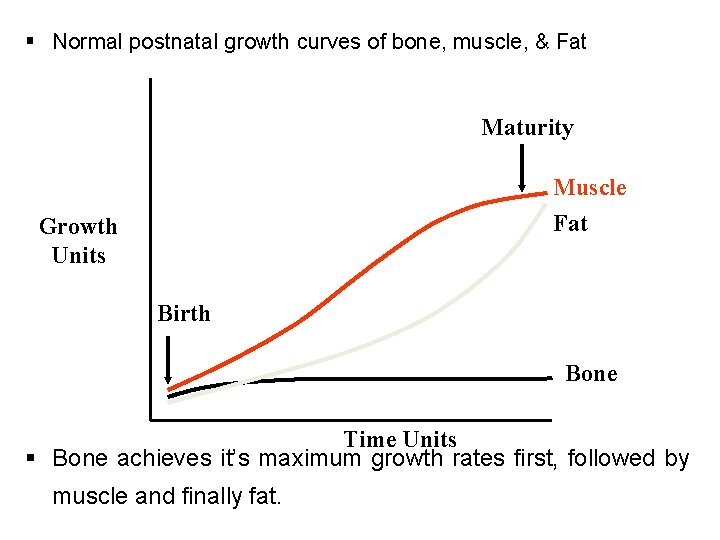
§ Normal postnatal growth curves of bone, muscle, & Fat Maturity Muscle Fat Growth Units Birth Bone Time Units § Bone achieves it’s maximum growth rates first, followed by muscle and finally fat.
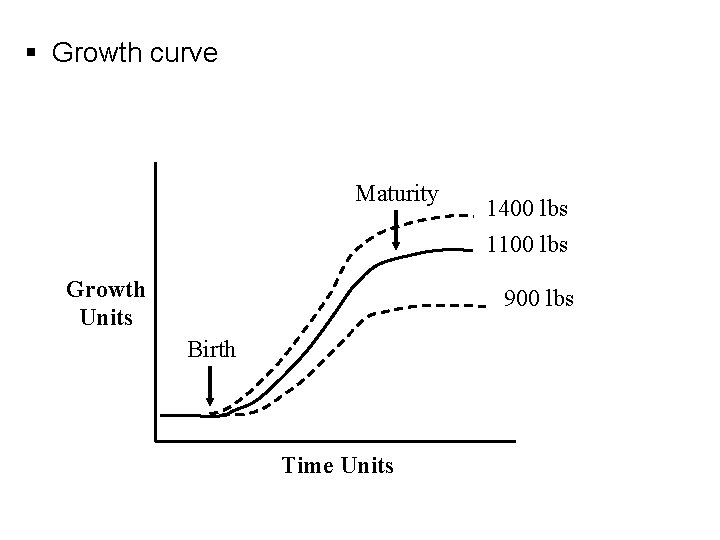
§ Growth curve Maturity Growth Units 1400 lbs 1100 lbs 900 lbs Birth Time Units
Factors affecting growth & development 1) Feed factors § Nutritional factors: critical for growth & development of the animal 1. Types of growing/finishing cattle a. Grass Cattle - growing b. Finishing- growing/fattening 2) Genetics 3) Breed and sex affect rate of growth 4) Physiological factors 5) Diseases
§ 5. 4. Hormonal control of growth § What is hormone? hormone - regulatory chemical secreted by endocrine gland § Important hormones involved in growth & development 1. Insulin is a protein hormone Ø It is produced by pancreas q It is anabolic hormone which promote growth & development of cells
§ It modulates transcription & stimulate protein translocation, § cell growth, § DNA synthesis, & § cell replication § It also regulates the metabolism of carbohydrates & fats by promoting the absorption of glucose from the blood to skeletal muscles & fat tissue
2. Growth hormone is a peptide hormone that stimulates growth, development & regeneration by stimulating protein anabolism Increase amino acid uptake Increase protein synthesis Decrease oxidation of protein • It enhance utilization of fats by stimulating triglycerides breakdown & oxidation of adipocytes • It stimulate the bone growth by initiating the differentiation of chondrochytes
3. Insulin-like growth factor 1(IGF-1), § It is know as somatomedin. Ø It stimulate proliferation of chondrochytes (cartilage cells) which result in bone growth Ø Enhance differentiation & proliferation mesoblast Ø Enhance amino acid uptake & protein synthesis in muscles
4. Thyroid hormones • Regulates basal metabolic rate, which controls protein synthesis and therefore lean tissue growth and body weight of the animal. § Its deficiency results: Øreduce growth ØDecrease muscles synthesis ØIncrease proteolysis (breakdown of protein)
5. Glucocorticoid/adrenal cortex § Important for metabolic rate & energy balance § Its deficiency restrict growth &muscles emaciation 6. Sex steroid § Play a crucial role in pubertal growth Ø Androgen Ø Are responsible for development of secondary sex characters in males and important for bone and muscle growth in both sexes. § Enhance muscle development & growth by protein synthesizing
Ø Estrogen § Mainly used artificial growth promoting in both male & female § Tend to increase muscle growth in ruminants and fat deposition in poultry 5. 5 Growth-promoting agents § It promote protein synthesis § Improve feed efficiency § Types of Growth Implants § There are three types of growth implants used in beef production.
§ Natural hormones: Ø progesterone, Ø estrogen & Ø testosterone which are produced by the animal. q They are used as a single estrogen implant or as estrogens in combinations. § Biologically active (estrogenic) product, zeranol, which stimulates the animal to produce more of its own natural hormones. § Synthetic testosterone, trenbolone acetate, which is combined with estrogen.
Common antibiotics as growth promoters a) Ionophores § It is antimicrobial compounds commonly fed to ruminant animals to improve feed efficiency § Antimicrobials target the bacteria that live in the animals’ stomachs & alter the bacteria so feed can be better digested. § weight gain efficiency & decrease the time it takes to reach market weight (more meat per pound of feed).
b) Ractopamine § It is a feed additive that helps to improve weight gain, improve feed efficiency, & increase leanness in pigs & cattle. § Leanness means that the animal does not have a large amount of fat in its body. § By improving feed efficiency, animals are better able to use feed to grow & increase in weight.
c) Recombinant bovine somatropin (rb. ST) § It is a man-made version of b. ST § rb. ST is given to cows by a shot & helps to increase the amount of milk a cow produces. d) Flavophospholipol § It is known to suppress certain microorganisms & thus contributes to an improved equilibrium of the gut microflora providing a barrier to colonization with pathogenic bacteria & resultant improved weight gain & feed conversion
§ Synthetic hormones used in beef: a) Zeranol – has biological activity as weak estrogen b)Trenbolone acetate- biological activity like androgen, increase muscles growth & appetite c) Melengestrol progesterone acetate-biological activity like
Ø Growth promoter are primarily given to cattle in the form of small pellets placed under the skin in the animal’s ear. Ø These ear implants dissolve slowly over a 100 -120 day period. Ø The ear is used because ears do not enter the food supply. Ø What are the limitation of growth hormone ? Ø Mutagen(cause of genetic mutation) Ø Carcinogenic(cause of cancer) Ø Environmental impact
- Slides: 30