
Chapter 5 Gender and Sexuality Power Point Presentation

- Slides: 37
Chapter 5 Gender and Sexuality Power. Point® Presentation by Jim Foley
Gender Development Gender refers to the physical, social, and behavioral characteristics that are culturally associated with male and female roles and identity. Some of these traits may be genetic differences; other role differences may be nurtured by culture.
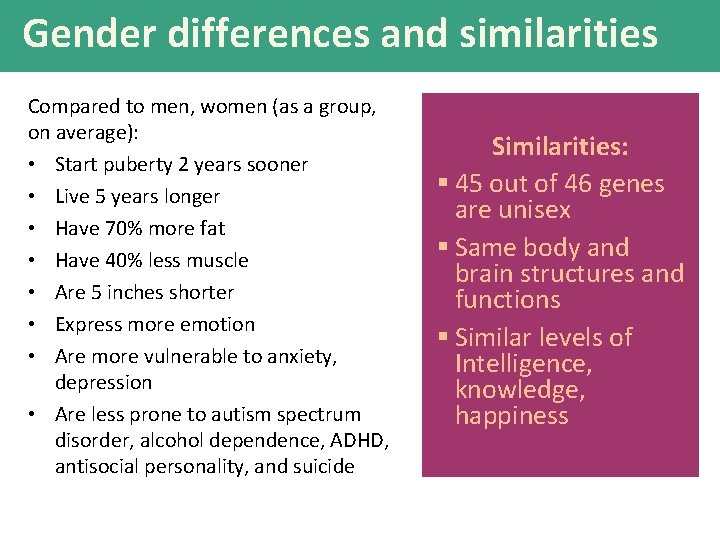
Gender differences and similarities Compared to men, women (as a group, on average): • Start puberty 2 years sooner • Live 5 years longer • Have 70% more fat • Have 40% less muscle • Are 5 inches shorter • Express more emotion • Are more vulnerable to anxiety, depression • Are less prone to autism spectrum disorder, alcohol dependence, ADHD, antisocial personality, and suicide Similarities: § 45 out of 46 genes are unisex § Same body and brain structures and functions § Similar levels of Intelligence, knowledge, happiness
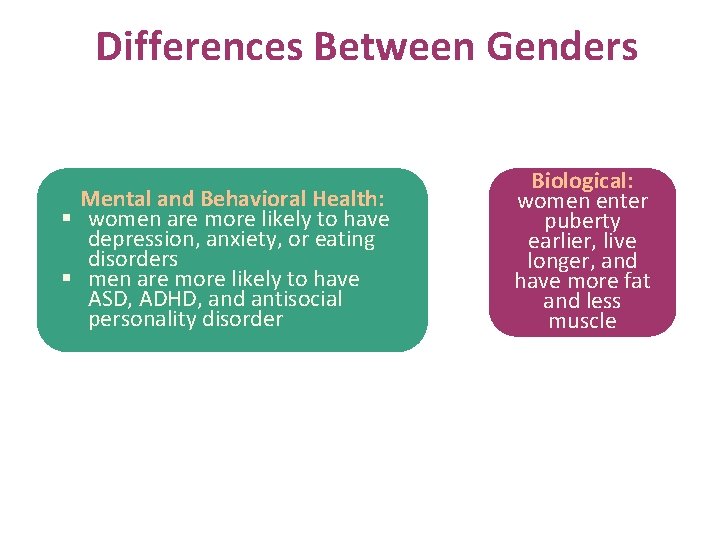
Differences Between Genders Mental and Behavioral Health: § women are more likely to have depression, anxiety, or eating disorders § men are more likely to have ASD, ADHD, and antisocial personality disorder Biological: women enter puberty earlier, live longer, and have more fat and less muscle
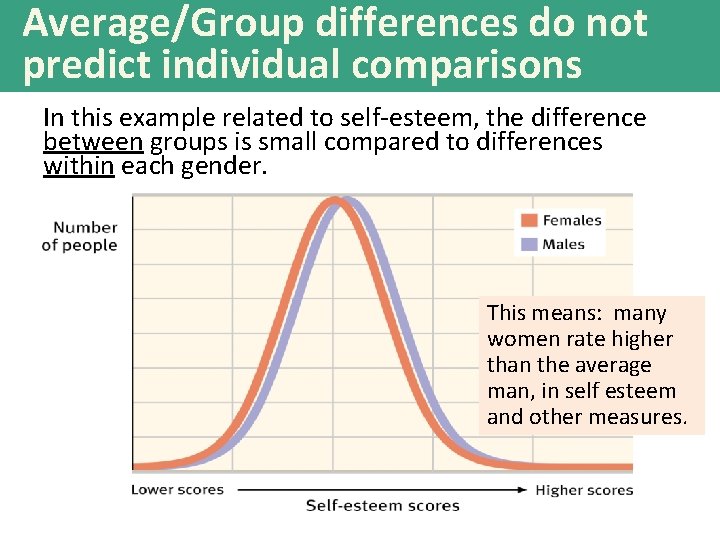
Average/Group differences do not predict individual comparisons In this example related to self-esteem, the difference between groups is small compared to differences within each gender. This means: many women rate higher than the average man, in self esteem and other measures.
Gender and Aggression § Men behave more aggressively than women, and are more likely to behave in ways that harm others § This difference applies to physical aggression rather than verbal or relational aggression. § And yet violent acts by women do occur, including acts of terrorism.
Gender and Social Power § In a variety of cultures, men have attributes and reputations that help them attain more social power (positions controlling more people and resources) than women do. § Men tend to interact in more dominating ways than women. Men often speak opinions rather than offering support and inviting input as women do.
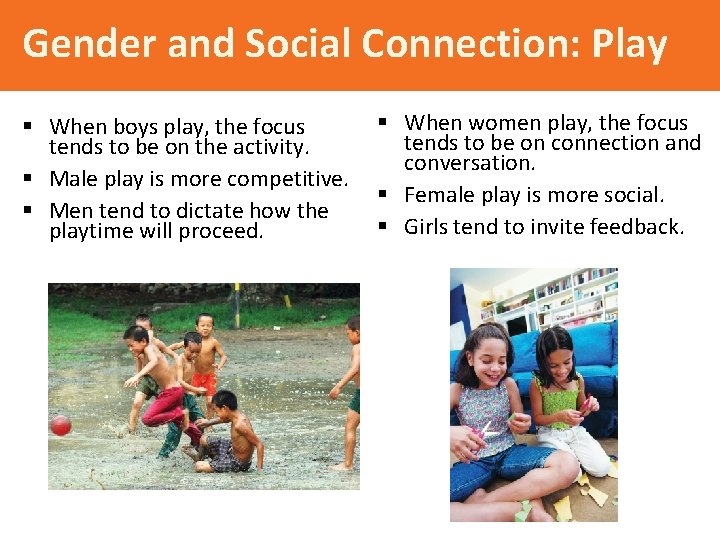
Gender and Social Connection: Play § When boys play, the focus tends to be on the activity. § Male play is more competitive. § Men tend to dictate how the playtime will proceed. § When women play, the focus tends to be on connection and conversation. § Female play is more social. § Girls tend to invite feedback.
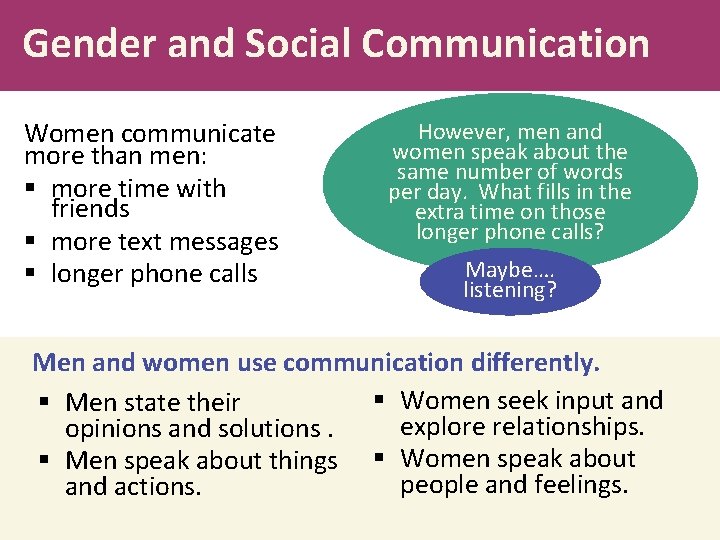
Gender and Social Communication Women communicate more than men: § more time with friends § more text messages § longer phone calls However, men and women speak about the same number of words per day. What fills in the extra time on those longer phone calls? Maybe…. listening? Men and women use communication differently. § Women seek input and § Men state their explore relationships. opinions and solutions. § Men speak about things § Women speak about people and feelings. and actions.
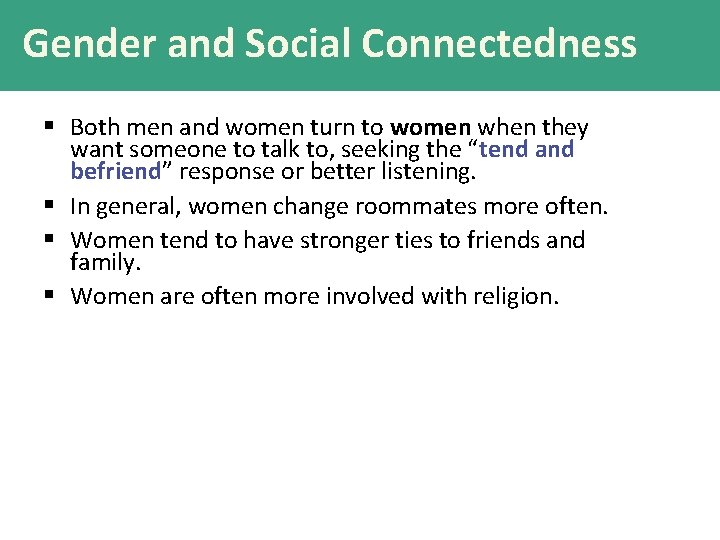
Gender and Social Connectedness § Both men and women turn to women when they want someone to talk to, seeking the “tend and befriend” response or better listening. § In general, women change roommates more often. § Women tend to have stronger ties to friends and family. § Women are often more involved with religion.
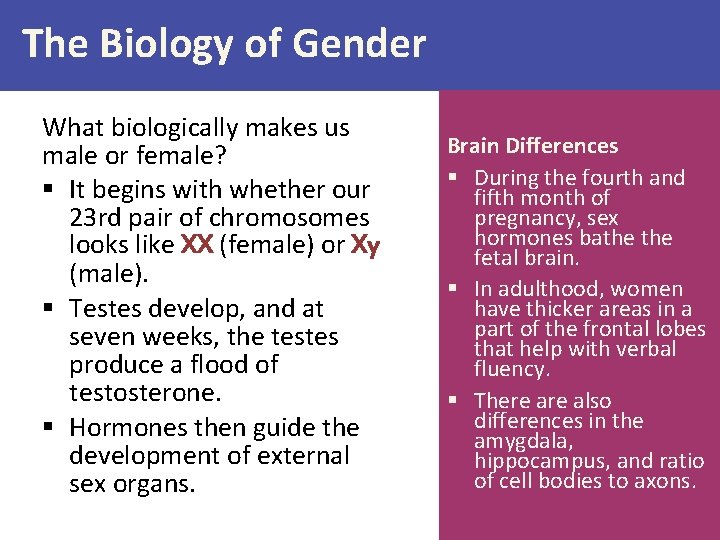
The Biology of Gender What biologically makes us male or female? § It begins with whether our 23 rd pair of chromosomes looks like XX (female) or Xy (male). § Testes develop, and at seven weeks, the testes produce a flood of testosterone. § Hormones then guide the development of external sex organs. Brain Differences § During the fourth and fifth month of pregnancy, sex hormones bathe fetal brain. § In adulthood, women have thicker areas in a part of the frontal lobes that help with verbal fluency. § There also differences in the amygdala, hippocampus, and ratio of cell bodies to axons.
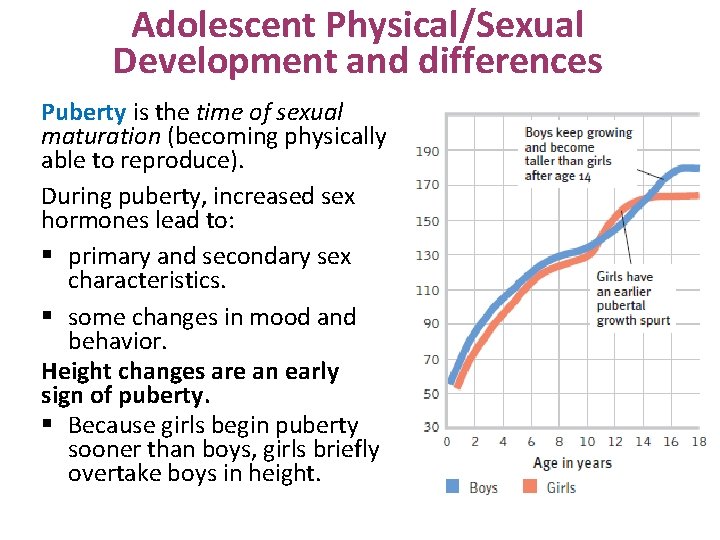
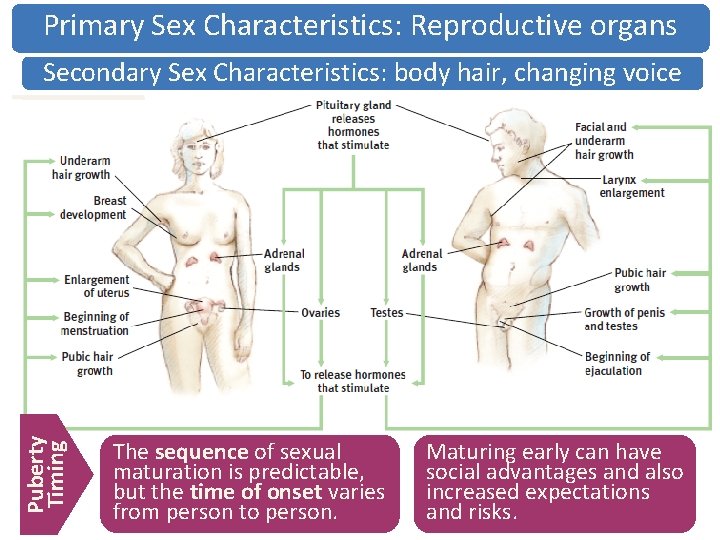
Adolescent Physical/Sexual Development and differences Puberty is the time of sexual maturation (becoming physically able to reproduce). During puberty, increased sex hormones lead to: § primary and secondary sex characteristics. § some changes in mood and behavior. Height changes are an early sign of puberty. § Because girls begin puberty sooner than boys, girls briefly overtake boys in height.
Primary Sex Characteristics: Reproductive organs Puberty Timing Secondary Sex Characteristics: body hair, changing voice The sequence of sexual maturation is predictable, but the time of onset varies from person to person. Maturing early can have social advantages and also increased expectations and risks.
Variations in Sexual Development Intersex Individuals § Some people develop with a combination of male and female physical characteristics, despite being genetically male or female. This can lead to controversies of sex typing in athletic competition. § In cases where males had genitalia that were underformed, absent, or accidentally removed, attempts to raise them as females often did not work out well psychosocially. § David “Brenda” Reimer case: After his genitalia were accidentally damaged, then removed, he was raised as a female, though he showed male behaviors. As an adult, he learned the truth, lived as a man, got married, but eventually committed suicide.
Gender Roles: The Influence of Culture Gender role: the behaviors expected of people related to their identity as men and women Gender identity: one’s sense of whether one is male and female, including a sense of what it means to be that gender Does culture define which behaviors fill a gender role? Or do the roles affect culture? Gender roles and culture: Expectations may vary In North American societies, men have been providers, women were caretakers In some societies, men and women share more in child rearing and accumulating resources § Gender roles have simplified, yet constrained, choices for men and women. § In the past century, women have been gaining more options for participation in workplaces and politics.
Culture Influence on Gender Role Development § Social learning theory: we learn gender role behavior by imitation, and by rewards and punishments that shape our behavior § Gender schemas: the cognitive frameworks for developing concepts of “male” and “female”; these frameworks guide our observations § Gender typing: the instinct which drives some children to fit into traditional gender roles
Variations in Sexual Identity Breaking free of gender roles § Transgendered people have a sense of sexual identity (sense of being male or female) or gender expression (behaviors and appearance that express gender identity) that is different from what is culturally typical for the biological sex/gender they were born with. § Transsexual people act on this sense of difference by living as a member of the opposite sex, often with hormonal and surgical interventions that support this gender reassignment.
Hormones and Sexual Behavior § Hormones such as estrogens (female sex hormones) and also in testosterone (male sex hormones) guide the physical development of sex characteristics and behaviors. § During ovulation, women show a rise in both sex hormones. § As this happens, sexual desire rises in women and also in the men around them (whose testosterone level rises). § Low levels of testosterone can reduce sexual motivation. § Sex hormone levels fall with age (menopause), drugs, or surgery.
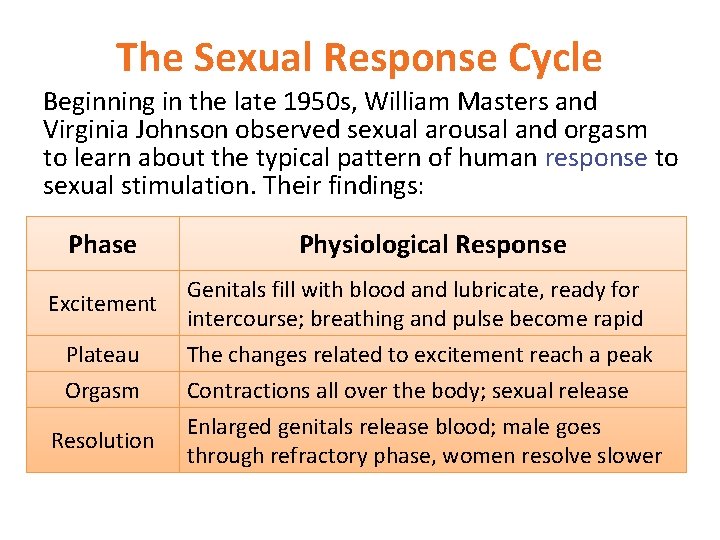
The Sexual Response Cycle Beginning in the late 1950 s, William Masters and Virginia Johnson observed sexual arousal and orgasm to learn about the typical pattern of human response to sexual stimulation. Their findings: Phase Excitement Plateau Orgasm Resolution Physiological Response Genitals fill with blood and lubricate, ready for intercourse; breathing and pulse become rapid The changes related to excitement reach a peak Contractions all over the body; sexual release Enlarged genitals release blood; male goes through refractory phase, women resolve slower
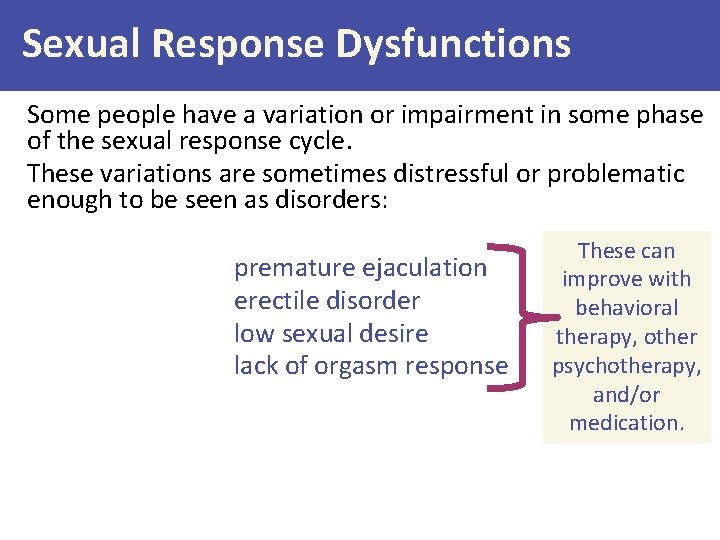
Sexual Response Dysfunctions Some people have a variation or impairment in some phase of the sexual response cycle. These variations are sometimes distressful or problematic enough to be seen as disorders: premature ejaculation erectile disorder low sexual desire lack of orgasm response These can improve with behavioral therapy, other psychotherapy, and/or medication.
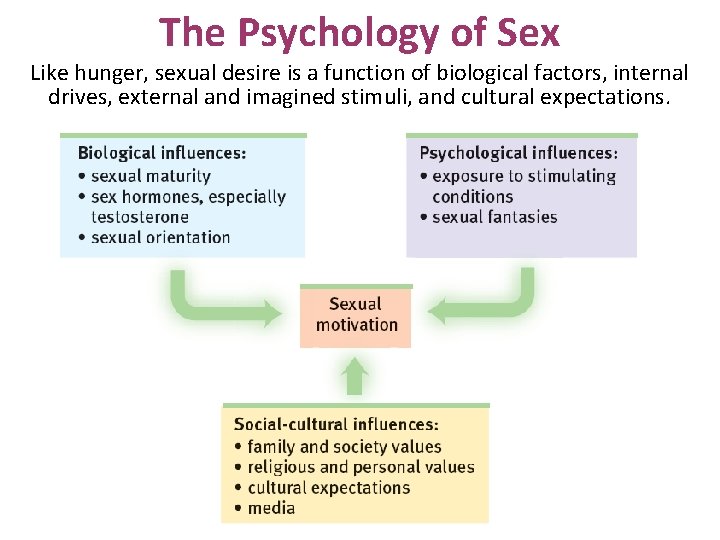
The Psychology of Sex Like hunger, sexual desire is a function of biological factors, internal drives, external and imagined stimuli, and cultural expectations.
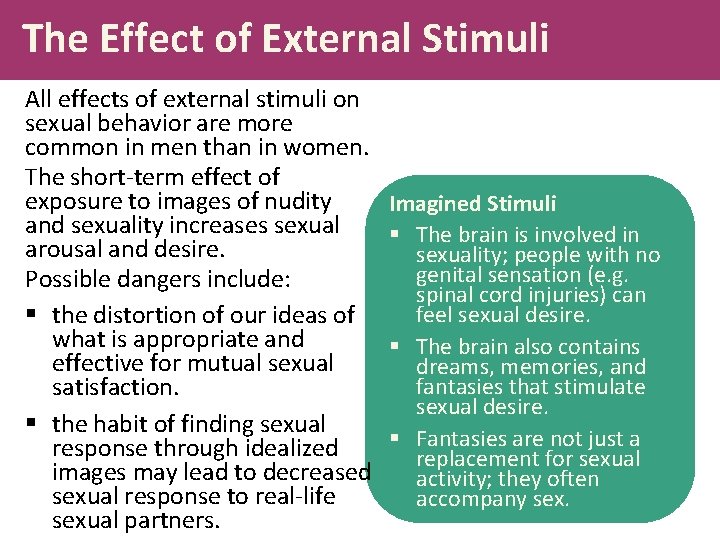
The Effect of External Stimuli All effects of external stimuli on sexual behavior are more common in men than in women. The short-term effect of exposure to images of nudity and sexuality increases sexual arousal and desire. Possible dangers include: § the distortion of our ideas of what is appropriate and effective for mutual sexual satisfaction. § the habit of finding sexual response through idealized images may lead to decreased sexual response to real-life sexual partners. Imagined Stimuli § The brain is involved in sexuality; people with no genital sensation (e. g. spinal cord injuries) can feel sexual desire. § The brain also contains dreams, memories, and fantasies that stimulate sexual desire. § Fantasies are not just a replacement for sexual activity; they often accompany sex.
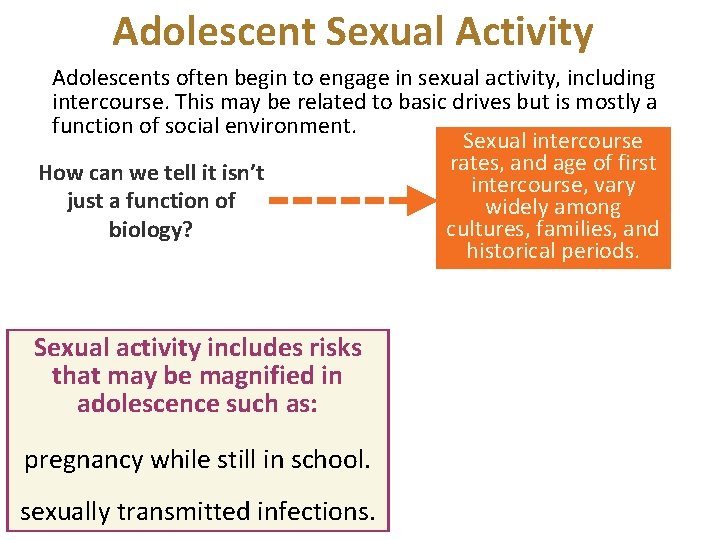
Adolescent Sexual Activity Adolescents often begin to engage in sexual activity, including intercourse. This may be related to basic drives but is mostly a function of social environment. Sexual intercourse rates, and age of first How can we tell it isn’t intercourse, vary just a function of widely among cultures, families, and biology? historical periods. Sexual activity includes risks that may be magnified in adolescence such as: pregnancy while still in school. sexually transmitted infections.
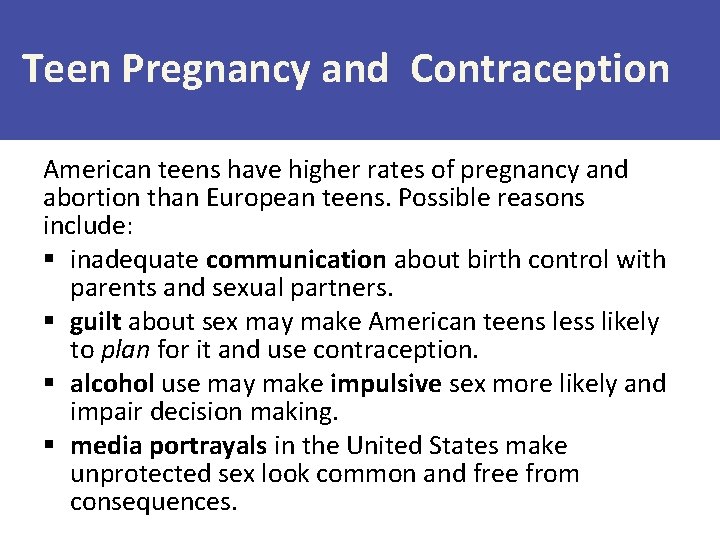
Teen Pregnancy and Contraception American teens have higher rates of pregnancy and abortion than European teens. Possible reasons include: § inadequate communication about birth control with parents and sexual partners. § guilt about sex may make American teens less likely to plan for it and use contraception. § alcohol use may make impulsive sex more likely and impair decision making. § media portrayals in the United States make unprotected sex look common and free from consequences.
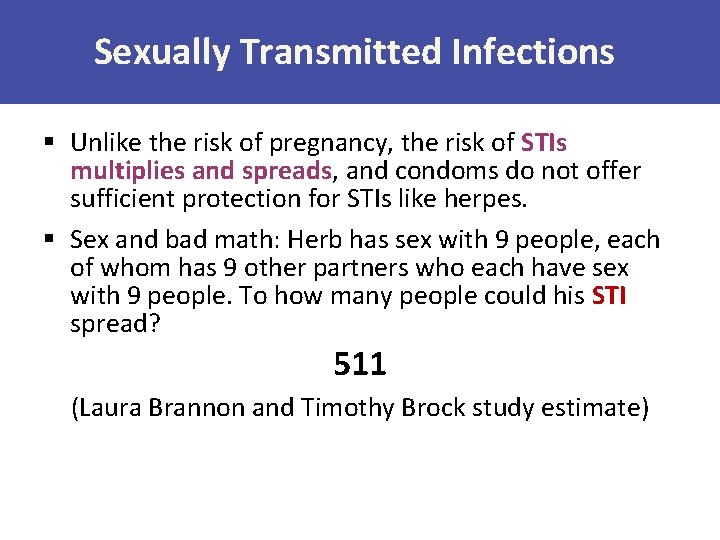
Sexually Transmitted Infections § Unlike the risk of pregnancy, the risk of STIs multiplies and spreads, and condoms do not offer sufficient protection for STIs like herpes. § Sex and bad math: Herb has sex with 9 people, each of whom has 9 other partners who each have sex with 9 people. To how many people could his STI spread? 511 (Laura Brannon and Timothy Brock study estimate)
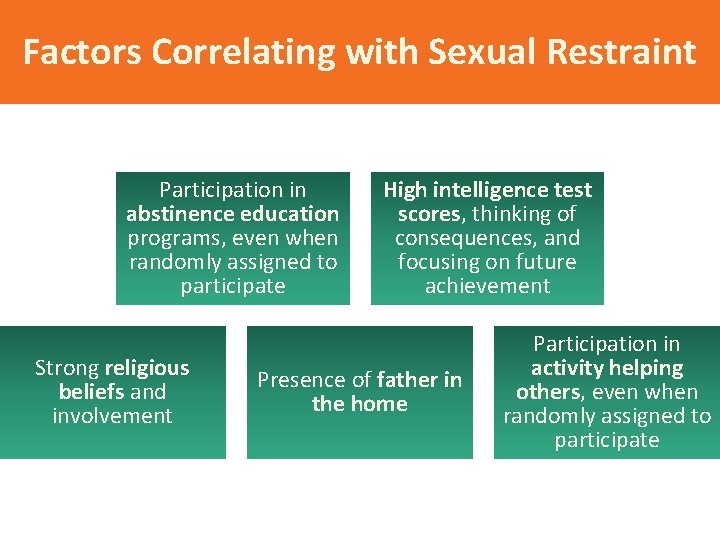
Factors Correlating with Sexual Restraint Participation in abstinence education programs, even when randomly assigned to participate Strong religious beliefs and involvement High intelligence test scores, thinking of consequences, and focusing on future achievement Presence of father in the home Participation in activity helping others, even when randomly assigned to participate
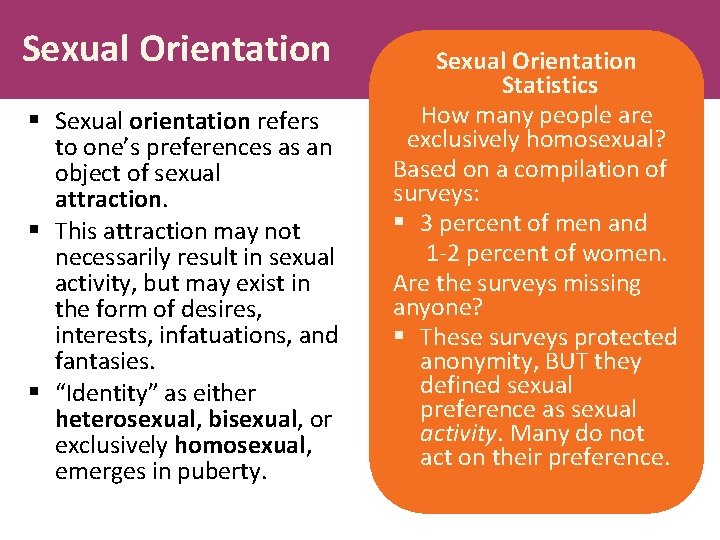
Sexual Orientation § Sexual orientation refers to one’s preferences as an object of sexual attraction. § This attraction may not necessarily result in sexual activity, but may exist in the form of desires, interests, infatuations, and fantasies. § “Identity” as either heterosexual, bisexual, or exclusively homosexual, emerges in puberty. Sexual Orientation Statistics How many people are exclusively homosexual? Based on a compilation of surveys: § 3 percent of men and 1 -2 percent of women. Are the surveys missing anyone? § These surveys protected anonymity, BUT they defined sexual preference as sexual activity. Many do not act on their preference.
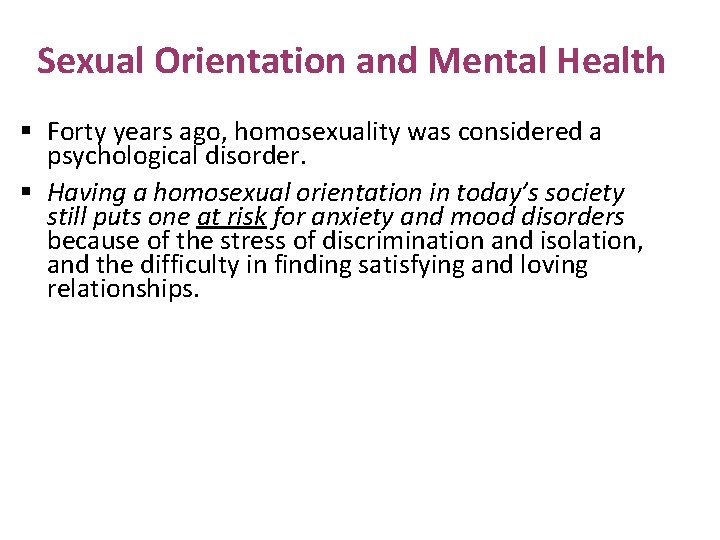
Sexual Orientation and Mental Health § Forty years ago, homosexuality was considered a psychological disorder. § Having a homosexual orientation in today’s society still puts one at risk for anxiety and mood disorders because of the stress of discrimination and isolation, and the difficulty in finding satisfying and loving relationships.
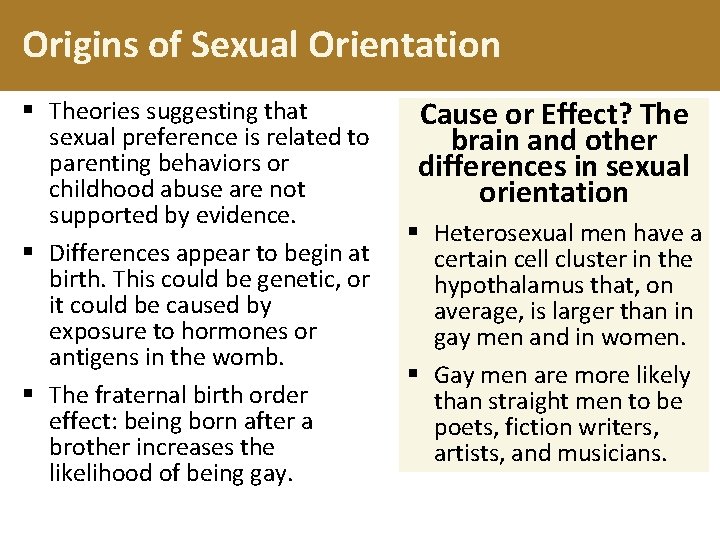
Origins of Sexual Orientation § Theories suggesting that sexual preference is related to parenting behaviors or childhood abuse are not supported by evidence. § Differences appear to begin at birth. This could be genetic, or it could be caused by exposure to hormones or antigens in the womb. § The fraternal birth order effect: being born after a brother increases the likelihood of being gay. Cause or Effect? The brain and other differences in sexual orientation § Heterosexual men have a certain cell cluster in the hypothalamus that, on average, is larger than in gay men and in women. § Gay men are more likely than straight men to be poets, fiction writers, artists, and musicians.
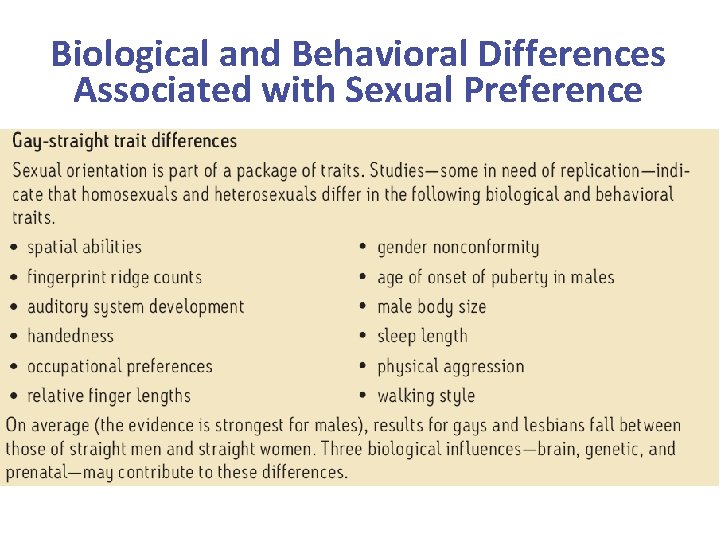
Biological and Behavioral Differences Associated with Sexual Preference
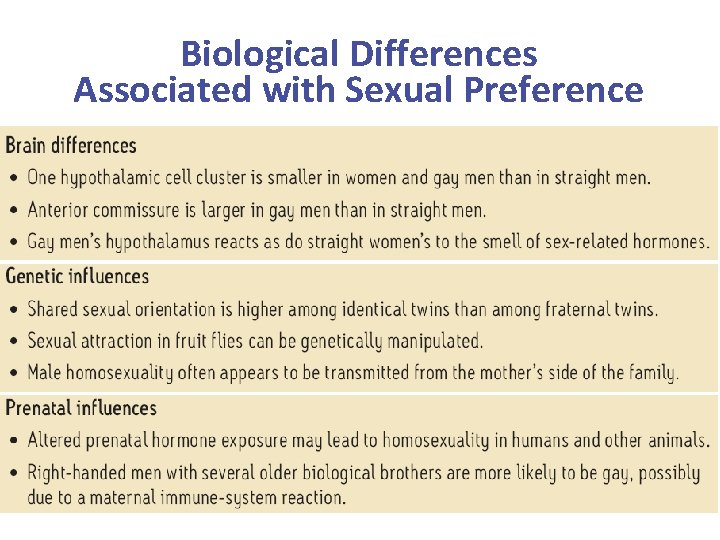
Biological Differences Associated with Sexual Preference
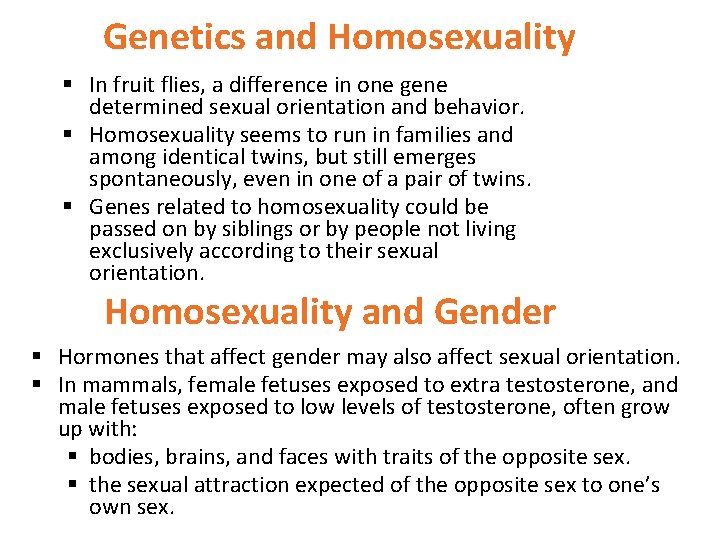
Genetics and Homosexuality § In fruit flies, a difference in one gene determined sexual orientation and behavior. § Homosexuality seems to run in families and among identical twins, but still emerges spontaneously, even in one of a pair of twins. § Genes related to homosexuality could be passed on by siblings or by people not living exclusively according to their sexual orientation. Homosexuality and Gender § Hormones that affect gender may also affect sexual orientation. § In mammals, female fetuses exposed to extra testosterone, and male fetuses exposed to low levels of testosterone, often grow up with: § bodies, brains, and faces with traits of the opposite sex. § the sexual attraction expected of the opposite sex to one’s own sex.
Sexual Orientation: Acceptance § Whatever the level of evidence accumulates that sexual orientation becomes part of one’s identity because of biology: it is possible to accept another person’s sexual orientation and behavior. § This acceptance seems to be growing, at least in the acceptance of homosexual life commitment in the form of marriage.
Gender Differences in Sexuality: An Evolutionary Perspective • Generally, men think more than women about sex, and men are more likely to think that casual sex is acceptable. • Why might natural selection have resulted in greater male promiscuity? An evolutionary psychologist’s answer: Men who had the trait of promiscuity were more likely to have their genes continue, and even spread, in the next generation. And there is little cost to spreading extra genes. For women, a trait of promiscuity would not greatly increase the number of babies, and it would have greater survival costs (pregnancy, once a life-threatening condition).
Natural Selection and Mating Preferences Q: How would evolutionary psychology explain why males and females have different preferences for sexual partners? Men seek women with a fuller figure… to make sure they are not too young or too old to have children? Women seek males with loyal behavior and physical/social power and resources… in order to ensure the survival of the mother’s offspring?
Critiquing the Evolutionary Perspective on Gender Differences in Sexuality Are males and female really so different in their mating choices? Differences are less in cultures that move to gender equality. Isn’t much of gender behavior a function of culture? Yes, though genetics may be part of the picture. How do you explain homosexuality? Guesses such as population control or misplaced instincts are unproven and seem forced.
Photo Credits • Slide 8: – Getty Images/Gallo Images – © Ocean/Corbis