
Chapter 5 From formulating to Developing a thesis
- Slides: 23
Chapter 5: From formulating to Developing a thesis
Thesis: An assertion that academic writers make at the beginning of what they write and then support with evidence throughout their essay Reflects an awareness of the conversation Is placed at the beginning of the essay Penetrates every paragraph like the skewer in a shish kebab Acknowledges point of view that differ from the writer’s Demonstrates an awareness of the reader’s assumptions and anticipates possible counterarguments Conveys a significant fresh perspective
Thesis (continued): Concise: one or two sentences Specific: deals with a narrow and focused topic, think about what you can reasonably argue well in 10 -12 pages Arguable: a scholar in your field could (or maybe already has!) disagree with your assertion Unique: makes an original claim
Is your thesis a statement that can be argued? Here’s the criteria to check! 1. Does it attempt to convince readers of something, change their minds or urge them to do something, or explore a topic to make an informed decision? 2. Does it address a problem for which no easily acceptable solution exists or asks a question to which no answer exists? 3. Does it present a position that readers might realistically have varying perspectives on?
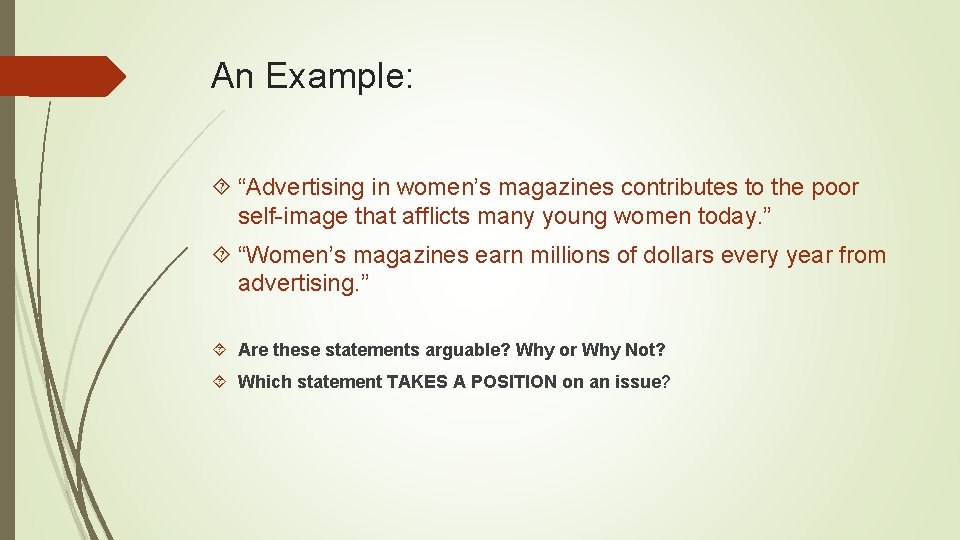
An Example: “Advertising in women’s magazines contributes to the poor self-image that afflicts many young women today. ” “Women’s magazines earn millions of dollars every year from advertising. ” Are these statements arguable? Why or Why Not? Which statement TAKES A POSITION on an issue?
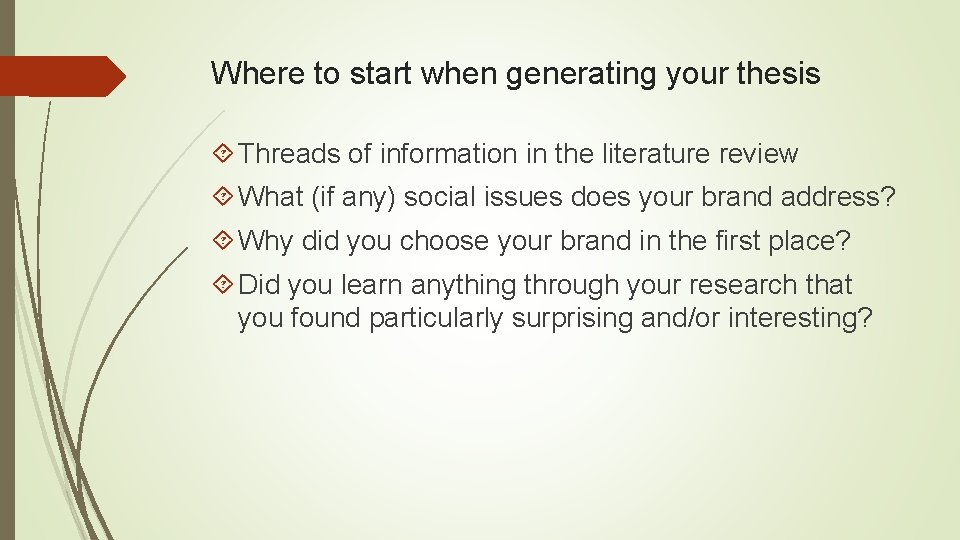
Where to start when generating your thesis Threads of information in the literature review What (if any) social issues does your brand address? Why did you choose your brand in the first place? Did you learn anything through your research that you found particularly surprising and/or interesting?
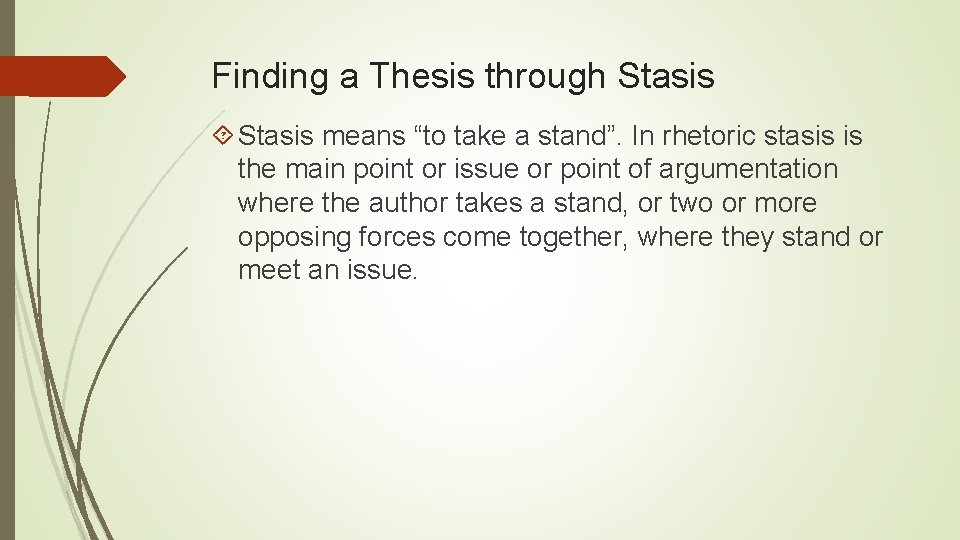
Finding a Thesis through Stasis means “to take a stand”. In rhetoric stasis is the main point or issue or point of argumentation where the author takes a stand, or two or more opposing forces come together, where they stand or meet an issue.
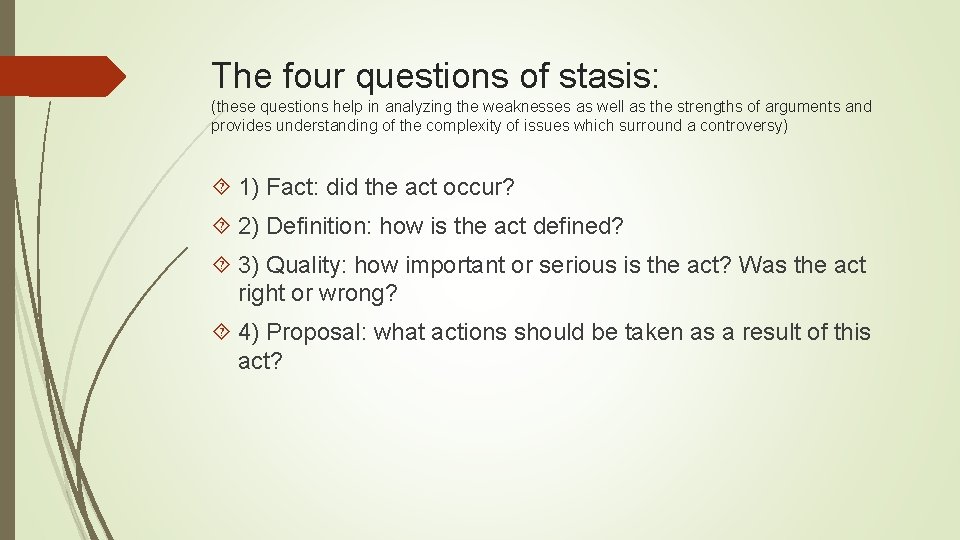
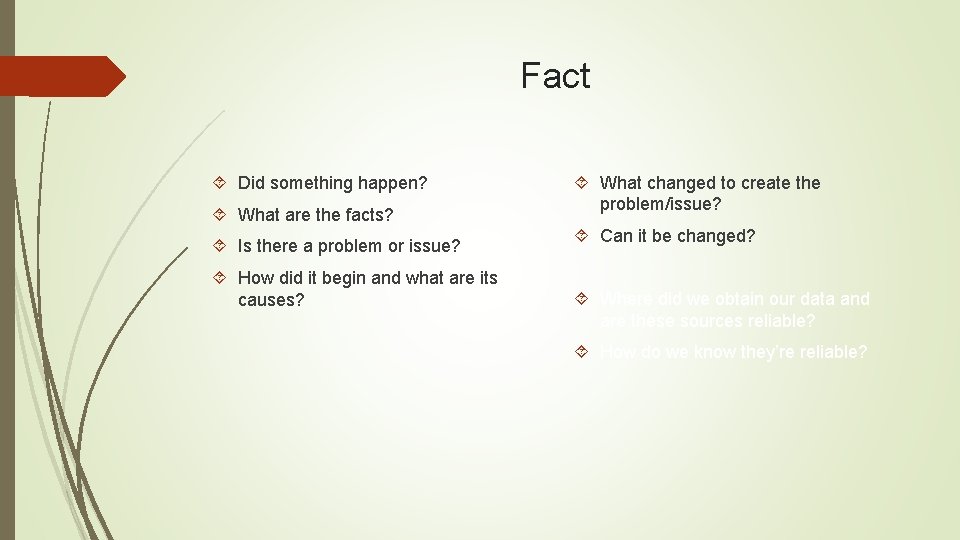
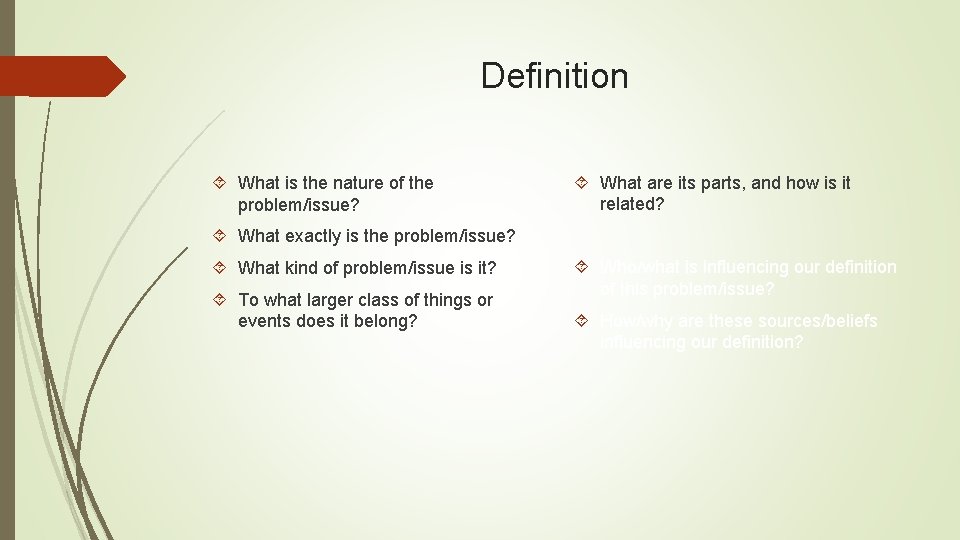
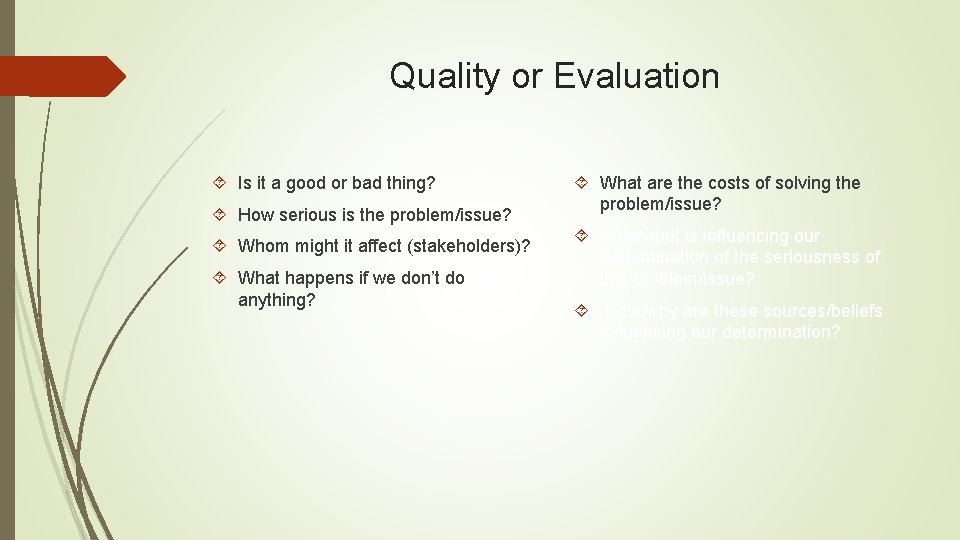
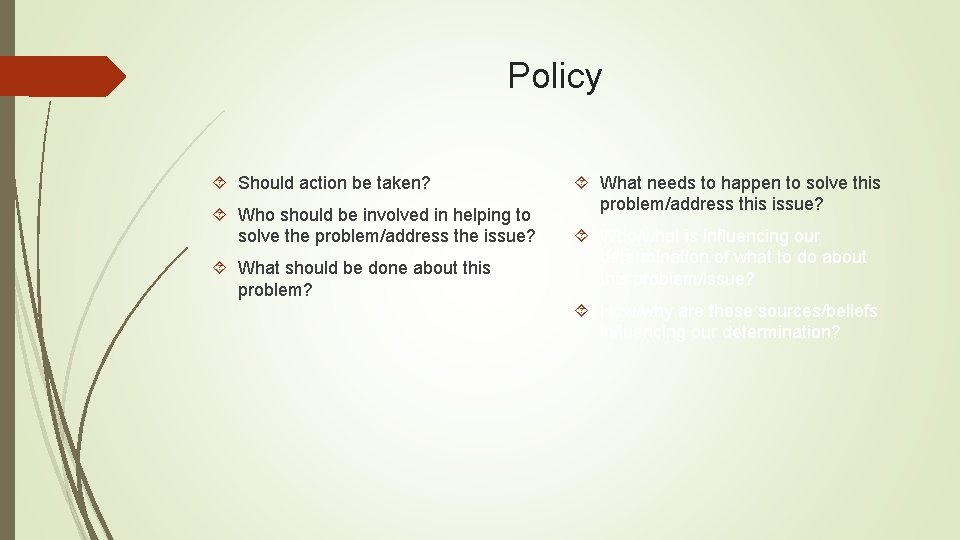
The four questions of stasis: (these questions help in analyzing the weaknesses as well as the strengths of arguments and provides understanding of the complexity of issues which surround a controversy) 1) Fact: did the act occur? 2) Definition: how is the act defined? 3) Quality: how important or serious is the act? Was the act right or wrong? 4) Proposal: what actions should be taken as a result of this act?
Fact Did something happen? What are the facts? Is there a problem or issue? How did it begin and what are its causes? What changed to create the problem/issue? Can it be changed? Where did we obtain our data and are these sources reliable? How do we know they’re reliable?
Definition What is the nature of the problem/issue? What are its parts, and how is it related? What exactly is the problem/issue? What kind of problem/issue is it? To what larger class of things or events does it belong? Who/what is influencing our definition of this problem/issue? How/why are these sources/beliefs influencing our definition?
Quality or Evaluation Is it a good or bad thing? How serious is the problem/issue? Whom might it affect (stakeholders)? What happens if we don’t do anything? What are the costs of solving the problem/issue? Who/what is influencing our determination of the seriousness of this problem/issue? How/why are these sources/beliefs influencing our determination?
Policy Should action be taken? Who should be involved in helping to solve the problem/address the issue? What should be done about this problem? What needs to happen to solve this problem/address this issue? Who/what is influencing our determination of what to do about this problem/issue? How/why are these sources/beliefs influencing our determination?
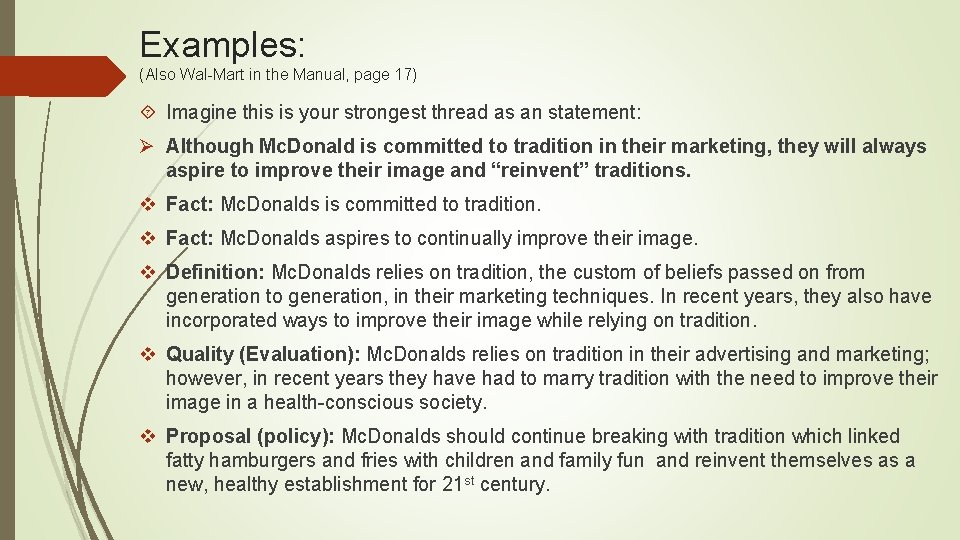
Examples: (Also Wal-Mart in the Manual, page 17) Imagine this is your strongest thread as an statement: Ø Although Mc. Donald is committed to tradition in their marketing, they will always aspire to improve their image and “reinvent” traditions. v Fact: Mc. Donalds is committed to tradition. v Fact: Mc. Donalds aspires to continually improve their image. v Definition: Mc. Donalds relies on tradition, the custom of beliefs passed on from generation to generation, in their marketing techniques. In recent years, they also have incorporated ways to improve their image while relying on tradition. v Quality (Evaluation): Mc. Donalds relies on tradition in their advertising and marketing; however, in recent years they have had to marry tradition with the need to improve their image in a health-conscious society. v Proposal (policy): Mc. Donalds should continue breaking with tradition which linked fatty hamburgers and fries with children and family fun and reinvent themselves as a new, healthy establishment for 21 st century.
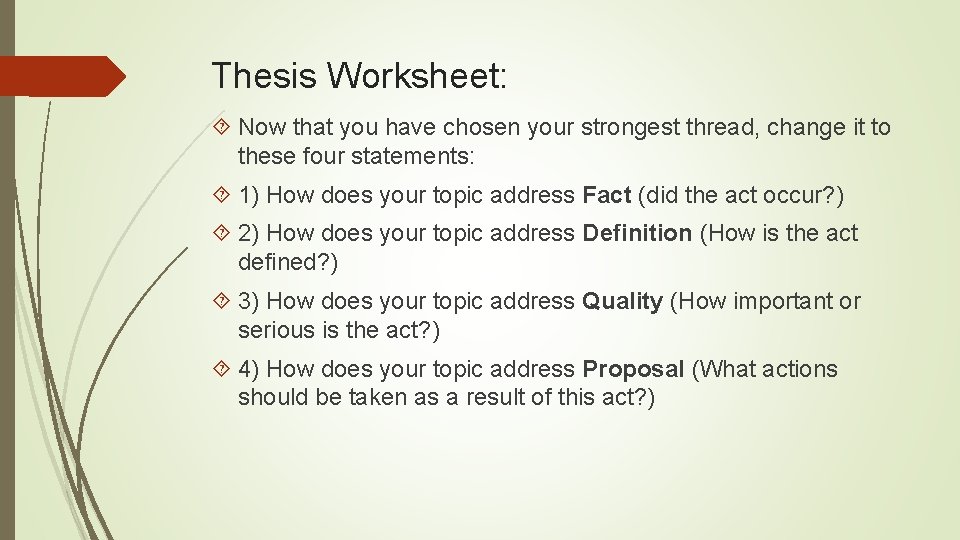
Thesis Worksheet: Now that you have chosen your strongest thread, change it to these four statements: 1) How does your topic address Fact (did the act occur? ) 2) How does your topic address Definition (How is the act defined? ) 3) How does your topic address Quality (How important or serious is the act? ) 4) How does your topic address Proposal (What actions should be taken as a result of this act? )
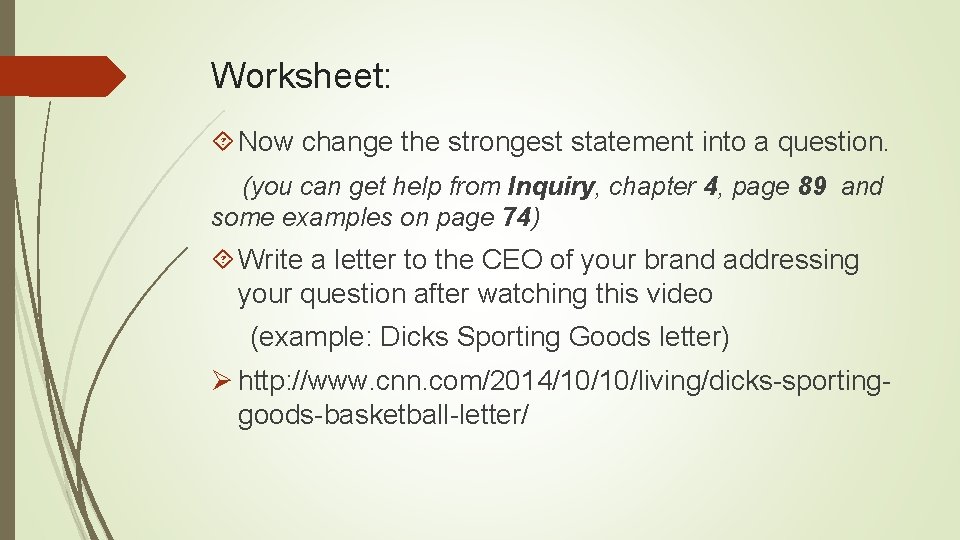
Worksheet: Now change the strongest statement into a question. (you can get help from Inquiry, chapter 4, page 89 and some examples on page 74) Write a letter to the CEO of your brand addressing your question after watching this video (example: Dicks Sporting Goods letter) Ø http: //www. cnn. com/2014/10/10/living/dicks-sportinggoods-basketball-letter/
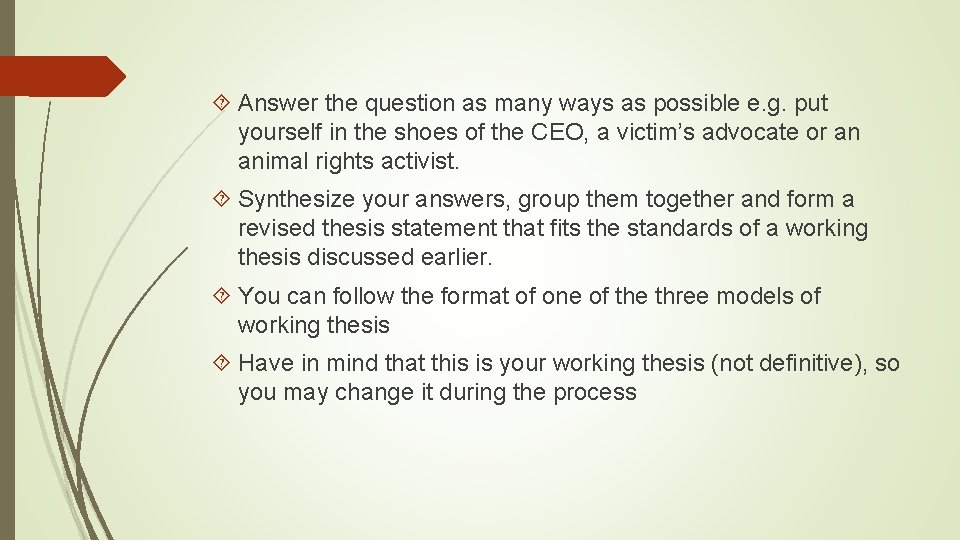
Answer the question as many ways as possible e. g. put yourself in the shoes of the CEO, a victim’s advocate or an animal rights activist. Synthesize your answers, group them together and form a revised thesis statement that fits the standards of a working thesis discussed earlier. You can follow the format of one of the three models of working thesis Have in mind that this is your working thesis (not definitive), so you may change it during the process
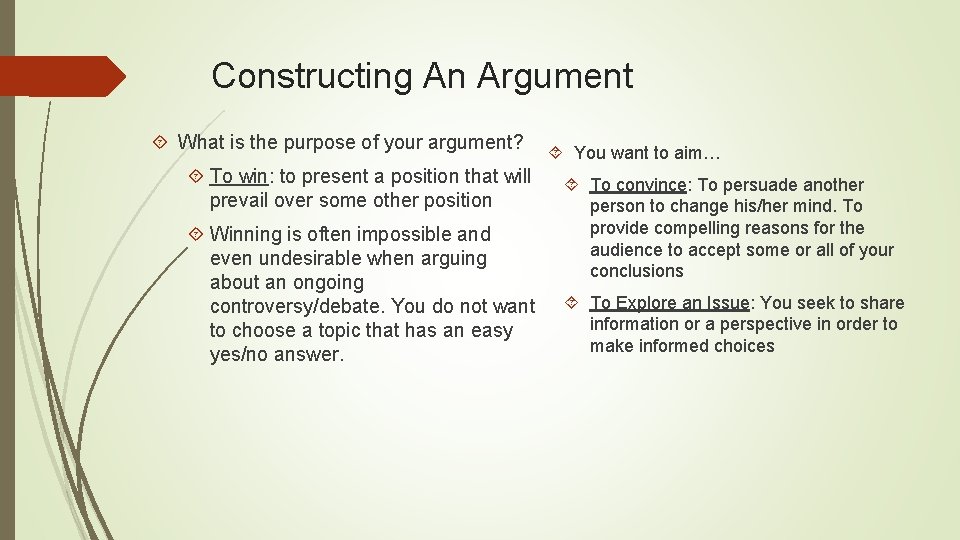
Constructing An Argument What is the purpose of your argument? To win: to present a position that will prevail over some other position Winning is often impossible and even undesirable when arguing about an ongoing controversy/debate. You do not want to choose a topic that has an easy yes/no answer. You want to aim… To convince: To persuade another person to change his/her mind. To provide compelling reasons for the audience to accept some or all of your conclusions To Explore an Issue: You seek to share information or a perspective in order to make informed choices
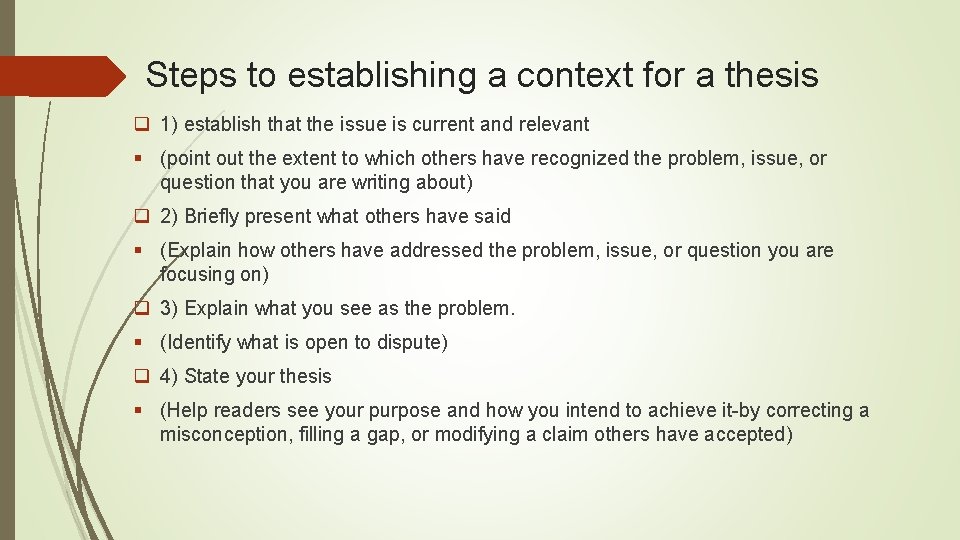
Steps to establishing a context for a thesis q 1) establish that the issue is current and relevant § (point out the extent to which others have recognized the problem, issue, or question that you are writing about) q 2) Briefly present what others have said § (Explain how others have addressed the problem, issue, or question you are focusing on) q 3) Explain what you see as the problem. § (Identify what is open to dispute) q 4) State your thesis § (Help readers see your purpose and how you intend to achieve it-by correcting a misconception, filling a gap, or modifying a claim others have accepted)
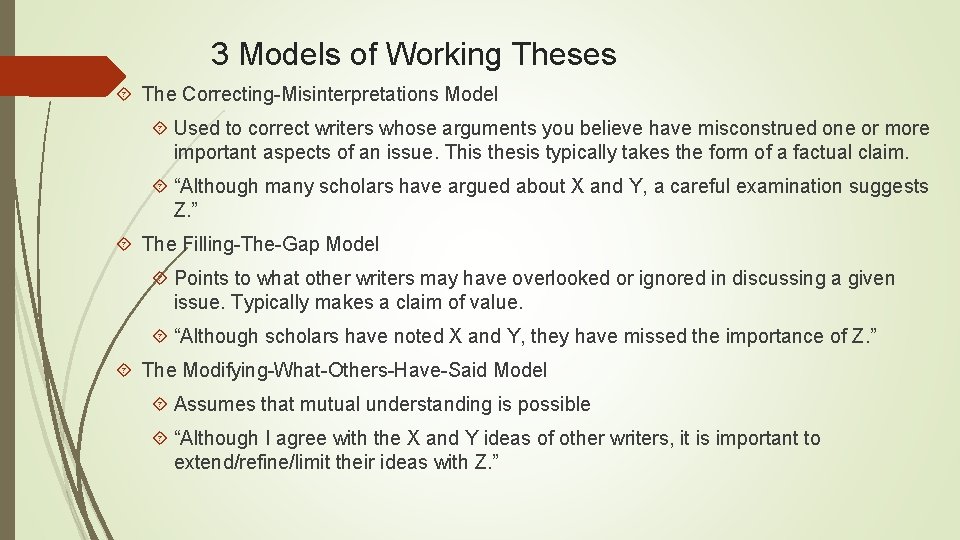
3 Models of Working Theses The Correcting-Misinterpretations Model Used to correct writers whose arguments you believe have misconstrued one or more important aspects of an issue. This thesis typically takes the form of a factual claim. “Although many scholars have argued about X and Y, a careful examination suggests Z. ” The Filling-The-Gap Model Points to what other writers may have overlooked or ignored in discussing a given issue. Typically makes a claim of value. “Although scholars have noted X and Y, they have missed the importance of Z. ” The Modifying-What-Others-Have-Said Model Assumes that mutual understanding is possible “Although I agree with the X and Y ideas of other writers, it is important to extend/refine/limit their ideas with Z. ”
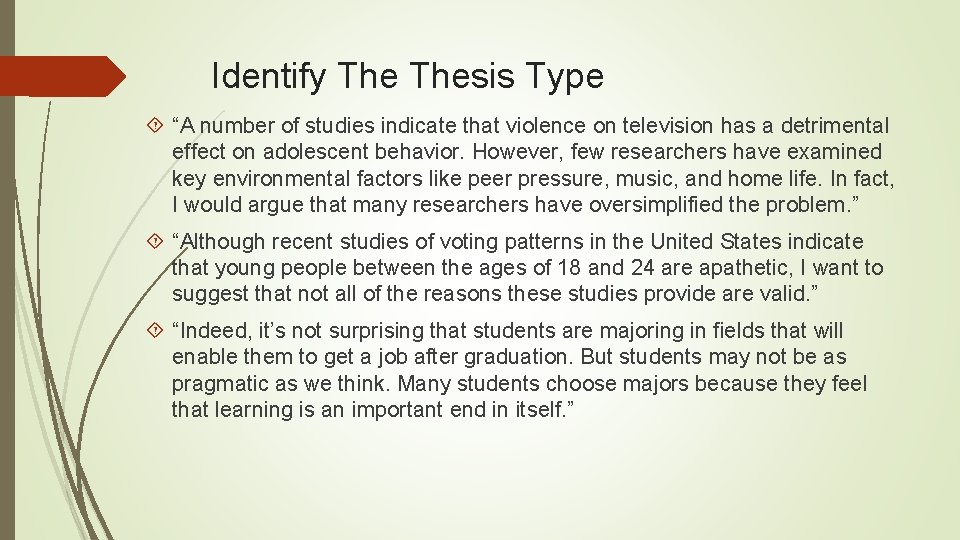
Identify Thesis Type “A number of studies indicate that violence on television has a detrimental effect on adolescent behavior. However, few researchers have examined key environmental factors like peer pressure, music, and home life. In fact, I would argue that many researchers have oversimplified the problem. ” “Although recent studies of voting patterns in the United States indicate that young people between the ages of 18 and 24 are apathetic, I want to suggest that not all of the reasons these studies provide are valid. ” “Indeed, it’s not surprising that students are majoring in fields that will enable them to get a job after graduation. But students may not be as pragmatic as we think. Many students choose majors because they feel that learning is an important end in itself. ”
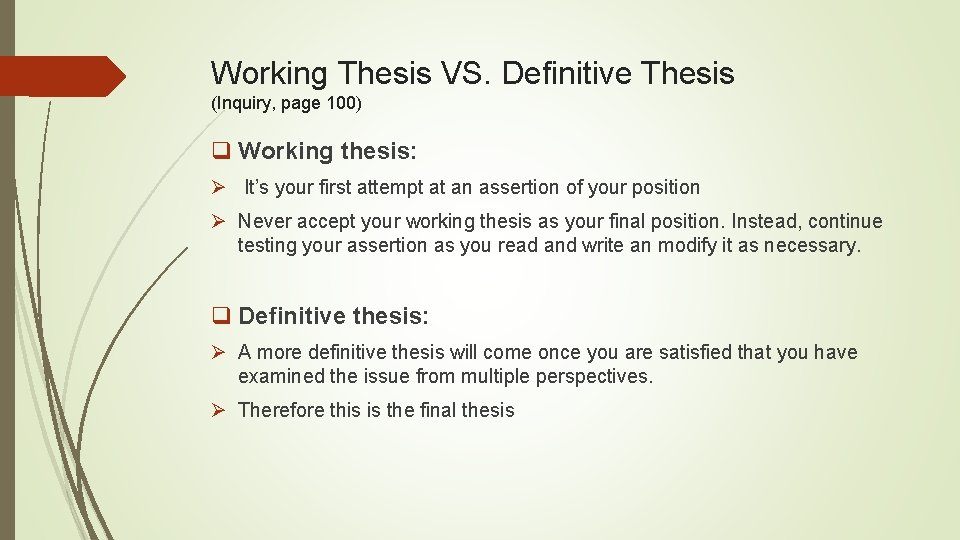
Working Thesis VS. Definitive Thesis (Inquiry, page 100) q Working thesis: Ø It’s your first attempt at an assertion of your position Ø Never accept your working thesis as your final position. Instead, continue testing your assertion as you read and write an modify it as necessary. q Definitive thesis: Ø A more definitive thesis will come once you are satisfied that you have examined the issue from multiple perspectives. Ø Therefore this is the final thesis
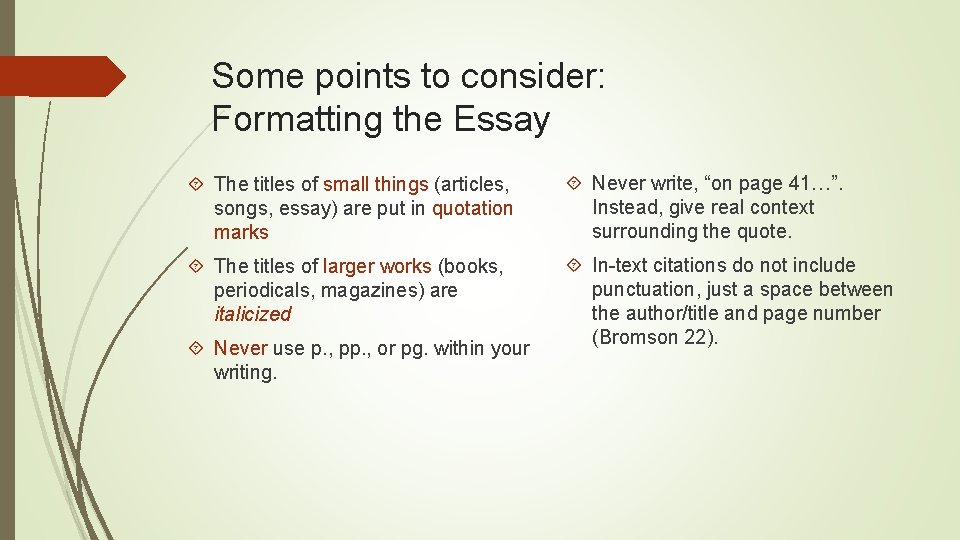
Some points to consider: Formatting the Essay The titles of small things (articles, songs, essay) are put in quotation marks Never write, “on page 41…”. Instead, give real context surrounding the quote. The titles of larger works (books, periodicals, magazines) are italicized In-text citations do not include punctuation, just a space between the author/title and page number (Bromson 22). Never use p. , pp. , or pg. within your writing.
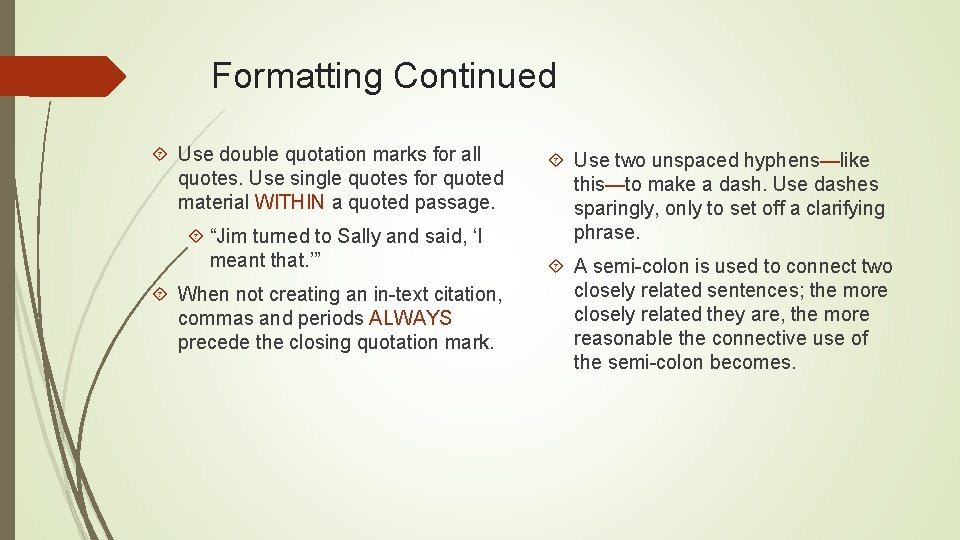
Formatting Continued Use double quotation marks for all quotes. Use single quotes for quoted material WITHIN a quoted passage. “Jim turned to Sally and said, ‘I meant that. ’” When not creating an in-text citation, commas and periods ALWAYS precede the closing quotation mark. Use two unspaced hyphens—like this—to make a dash. Use dashes sparingly, only to set off a clarifying phrase. A semi-colon is used to connect two closely related sentences; the more closely related they are, the more reasonable the connective use of the semi-colon becomes.