
Chapter 5 Foundations of Business Intelligence Databases and
Chapter 5 Foundations of Business Intelligence: Databases and Information Management 5. 1 © Copyright © 2011 Pearson Education, Inc. publishing as Prentice Hall
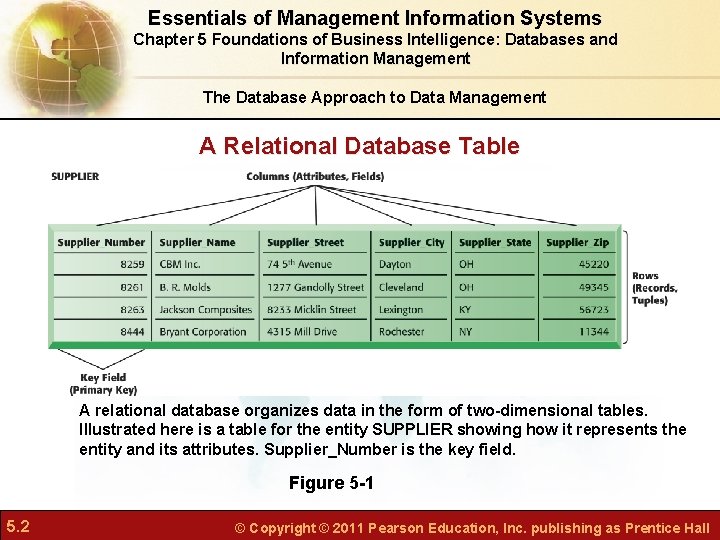
Essentials of Management Information Systems Chapter 5 Foundations of Business Intelligence: Databases and Information Management The Database Approach to Data Management A Relational Database Table A relational database organizes data in the form of two-dimensional tables. Illustrated here is a table for the entity SUPPLIER showing how it represents the entity and its attributes. Supplier_Number is the key field. Figure 5 -1 5. 2 © Copyright © 2011 Pearson Education, Inc. publishing as Prentice Hall
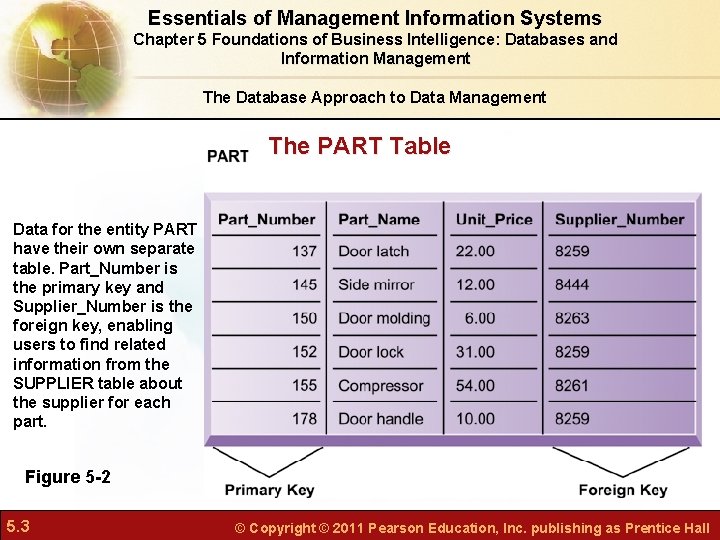
Essentials of Management Information Systems Chapter 5 Foundations of Business Intelligence: Databases and Information Management The Database Approach to Data Management The PART Table Data for the entity PART have their own separate table. Part_Number is the primary key and Supplier_Number is the foreign key, enabling users to find related information from the SUPPLIER table about the supplier for each part. Figure 5 -2 5. 3 © Copyright © 2011 Pearson Education, Inc. publishing as Prentice Hall
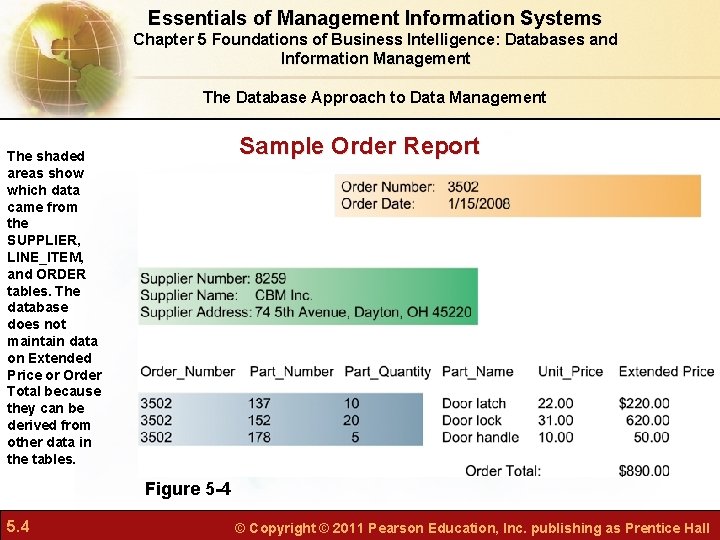
Essentials of Management Information Systems Chapter 5 Foundations of Business Intelligence: Databases and Information Management The Database Approach to Data Management Sample Order Report The shaded areas show which data came from the SUPPLIER, LINE_ITEM, and ORDER tables. The database does not maintain data on Extended Price or Order Total because they can be derived from other data in the tables. Figure 5 -4 5. 4 © Copyright © 2011 Pearson Education, Inc. publishing as Prentice Hall

Essentials of Management Information Systems Chapter 5 Foundations of Business Intelligence: Databases and Information Management The Database Approach to Data Management Entity-Relationship Diagram for the Database with Four Tables This diagram shows the relationship between the entities SUPPLIER, ART, LINE_ITEM, and ORDER. Figure 5 -6 5. 5 © Copyright © 2011 Pearson Education, Inc. publishing as Prentice Hall
Essentials of Management Information Systems Chapter 5 Foundations of Business Intelligence: Databases and Information Management Using Databases to Improve Business Performance and Decision Making • Databases provide information to help the company run the business more efficiently, and help managers and employees make better decisions. • Tools for analyzing, accessing vast quantities of data: • Data warehousing • Multidimensional data analysis • Data mining • Utilizing Web interfaces to databases 5. 6 © Copyright © 2011 Pearson Education, Inc. publishing as Prentice Hall
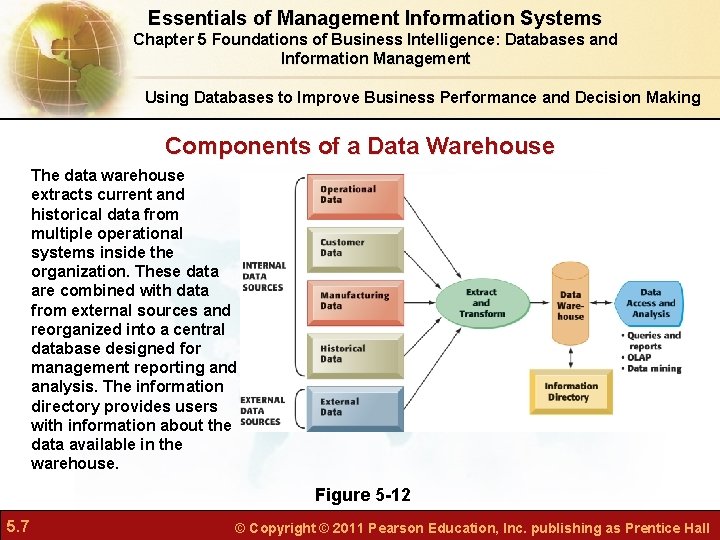
Essentials of Management Information Systems Chapter 5 Foundations of Business Intelligence: Databases and Information Management Using Databases to Improve Business Performance and Decision Making Components of a Data Warehouse The data warehouse extracts current and historical data from multiple operational systems inside the organization. These data are combined with data from external sources and reorganized into a central database designed for management reporting and analysis. The information directory provides users with information about the data available in the warehouse. Figure 5 -12 5. 7 © Copyright © 2011 Pearson Education, Inc. publishing as Prentice Hall
Essentials of Management Information Systems Chapter 5 Foundations of Business Intelligence: Databases and Information Management Using Databases to Improve Business Performance and Decision Making Business Intelligence, Multidimensional Data Analysis, and Data Mining • Business intelligence: tools for consolidating, analyzing, and providing access to large amounts of data to improve decision making • Software for database reporting and querying • Tools for multidimensional data analysis (online analytical processing) • Data mining • E. g. , Harrah’s Entertainment gathers and analyzes customer data to create gambling profile and identify most profitable customers 5. 8 © Copyright © 2011 Pearson Education, Inc. publishing as Prentice Hall

Essentials of Management Information Systems Chapter 5 Foundations of Business Intelligence: Databases and Information Management Using Databases to Improve Business Performance and Decision Making Business Intelligence A series of analytical tools works with data stored in databases to find patterns and insights for helping managers and employees make better decisions to improve organizational performance. Figure 5 -13 5. 9 © Copyright © 2011 Pearson Education, Inc. publishing as Prentice Hall
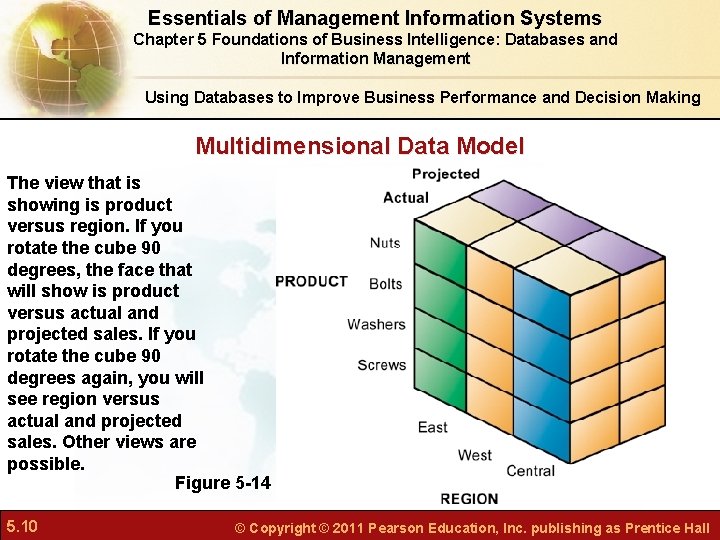
Essentials of Management Information Systems Chapter 5 Foundations of Business Intelligence: Databases and Information Management Using Databases to Improve Business Performance and Decision Making Multidimensional Data Model The view that is showing is product versus region. If you rotate the cube 90 degrees, the face that will show is product versus actual and projected sales. If you rotate the cube 90 degrees again, you will see region versus actual and projected sales. Other views are possible. Figure 5 -14 5. 10 © Copyright © 2011 Pearson Education, Inc. publishing as Prentice Hall
Using Databases to Improve Business Performance and Decision Making Data Mining • Finds hidden patterns and relationships in large databases and infers rules from them to predict future behavior • Types of information obtainable from data mining • Associations: occurrences linked to single event –corn chips attract the sale of a cola 65%. Promotion 85% • Sequences: events linked over time – if a house is purchased, refrigerator within two weeks 65%, washing machine in 3 55% and oven in 4 weeks 45% • Classifications: patterns describing a group an item belongs to – e, g, it helps credit card/mobile phone companies to discover characteristics of customers who are likely to leave, and can provide a model to predict who these customers are so that the managers can devise some special campaigns. 5. 11 © Copyright © 2011 Pearson Education, Inc. publishing as Prentice Hall
Using Databases to Improve Business Performance and Decision Making Data Mining • Clusters: discovering as yet unclassified groupings – can discover the clusters in the customer data to find affinity groups or the one who are likely to go for a particular product. It differs from classification in the manner that the clusters are previously unknown. • Forecasting: uses series of existing values to forecast future values – e. g. forecasting of sales figures in 2012. • Terrorism: How should the Saudi Govt use data mining to identify potential or actual terrorists? Relate your answer to associations, sequences, classifications, and clusters • Hajj Management: Any group taking on the Hajj management must discuss Data Mining Issues, requirements and benefits in detail. 5. 12 © Copyright © 2011 Pearson Education, Inc. publishing as Prentice Hall
Using Databases to Improve Business Performance and Decision Making Data Mining • One popular use of data mining: analyzing patterns in customer data for one-to-one marketing campaigns or for identifying profitable customers –Virgin Mobile company of Australia uses a data warehouse and data mining to increase customer loyalty and provide new services. It created a d DW that consolidated data from its Enterprise System, CRMS and customer billing system in a massive database. DM has enabled demographic profile of new customers and relate it to the handset they purchase, amongst many other things. • Predictive analysis: • Uses data mining techniques, historical data, and assumptions about future conditions to predict outcomes of events, such as the probability a customer will respond to an offer or purchase a specific product • Data mining versus privacy concerns 5. 13 © Copyright © 2011 Pearson Education, Inc. publishing as Prentice Hall
- Slides: 13