Chapter 5 Force and Motion I I Newtons



- Slides: 20
Chapter 5 – Force and Motion I I. Newton’s first law. II. Newton’s second law. III. Particular forces: - Gravitational - Weight - Normal - Tension IV. Newton’s third law.
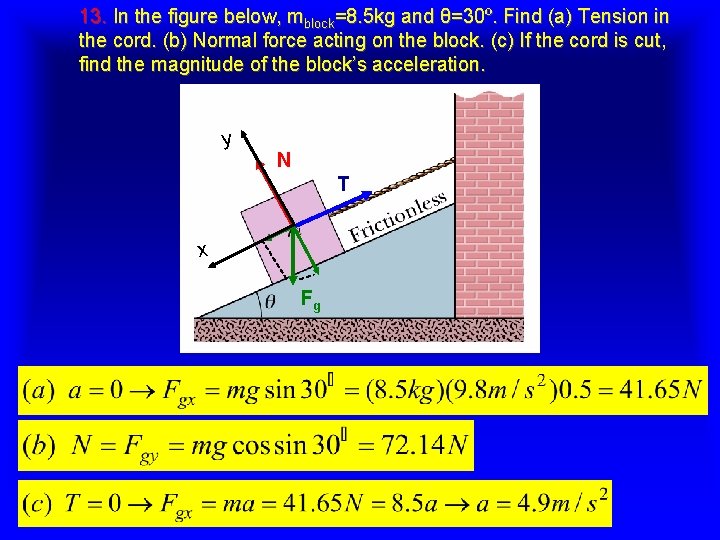
13. In the figure below, mblock=8. 5 kg and θ=30º. Find (a) Tension in the cord. (b) Normal force acting on the block. (c) If the cord is cut, find the magnitude of the block’s acceleration. y N T x Fg
Chapter 6 – Force and Motion II I. Frictional forces. II. Drag forces and terminal speed. III. Uniform circular motion.
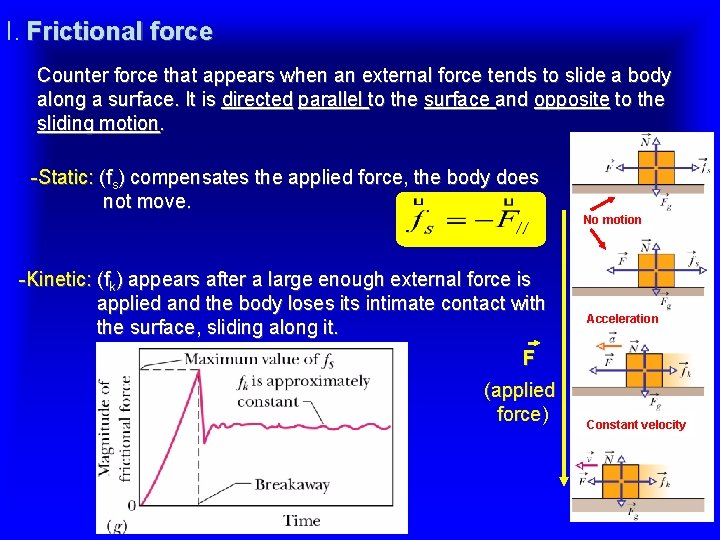
I. Frictional force Counter force that appears when an external force tends to slide a body along a surface. It is directed parallel to the surface and opposite to the sliding motion. -Static: (fs) compensates the applied force, the body does not move. No motion -Kinetic: (fk) appears after a large enough external force is applied and the body loses its intimate contact with the surface, sliding along it. F (applied force) Acceleration Constant velocity
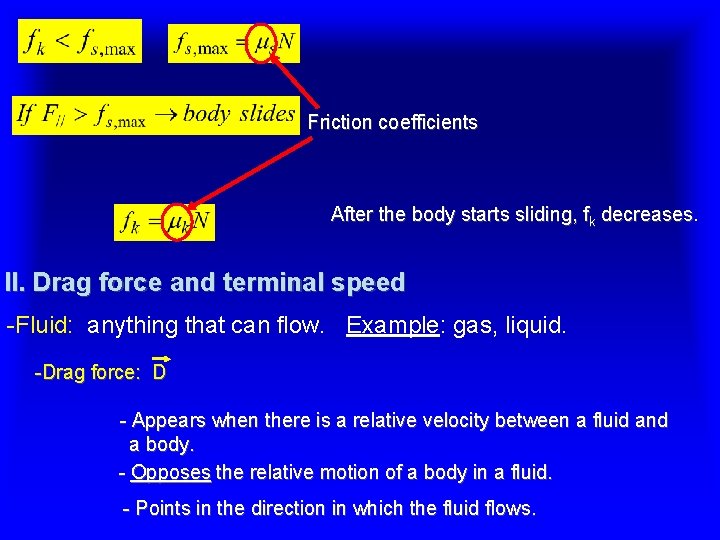
Friction coefficients After the body starts sliding, fk decreases II. Drag force and terminal speed -Fluid: anything that can flow. Example: gas, liquid. -Drag force: D - Appears when there is a relative velocity between a fluid and a body. - Opposes the relative motion of a body in a fluid. - Points in the direction in which the fluid flows.
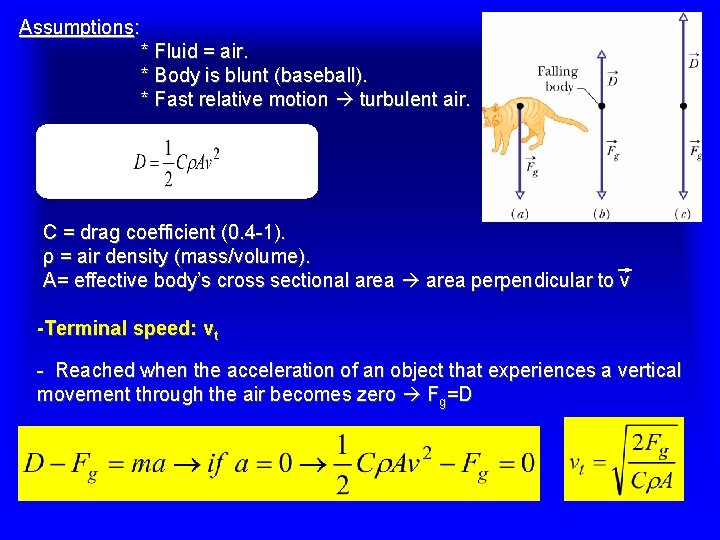
Assumptions: * Fluid = air. * Body is blunt (baseball). * Fast relative motion turbulent air. C = drag coefficient (0. 4 -1). ρ = air density (mass/volume). A= effective body’s cross sectional area perpendicular to v -Terminal speed: vt - Reached when the acceleration of an object that experiences a vertical movement through the air becomes zero Fg=D
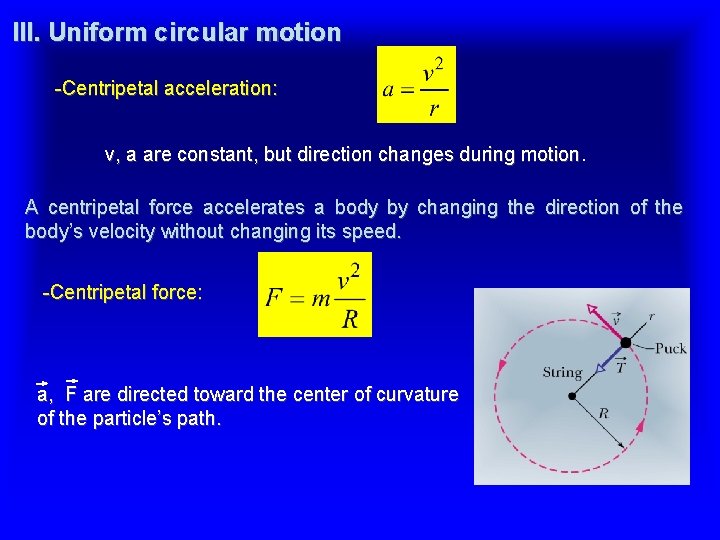
III. Uniform circular motion -Centripetal acceleration: v, a are constant, but direction changes during motion A centripetal force accelerates a body by changing the direction of the body’s velocity without changing its speed. -Centripetal force: a, F are directed toward the center of curvature of the particle’s path.
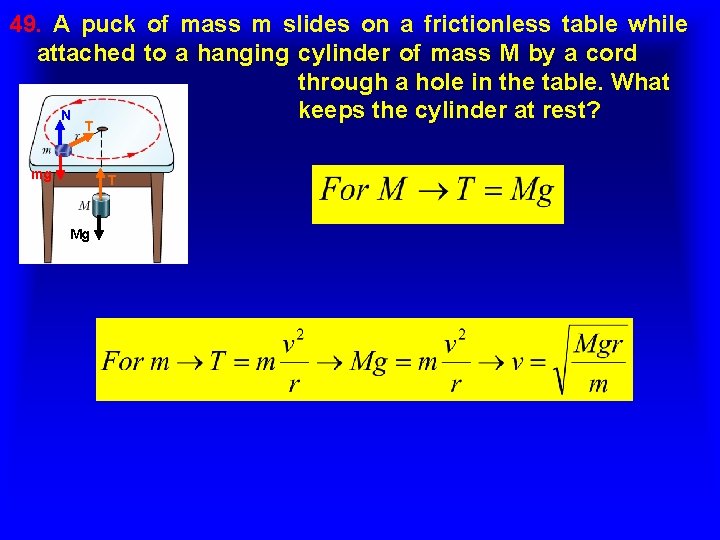
49. A puck of mass m slides on a frictionless table while attached to a hanging cylinder of mass M by a cord through a hole in the table. What speed keeps the cylinder at rest? N T mg T Mg
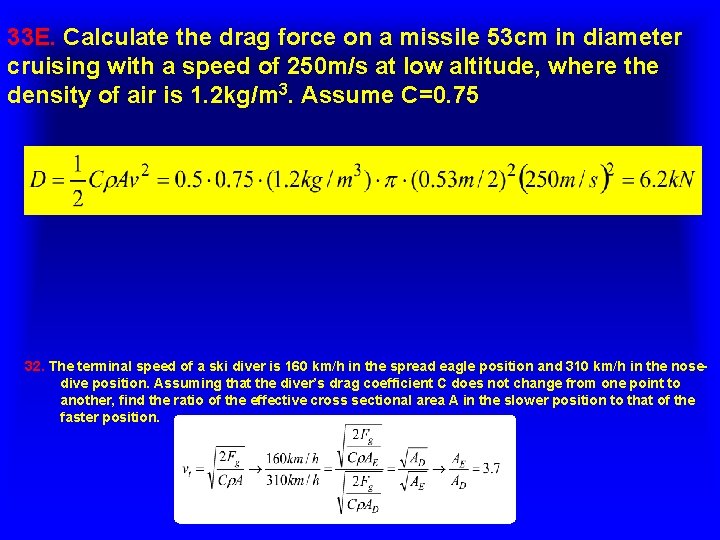
33 E. Calculate the drag force on a missile 53 cm in diameter cruising with a speed of 250 m/s at low altitude, where the density of air is 1. 2 kg/m 3. Assume C=0. 75 32. The terminal speed of a ski diver is 160 km/h in the spread eagle position and 310 km/h in the nosedive position. Assuming that the diver’s drag coefficient C does not change from one point to another, find the ratio of the effective cross sectional area A in the slower position to that of the faster position.
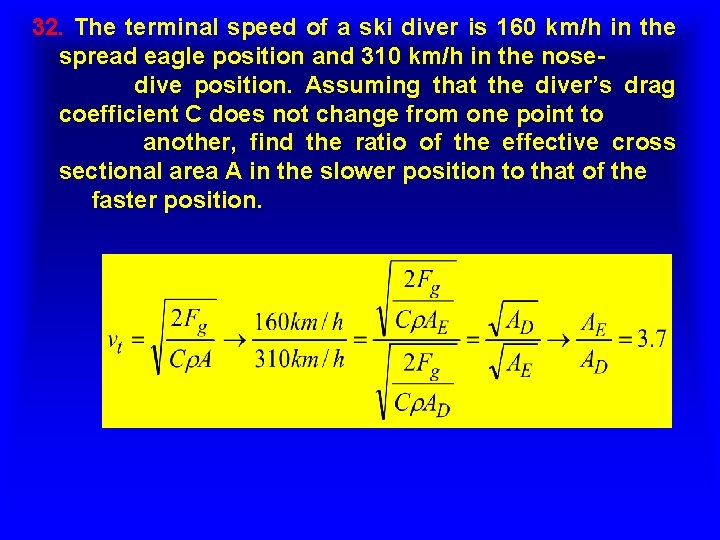
32. The terminal speed of a ski diver is 160 km/h in the spread eagle position and 310 km/h in the nosedive position. Assuming that the diver’s drag coefficient C does not change from one point to another, find the ratio of the effective cross sectional area A in the slower position to that of the faster position.
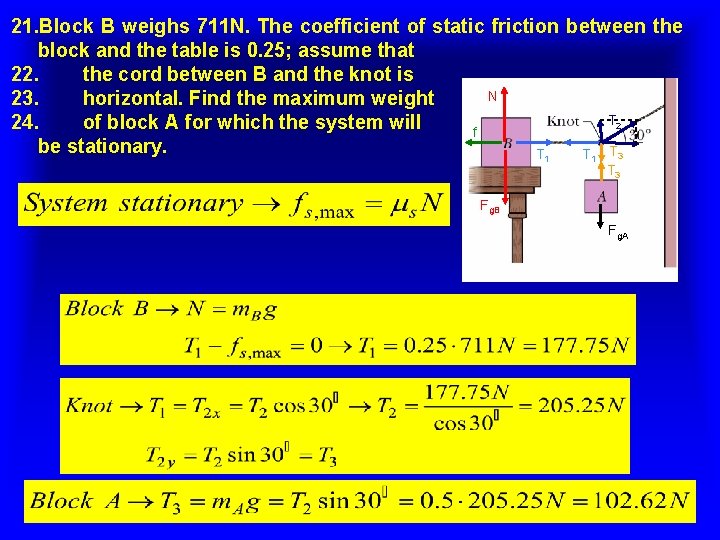
21. Block B weighs 711 N. The coefficient of static friction between the block and the table is 0. 25; assume that 22. the cord between B and the knot is N 23. horizontal. Find the maximum weight T 2 24. of block A for which the system will f be stationary. T 1 T 3 Fg. B Fg. A
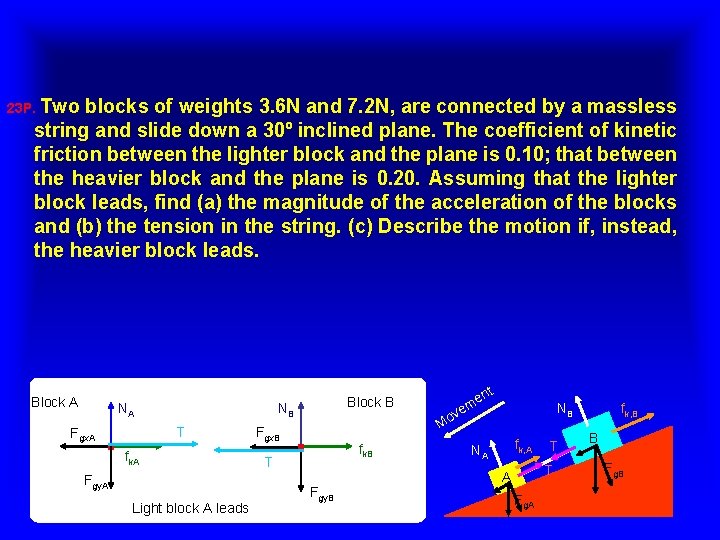
23 P. Two blocks of weights 3. 6 N and 7. 2 N, are connected by a massless string and slide down a 30º inclined plane. The coefficient of kinetic friction between the lighter block and the plane is 0. 10; that between the heavier block and the plane is 0. 20. Assuming that the lighter block leads, find (a) the magnitude of the acceleration of the blocks and (b) the tension in the string. (c) Describe the motion if, instead, the heavier block leads. Block A NA NB T Fgx. A fk. A Fgy. A Light block A leads t n me e v Block B NB Mo Fgx. B fk. B T Fgy. B fk, A NA T T A Fg. A fk, B B Fg. B
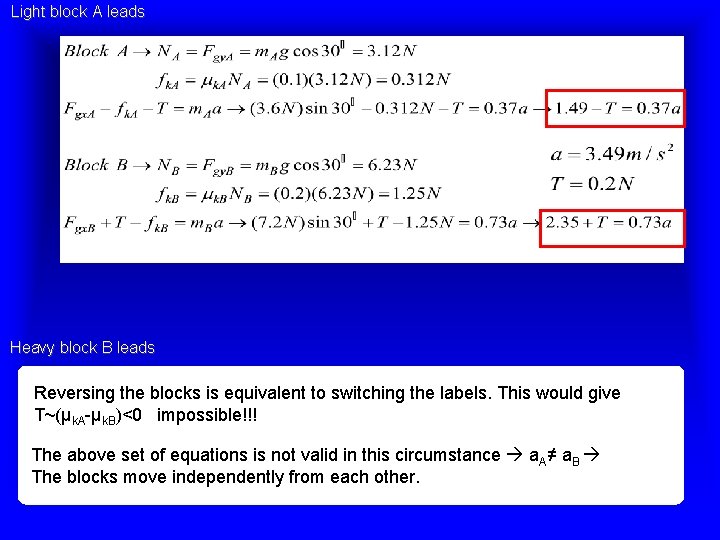
Light block A leads Heavy block B leads Reversing the blocks is equivalent to switching the labels. This would give T~(μk. A-μk. B)<0 impossible!!! The above set of equations is not valid in this circumstance a. A≠ a. B The blocks move independently from each other.
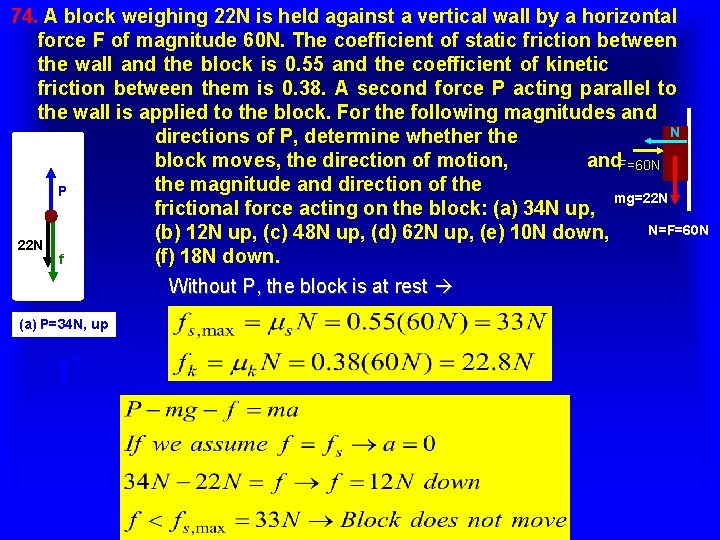
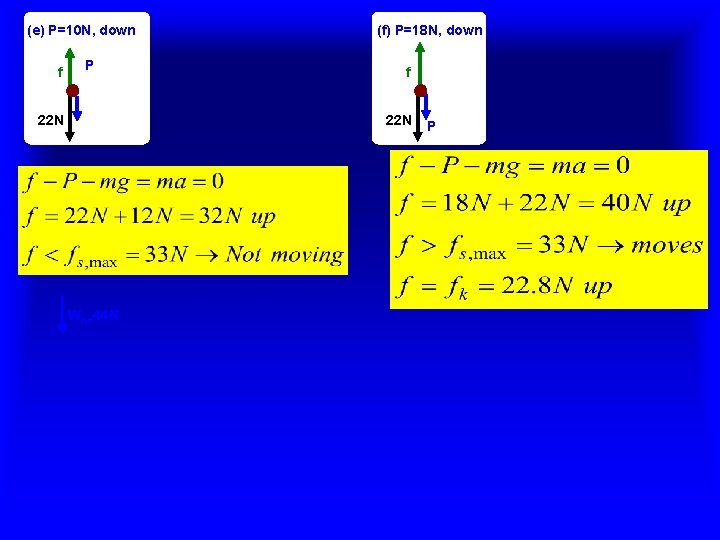
74. A block weighing 22 N is held against a vertical wall by a horizontal force F of magnitude 60 N. The coefficient of static friction between the wall and the block is 0. 55 and the coefficient of kinetic friction between them is 0. 38. A second force P acting parallel to the wall is applied to the block. For the following magnitudes and N directions of P, determine whether the block moves, the direction of motion, and. F=60 N the magnitude and direction of the P mg=22 N frictional force acting on the block: (a) 34 N up, N=F=60 N (b) 12 N up, (c) 48 N up, (d) 62 N up, (e) 10 N down, 22 N (f) 18 N down. f Without P, the block is at rest (a) P=34 N, up P
74. A block weighing 22 N is held against a vertical wall by a horizontal force F of magnitude 60 N. The coefficient of static friction between the wall and the block is 0. 55 and the coefficient of kinetic friction between them is 0. 38. A second P acting parallel to the wall is applied to the block. (a) P=34 N, up following magnitudes and directions of P, For the determine whether the block moves, the direction of P motion, and the magnitude and direction of the frictional force acting on the block: (a) 34 N up (b) 12 N up, (c) 48 N up, (d) 62 N up, (e) 10 N down, (f) 18 N down. (c) P=48 N, up (b) P=12 N, up f P P 22 N (d) P=62 N, up P f 22 N f N F=60 N mg=22 N N=F=60 N
(e) P=10 N, down f P 22 N (f) P=18 N, down f 22 N WA=44 N P
28. Blocks A and B have weights of 44 N and 22 N, respectively. (a) Determine the minimum weight of block C to keep A from P sliding if μs between A and the table is 0. 2. (b) Block C suddenly is lifted of A. What is the acceleration of block A if μk between A and the table is 0. 15? (a) N f T Wc WA=44 N T WB=22 N
28. Blocks A and B have weights of 44 N and 22 N, respectively. (a) Determine the minimum weight of block C to keep A from P sliding if μs between A and the table is 0. 2. (b) Block C suddenly is lifted of A. What is the acceleration of block A if μk between A and the table is 0. 15? (b) N f T Wc WA=44 N T WB=22 N
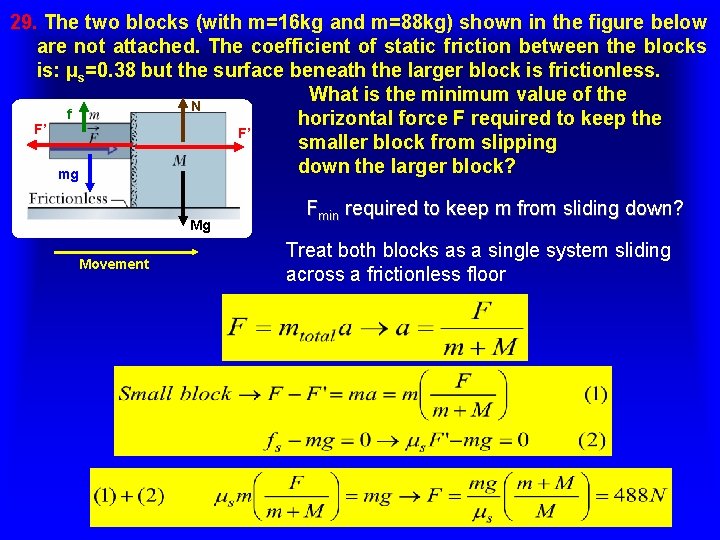
29. The two blocks (with m=16 kg and m=88 kg) shown in the figure below are not attached. The coefficient of static friction between the blocks is: μs=0. 38 but the surface beneath the larger block is frictionless. What is the minimum value of the N f horizontal force F required to keep the F’ F’ smaller block from slipping down the larger block? mg Mg Movement Fmin required to keep m from sliding down? Treat both blocks as a single system sliding across a frictionless floor
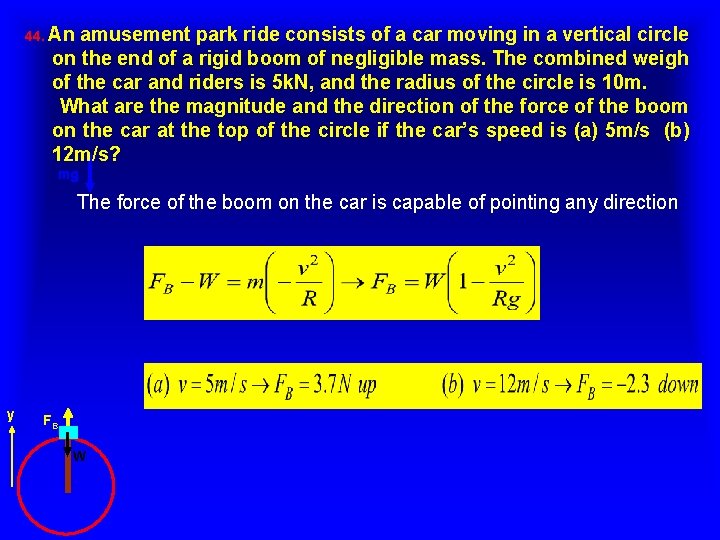
44. An amusement park ride consists of a car moving in a vertical circle on the end of a rigid boom of negligible mass. The combined weigh of the car and riders is 5 k. N, and the radius of the circle is 10 m. What are the magnitude and the direction of the force of the boom on the car at the top of the circle if the car’s speed is (a) 5 m/s (b) 12 m/s? mg The force of the boom on the car is capable of pointing any direction y FB W