
Chapter 5 Finite Automata 5 1 Finite State
- Slides: 26
Chapter 5 Finite Automata
5. 1 Finite State Automata n n n Capable of recognizing numerous symbol patterns, the class of regular languages Suitable for pattern-recognition type applications, such as the lexical analyzer of a compiler An abstract (computing) machine M, which is implementation independent, can be used to determine the acceptability (the outputs) of input strings (which make up the language of M) 2
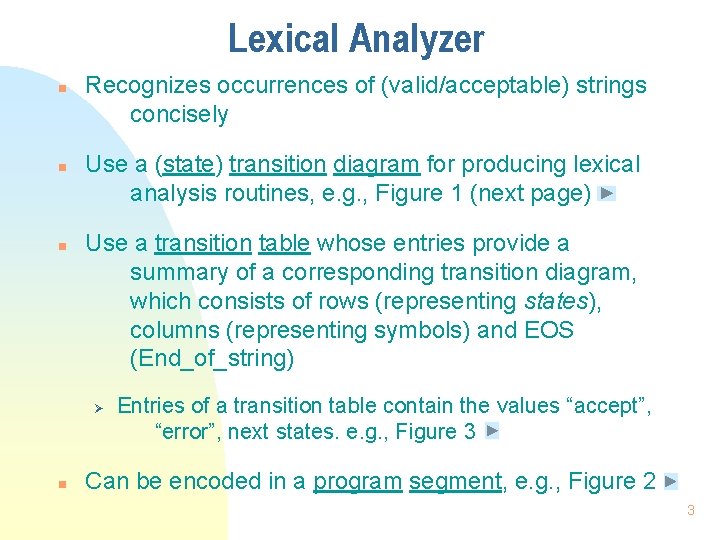
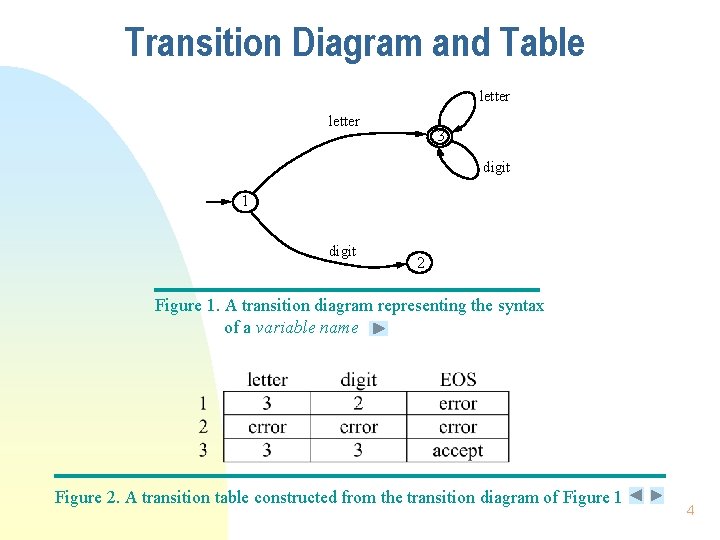
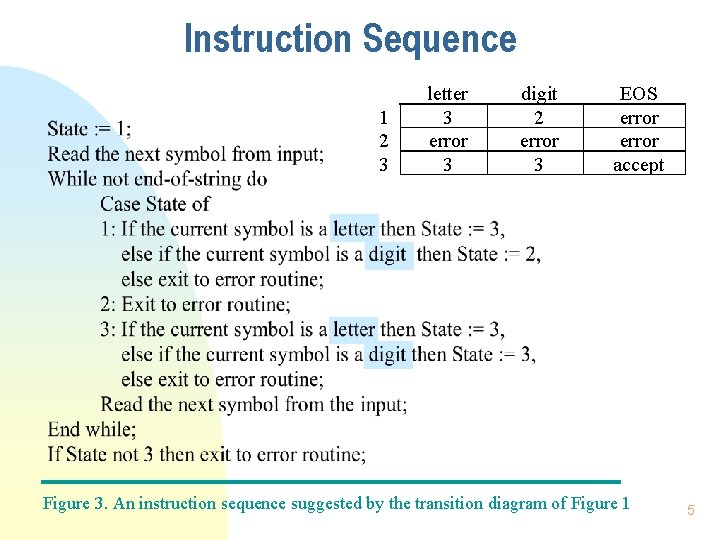
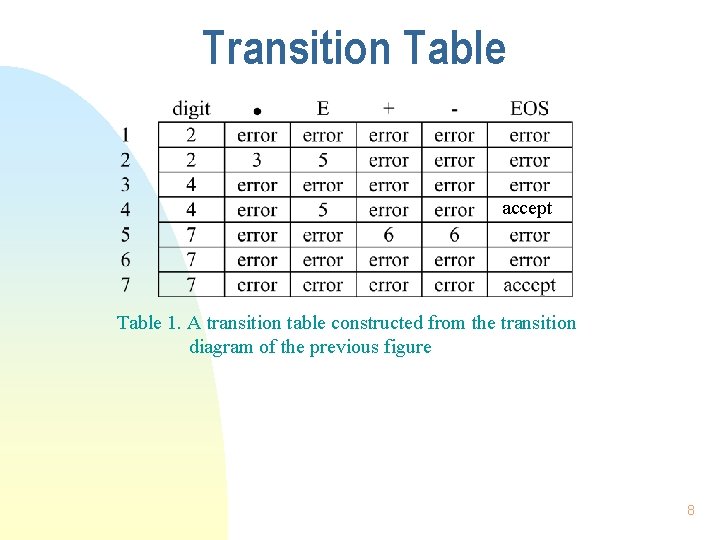
Lexical Analyzer n n n Recognizes occurrences of (valid/acceptable) strings concisely Use a (state) transition diagram for producing lexical analysis routines, e. g. , Figure 1 (next page) Use a transition table whose entries provide a summary of a corresponding transition diagram, which consists of rows (representing states), columns (representing symbols) and EOS (End_of_string) Ø n Entries of a transition table contain the values “accept”, “error”, next states. e. g. , Figure 3 Can be encoded in a program segment, e. g. , Figure 2 3
Transition Diagram and Table letter 3 digit 1 digit 2 Figure 1. A transition diagram representing the syntax of a variable name Figure 2. A transition table constructed from the transition diagram of Figure 1 4
Instruction Sequence 1 2 3 letter 3 error 3 digit 2 error 3 EOS error accept Figure 3. An instruction sequence suggested by the transition diagram of Figure 1 5
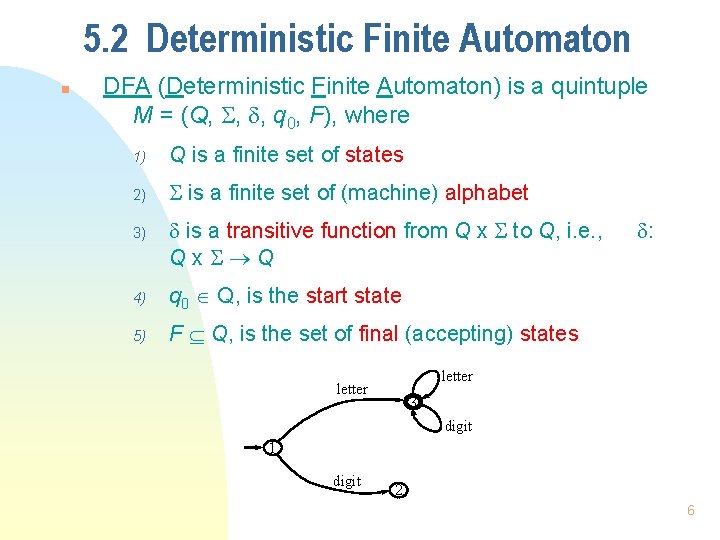
5. 2 Deterministic Finite Automaton n DFA (Deterministic Finite Automaton) is a quintuple M = (Q, , , q 0, F), where 1) Q is a finite set of states 2) is a finite set of (machine) alphabet 3) is a transitive function from Q x to Q, i. e. , Qx Q 4) q 0 Q, is the start state 5) F Q, is the set of final (accepting) states : letter 3 digit 1 digit 2 6
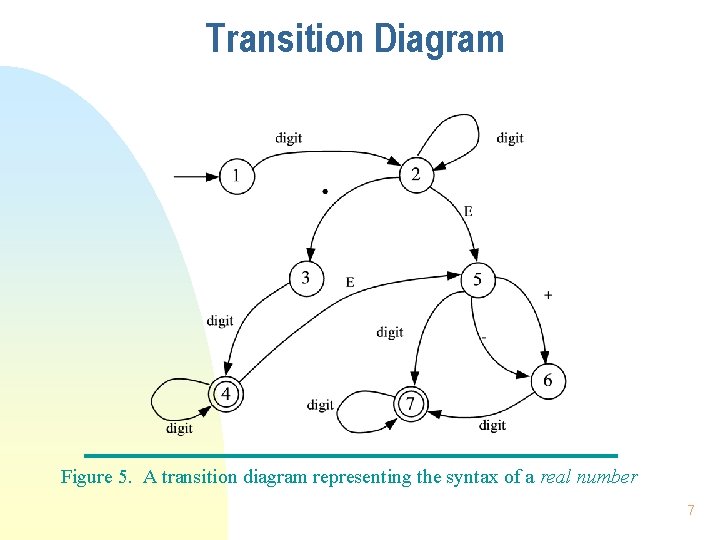
Transition Diagram Figure 5. A transition diagram representing the syntax of a real number 7
Transition Table accept Table 1. A transition table constructed from the transition diagram of the previous figure 8
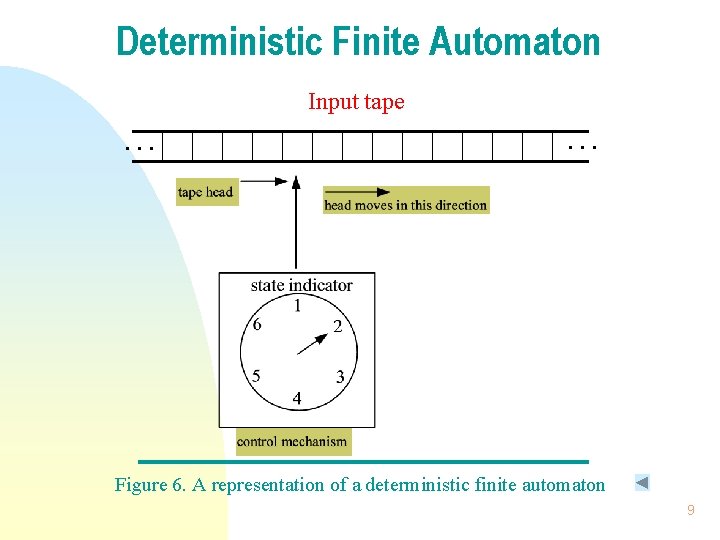
Deterministic Finite Automaton … Input tape … Figure 6. A representation of a deterministic finite automaton 9
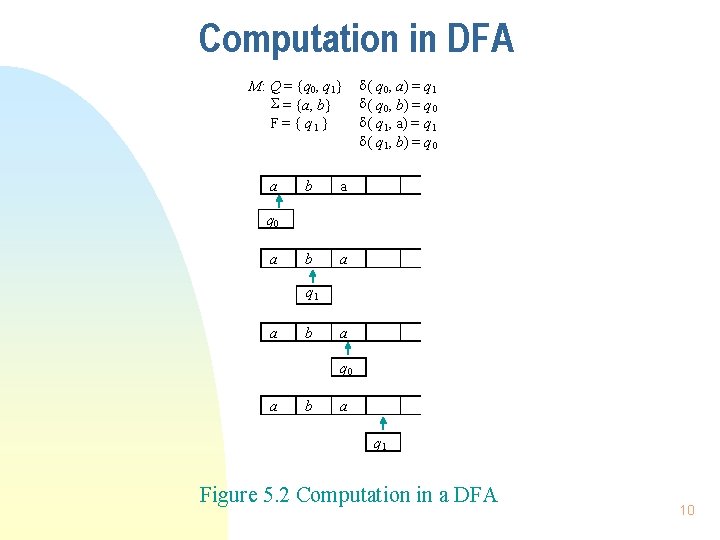
Computation in DFA M: Q = {q 0, q 1} = {a, b} F = { q 1 } a b a ( q 0, a) = q 1 ( q 0, b) = q 0 ( q 1, a) = q 1 ( q 1, b) = q 0 a q 1 a b a q 0 a b a q 1 Figure 5. 2 Computation in a DFA 10
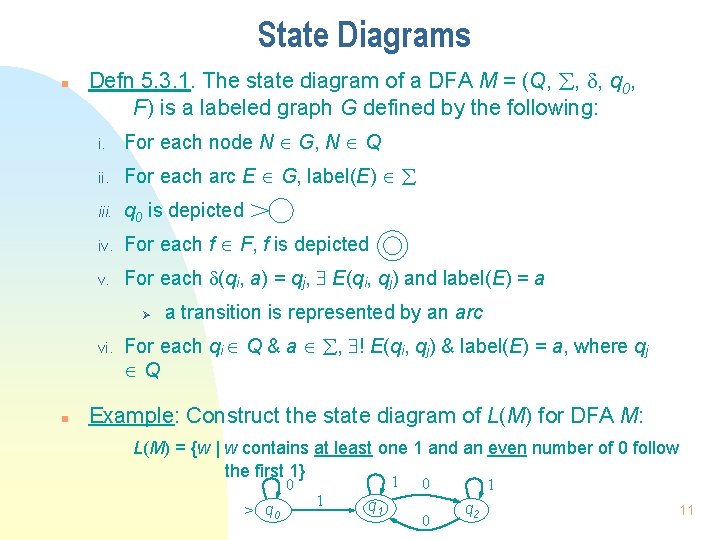
State Diagrams n Defn 5. 3. 1. The state diagram of a DFA M = (Q, , , q 0, F) is a labeled graph G defined by the following: i. For each node N G, N Q ii. For each arc E G, label(E) iii. q 0 is depicted iv. For each f F, f is depicted v. For each (qi, a) = qj, E(qi, qj) and label(E) = a Ø vi. n a transition is represented by an arc For each qi Q & a , ! E(qi, qj) & label(E) = a, where qj Q Example: Construct the state diagram of L(M) for DFA M: L(M) = {w | w contains at least one 1 and an even number of 0 follow the first 1} 0 > q 0 1 1 q 1 0 0 1 q 2 11
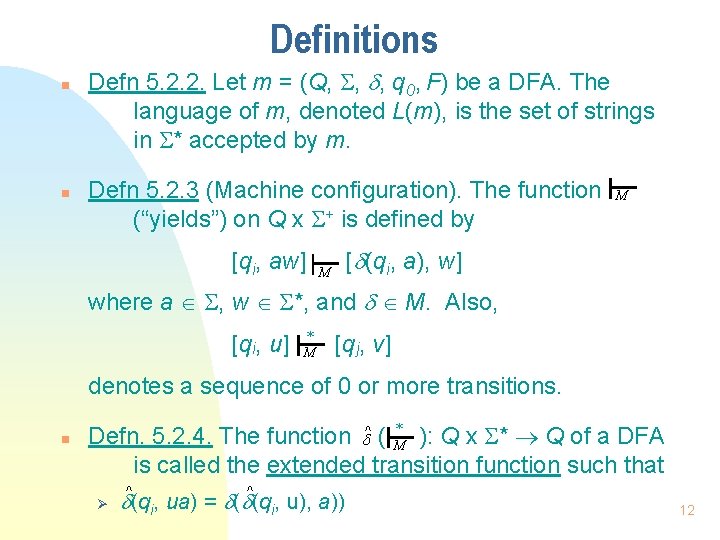
Definitions n n Defn 5. 2. 2. Let m = (Q, , , q 0, F) be a DFA. The language of m, denoted L(m), is the set of strings in * accepted by m. Defn 5. 2. 3 (Machine configuration). The function (“yields”) on Q x + is defined by [qi, aw] M [ (qi, a), w] M where a , w *, and M. Also, [qi, u] * M [qj, v] denotes a sequence of 0 or more transitions. n Defn. 5. 2. 4. The function ( M* ): Q x * Q of a DFA is called the extended transition function such that Ù Ù Ø Ù (qi, ua) = ( (qi, u), a)) 12
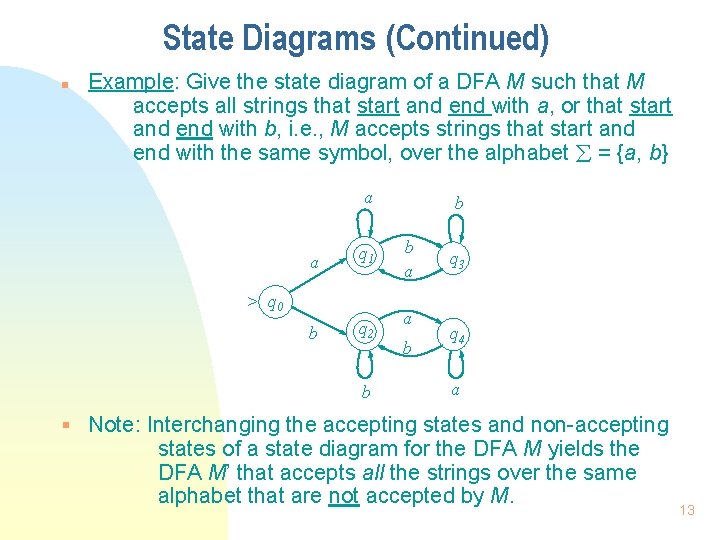
State Diagrams (Continued) n Example: Give the state diagram of a DFA M such that M accepts all strings that start and end with a, or that start and end with b, i. e. , M accepts strings that start and end with the same symbol, over the alphabet = {a, b} a a q 1 b q 2 > q 0 b b b a a b q 3 q 4 a § Note: Interchanging the accepting states and non-accepting states of a state diagram for the DFA M yields the DFA M’ that accepts all the strings over the same alphabet that are not accepted by M. 13
DFA and State Diagrams n Construct a DFA that accepts one of the following languages over the alphabet { 0, 1 } i. “The set of all strings ending in 00”. ii. “The set of all strings when interpreted as a binary integer, is a multiple of 5, e. g. , strings 101, 1010, and 1111 are in the language, whereas 10, 100, and 111 are not”. 14
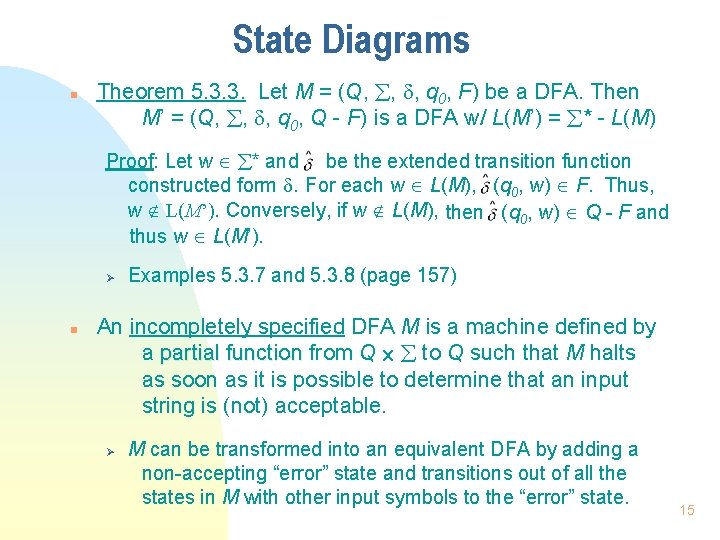
State Diagrams n Theorem 5. 3. 3. Let M = (Q, , , q 0, F) be a DFA. Then M’ = (Q, , , q 0, Q - F) is a DFA w/ L(M’) = * - L(M) Proof: Let w * and be the extended transition function constructed form . For each w L(M), (q 0, w) F. Thus, w L(M’). Conversely, if w L(M), then (q 0, w) Q - F and thus w L(M’). Ø n Examples 5. 3. 7 and 5. 3. 8 (page 157) An incompletely specified DFA M is a machine defined by a partial function from Q to Q such that M halts as soon as it is possible to determine that an input string is (not) acceptable. Ø M can be transformed into an equivalent DFA by adding a non-accepting “error” state and transitions out of all the states in M with other input symbols to the “error” state. 15
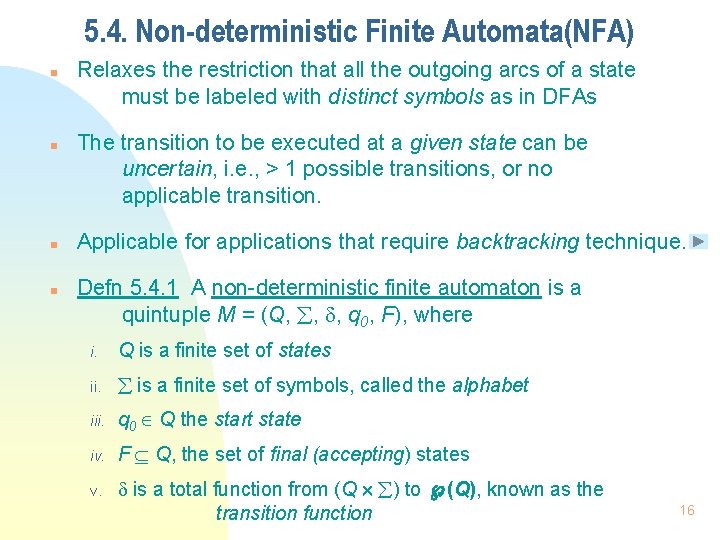
5. 4. Non-deterministic Finite Automata(NFA) n n Relaxes the restriction that all the outgoing arcs of a state must be labeled with distinct symbols as in DFAs The transition to be executed at a given state can be uncertain, i. e. , > 1 possible transitions, or no applicable transition. Applicable for applications that require backtracking technique. Defn 5. 4. 1 A non-deterministic finite automaton is a quintuple M = (Q, , , q 0, F), where i. Q is a finite set of states ii. is a finite set of symbols, called the alphabet iii. q 0 Q the start state iv. F Q, the set of final (accepting) states v. is a total function from (Q ) to (Q), known as the transition function 16
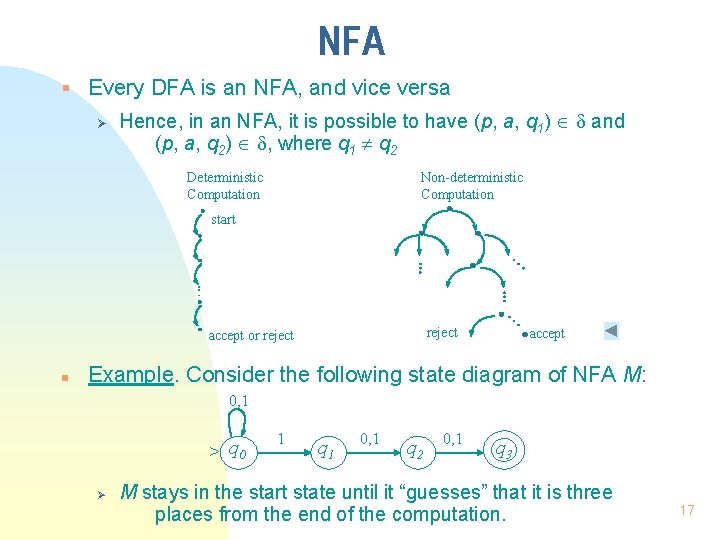
NFA § Every DFA is an NFA, and vice versa Ø Hence, in an NFA, it is possible to have (p, a, q 1) and (p, a, q 2) , where q 1 q 2 Deterministic Computation Non-deterministic Computation start reject accept or reject n accept Example. Consider the following state diagram of NFA M: 0, 1 > q 0 Ø 1 q 1 0, 1 q 2 0, 1 q 3 M stays in the start state until it “guesses” that it is three places from the end of the computation. 17
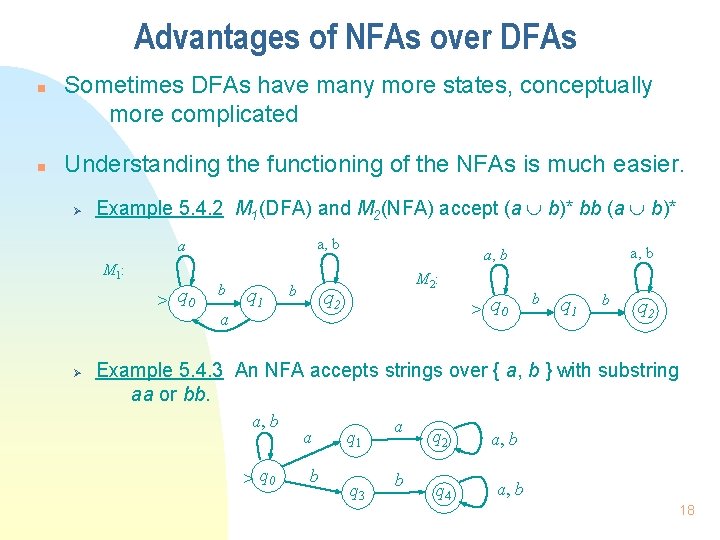
Advantages of NFAs over DFAs n n Sometimes DFAs have many more states, conceptually more complicated Understanding the functioning of the NFAs is much easier. Ø Example 5. 4. 2 M 1(DFA) and M 2(NFA) accept (a b)* bb (a b)* a, b a M 1: > q 0 Ø b a q 1 b a, b M 2: q 2 > q 0 b q 1 b q 2 Example 5. 4. 3 An NFA accepts strings over { a, b } with substring aa or bb. a, b > q 0 a b q 1 q 3 a b q 2 q 4 a, b 18
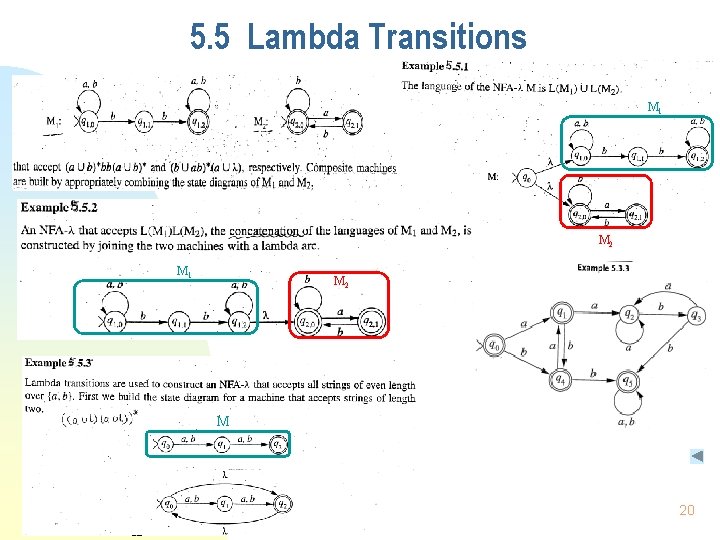
5. 5 Lambda Transitions n n n A transition of any finite automata which shifts from one state to another without reading a symbol from the input tape is known as -transition is labeled by on an arc in the state transition diagram -transition represent another form of non-DFA computations Provide a useful tool for designing finite automata to accept complex languages Defn. 5. 5. 1. An NFA with -transition, denoted NFA- , is a quintuple M = (Q, , , q 0, F), where i) Q, , q 0, and F are the same as in an NFA ii) : Q ( { }) (Q) Ø Example 5. 5. 1 ( ) and compared with the equivalent DFA in Ex. 5. 3. 3 Ø Example 5. 5. 2 ( ) and Example 5. 5. 3 (*) 19
5. 5 Lambda Transitions M 1 M 2 M 20
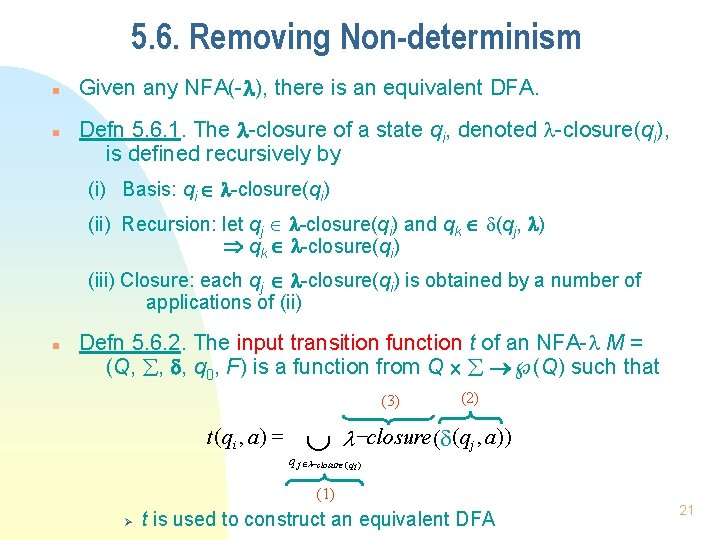
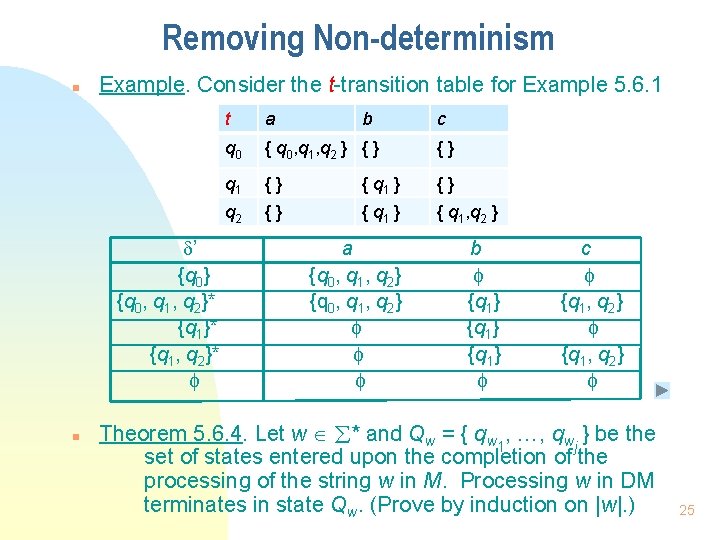
5. 6. Removing Non-determinism n n Given any NFA(- ), there is an equivalent DFA. Defn 5. 6. 1. The -closure of a state qi, denoted -closure(qi), is defined recursively by (i) Basis: qi -closure(qi) (ii) Recursion: let qj -closure(qi) and qk (qj, ) qk -closure(qi) (iii) Closure: each qj -closure(qi) is obtained by a number of applications of (ii) n Defn 5. 6. 2. The input transition function t of an NFA- M = (Q, , , q 0, F) is a function from Q (Q) such that (3) t ( qi , a ) = (2) -closure( (qj , a )) q j -closure ( qi ) (1) Ø t is used to construct an equivalent DFA 21
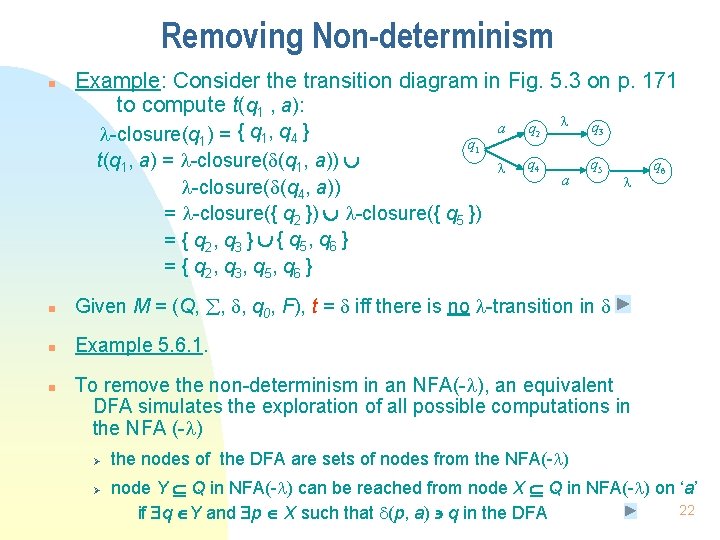
Removing Non-determinism n Example: Consider the transition diagram in Fig. 5. 3 on p. 171 to compute t(q 1 , a): -closure(q 1) = { q 1, q 4 } q 1 t(q 1, a) = -closure( (q 1, a)) -closure( (q 4, a)) = -closure({ q 2 }) -closure({ q 5 }) = { q 2 , q 3 } { q 5 , q 6 } = { q 2 , q 3 , q 5 , q 6 } a q 2 q 4 a q 3 q 5 n Given M = (Q, , , q 0, F), t = iff there is no -transition in n Example 5. 6. 1. n q 6 To remove the non-determinism in an NFA(- ), an equivalent DFA simulates the exploration of all possible computations in the NFA (- ) Ø Ø the nodes of the DFA are sets of nodes from the NFA(- ) node Y Q in NFA(- ) can be reached from node X Q in NFA(- ) on ‘a’ 22 if q Y and p X such that (p, a) q in the DFA
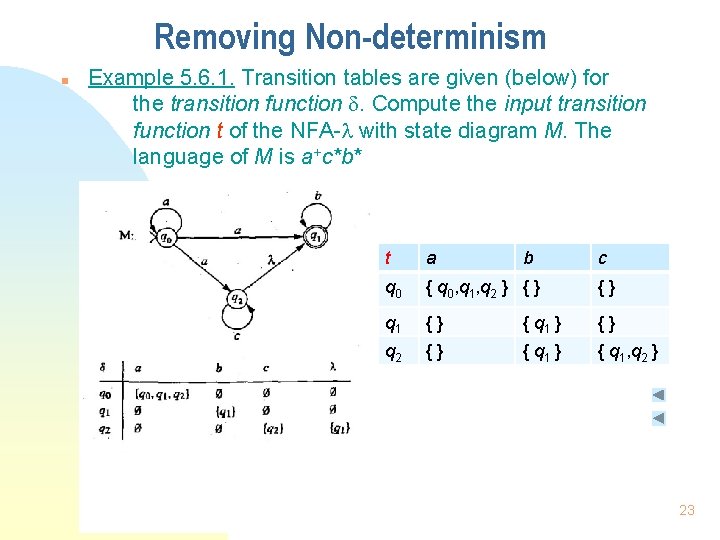
Removing Non-determinism n Example 5. 6. 1. Transition tables are given (below) for the transition function . Compute the input transition function t of the NFA- with state diagram M. The language of M is a+c*b* t a b c q 0 { q 0, q 1, q 2 } {} q 1 {} { q 1 } {} q 2 {} { q 1, q 2 } 23
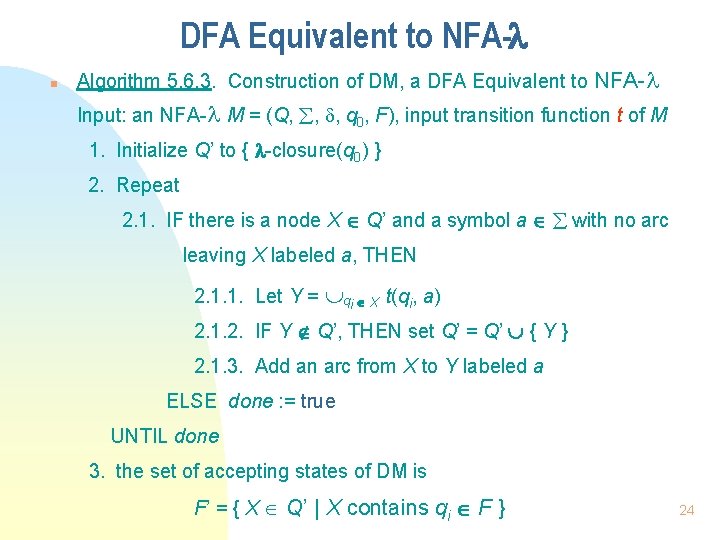
DFA Equivalent to NFA- n Algorithm 5. 6. 3. Construction of DM, a DFA Equivalent to NFA- Input: an NFA- M = (Q, , , q 0, F), input transition function t of M 1. Initialize Q’ to { -closure(q 0) } 2. Repeat 2. 1. IF there is a node X Q’ and a symbol a with no arc leaving X labeled a, THEN 2. 1. 1. Let Y = qi X t(qi, a) 2. 1. 2. IF Y Q’, THEN set Q’ = Q’ { Y } 2. 1. 3. Add an arc from X to Y labeled a ELSE done : = true UNTIL done 3. the set of accepting states of DM is F’ = { X Q’ | X contains qi F } 24
Removing Non-determinism n Example. Consider the t-transition table for Example 5. 6. 1 ’ {q 0} {q 0, q 1, q 2}* {q 1, q 2}* n t a b c q 0 { q 0, q 1, q 2 } {} q 1 {} { q 1 } {} q 2 {} { q 1, q 2 } a {q 0, q 1, q 2} b {q 1} c {q 1, q 2} Theorem 5. 6. 4. Let w * and Qw = { qw 1, …, qwj } be the set of states entered upon the completion of the processing of the string w in M. Processing w in DM terminates in state Qw. (Prove by induction on |w|. ) 25
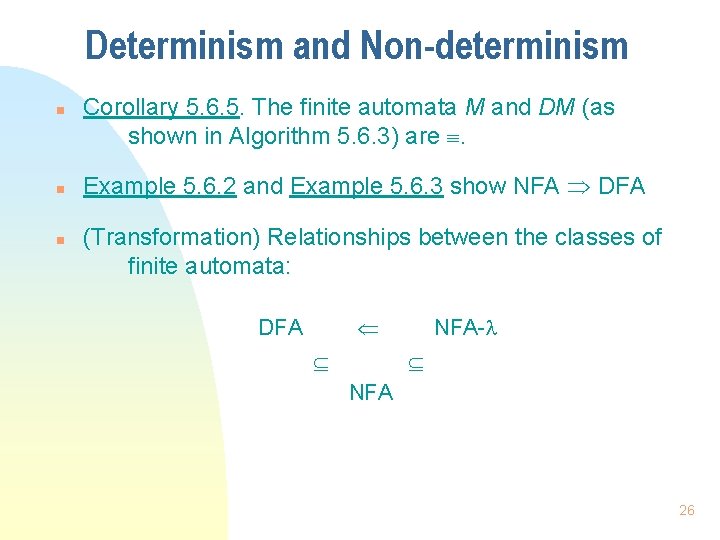
Determinism and Non-determinism n n n Corollary 5. 6. 5. The finite automata M and DM (as shown in Algorithm 5. 6. 3) are . Example 5. 6. 2 and Example 5. 6. 3 show NFA DFA (Transformation) Relationships between the classes of finite automata: DFA NFA- NFA 26