
CHAPTER 5 Ferrous Metals and Alloys Production General





- Slides: 19
CHAPTER 5 Ferrous Metals and Alloys: Production, General Properties, and Applications
Introduction General catagories of ferrous metals and alloys: 1. 2. 3. 4. 5. Carbon and alloy steels Stainless steels Tool and die steels Cast irons Cast steels Produced as 1. 2. 3. 4. 5. 6. Sheet Plates Structural members Gears Music wires Fasteners
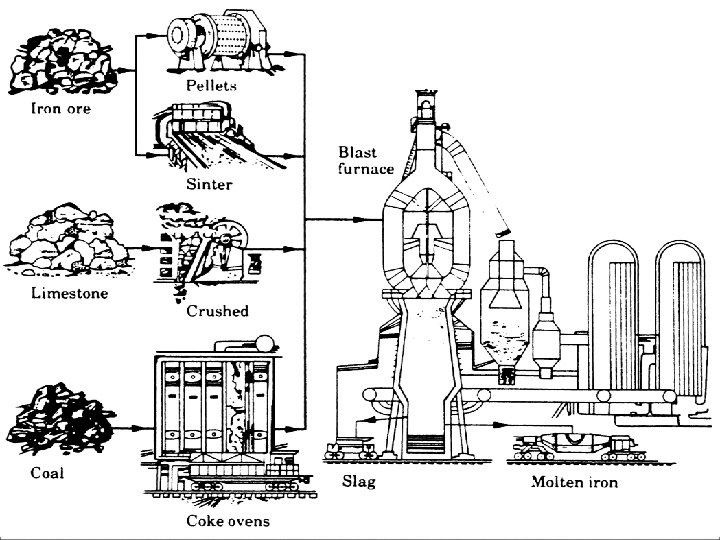
Production of Iron and Steel Raw Materials Three basic materials used in iron & steel making: 1. 2. 3. Iron ore Limestone Coke Principal iron ores: Taconite: black rock Hematite: iron oxide mineral Limonite: iron oxide containing water Limestone (calcium carbonate) is used to remove impurities from the molten iron by chemically reacting with impurities to form a slag
Production of Iron and Steel Raw Materials After it is mined, the ore is: 1. 2. 3. crushed into fine particles Impurities are removed The ore is formed into pellets Coke is obtained from special grades of bituminous coal, which are heated in vertical ovens @ 1150 ⁰C and then cooled with water in quenching towers. Functions of coke: 1. 2. Generate high level of heat required for the chemical reaction Produce CO, which is used to reduce iron oxide to iron
Production of Iron and Steel Iron Making The three raw materials are carried to the top of the blast furnace and dumped into it. The charge mixture is melted in a reaction at ° 1650 C with air pre-heated to about 1100 °C and blasted into the furnace through nozzles. The molten metal accumulates at the bottom of the furnace while the impurities float to the top of the metal as slag Molten metal is drawn off into ladle cars (pig iron). Pig iron composition: 4% C, 1. 5% Si, 1%Mn, 0. 04% S, 0. 4% P
Production of Iron and Steel Making – Electric Furnaces Refining of pig iron Electric Furnaces
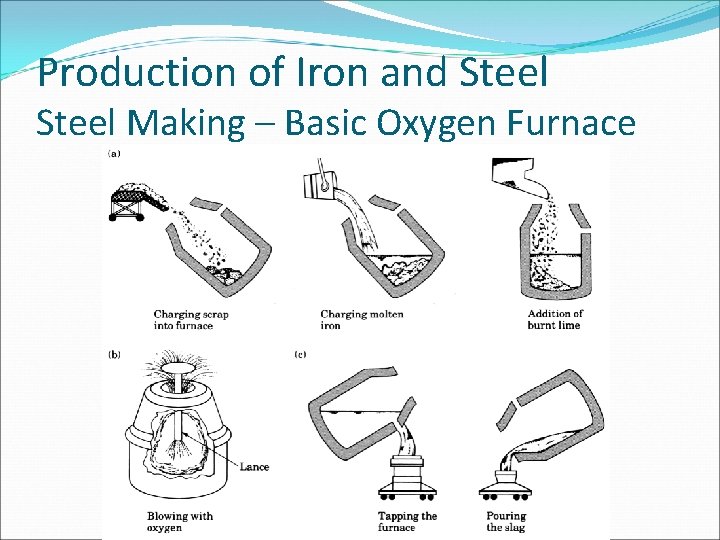
Production of Iron and Steel Making – Basic Oxygen Furnace
Casting of Ingots Depending on the amount of gas evolved during solidification, three types of steel ingots can be produced: 1. Killed steel 2. Semi-Killed steel 3. Rimmed steel
Casting of Ingots Killed Steel Fully deoxidized steel, oxygen is removed and porosity is eliminated. The dissolved oxygen reacts with Al, Mn, and Vn. The chemical and mechanical properties are uniform Because of shrinkage during solidification, a pipe (funnel-like) is developed at the top of the ingot
Casting of Ingots Semi-Killed Steel Partially deoxidized steel with some porosity in the upper central section of the ingot Little or no pipe Economical to produce
Casting of Ingots Rimmed Steel Low carbon content (<0. 15%) Evolved gases are killed partially using Al. Little or no piping Ductile skin with good surface finish Impurities and inclusions tend to segregate toward the center of the ingot
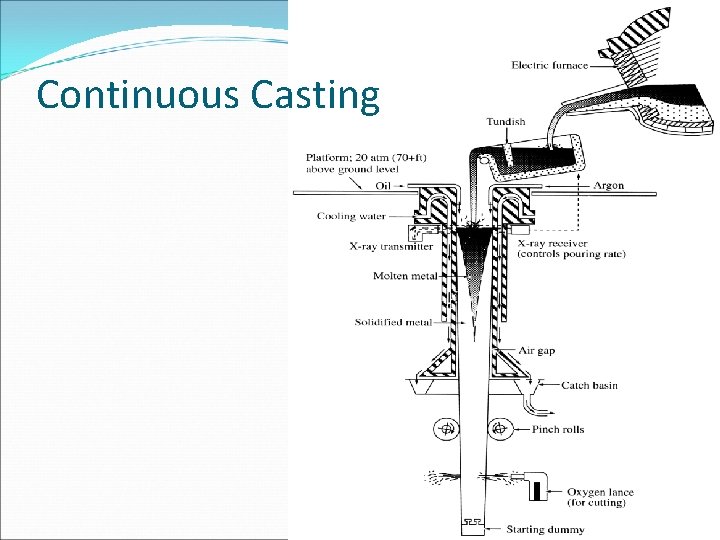
Continuous Casting
Carbon and Alloy Steels Effects of various elements in steel Boron: improves hardenability without loss of machinability and formability. Calcium: deoxidizes steels, improves tougness and may improve machineablity and formablity Carbon: improves hardenability, strength, hardness, and wear resistance Cerium or mangnese or Zirconium: controls the shape of inclusions and improves toughness in high strength alloy steels, it deoxidizes steel Chromium: improves toughness, hardenability, wear and corrosion resistance, and high-temperature strength. It increases the depth of hardness penetration in HT by promoting carbonization.
Carbon and Alloy Steels Residual elements in steel Antimony and Arsenic: cause temper embrittlement Hydrogen: embrittle steel Nitrogen: improves strength, hardness, and machinability. In Al deoxidized steels, it controls the size of inclusions and improves strength and toughness. It decreases ductility and toughness Oxygen: increases strength of rimmes steel. It reduces tougness Lead: causes hot shortness and temper embrittlement
Carbon and Alloy Steels Designations for steels AISI and SAE: 4 digits 1 st two digits: %weight of alloying elements 2 nd two digits: %weight of carbon Table 5 -2 Alloy steels: steels containing significant amounts of alloying elements
Carbon and Alloy Steels High strength alloy steels Low carbon content: <0. 30% Microstructure consists of fine grain ferrite as one phase and a hard 2 nd phase of martensite and austenite Designation: Table 5 -3 Structural quality (S): C, Mn, P, N Low Alloys (X): Nb, Cr, Cu, Mn, Ni, Si, Ti, V, Zr Weathering steels (W): environmental corrosion resistance; Si, P, Cu, Ni, Cr Formability: F(excelemt), K (good), O (fair)
Stainless Steels Main alloying element: : Cr (10 -12% min) Other alloying elements: Ni, Mo, Cu, Ti, Si, Mn, Al, N, S Higher C content reduces corrosion resistance 5 types: 1. Austenstic (200 and 300 series) 2. Ferretic (400 series) 3. Martenstic (400 and 500 series) 4. Preciptation hardening (PH) 5. Duplex structure
Tool and die steels Designed for high strength, impact toughness, and wear resistance at room and elevated temperatures Used in forming and machining of metals Basic types (see table 5 -5)