
Chapter 5 Extrusion and rod drawing IE 252
- Slides: 45
Chapter 5: Extrusion and rod drawing - IE 252 Power Estimation in Extrusion and Wire-rod Drawing 11/28/2020 Chapter 5 1
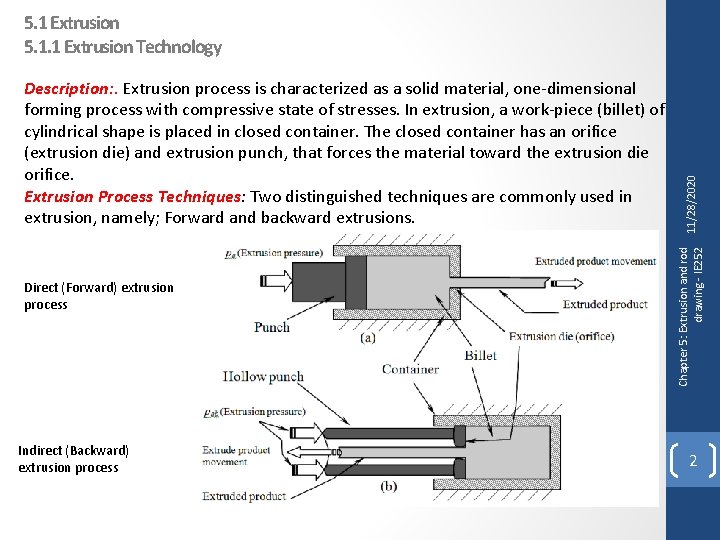
Direct (Forward) extrusion process Indirect (Backward) extrusion process Chapter 5: Extrusion and rod drawing - IE 252 Description: . Extrusion process is characterized as a solid material, one-dimensional forming process with compressive state of stresses. In extrusion, a work-piece (billet) of cylindrical shape is placed in closed container. The closed container has an orifice (extrusion die) and extrusion punch, that forces the material toward the extrusion die orifice. Extrusion Process Techniques: Two distinguished techniques are commonly used in extrusion, namely; Forward and backward extrusions. 11/28/2020 5. 1 Extrusion 5. 1. 1 Extrusion Technology 2
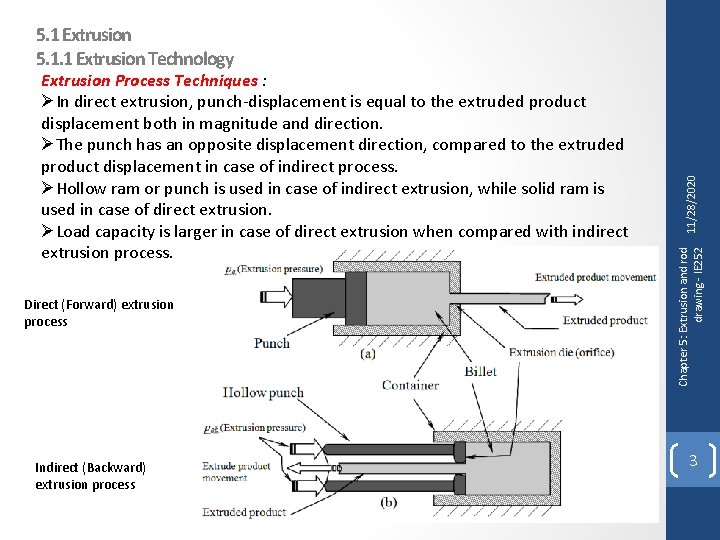
Direct (Forward) extrusion process Indirect (Backward) extrusion process Chapter 5: Extrusion and rod drawing - IE 252 Extrusion Process Techniques : ØIn direct extrusion, punch-displacement is equal to the extruded product displacement both in magnitude and direction. ØThe punch has an opposite displacement direction, compared to the extruded product displacement in case of indirect process. ØHollow ram or punch is used in case of indirect extrusion, while solid ram is used in case of direct extrusion. ØLoad capacity is larger in case of direct extrusion when compared with indirect extrusion process. 11/28/2020 5. 1 Extrusion 5. 1. 1 Extrusion Technology 3
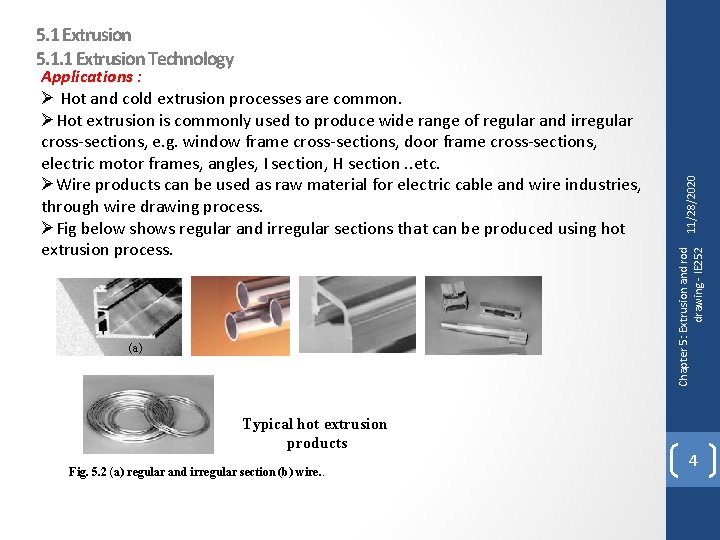
(a) Typical hot extrusion products Fig. 5. 2 (a) regular and irregular section (b) wire. . Chapter 5: Extrusion and rod drawing - IE 252 Applications : Ø Hot and cold extrusion processes are common. ØHot extrusion is commonly used to produce wide range of regular and irregular cross-sections, e. g. window frame cross-sections, door frame cross-sections, electric motor frames, angles, I section, H section. . etc. ØWire products can be used as raw material for electric cable and wire industries, through wire drawing process. ØFig below shows regular and irregular sections that can be produced using hot extrusion process. 11/28/2020 5. 1 Extrusion 5. 1. 1 Extrusion Technology 4
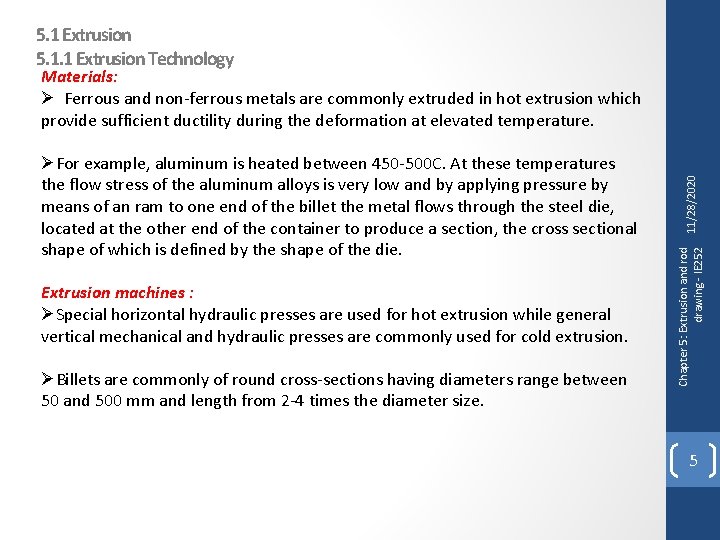
5. 1 Extrusion 5. 1. 1 Extrusion Technology Extrusion machines : ØSpecial horizontal hydraulic presses are used for hot extrusion while general vertical mechanical and hydraulic presses are commonly used for cold extrusion. ØBillets are commonly of round cross-sections having diameters range between 50 and 500 mm and length from 2 -4 times the diameter size. Chapter 5: Extrusion and rod drawing - IE 252 ØFor example, aluminum is heated between 450 -500 C. At these temperatures the flow stress of the aluminum alloys is very low and by applying pressure by means of an ram to one end of the billet the metal flows through the steel die, located at the other end of the container to produce a section, the cross sectional shape of which is defined by the shape of the die. 11/28/2020 Materials: Ø Ferrous and non-ferrous metals are commonly extruded in hot extrusion which provide sufficient ductility during the deformation at elevated temperature. 5
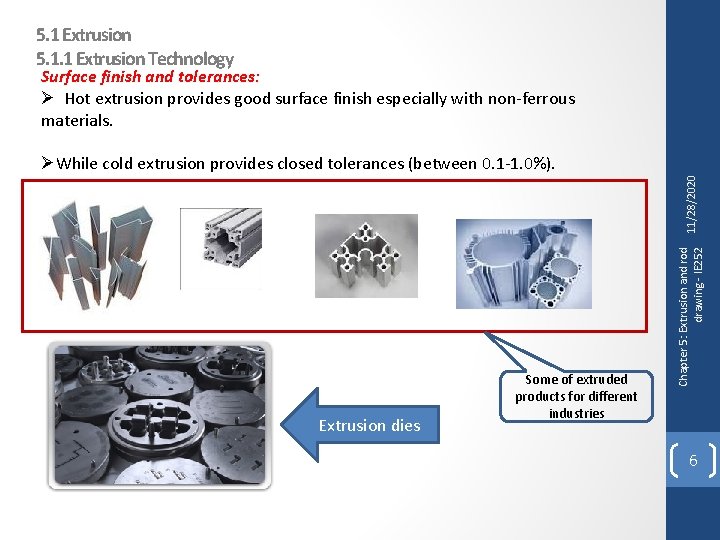
5. 1 Extrusion 5. 1. 1 Extrusion Technology Surface finish and tolerances: Ø Hot extrusion provides good surface finish especially with non-ferrous materials. Extrusion dies Some of extruded products for different industries Chapter 5: Extrusion and rod drawing - IE 252 11/28/2020 ØWhile cold extrusion provides closed tolerances (between 0. 1 -1. 0%). 6
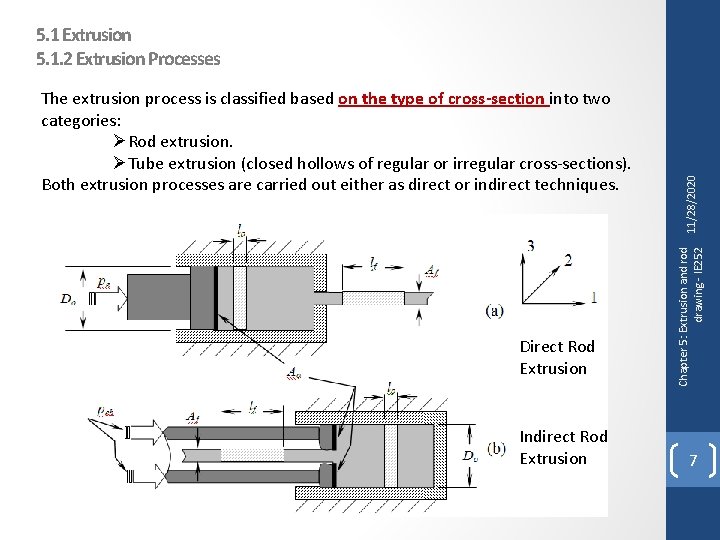
Direct Rod Extrusion Indirect Rod Extrusion Chapter 5: Extrusion and rod drawing - IE 252 The extrusion process is classified based on the type of cross-section into two categories: ØRod extrusion. ØTube extrusion (closed hollows of regular or irregular cross-sections). Both extrusion processes are carried out either as direct or indirect techniques. 11/28/2020 5. 1 Extrusion 5. 1. 2 Extrusion Processes 7
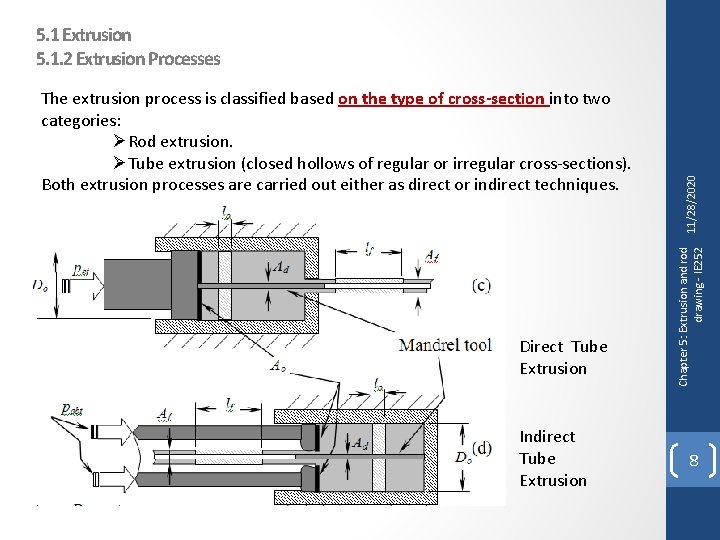
Direct Tube Extrusion Indirect Tube Extrusion Chapter 5: Extrusion and rod drawing - IE 252 The extrusion process is classified based on the type of cross-section into two categories: ØRod extrusion. ØTube extrusion (closed hollows of regular or irregular cross-sections). Both extrusion processes are carried out either as direct or indirect techniques. 11/28/2020 5. 1 Extrusion 5. 1. 2 Extrusion Processes 8
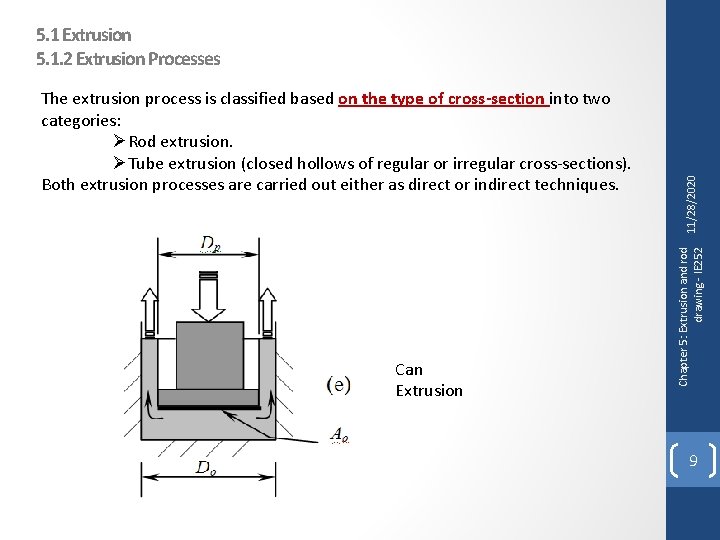
Can Extrusion Chapter 5: Extrusion and rod drawing - IE 252 The extrusion process is classified based on the type of cross-section into two categories: ØRod extrusion. ØTube extrusion (closed hollows of regular or irregular cross-sections). Both extrusion processes are carried out either as direct or indirect techniques. 11/28/2020 5. 1 Extrusion 5. 1. 2 Extrusion Processes 9
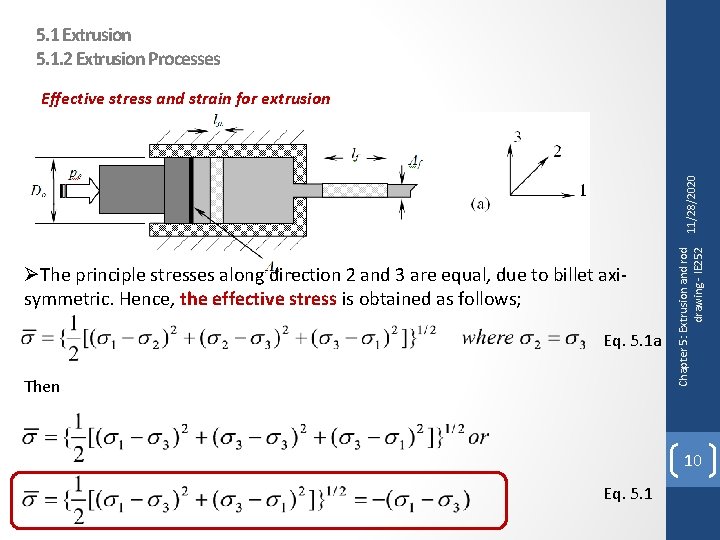
5. 1 Extrusion 5. 1. 2 Extrusion Processes ØThe principle stresses along direction 2 and 3 are equal, due to billet axisymmetric. Hence, the effective stress is obtained as follows; Eq. 5. 1 a Then Chapter 5: Extrusion and rod drawing - IE 252 11/28/2020 Effective stress and strain for extrusion 10 Eq. 5. 1
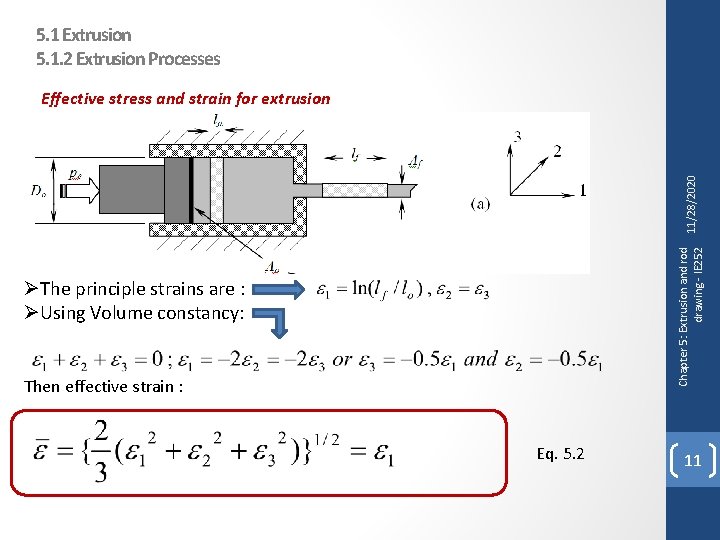
5. 1 Extrusion 5. 1. 2 Extrusion Processes Chapter 5: Extrusion and rod drawing - IE 252 11/28/2020 Effective stress and strain for extrusion ØThe principle strains are : ØUsing Volume constancy: Then effective strain : Eq. 5. 2 11
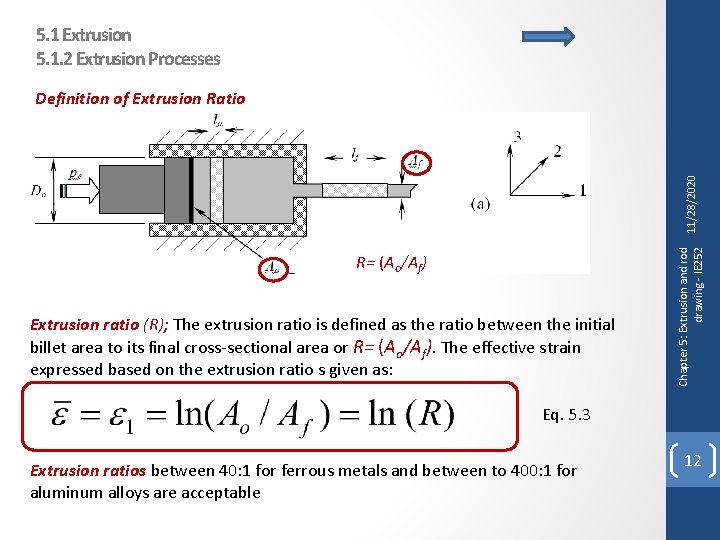
5. 1 Extrusion 5. 1. 2 Extrusion Processes R= (Ao/Af) Extrusion ratio (R); The extrusion ratio is defined as the ratio between the initial billet area to its final cross-sectional area or R= (Ao/Af). The effective strain expressed based on the extrusion ratio s given as: Chapter 5: Extrusion and rod drawing - IE 252 11/28/2020 Definition of Extrusion Ratio Eq. 5. 3 Extrusion ratios between 40: 1 for ferrous metals and between to 400: 1 for aluminum alloys are acceptable 12
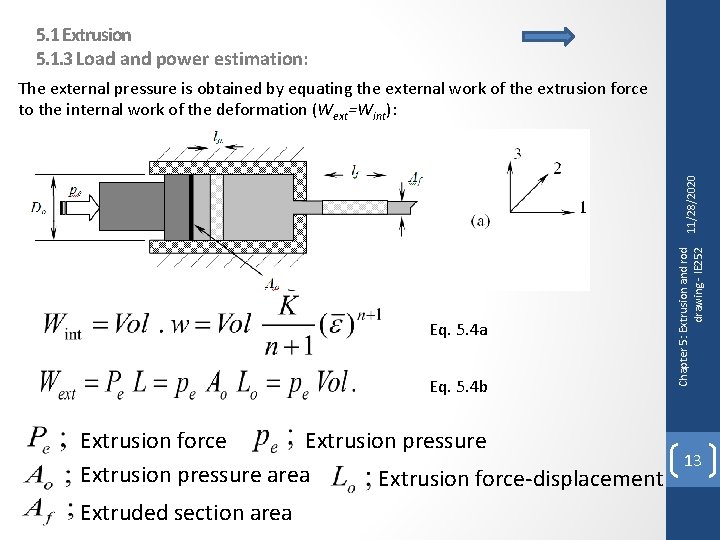
5. 1 Extrusion 5. 1. 3 Load and power estimation: Eq. 5. 4 a Eq. 5. 4 b Extrusion force Extrusion pressure area Extrusion force-displacement Extruded section area Chapter 5: Extrusion and rod drawing - IE 252 11/28/2020 The external pressure is obtained by equating the external work of the extrusion force to the internal work of the deformation (Wext=Wint): 13
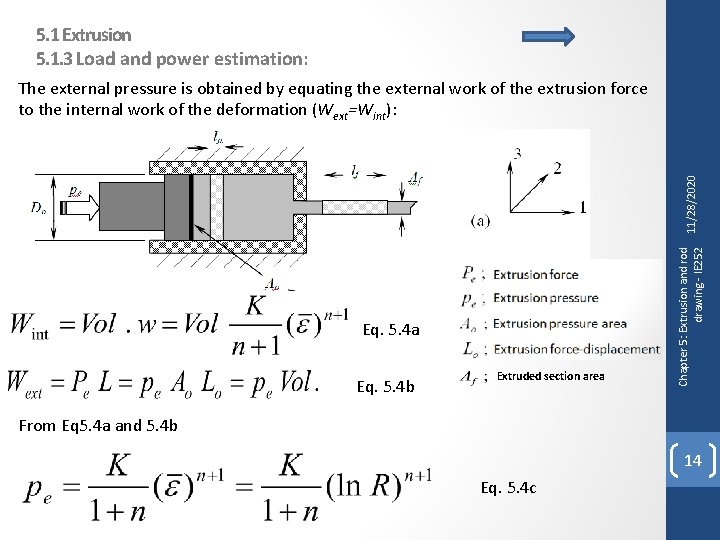
5. 1 Extrusion 5. 1. 3 Load and power estimation: Eq. 5. 4 a Eq. 5. 4 b Extruded section area Chapter 5: Extrusion and rod drawing - IE 252 11/28/2020 The external pressure is obtained by equating the external work of the extrusion force to the internal work of the deformation (Wext=Wint): From Eq 5. 4 a and 5. 4 b 14 Eq. 5. 4 c
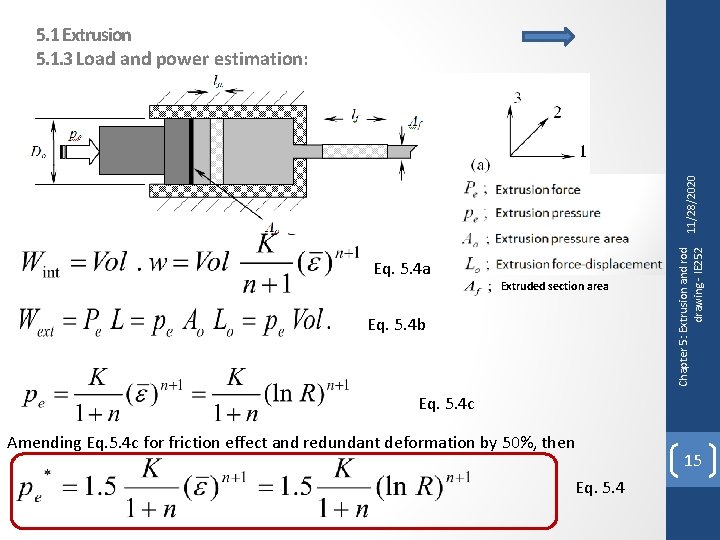
Eq. 5. 4 a Extruded section area Eq. 5. 4 b Chapter 5: Extrusion and rod drawing - IE 252 11/28/2020 5. 1 Extrusion 5. 1. 3 Load and power estimation: Eq. 5. 4 c Amending Eq. 5. 4 c for friction effect and redundant deformation by 50%, then 15 Eq. 5. 4
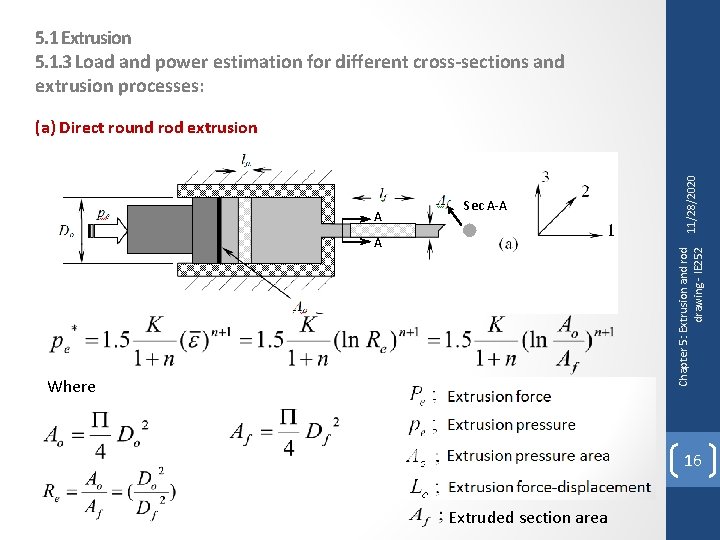
5. 1 Extrusion 5. 1. 3 Load and power estimation for different cross-sections and extrusion processes: A Sec A-A Chapter 5: Extrusion and rod drawing - IE 252 A 11/28/2020 (a) Direct round rod extrusion Where 16 Extruded section area
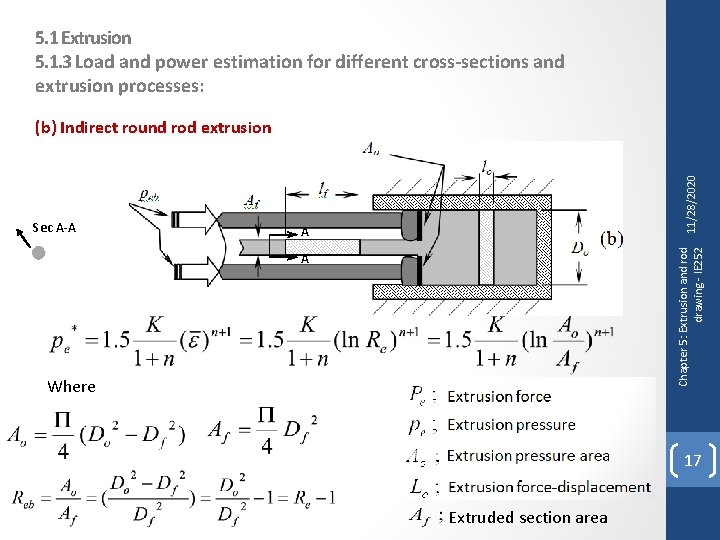
5. 1 Extrusion 5. 1. 3 Load and power estimation for different cross-sections and extrusion processes: A Chapter 5: Extrusion and rod drawing - IE 252 Sec A-A 11/28/2020 (b) Indirect round rod extrusion A Where 17 Extruded section area
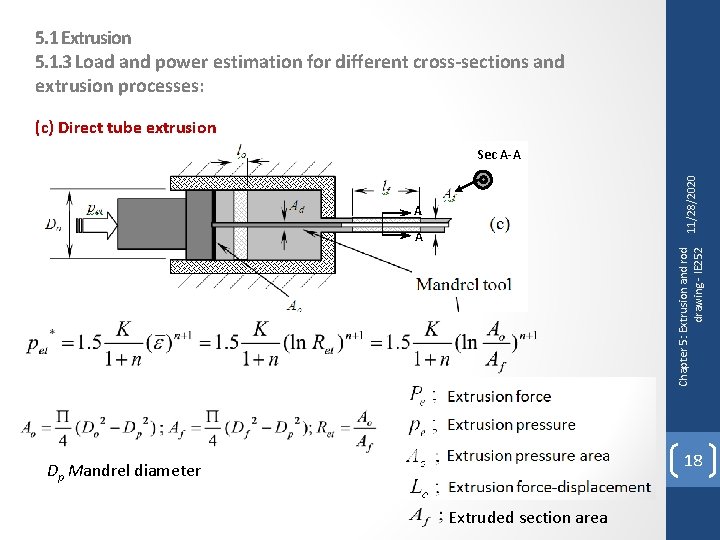
5. 1 Extrusion 5. 1. 3 Load and power estimation for different cross-sections and extrusion processes: (c) Direct tube extrusion 11/28/2020 Sec A-A A Chapter 5: Extrusion and rod drawing - IE 252 A 18 Dp Mandrel diameter Extruded section area
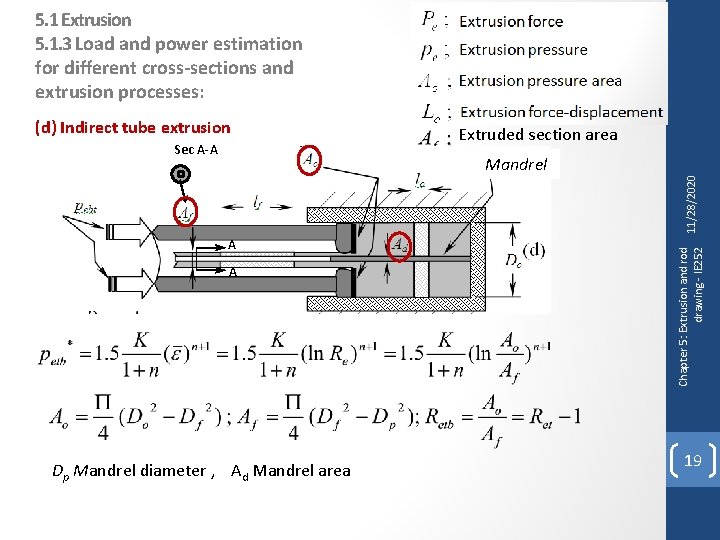
5. 1 Extrusion 5. 1. 3 Load and power estimation for different cross-sections and extrusion processes: (d) Indirect tube extrusion Sec A-A Extruded section area A A Dp Mandrel diameter , Ad Mandrel area Chapter 5: Extrusion and rod drawing - IE 252 11/28/2020 Mandrel 19
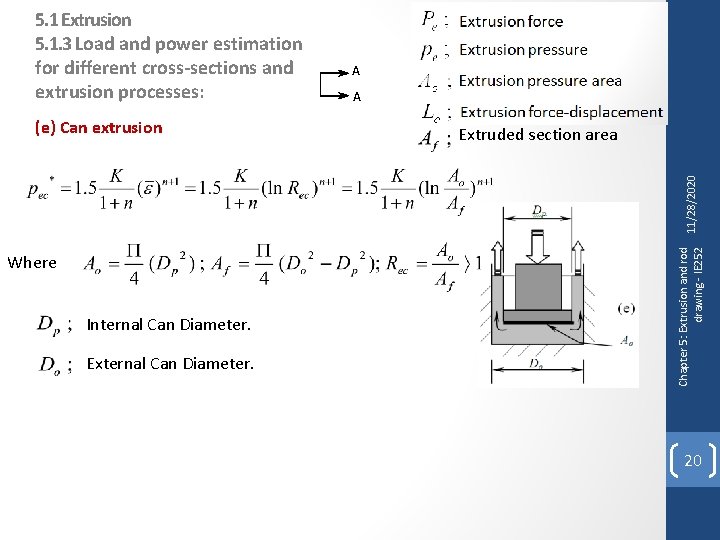
5. 1 Extrusion 5. 1. 3 Load and power estimation for different cross-sections and extrusion processes: A Extruded section area Where Internal Can Diameter. External Can Diameter. Chapter 5: Extrusion and rod drawing - IE 252 11/28/2020 (e) Can extrusion A 20
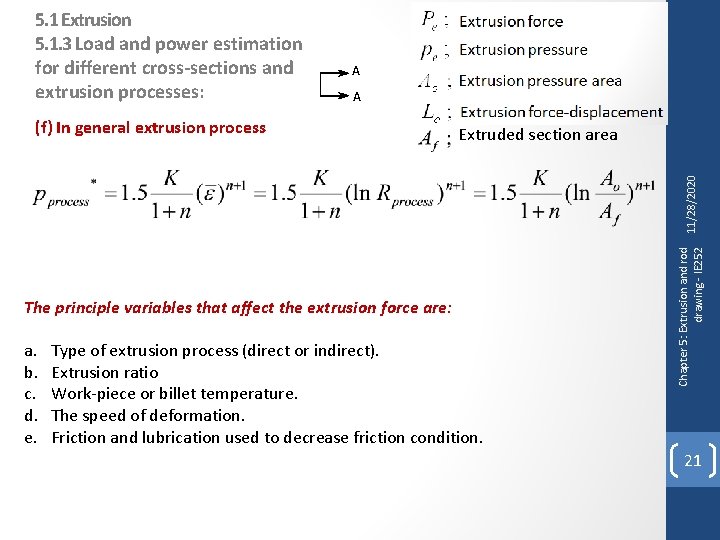
5. 1 Extrusion 5. 1. 3 Load and power estimation for different cross-sections and extrusion processes: A A Extruded section area The principle variables that affect the extrusion force are: a. b. c. d. e. Type of extrusion process (direct or indirect). Extrusion ratio Work-piece or billet temperature. The speed of deformation. Friction and lubrication used to decrease friction condition. Chapter 5: Extrusion and rod drawing - IE 252 11/28/2020 (f) In general extrusion process 21
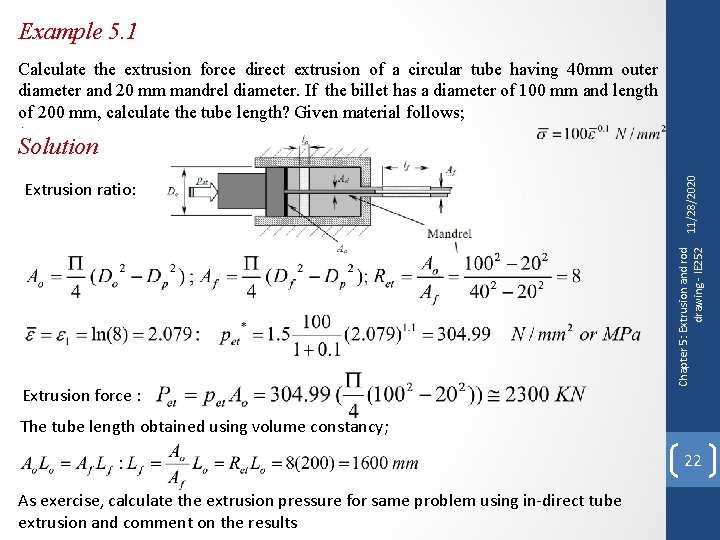
Example 5. 1 Calculate the extrusion force direct extrusion of a circular tube having 40 mm outer diameter and 20 mm mandrel diameter. If the billet has a diameter of 100 mm and length of 200 mm, calculate the tube length? Given material follows; . Extrusion force : Chapter 5: Extrusion and rod drawing - IE 252 Extrusion ratio: 11/28/2020 Solution The tube length obtained using volume constancy; 22 As exercise, calculate the extrusion pressure for same problem using in-direct tube extrusion and comment on the results
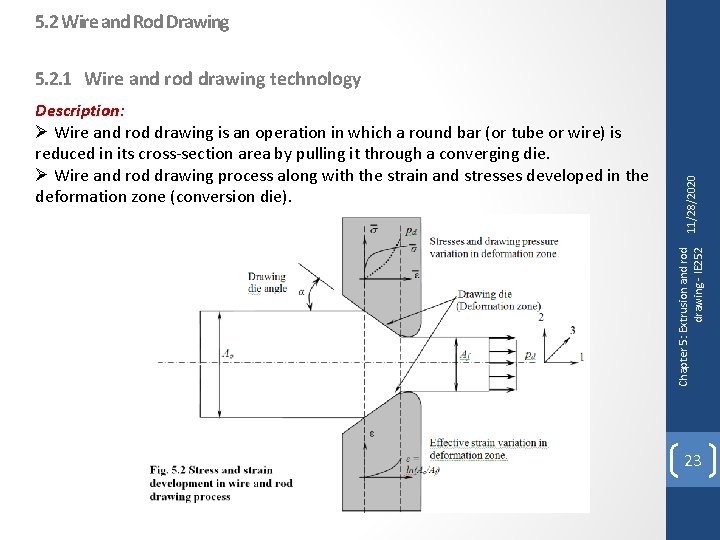
5. 2 Wire and Rod Drawing Chapter 5: Extrusion and rod drawing - IE 252 Description: Ø Wire and rod drawing is an operation in which a round bar (or tube or wire) is reduced in its cross-section area by pulling it through a converging die. Ø Wire and rod drawing process along with the strain and stresses developed in the deformation zone (conversion die). 11/28/2020 5. 2. 1 Wire and rod drawing technology 23
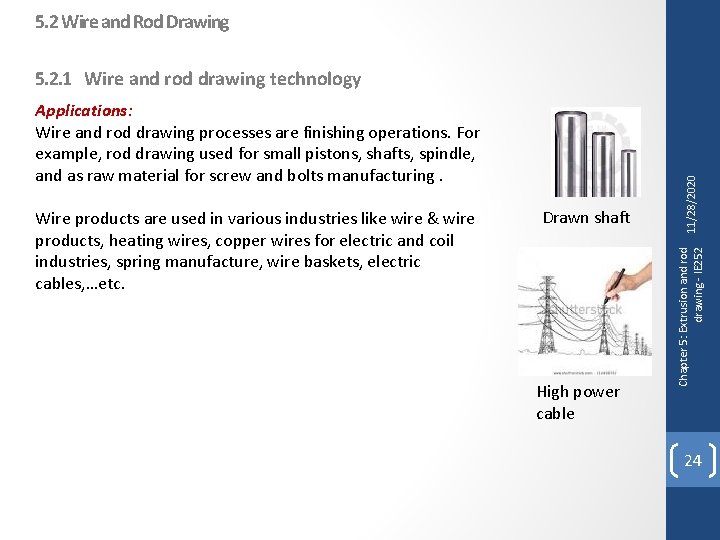
5. 2 Wire and Rod Drawing Wire products are used in various industries like wire & wire products, heating wires, copper wires for electric and coil industries, spring manufacture, wire baskets, electric cables, …etc. Drawn shaft High power cable Chapter 5: Extrusion and rod drawing - IE 252 Applications: Wire and rod drawing processes are finishing operations. For example, rod drawing used for small pistons, shafts, spindle, and as raw material for screw and bolts manufacturing. 11/28/2020 5. 2. 1 Wire and rod drawing technology 24
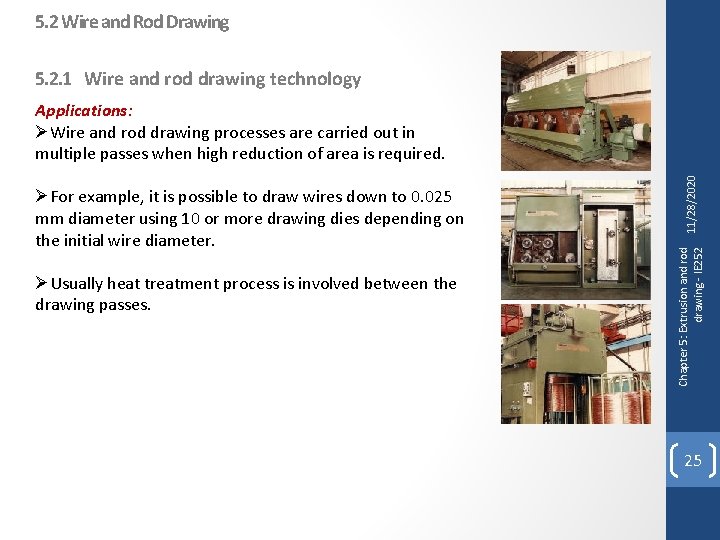
5. 2 Wire and Rod Drawing 5. 2. 1 Wire and rod drawing technology ØUsually heat treatment process is involved between the drawing passes. Chapter 5: Extrusion and rod drawing - IE 252 ØFor example, it is possible to draw wires down to 0. 025 mm diameter using 10 or more drawing dies depending on the initial wire diameter. 11/28/2020 Applications: ØWire and rod drawing processes are carried out in multiple passes when high reduction of area is required. 25
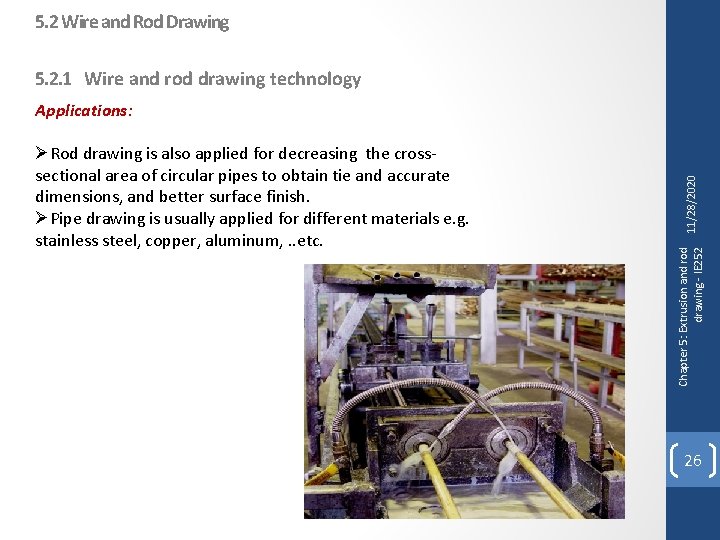
5. 2 Wire and Rod Drawing 5. 2. 1 Wire and rod drawing technology Chapter 5: Extrusion and rod drawing - IE 252 ØRod drawing is also applied for decreasing the crosssectional area of circular pipes to obtain tie and accurate dimensions, and better surface finish. ØPipe drawing is usually applied for different materials e. g. stainless steel, copper, aluminum, . . etc. 11/28/2020 Applications: 26
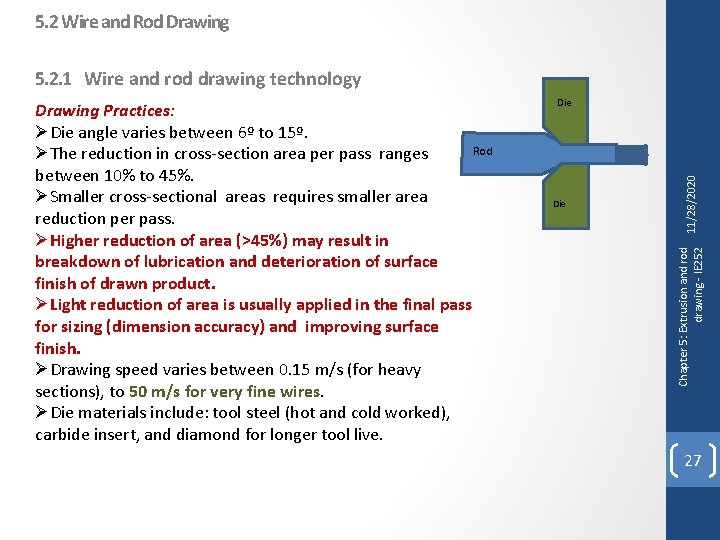
5. 2 Wire and Rod Drawing 5. 2. 1 Wire and rod drawing technology Die 11/28/2020 Die Chapter 5: Extrusion and rod drawing - IE 252 Drawing Practices: ØDie angle varies between 6º to 15º. Rod ØThe reduction in cross-section area per pass ranges between 10% to 45%. ØSmaller cross-sectional areas requires smaller area reduction per pass. ØHigher reduction of area (>45%) may result in breakdown of lubrication and deterioration of surface finish of drawn product. ØLight reduction of area is usually applied in the final pass for sizing (dimension accuracy) and improving surface finish. ØDrawing speed varies between 0. 15 m/s (for heavy sections), to 50 m/s for very fine wires. ØDie materials include: tool steel (hot and cold worked), carbide insert, and diamond for longer tool live. 27
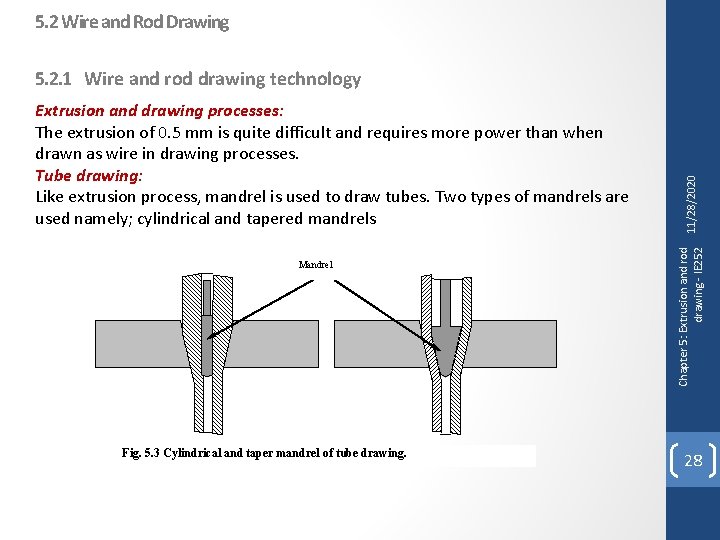
5. 2 Wire and Rod Drawing Mandrel Fig. 5. 3 Cylindrical and taper mandrel of tube drawing. Chapter 5: Extrusion and rod drawing - IE 252 Extrusion and drawing processes: The extrusion of 0. 5 mm is quite difficult and requires more power than when drawn as wire in drawing processes. Tube drawing: Like extrusion process, mandrel is used to draw tubes. Two types of mandrels are used namely; cylindrical and tapered mandrels 11/28/2020 5. 2. 1 Wire and rod drawing technology 28
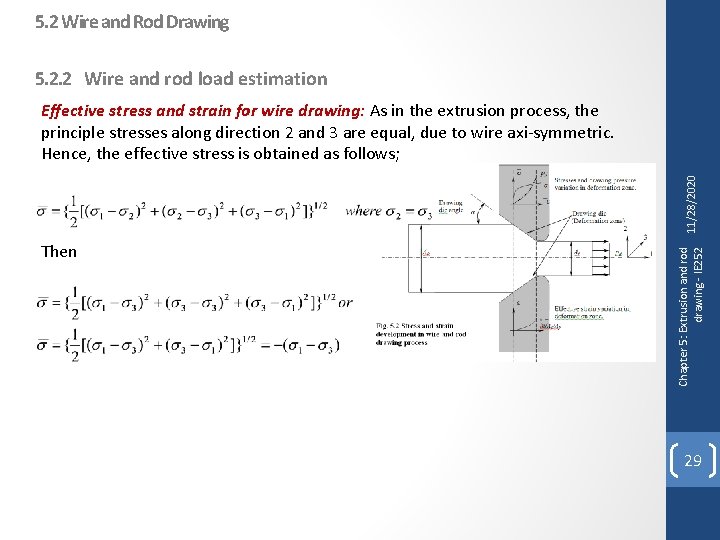
5. 2 Wire and Rod Drawing 5. 2. 2 Wire and rod load estimation Then Chapter 5: Extrusion and rod drawing - IE 252 11/28/2020 Effective stress and strain for wire drawing: As in the extrusion process, the principle stresses along direction 2 and 3 are equal, due to wire axi-symmetric. Hence, the effective stress is obtained as follows; 29
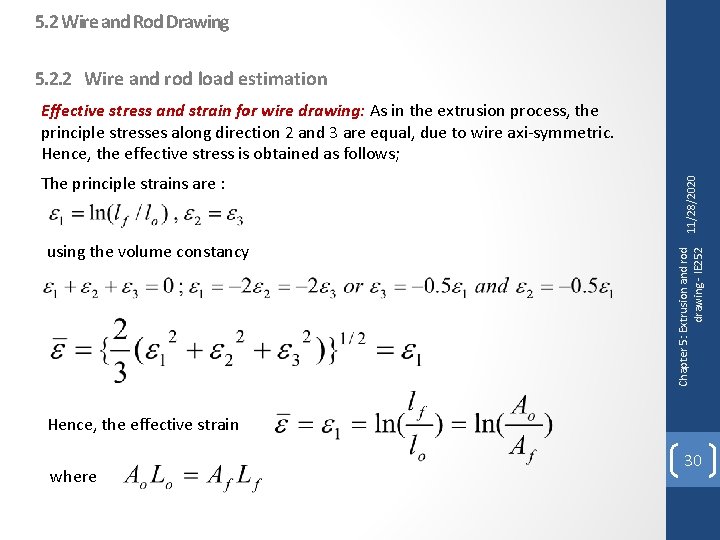
5. 2 Wire and Rod Drawing 5. 2. 2 Wire and rod load estimation using the volume constancy Chapter 5: Extrusion and rod drawing - IE 252 The principle strains are : 11/28/2020 Effective stress and strain for wire drawing: As in the extrusion process, the principle stresses along direction 2 and 3 are equal, due to wire axi-symmetric. Hence, the effective stress is obtained as follows; Hence, the effective strain where 30
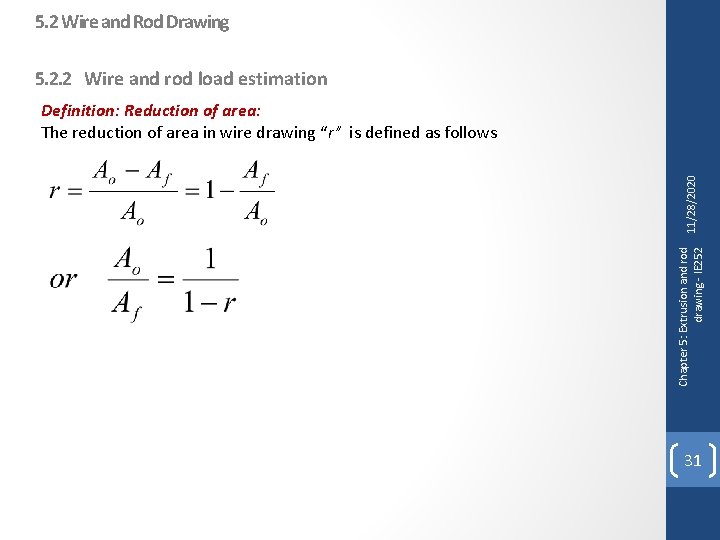
5. 2 Wire and Rod Drawing 5. 2. 2 Wire and rod load estimation Chapter 5: Extrusion and rod drawing - IE 252 11/28/2020 Definition: Reduction of area: The reduction of area in wire drawing “r” is defined as follows 31
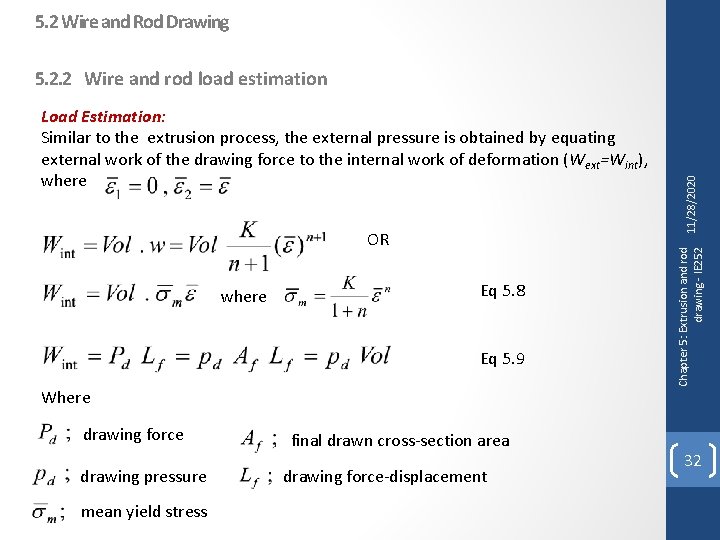
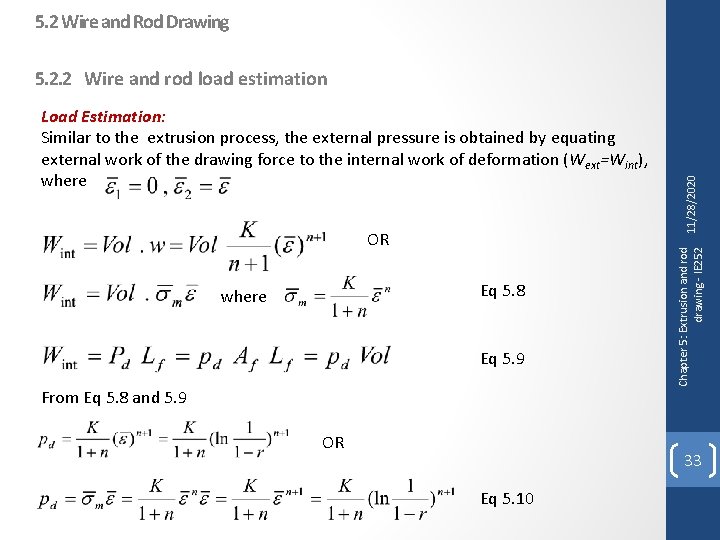
5. 2 Wire and Rod Drawing OR where Eq 5. 8 Eq 5. 9 Where drawing force drawing pressure mean yield stress final drawn cross-section area drawing force-displacement Chapter 5: Extrusion and rod drawing - IE 252 Load Estimation: Similar to the extrusion process, the external pressure is obtained by equating external work of the drawing force to the internal work of deformation (Wext=Wint), where 11/28/2020 5. 2. 2 Wire and rod load estimation 32
5. 2 Wire and Rod Drawing OR Eq 5. 8 where Eq 5. 9 From Eq 5. 8 and 5. 9 OR Chapter 5: Extrusion and rod drawing - IE 252 Load Estimation: Similar to the extrusion process, the external pressure is obtained by equating external work of the drawing force to the internal work of deformation (Wext=Wint), where 11/28/2020 5. 2. 2 Wire and rod load estimation 33 Eq 5. 10
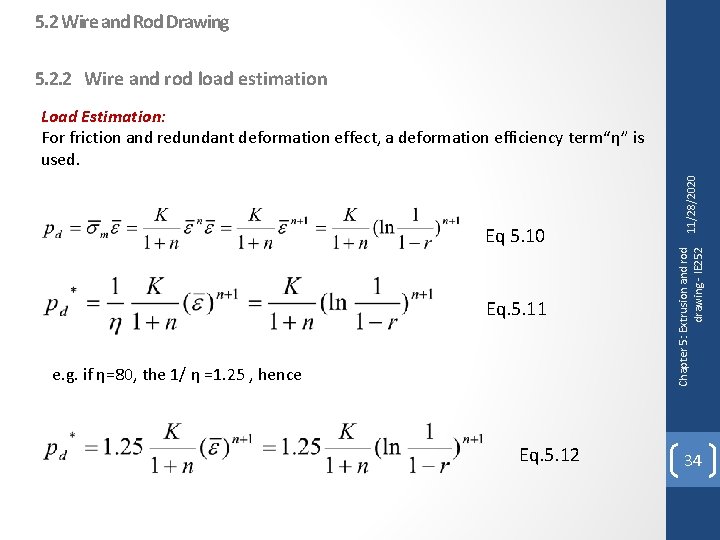
5. 2 Wire and Rod Drawing 5. 2. 2 Wire and rod load estimation Eq. 5. 11 e. g. if η=80, the 1/ η =1. 25 , hence Eq. 5. 12 Chapter 5: Extrusion and rod drawing - IE 252 Eq 5. 10 11/28/2020 Load Estimation: For friction and redundant deformation effect, a deformation efficiency term“η” is used. 34
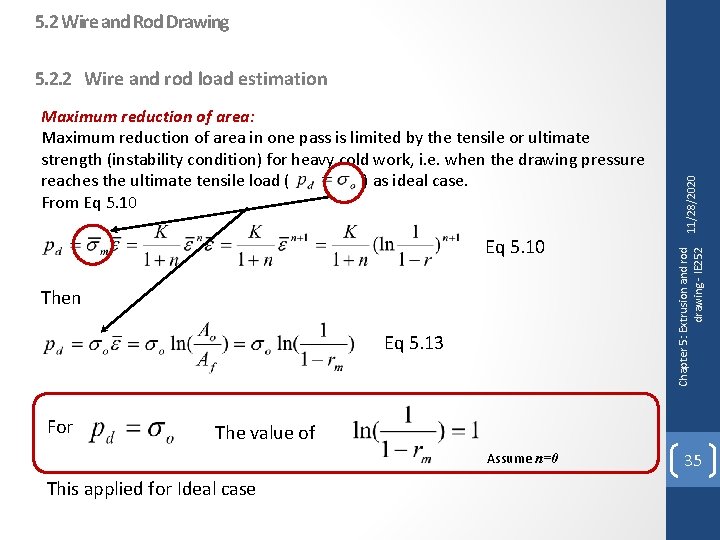
5. 2 Wire and Rod Drawing Eq 5. 10 Then Eq 5. 13 For Chapter 5: Extrusion and rod drawing - IE 252 Maximum reduction of area: Maximum reduction of area in one pass is limited by the tensile or ultimate strength (instability condition) for heavy cold work, i. e. when the drawing pressure reaches the ultimate tensile load ( ) as ideal case. From Eq 5. 10 11/28/2020 5. 2. 2 Wire and rod load estimation The value of Assume n=0 This applied for Ideal case 35
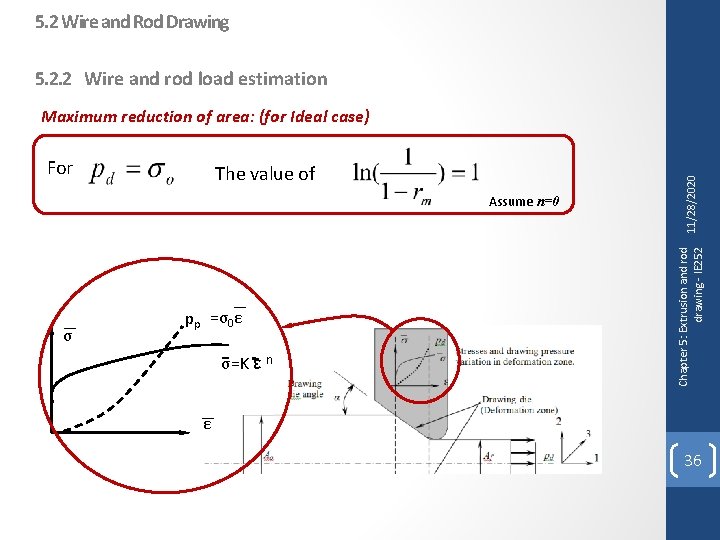
5. 2 Wire and Rod Drawing 5. 2. 2 Wire and rod load estimation The value of Assume n=0 σ pp =σ0ε σ=K ε n Chapter 5: Extrusion and rod drawing - IE 252 For 11/28/2020 Maximum reduction of area: (for Ideal case) ε 36
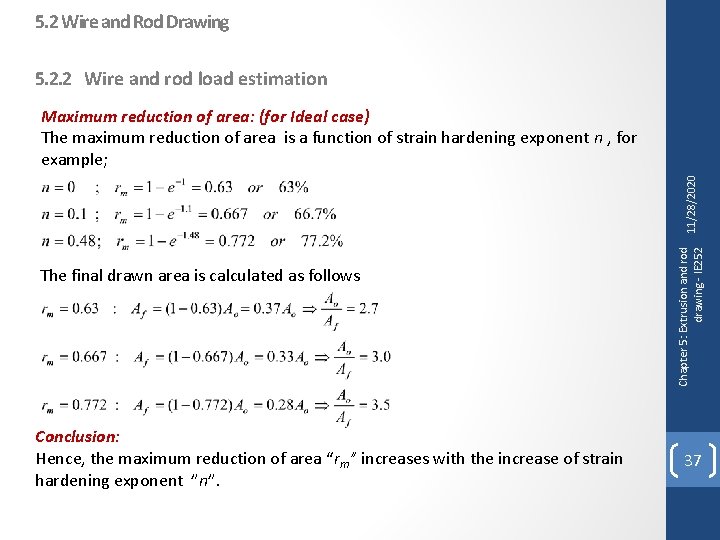
5. 2 Wire and Rod Drawing 5. 2. 2 Wire and rod load estimation The final drawn area is calculated as follows Conclusion: Hence, the maximum reduction of area “rm” increases with the increase of strain hardening exponent ”n”. Chapter 5: Extrusion and rod drawing - IE 252 11/28/2020 Maximum reduction of area: (for Ideal case) The maximum reduction of area is a function of strain hardening exponent n , for example; 37
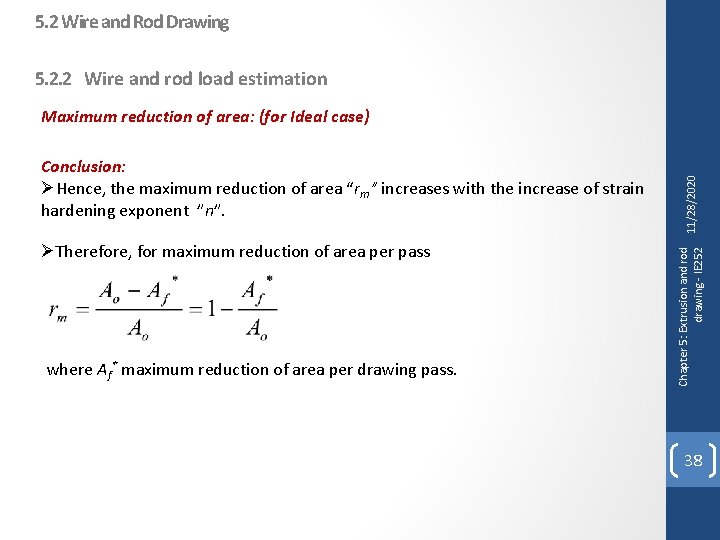
5. 2 Wire and Rod Drawing 5. 2. 2 Wire and rod load estimation ØTherefore, for maximum reduction of area per pass where Af* maximum reduction of area per drawing pass. Chapter 5: Extrusion and rod drawing - IE 252 Conclusion: ØHence, the maximum reduction of area “rm” increases with the increase of strain hardening exponent ”n”. 11/28/2020 Maximum reduction of area: (for Ideal case) 38
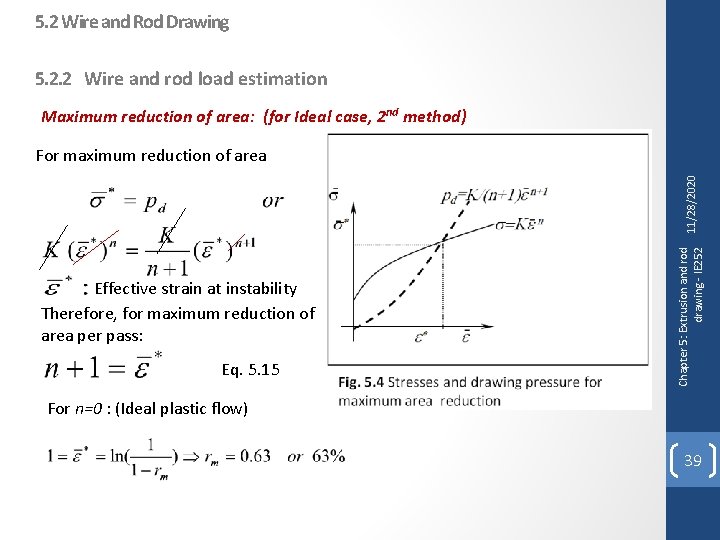
5. 2 Wire and Rod Drawing 5. 2. 2 Wire and rod load estimation Maximum reduction of area: (for Ideal case, 2 nd method) Effective strain at instability Therefore, for maximum reduction of area per pass: Eq. 5. 15 Chapter 5: Extrusion and rod drawing - IE 252 11/28/2020 For maximum reduction of area For n=0 : (Ideal plastic flow) 39
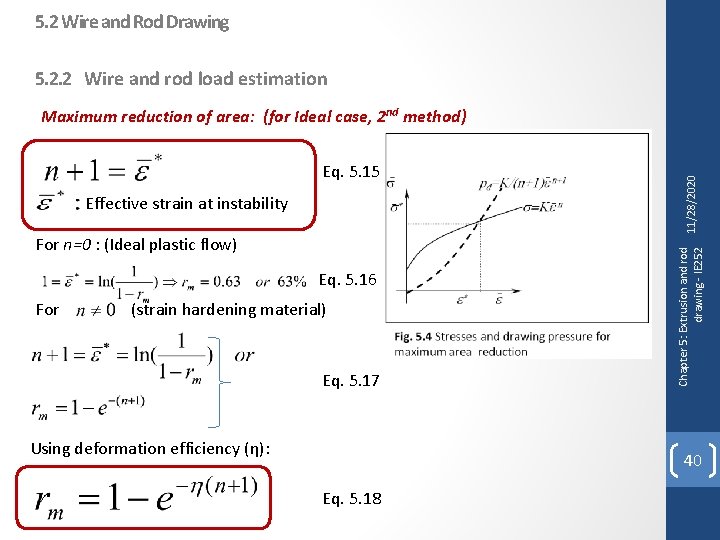
5. 2 Wire and Rod Drawing 5. 2. 2 Wire and rod load estimation Effective strain at instability For n=0 : (Ideal plastic flow) Eq. 5. 16 For (strain hardening material) Eq. 5. 17 Using deformation efficiency (η): Chapter 5: Extrusion and rod drawing - IE 252 Eq. 5. 15 11/28/2020 Maximum reduction of area: (for Ideal case, 2 nd method) 40 Eq. 5. 18
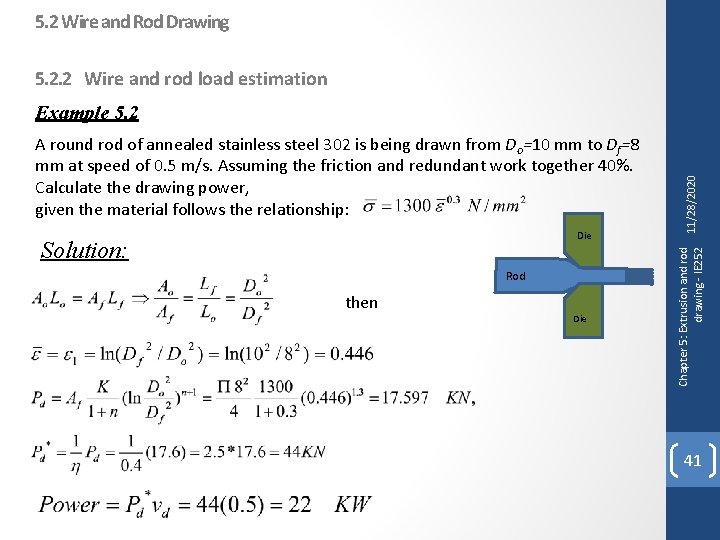
5. 2 Wire and Rod Drawing 5. 2. 2 Wire and rod load estimation Die Solution: Rod then Die Chapter 5: Extrusion and rod drawing - IE 252 A round rod of annealed stainless steel 302 is being drawn from Do=10 mm to Df=8 mm at speed of 0. 5 m/s. Assuming the friction and redundant work together 40%. Calculate the drawing power, given the material follows the relationship: 11/28/2020 Example 5. 2 41
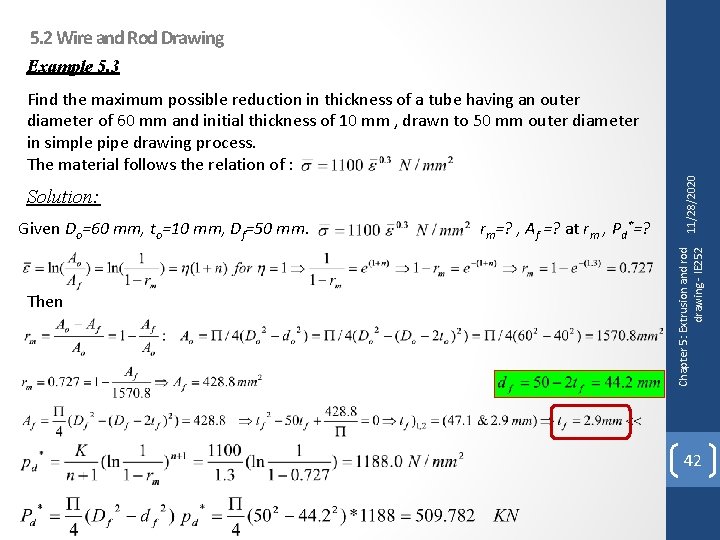
5. 2 Wire and Rod Drawing Example 5. 3 Given Do=60 mm, to=10 mm, Df=50 mm. Then rm=? , Af =? at rm , Pd*=? Chapter 5: Extrusion and rod drawing - IE 252 Solution: 11/28/2020 Find the maximum possible reduction in thickness of a tube having an outer diameter of 60 mm and initial thickness of 10 mm , drawn to 50 mm outer diameter in simple pipe drawing process. The material follows the relation of : 42
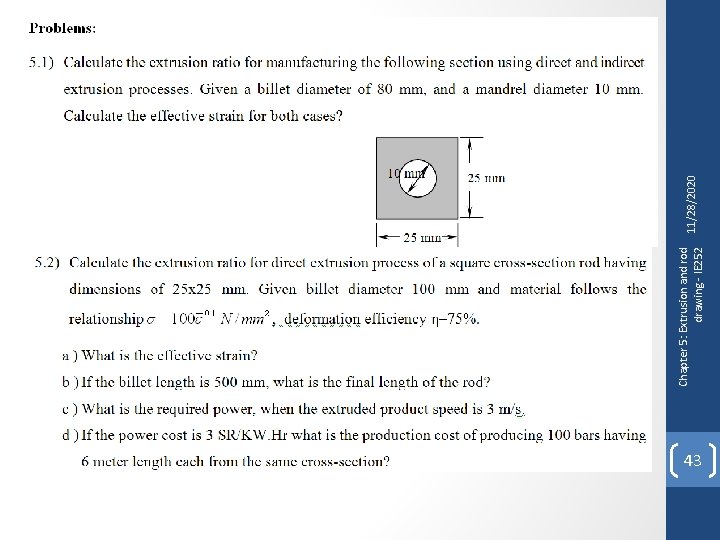
43 Chapter 5: Extrusion and rod drawing - IE 252 11/28/2020
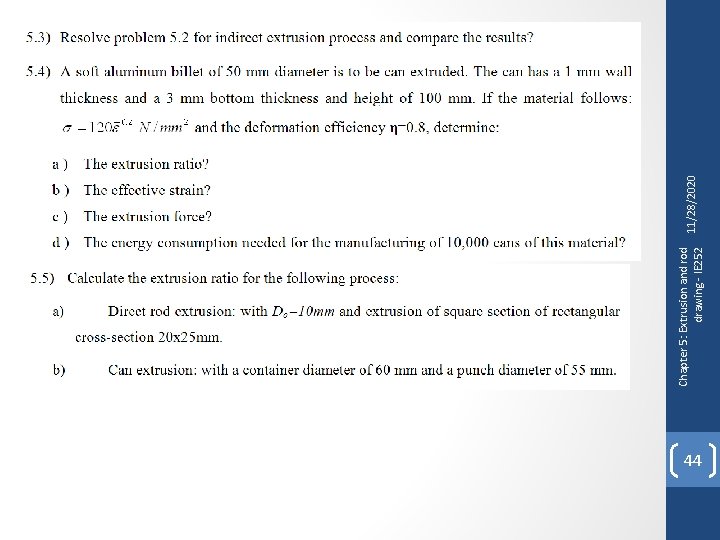
44 Chapter 5: Extrusion and rod drawing - IE 252 11/28/2020
45 Chapter 5: Extrusion and rod drawing - IE 252 11/28/2020