
Chapter 5 Externalities Public Economics 1 Externality Defined
Chapter 5 - Externalities Public Economics 1
Externality Defined • An externality is present when the activity of one entity (person or firm) directly affects the welfare of another entity in a way that is outside the market mechanism. – Negative externality: These activities impose damages on others. – Positive externality: These activities benefits on others. 2

Examples of Externalities • Negative Externalities • – – – Pollution Cell phones in a movie theater Congestion on the internet Drinking and driving Student cheating that changes the grade curve – The “Club” anti-theft devise for automobiles. Positive Externalities – – Research & development Vaccinations A neighbor’s nice landscape Students asking good questions in class – The “Lo. Jack” anti-theft devise for automobiles • Not Considered Externalities – Land prices rising in urban area. – Known as “pecuniary” externalities. 3

Nature of Externalities • Arise because there is no market price attached to the activity. • Can be produced by people or firms. • Can be positive or negative. • Public goods are special case. – Positive externality’s full effects are felt by everyone in the economy. 4
Graphical Analysis: Negative Externalities • For simplicity, assume that a steel firm dumps pollution into a river that harms a fishery downstream. • Competitive markets, firms maximize profits – Note that steel firm only care’s about its own profits, not the fishery’s – Fishery only cares about its profits, not the steel firm’s. 5
Graphical Analysis, continued • MB = marginal benefit to steel firm • MPC = marginal private cost to steel firm • MD = marginal damage to fishery • MSC = MPC+MD = marginal social cost 6
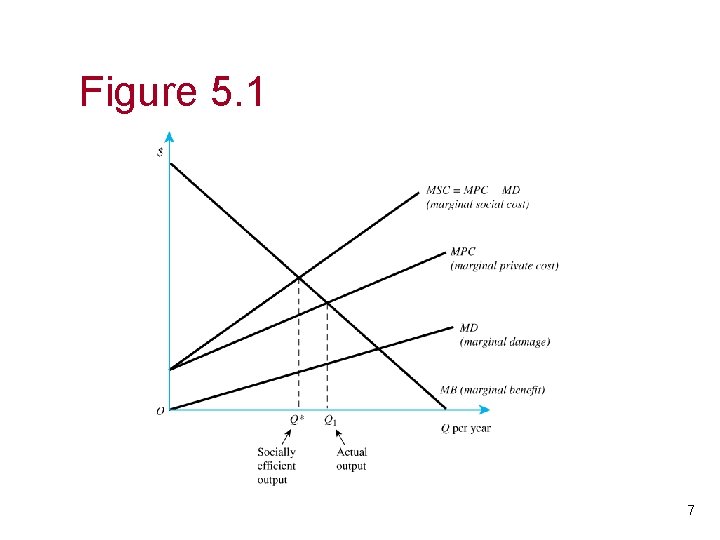
Figure 5. 1 7
Graphical Analysis, continued • From figure 5. 1, as usual, the steel firm maximizes profits at MB=MPC. This quantity is denoted as Q 1 in the figure. • Social welfare is maximized at MB=MSC, which is denoted as Q* in the figure. 8
Graphical Analysis, Implications • Result 1: Q 1>Q* – Steel firm privately produces “too much” steel, because it does not account for the damages to the fishery. • Result 2: Fishery’s preferred amount is 0. – Fishery’s damages are minimized at MD=0. • Result 3: Q* is not the preferred quantity for either party, but is the best compromise between fishery and steel firm. • Result 4: Socially efficient level entails some pollution. – Zero pollution is not socially desirable. 9
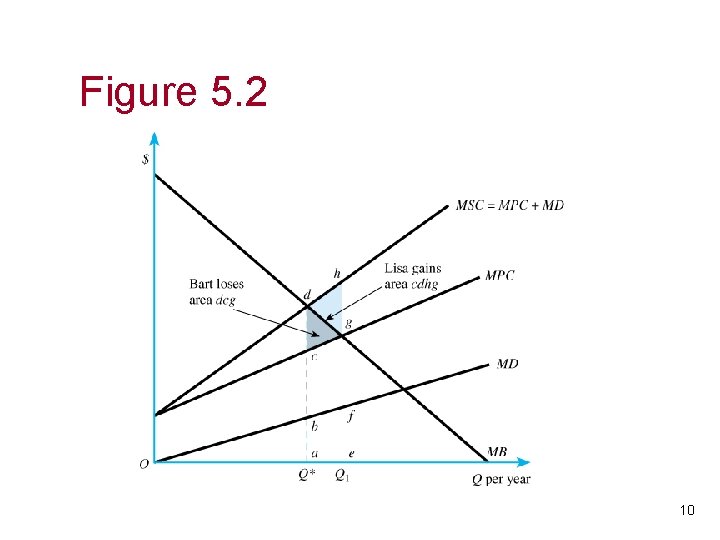
Figure 5. 2 10
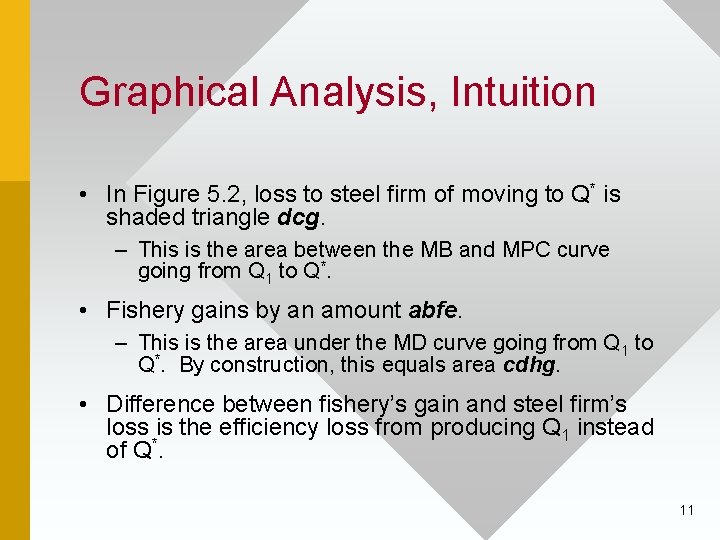
Graphical Analysis, Intuition • In Figure 5. 2, loss to steel firm of moving to Q* is shaded triangle dcg. – This is the area between the MB and MPC curve going from Q 1 to Q*. • Fishery gains by an amount abfe. – This is the area under the MD curve going from Q 1 to Q*. By construction, this equals area cdhg. • Difference between fishery’s gain and steel firm’s loss is the efficiency loss from producing Q 1 instead of Q*. 11

Numerical Example: Negative Externa • Assume the steel firm faces the following MB and MPC curves: • Assume the fishery faces the following MD curve: 12
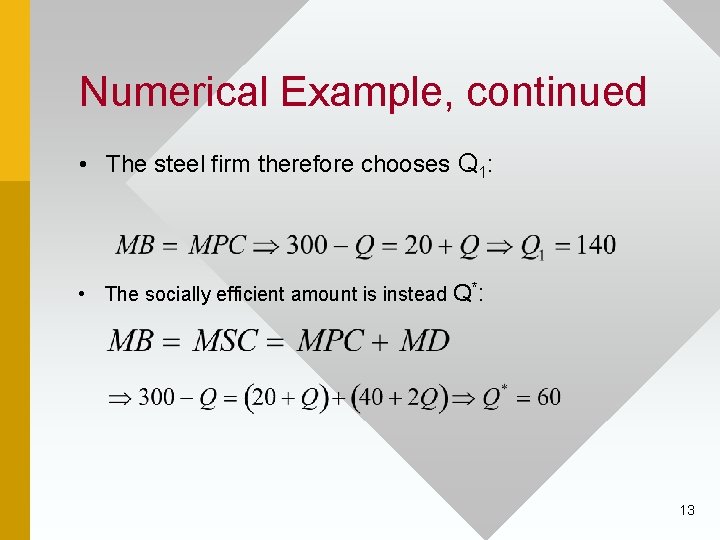
Numerical Example, continued • The steel firm therefore chooses Q 1: • The socially efficient amount is instead Q*: 13
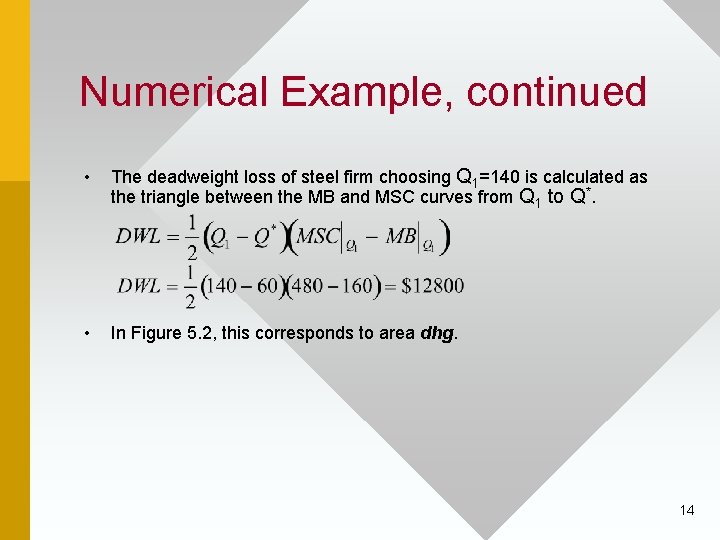
Numerical Example, continued • The deadweight loss of steel firm choosing Q 1=140 is calculated as the triangle between the MB and MSC curves from Q 1 to Q*. • In Figure 5. 2, this corresponds to area dhg. 14
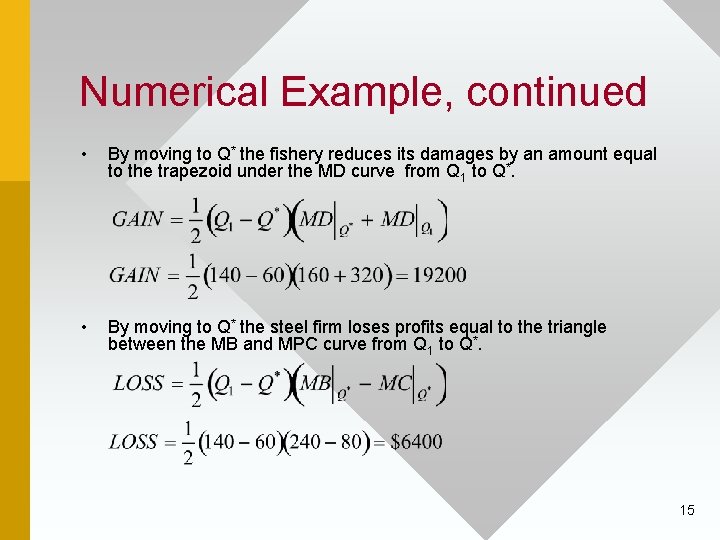
Numerical Example, continued • By moving to Q* the fishery reduces its damages by an amount equal to the trapezoid under the MD curve from Q 1 to Q*. • By moving to Q* the steel firm loses profits equal to the triangle between the MB and MPC curve from Q 1 to Q*. 15

Calculating gains & losses raises practical questions • What activities produce pollutants? – With acid rain it is not known how much is associated with factory production versus natural activities like plant decay. • Which pollutants do harm? – Pinpointing a pollutant’s effect is difficult. Some studies show very limited damage from acid rain. • What is the value of the damage done? – Difficult to value because pollution not bought/sold in market. Housing values may capitalize in pollution’s effect. 16
Private responses • Coase theorem • Mergers • Social conventions 17
Coase Theorem • Insight: root of the inefficiencies from externalities is the absence of property rights. • The Coase Theorem states that once property rights are established and transaction costs are small, then one of the parties will bribe the other to attain the socially efficient quantity. • The socially efficient quantity is attained regardless of whom the property rights were initially assigned. 18
Illustration of the Coase Theorem • Recall the steel firm / fishery example. If the steel firm was assigned property rights, it would initially produce Q 1, which maximizes its profits. • If the fishery was assigned property rights, it would initially mandate zero production, which minimizes its damages. 19
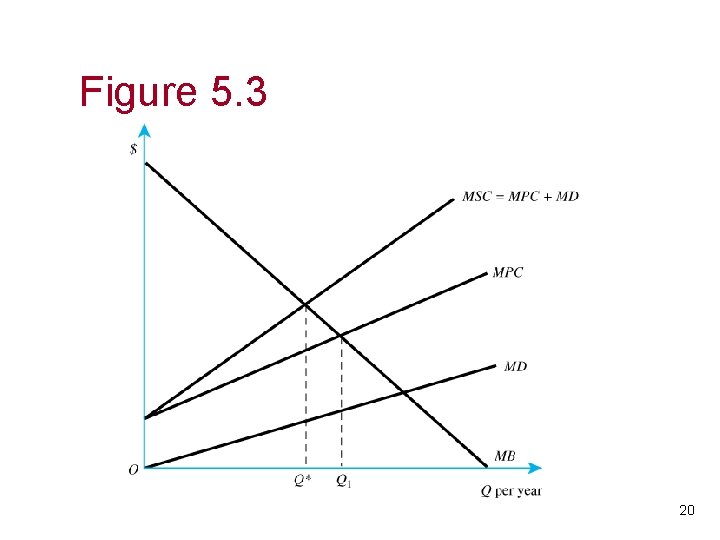
Figure 5. 3 20
Coase Theorem – assign property rights to steel firm • Consider the effects of the steel firm reducing production in the direction of the socially efficient level, Q*. This entails a cost to the steel firm and a benefit to the fishery: – The steel firm (and its customers) would lose surplus between the MB and MPC curves between Q 1 and Q 1 -1, while the fishery’s damages are reduced by the area under the MD curve between Q 1 and Q 1 -1. – Note that the marginal loss in profits is extremely small, because the steel firm was profit maximizing, while the reduction in damages to the fishery is substantial. – A bribe from the fishery to the steel firm could therefore make all parties better off. 21
Coase Theorem – assign property rights to steel firm • When would the process of bribes (and pollution reduction) stop? – When the parties no longer find it beneficial to bribe. – The fishery will not offer a bribe larger than it’s MD for a given quantity, and the steel firm will not accept a bribe smaller than its loss in profits (MB-MPC) for a given quantity. – Thus, the quantity where MD=(MB-MPC) will be where the parties stop bribing and reducing output. – Rearranging, MC+MPC=MB, or MSC=MB, which is equal at Q*, the socially efficient level. 22
Coase Theorem – assign property rights to fishery • Similar reasoning follows when the fishery has property rights, and initially allows zero production. – The fishery’s damages are increased by the area under the MD curve by moving from 0 to 1. On the other hand, the steel firm’s surplus is increased. – The increase in damages to the fishery is initially very small, while the gain in surplus to the steel firm is large. – A bribe from the steel firm to the fishery could therefore make all parties better off. 23
Coase Theorem – assign property rights to fishery • When would the process of bribes now stop? – Again, when the parties no longer find it beneficial to bribe. – The fishery will not accept a bribe smaller than it’s MD for a given quantity, and the steel firm will not offer a bribe larger than its gain in profits (MB-MPC) for a given quantity. – Again, the quantity where MD=(MB-MPC) will be where the parties stop bribing and reducing output. This still occurs at Q*. 24
When is the Coase Theorem relevant or not? • Low transaction costs • Not relevant with high transaction costs or ill – Few parties involved -defined externality • Source of externality • Example: Air pollution well defined • Example: Several firms with pollution 25
Private responses, continued • Mergers • Social conventions 26
Mergers • Mergers between firms “internalize” the externality. • A firm that consisted of both the steel firm & fishery would only care about maximizing the joint profits of the two firms, not either’s profits individually. • Thus, it would take into account the effects of increased steel production on the fishery. 27

Social Conventions • Certain social conventions can be viewed as attempts to force people to account for the externalities they generate. • Examples include conventions about not littering, not talking in a movie theatre, etc. 28
Public responses • Taxes • Subsidies • Creating a market • Regulation 29
Taxes • Again, return to the steel firm / fishery example. • Steel firm produces inefficiently because the prices for inputs incorrectly signal social costs. Input prices are too low. Natural solution is to levy a tax on a polluter. • A Pigouvian tax is a tax levied on each unit of a polluter’s output in an amount just equal to the marginal damage it inflicts at the efficient level of output. 30
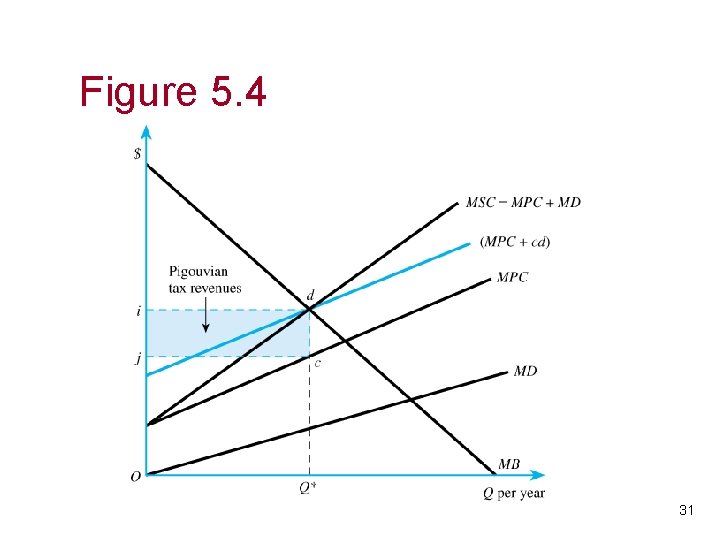
Figure 5. 4 31
Taxes • This tax clearly raises the cost to the steel firm and will result in a reduction of output. • Will it achieve a reduction to Q*? – With the tax, t, the steel firm chooses quantity such that MB=MPC+t. – When the tax is set to equal the MD evaluated at Q*, the expression becomes MB=MPC+MD(Q*). – Graphically it is clear that MB(Q*)-MPC(Q*)=MD(Q*), thus the firm produces the efficient level. 32
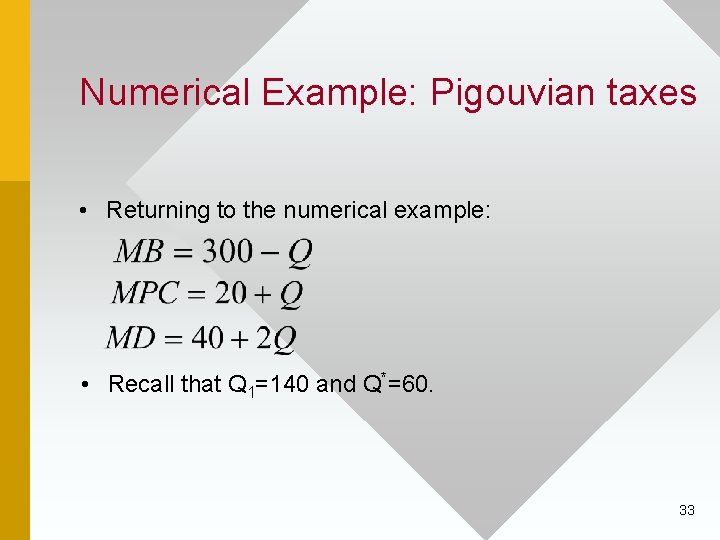
Numerical Example: Pigouvian taxes • Returning to the numerical example: • Recall that Q 1=140 and Q*=60. 33
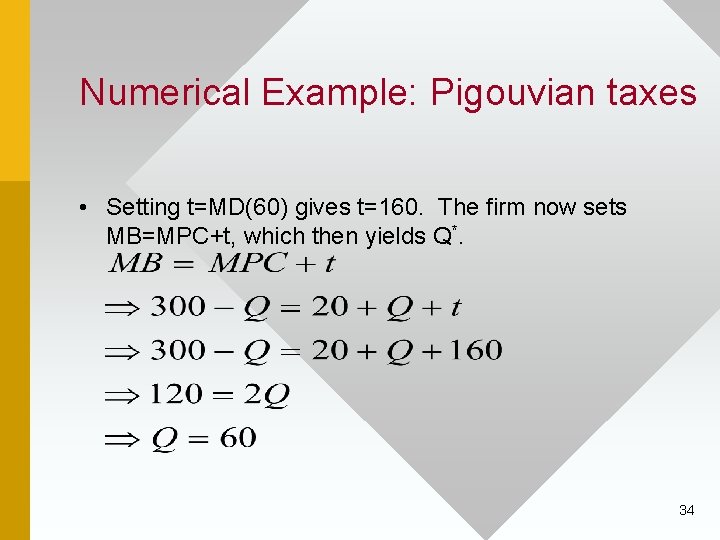
Numerical Example: Pigouvian taxes • Setting t=MD(60) gives t=160. The firm now sets MB=MPC+t, which then yields Q*. 34
Public responses • Subsidies • Creating a market • Regulation 35
Subsidies • Another solutions is paying the polluter to not pollute. • Assume this subsidy was again equal to the marginal damage at the socially efficient level. • Steel firm would cut back production until the loss in profit was equal to the subsidy; this again occurs at Q*. • Subsidy could induce new firms to enter the market, however. 36
Public responses • Creating a market • Regulation 37
Creating a market • Sell producers permits to pollute. Creates market that would not have emerged. • Process: – Government sells permits to pollute in the quantity Z*. – Firms bid for the right to own these permits, fee charged clears the market. • In effect, supply of permits is inelastic. 38
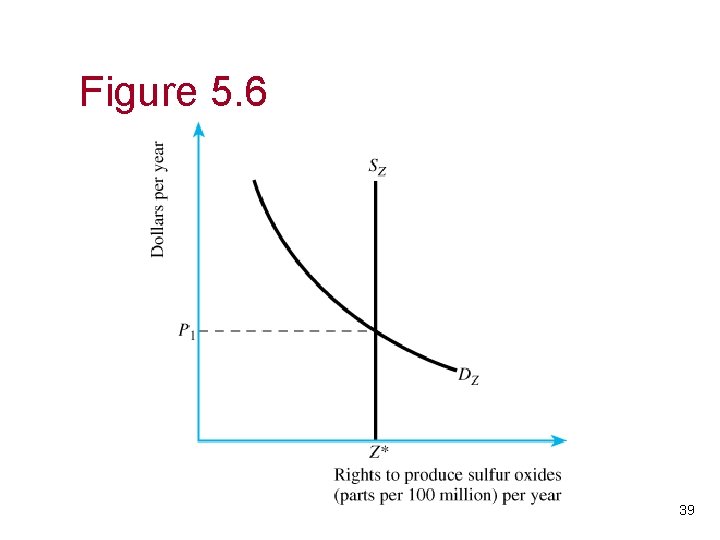
Figure 5. 6 39

Creating a market, continued • Process would also work if the government initially assigned permits to firms, and then allowed firms to sell permits. – Distributional consequences are different – firms that are assigned permits initially now benefit. • One advantage over Pigouvian taxes: permit scheme reduces uncertainty over ultimate level of pollution when costs of MB, MPC, and MD are unknown. 40

Public responses • Regulation 41
Regulation • Each polluter must reduce pollution by a certain amount or face legal sanctions. • Inefficient when there are multiple firms with different costs to pollution reduction. Efficiency does not require equal reductions in pollution emissions; rather it depends on the shapes of the MB and MPC curves. 42
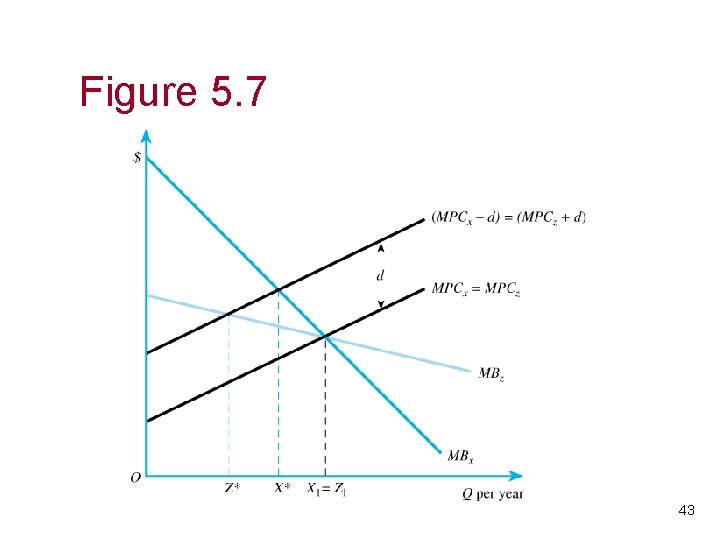
Figure 5. 7 43
The U. S. response • 1970’s: Regulation – Congress set national air quality standards that were to be met independent of the costs of doing so. • 1990’s: Market oriented approaches have somewhat more influence, but not dominant – 1990 Clean Air Act created a market to control emissions of sulfur dioxide with permits. 44

Graphical Analysis: Positive Externalities • For simplicity, assume that a university conducts research that has spillovers to a private firm. • Competitive markets, firms maximize profits – Note that university only care’s about its own profits, not the private firm’s. – Private firm only cares about its profits, not the university’s. 45
Graphical Analysis, continued • MPB = marginal private benefit to university • MC = marginal cost to university • MEB = marginal external benefit to private firm • MSB = MPB+MEB = marginal social benefit 46
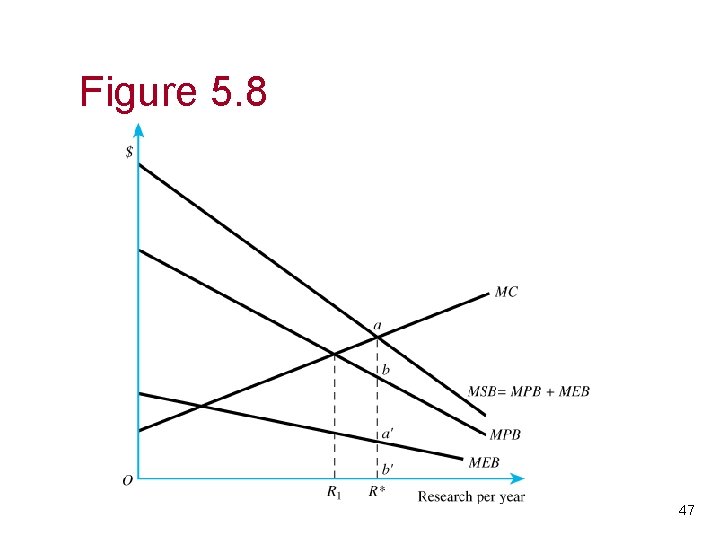
Figure 5. 8 47
Graphical Analysis, continued • From figure 5. 8, as usual, the university maximizes profits at MPB=MC. This quantity is denoted as R 1 in the figure. • Social welfare is maximized at MSB=MC, which is denoted as R* in the figure. 48
Graphical Analysis, Implications • Result 1: R 1<R* – University privately produces “too little” research, because it does not account for the benefits to the private firm. • Result 2: Private firm’s preferred amount is where the MEB curve intersects the x-axis. – Firm’s benefits are maximized at MEB=0. • Result 3: R* is not the preferred quantity for either party, but is the best compromise between university and private firm. 49
Graphical Analysis, Intuition • In Figure 5. 8, loss to university of moving to R* is the triangle area between the MC and MPB curve going from R 1 to R*. • Private firm gains by the area under the MEB curve going from R 1 to R*. • Difference between private firm’s gain and university’s loss is the efficiency loss from producing R 1 instead of R*. 50
Recap of externalities • Externalities definition • Negative externalities – graphical & numerical examples • Private responses • Public responses • Positive externalities 51
- Slides: 51