
Chapter 5 Exponential and Logarithmic Functions Copyright 2017
- Slides: 9
Chapter 5 Exponential and Logarithmic Functions Copyright 2017, 2013, 2009, Pearson Education, Inc. Section 5. 6, Slide 1
Section 5. 6 Logarithmic and Exponential Equations Copyright 2017, 2013, 2009, Pearson Education, Inc. Section 5. 6, Slide 2
Objectives Solve Logarithmic Equations • Solve Exponential Equations • Solve Logarithmic and Exponential Equations Using a Graphing Utility • Copyright 2017, 2013, 2009, Pearson Education, Inc. Section 5. 6, Slide 3
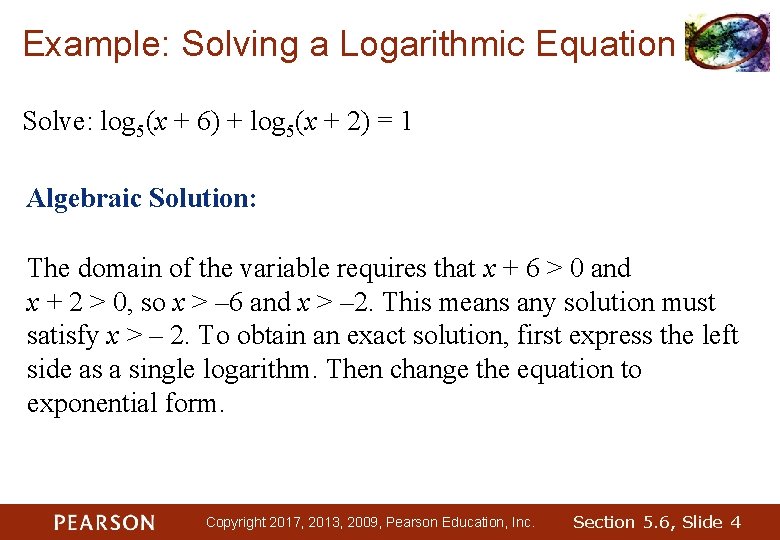
Example: Solving a Logarithmic Equation Solve: log 5(x + 6) + log 5(x + 2) = 1 Algebraic Solution: The domain of the variable requires that x + 6 > 0 and x + 2 > 0, so x > – 6 and x > – 2. This means any solution must satisfy x > – 2. To obtain an exact solution, first express the left side as a single logarithm. Then change the equation to exponential form. Copyright 2017, 2013, 2009, Pearson Education, Inc. Section 5. 6, Slide 4
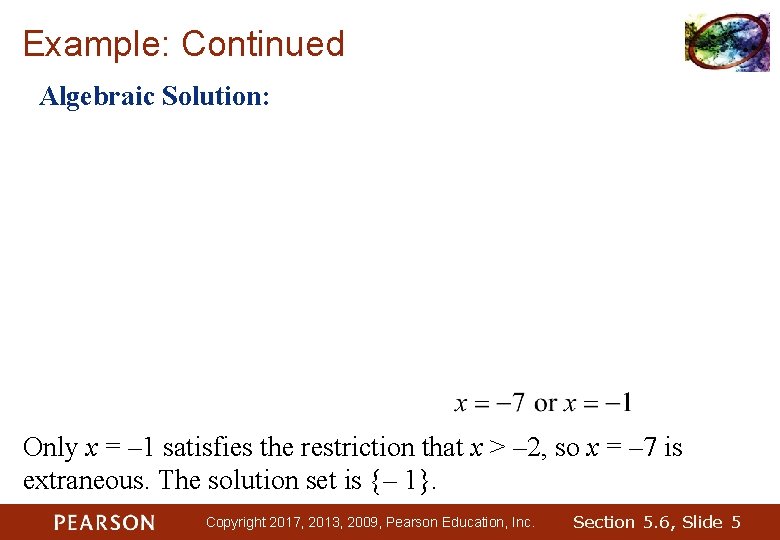
Example: Continued Algebraic Solution: Only x = – 1 satisfies the restriction that x > – 2, so x = – 7 is extraneous. The solution set is {– 1}. Copyright 2017, 2013, 2009, Pearson Education, Inc. Section 5. 6, Slide 5
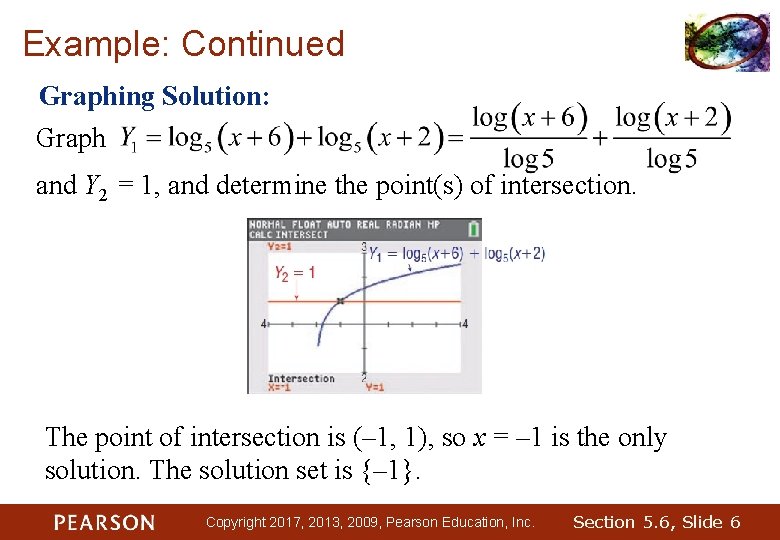
Example: Continued Graphing Solution: Graph and Y 2 = 1, and determine the point(s) of intersection. The point of intersection is (– 1, 1), so x = – 1 is the only solution. The solution set is {– 1}. Copyright 2017, 2013, 2009, Pearson Education, Inc. Section 5. 6, Slide 6
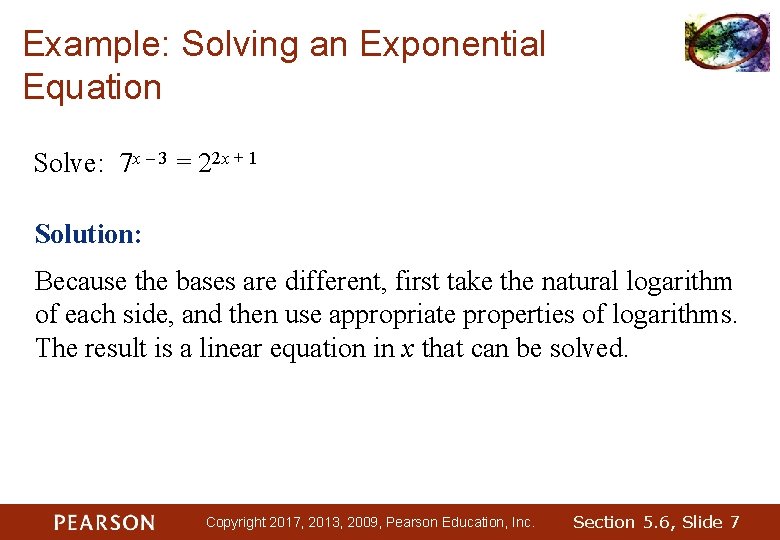
Example: Solving an Exponential Equation Solve: 7 x – 3 = 22 x + 1 Solution: Because the bases are different, first take the natural logarithm of each side, and then use appropriate properties of logarithms. The result is a linear equation in x that can be solved. Copyright 2017, 2013, 2009, Pearson Education, Inc. Section 5. 6, Slide 7
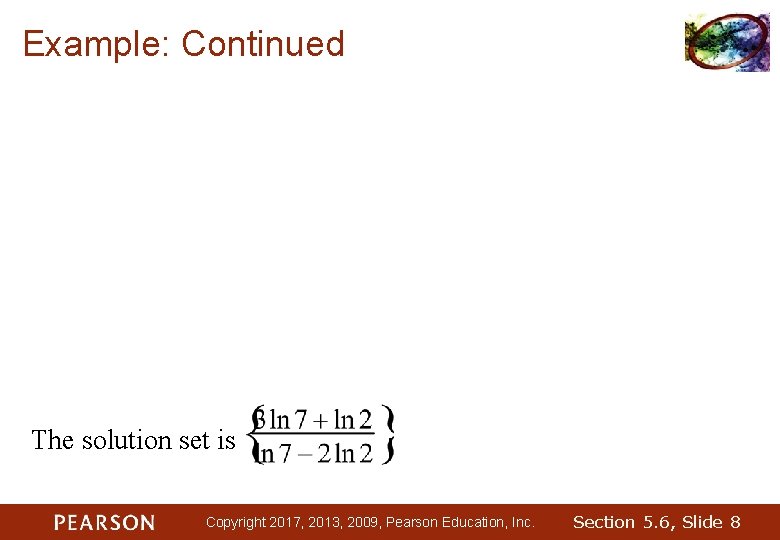
Example: Continued The solution set is Copyright 2017, 2013, 2009, Pearson Education, Inc. Section 5. 6, Slide 8
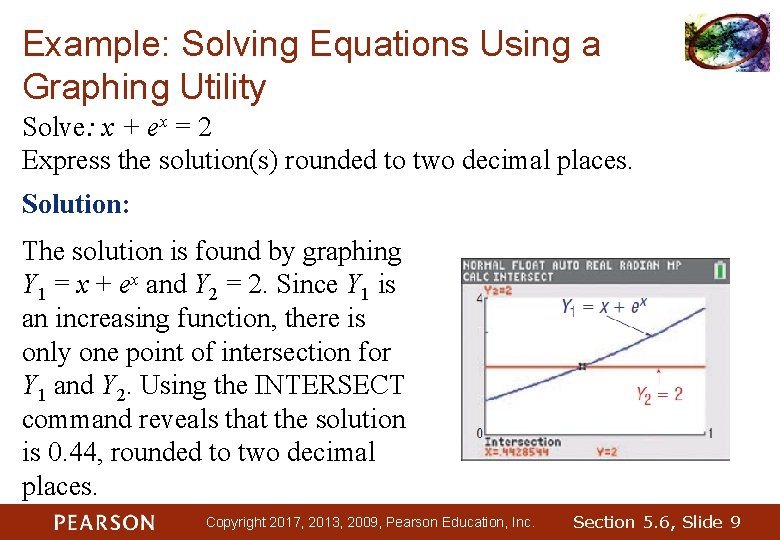
Example: Solving Equations Using a Graphing Utility Solve: x + ex = 2 Express the solution(s) rounded to two decimal places. Solution: The solution is found by graphing Y 1 = x + ex and Y 2 = 2. Since Y 1 is an increasing function, there is only one point of intersection for Y 1 and Y 2. Using the INTERSECT command reveals that the solution is 0. 44, rounded to two decimal places. Copyright 2017, 2013, 2009, Pearson Education, Inc. Section 5. 6, Slide 9