
Chapter 5 Evolution and Biodiversity I Origins of
Chapter 5 Evolution and Biodiversity
I. Origins of Life A. How did life emerge on the primitive Earth? n Developed in two phases n Has taken 4. 6 -4. 7 billion years n First phase – chemical evolution – Organic molecules and biopolymers n Second phase – biological evolution – Prokaryotes single celled eukaryotes multicellular organisms
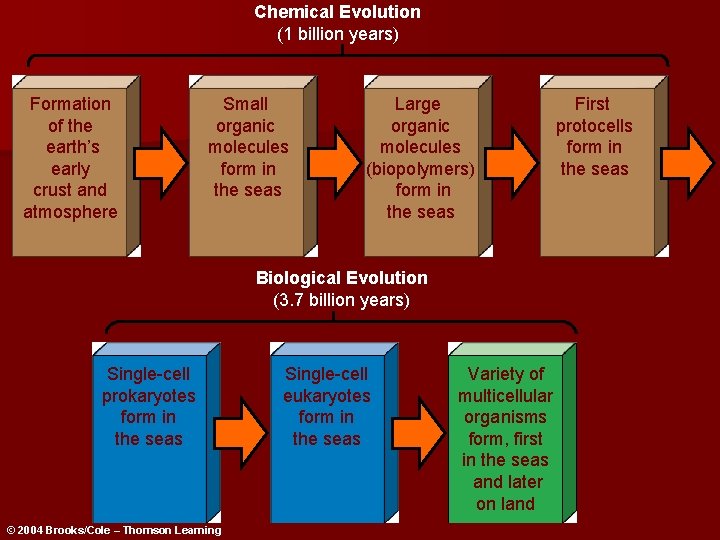
Chemical Evolution (1 billion years) Formation of the earth’s early crust and atmosphere Small organic molecules form in the seas Large organic molecules (biopolymers) form in the seas Biological Evolution (3. 7 billion years) Single-cell prokaryotes form in the seas © 2004 Brooks/Cole – Thomson Learning Single-cell eukaryotes form in the seas Variety of multicellular organisms form, first in the seas and later on land First protocells form in the seas
B. How do we know what organisms lived in the past? Fossils n Chemical analysis and half-life of radioactive rocks n Comparisons of DNA drilled from ice n
n How did life become so diverse on earth? does natural selection mean? n What n Is it possible to observe these processes in action?
II. Evolution and Adaptation A. What is evolution? n Change in a population’s genetic makeup through successive generations n Must have genetic variation- usually through mutations n Major driving force is changes in environmental conditions n Those best adapted to the new environment are the ones that survive and reproduce- Natural Selection n Explains how life has changed over time and why life is so diverse
n Adaptation – any heritable trait that enable organisms to better survive and reproduce under prevailing environmental conditions n If there is a critical change in environment… – Adapt – Migrate – Become extinct
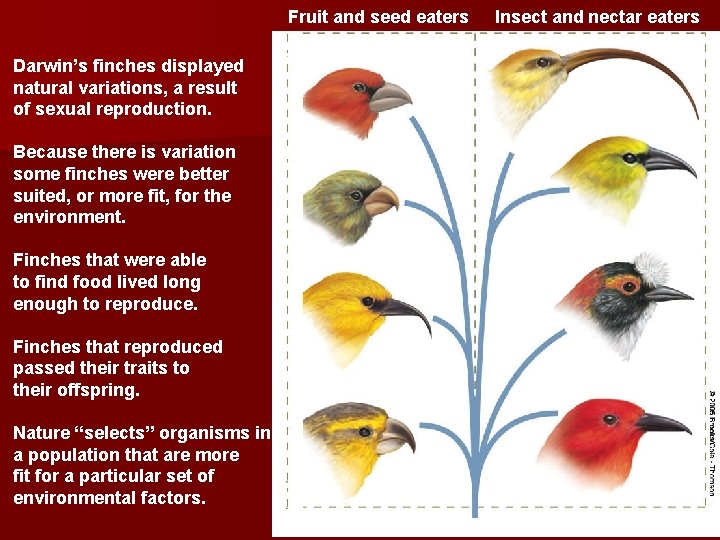
Fruit and seed eaters Darwin’s finches displayed natural variations, a result of sexual reproduction. Because there is variation some finches were better suited, or more fit, for the environment. Insect and nectar eaters Greater Koa-finch Kuai Akialoa Amakihi Kona Grosbeak Crested Honeycreeper Finches that were able to find food lived long enough to reproduce. Finches that reproduced passed their traits to their offspring. Maui Parrotbill Apapane Nature “selects” organisms in a population that are more fit for a particular set of environmental factors. Unknown finch ancestor
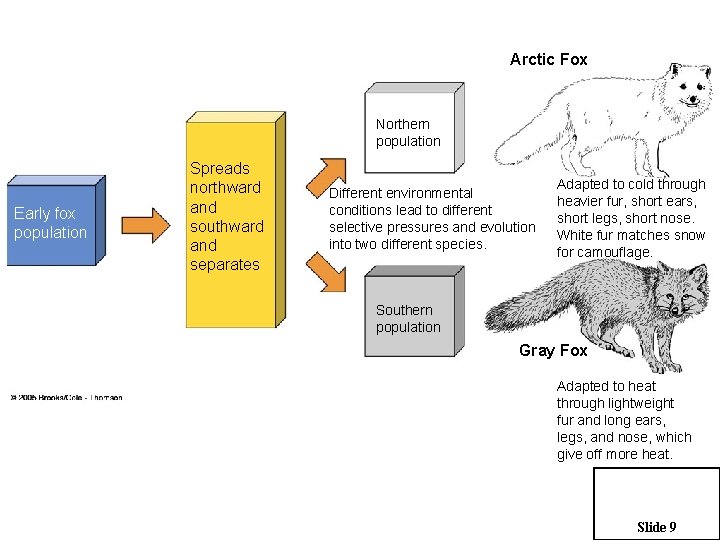
Arctic Fox Northern population Early fox population Spreads northward and southward and separates Different environmental conditions lead to different selective pressures and evolution into two different species. Adapted to cold through heavier fur, short ears, short legs, short nose. White fur matches snow for camouflage. Southern population Gray Fox Adapted to heat through lightweight fur and long ears, legs, and nose, which give off more heat. Slide 9
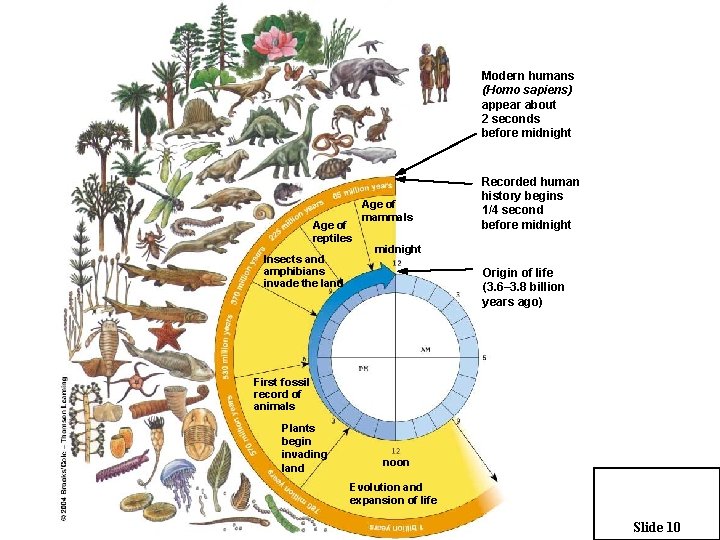
Modern humans (Homo sapiens) appear about 2 seconds before midnight Age of reptiles Insects and amphibians invade the land Age of mammals Recorded human history begins 1/4 second before midnight Origin of life (3. 6– 3. 8 billion years ago) First fossil record of animals Plants begin invading land noon Evolution and expansion of life Slide 10
D. What is coevolution? n Interactions between species results in microevolution in each of their populations n Changes in the gene pool of one species can lead to changes in the gene pool of the other (coevolution) n Example – bats and moths n Predators and prey take turns in having the upper hand
III. Ecological Niches and Adaptation A. What is an ecological niche? A role a certain species plays in an ecosystem n Includes… n – Adaptations its members have acquired through evolution – Range of tolerance for physical and chemical conditions – Types and amounts of resources the species uses – How it interacts with other living and non-living components of the ecosystem – The role it plays in energy flow and matter recycling
A. What is an ecological niche? (continued) n Different than habitat (where it lives) n Fundamental niche – full potential niche of the species provided that there was no competition n Realized niche – the part of the fundamental niche that the species actually occupies
B. What are generalist and specialist species? n Generalist species have broad niches – Live in many places – Eat a variety of food – Tolerate a wide range of conditions n Specialist species have narrow niches – – – Live in only one type of habitat Eat one type of food Narrow range of conditions More prone to extinction Only advantage is that they have fewer competitors
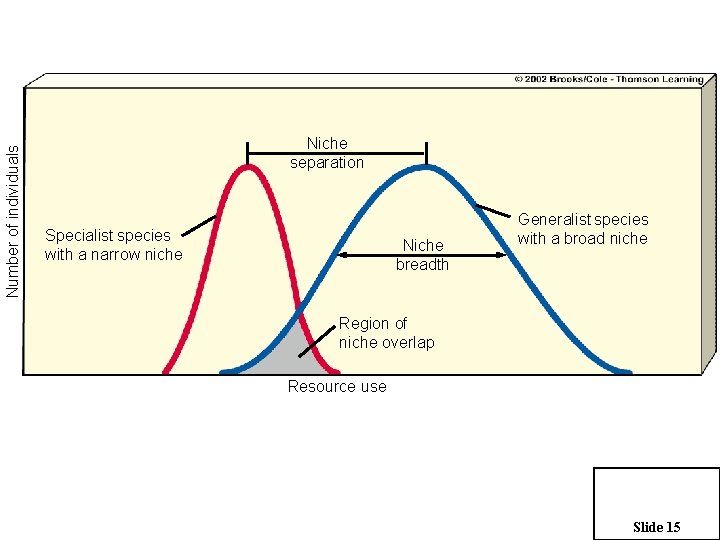
Number of individuals Niche separation Specialist species with a narrow niche Niche breadth Generalist species with a broad niche Region of niche overlap Resource use Slide 15
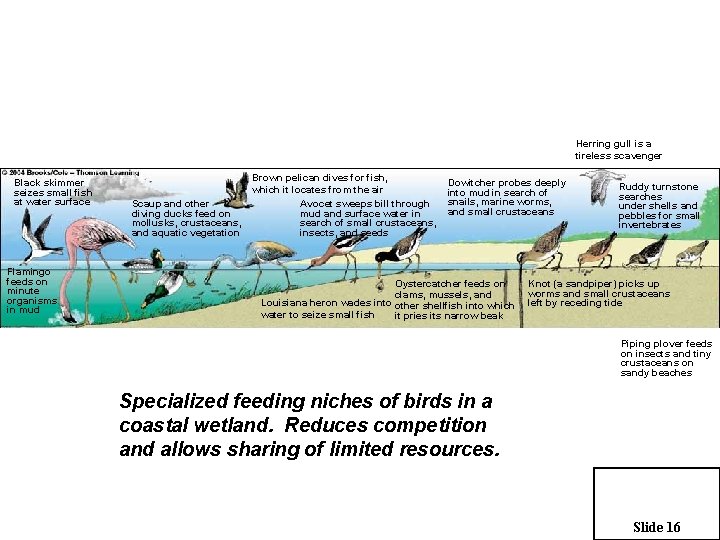
Herring gull is a tireless scavenger Black skimmer seizes small fish at water surface Flamingo feeds on minute organisms in mud Scaup and other diving ducks feed on mollusks, crustaceans, and aquatic vegetation Brown pelican dives for fish, which it locates from the air Avocet sweeps bill through mud and surface water in search of small crustaceans, insects, and seeds Dowitcher probes deeply into mud in search of snails, marine worms, and small crustaceans Oystercatcher feeds on clams, mussels, and Louisiana heron wades into other shellfish into which water to seize small fish it pries its narrow beak Ruddy turnstone searches under shells and pebbles for small invertebrates Knot (a sandpiper) picks up worms and small crustaceans left by receding tide Piping plover feeds on insects and tiny crustaceans on sandy beaches Specialized feeding niches of birds in a coastal wetland. Reduces competition and allows sharing of limited resources. Slide 16
B. What are generalist and specialist species? (continued) n When niches of species compete intensely for scarce resources, the species will evolve with different adaptations to reduce competition – this is evolutionary divergence
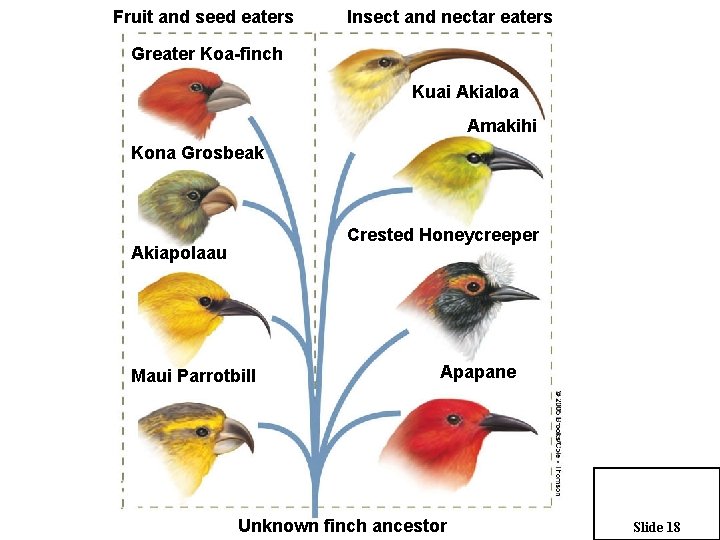
Fruit and seed eaters Insect and nectar eaters Greater Koa-finch Kuai Akialoa Amakihi Kona Grosbeak Crested Honeycreeper Akiapolaau Maui Parrotbill Apapane Unknown finch ancestor Slide 18
C. What are commonly misunderstood aspects of evolution? n “Survival of the fittest” means the strongest – fittest actually means reproductive success
- Slides: 19