
Chapter 5 Encoding Information must be encoded into
Chapter 5: Encoding Information must be encoded into signals before it can be transported across communication media l Information can be either l – Digital, or – Analog l Signals can be also of two types: – Digital – Analog 2/1/2022 CCE 484 - Computer Networks 1
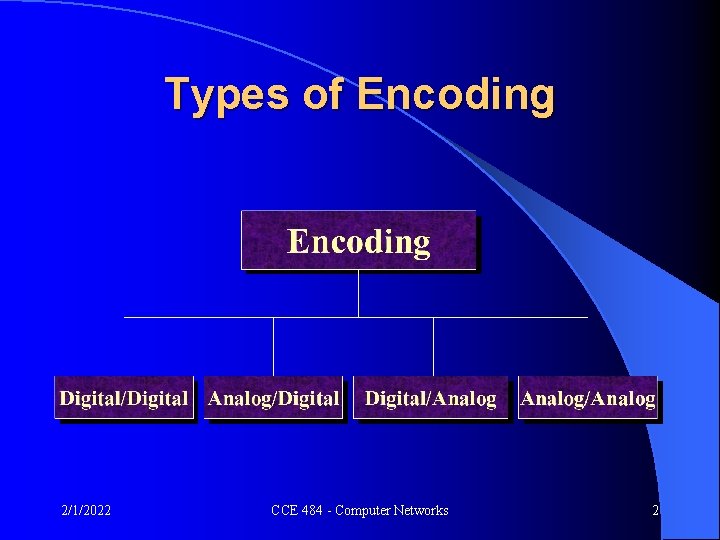
Types of Encoding 2/1/2022 CCE 484 - Computer Networks 2
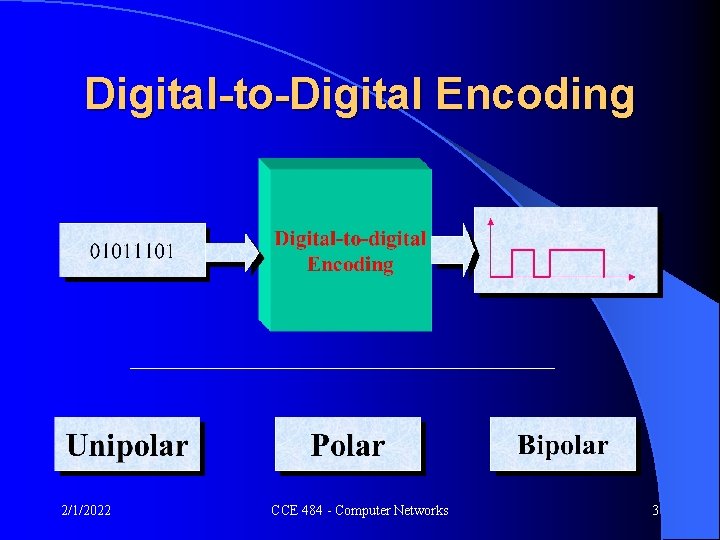
Digital-to-Digital Encoding 2/1/2022 CCE 484 - Computer Networks 3
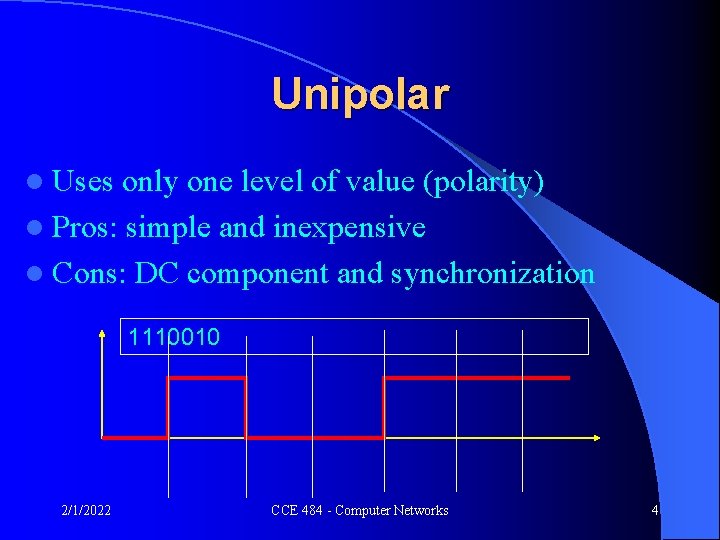
Unipolar l Uses only one level of value (polarity) l Pros: simple and inexpensive l Cons: DC component and synchronization 1110010 2/1/2022 CCE 484 - Computer Networks 4
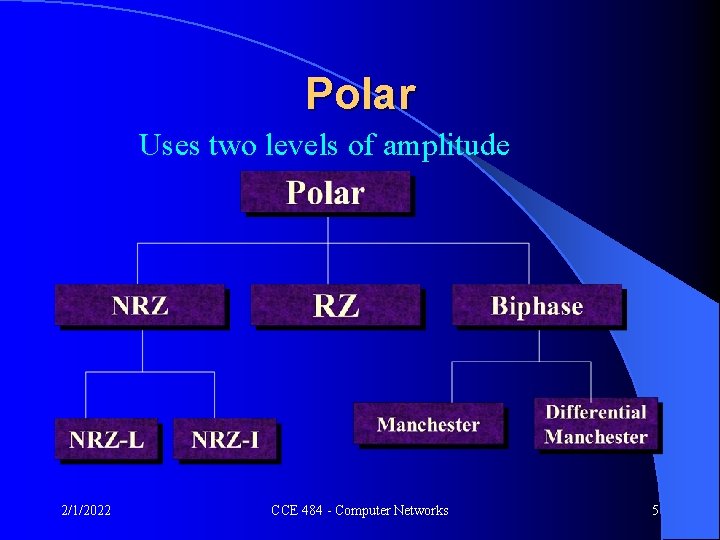
Polar Uses two levels of amplitude 2/1/2022 CCE 484 - Computer Networks 5
Non-Return to Zero (NZR) l The level of the signal is always either positive or negative l NZR-Level : the level of the signal is dependent on the state of the bit (ex. + 1 and – 0) l NRZ-Inverted: The signal is inverted if a 1 is encountered l Less DC-component and more synchronization than Unipolar 2/1/2022 CCE 484 - Computer Networks 6
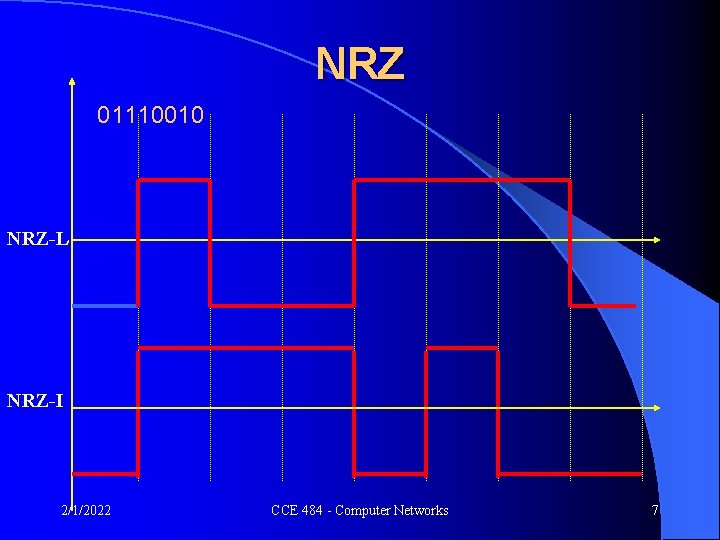
NRZ 01110010 NRZ-L NRZ-I 2/1/2022 CCE 484 - Computer Networks 7
Return to Zero (RZ) • Uses three signal values: positive, zero, and negative • There is a signal change for each bit (negative-tozero for 0 and positive-to-zero for 1 • Excellent synchronization • Disadvantage: It needs more bandwidth since two signal changes per bit 2/1/2022 CCE 484 - Computer Networks 8
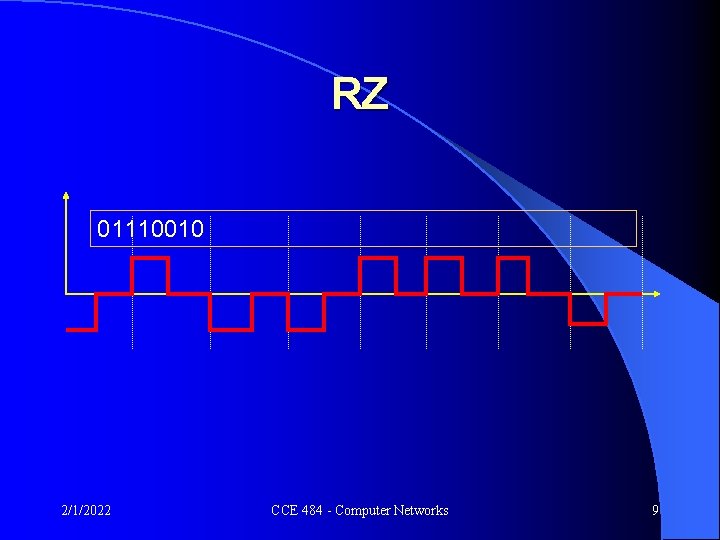
RZ 01110010 2/1/2022 CCE 484 - Computer Networks 9
Biphase Manchester: negative-to-positive transition represents 1 and a positive-to-negative transition represents 0. l Transition at the middle of the bit is used for both synchronization and bit representation. l Differential Manchester: a transition means 0 and no transition means 1. l Transition at the middle of the bit is used only for synchronization. Bit representation is shown by the inversion or noninversion at the beginning of the bit. l 2/1/2022 CCE 484 - Computer Networks 10
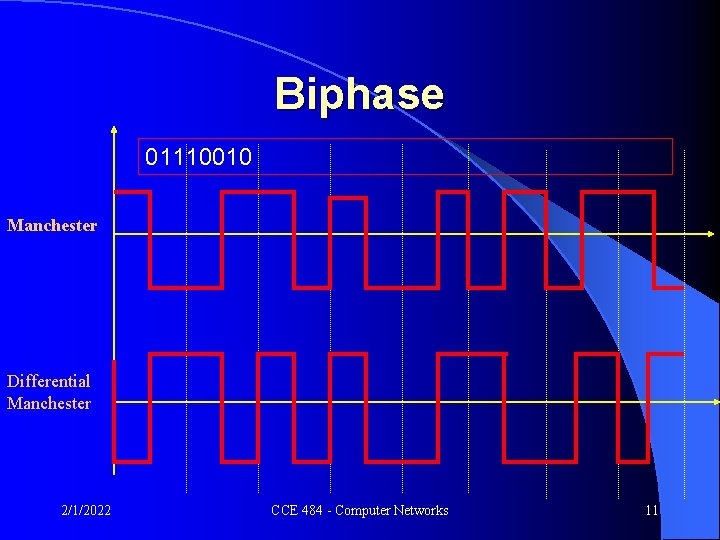
Biphase 01110010 Manchester Differential Manchester 2/1/2022 CCE 484 - Computer Networks 11
Bipolar l Uses three signal levels: positive, zero, and negative l Zero level represents binary 0 l Positive and negative levels represent alternating 1 s 2/1/2022 CCE 484 - Computer Networks 12
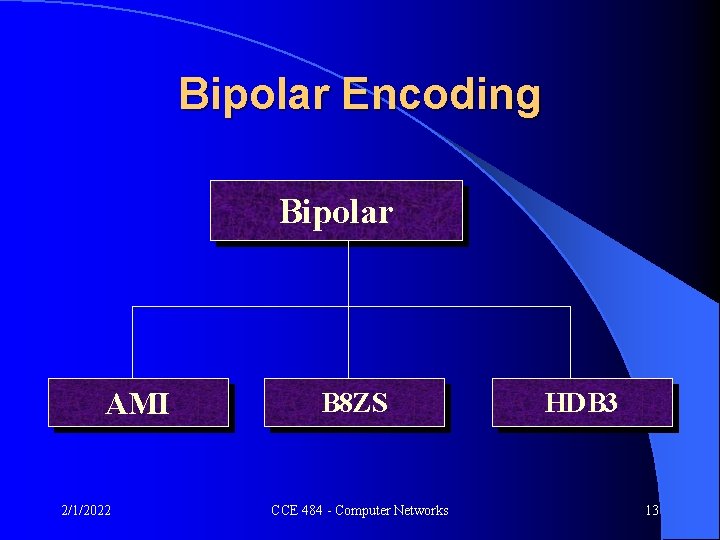
Bipolar Encoding Bipolar AMI 2/1/2022 B 8 ZS CCE 484 - Computer Networks HDB 3 13
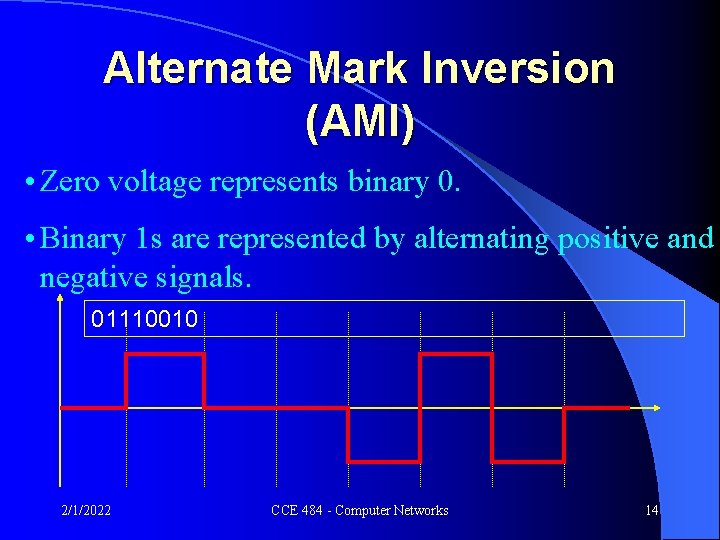
Alternate Mark Inversion (AMI) • Zero voltage represents binary 0. • Binary 1 s are represented by alternating positive and negative signals. 01110010 2/1/2022 CCE 484 - Computer Networks 14
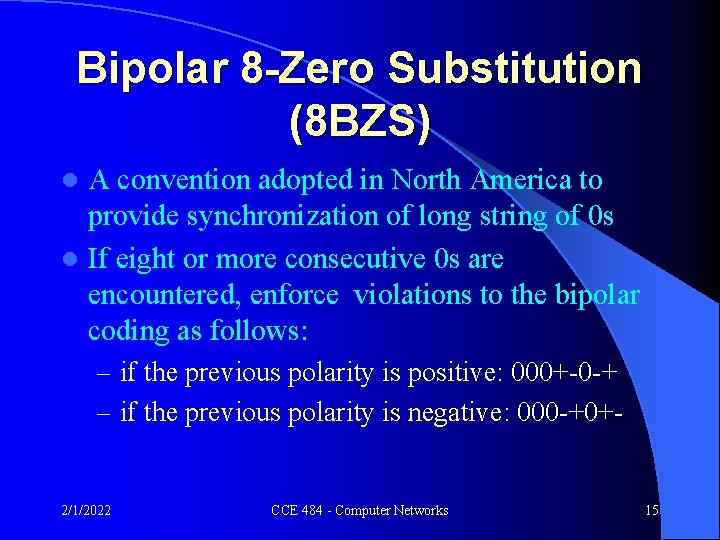
Bipolar 8 -Zero Substitution (8 BZS) A convention adopted in North America to provide synchronization of long string of 0 s l If eight or more consecutive 0 s are encountered, enforce violations to the bipolar coding as follows: l – if the previous polarity is positive: 000+-0 -+ – if the previous polarity is negative: 000 -+0+- 2/1/2022 CCE 484 - Computer Networks 15
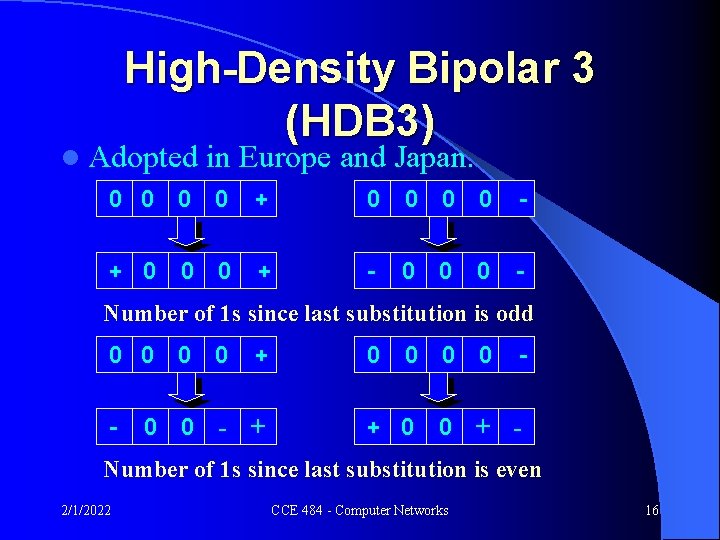
High-Density Bipolar 3 (HDB 3) l Adopted in Europe and Japan. 0 0 + 0 0 - + 0 0 0 + - 0 0 0 - Number of 1 s since last substitution is odd 0 0 + 0 0 - - 0 - + + 0 0 + - 0 Number of 1 s since last substitution is even 2/1/2022 CCE 484 - Computer Networks 16
- Slides: 16