
Chapter 5 Electronic Commerce Intranets and Extranets www

- Slides: 37
Chapter 5 Electronic Commerce, Intranets, and Extranets www. prenhall. com/jessup 5 -1
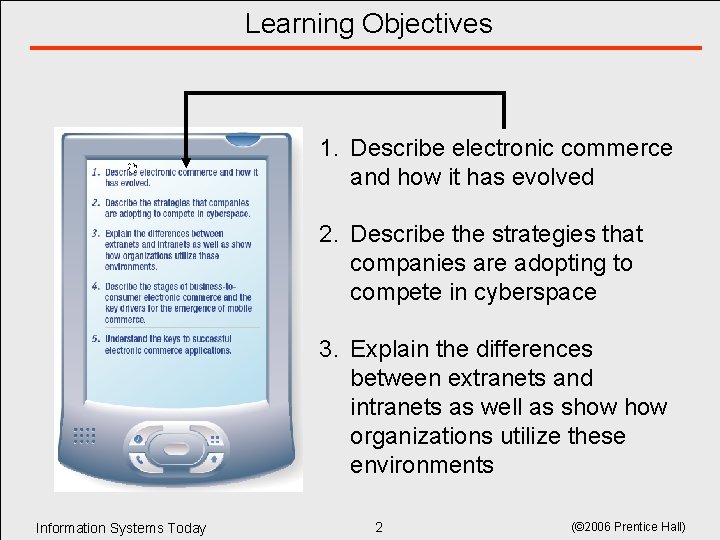
Learning Objectives 1. Describe electronic commerce and how it has evolved 2. Describe the strategies that companies are adopting to compete in cyberspace 3. Explain the differences between extranets and intranets as well as show organizations utilize these environments Information Systems Today 2 (© 2006 Prentice Hall)
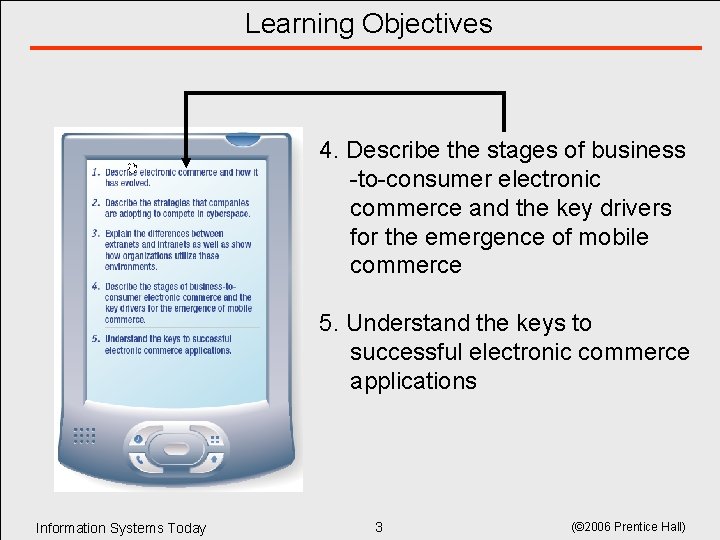
Learning Objectives 4. Describe the stages of business -to-consumer electronic commerce and the key drivers for the emergence of mobile commerce 5. Understand the keys to successful electronic commerce applications Information Systems Today 3 (© 2006 Prentice Hall)
Electronic Commerce The online exchange of goods, services, and money among firms, and between firms and their customers Information Systems Today 4 (© 2006 Prentice Hall)
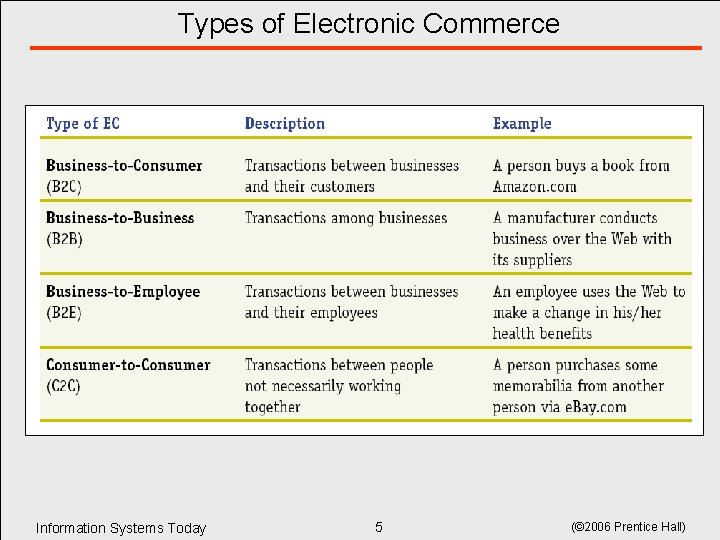
Types of Electronic Commerce Information Systems Today 5 (© 2006 Prentice Hall)
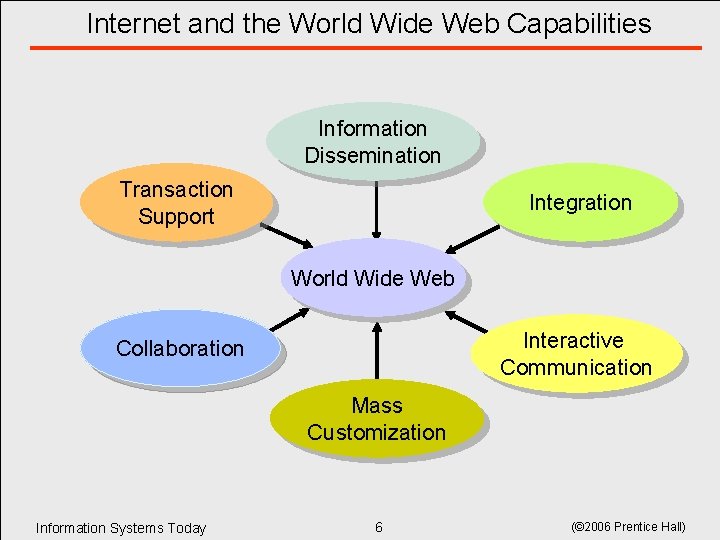
Internet and the World Wide Web Capabilities Information Dissemination Transaction Support Integration World Wide Web Interactive Communication Collaboration Mass Customization Information Systems Today 6 (© 2006 Prentice Hall)
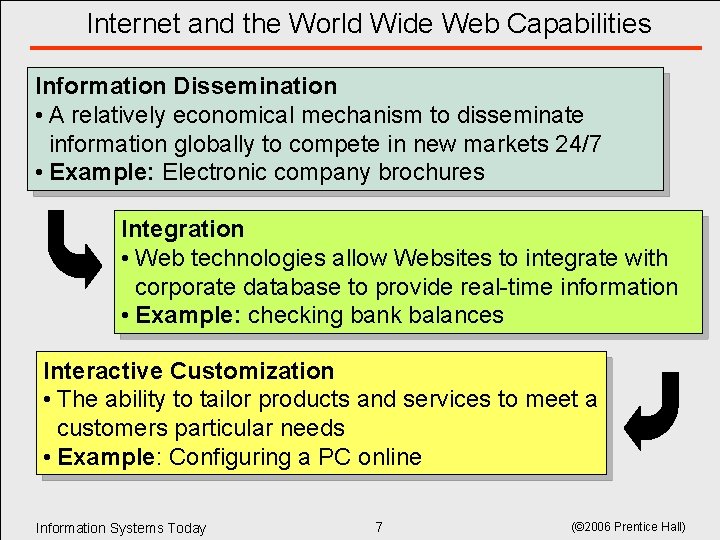
Internet and the World Wide Web Capabilities Information Dissemination • A relatively economical mechanism to disseminate information globally to compete in new markets 24/7 • Example: Electronic company brochures Integration • Web technologies allow Websites to integrate with corporate database to provide real-time information • Example: checking bank balances Interactive Customization • The ability to tailor products and services to meet a customers particular needs • Example: Configuring a PC online Information Systems Today 7 (© 2006 Prentice Hall)
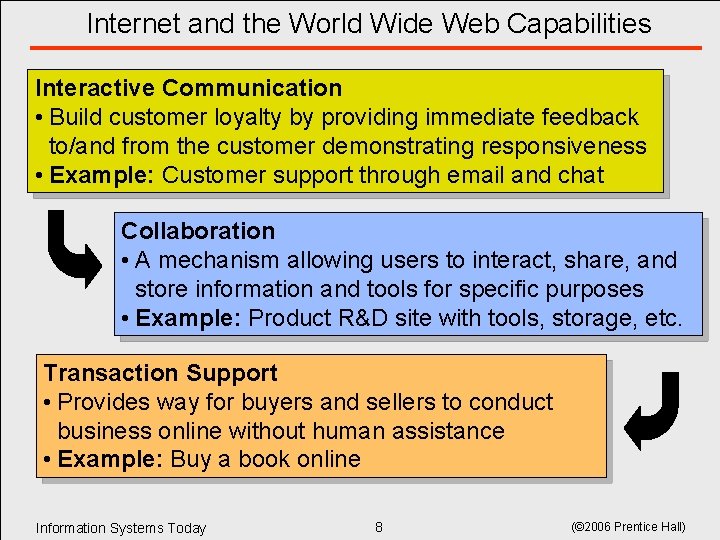
Internet and the World Wide Web Capabilities Interactive Communication • Build customer loyalty by providing immediate feedback to/and from the customer demonstrating responsiveness • Example: Customer support through email and chat Collaboration • A mechanism allowing users to interact, share, and store information and tools for specific purposes • Example: Product R&D site with tools, storage, etc. Transaction Support • Provides way for buyers and sellers to conduct business online without human assistance • Example: Buy a book online Information Systems Today 8 (© 2006 Prentice Hall)
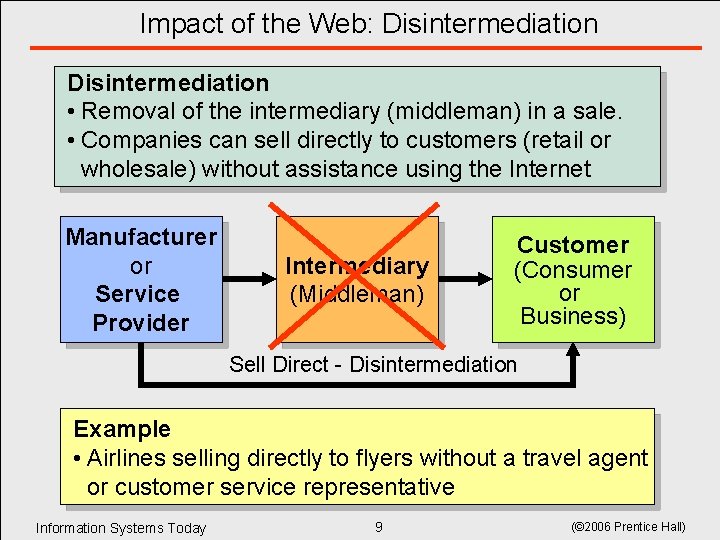
Impact of the Web: Disintermediation • Removal of the intermediary (middleman) in a sale. • Companies can sell directly to customers (retail or wholesale) without assistance using the Internet Manufacturer or Service Provider Intermediary (Middleman) Customer (Consumer or Business) Sell Direct - Disintermediation Example • Airlines selling directly to flyers without a travel agent or customer service representative Information Systems Today 9 (© 2006 Prentice Hall)
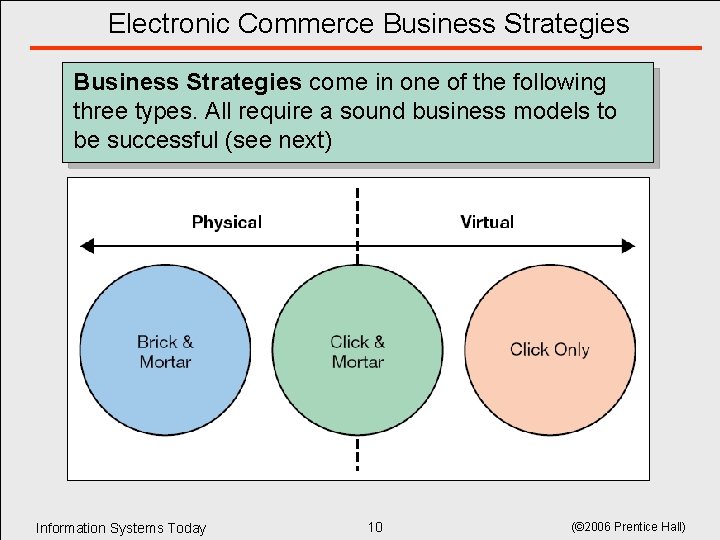
Electronic Commerce Business Strategies come in one of the following three types. All require a sound business models to be successful (see next) Information Systems Today 10 (© 2006 Prentice Hall)
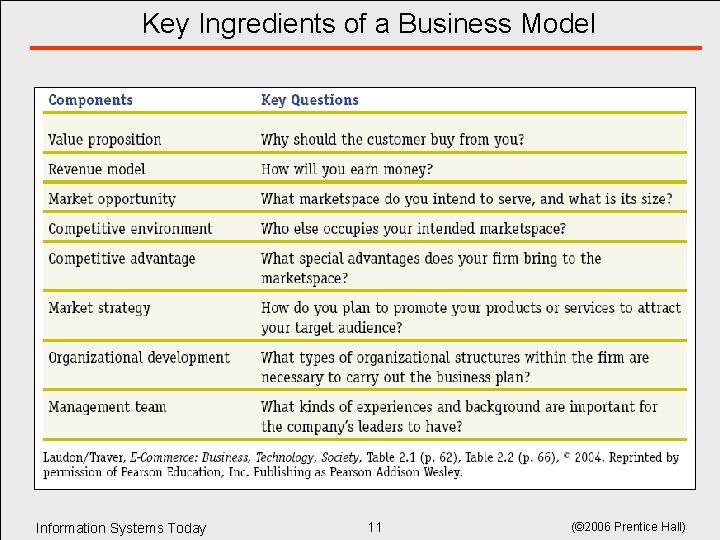
Key Ingredients of a Business Model Information Systems Today 11 (© 2006 Prentice Hall)
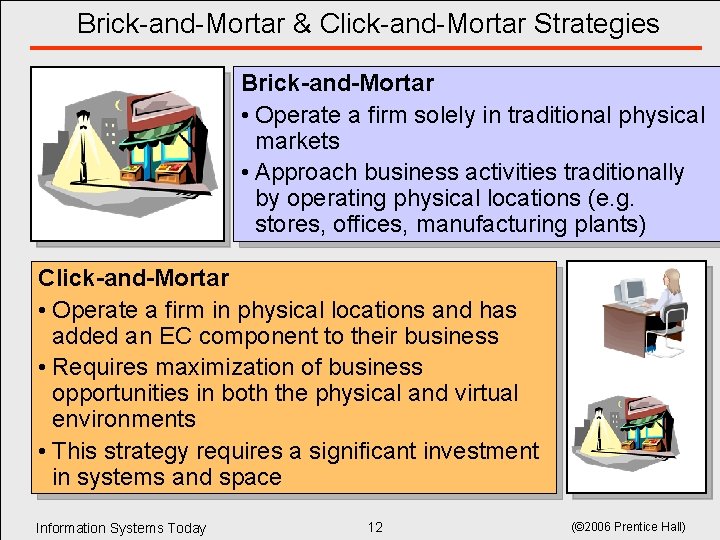
Brick-and-Mortar & Click-and-Mortar Strategies Brick-and-Mortar • Operate a firm solely in traditional physical markets • Approach business activities traditionally by operating physical locations (e. g. stores, offices, manufacturing plants) Click-and-Mortar • Operate a firm in physical locations and has added an EC component to their business • Requires maximization of business opportunities in both the physical and virtual environments • This strategy requires a significant investment in systems and space Information Systems Today 12 (© 2006 Prentice Hall)
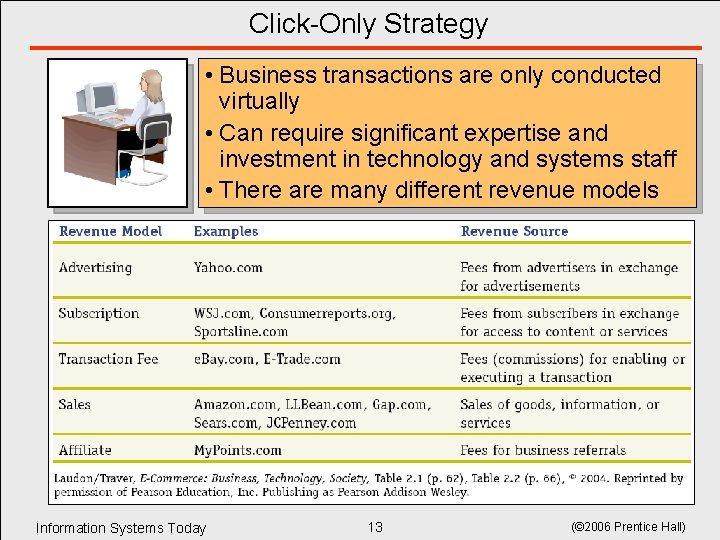
Click-Only Strategy • Business transactions are only conducted virtually • Can require significant expertise and investment in technology and systems staff • There are many different revenue models Information Systems Today 13 (© 2006 Prentice Hall)
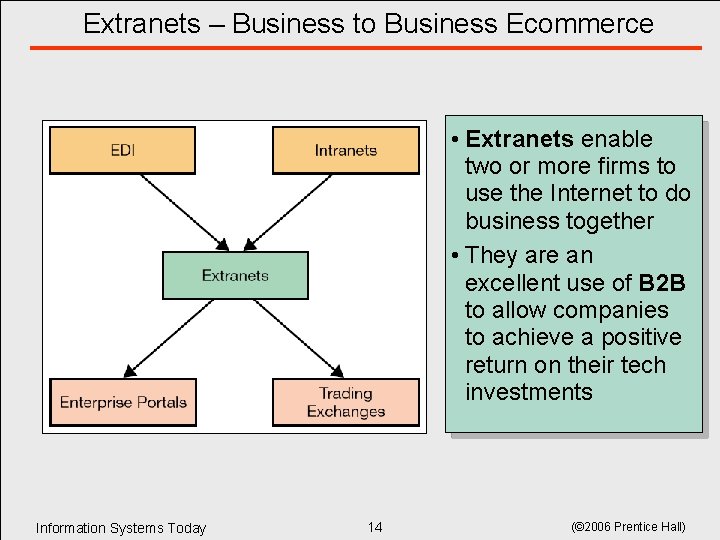
Extranets – Business to Business Ecommerce • Extranets enable two or more firms to use the Internet to do business together • They are an excellent use of B 2 B to allow companies to achieve a positive return on their tech investments Information Systems Today 14 (© 2006 Prentice Hall)
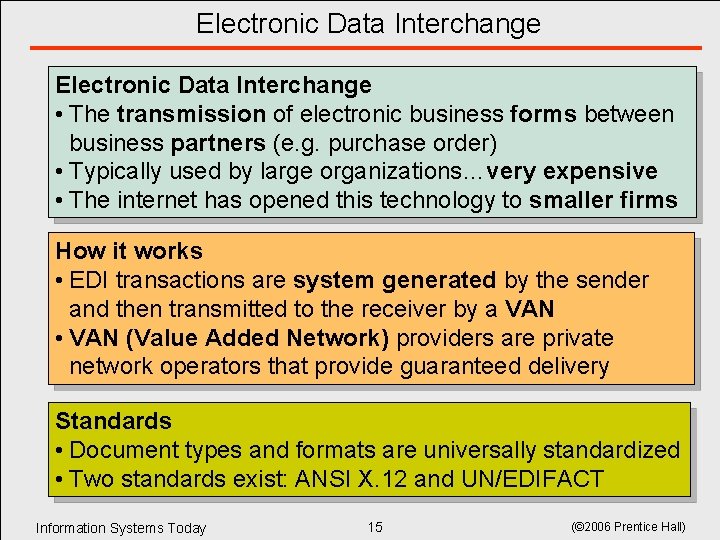
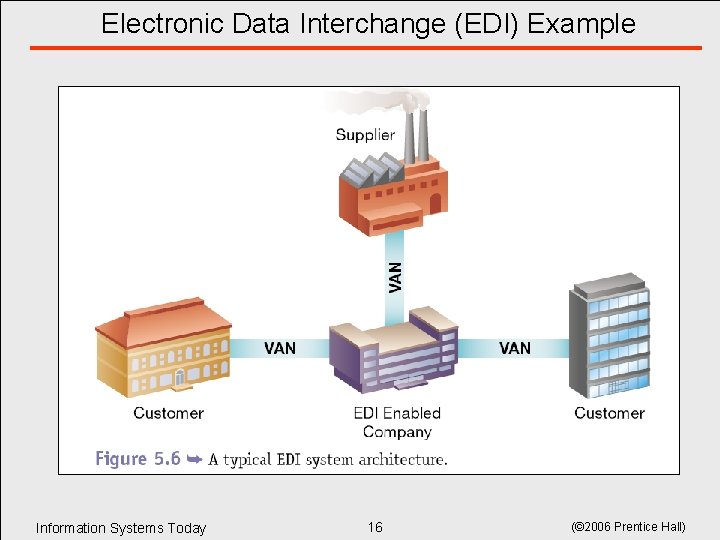
Electronic Data Interchange • The transmission of electronic business forms between business partners (e. g. purchase order) • Typically used by large organizations…very expensive • The internet has opened this technology to smaller firms How it works • EDI transactions are system generated by the sender and then transmitted to the receiver by a VAN • VAN (Value Added Network) providers are private network operators that provide guaranteed delivery Standards • Document types and formats are universally standardized • Two standards exist: ANSI X. 12 and UN/EDIFACT Information Systems Today 15 (© 2006 Prentice Hall)
Electronic Data Interchange (EDI) Example Information Systems Today 16 (© 2006 Prentice Hall)
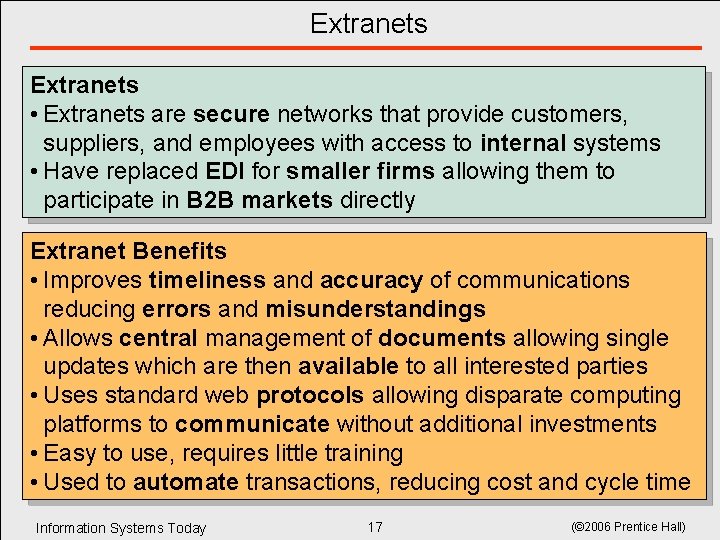
Extranets • Extranets are secure networks that provide customers, suppliers, and employees with access to internal systems • Have replaced EDI for smaller firms allowing them to participate in B 2 B markets directly Extranet Benefits • Improves timeliness and accuracy of communications reducing errors and misunderstandings • Allows central management of documents allowing single updates which are then available to all interested parties • Uses standard web protocols allowing disparate computing platforms to communicate without additional investments • Easy to use, requires little training • Used to automate transactions, reducing cost and cycle time Information Systems Today 17 (© 2006 Prentice Hall)
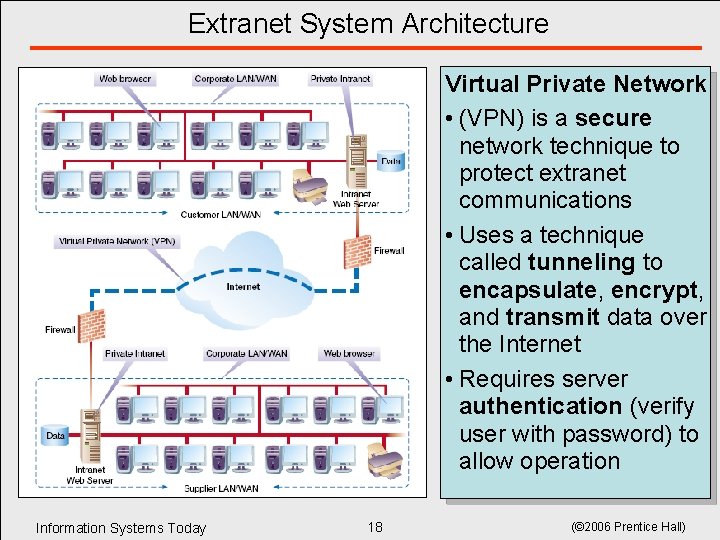
Extranet System Architecture Virtual Private Network • (VPN) is a secure network technique to protect extranet communications • Uses a technique called tunneling to encapsulate, encrypt, and transmit data over the Internet • Requires server authentication (verify user with password) to allow operation Information Systems Today 18 (© 2006 Prentice Hall)
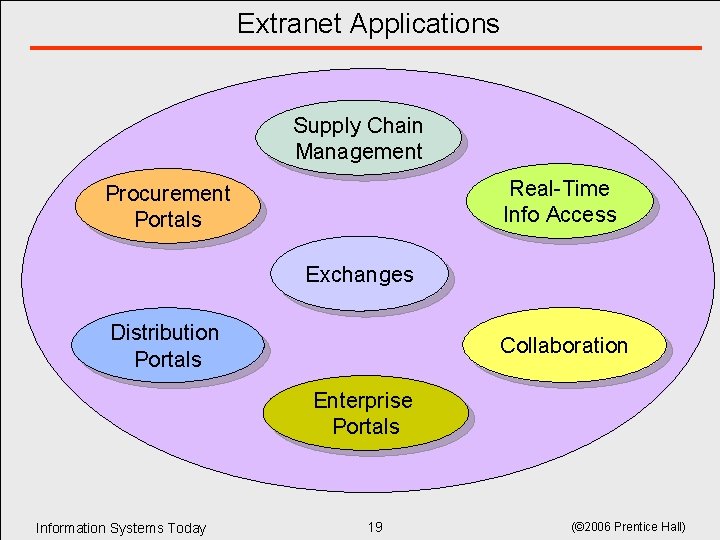
Extranet Applications Supply Chain Management Real-Time Info Access Procurement Portals Exchanges Distribution Portals Collaboration Enterprise Portals Information Systems Today 19 (© 2006 Prentice Hall)
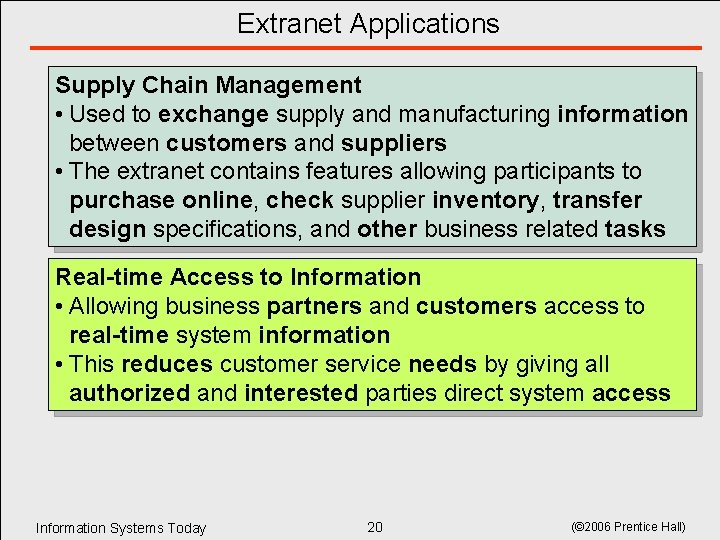
Extranet Applications Supply Chain Management • Used to exchange supply and manufacturing information between customers and suppliers • The extranet contains features allowing participants to purchase online, check supplier inventory, transfer design specifications, and other business related tasks Real-time Access to Information • Allowing business partners and customers access to real-time system information • This reduces customer service needs by giving all authorized and interested parties direct system access Information Systems Today 20 (© 2006 Prentice Hall)
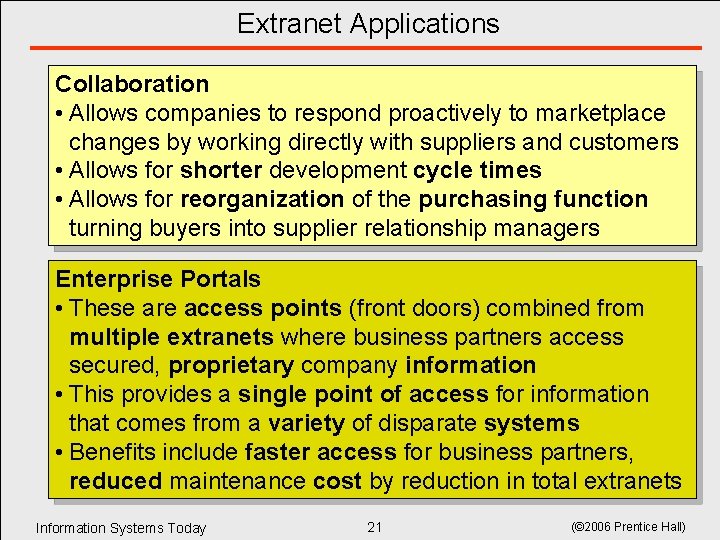
Extranet Applications Collaboration • Allows companies to respond proactively to marketplace changes by working directly with suppliers and customers • Allows for shorter development cycle times • Allows for reorganization of the purchasing function turning buyers into supplier relationship managers Enterprise Portals • These are access points (front doors) combined from multiple extranets where business partners access secured, proprietary company information • This provides a single point of access for information that comes from a variety of disparate systems • Benefits include faster access for business partners, reduced maintenance cost by reduction in total extranets Information Systems Today 21 (© 2006 Prentice Hall)
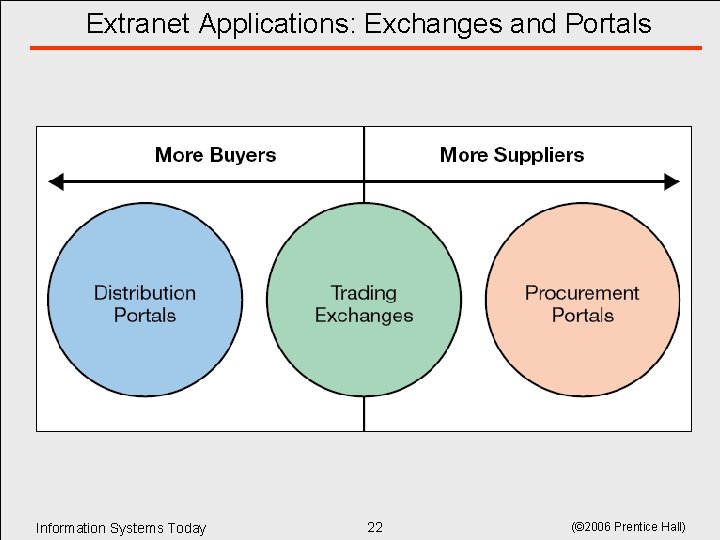
Extranet Applications: Exchanges and Portals Information Systems Today 22 (© 2006 Prentice Hall)
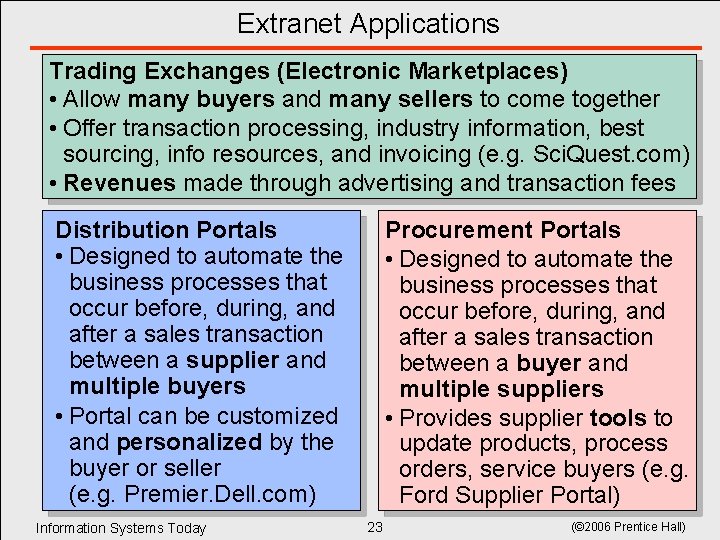
Extranet Applications Trading Exchanges (Electronic Marketplaces) • Allow many buyers and many sellers to come together • Offer transaction processing, industry information, best sourcing, info resources, and invoicing (e. g. Sci. Quest. com) • Revenues made through advertising and transaction fees Distribution Portals • Designed to automate the business processes that occur before, during, and after a sales transaction between a supplier and multiple buyers • Portal can be customized and personalized by the buyer or seller (e. g. Premier. Dell. com) Information Systems Today Procurement Portals • Designed to automate the business processes that occur before, during, and after a sales transaction between a buyer and multiple suppliers • Provides supplier tools to update products, process orders, service buyers (e. g. Ford Supplier Portal) 23 (© 2006 Prentice Hall)
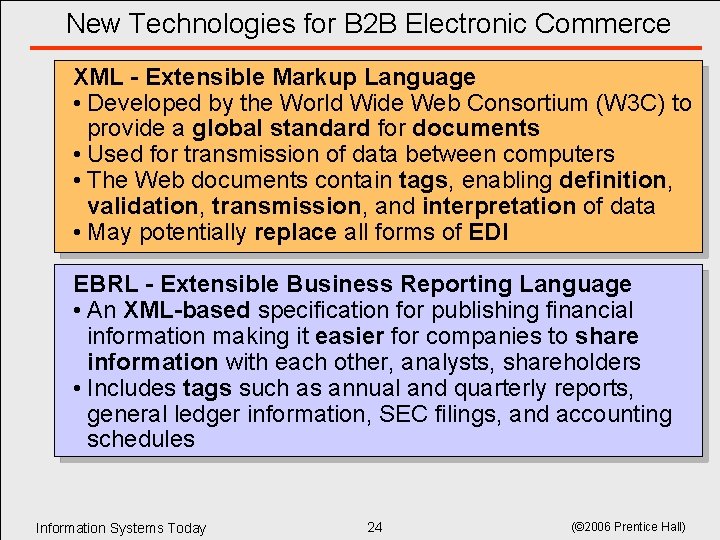
New Technologies for B 2 B Electronic Commerce XML - Extensible Markup Language • Developed by the World Wide Web Consortium (W 3 C) to provide a global standard for documents • Used for transmission of data between computers • The Web documents contain tags, enabling definition, validation, transmission, and interpretation of data • May potentially replace all forms of EDI EBRL - Extensible Business Reporting Language • An XML-based specification for publishing financial information making it easier for companies to share information with each other, analysts, shareholders • Includes tags such as annual and quarterly reports, general ledger information, SEC filings, and accounting schedules Information Systems Today 24 (© 2006 Prentice Hall)
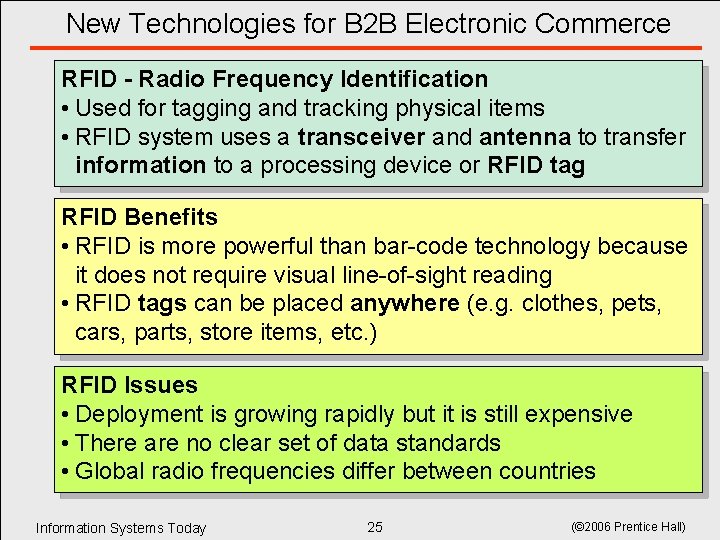
New Technologies for B 2 B Electronic Commerce RFID - Radio Frequency Identification • Used for tagging and tracking physical items • RFID system uses a transceiver and antenna to transfer information to a processing device or RFID tag RFID Benefits • RFID is more powerful than bar-code technology because it does not require visual line-of-sight reading • RFID tags can be placed anywhere (e. g. clothes, pets, cars, parts, store items, etc. ) RFID Issues • Deployment is growing rapidly but it is still expensive • There are no clear set of data standards • Global radio frequencies differ between countries Information Systems Today 25 (© 2006 Prentice Hall)
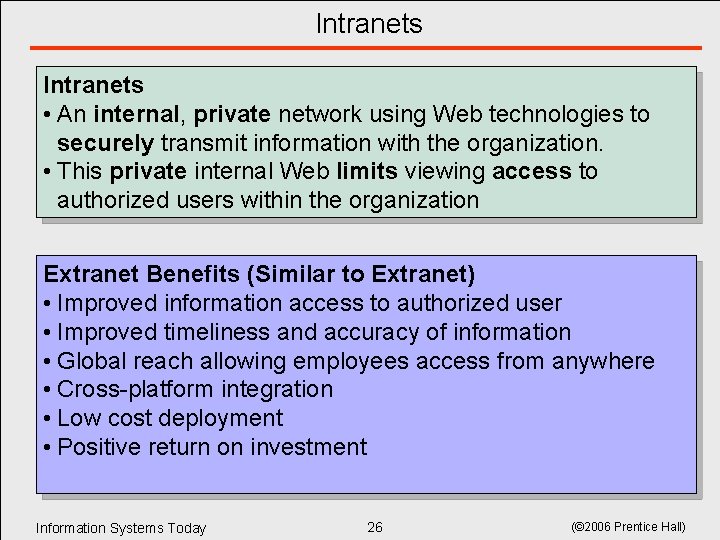
Intranets • An internal, private network using Web technologies to securely transmit information with the organization. • This private internal Web limits viewing access to authorized users within the organization Extranet Benefits (Similar to Extranet) • Improved information access to authorized user • Improved timeliness and accuracy of information • Global reach allowing employees access from anywhere • Cross-platform integration • Low cost deployment • Positive return on investment Information Systems Today 26 (© 2006 Prentice Hall)
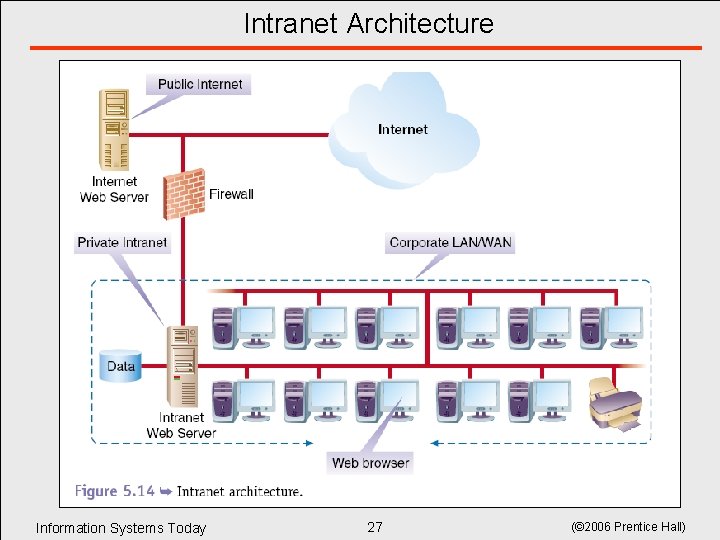
Intranet Architecture Information Systems Today 27 (© 2006 Prentice Hall)
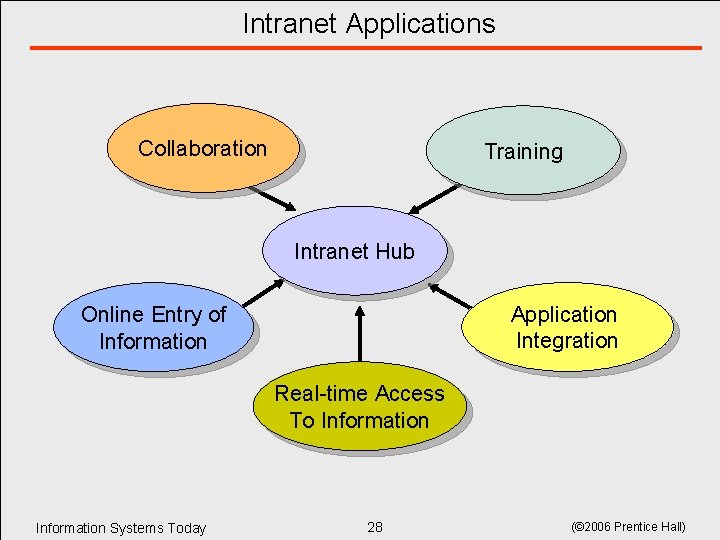
Intranet Applications Collaboration Training Intranet Hub Application Integration Online Entry of Information Real-time Access To Information Systems Today 28 (© 2006 Prentice Hall)
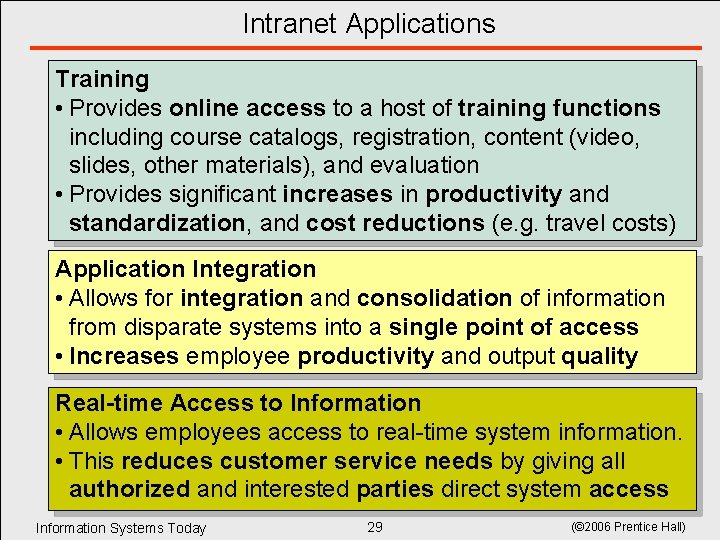
Intranet Applications Training • Provides online access to a host of training functions including course catalogs, registration, content (video, slides, other materials), and evaluation • Provides significant increases in productivity and standardization, and cost reductions (e. g. travel costs) Application Integration • Allows for integration and consolidation of information from disparate systems into a single point of access • Increases employee productivity and output quality Real-time Access to Information • Allows employees access to real-time system information. • This reduces customer service needs by giving all authorized and interested parties direct system access Information Systems Today 29 (© 2006 Prentice Hall)
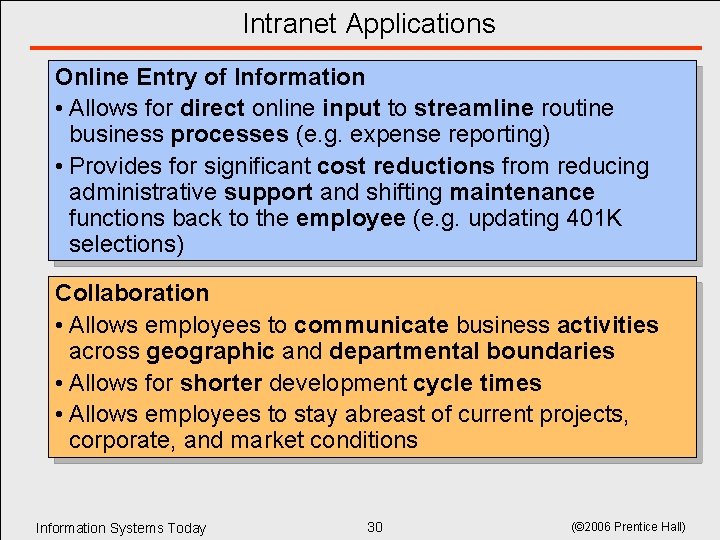
Intranet Applications Online Entry of Information • Allows for direct online input to streamline routine business processes (e. g. expense reporting) • Provides for significant cost reductions from reducing administrative support and shifting maintenance functions back to the employee (e. g. updating 401 K selections) Collaboration • Allows employees to communicate business activities across geographic and departmental boundaries • Allows for shorter development cycle times • Allows employees to stay abreast of current projects, corporate, and market conditions Information Systems Today 30 (© 2006 Prentice Hall)
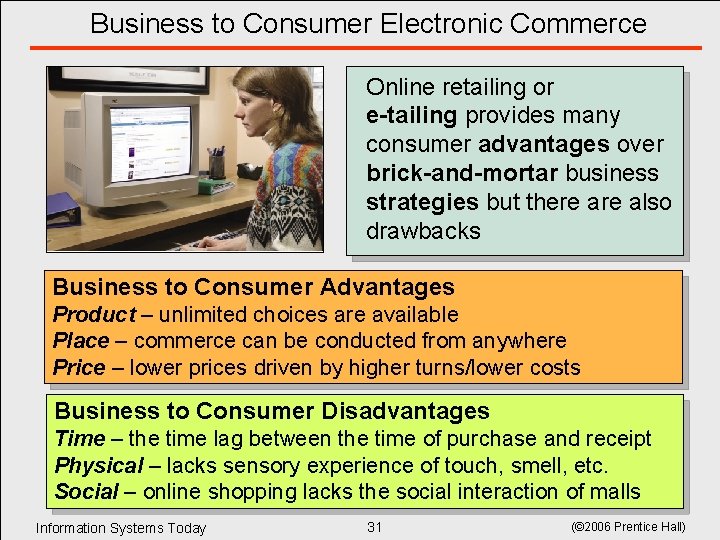
Business to Consumer Electronic Commerce Online retailing or e-tailing provides many consumer advantages over brick-and-mortar business strategies but there also drawbacks Business to Consumer Advantages Product – unlimited choices are available Place – commerce can be conducted from anywhere Price – lower prices driven by higher turns/lower costs Business to Consumer Disadvantages Time – the time lag between the time of purchase and receipt Physical – lacks sensory experience of touch, smell, etc. Social – online shopping lacks the social interaction of malls Information Systems Today 31 (© 2006 Prentice Hall)
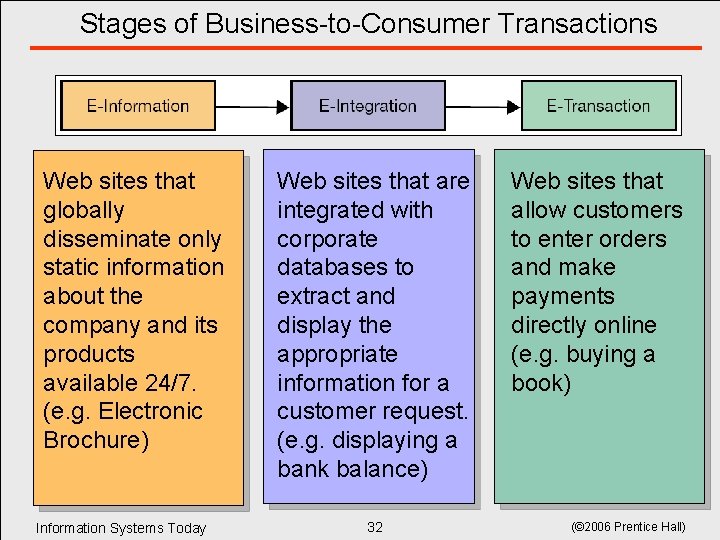
Stages of Business-to-Consumer Transactions Web sites that globally disseminate only static information about the company and its products available 24/7. (e. g. Electronic Brochure) Information Systems Today Web sites that are integrated with corporate databases to extract and display the appropriate information for a customer request. (e. g. displaying a bank balance) 32 Web sites that allow customers to enter orders and make payments directly online (e. g. buying a book) (© 2006 Prentice Hall)
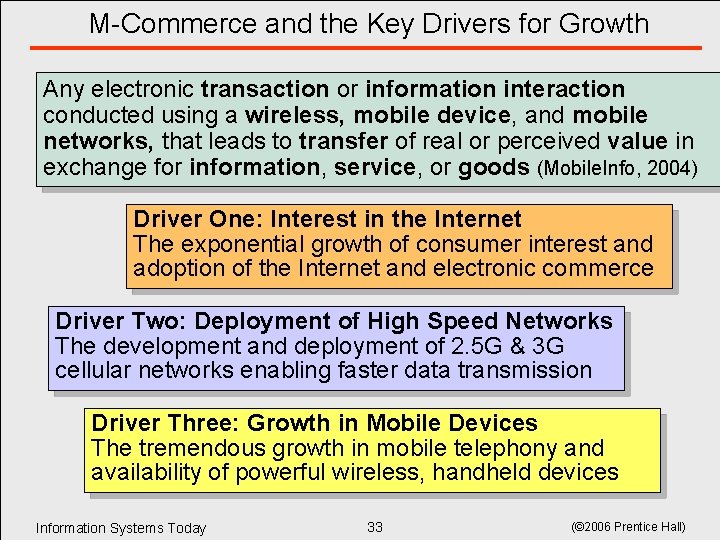
M-Commerce and the Key Drivers for Growth Any electronic transaction or information interaction conducted using a wireless, mobile device, and mobile networks, that leads to transfer of real or perceived value in exchange for information, service, or goods (Mobile. Info, 2004) Driver One: Interest in the Internet The exponential growth of consumer interest and adoption of the Internet and electronic commerce Driver Two: Deployment of High Speed Networks The development and deployment of 2. 5 G & 3 G cellular networks enabling faster data transmission Driver Three: Growth in Mobile Devices The tremendous growth in mobile telephony and availability of powerful wireless, handheld devices Information Systems Today 33 (© 2006 Prentice Hall)
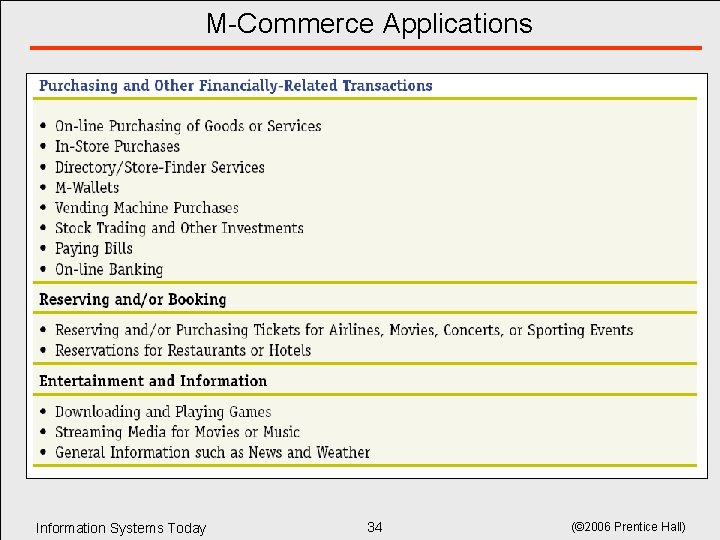
M-Commerce Applications Information Systems Today 34 (© 2006 Prentice Hall)
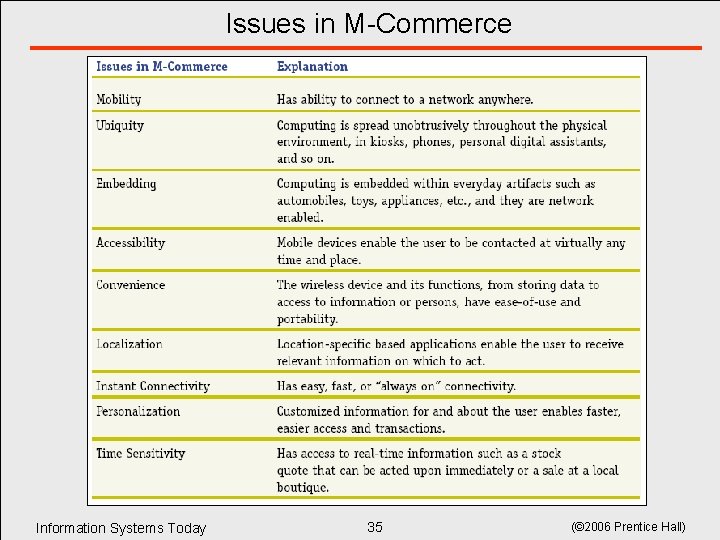
Issues in M-Commerce Information Systems Today 35 (© 2006 Prentice Hall)
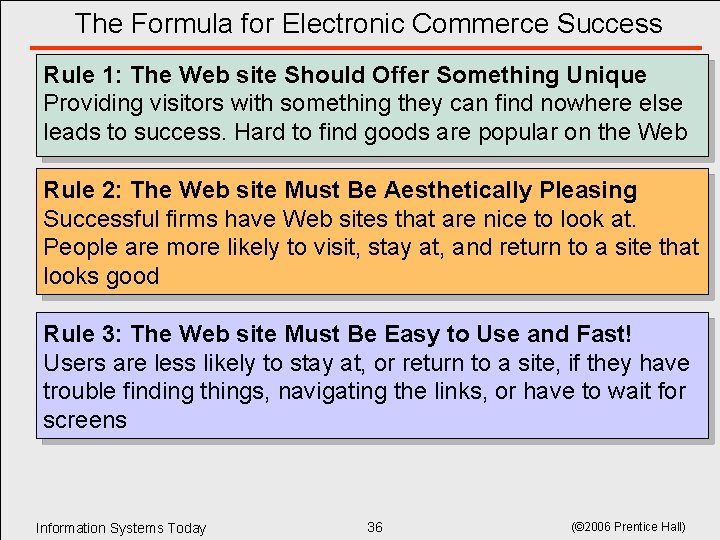
The Formula for Electronic Commerce Success Rule 1: The Web site Should Offer Something Unique Providing visitors with something they can find nowhere else leads to success. Hard to find goods are popular on the Web Rule 2: The Web site Must Be Aesthetically Pleasing Successful firms have Web sites that are nice to look at. People are more likely to visit, stay at, and return to a site that looks good Rule 3: The Web site Must Be Easy to Use and Fast! Users are less likely to stay at, or return to a site, if they have trouble finding things, navigating the links, or have to wait for screens Information Systems Today 36 (© 2006 Prentice Hall)
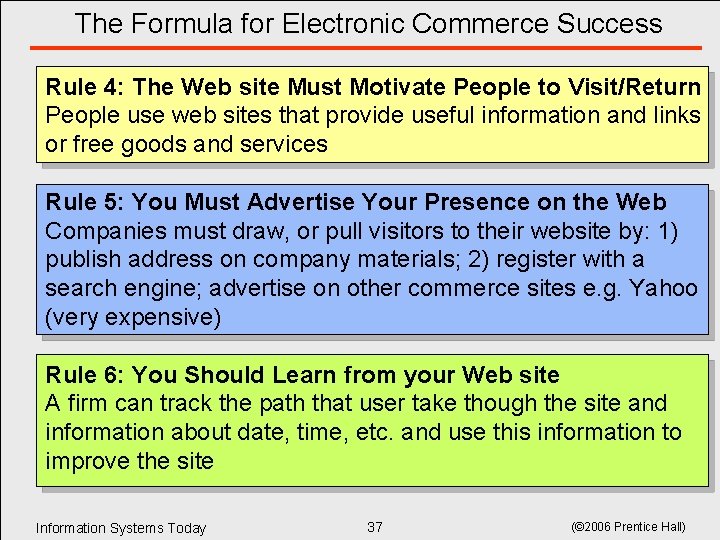
The Formula for Electronic Commerce Success Rule 4: The Web site Must Motivate People to Visit/Return People use web sites that provide useful information and links or free goods and services Rule 5: You Must Advertise Your Presence on the Web Companies must draw, or pull visitors to their website by: 1) publish address on company materials; 2) register with a search engine; advertise on other commerce sites e. g. Yahoo (very expensive) Rule 6: You Should Learn from your Web site A firm can track the path that user take though the site and information about date, time, etc. and use this information to improve the site Information Systems Today 37 (© 2006 Prentice Hall)