
Chapter 5 Ecosystems Concepts and Fundamentals Overview n
- Slides: 48
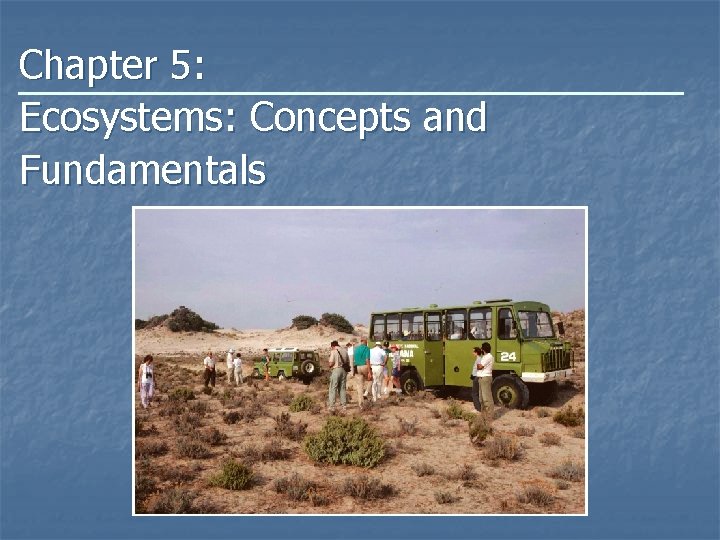
Chapter 5: Ecosystems: Concepts and Fundamentals
Overview n n n n n The Ecosystem: Sustaining Life on Earth Ecosystem Communities and Food Chains Ecosystems as Systems Biological Production and Ecosystem Energy Flow Biological Production and Biomass Energy Efficiency and Transfer Efficiency Ecological Stability and Succession Chemical Cycling and Succession How Species Change Succession
The Ecosystem: Sustaining Life on Earth n n Sustaining life on Earth requires more than individuals Ecosystem Interactions of many organisms functioning together in ecosystems n Physical and chemical environments n
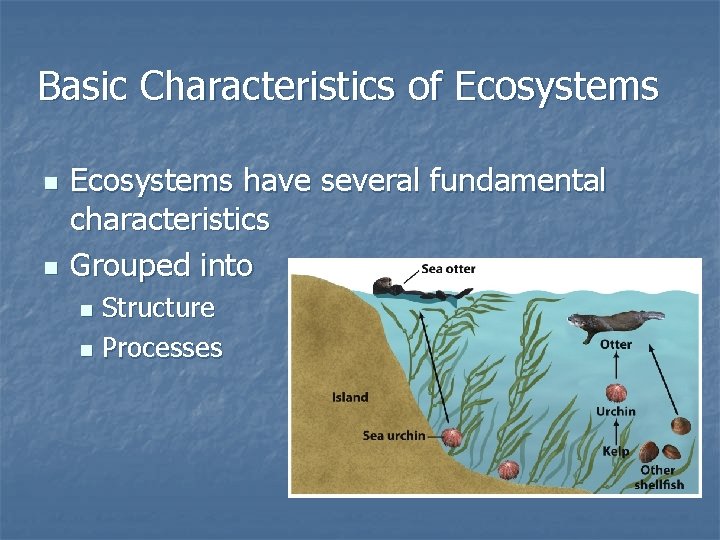
Basic Characteristics of Ecosystems n n Ecosystems have several fundamental characteristics Grouped into Structure n Processes n
Basic Characteristics of Ecosystems n Structure n Made up of two major parts Living (ecological community) n Non living (physical & chemical environment) n n Processes Cycling of chemical elements n Flow of energy n
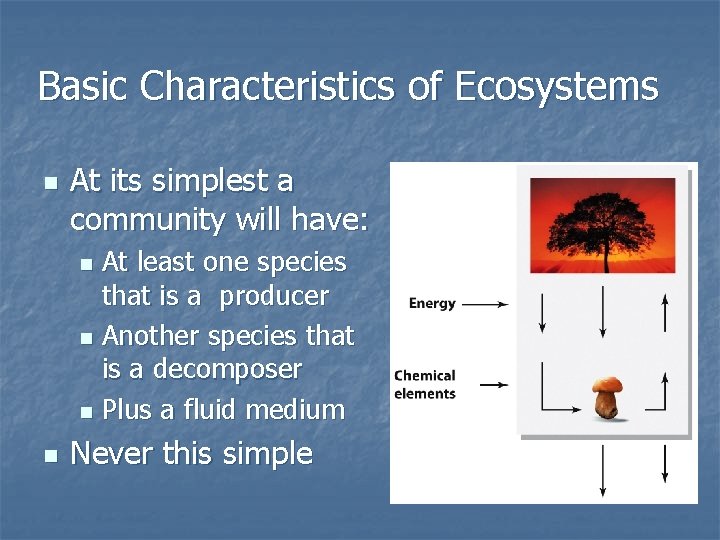
Basic Characteristics of Ecosystems n At its simplest a community will have: At least one species that is a producer n Another species that is a decomposer n Plus a fluid medium n n Never this simple
Basic Characteristics of Ecosystems n Ecosystem chemical cycling n For complete recycling of chemical elements, several species must interact Photosynthetic organisms produce sugar from carbon dioxide and water n From sugar and inorganic compound they make other organic compounds (protein, woody tissue) n Need decomposers to get back to inorganic compounds n
Ecological Communities and Food Chains n Ecological community definitions n A set of interacting species found in the same place and functioning together to maintain life n n In practice it is difficult to identify the interacting species All the species found in an area, whether or not they interact n Operational definition
Food Chains n Food chain Linkage of who feeds on whom n Energy, chemicals and some compounds are transferred from creature to creature along food chains or food webs (more complex) n n Grouped by trophic level n Number of feeding levels away from original source of energy
Trophic Levels n First trophic level Use energy from the sun and carbon dioxide from the air to photosynthesizes n Green plants, algae and certain bacteria n n n Called autotrophs Second trophic level Organisms that feed on autotrophs n Called herbivores n
Trophic Levels n Third trophic level Feed directly on herbivores n Called carnivores (meat eaters) n n Forth trophic level n n Carnivores that feed on third-level carnivores Decomposers- feed on waste and dead organisms of all trophic levels
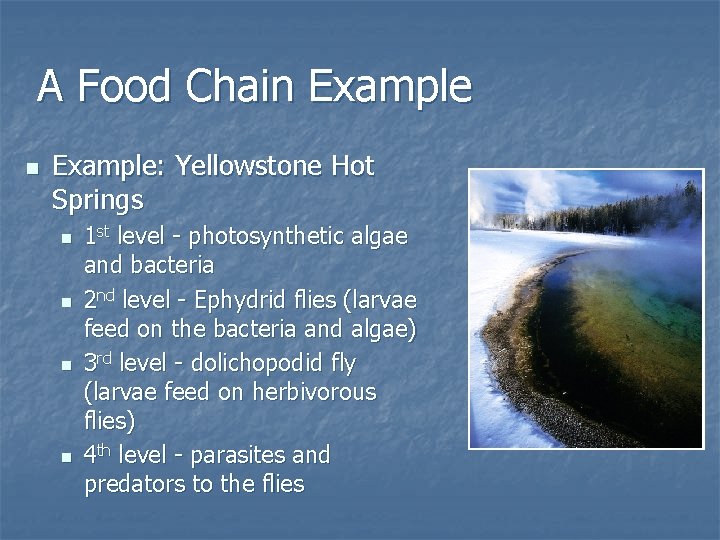
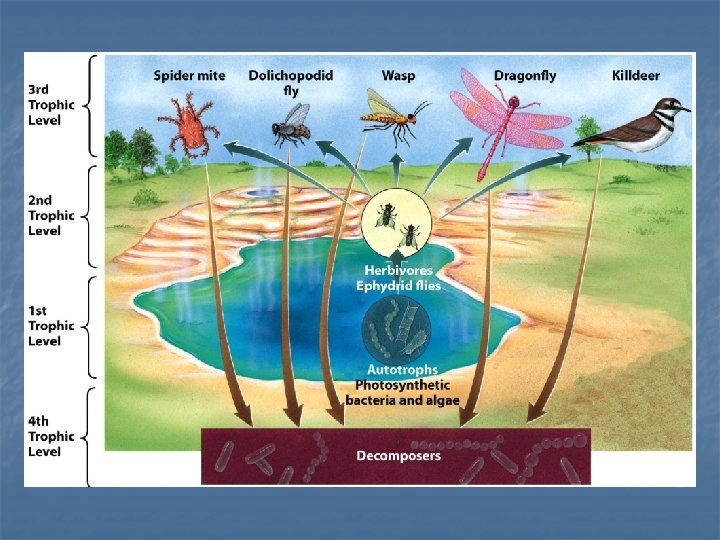
A Food Chain Example: Yellowstone Hot Springs n n 1 st level - photosynthetic algae and bacteria 2 nd level - Ephydrid flies (larvae feed on the bacteria and algae) 3 rd level - dolichopodid fly (larvae feed on herbivorous flies) 4 th level - parasites and predators to the flies
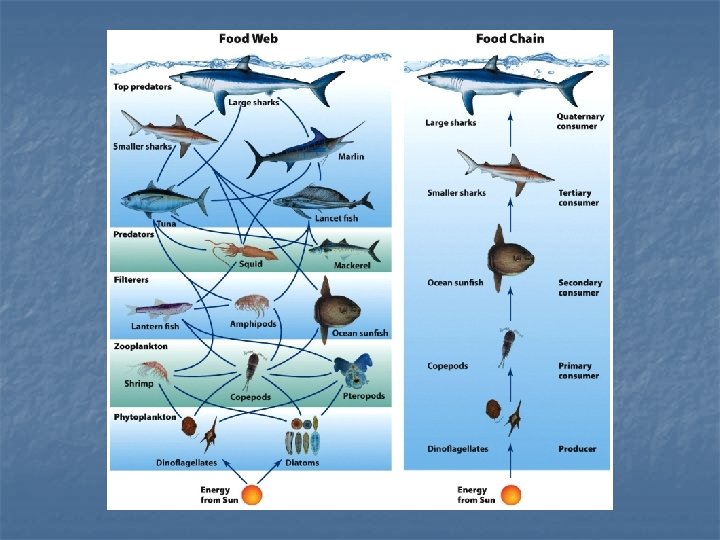
An Oceanic Food Chain n n Tend to have more trophic levels 1 st level - planktonic algae and planktonic bacteria 2 nd level - zooplankton and some fish 3 rd level - fish and invertebrates feed on herbivores, baleen whales 4 th+ levels - killer whales, predatory fish
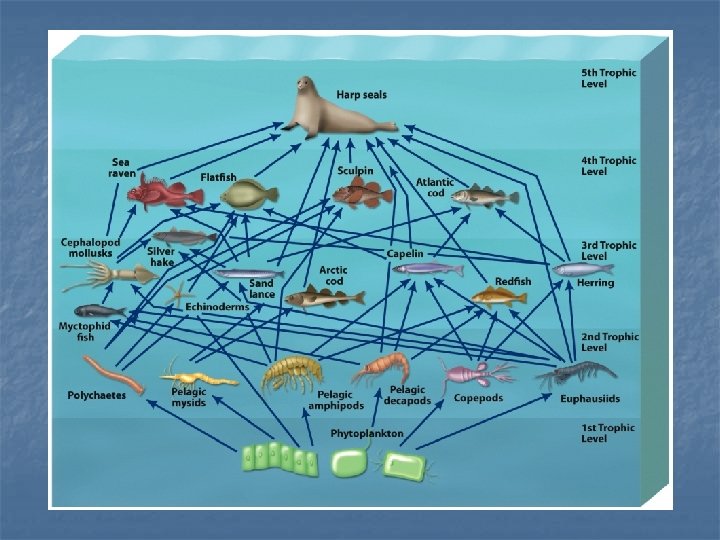
Complex Food Web - Harp Seal n n Most species feed on several trophic levels Harp seal (shown at 5 th level) Feeds on flatfish (4 th level) n But also feed on foods from 2 nd – 4 th n A species that feeds on several levels placed in a category one above the highest level it feeds on n
Ecosystem as Systems n n An ecosystem is the minimal entity that has the properties required to sustain life Vary greatly in: Structural complexity and clarity of their boundaries n Size n Composition n Proportion of non-biological constituents n Degree of variation in time and space n
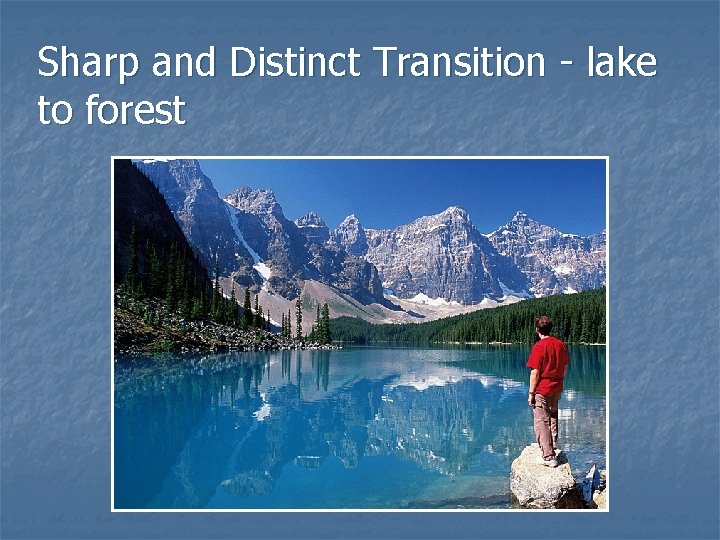
Sharp and Distinct Transition - lake to forest
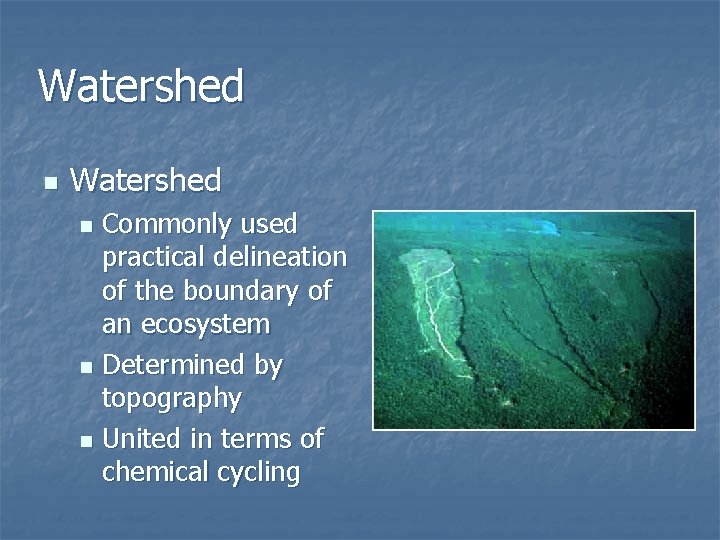
Watershed n Watershed Commonly used practical delineation of the boundary of an ecosystem n Determined by topography n United in terms of chemical cycling n
Ecosystem Energy flow n All life requires energy n n Ability to do work Ecosystem energy flow n Movement of energy through an ecosystem from the external environment through a series of organisms and back to the external environment
Energy Flow Energy enters an ecosystem by two pathways: n 1. 2. Energy fixed by organisms Transfer of heat energy by air, water, soil and warm living things
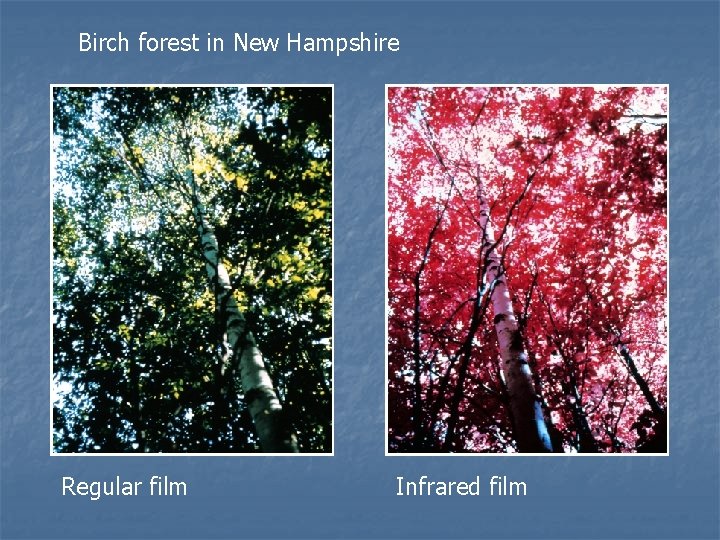
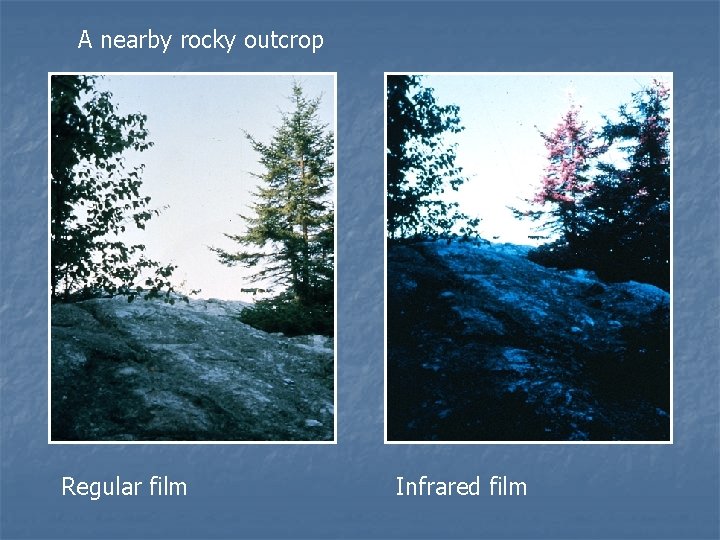
Ecosystem Energy Flow n n Energy is difficult and abstract concept Most of the time energy is invisible to us n With infrared film we can see difference between warm and cold object
Birch forest in New Hampshire Regular film Infrared film
A nearby rocky outcrop Regular film Infrared film
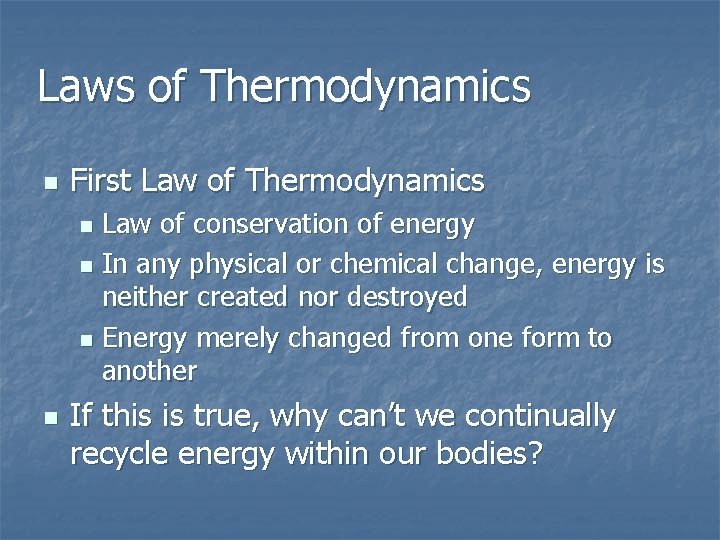
Laws of Thermodynamics n First Law of Thermodynamics Law of conservation of energy n In any physical or chemical change, energy is neither created nor destroyed n Energy merely changed from one form to another n n If this is true, why can’t we continually recycle energy within our bodies?
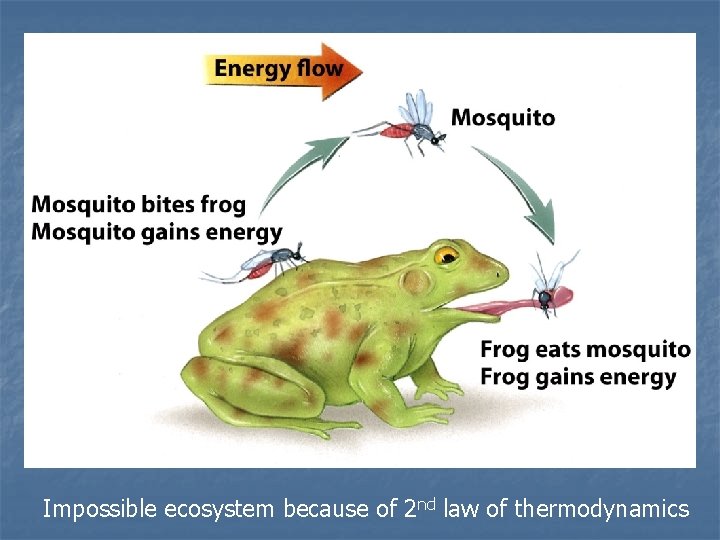
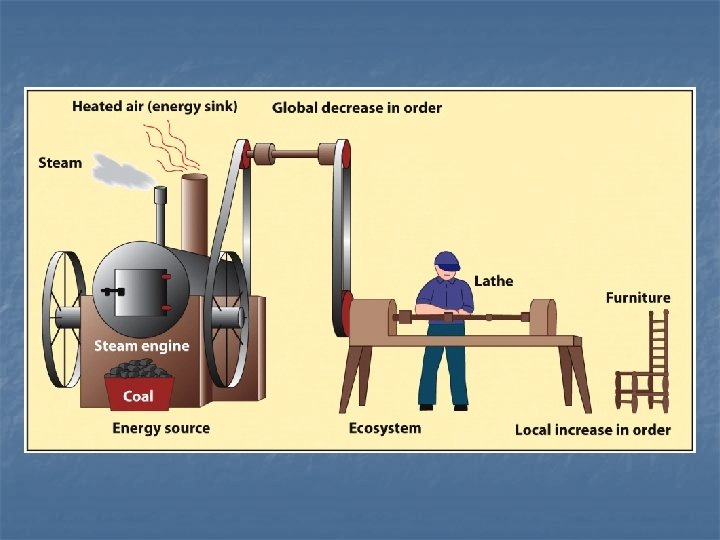
Impossible ecosystem because of 2 nd law of thermodynamics
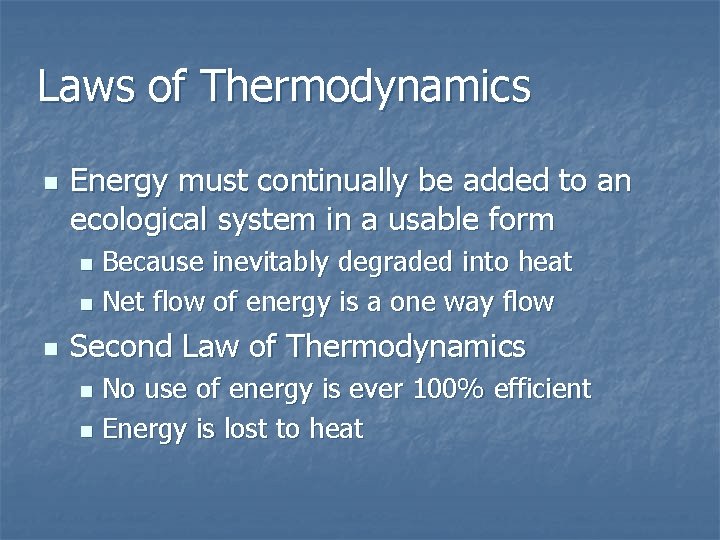
Laws of Thermodynamics n Energy must continually be added to an ecological system in a usable form Because inevitably degraded into heat n Net flow of energy is a one way flow n n Second Law of Thermodynamics No use of energy is ever 100% efficient n Energy is lost to heat n
Energy Efficiency n As energy flows through a food web, it is degraded, and less is useable n n Entropy Energy must be continually added to an ecosystem, in usable form
Biological Production n Biomass Total amount of organic matter on Earth or in any ecosystem or area n Measured as the amount per unit surface area n n Biological production n Capture of usable energy from the environment to produce organic compounds
Biological Production n Gross Production n n Net Production n n Increase in stored energy before any is used Change in biomass over a given time Three measures used for biological production Biomass n Energy stored n Carbon stored n
Two Kinds of Biological Production n Primary Production Autotrophs (& chemoautotrophs) n Photosynthesize or chemosynthesize n n n Make their own organic matter from energy source and inorganic compounds Secondary production Heterotrophs n Cannot make their own organic compounds and must feed on other living things n
Biological Production n Respiration n Use of energy from organic matter by most heterotrophic and autotrophic organisms Organic matter combines with oxygen n Releases energy, carbon dioxide and water n n Use of biomass to release energy that can be used to do work
Energy Efficiency and Transfer Efficiency n Trophic-level efficiency Ratio of production of one trophic level to the production of the next trophic level n Never very high n 1– 3% in natural ecosystems n 10% may be maximum n n 90% of all energy lost as heat
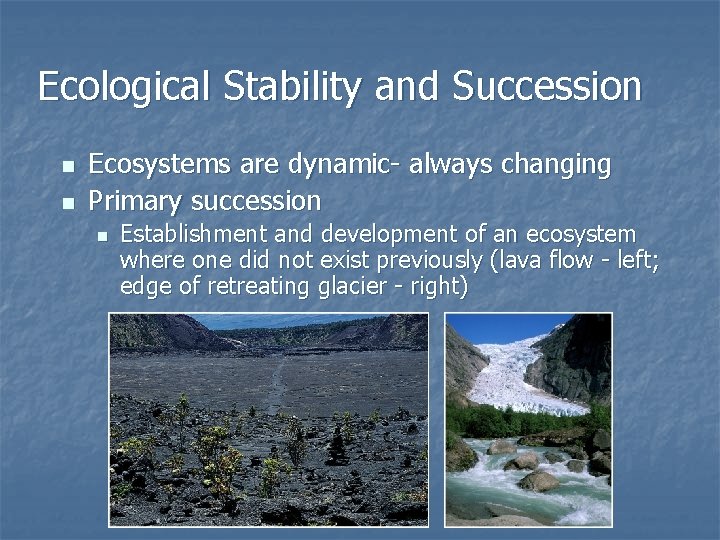
Ecological Stability and Succession n n Ecosystems are dynamic- always changing Primary succession n Establishment and development of an ecosystem where one did not exist previously (lava flow - left; edge of retreating glacier - right)
Ecological Stability and Succession n Secondary succession Reestablishment of an ecosystem following disturbance n Remnants of previous biological community (soil, seeds, organic material, etc. ) n Examples n Forests that develop on abandoned pastures n Development after hurricanes, floods, fires n
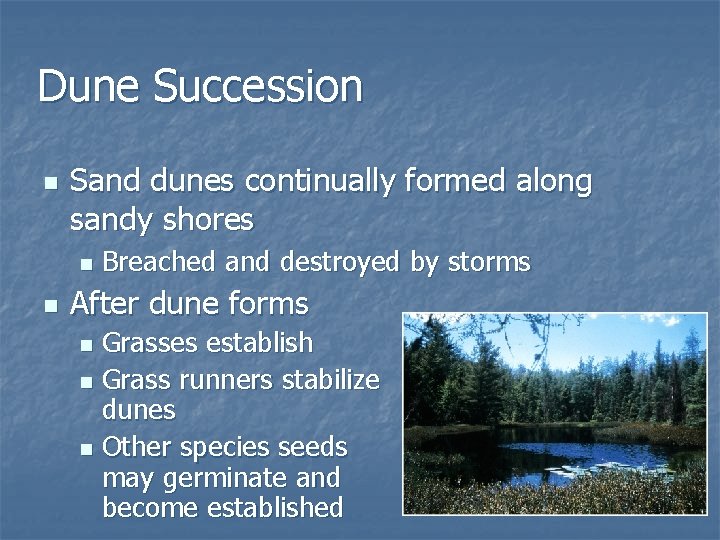
Dune Succession n Sand dunes continually formed along sandy shores n n Breached and destroyed by storms After dune forms Grasses establish n Grass runners stabilize dunes n Other species seeds may germinate and become established n
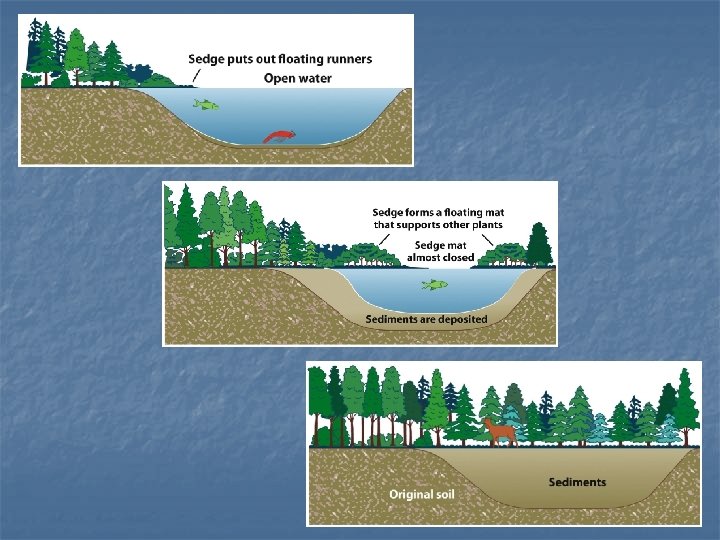
Bog Succession n n Bog - Open body of water with surface inlets but no surface outlets Succession: Sedge puts out floating runners n Wind blows particles into the mat of runners n Seeds land on runners and germinate n Mat becomes thicker and shrubs and trees develop n
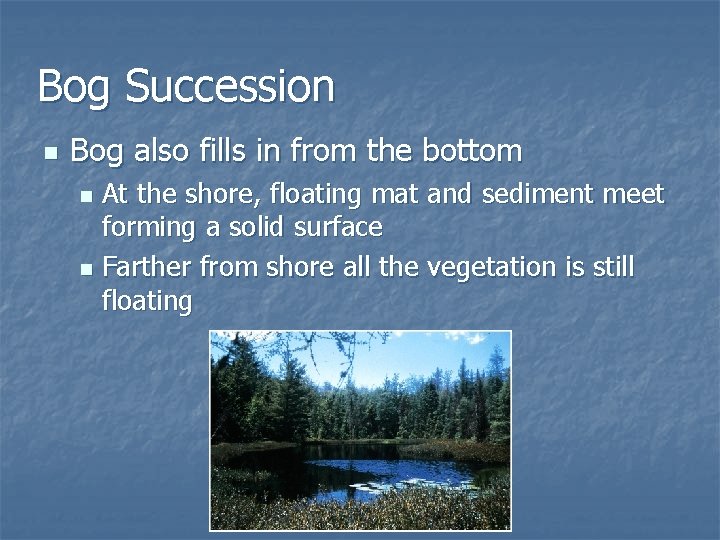
Bog Succession n Bog also fills in from the bottom At the shore, floating mat and sediment meet forming a solid surface n Farther from shore all the vegetation is still floating n
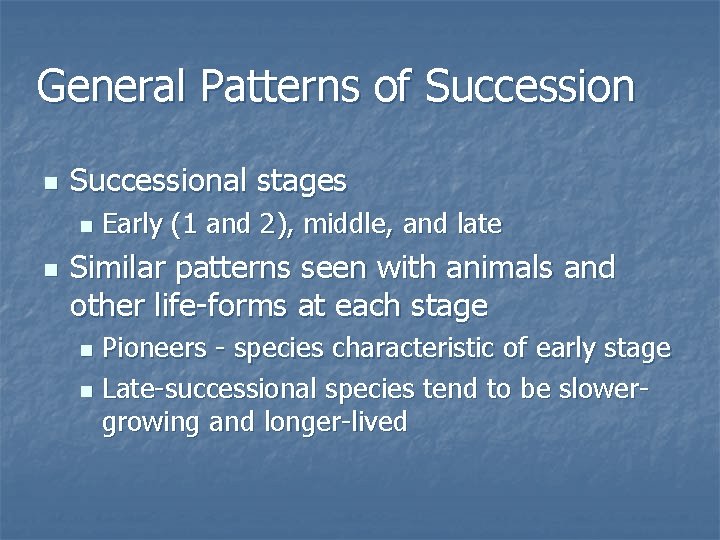
General Patterns of Succession n Successional stages n n Early (1 and 2), middle, and late Similar patterns seen with animals and other life-forms at each stage Pioneers - species characteristic of early stage n Late-successional species tend to be slowergrowing and longer-lived n
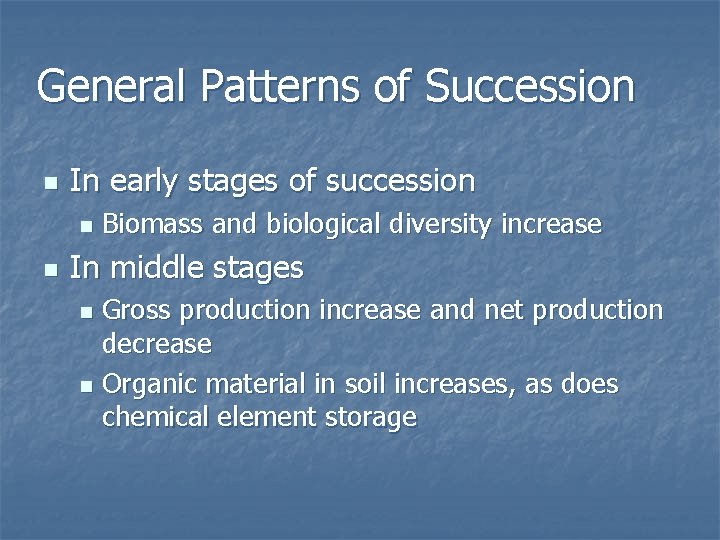
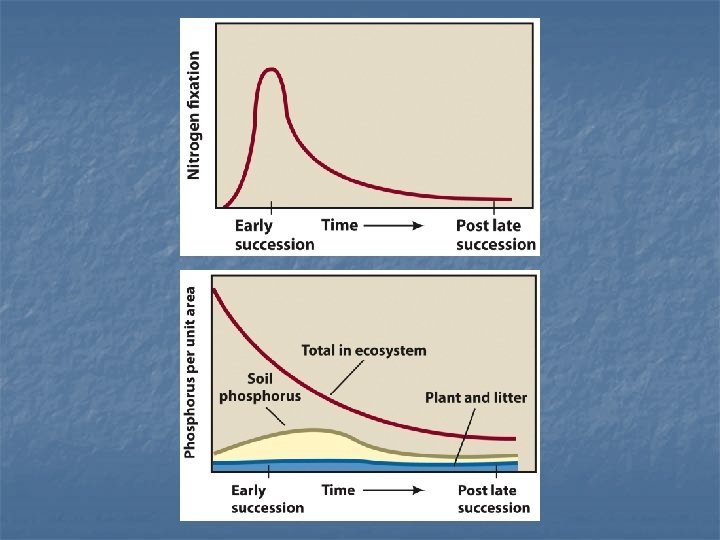
General Patterns of Succession n In early stages of succession n n Biomass and biological diversity increase In middle stages Gross production increase and net production decrease n Organic material in soil increases, as does chemical element storage n
How Species Change Succession n Earlier succession species affect what happens later in succession through: Facilitation n Interference n Life history differences n
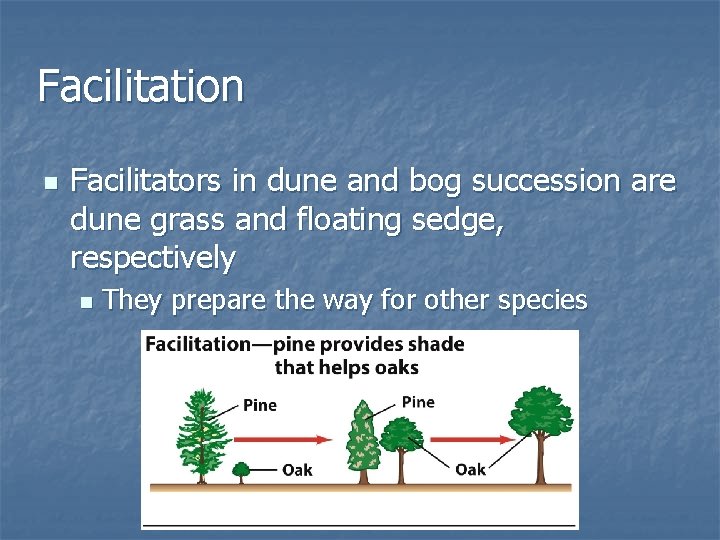
Facilitation n Facilitators in dune and bog succession are dune grass and floating sedge, respectively n They prepare the way for other species
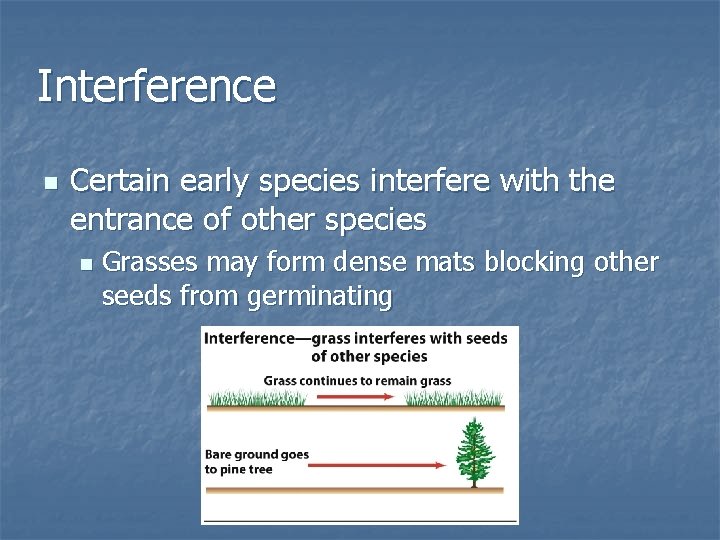
Interference n Certain early species interfere with the entrance of other species n Grasses may form dense mats blocking other seeds from germinating
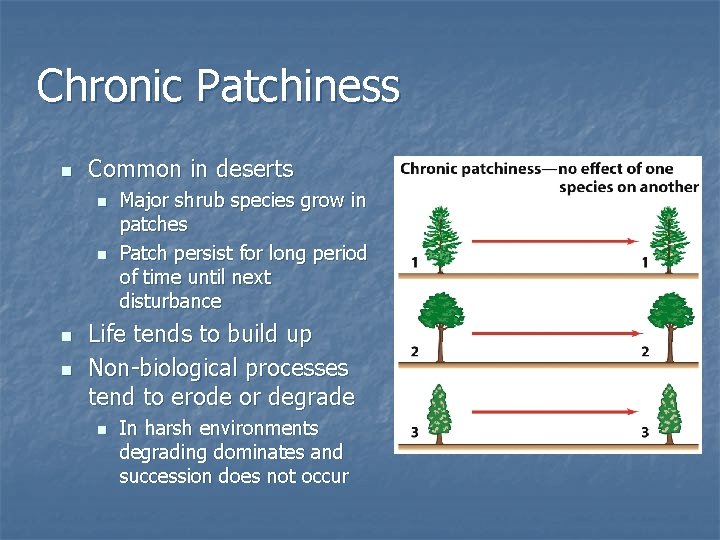
Chronic Patchiness n Common in deserts n n Major shrub species grow in patches Patch persist for long period of time until next disturbance Life tends to build up Non-biological processes tend to erode or degrade n In harsh environments degrading dominates and succession does not occur