
Chapter 5 Discrete Probability Distributions Copyright 2012 The
Chapter 5 Discrete Probability Distributions Copyright © 2012 The Mc. Graw-Hill Companies, Inc. Permission required for reproduction or display. 1
Discrete Probability Distributions Outline: 5 -1 Probability Distributions 5 -2 Mean, Variance, Standard Deviation, and Expectation 5 -3 The Binomial Distribution 5 -4 Other Types of Distributions (Optional) 5
Discrete Probability Distributions Goals 5 1 Construct a probability distribution for a random variable. 2 Find the mean, variance, standard deviation, and expected value for a discrete random variable. 3 Find the exact probability for X successes in n trials of a binomial experiment. 4 Find the mean, variance, and standard deviation for the variable of a binomial distribution. 5 Find probabilities for outcomes of variables, using the Poisson, hyper geometric, and multinomial distributions.
Standard DA-5: Chapter 5: Lesson 5. 1 Objective: 1. Complete the problems in Review Exercises of Chapter 4: (2 -40) 2. Identify a probability distribution 3. Construct the probability distribution of a random variable
Key words § § 1. random variable 2. discrete random variable 3. continuous random variable 4. probability distribution function
Random variable: X l l l l Example: 1. Suppose a coin is tossed five times. X: the number of heads that can happen 2. Suppose you are waiting for school bus X: the number of minutes of waiting time 3. Suppose you work in MCHS front office X: the number of telephone calls you receive in a day
discrete random variable n It assumes the values from whole numbers. n Example: n 1. number of printing mistakes in a book. n 2. number of senior citizens in Bennettsville n 3. numbers of computers in our school n
continuous random variable n It assumes the numbers that may include the decimals. n Example n 1. life time of a battery of a wall clock in hours n 2. weight of a pumpkin in kilograms n 3. your height in meters
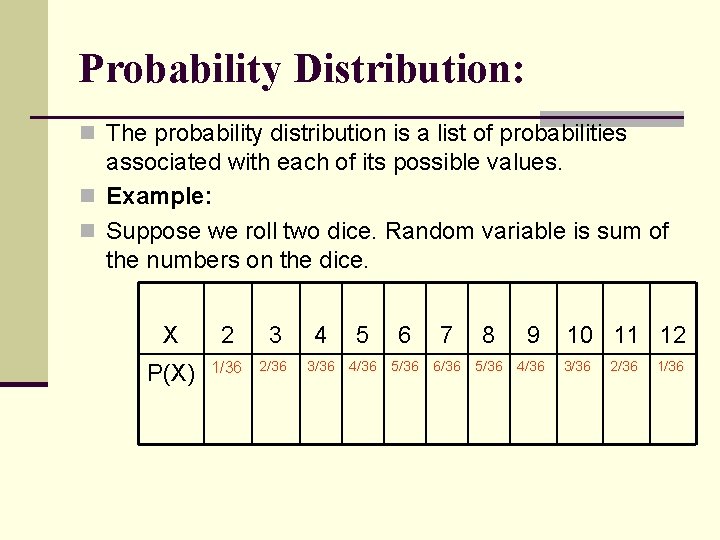
Probability Distribution: n The probability distribution is a list of probabilities associated with each of its possible values. n Example: n Suppose we roll two dice. Random variable is sum of the numbers on the dice. X 2 3 4 5 6 7 8 9 P(X) 1/36 2/36 3/36 4/36 5/36 6/36 5/36 4/36 10 11 12 3/36 2/36 1/36
To identify probability distribution n 1. In the list of probabilities each number should be between 0 and 1 or 0 or 1. n 2. The sum of all probabilities is equal to 1
Construct a probability distribution n Example: n Two coins are tossed. Construct probability distribution for the following random variables. n 1. the number of heads n 2. the number of tails
Classwork/home work n Textbook: pages 258 -259 n Solve the problems 1 thru 30 in exercises 5. 1
- Slides: 12