
Chapter 5 Digital Modulation Systems Multilevel Modulated Bandpass
Chapter 5 Digital Modulation Systems Ø Ø Ø Multilevel Modulated Bandpass Signalling Representation in the I-Q Plane MPSK and QPSK QAM PSD of MPSK, QPSK and QAM Huseyin Bilgekul EEE 461 Communication Systems II Department of Electrical and Electronic Engineering Eastern Mediterranean University EEE 461 1
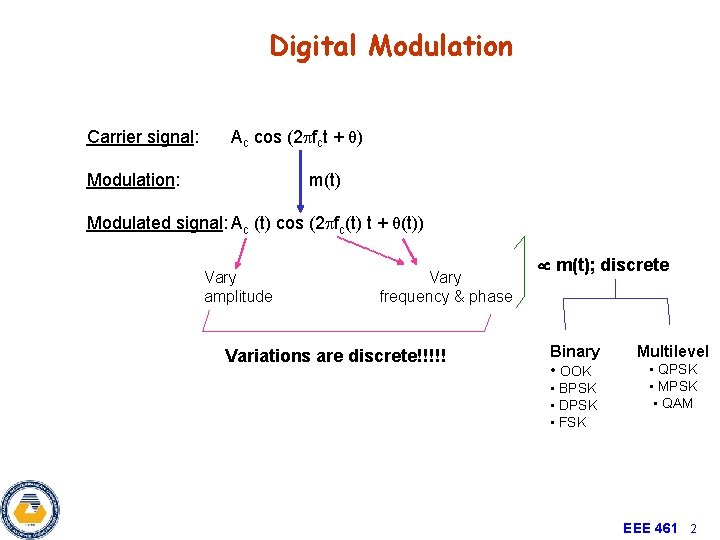
Digital Modulation Carrier signal: Ac cos (2 pfct + θ) Modulation: m(t) Modulated signal: Ac (t) cos (2 pfc(t) t + θ(t)) Vary amplitude Vary frequency & phase Variations are discrete!!!!! m(t); discrete Binary • OOK • BPSK • DPSK • FSK Multilevel • QPSK • MPSK • QAM EEE 461 2
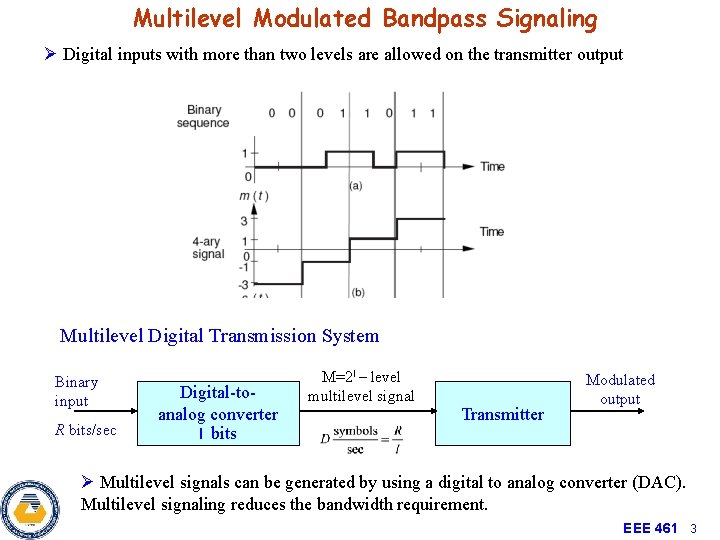
Multilevel Modulated Bandpass Signaling Ø Digital inputs with more than two levels are allowed on the transmitter output Multilevel Digital Transmission System Binary input R bits/sec Digital-toanalog converter l bits M=2 l – level multilevel signal Transmitter Modulated output Ø Multilevel signals can be generated by using a digital to analog converter (DAC). Multilevel signaling reduces the bandwidth requirement. EEE 461 3
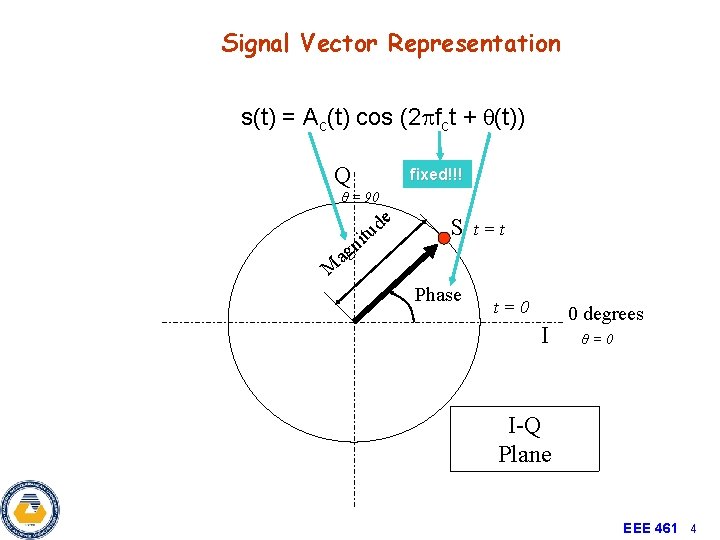
Signal Vector Representation s(t) = Ac(t) cos (2 pfct + θ(t)) Q fixed!!! θ = 90 n g a M de u it S Phase t=t t=0 I 0 degrees θ=0 I-Q Plane EEE 461 4
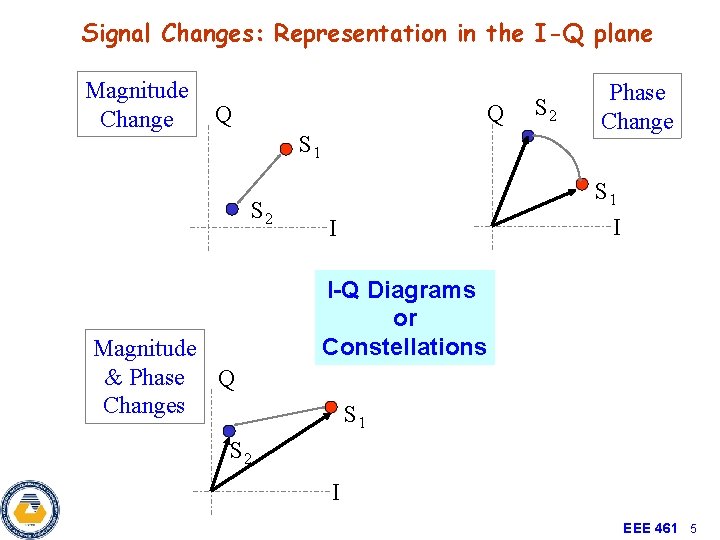
Signal Changes: Representation in the I-Q plane Magnitude Change Q Q S 1 S 2 Magnitude & Phase Q Changes S 2 Phase Change S 1 I I I-Q Diagrams or Constellations S 1 S 2 I EEE 461 5
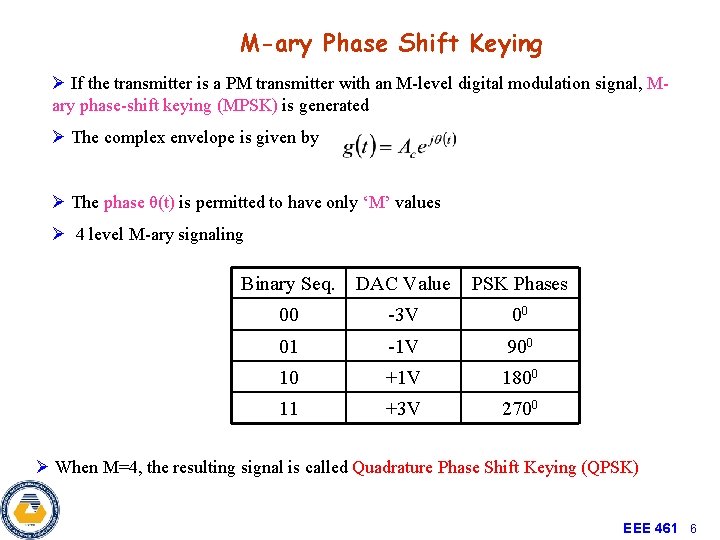
M-ary Phase Shift Keying Ø If the transmitter is a PM transmitter with an M-level digital modulation signal, Mary phase-shift keying (MPSK) is generated Ø The complex envelope is given by Ø The phase θ(t) is permitted to have only ‘M’ values Ø 4 level M-ary signaling Binary Seq. DAC Value PSK Phases 00 -3 V 00 01 -1 V 900 10 +1 V 1800 11 +3 V 2700 Ø When M=4, the resulting signal is called Quadrature Phase Shift Keying (QPSK) EEE 461 6
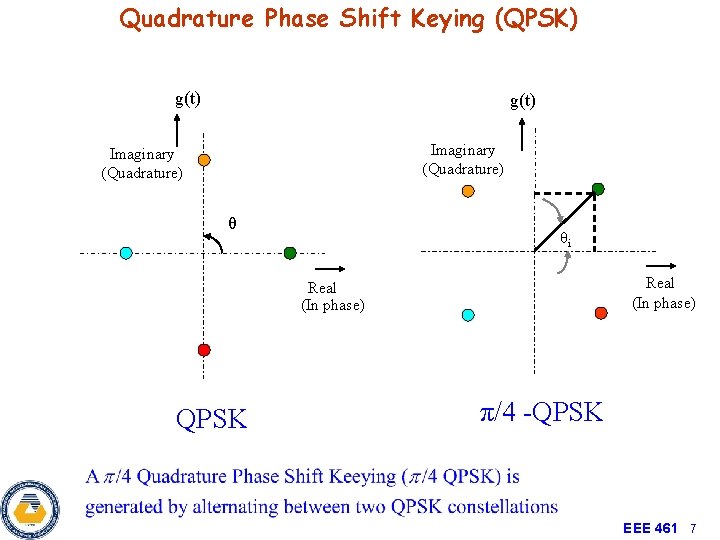
Quadrature Phase Shift Keying (QPSK) g(t) Imaginary (Quadrature) θ θi Real (In phase) QPSK π/4 -QPSK EEE 461 7
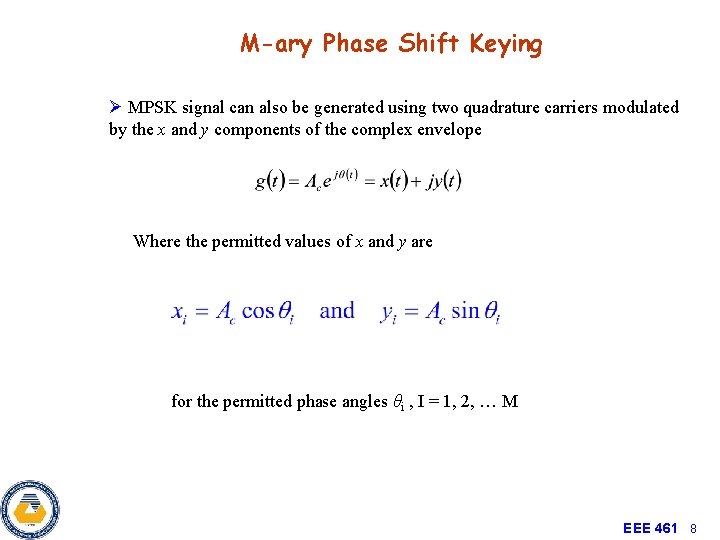
M-ary Phase Shift Keying Ø MPSK signal can also be generated using two quadrature carriers modulated by the x and y components of the complex envelope Where the permitted values of x and y are for the permitted phase angles θi , I = 1, 2, … M EEE 461 8

QPSK signal EEE 461 9
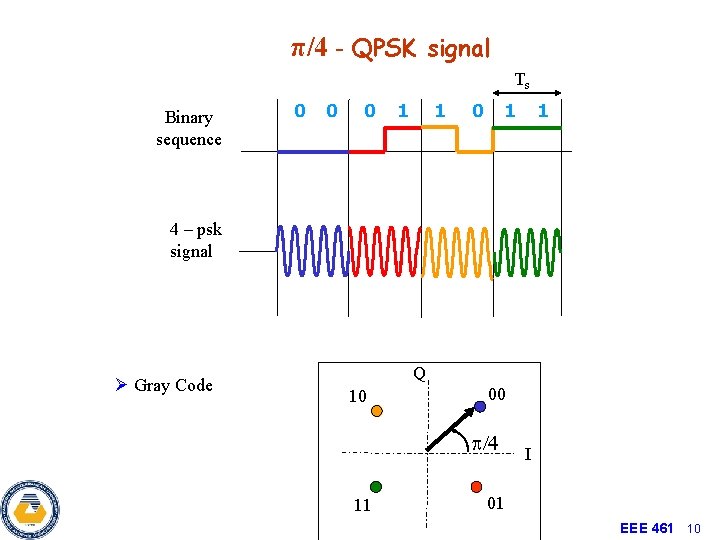
π/4 - QPSK signal Ts Binary sequence 0 0 0 1 1 4 – psk signal Ø Gray Code Q 10 00 p/4 11 I 01 EEE 461 10
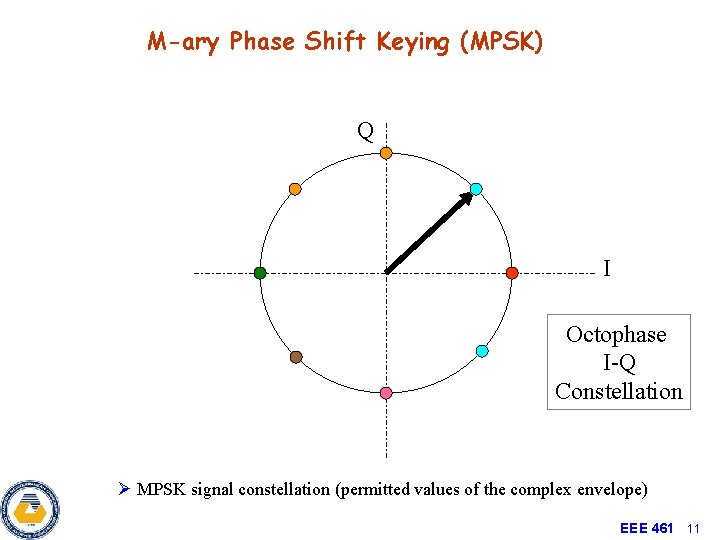
M-ary Phase Shift Keying (MPSK) Q I Octophase I-Q Constellation Ø MPSK signal constellation (permitted values of the complex envelope) EEE 461 11

Quadrature Amplitude Modulation (QAM) Ø QAM signal constellations are not restricted to having signaling points only on the circle of radius Ac (This is unlike M-PSK) The general QAM signal Where the complex envelope is With and where (xn, yn) denotes one of the permitted values of (xi, yi) during the symbol time that is centered on EEE 461 12

Quadrature Amplitude Modulation (QAM) Q I 16 -QAM I-Q Constellation Ø 16 symbol QAM constellation (four symbols per dimension) EEE 461 13
OPSK & π/4 QPSK Ø Offset Quadrature Phase-Shift Keying (OQPSK) is M=4 PSK in which allowed data transition times for the I and Q components are offset by a ½ symbol period Ø A π/4 Quadrature Phase-shift Keying (π/4 QPSK) signal is generated by alternating between two QPSK constellations that are rotated by π/4 with respect to each other EEE 461 14
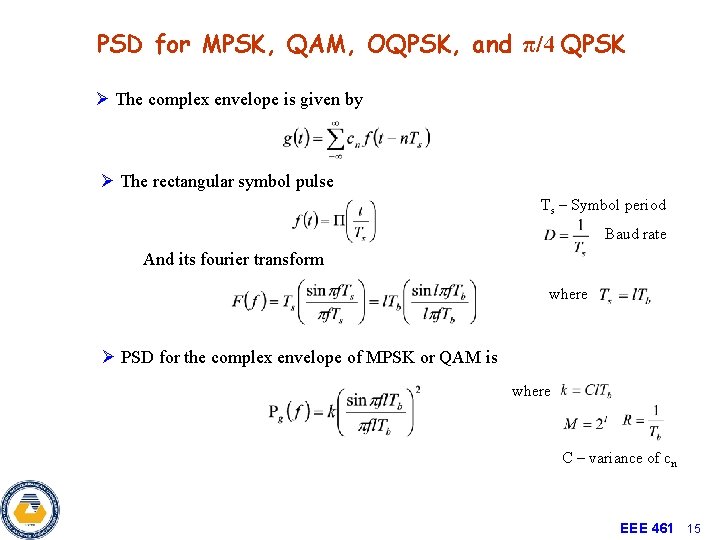
PSD for MPSK, QAM, OQPSK, and π/4 QPSK Ø The complex envelope is given by Ø The rectangular symbol pulse Ts – Symbol period Baud rate And its fourier transform where Ø PSD for the complex envelope of MPSK or QAM is where C – variance of cn EEE 461 15
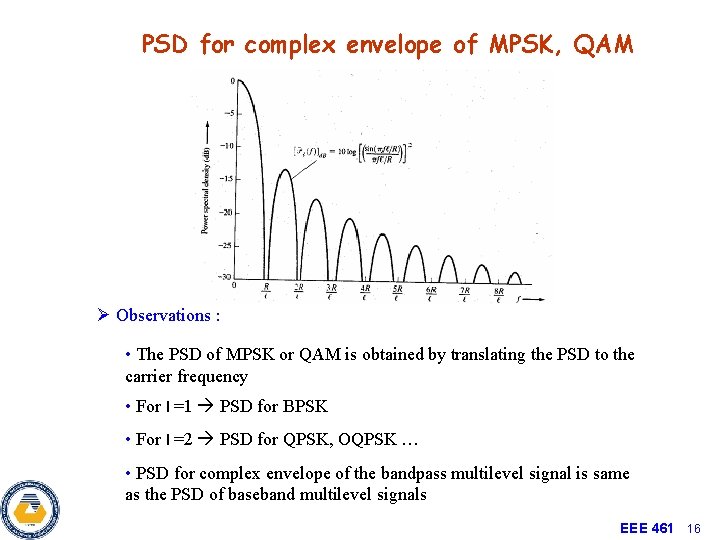
PSD for complex envelope of MPSK, QAM Ø Observations : • The PSD of MPSK or QAM is obtained by translating the PSD to the carrier frequency • For l =1 PSD for BPSK • For l =2 PSD for QPSK, OQPSK … • PSD for complex envelope of the bandpass multilevel signal is same as the PSD of baseband multilevel signals EEE 461 16
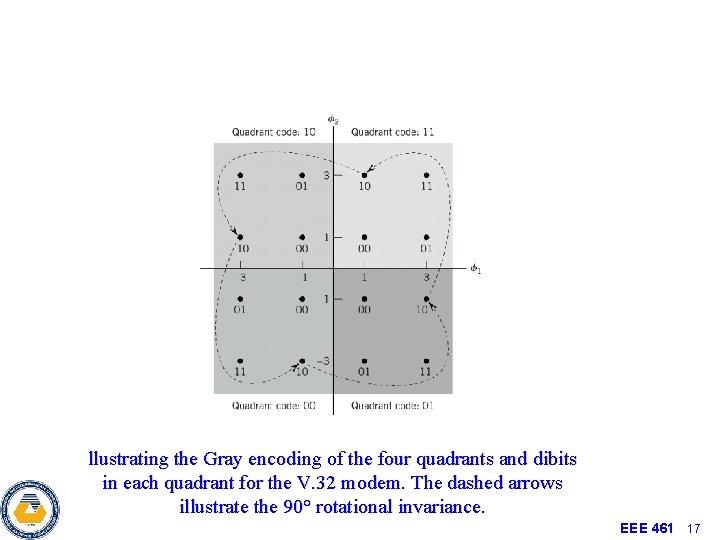
llustrating the Gray encoding of the four quadrants and dibits in each quadrant for the V. 32 modem. The dashed arrows illustrate the 90° rotational invariance. EEE 461 17
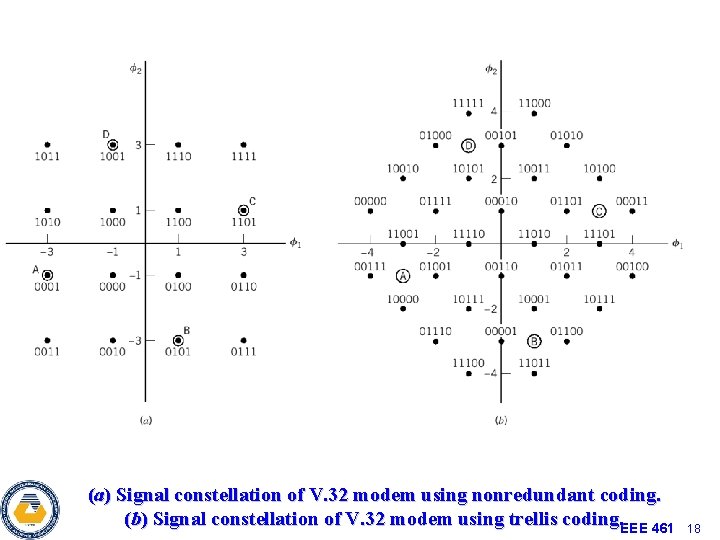
(a) Signal constellation of V. 32 modem using nonredundant coding. (b) Signal constellation of V. 32 modem using trellis coding. EEE 461 18
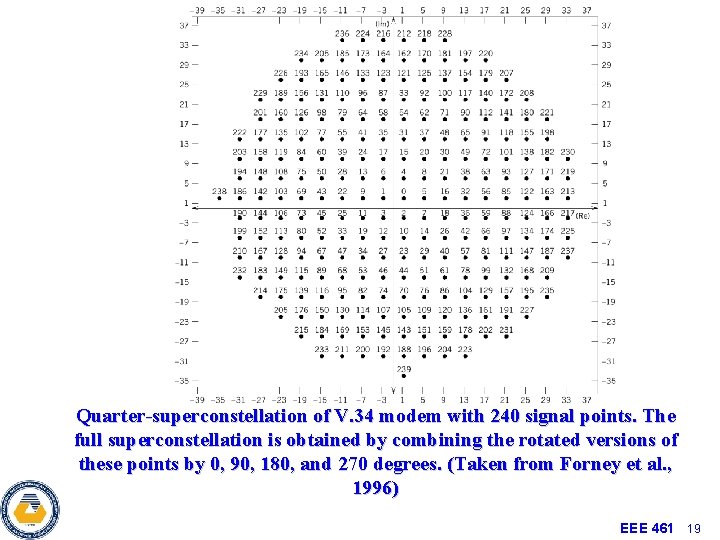
Quarter-superconstellation of V. 34 modem with 240 signal points. The full superconstellation is obtained by combining the rotated versions of these points by 0, 90, 180, and 270 degrees. (Taken from Forney et al. , 1996) EEE 461 19
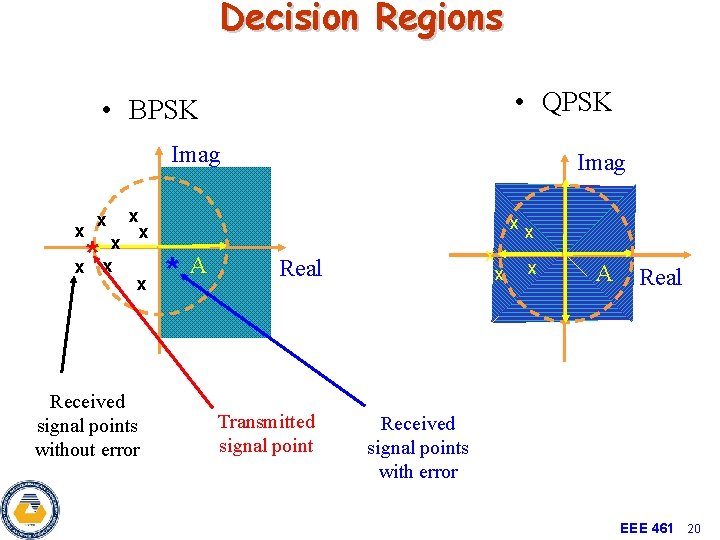
Decision Regions • QPSK • BPSK Imag x x x * Imag x x x Received signal points without error xx * A x Real Transmitted signal point x x A Real Received signal points with error EEE 461 20
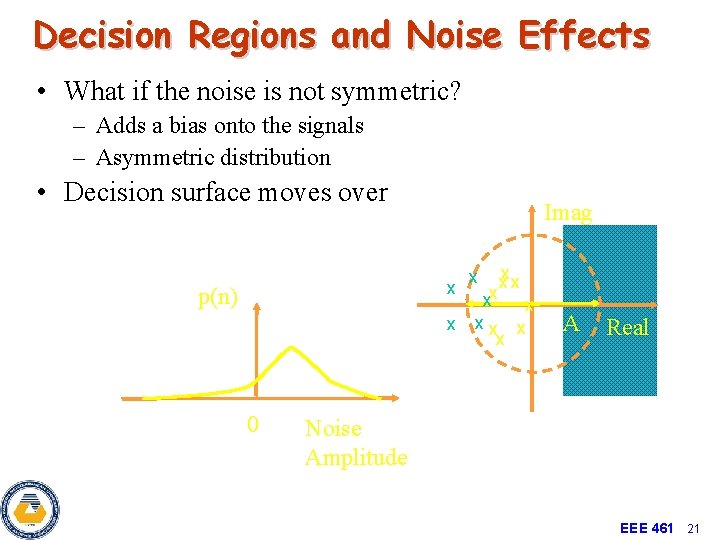
Decision Regions and Noise Effects • What if the noise is not symmetric? – Adds a bias onto the signals – Asymmetric distribution • Decision surface moves over Imag x p(n) x 0 x xx x x A Real Noise Amplitude EEE 461 21
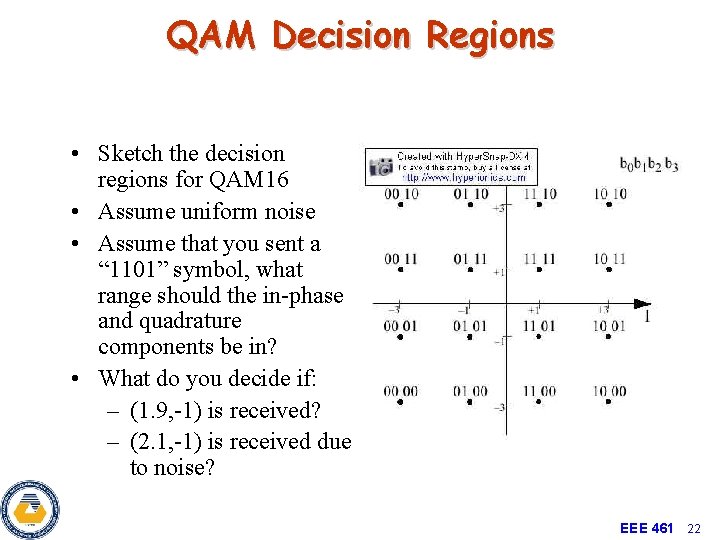
QAM Decision Regions • Sketch the decision regions for QAM 16 • Assume uniform noise • Assume that you sent a “ 1101” symbol, what range should the in-phase and quadrature components be in? • What do you decide if: – (1. 9, -1) is received? – (2. 1, -1) is received due to noise? EEE 461 22
- Slides: 22