
Chapter 5 Developing Through the Life Span Power



- Slides: 37
Chapter 5 Developing Through the Life Span Power. Point® Presentation by Jim Foley © 2013 Worth Publishers 1
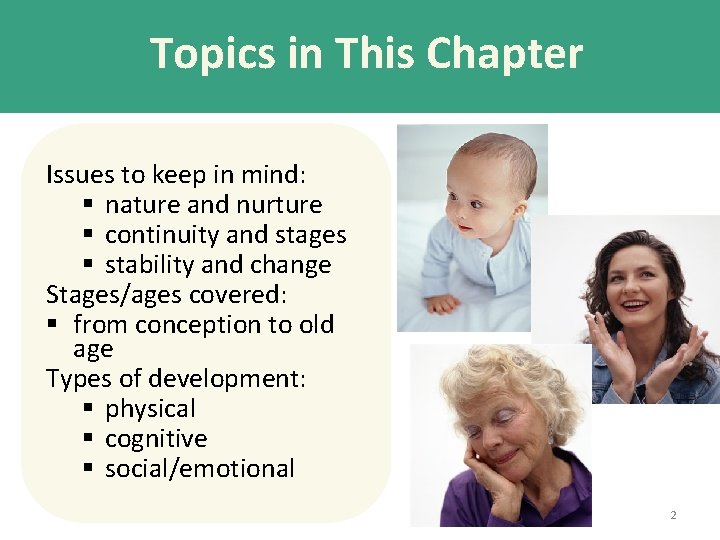
Topics in This Chapter Issues to keep in mind: § nature and nurture § continuity and stages § stability and change Stages/ages covered: § from conception to old age Types of development: § physical § cognitive § social/emotional 2
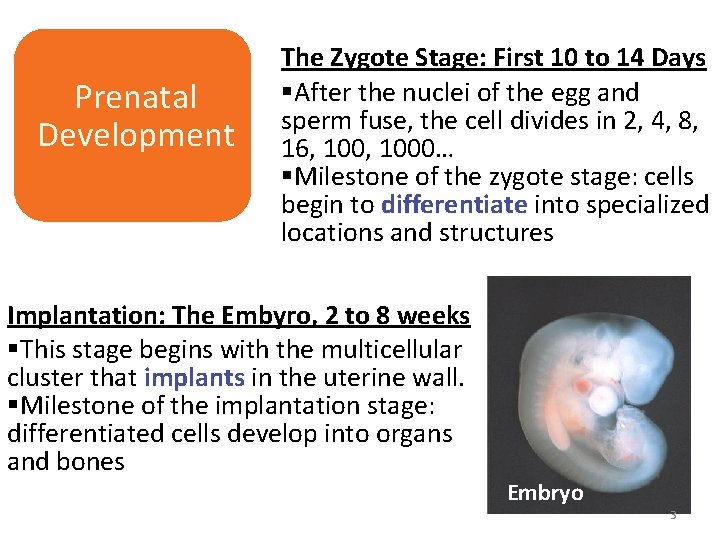
Prenatal Development The Zygote Stage: First 10 to 14 Days §After the nuclei of the egg and sperm fuse, the cell divides in 2, 4, 8, 16, 1000… §Milestone of the zygote stage: cells begin to differentiate into specialized locations and structures Implantation: The Embyro, 2 to 8 weeks §This stage begins with the multicellular cluster that implants in the uterine wall. §Milestone of the implantation stage: differentiated cells develop into organs and bones Embryo 3
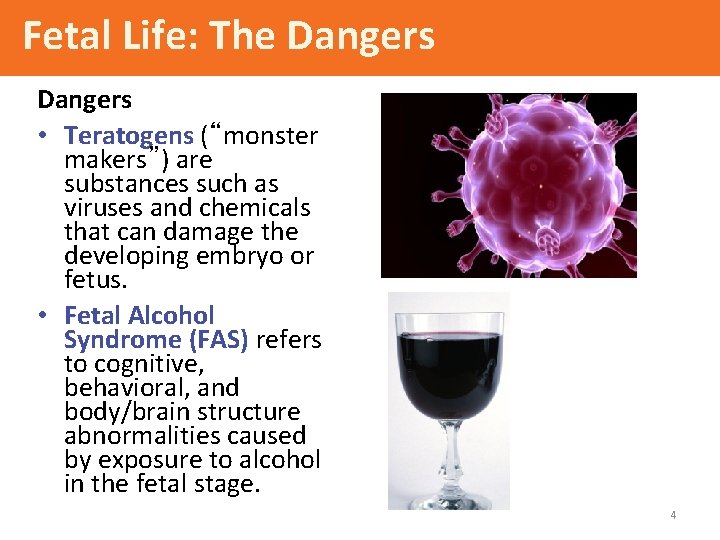
Fetal Life: The Dangers • Teratogens (“monster makers”) are substances such as viruses and chemicals that can damage the developing embryo or fetus. • Fetal Alcohol Syndrome (FAS) refers to cognitive, behavioral, and body/brain structure abnormalities caused by exposure to alcohol in the fetal stage. 4
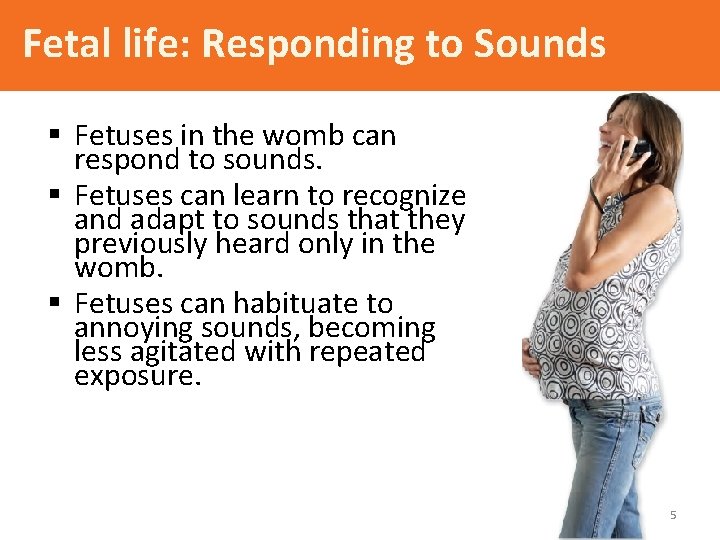
Fetal life: Responding to Sounds § Fetuses in the womb can respond to sounds. § Fetuses can learn to recognize and adapt to sounds that they previously heard only in the womb. § Fetuses can habituate to annoying sounds, becoming less agitated with repeated exposure. 5
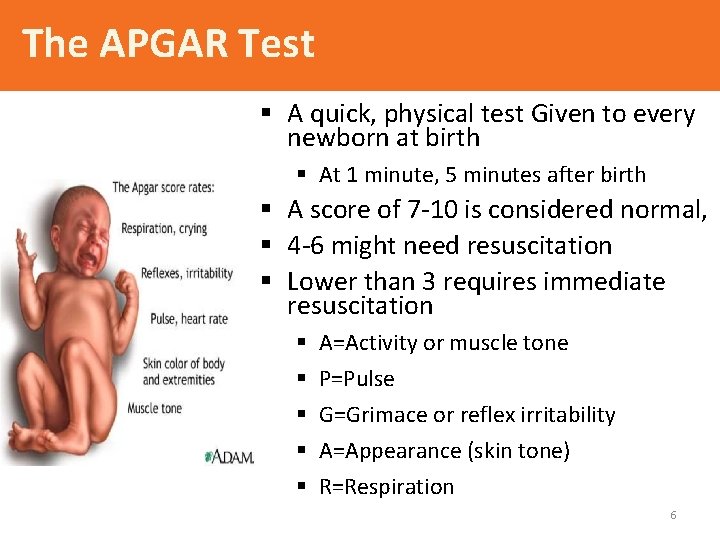
The APGAR Test § A quick, physical test Given to every newborn at birth § At 1 minute, 5 minutes after birth § A score of 7 -10 is considered normal, § 4 -6 might need resuscitation § Lower than 3 requires immediate resuscitation § § § A=Activity or muscle tone P=Pulse G=Grimace or reflex irritability A=Appearance (skin tone) R=Respiration 6
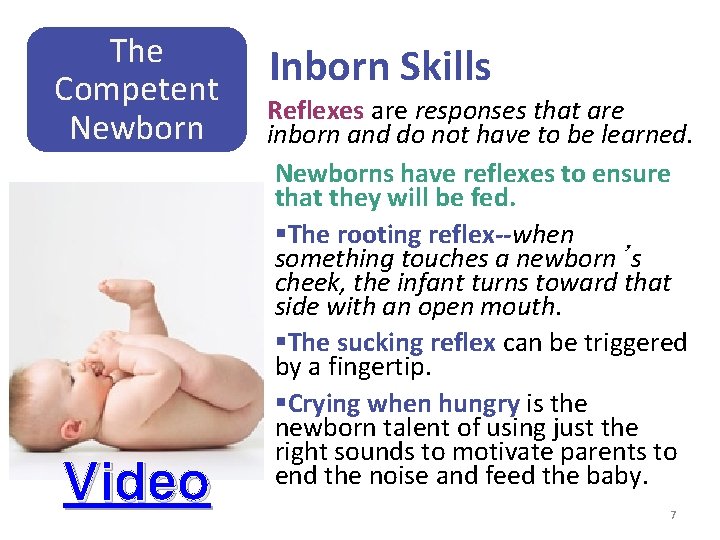
The Competent Newborn Video Inborn Skills Reflexes are responses that are inborn and do not have to be learned. Newborns have reflexes to ensure that they will be fed. §The rooting reflex--when something touches a newborn’s cheek, the infant turns toward that side with an open mouth. §The sucking reflex can be triggered by a fingertip. §Crying when hungry is the newborn talent of using just the right sounds to motivate parents to end the noise and feed the baby. 7
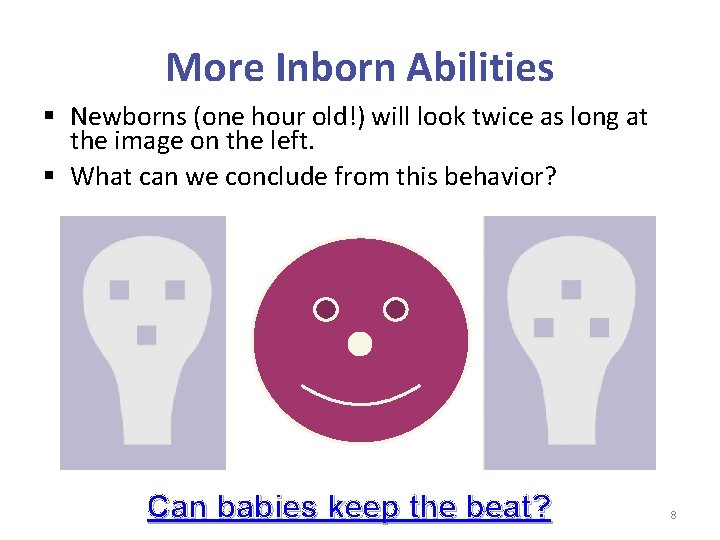
More Inborn Abilities § Newborns (one hour old!) will look twice as long at the image on the left. § What can we conclude from this behavior? Can babies keep the beat? 8
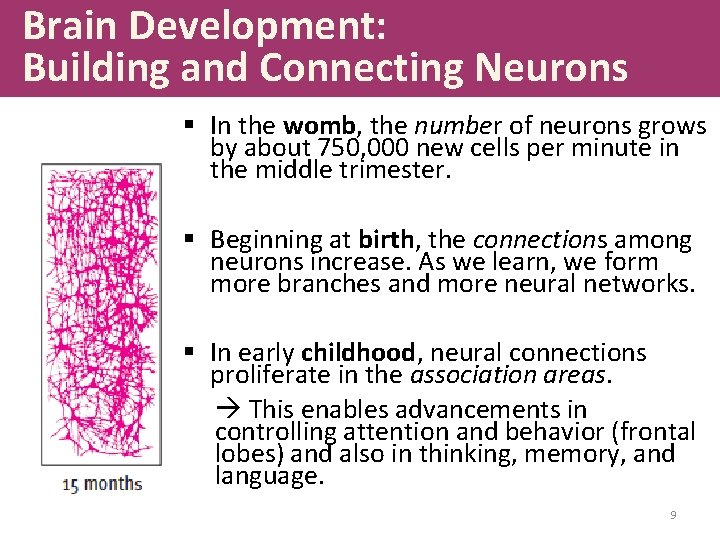
Brain Development: Building and Connecting Neurons § In the womb, the number of neurons grows by about 750, 000 new cells per minute in the middle trimester. § Beginning at birth, the connections among neurons increase. As we learn, we form more branches and more neural networks. § In early childhood, neural connections proliferate in the association areas. This enables advancements in controlling attention and behavior (frontal lobes) and also in thinking, memory, and language. 9
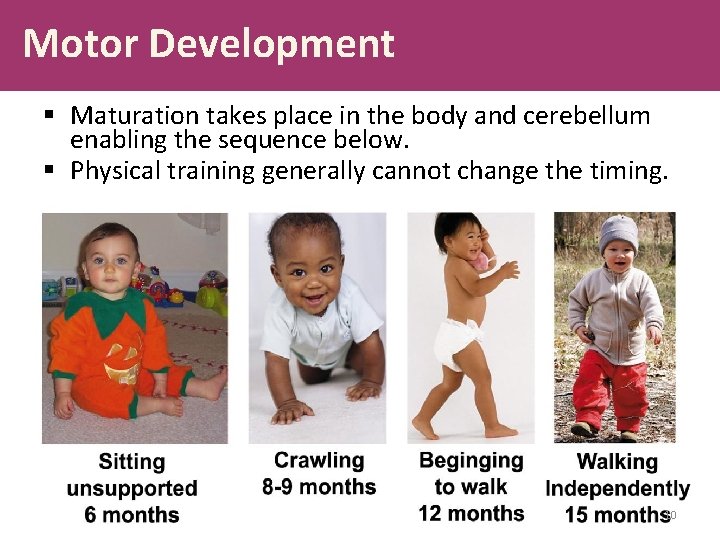
Motor Development § Maturation takes place in the body and cerebellum enabling the sequence below. § Physical training generally cannot change the timing. 10
Cognitive Development Cognition refers to the mental activities that help us function, including: • problem-solving. • figuring out how the world works. • developing models and concepts. • storing and retrieving knowledge. • understanding and using language. • using self-talk and inner thoughts. 11
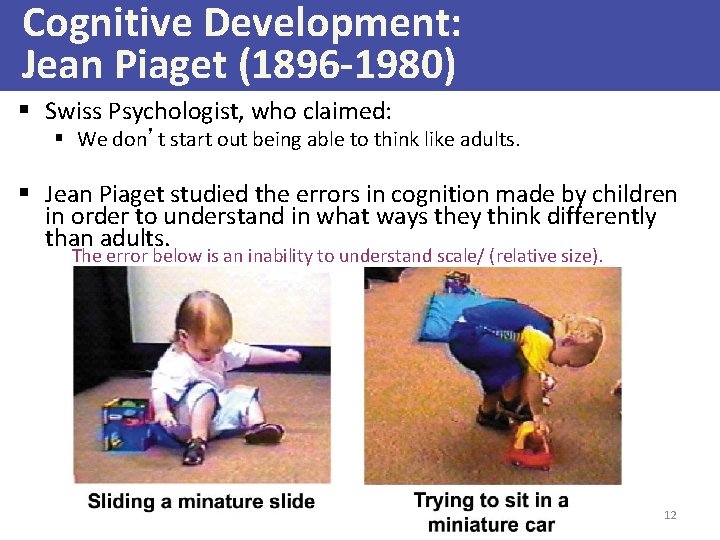
Cognitive Development: Jean Piaget (1896 -1980) § Swiss Psychologist, who claimed: § We don’t start out being able to think like adults. § Jean Piaget studied the errors in cognition made by children in order to understand in what ways they think differently than adults. The error below is an inability to understand scale/ (relative size). 12
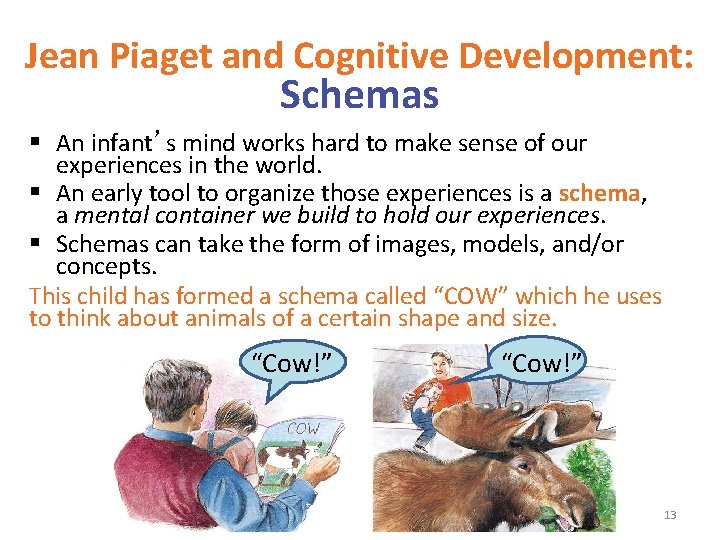
Jean Piaget and Cognitive Development: Schemas § An infant’s mind works hard to make sense of our experiences in the world. § An early tool to organize those experiences is a schema, a mental container we build to hold our experiences. § Schemas can take the form of images, models, and/or concepts. This child has formed a schema called “COW” which he uses to think about animals of a certain shape and size. “Cow!” 13
Jean Piaget and Cognitive Development:
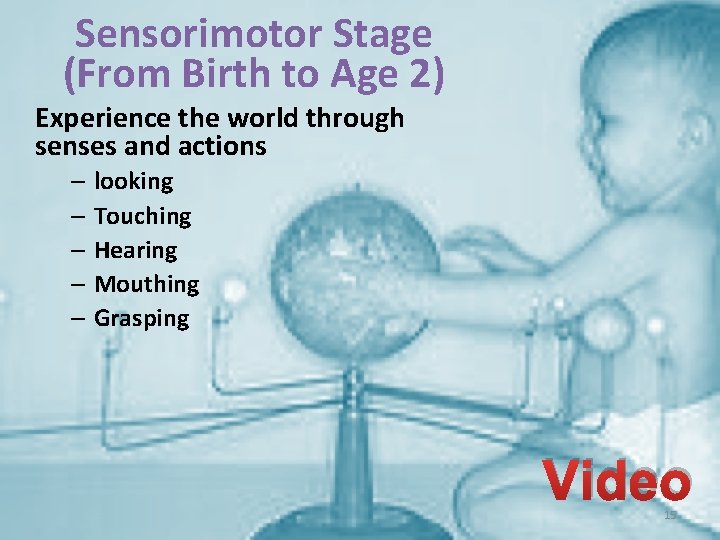
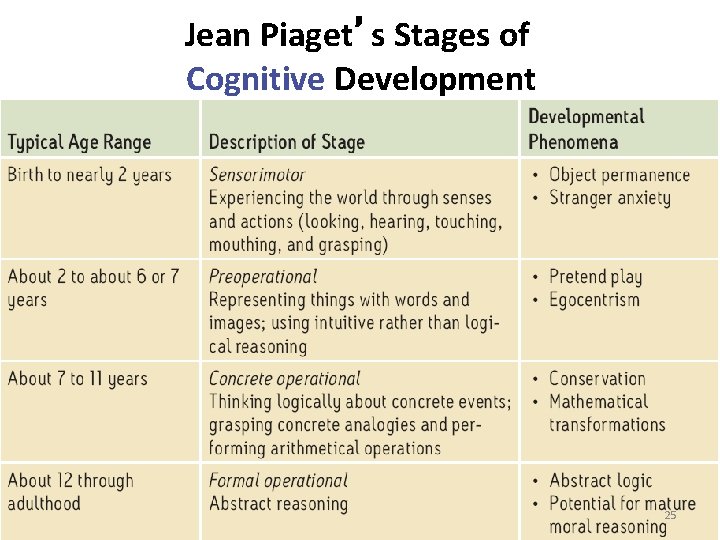
Sensorimotor Stage (From Birth to Age 2) Experience the world through senses and actions – looking – Touching – Hearing – Mouthing – Grasping Video 15
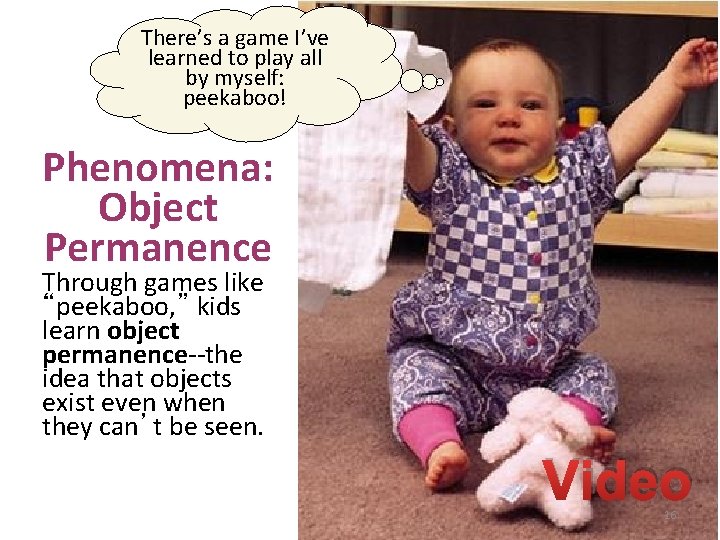
There’s a game I’ve learned to play all by myself: peekaboo! Hmm, a bear, should I put it in my mouth? Phenomena: Object Permanence Through games like “peekaboo, ” kids learn object permanence--the idea that objects exist even when they can’t be seen. Video 16
Preoperational Stage (From roughly Age 2 -6) Representing things with words and images Using intuitive, rather than logical reasoning Video 17
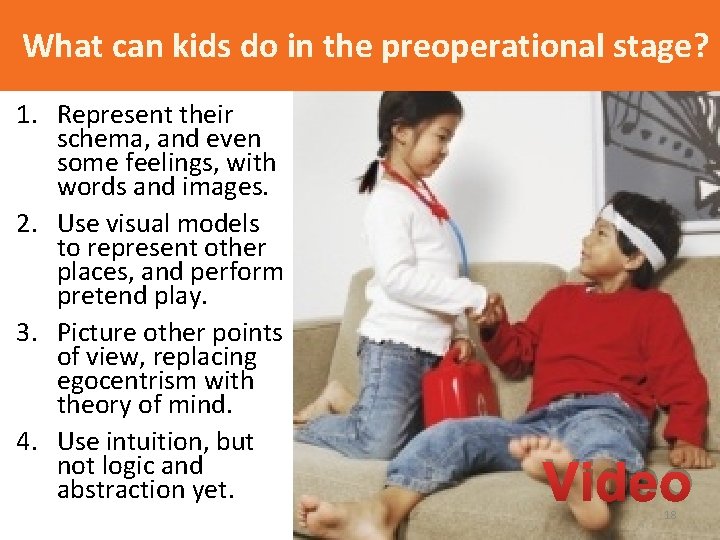
What can kids do in the preoperational stage? 1. Represent their schema, and even some feelings, with words and images. 2. Use visual models to represent other places, and perform pretend play. 3. Picture other points of view, replacing egocentrism with theory of mind. 4. Use intuition, but not logic and abstraction yet. Video 18
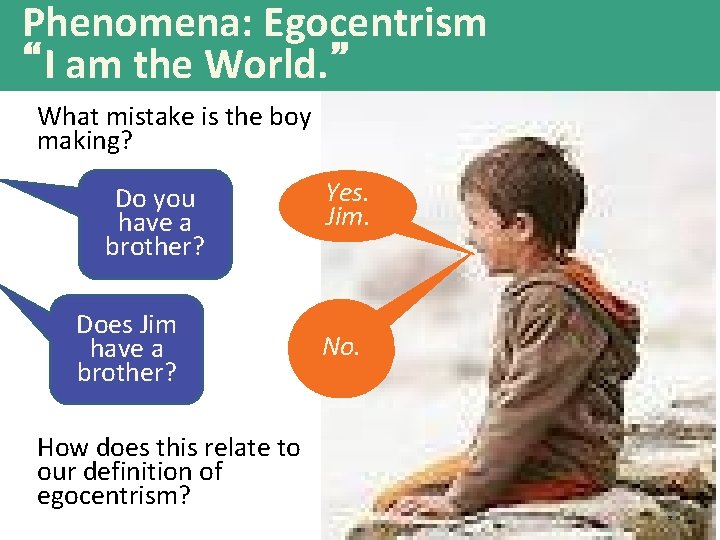
Phenomena: Egocentrism “I am the World. ” What mistake is the boy making? Do you have a brother? Does Jim have a brother? How does this relate to our definition of egocentrism? Yes. Jim. No. 19
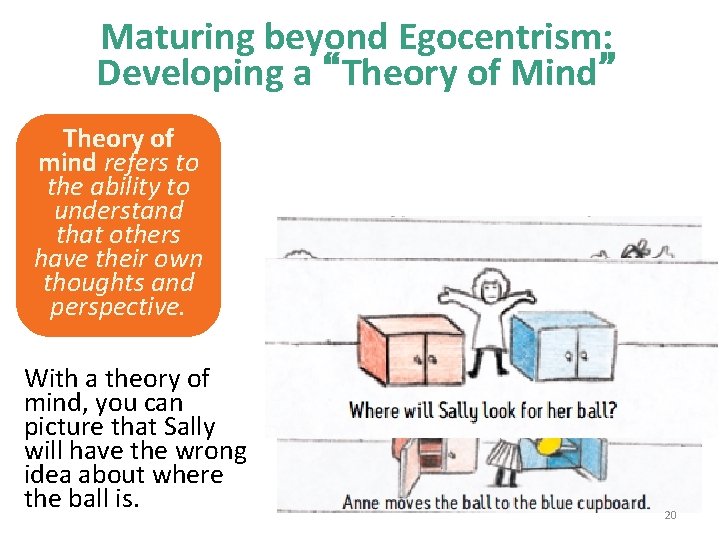
Maturing beyond Egocentrism: Developing a “Theory of Mind” Theory of mind refers to the ability to understand that others have their own thoughts and perspective. With a theory of mind, you can picture that Sally will have the wrong idea about where the ball is. 20
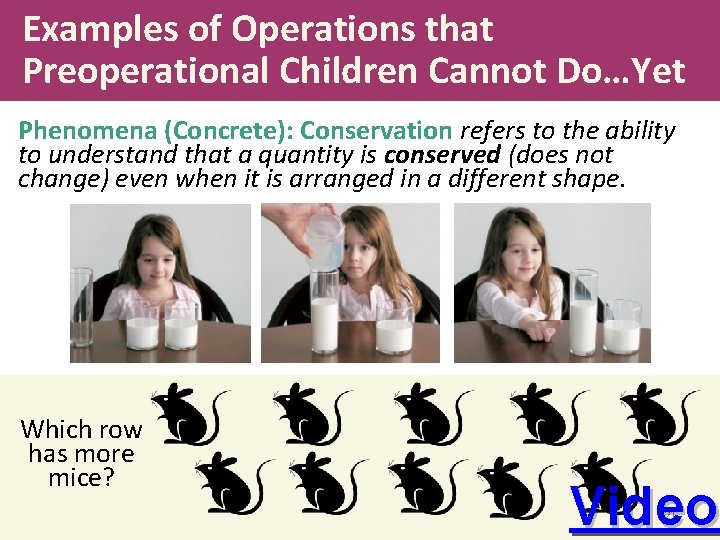
Examples of Operations that Preoperational Children Cannot Do…Yet Phenomena (Concrete): Conservation refers to the ability to understand that a quantity is conserved (does not change) even when it is arranged in a different shape. Which row has more mice? Video 21
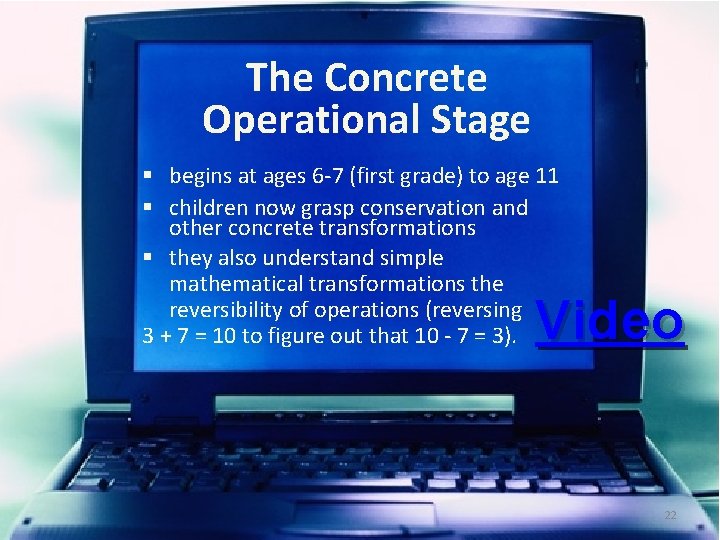
The Concrete Operational Stage § begins at ages 6 -7 (first grade) to age 11 § children now grasp conservation and other concrete transformations § they also understand simple mathematical transformations the reversibility of operations (reversing 3 + 7 = 10 to figure out that 10 - 7 = 3). Video 22
Formal Operational Stage (Age 11+) • Abstract reasoning 23
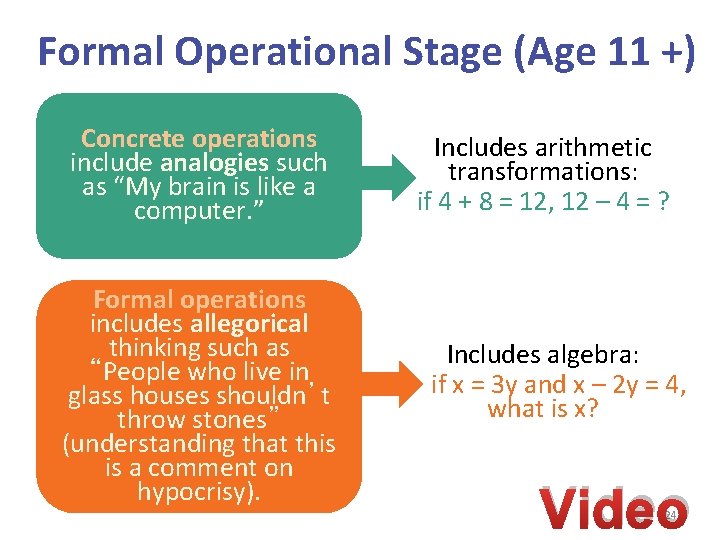
Formal Operational Stage (Age 11 +) Concrete operations include analogies such as “My brain is like a computer. ” Formal operations includes allegorical thinking such as “People who live in glass houses shouldn’t throw stones” (understanding that this is a comment on hypocrisy). Includes arithmetic transformations: if 4 + 8 = 12, 12 – 4 = ? Includes algebra: if x = 3 y and x – 2 y = 4, what is x? Video 24
Jean Piaget’s Stages of Cognitive Development 25
Reassessment of Jean Piaget’s Theory Although Jean Piaget’s observation and stage theory are useful, today’s researchers believe: 1. development is a continuous process. 2. children show some mental abilities and operations at an earlier age than Piaget thought. 3. formal logic is a smaller part of cognition, even for adults, than Piaget believed. 26
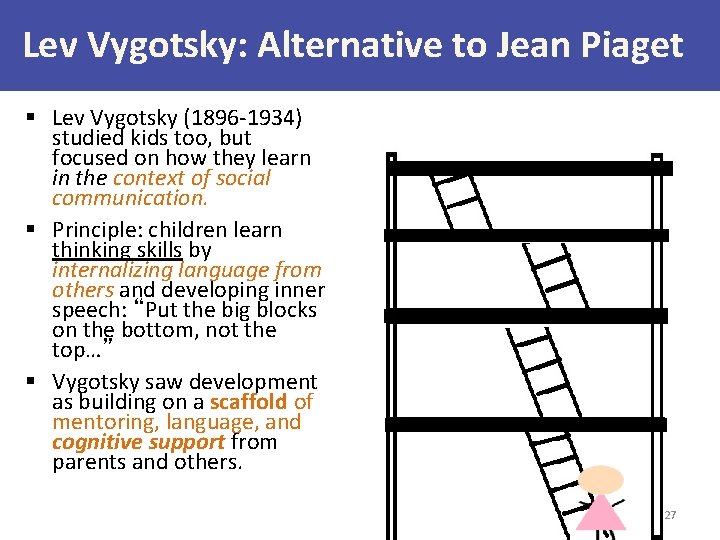
Lev Vygotsky: Alternative to Jean Piaget § Lev Vygotsky (1896 -1934) studied kids too, but focused on how they learn in the context of social communication. § Principle: children learn thinking skills by internalizing language from others and developing inner speech: “Put the big blocks on the bottom, not the top…” § Vygotsky saw development as building on a scaffold of mentoring, language, and cognitive support from parents and others. 27
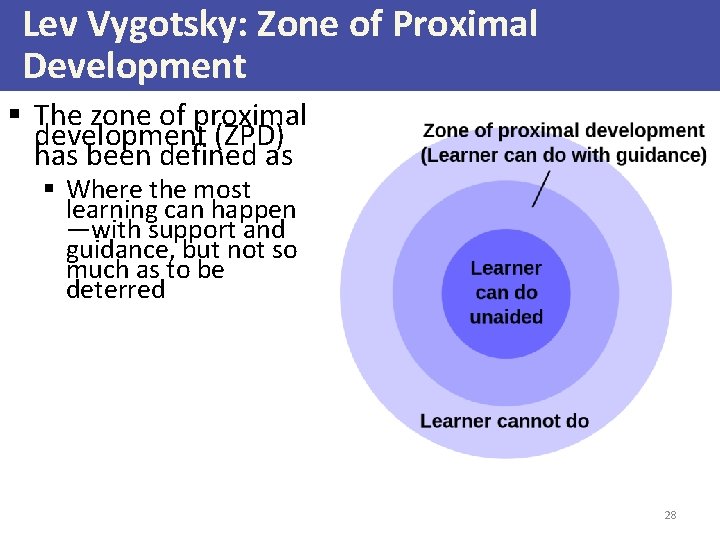
Lev Vygotsky: Zone of Proximal Development § The zone of proximal development (ZPD) has been defined as § Where the most learning can happen —with support and guidance, but not so much as to be deterred 28
Lev Vygotsky: Zone of Proximal Development § Bobby and his dad are going to do a puzzle for the first time! 29
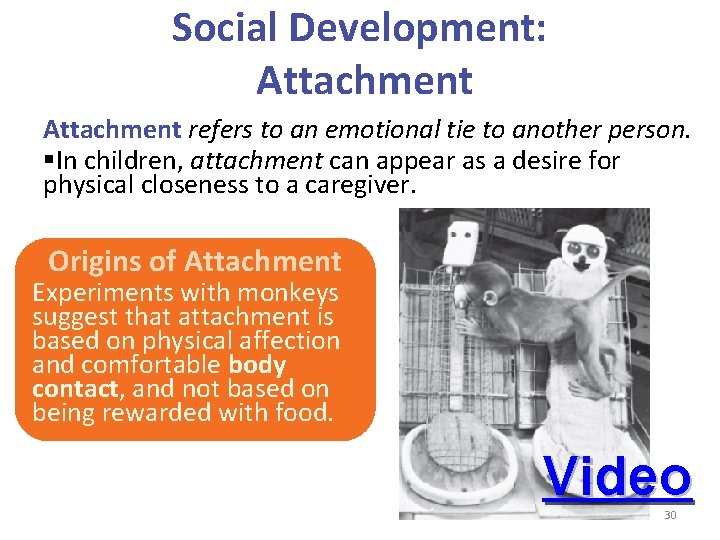
Social Development: Attachment refers to an emotional tie to another person. §In children, attachment can appear as a desire for physical closeness to a caregiver. Origins of Attachment Experiments with monkeys suggest that attachment is based on physical affection and comfortable body contact, and not based on being rewarded with food. Video 30
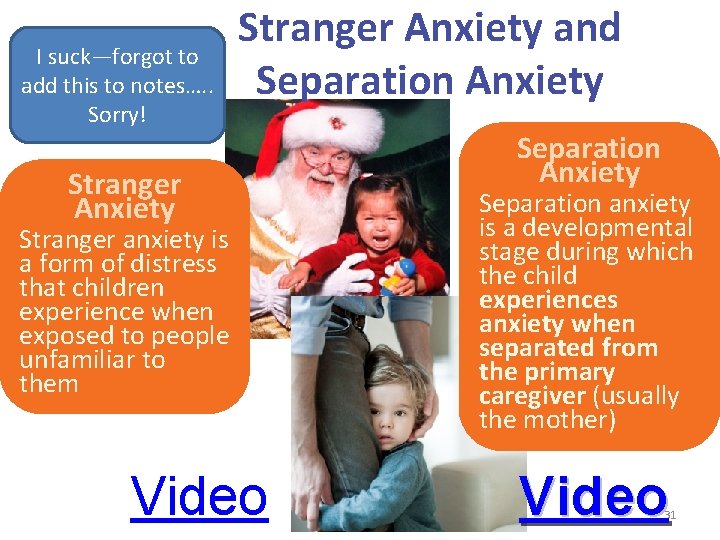
I suck—forgot to add this to notes…. . Sorry! Stranger Anxiety and Separation Anxiety Stranger anxiety is a form of distress that children experience when exposed to people unfamiliar to them Video Separation Anxiety Separation anxiety is a developmental stage during which the child experiences anxiety when separated from the primary caregiver (usually the mother) Video 31
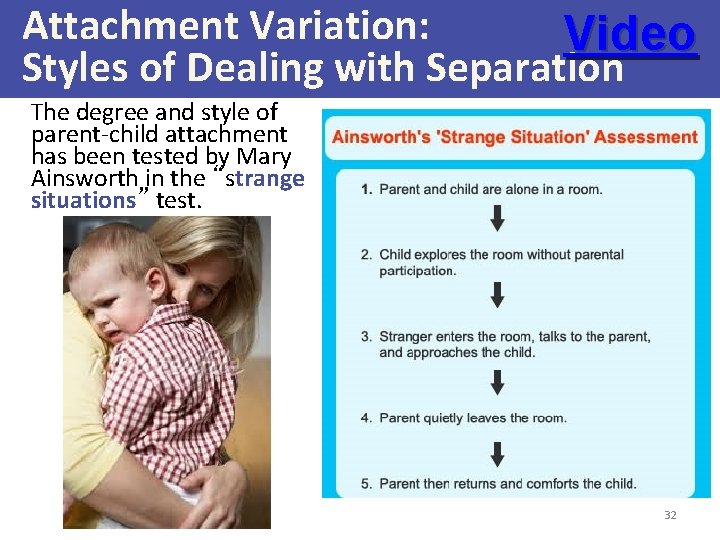
Attachment Variation: Video Styles of Dealing with Separation The degree and style of parent-child attachment has been tested by Mary Ainsworth in the “strange situations” test. 32
33
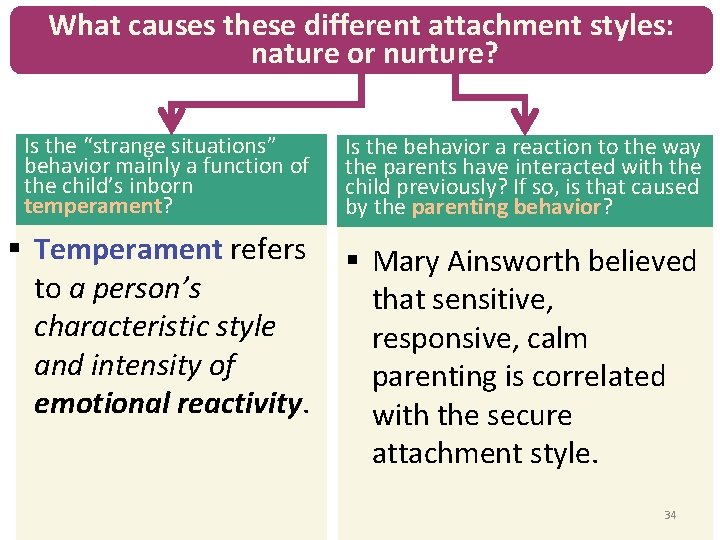
What causes these different attachment styles: nature or nurture? Is the “strange situations” behavior mainly a function of the child’s inborn temperament? Is the behavior a reaction to the way the parents have interacted with the child previously? If so, is that caused by the parenting behavior? § Temperament refers to a person’s characteristic style and intensity of emotional reactivity. § Mary Ainsworth believed that sensitive, responsive, calm parenting is correlated with the secure attachment style. 34
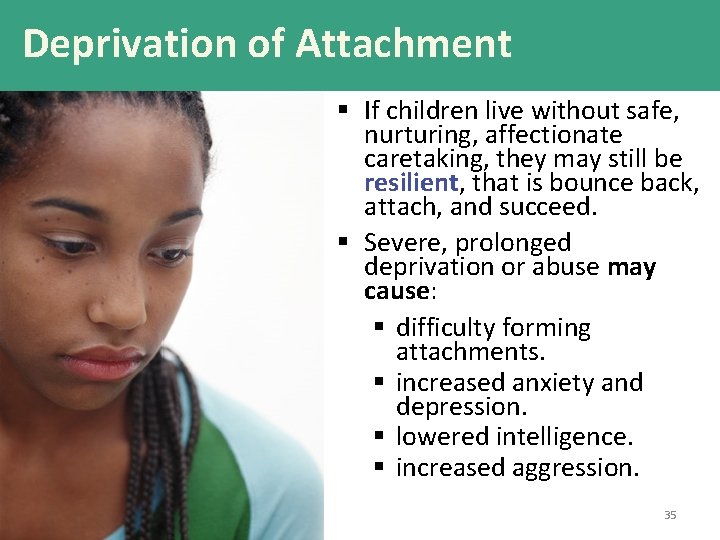
Deprivation of Attachment § If children live without safe, nurturing, affectionate caretaking, they may still be resilient, that is bounce back, attach, and succeed. § Severe, prolonged deprivation or abuse may cause: § difficulty forming attachments. § increased anxiety and depression. § lowered intelligence. § increased aggression. 35
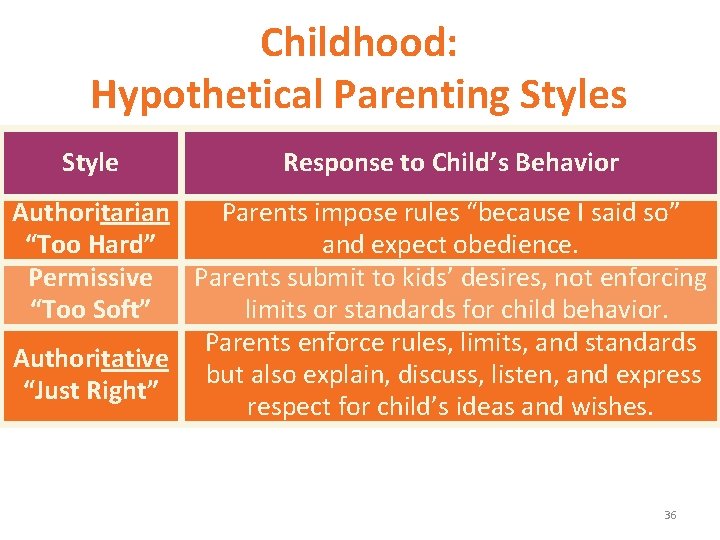
Childhood: Hypothetical Parenting Styles Style Response to Child’s Behavior Authoritarian Parents impose rules “because I said so” “Too Hard” and expect obedience. Permissive Parents submit to kids’ desires, not enforcing “Too Soft” limits or standards for child behavior. Parents enforce rules, limits, and standards Authoritative but also explain, discuss, listen, and express “Just Right” respect for child’s ideas and wishes. 36
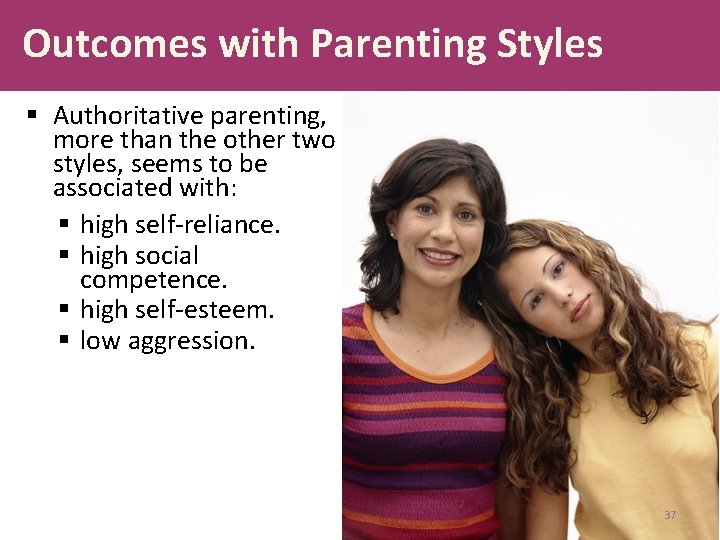
Outcomes with Parenting Styles § Authoritative parenting, more than the other two styles, seems to be associated with: § high self-reliance. § high social competence. § high self-esteem. § low aggression. 37