
Chapter 5 DC and AC Machines Part 1
- Slides: 35
Chapter 5 DC and AC Machines Part 1 Prepared by Dr. Mohd Azrik Bin Roslan
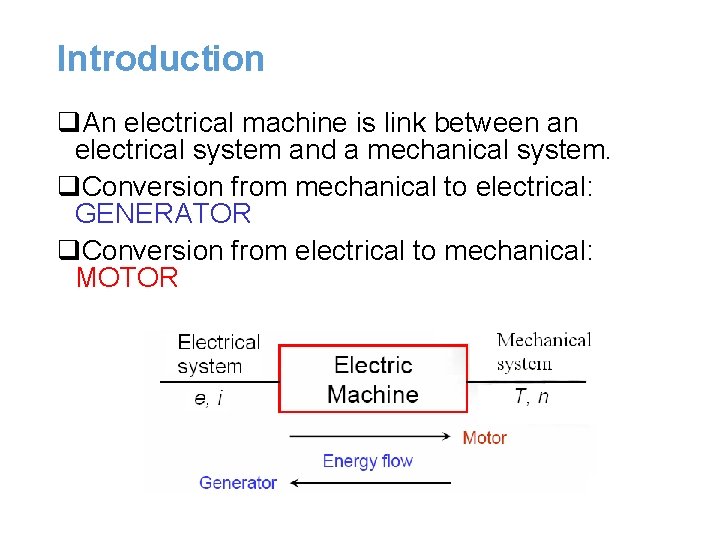
Introduction q. An electrical machine is link between an electrical system and a mechanical system. q. Conversion from mechanical to electrical: GENERATOR q. Conversion from electrical to mechanical: MOTOR
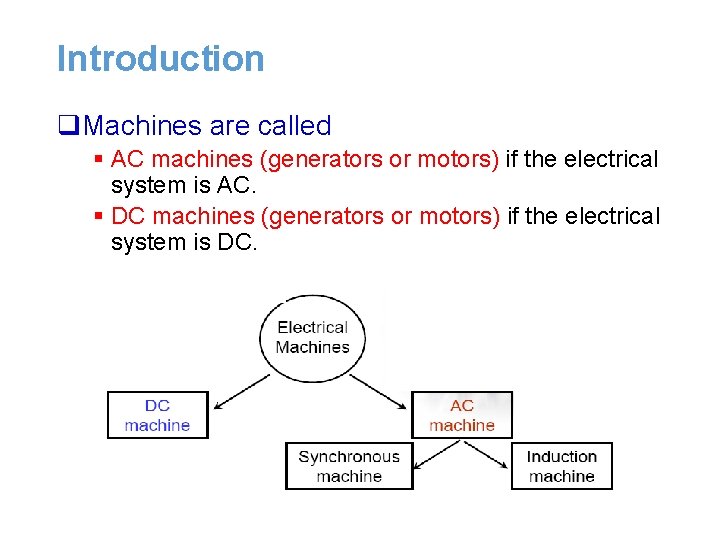
Introduction q. Machines are called § AC machines (generators or motors) if the electrical system is AC. § DC machines (generators or motors) if the electrical system is DC.
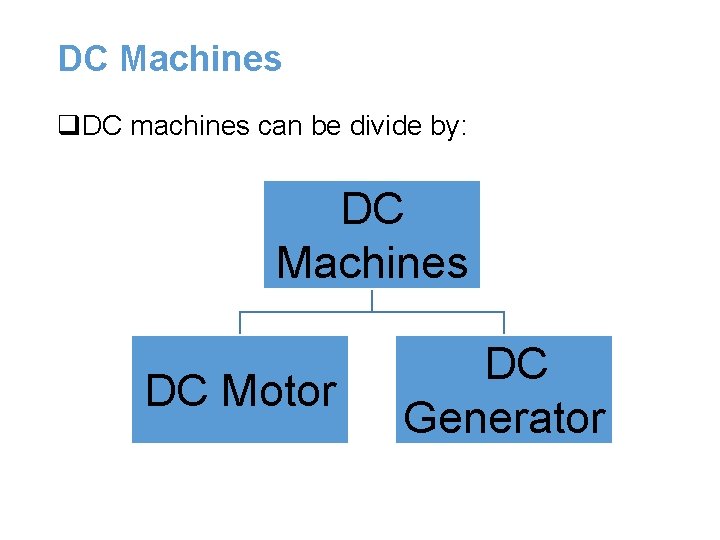
DC Machines q. DC machines can be divide by: DC Machines DC Motor DC Generator
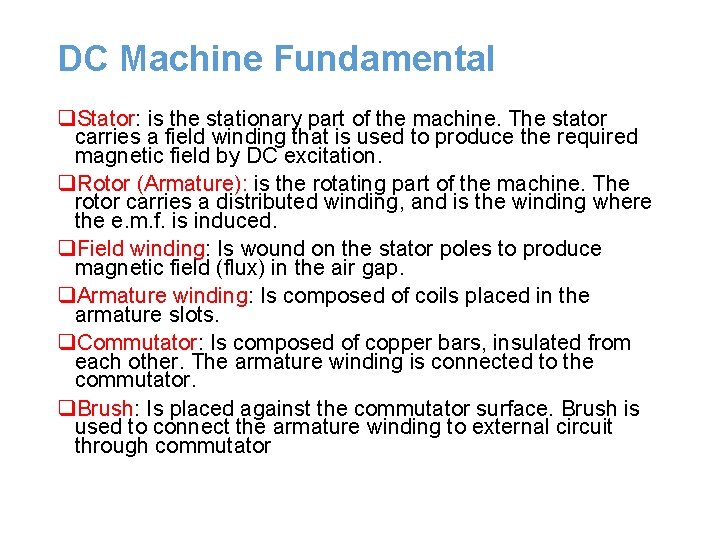
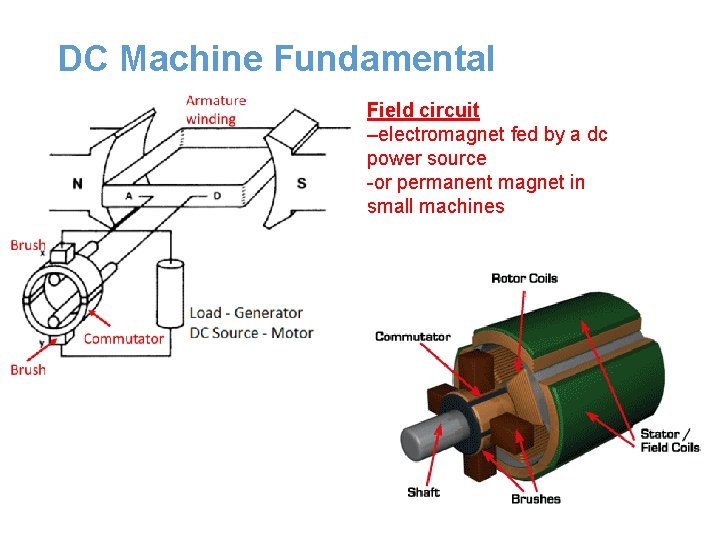
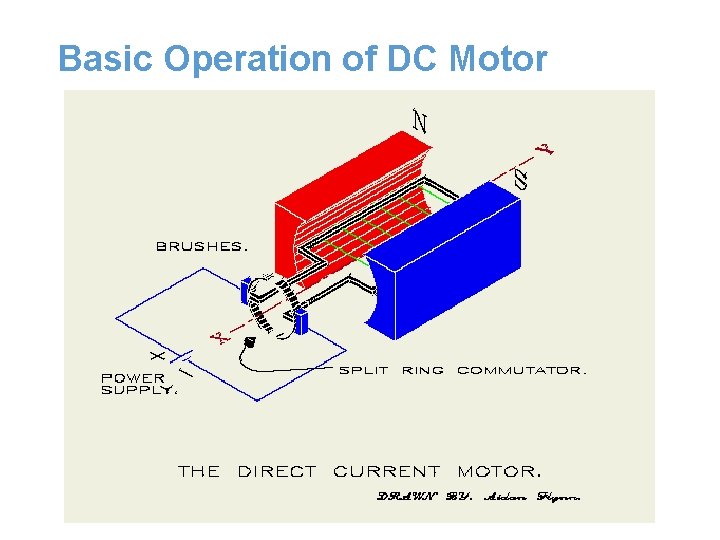
DC Machine Fundamental q. Stator: is the stationary part of the machine. The stator carries a field winding that is used to produce the required magnetic field by DC excitation. q. Rotor (Armature): is the rotating part of the machine. The rotor carries a distributed winding, and is the winding where the e. m. f. is induced. q. Field winding: Is wound on the stator poles to produce magnetic field (flux) in the air gap. q. Armature winding: Is composed of coils placed in the armature slots. q. Commutator: Is composed of copper bars, insulated from each other. The armature winding is connected to the commutator. q. Brush: Is placed against the commutator surface. Brush is used to connect the armature winding to external circuit through commutator
DC Machine Fundamental Field circuit –electromagnet fed by a dc power source -or permanent magnet in small machines
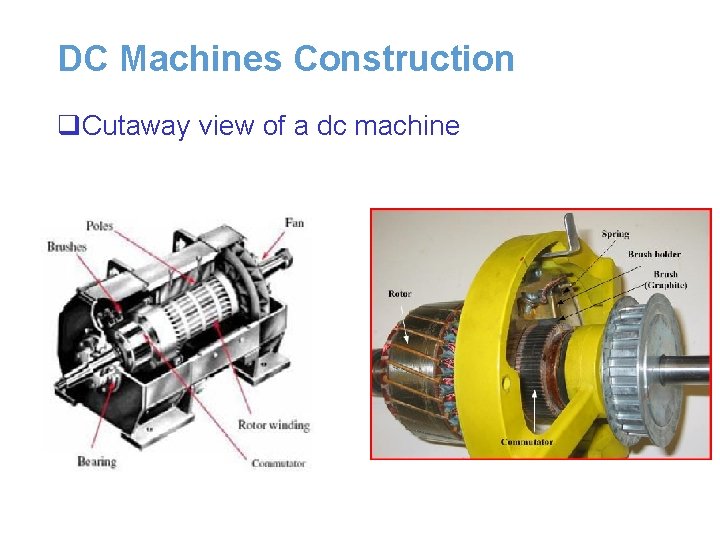
DC Machines Construction q. Cutaway view of a dc machine
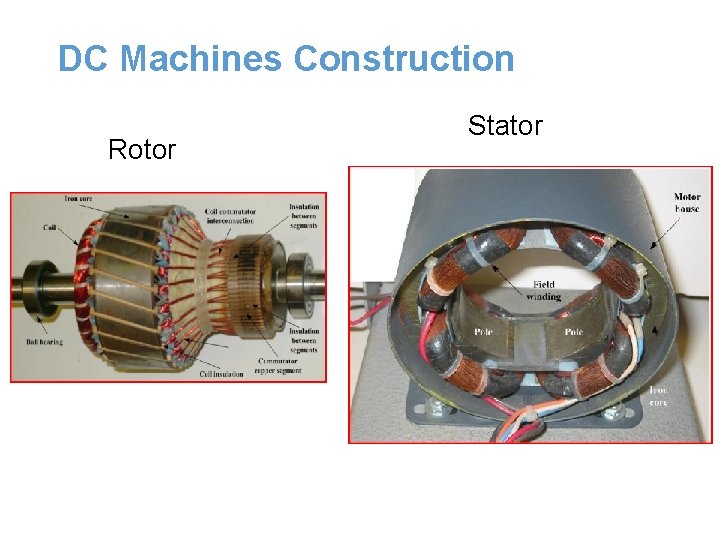
DC Machines Construction Rotor Stator
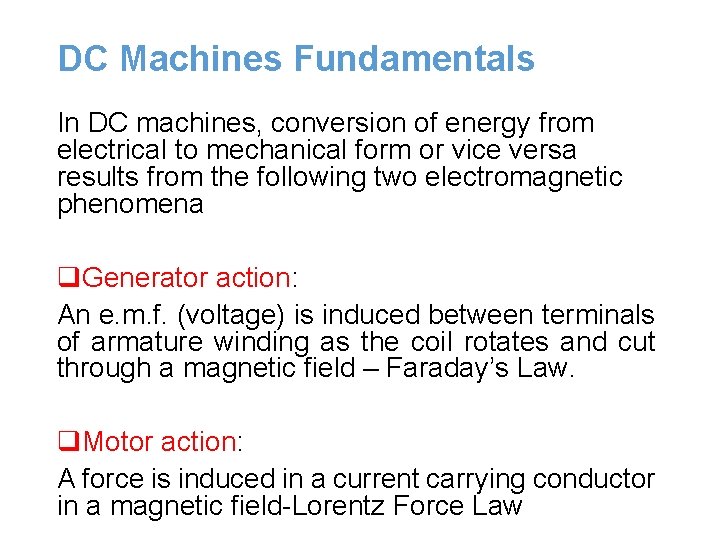
DC Machines Fundamentals In DC machines, conversion of energy from electrical to mechanical form or vice versa results from the following two electromagnetic phenomena q. Generator action: An e. m. f. (voltage) is induced between terminals of armature winding as the coil rotates and cut through a magnetic field – Faraday’s Law. q. Motor action: A force is induced in a current carrying conductor in a magnetic field-Lorentz Force Law
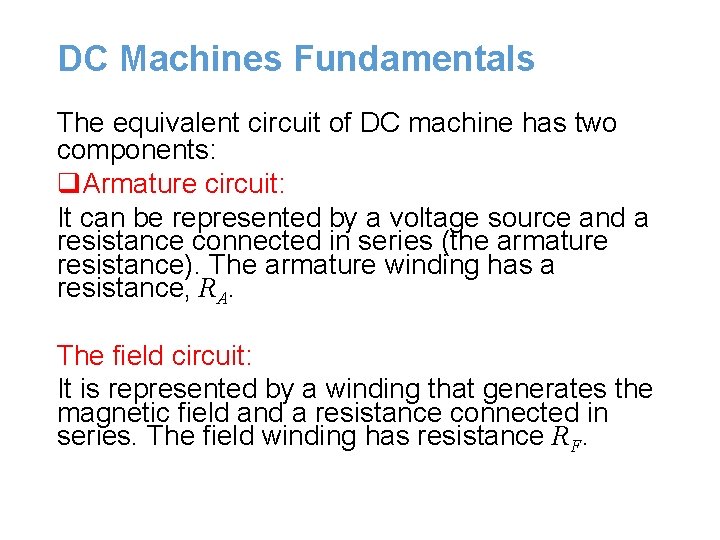
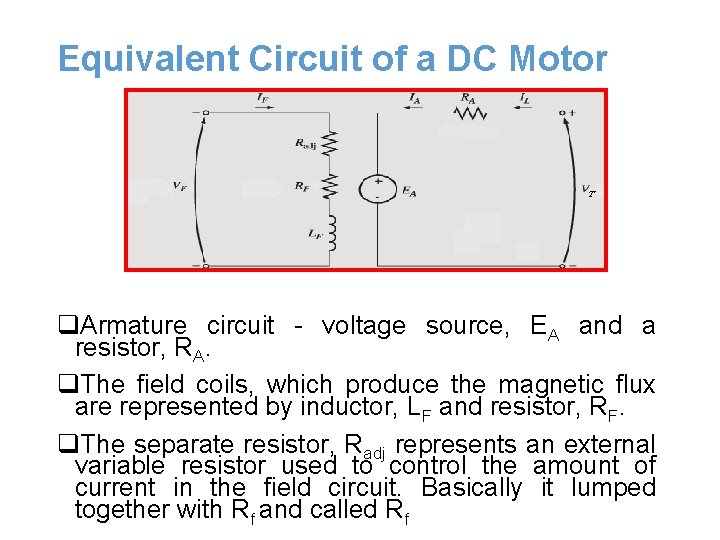
DC Machines Fundamentals The equivalent circuit of DC machine has two components: q. Armature circuit: It can be represented by a voltage source and a resistance connected in series (the armature resistance). The armature winding has a resistance, RA. The field circuit: It is represented by a winding that generates the magnetic field and a resistance connected in series. The field winding has resistance RF.
DC MOTOR
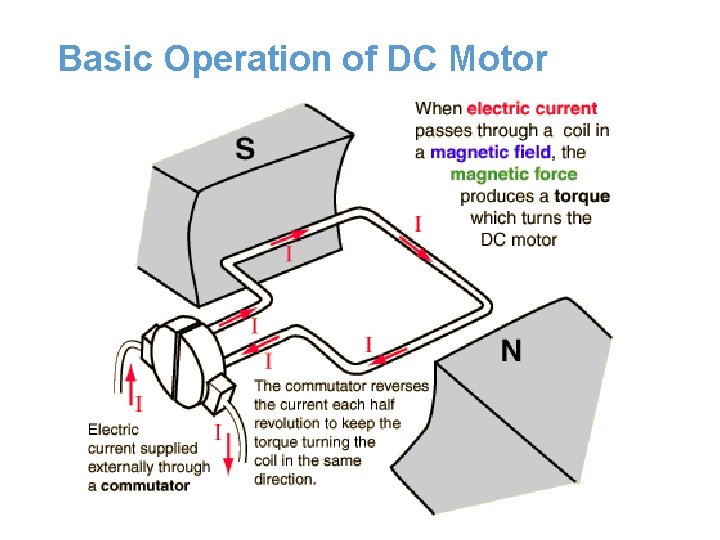
Basic Operation of DC Motor
Basic Operation of DC Motor
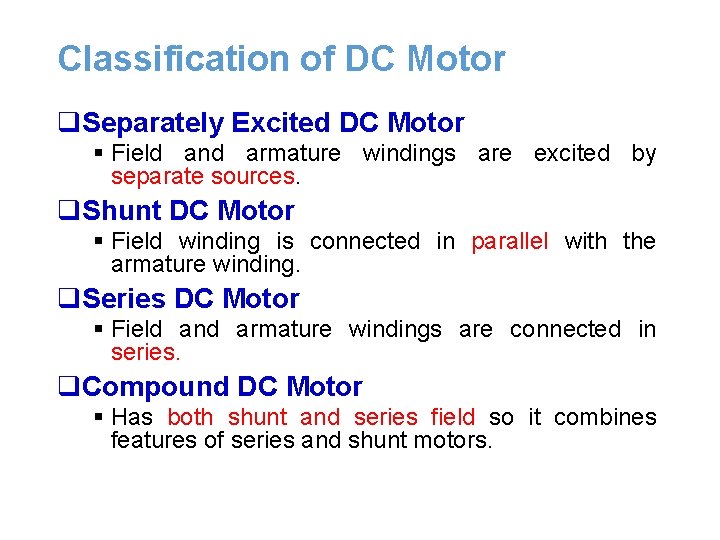
Classification of DC Motor q. Separately Excited DC Motor § Field and armature windings are excited by separate sources. q. Shunt DC Motor § Field winding is connected in parallel with the armature winding. q. Series DC Motor § Field and armature windings are connected in series. q. Compound DC Motor § Has both shunt and series field so it combines features of series and shunt motors.
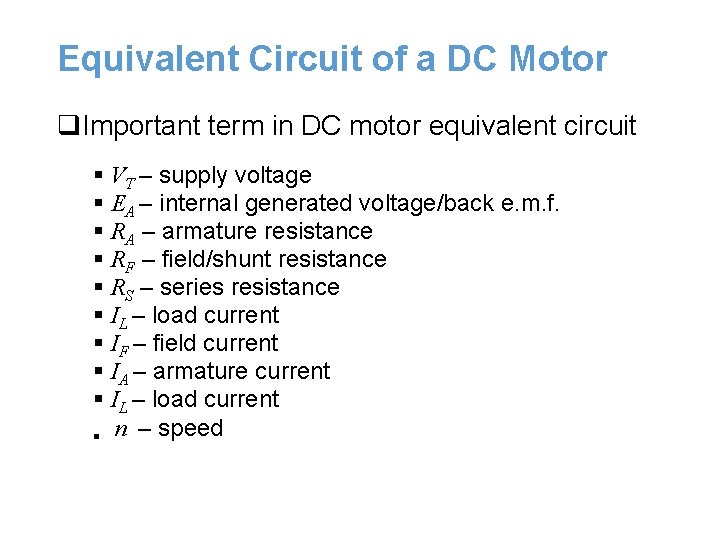
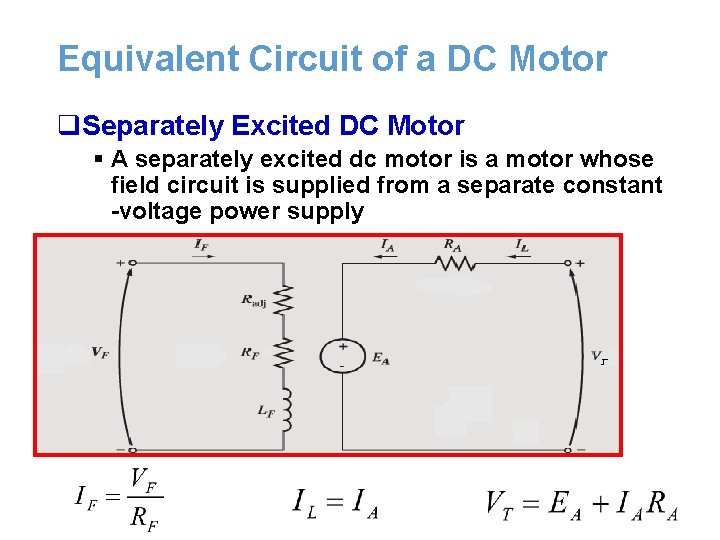
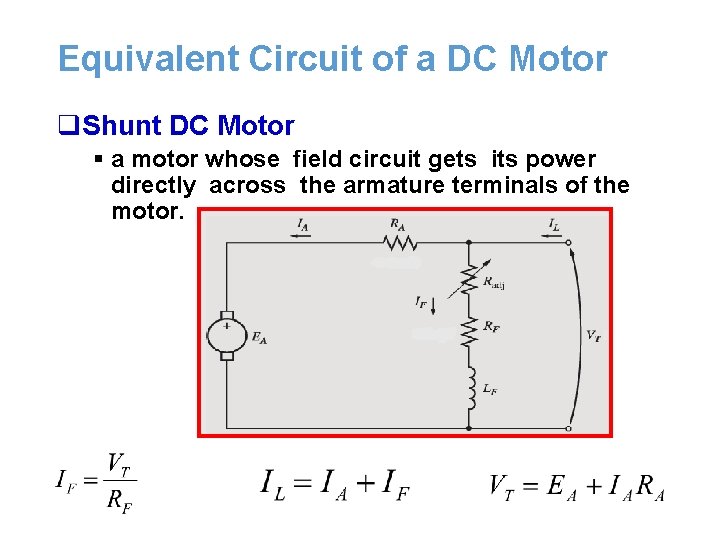
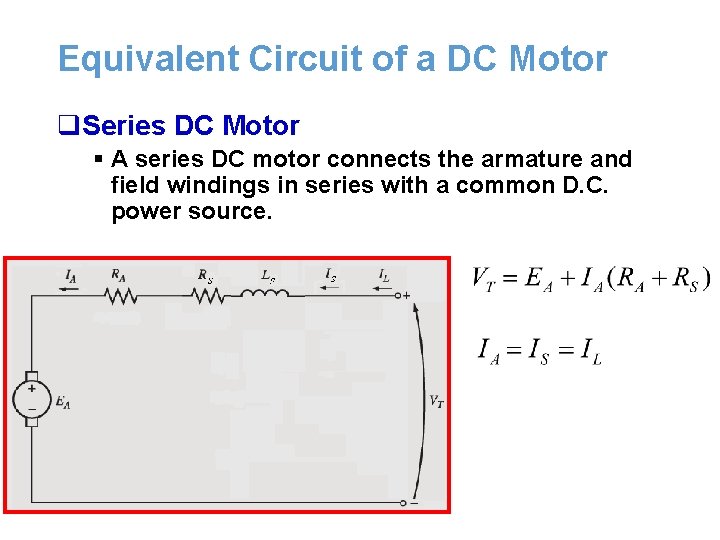
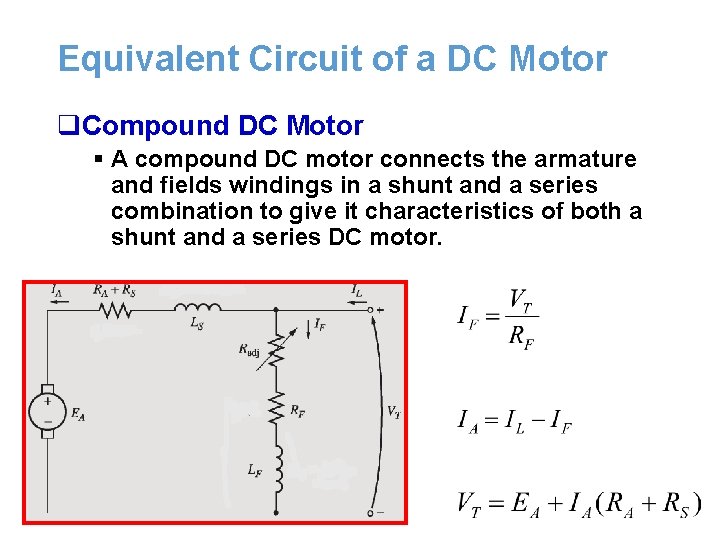
Equivalent Circuit of a DC Motor q. Important term in DC motor equivalent circuit § VT – supply voltage § EA – internal generated voltage/back e. m. f. § RA – armature resistance § RF – field/shunt resistance § RS – series resistance § IL – load current § IF – field current § IA – armature current § IL – load current § n – speed
Equivalent Circuit of a DC Motor q. Armature circuit - voltage source, EA and a resistor, RA. q. The field coils, which produce the magnetic flux are represented by inductor, LF and resistor, RF. q. The separate resistor, Radj represents an external variable resistor used to control the amount of current in the field circuit. Basically it lumped together with Rf and called Rf
Equivalent Circuit of a DC Motor q. Separately Excited DC Motor § A separately excited dc motor is a motor whose field circuit is supplied from a separate constant -voltage power supply
Equivalent Circuit of a DC Motor q. Shunt DC Motor § a motor whose field circuit gets its power directly across the armature terminals of the motor.
Equivalent Circuit of a DC Motor q. Series DC Motor § A series DC motor connects the armature and field windings in series with a common D. C. power source.
Equivalent Circuit of a DC Motor q. Compound DC Motor § A compound DC motor connects the armature and fields windings in a shunt and a series combination to give it characteristics of both a shunt and a series DC motor.
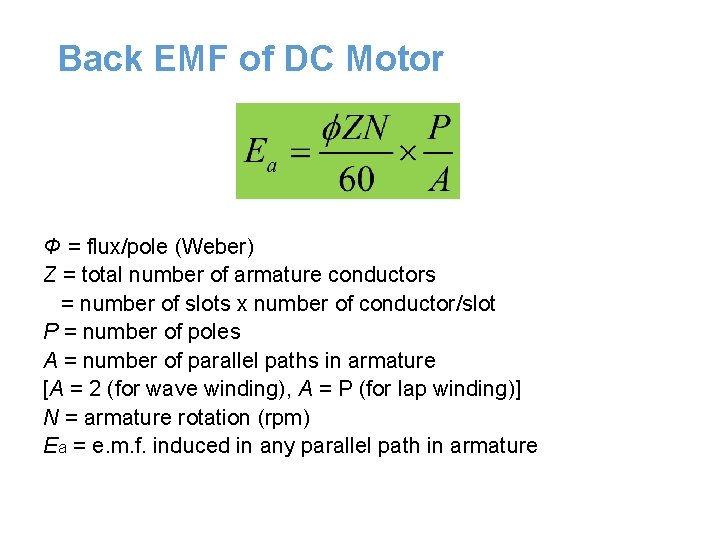
Back EMF of DC Motor Φ = flux/pole (Weber) Z = total number of armature conductors = number of slots x number of conductor/slot P = number of poles A = number of parallel paths in armature [A = 2 (for wave winding), A = P (for lap winding)] N = armature rotation (rpm) Ea = e. m. f. induced in any parallel path in armature
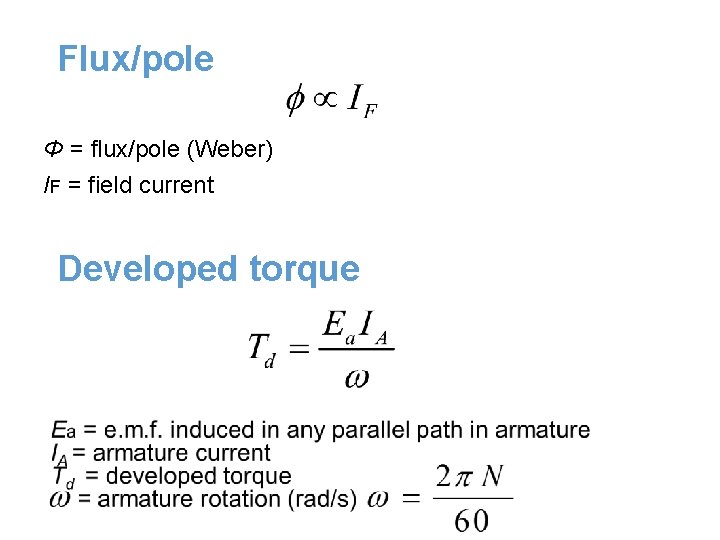
Flux/pole Φ = flux/pole (Weber) IF = field current Developed torque
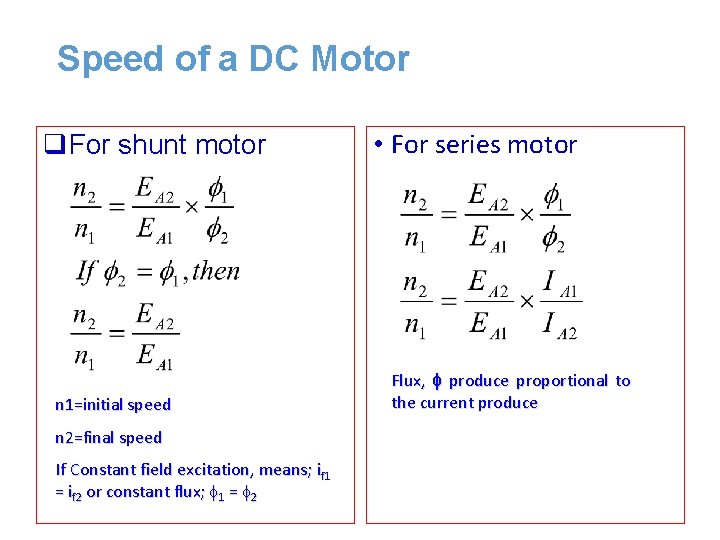
Speed of a DC Motor q. For shunt motor n 1=initial speed n 2=final speed If Constant field excitation, means; if 1 = if 2 or constant flux; 1 = 2 • For series motor Flux, ϕ produce proportional to the current produce
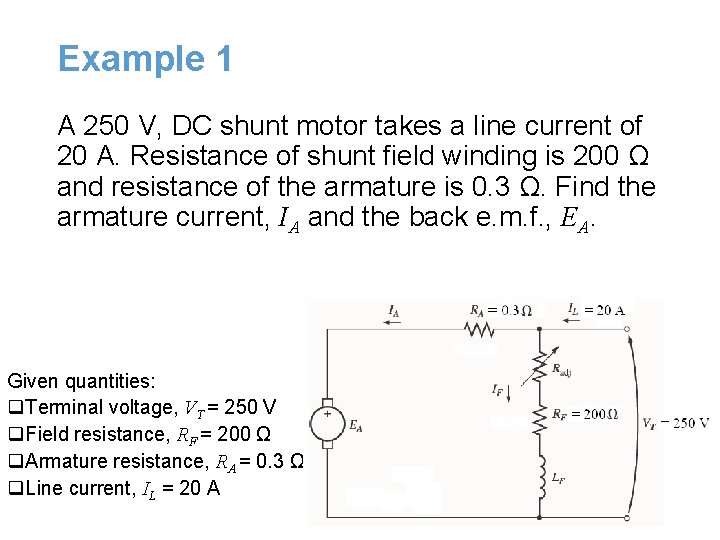
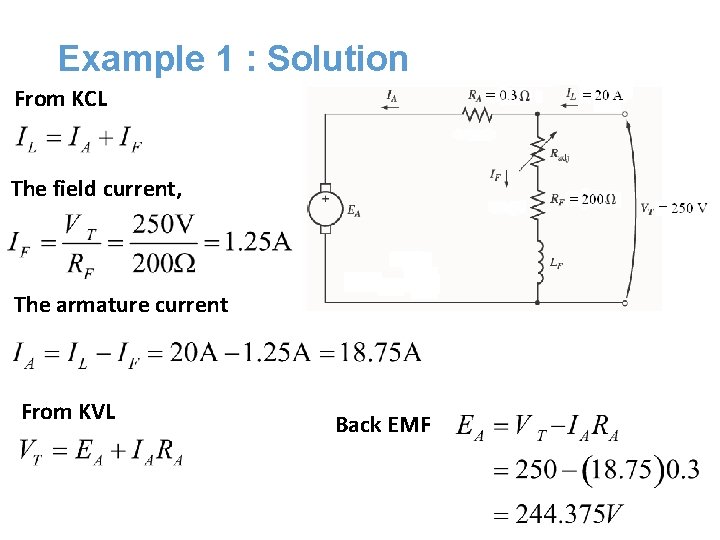
Example 1 A 250 V, DC shunt motor takes a line current of 20 A. Resistance of shunt field winding is 200 Ω and resistance of the armature is 0. 3 Ω. Find the armature current, IA and the back e. m. f. , EA. Given quantities: q. Terminal voltage, VT = 250 V q. Field resistance, RF = 200 Ω q. Armature resistance, RA = 0. 3 Ω q. Line current, IL = 20 A
Example 1 : Solution From KCL The field current, The armature current From KVL Back EMF
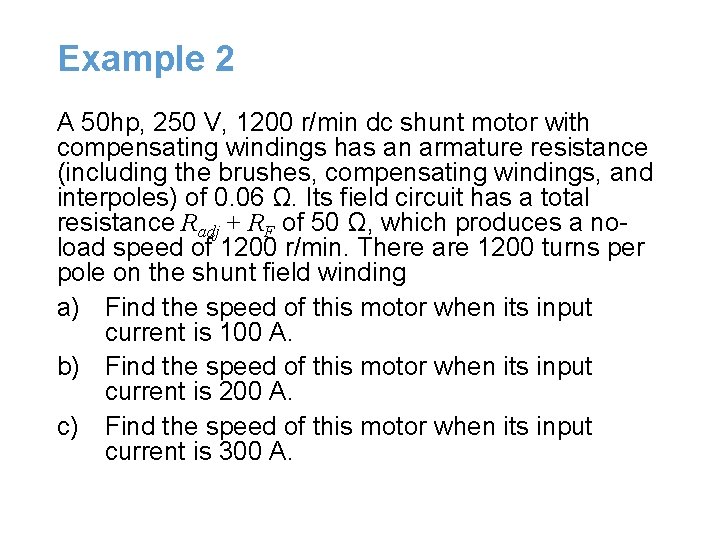
Example 2 A 50 hp, 250 V, 1200 r/min dc shunt motor with compensating windings has an armature resistance (including the brushes, compensating windings, and interpoles) of 0. 06 Ω. Its field circuit has a total resistance Radj + RF of 50 Ω, which produces a noload speed of 1200 r/min. There are 1200 turns per pole on the shunt field winding a) Find the speed of this motor when its input current is 100 A. b) Find the speed of this motor when its input current is 200 A. c) Find the speed of this motor when its input current is 300 A.
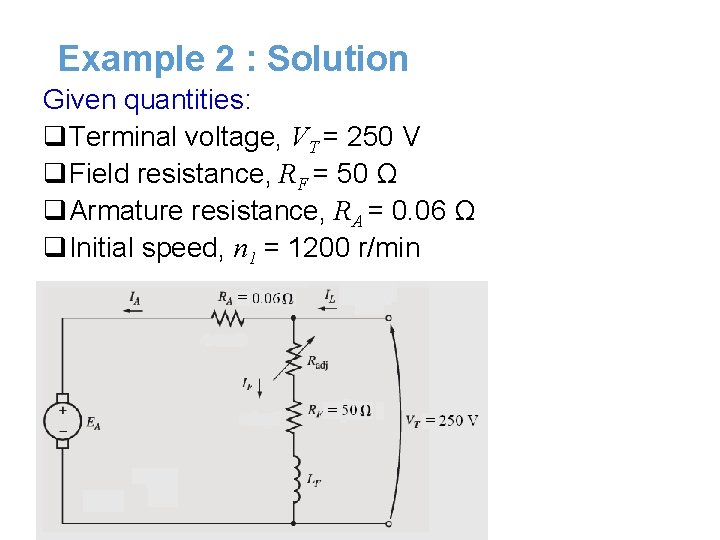
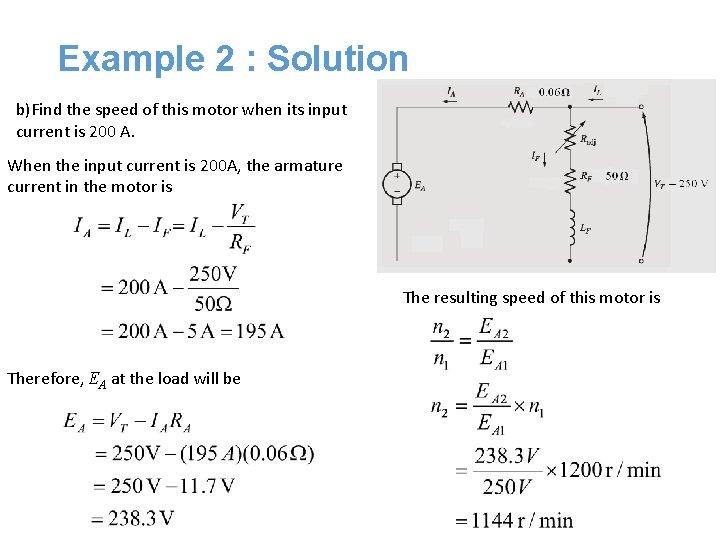
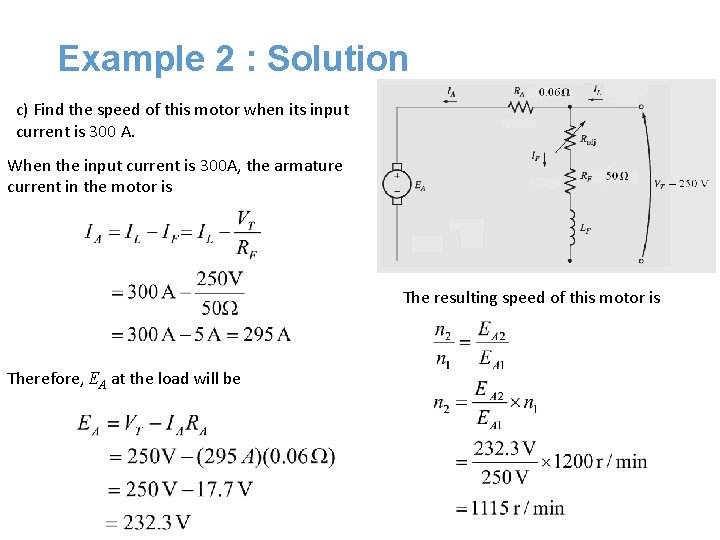
Example 2 : Solution Given quantities: q. Terminal voltage, VT = 250 V q. Field resistance, RF = 50 Ω q. Armature resistance, RA = 0. 06 Ω q. Initial speed, n 1 = 1200 r/min
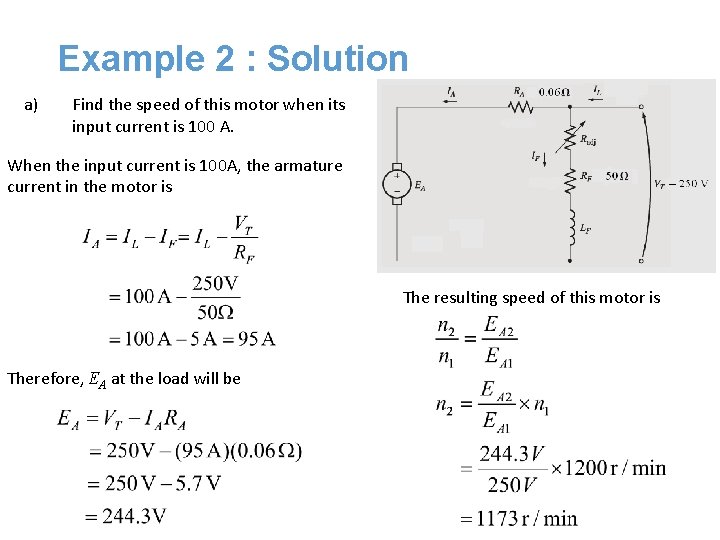
Example 2 : Solution a) Find the speed of this motor when its input current is 100 A. When the input current is 100 A, the armature current in the motor is The resulting speed of this motor is Therefore, EA at the load will be
Example 2 : Solution b)Find the speed of this motor when its input current is 200 A. When the input current is 200 A, the armature current in the motor is The resulting speed of this motor is Therefore, EA at the load will be
Example 2 : Solution c) Find the speed of this motor when its input current is 300 A. When the input current is 300 A, the armature current in the motor is The resulting speed of this motor is Therefore, EA at the load will be
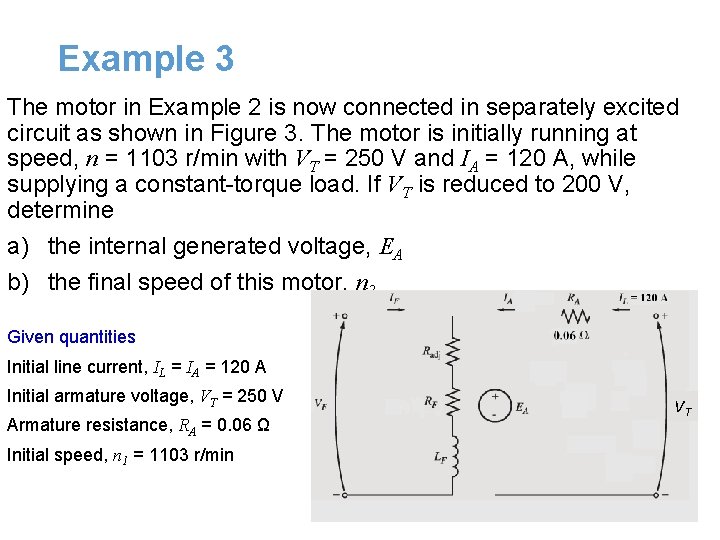
Example 3 The motor in Example 2 is now connected in separately excited circuit as shown in Figure 3. The motor is initially running at speed, n = 1103 r/min with VT = 250 V and IA = 120 A, while supplying a constant-torque load. If VT is reduced to 200 V, determine a) the internal generated voltage, EA b) the final speed of this motor, n 2 Given quantities Initial line current, IL = IA = 120 A Initial armature voltage, VT = 250 V Armature resistance, RA = 0. 06 Ω Initial speed, n 1 = 1103 r/min VT
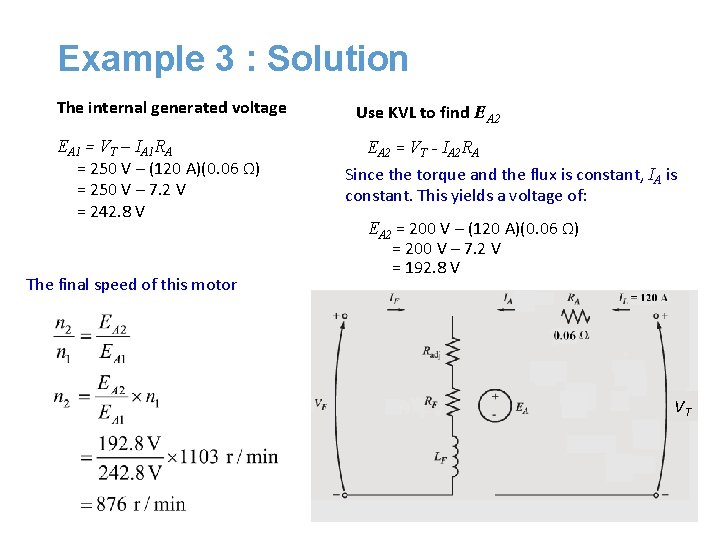
Example 3 : Solution The internal generated voltage EA 1 = VT – IA 1 RA = 250 V – (120 A)(0. 06 Ω) = 250 V – 7. 2 V = 242. 8 V The final speed of this motor Use KVL to find EA 2 = VT - IA 2 RA Since the torque and the flux is constant, IA is constant. This yields a voltage of: EA 2 = 200 V – (120 A)(0. 06 Ω) = 200 V – 7. 2 V = 192. 8 V VT
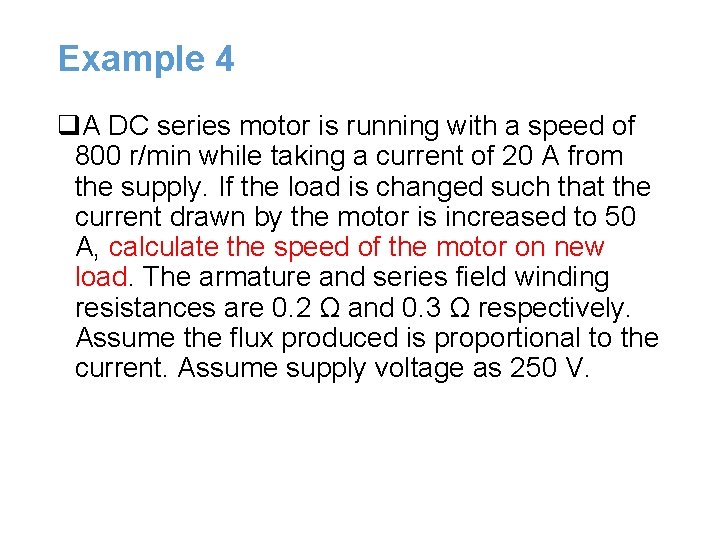
Example 4 q. A DC series motor is running with a speed of 800 r/min while taking a current of 20 A from the supply. If the load is changed such that the current drawn by the motor is increased to 50 A, calculate the speed of the motor on new load. The armature and series field winding resistances are 0. 2 Ω and 0. 3 Ω respectively. Assume the flux produced is proportional to the current. Assume supply voltage as 250 V.
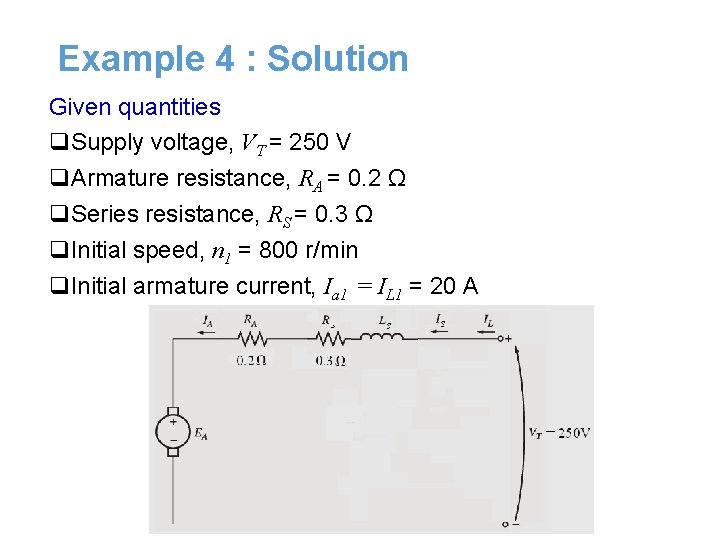
Example 4 : Solution Given quantities q. Supply voltage, VT = 250 V q. Armature resistance, RA = 0. 2 Ω q. Series resistance, RS = 0. 3 Ω q. Initial speed, n 1 = 800 r/min q. Initial armature current, Ia 1 = IL 1 = 20 A
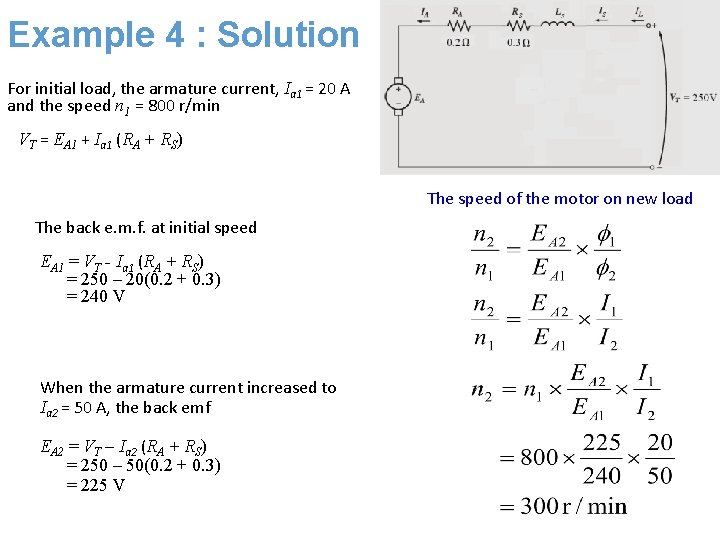
Example 4 : Solution For initial load, the armature current, Ia 1 = 20 A and the speed n 1 = 800 r/min VT = EA 1 + Ia 1 (RA + RS) The speed of the motor on new load The back e. m. f. at initial speed EA 1 = VT - Ia 1 (RA + RS) = 250 – 20(0. 2 + 0. 3) = 240 V When the armature current increased to Ia 2 = 50 A, the back emf EA 2 = VT – Ia 2 (RA + RS) = 250 – 50(0. 2 + 0. 3) = 225 V