
Chapter 5 Cultural Implications for Psychiatric Mental Health
- Slides: 17
Chapter 5 Cultural Implications for Psychiatric Mental Health Nursing Copyright © 2014, 2010, 2006 by Saunders, an imprint of Elsevier Inc.
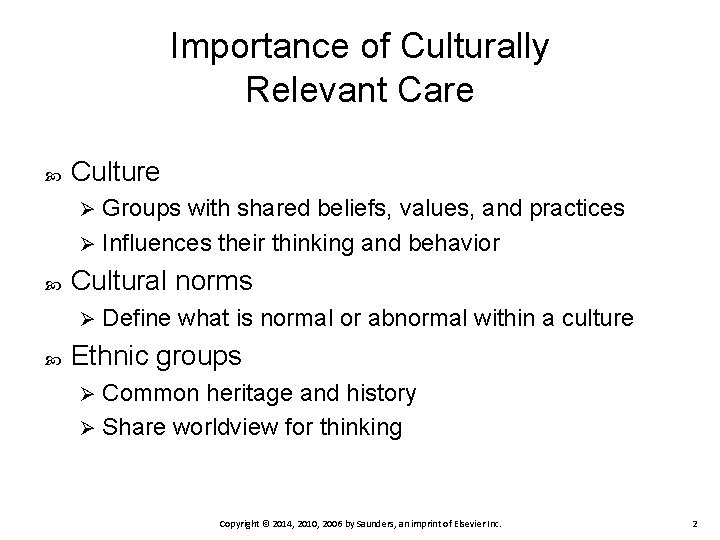
Importance of Culturally Relevant Care Culture Groups with shared beliefs, values, and practices Ø Influences their thinking and behavior Ø Cultural norms Ø Define what is normal or abnormal within a culture Ethnic groups Common heritage and history Ø Share worldview for thinking Ø Copyright © 2014, 2010, 2006 by Saunders, an imprint of Elsevier Inc. 2
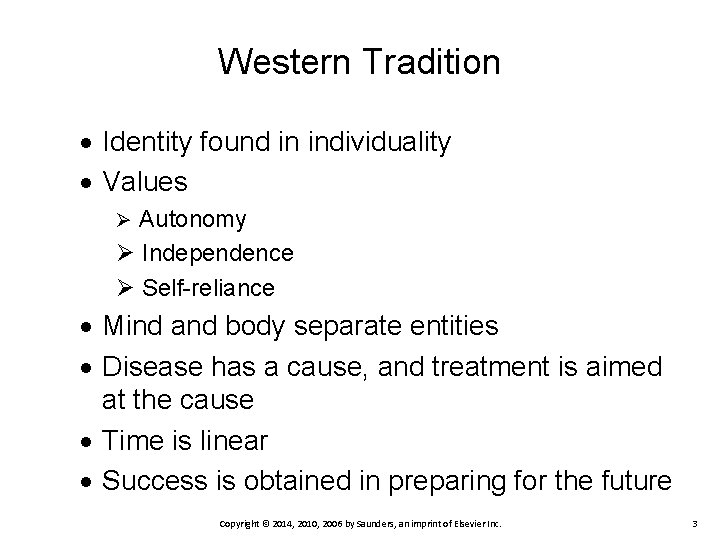
Western Tradition Identity found in individuality Values Ø Autonomy Ø Independence Ø Self-reliance Mind and body separate entities Disease has a cause, and treatment is aimed at the cause Time is linear Success is obtained in preparing for the future Copyright © 2014, 2010, 2006 by Saunders, an imprint of Elsevier Inc. 3
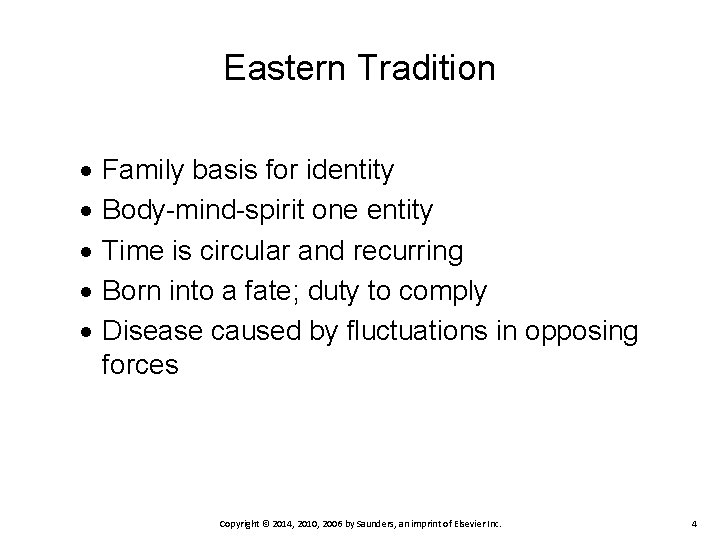
Eastern Tradition Family basis for identity Body-mind-spirit one entity Time is circular and recurring Born into a fate; duty to comply Disease caused by fluctuations in opposing forces Copyright © 2014, 2010, 2006 by Saunders, an imprint of Elsevier Inc. 4
Indigenous Culture Places significance on place of humans in natural world Basis of identity is the tribe Person is an entity only in relation to others Disease – Lack of harmony between individual and environment Copyright © 2014, 2010, 2006 by Saunders, an imprint of Elsevier Inc. 5
Culture and Mental Health Enculturation Deviance from cultural expectations can be defined as illness by other members of the group Ethnocentrism Cultural imposition Copyright © 2014, 2010, 2006 by Saunders, an imprint of Elsevier Inc. 6
Barriers to Quality Mental Health Services Communication barriers Stigma of mental illness Misdiagnosis Ø Culture-bound syndromes Genetic variations in pharmacodynamics Copyright © 2014, 2010, 2006 by Saunders, an imprint of Elsevier Inc. 7
Populations at Risk of Mental Illness and Inadequate Care Immigrants Refugees Cultural “minorities” Copyright © 2014, 2010, 2006 by Saunders, an imprint of Elsevier Inc. 8
Cultural Competence for Psychiatric Mental Health Nurses Five constructs 1. Cultural awareness Ø 2. Cultural knowledge Ø 3. Cultural encounters Ø 4. Cultural skill Ø 5. Cultural desire Ø Copyright © 2014, 2010, 2006 by Saunders, an imprint of Elsevier Inc. 9
Cultural Competence for Psychiatric Mental Health Nurses (Cont. ) 1. Cultural awareness Examine beliefs, values, and practices of own culture Ø Recognize that during a cultural encounter, three cultures are intersecting Ø • Culture of the patient, nurse, and setting Copyright © 2014, 2010, 2006 by Saunders, an imprint of Elsevier Inc. 10
Cultural Competence for Psychiatric Mental Health Nurses (Cont. ) 2. Cultural knowledge Learn by attending cultural events and programs Ø Forge friendships with diverse cultural groups Ø Learn by studying Ø Learning cultural differences helps nurse Ø • Establish rapport • Ask culturally relevant questions • Identify cultural variables to be considered Copyright © 2014, 2010, 2006 by Saunders, an imprint of Elsevier Inc. 11
Cultural Competence for Psychiatric Mental Health Nurses (Cont. ) 3. Cultural encounters Deter nurses from stereotyping Ø Help nurses gain confidence in cross-cultural interactions Ø Help nurses avoid or reduce cultural pain Ø Copyright © 2014, 2010, 2006 by Saunders, an imprint of Elsevier Inc. 12
Cultural Competence for Psychiatric Mental Health Nurses (Cont. ) 4. Cultural skill Ø Ability to perform a cultural assessment in a sensitive way • Use professional medical interpreter to ensure meaningful communication • Use culturally sensitive assessment tools Ø Goal • A mutually agreeable therapeutic plan Culturally acceptable Capable of producing positive outcomes Copyright © 2014, 2010, 2006 by Saunders, an imprint of Elsevier Inc. 13
Case Study Ms. B is admitted to your unit. In your assessment you identify some cultural patterns that may support or interfere with her health and recovery process. What can you do? Copyright © 2014, 2010, 2006 by Saunders, an imprint of Elsevier Inc. 14
Cultural Competence for Psychiatric Mental Health Nurses (Cont. ) 5. Cultural desire Genuine concern for patient’s welfare Ø Willingness to listen until patient’s viewpoint is understood Ø Patience, consideration, and empathy Ø Copyright © 2014, 2010, 2006 by Saunders, an imprint of Elsevier Inc. 15
Audience Response Questions 1. Which worldview would the nurse anticipate from a client who says, “It is important to save enough money to take care of yourself in your old age. We should not rely on anyone else to take care of us. ” A. Eastern (balance) B. Western (science) C. Indigenous (harmony) Copyright © 2014, 2010, 2006 by Saunders, an imprint of Elsevier Inc. 16
Audience Response Questions 2. Which term refers to individuals’ belief that their cultural values and practices are correct and superior to those of others? A. Assimilation B. Enculturation C. Ethnocentrism D. Somaticization Copyright © 2014, 2010, 2006 by Saunders, an imprint of Elsevier Inc. 17