
Chapter 5 Crime and Criminalization Book Deviant Behavior
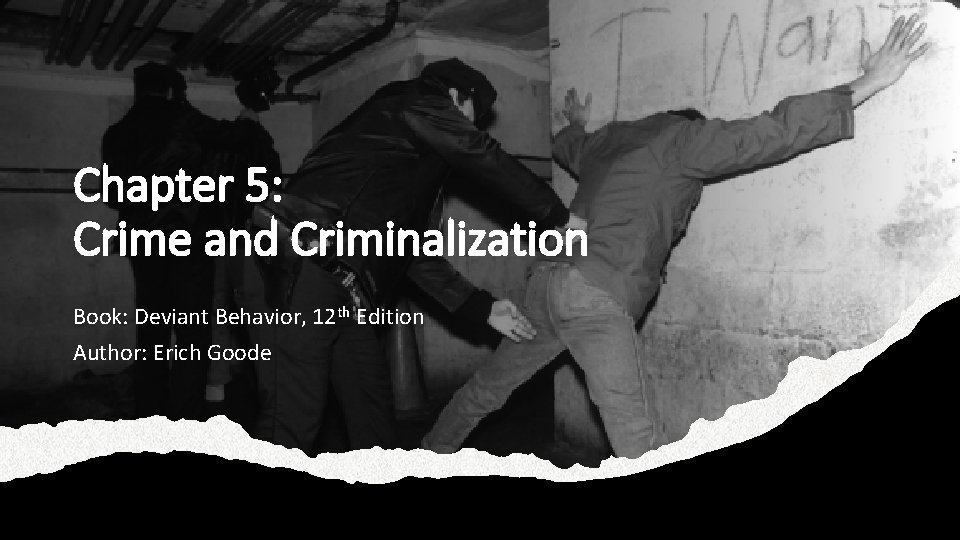
Chapter 5: Crime and Criminalization Book: Deviant Behavior, 12 th Edition Author: Erich Goode
Getting Started • At some point in the evolution of humanity, humans developed a criminal code, which detailed which offenses called for punishments; criminologists refer to such offenses as primal crime. • For most of humanity’s existence, no explicitly detailed, written criminal code existed; the first such set of laws was The Code of Hammurabi, devised by the ruler of the same name, in ancient Babylonia, which was chiseled in stone in in 1750 BCE. • Crime and deviance are not the same thing; in contemporary society, for the most part, deviant beliefs, involuntarilyacquired undesirable physical characteristics, and being a member of a stigmatized racial or ethnic group are not criminal.
The Social Construction of Murder is an unlawful, unjustified, and deviant killing. When is killing not considered murder? • When it is legally permissible by law. • In the case of “criminal negligence, ” the act is still a crime, but it is not technically murder, the most serious form of homicide. • In the case of “justifiable homicide. ” • Hargrove: when the victims are deemed insignificant.
Crime and Deviance: A Conceptual Distinction Crime is an act that attracts formal sanctions. • The most serious crimes are “high-consensus deviance. ” • Criminologists primarily focus on behaviors, rather than beliefs or traits, which are not crimes. Not all deviance is criminal. All crime is officially deviant. • The study of deviance focuses primarily on informal sanctions. • Significant overlap between crime and deviance. • Deviance is much more wide-ranging in scope.
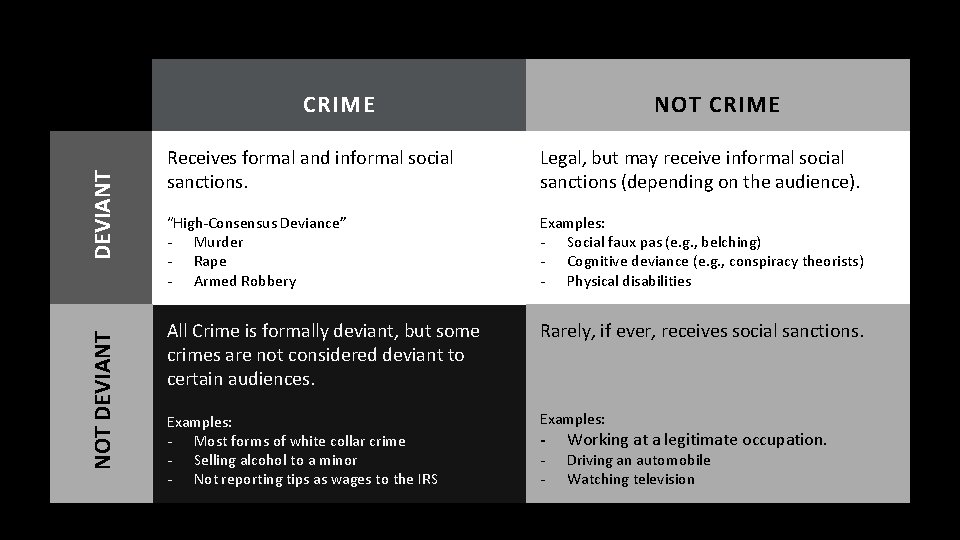
NOT DEVIANT CRIME NOT CRIME Receives formal and informal social sanctions. Legal, but may receive informal social sanctions (depending on the audience). “High-Consensus Deviance” - Murder - Rape - Armed Robbery Examples: - Social faux pas (e. g. , belching) - Cognitive deviance (e. g. , conspiracy theorists) - Physical disabilities All Crime is formally deviant, but some crimes are not considered deviant to certain audiences. Rarely, if ever, receives social sanctions. Examples: - Most forms of white collar crime - Selling alcohol to a minor - Not reporting tips as wages to the IRS Examples: - Working at a legitimate occupation. Driving an automobile Watching television
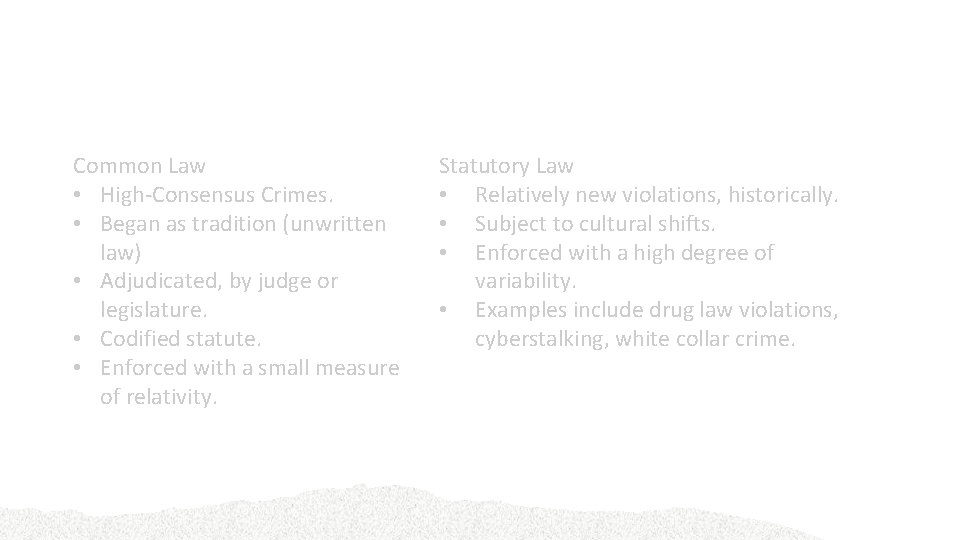
Common Law and Statutory Law Common Law • High-Consensus Crimes. • Began as tradition (unwritten law) • Adjudicated, by judge or legislature. • Codified statute. • Enforced with a small measure of relativity. Statutory Law • Relatively new violations, historically. • Subject to cultural shifts. • Enforced with a high degree of variability. • Examples include drug law violations, cyberstalking, white collar crime.
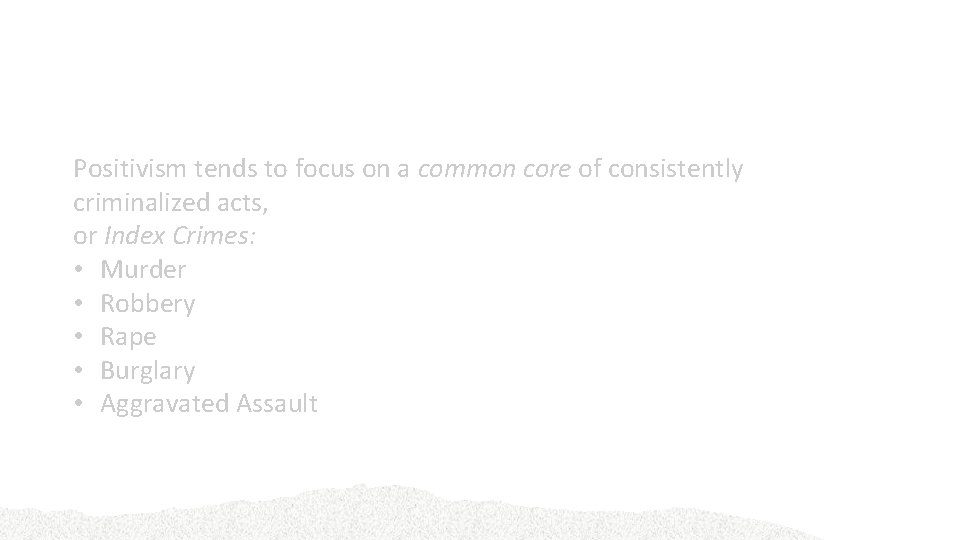
Constructionism vs Positivism Revisited Positivism tends to focus on a common core of consistently criminalized acts, or Index Crimes: • Murder • Robbery • Rape • Burglary • Aggravated Assault
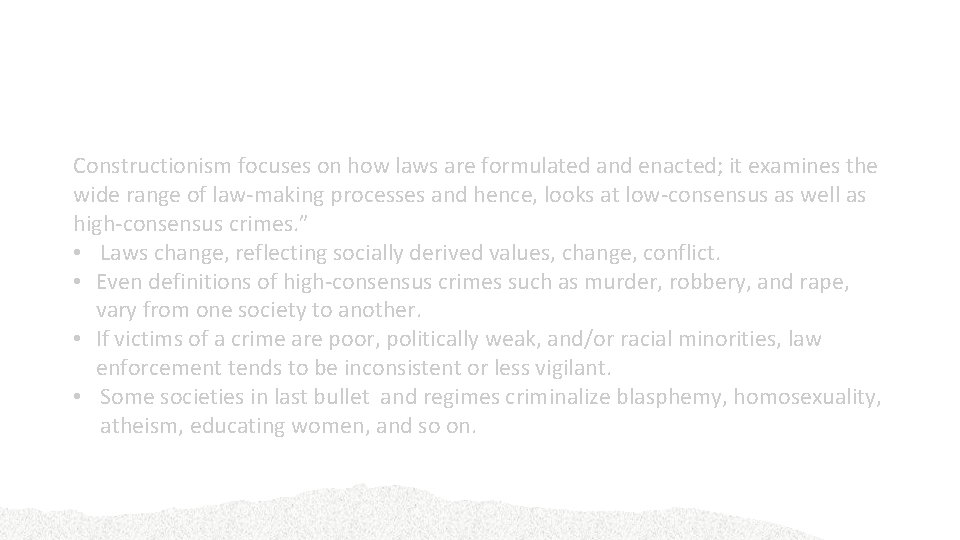
Constructionism vs Positivism Revisited Constructionism focuses on how laws are formulated and enacted; it examines the wide range of law-making processes and hence, looks at low-consensus as well as high-consensus crimes. ” • Laws change, reflecting socially derived values, change, conflict. • Even definitions of high-consensus crimes such as murder, robbery, and rape, vary from one society to another. • If victims of a crime are poor, politically weak, and/or racial minorities, law enforcement tends to be inconsistent or less vigilant. • Some societies in last bullet and regimes criminalize blasphemy, homosexuality, atheism, educating women, and so on.
Mass Incarceration Law enforcement uses jails to: • incarcerate for misdemeanor crimes. • hold those awaiting trial. • Incarcerate arrestees unable to make bail. • hold felons before or between transfer to prisons. States and the federal government administer prisons in order to: • incarcerate for felony crimes. • Hold inmates awaiting execution. Counties and municipalities administer jails. Prisoners may be held without trial indefinitely. Federal Prisons primarily incarcerate for federal crimes (for example: drugs, guns, immigration).
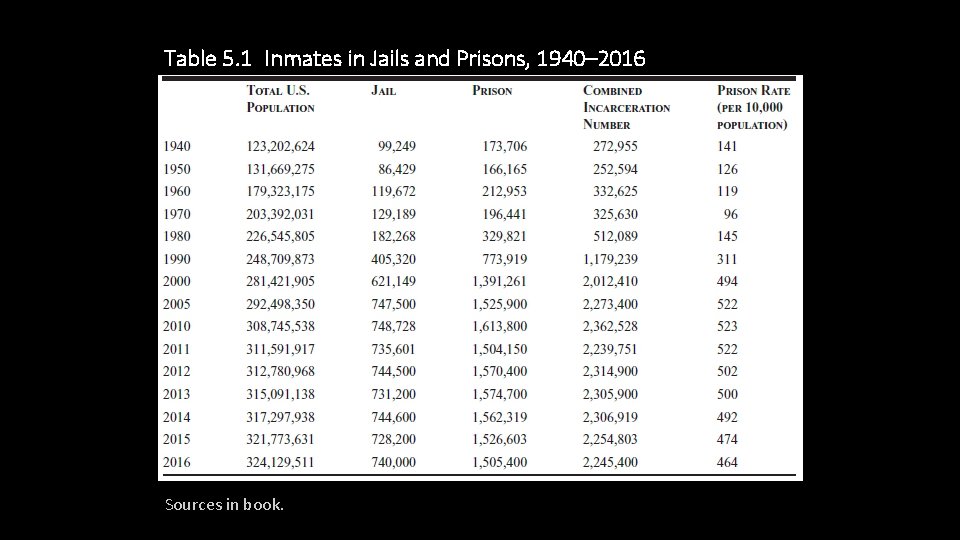
Table 5. 1 Inmates in Jails and Prisons, 1940– 2016 Sources in book.
Race and the Criminal Justice System Symbolic Assailants – The police construct a profile of ‘symbolic assailants, ’ mainly young African American males, whom they regard as potentially dangerous. This results in: • In New York City, the police are more likely to stop and frisk African Americans than whites on no more than suspicion. • The police issue more citations for public smoking, mainly of marijuana, in Black communities. • Traffic police issue a disproportionately high number of citations to Blacks for trivial driving offenses. • In addition, traffic officers are more likely to search the cars of African American drivers based on suspicion. ” • Police more likely to use force on African Americans.

Race and the Criminal Justice System: Predicting Crime Comp. Stat—A methodology that tabulates crime to locate “hot spots” to target enforcement. Predictive Policing – A system shifts the focus from “hot spots” to “hot people, ” meaning past offenders and potential future offenders, for enhanced surveillance.
Racial Disparities in Incarceration America’s Incarcerated Population (2017): 2. 2 million; 40% black, 39% white, and 19% Latino. • The black incarceration rate seven times higher than for whites. • One out of forty children in the U. S. have an incarcerated parent; for African American children, this figure is one in fifteen.
Missing Black Men 1. 5 million African American males between the ages 25 -54 are missing from public life, primarily due to: • A disproportionally high rate of incarceration. • A disproportionally high death rate. If a particular racial category goes missing, that’s a sign of tribal stigma.
Disparities in Sentencing “After controlling for the arrest offense, criminal history, and other prior characteristics … sentences for black male arrestees diverge substantially from those of white male arrestees (by about 10% on average). While this disparity does not seem to be growing, it is persistent” (Starr and Rahvi 2013, p. 200).
Banishing the Deviant from Public Life Many affluent communities create zones of exclusion which limit access by persons considered “undesirables. ” • Examples: beggars, buskers, the homeless, vagrants, the mentally disordered, even racial and ethnic minorities. • Such bans have an ancient history; in the past, they excluded the diseased (such as lepers), religious heretics, labor organizers, civil rights workers, alcoholics, and out of work hobos. • Using bans to keep undesirables out of a neighborhood increase the number of inmates in already-crowded jails.
Summary Some laws began as the formation of unwritten, traditional norms which stipulate punishment for their violation; they constitute the common law. • Such law may also be called primal law. • Examples include laws high-consensus crimes such as against murder, robbery, and rape. More recently, others began in the form of enacted legislation or as decisions in court cases. • Such laws address lower-consensus offenses or recently-emerged undesirable activities. • Examples of recently criminalized activities include drug possession and sale, gambling, and unethical white-collar activities.
Summary (Continued) The rate of incarceration in the United States is the highest in the world. African Americans and Latinos, especially males, are disproportionally incarcerated. Systemic racism a major factor in social construction of crime, policing, enforcement, and sentencing.
- Slides: 18