
Chapter 5 Creating Effective Business Messages Mc GrawHill
Chapter 5 Creating Effective Business Messages ©Mc. Graw-Hill Education. All rights reserved. Authorized only for instructor use in the classroom. No reproduction or further distribution permitted without the prior written consent of Mc. Graw-Hill Education.
Learning Objectives Learning Objective 5. 1: Explain the goals of effective business messages and the process for creating them. Learning Objective 5. 2: Identify the needs of your audience in the AIM planning process Learning Objective 5. 3: Gather the right information and refine business ideas in the AIM planning process. Learning Objective 5. 4: Develop your primary message and key points in the AIM planning process. Learning Objective 5. 5: Explain and apply positive and otheroriented tone in business messages. ©Mc. Graw-Hill Education.

Chapter Overview Goals of effective business messages AIM planning process – Audience needs, business ideas, key points Positive tones ©Mc. Graw-Hill Education.

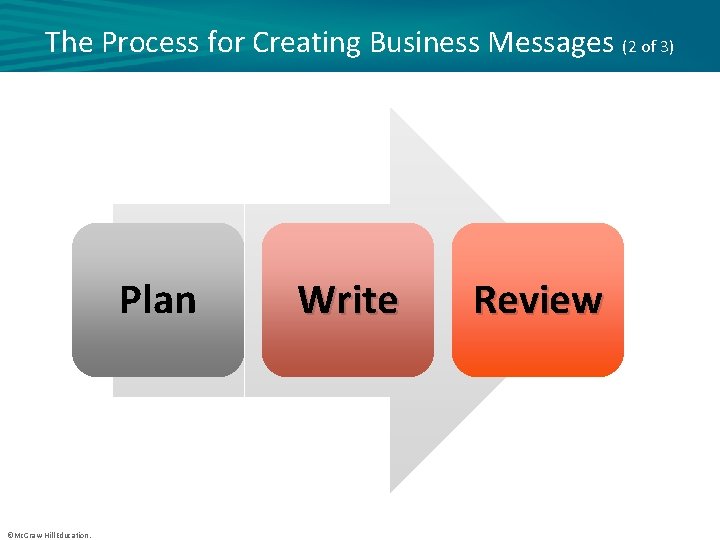
The Process for Creating Business Messages (1 of 3) Writing effective business messages involves a process —one that involves examining, developing, and refining business ideas in a way that provides business value to your audience. It drives collaboration and productivity in your work relationships. ©Mc. Graw-Hill Education.
The Process for Creating Business Messages (2 of 3) Plan ©Mc. Graw-Hill Education. Write Review

Figure 5. 1 Stages and Goals of Effective Message Creation ©Mc. Graw-Hill Education. Jump to Appendix 1 Long Image Description
The Process for Creating Business Messages (3 of 3) Expert writers are more likely to analyze the needs of the audience, generate the best ideas to tackle a problem, and identify the primary message and key points before starting a formal draft of a business message. ©Mc. Graw-Hill Education.
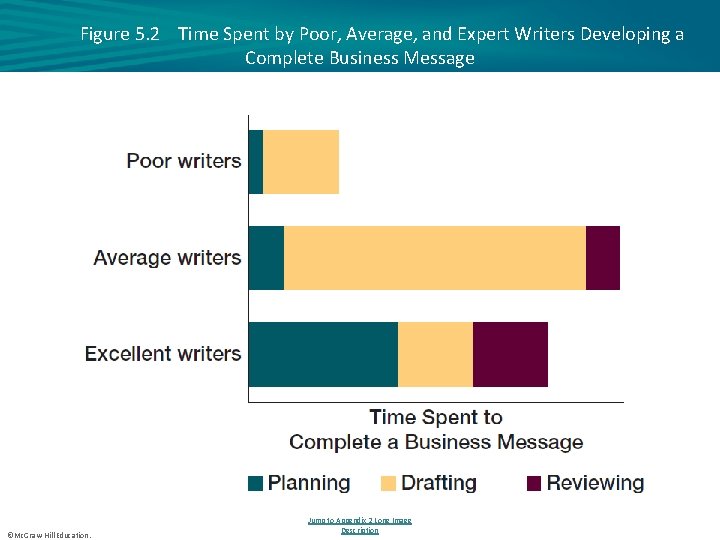
Figure 5. 2 Time Spent by Poor, Average, and Expert Writers Developing a Complete Business Message ©Mc. Graw-Hill Education. Jump to Appendix 2 Long Image Description
The AIM Planning Process for Business Messages The most important stage of creating effective business messages is planning. The AIM planning process unleashes your best thinking and allows you to deliver influential messages. ©Mc. Graw-Hill Education.

Audience Analysis (1 of 2) Effective business communicators think about the needs, priorities, and values of their audience members. They envision how their readers will respond when getting the message—in thought, feeling, and action. ©Mc. Graw-Hill Education.
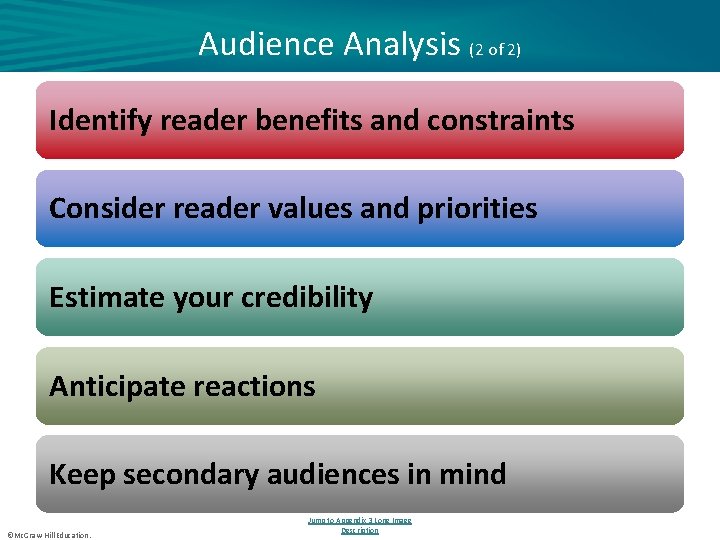
Audience Analysis (2 of 2) Identify reader benefits and constraints Consider reader values and priorities Estimate your credibility Anticipate reactions Keep secondary audiences in mind ©Mc. Graw-Hill Education. Jump to Appendix 3 Long Image Description
Identifying Reader Benefits and Constraints For many messages, this is the single most important planning step. Your readers respond when you provide them with something that they value. ©Mc. Graw-Hill Education.
Considering Reader Values and Priorities Values – Enduring beliefs and ideals that individuals hold ©Mc. Graw-Hill Education. Priorities – Involves ranking or assigning importance to things, such as projects, goals, and tasks
Estimating Your Credibility Your readers will judge your recommendations, requests, and other messages based on their view of your credibility. Many entry-level professionals have relatively low professional credibility because they are viewed as the newcomers. ©Mc. Graw-Hill Education.
Gaining Credibility Set up a time to talk with your boss. Ask your boss if you can take on any higherresponsibility projects. Make sure you fit in with the corporate culture in terms of professional dress and communication style. Attend a lot of meetings to get to know as many colleagues as possible. Create a professional blog about a niche area. ©Mc. Graw-Hill Education.
Idea Development (1 of 2) Developing great business ideas • Sort out the business issues and objectives. • Collect as many relevant facts as possible. • Make sound judgments about what the facts mean and imply. ©Mc. Graw-Hill Education.
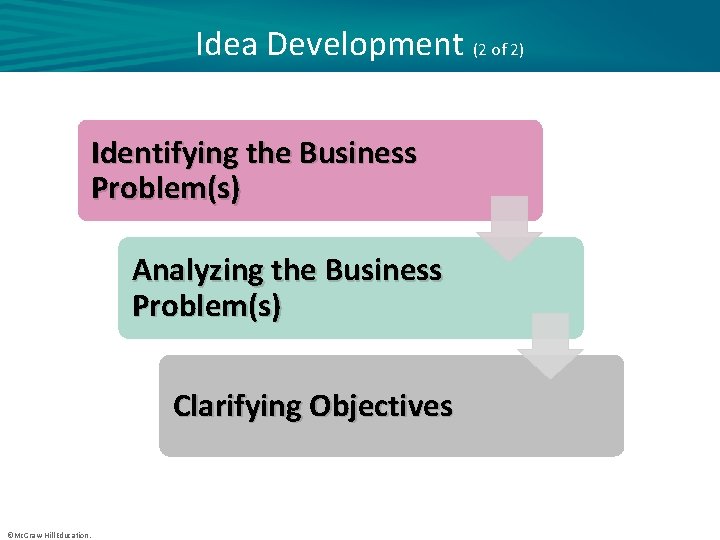
Idea Development (2 of 2) Identifying the Business Problem(s) Analyzing the Business Problem(s) Clarifying Objectives ©Mc. Graw-Hill Education.
Analyzing the Business Problem(s) (1 of 2) Facts – Statements that can be relied on with a fair amount of certainty and can be observed objectively Conclusions – Statements that are reasoned or deduced based on facts ©Mc. Graw-Hill Education.
Analyzing the Business Problem(s) (2 of 2) Positions – Stances that you take based on a set of conclusions ©Mc. Graw-Hill Education.
Clarifying Objectives: Message Structuring (1 of 2) Framing the primary message a) What is the primary message? b) What simple, vivid statement (15 words or less) captures the essence of your message? ©Mc. Graw-Hill Education.

Clarifying Objectives: Message Structuring (2 of 2) Setting up the logic of your message a) What are your supporting points? b) What do you want to explicitly ask your readers to do (call to action)? c) How will you order the logic of your message? ©Mc. Graw-Hill Education.
Setting Up the Message Framework Most business arguments employ a direct or deductive approach. They begin by stating the primary message. Then they lay out the supporting reasons and conclude with a call to action. In some cases, such as delivering bad news, an indirect or inductive approach is helpful. This approach provides supporting reasons first followed by the primary message. ©Mc. Graw-Hill Education.
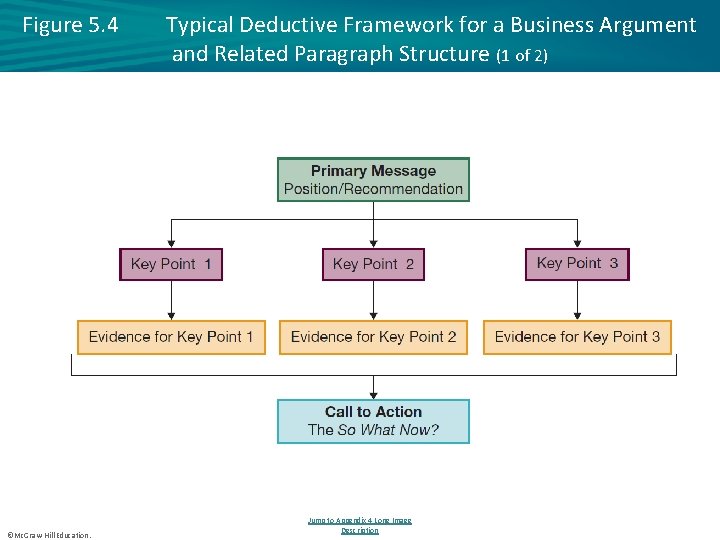
Figure 5. 4 ©Mc. Graw-Hill Education. Typical Deductive Framework for a Business Argument and Related Paragraph Structure (1 of 2) Jump to Appendix 4 Long Image Description
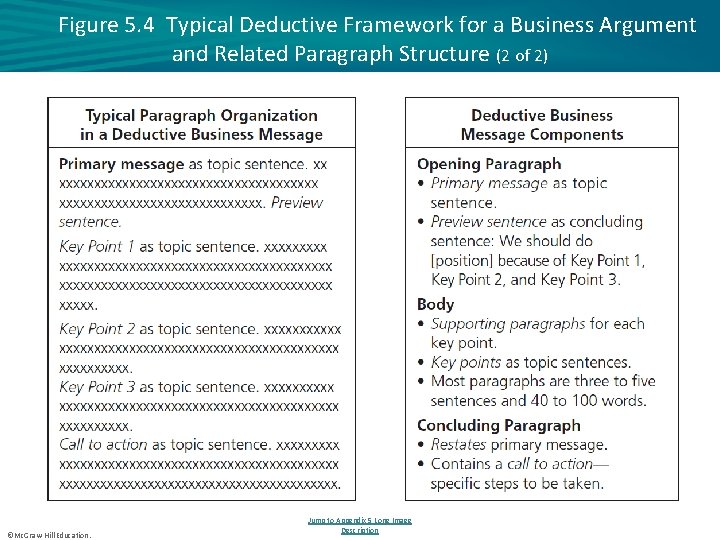
Figure 5. 4 Typical Deductive Framework for a Business Argument and Related Paragraph Structure (2 of 2) ©Mc. Graw-Hill Education. Jump to Appendix 5 Long Image Description
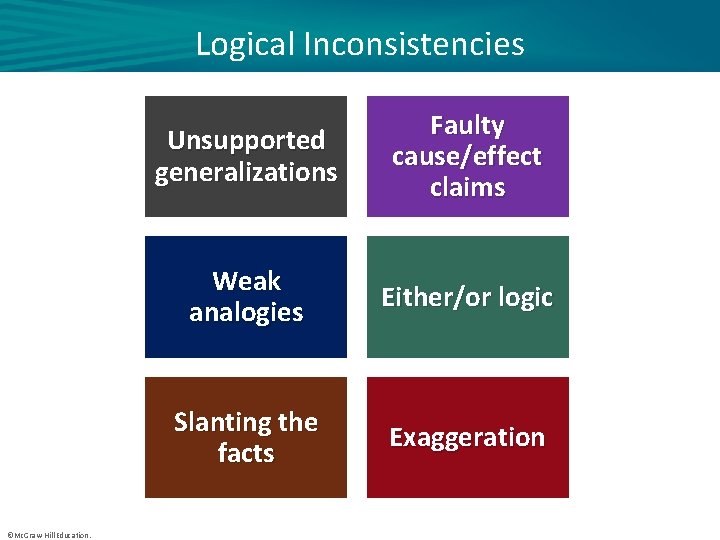
Logical Inconsistencies ©Mc. Graw-Hill Education. Unsupported generalizations Faulty cause/effect claims Weak analogies Either/or logic Slanting the facts Exaggeration
Setting the Tone of the Message Tone – The overall evaluation the reader perceives the writer to have toward the reader and the message content ©Mc. Graw-Hill Education.
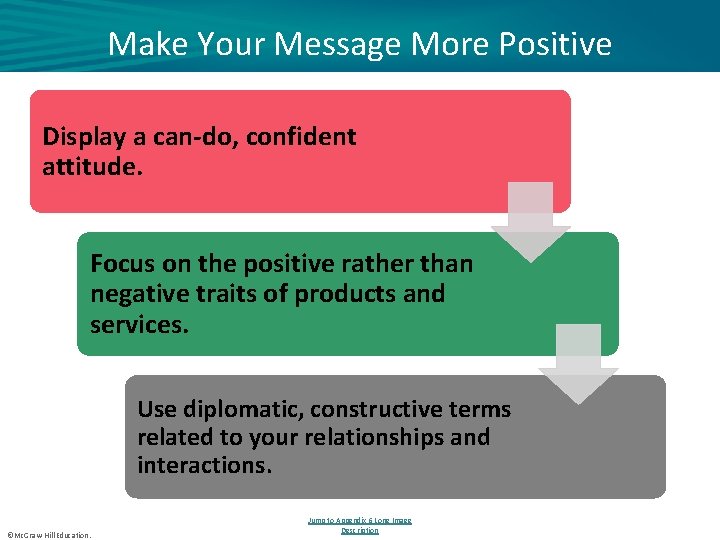
Make Your Message More Positive Display a can-do, confident attitude. Focus on the positive rather than negative traits of products and services. Use diplomatic, constructive terms related to your relationships and interactions. ©Mc. Graw-Hill Education. Jump to Appendix 6 Long Image Description
Concern for Others Avoid relying too heavily on the I-Voice. Respect the time and autonomy of your readers. Give credit to others. ©Mc. Graw-Hill Education.
Sending the Right Meta Messages (1 of 2) Meta messages – The overall but often underlying messages people take away from a communication or group of communications – Encoded and decoded as a combination of content, tone, and other signals ©Mc. Graw-Hill Education.
Sending the Right Meta Messages (2 of 2) Mixed signals occur when the content of a message conflicts with its tone, nonverbal communication, or other signals. Sending mixed signals is not only confusing, but it also frequently results in negative meta messages. ©Mc. Graw-Hill Education.
Chapter Takeaways Goals of effective business messages AIM planning process – Audience needs, business ideas, key points Positive tones ©Mc. Graw-Hill Education.
Business Communication Chapter 5 The End ©Mc. Graw-Hill Education. All rights reserved. Authorized only for instructor use in the classroom. No reproduction or further distribution permitted without the prior written consent of Mc. Graw-Hill Education.
- Slides: 32