
Chapter 5 Conditioning Part One Classical Conditioning Creates
- Slides: 54
Chapter 5: Conditioning
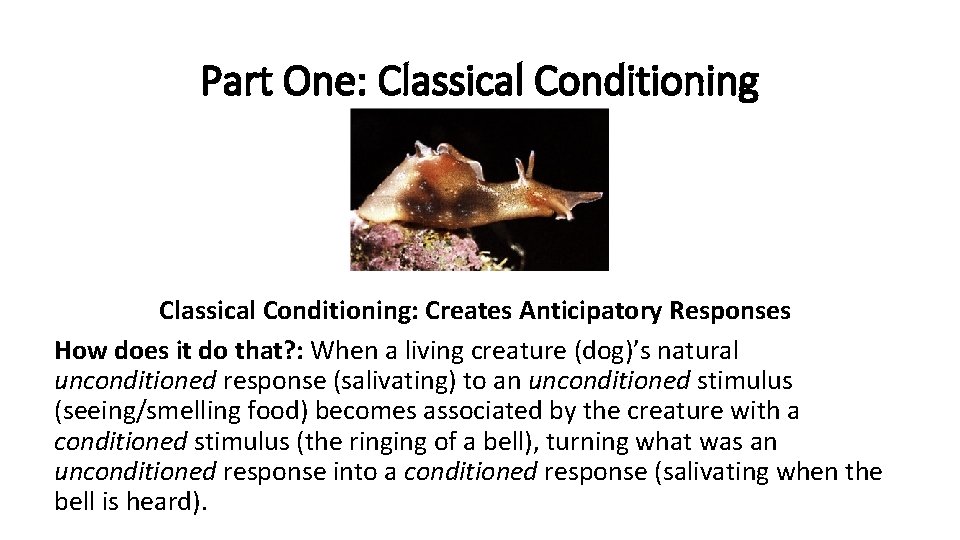
Part One: Classical Conditioning: Creates Anticipatory Responses How does it do that? : When a living creature (dog)’s natural unconditioned response (salivating) to an unconditioned stimulus (seeing/smelling food) becomes associated by the creature with a conditioned stimulus (the ringing of a bell), turning what was an unconditioned response into a conditioned response (salivating when the bell is heard).
Why this is Good for the Creature Anticipatory responses to stimuli are Good because: they give a creature an advantage over other creatures that lack the ability to anticipate the presence of something biologically valuable (in the case of the sea slug learning that an odor signals that food is nearby) or dangerous (in the case of the vocalizations of a predator that might eat you!). In other words: classical conditioning is a kind of learning that gives a creature the ability to anticipate the future. This gives the creature a competitive advantage over other creatures that lack the ability to anticipate. It is also good because it doesn’t required language or conscious thinking. After all, even SLUGS do it! What kind of cognitive processing seems most likely to be involved in classical conditioning? Answer: parallel, emotional, intuitive, unconscious.
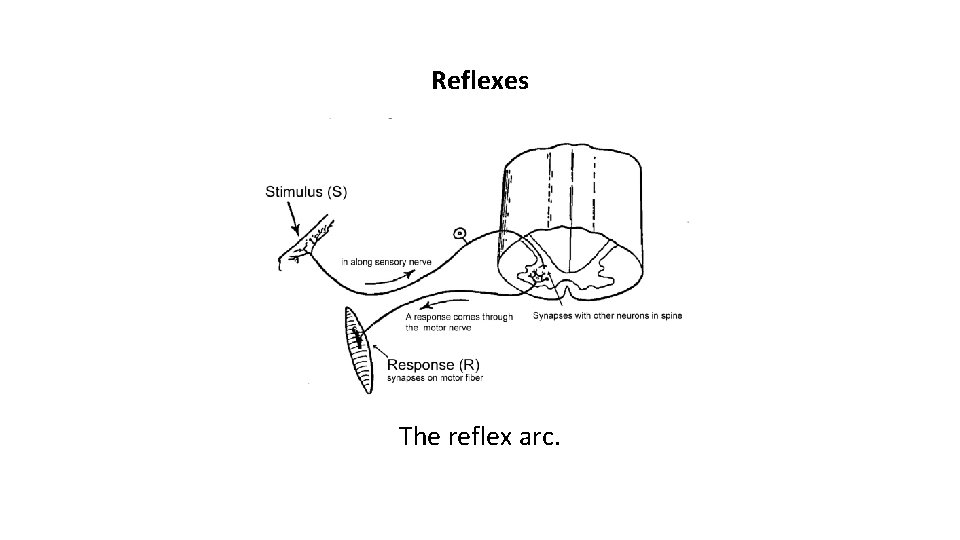
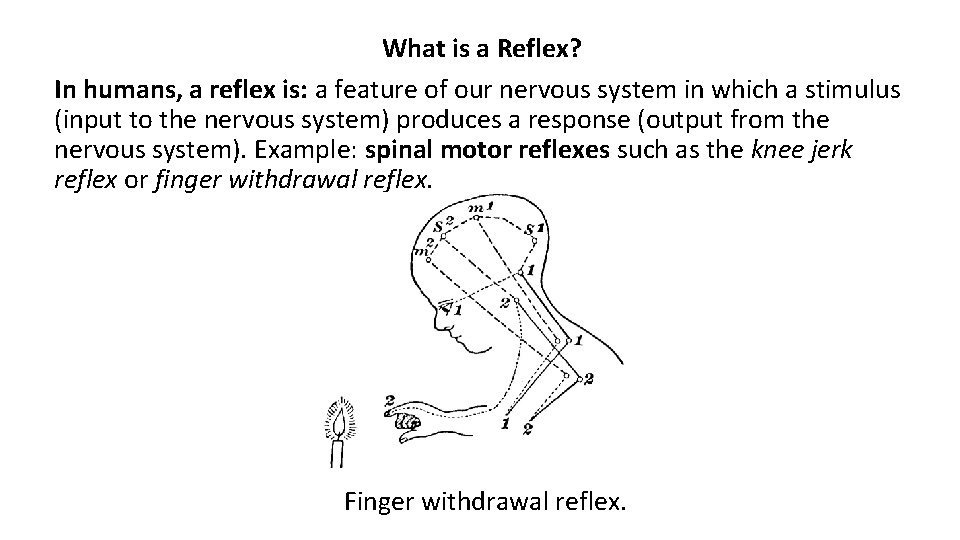
Reflexes The reflex arc.
What is a Reflex? In humans, a reflex is: a feature of our nervous system in which a stimulus (input to the nervous system) produces a response (output from the nervous system). Example: spinal motor reflexes such as the knee jerk reflex or finger withdrawal reflex. Finger withdrawal reflex.
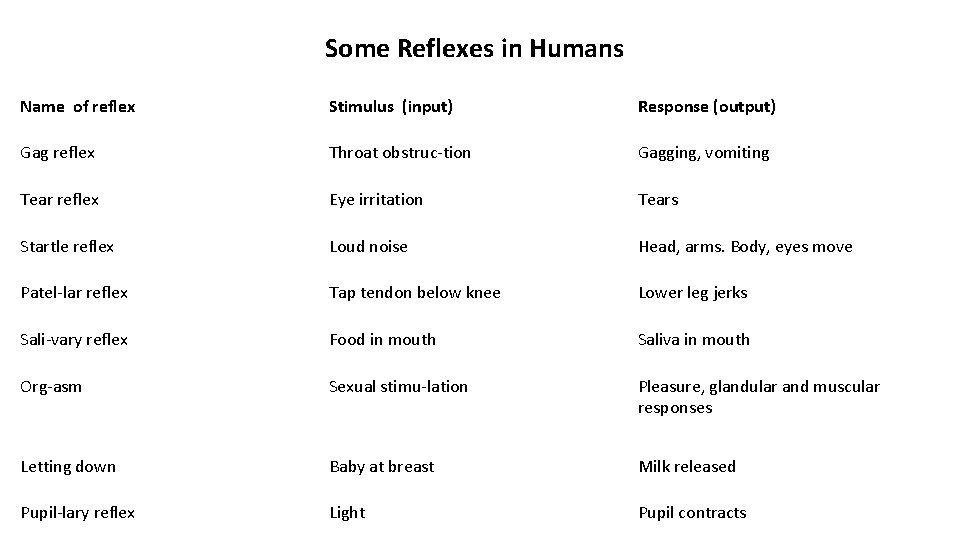
Some Reflexes in Humans Name of reflex Stimulus (input) Response (output) Gag reflex Throat obstruc tion Gagging, vomiting Tear reflex Eye irritation Tears Startle reflex Loud noise Head, arms. Body, eyes move Patel lar reflex Tap tendon below knee Lower leg jerks Sali vary reflex Food in mouth Saliva in mouth Org asm Sexual stimu lation Pleasure, glandular and muscular responses Letting down Baby at breast Milk released Pupil lary reflex Light Pupil contracts
Key Characteristic of Reflexes: Not learned Puzzle for Human Reflexes: given that human beings largely develop their behaviors through a process of learning, how could reflexes be the building blocks of human behavior? Answer: Pavlov supplied the explanation. Reflexes can be modified by learning. Example: Pavlov’s dog learns to salivate when a bell rings. Pavlov’s discovery was an ACCIDENT!: Pavlov was studying in built reflexes like the response of a dog’s salivary glands to the presence of meat in the dog’s mouth. To study this purely biological phenomenon, he restrained the dog’s head so the tube that collected the output of the salivary glands would do its job. When the dog got used to the fact that the approach of the experimenter meant FOOD IS COMING, the dog started to salivate even before the meat was in its mouth!
Pavlov Realized it was Something in the Dog’s MIND Causing it to Salivate A biological reflex was being modified by a psychological state! Only then did Pavlov create his famous experiment with the bell followed by the delivery of the food to “Pavlov’s Dog”. Pavlov’s own word for classical conditioning: signalization. Williams James repeated the experiment: but on humans. He conditioned people to respond with the finger withdrawal reflex when they were exposed to the sound of a bell.
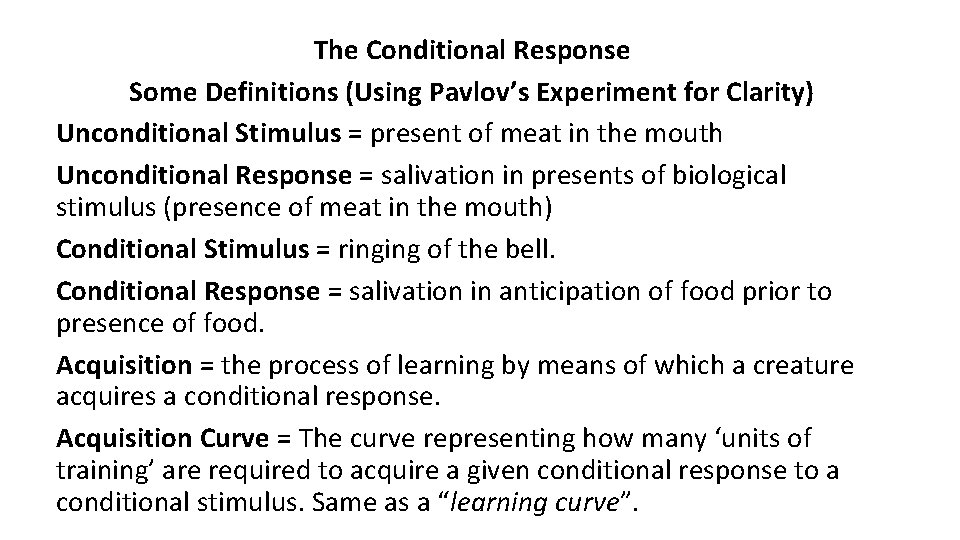
The Conditional Response Some Definitions (Using Pavlov’s Experiment for Clarity) Unconditional Stimulus = present of meat in the mouth Unconditional Response = salivation in presents of biological stimulus (presence of meat in the mouth) Conditional Stimulus = ringing of the bell. Conditional Response = salivation in anticipation of food prior to presence of food. Acquisition = the process of learning by means of which a creature acquires a conditional response. Acquisition Curve = The curve representing how many ‘units of training’ are required to acquire a given conditional response to a conditional stimulus. Same as a “learning curve”.
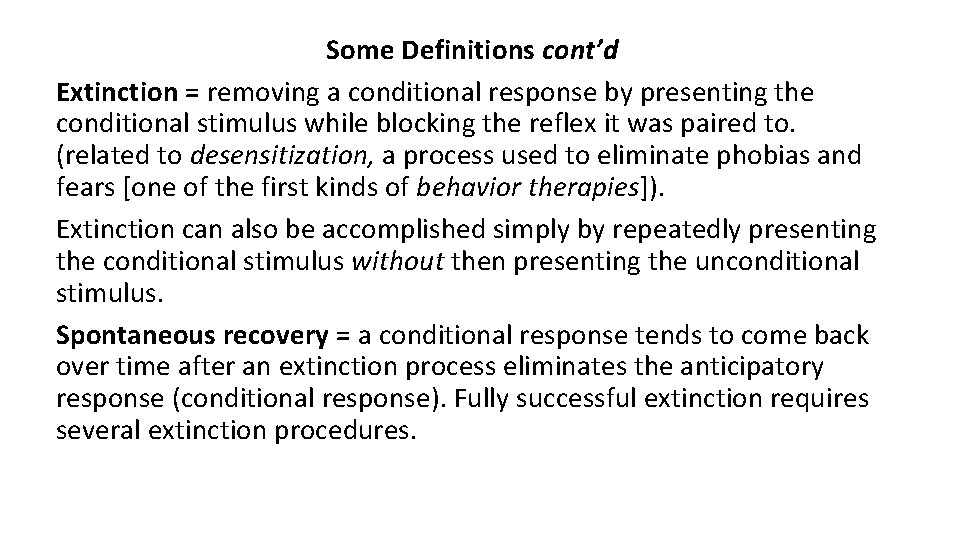
Some Definitions cont’d Extinction = removing a conditional response by presenting the conditional stimulus while blocking the reflex it was paired to. (related to desensitization, a process used to eliminate phobias and fears [one of the first kinds of behavior therapies]). Extinction can also be accomplished simply by repeatedly presenting the conditional stimulus without then presenting the unconditional stimulus. Spontaneous recovery = a conditional response tends to come back over time after an extinction process eliminates the anticipatory response (conditional response). Fully successful extinction requires several extinction procedures.
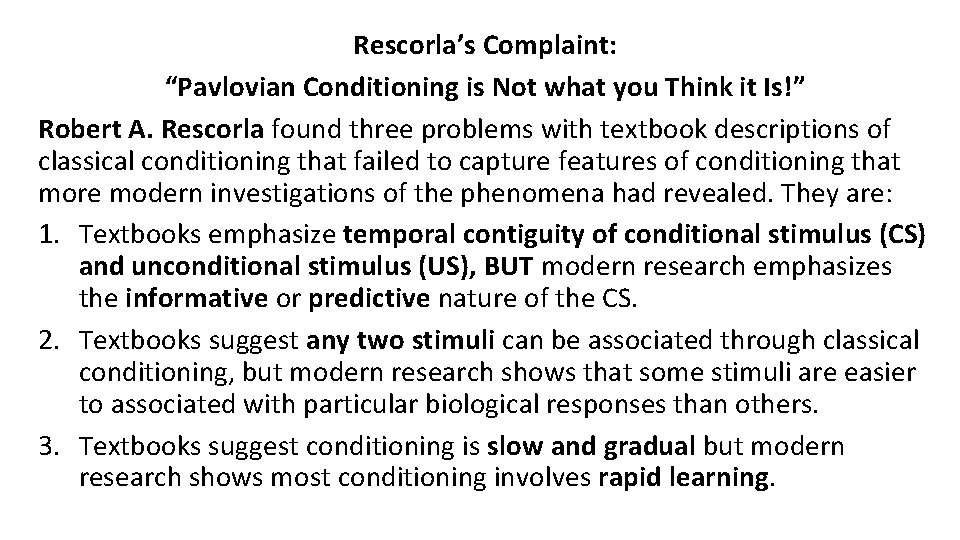
Rescorla’s Complaint: “Pavlovian Conditioning is Not what you Think it Is!” Robert A. Rescorla found three problems with textbook descriptions of classical conditioning that failed to capture features of conditioning that more modern investigations of the phenomena had revealed. They are: 1. Textbooks emphasize temporal contiguity of conditional stimulus (CS) and unconditional stimulus (US), BUT modern research emphasizes the informative or predictive nature of the CS. 2. Textbooks suggest any two stimuli can be associated through classical conditioning, but modern research shows that some stimuli are easier to associated with particular biological responses than others. 3. Textbooks suggest conditioning is slow and gradual but modern research shows most conditioning involves rapid learning.
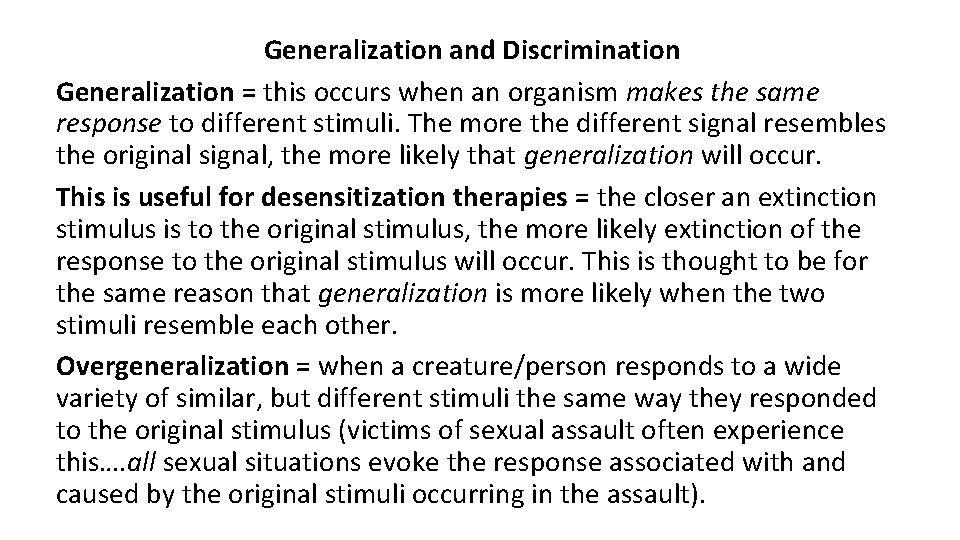
Generalization and Discrimination Generalization = this occurs when an organism makes the same response to different stimuli. The more the different signal resembles the original signal, the more likely that generalization will occur. This is useful for desensitization therapies = the closer an extinction stimulus is to the original stimulus, the more likely extinction of the response to the original stimulus will occur. This is thought to be for the same reason that generalization is more likely when the two stimuli resemble each other. Overgeneralization = when a creature/person responds to a wide variety of similar, but different stimuli the same way they responded to the original stimulus (victims of sexual assault often experience this…. all sexual situations evoke the response associated with and caused by the original stimuli occurring in the assault).
Discrimination = the opposite of generalization. When an organism responds differently to two stimuli. In classical conditioning: discrimination occurs when one stimulus generates the conditional response, but another does not. Can be useful in studying perceptual discrimination in animals = If a dog learns to salivate to a green light, but not to a red light, that shows the dog can tell the difference between the two stimuli. Reveals that dogs have color vision. Release from Habituation Related to discrimination. When an organism is exposed to a stimulus repeatedly, it eventually ceases to even notice the stimulus. Called dishabituation also. Used to study discrimination in babies (revealed that babies have a primitive sense of number [JP explains]). Related phenomenon: gradual loss of ability to discriminate all possible human phonemes after age one.
Part Two: Applications of Classical Conditioning Unconscious Classical Conditioning Based on classical conditioning applied to single neurons! Single neuron from the Alypsia (Sea Slug) called B 51 can be conditioned when impaled with two electrodes (one as ‘stimulus’ the other as detector of ‘response’).
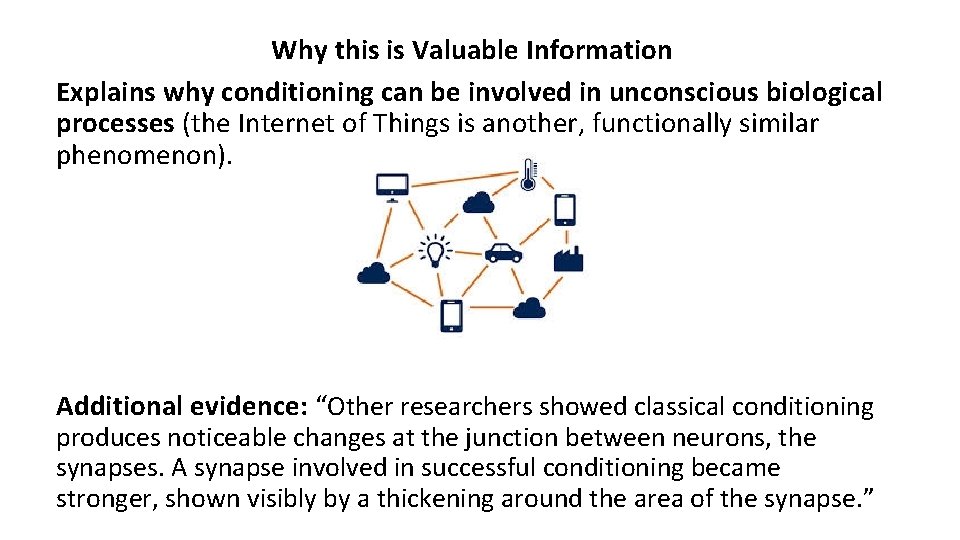
Why this is Valuable Information Explains why conditioning can be involved in unconscious biological processes (the Internet of Things is another, functionally similar phenomenon). Additional evidence: “Other researchers showed classical conditioning produces noticeable changes at the junction between neurons, the synapses. A synapse involved in successful conditioning became stronger, shown visibly by a thickening around the area of the synapse. ”
Conditioning and Drug Tolerance An Example of Unconscious Learning Your body learns to change how it reacts to drugs: “Eventually the act of drug taking triggers an anticipatory response: the secretion of drug antagonists that help eliminate the drug from the body. This lessens the body's response to the drug, which is what is called drug tolerance. ” Examples: drinkers who can ‘hold their liquor’. Only works if the drug is regularly used. Occasional users lose the drug tolerance. Interesting result: weekend drug users of potentially lethal drugs (heroin) are more likely to Overdose than regular users. (JP: a student in my school recently died of an OD and her death happened to coincide with a period when she had successfully stopped taking the drug for a long period!)
Interesting and Puzzling Case The immune system can be made to respond to a threat through a conditioning process. Example: natural killer (NK) cells (lymphocytes) that attack and destroy germs and other invaders in the body were used to generate unconditioned responses in rats condition their bodies to develop a conditioned response to an unconditional stimulus (the smell of camphor), which has no immunological effects. Question: why does this happen, since repeated exposure to a stimulus is, according to the evidence, supposed to produce tolerance (reduced tendency to react to the stimulus [the NK stimulating drug]).
Explanation: the body must interpret natural killer (NK) cell stimulating drug as something to resist. It resists by a general rise in immunological defense responses, including a rise in NK cells!) Missing: the exact mechanism that produces the rise in NK cells.
Conditional Emotional Responses (CERs) Learned emotional reactions like anxiety or happiness that occur as a response to predictive cues. Ideal interval to create a CER: longer than for a musculoskeletal response (which is ½ second). For CERs, 2 10 seconds. Probably because emotional responses involve slower acting systems (including glands). Emotional responses regulated by autonomic nervous system: parasympathetic system produces rest and recovery responses, whereas sympathetic system produces fight or flight responses. Neuroses = “are essentially conditional emotional responses” and as such are impossible to think your way out of. Hence the need for therapy.
Conditional Emotional Responses (CERs) cont’d How they arise in everyday life: as a result of any experience that generates a strong emotional response (trauma, intense events Emotional responses regulated by autonomic nervous system: parasympathetic system produces rest and recovery responses, whereas sympathetic system produces fight or flight responses. Neuroses = “are essentially conditional emotional responses” and as such are impossible to think your way out of. Hence the need for therapy. Example #1: “Take out a blank sheet of paper and put your books on the floor!” (reaction in most students: anxiety) Example #2: Sperm sampling using a red flag instead of parading mares in front of restrained stallions.
Taste Aversion Taste aversion is unusual because: 1. It occurs after one experience. 2. CS UCS gap is very long (up to six hours or more) yet conditioning is strong. 3. Association is selective: only the odor or taste of the food, not other stimuli in the environment at the time of explosure to the CS. 4. Learned response resists unlearning/extinction. 5. Given the importance, from an evolutionary perspective, of an organism responding quickly to dangers in its food sources, this shows the way classical conditioning involves automatic, involuntary, primitive processes in the human brain.
Especially Odd Case: Tumor Aversion Tumor aversion involves an anorexia response to the presence of a tumor in a subject. Possible cause: the subject’s brain responds to the presence of the tumor (the unconditional response) by associating eating of all foods (conditional stimulus) with the presence of the tumor. Problem for Predator Control Bait shyness: is a case of taste aversion where predators like coyotes become conditioned to avoid poisoned bait when they get ill, but don’t die, from eating it. Solution: ranchers gave the coyotes lithium (which would sicken but not kill any of the coyotes) in pieces of mutton. The result was the coyotes lost interest in killing and eating the sheep!
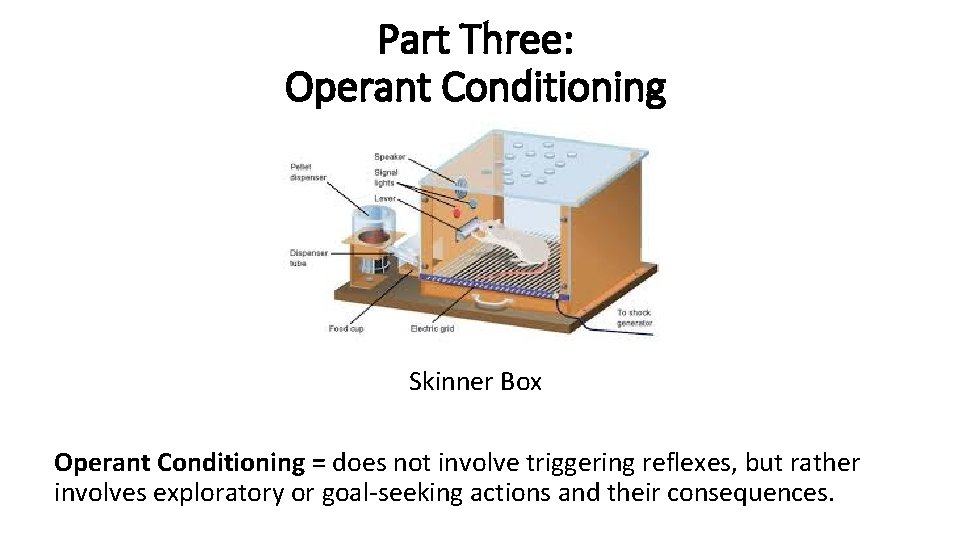
Part Three: Operant Conditioning Skinner Box Operant Conditioning = does not involve triggering reflexes, but rather involves exploratory or goal seeking actions and their consequences.
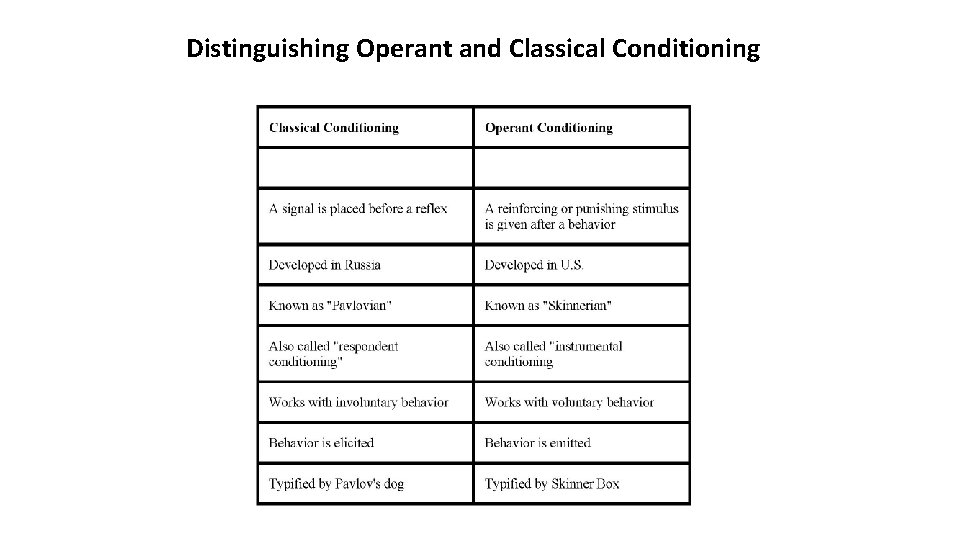
Distinguishing Operant and Classical Conditioning
Main Difference Between Classical and Operant Conditioning Classical conditioning elicits a natural biological response to a stimulus, whereas Operant Conditioning (OC) stimulates an organism to generate the response on its own, so the behavior is emitted not elicited, and is due to a general, goal directed behavior of the organism. OC only produces behavior, i. e. , activity of the organism. A behavior that is reinforced or punished by OC is called “operant” behavior. Brain level difference between CC and OC: “memory for patterns of operant responses (i. e. complex non instinctive behavior) typically requires the hippocampus, the part of the brain responsible for event memory. ” Best way to decide whether a response is to CC or OC: look for whether the response is automatic, built in, or not.
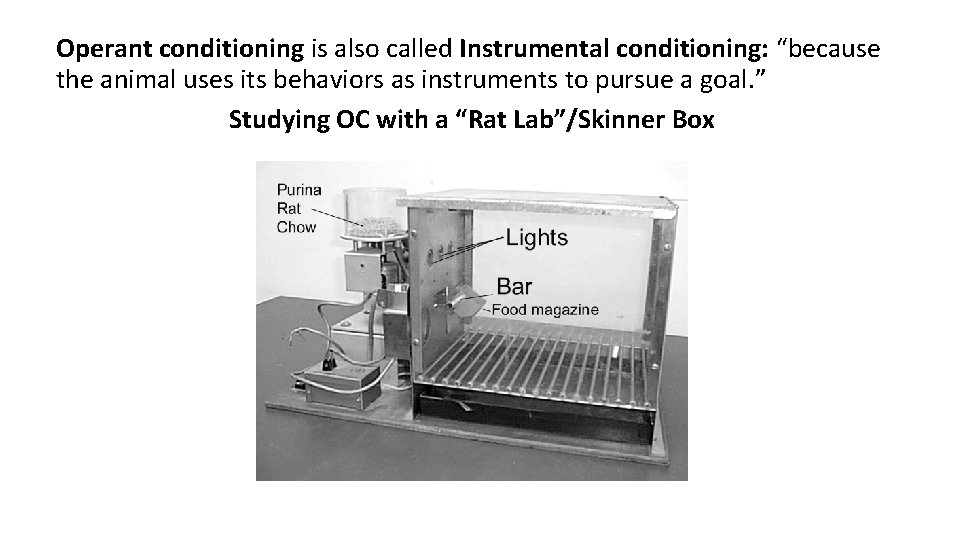
Operant conditioning is also called Instrumental conditioning: “because the animal uses its behaviors as instruments to pursue a goal. ” Studying OC with a “Rat Lab”/Skinner Box
Studying Rats in a ‘Rat Lab’ Good reason to study animal behavior through a ‘rat lab’: it reveals valuable information about learning in mammals that share some characteristics with all other mammals, and hence, offers clues about human learning. Some Terms Useful for Understanding the “Skinner Box” Unreinforced rate of response: the rate at which the rat, when new to the cage, engages in the activity that eventually will be reinforced or punished. Reinforced response: behavior that a stimulus (odor of the moistened pellets) elicits, i. e. , going to the food cup. Target behavior: The behavior to be elicited through reinforcement, or avoided through punishment. This can be going to the food cup, but it can be another behavior to be reinforced on top of the original behavior that was reinforced (e. g. , pressing the bar).
The Method of “Successive Approximations” The method of successive approxi mationsor shaping consists of rein forcing small steps toward the target behavior. First the student gives the rat a food pellet when it is anywhere near the little metal bar. The rat learns this and it stays near the bar. Then the rat may be required to touch the bar before it receives a food pellet. (It is likely to touch the bar at some point, if it is hungry and exploring. ) Finally, it is required to press the bar to receive a food pellet. This process of reinforcing gradual changes toward a target behavior is what is labeled shaping or the method of successive approximations. The method of successive approxima tions is very useful in dog obedience training or any other situation where animals must learn something new. We will discuss shaping more (using the example of teaching a dog to catch a frisbee) in the later section on applied behavior analysis.
Reinforcement = the effect of a reinforcer on behavior. Reinforcer = any stimulus that increases the frequency or probability of a behavior it follows. Positive Reinforcement = The word positive in positive reinforcement does not refer to the pleasantness of the stimulus. It means a stimulus is added or applied to the situation. Any stimulus that works to increase the frequency of a behavior it follows is a positive reinforcer. This is true even if the stimulus does not seem like it should be rewarding. A stimulus intended as a reinforcer may not function as a reinforcer. One must measure results before deciding. If a stimulus actually has the effect of reducing the frequency of the behavior it follows, then it is a punisher, not a reinforce. (see punishment trap later in chapter) Primary reinforcers: These are not learned. These can include food, water, attention, or a comfortable temperature. Secondary reinforces: learned or symbolic reinforcers. E. g. : Money, Grades.
The Premack Principle Tool for discovering what will act as a reinforcer for a given individual: look at what they already prefer (i. e. , observe their preferred behaviors). E. g. : someone loves playing video games, or prefers physical exercise. Premack Principle = As a rule, preferred behaviors can be used to reinforce unpreferred behaviors. Or, more formally, “high probability behaviors (those performed frequently under conditions of free choice) can be used to reinforce low probability behaviors. ” Simplistic example: If you want someone to press a bar, give them access to video games only after they have pressed the bar. More common example: parents saying “you can have dessert but only if you eat your peas!”
START HERE Observational Learning Albert Bandura discovered this phenomenon. Animals will imitate the behavior of another animal they have observed engaged in that behavior. Modeling is an example of observational learning. Lion cubs observe from concealed location the hunting activities of adult lions and then imitate them. Young chimps learning to fish for termites by watching parents do so with a stick, then trying it out themselves. Bandura’s explanation for observational learning: it is a case of vicarious reinforcement. We see what happens when others engage in a behavior, and that behavior is reinforced for us (if what the others are getting for performing the behavior is something we desire or need). Example: naturalist, wild turkeys and deer.
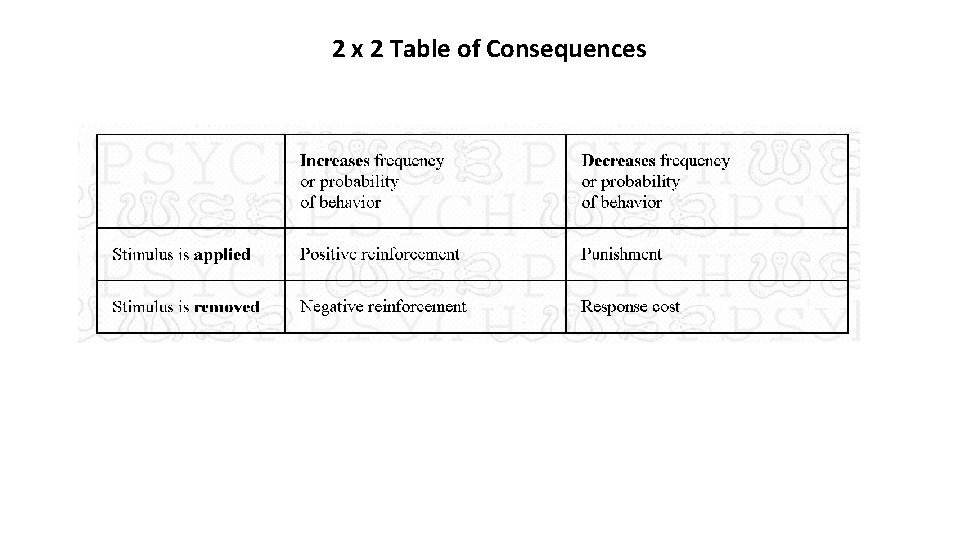
Negative Reinforcement Negative reinforcement is said to be the most misunderstood concept in psychology. Students commonly assume the word negative refers to something unpleasant. They conclude that negative reinforcement is the same thing as punishment. But negative reinforcement is not punishment. Negative reinforcement is a form of reinforcement. It increases the frequency or probability of a behavior by "taking away something bad. " For example, people go to the dentist to take away the pain of a toothache. This reinforces their going to the dentist behavior.
Punishment = when a stimulus is applied and the effect is to make the behavior less frequent. Punishers = a stimulus or stimuli that decrease the probability of a behavior it/they follow is a punisher, by definition. Example: electroshock to eliminate persistent hiccups or coughing. Reward vs. Reinforcement Psychologists refer to a ‘reward’ as the intention of a stimulus, not its effect. E. g. : a “gold star” is a reward, but it may not increase the frequency of the rewarded behavior (that depends on how the subject responds to the reward stimulus). E. g. , money can be a punisher because it may reduce, in a self motivated individual, a behavior (working hard) [Richard Wille]. It is very hard to be sure in advance of actual experimentation what behaviors (reinforced or punished) we commonly think of as rewards (or punishments).
Response Cost (Negative Punishment) Here, a stimulus is taken away in response to a behavior, which reduces the frequency of that behavior. Extinction vs. Response Cost Extinction = removal of the reinforcer causing the behavior, thus eliminating the conditional response/behavior. Response Cost = conjoining the behavior you wish to reduce in frequency with the removal of a valued stimulus (speeding ticket takes away your money, which is valuable, and tends to reduce your tendency to speed in the future). Avoidance and Escape Learning Aversive Control = changes in behavior under threat of an unpleasant stimulus (I will spank you if you don’t stop!). Escape Conditioning = When animal learns to perform an operant to terminate an ongoing aversive stimulus. Avoidance = when an animal learns that a signal comes from an aversive stimulus, it develops avoidance behavior.
2 x 2 Table of Consequences
Stimulus Control Key idea: “Teachers of operant conditioning some times saybehavior is controlled by its consequences. That sums up contingency management, but it is an incomplete description of operant conditioning. In situations of stimulus control, it is antecedents, not cons equences, that control behavior. ” Antecedents function as signals. It is signals that reinforce or punish behavior, so while the outcome of an operant conditioning procedure is to change the consequences (the behavior), it is the signals that determine whether the behavior is reinforced or punished, increased in frequency, or reduced. Thus the term stimulus control is a term used to de scribe situations in which a behavior is triggered by the presence or absence of some stimulus. A behavior is under stimulus control if it is triggered (or suppressed) by certain stimuli.
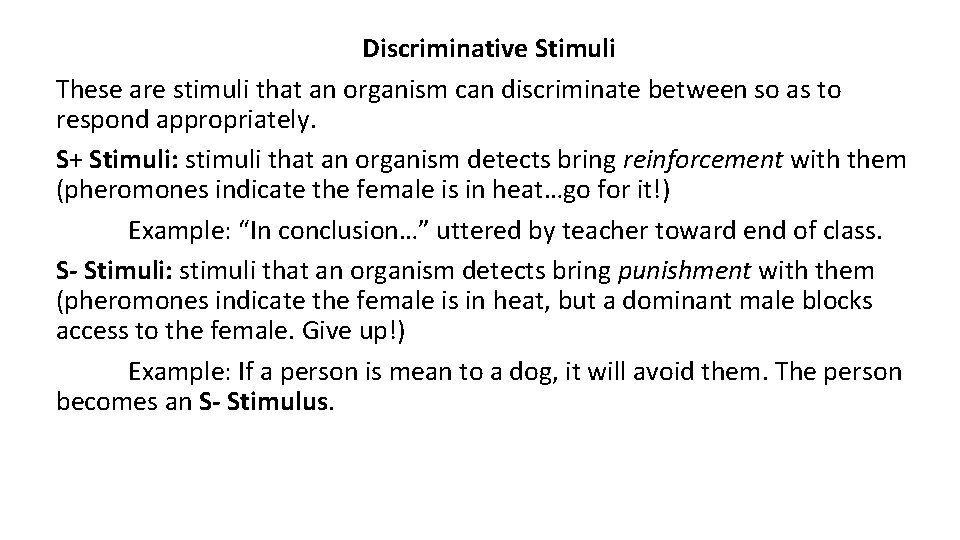
Discriminative Stimuli These are stimuli that an organism can discriminate between so as to respond appropriately. S+ Stimuli: stimuli that an organism detects bring reinforcement with them (pheromones indicate the female is in heat…go for it!) Example: “In conclusion…” uttered by teacher toward end of class. S Stimuli: stimuli that an organism detects bring punishment with them (pheromones indicate the female is in heat, but a dominant male blocks access to the female. Give up!) Example: If a person is mean to a dog, it will avoid them. The person becomes an S Stimulus.
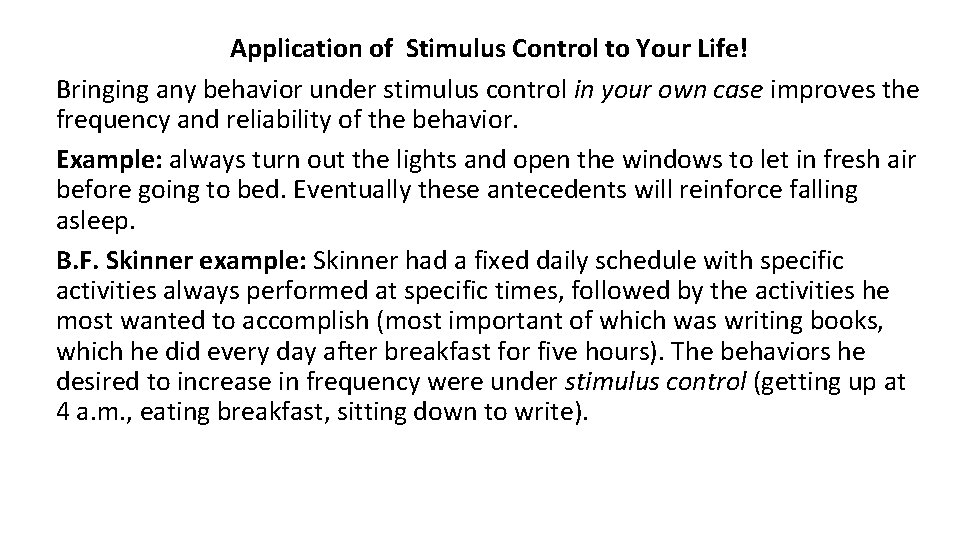
Application of Stimulus Control to Your Life! Bringing any behavior under stimulus control in your own case improves the frequency and reliability of the behavior. Example: always turn out the lights and open the windows to let in fresh air before going to bed. Eventually these antecedents will reinforce falling asleep. B. F. Skinner example: Skinner had a fixed daily schedule with specific activities always performed at specific times, followed by the activities he most wanted to accomplish (most important of which was writing books, which he did every day after breakfast for five hours). The behaviors he desired to increase in frequency were under stimulus control (getting up at 4 a. m. , eating breakfast, sitting down to write).
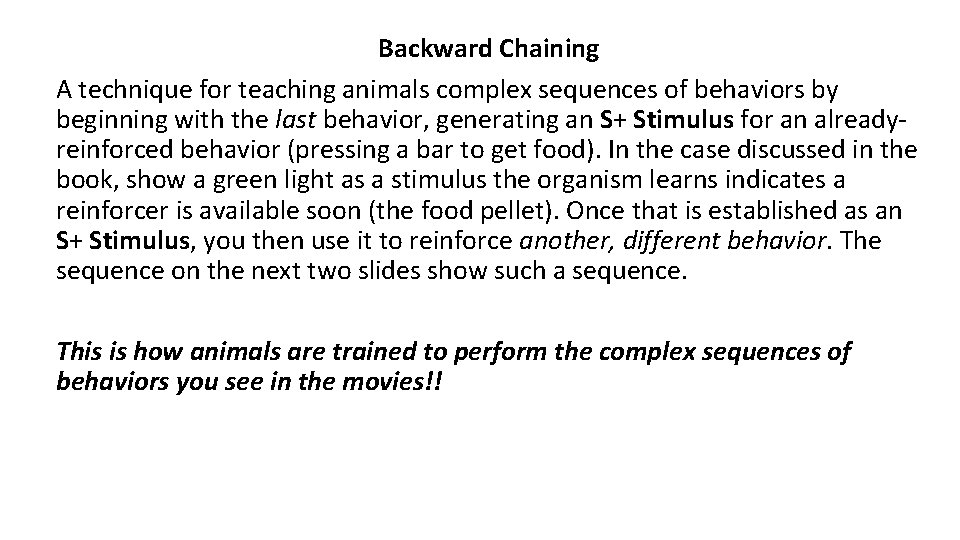
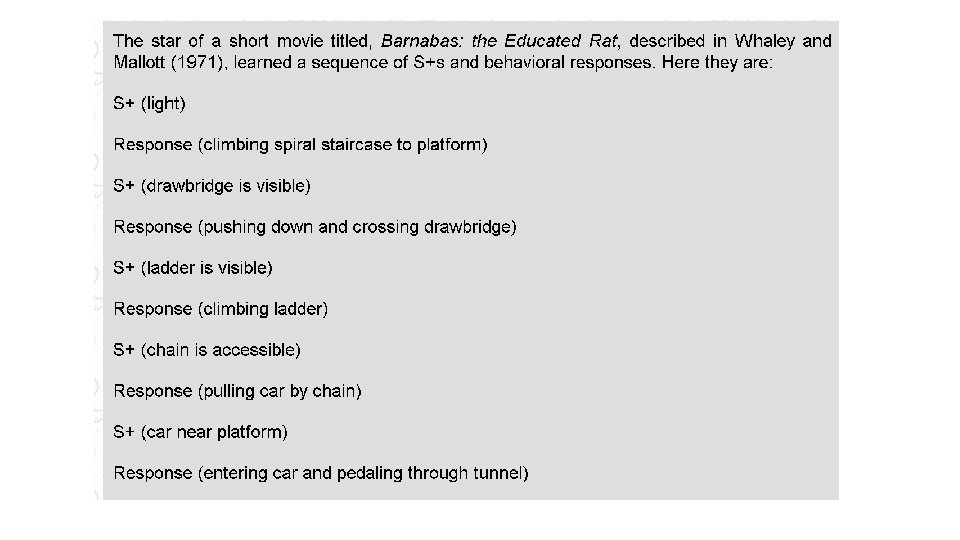
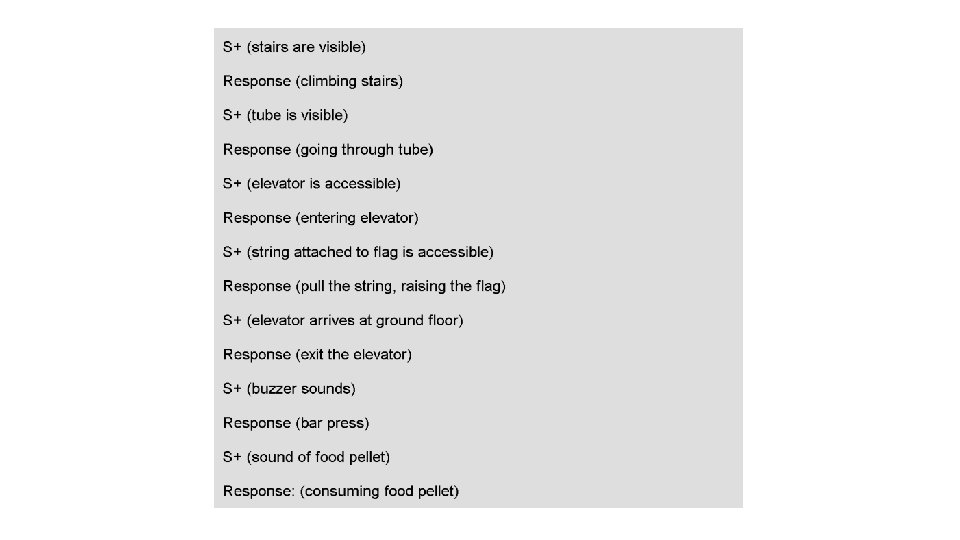
Backward Chaining A technique for teaching animals complex sequences of behaviors by beginning with the last behavior, generating an S+ Stimulus for an already reinforced behavior (pressing a bar to get food). In the case discussed in the book, show a green light as a stimulus the organism learns indicates a reinforcer is available soon (the food pellet). Once that is established as an S+ Stimulus, you then use it to reinforce another, different behavior. The sequence on the next two slides show such a sequence. This is how animals are trained to perform the complex sequences of behaviors you see in the movies!!
Humans can use language to describe a procedure, then practice it under the guidance of a plan, so they seldom benefit from backward chaining. With animals, there is no alternative to backward chaining, to teach long sequences of behaviors.
Extinction of an Operant This is the removal of an operant conditioning by removing the reinforcing stimulus. For extrinsically reinforced operants: just remove the external stimulus. Spontaneous recovery = reappearance of an extinguished behavior when insufficient extinction procedures have occurred. For intrinsically reinforced operants: reinforced from inside (probably not a candidate for producing extinction). Intermittent reinforcement and its effect on extinction: when reinforcement arises intermittently, it generates resistance to extinction (harder to extinguish these operants). Variable ratio schedules of reinforcers: these produce especially strong operants particularly resistant to extinction. Real life example: gambling (where the reinforcers are intermittent).
Variable ratio schedule phenomena explain why parents should never yield to a child’s tantrums: To only punish tantrum sometimes increases the extinction resistance to the behavior (tantrums) you want to discourage, increasing the likelihood that the child will continue to throw tantrums. Extinction Induced Resurgence Tendency of organisms subjected to extinction to try out all sorts of new behaviors in hopes the formerly reinforced behavior will make the reinforcers come back. (JP: It is as if there is regret at the loss of the reinforcer, you might say) Useful for animal trainers, who use the increase in variability of behaviors to select a new behavior to reinforce.
Part Four: Skinner Box Applied Behavior Analysis = applying the principles of operant conditioning outside the lab environment.
Tools Available to Applied Behavior Analyst 1. Systematic arrangement of consequences (reinforcement and punishment) and 2. Careful analysis and arrangement of antecedents (S+ and S ) Arrangement of consequences for behaviors is called contingency management, which is used whenever a creature is motivated either by incentives (such as getting paid for a job) or penalties (such as paying a fine for doing something wrong). Let’s Make a List of Problems We Want to Use ABA to Solve To make this list useful, we need to define the problems in terms of a behavior (some observable, measurable activity [behavior] that people wish to make either more frequent or less frequent). What the behavioral analyst would do with our list: apply conditioning techniques to make the desired changes.
How to Proceed The first step in applied behavior analysis is to analyze the problem in a behavioral way. That means stating the problem in terms of behaviors, controlling stimuli, reinforcers, punishers, or obser vational learning: the concepts we have covered in this chapter. Antecedent and consequent stimuli must be identified. After this analysis, one can make an educated guess about which intervention strategy or "treatment" might be best. Lindsley's Simplified Precision Model 1. Pinpoint the target behavior to be modified. 2. Record the rate of that behavior (called baselining). 3. Change consequences of the behavior (self monitoring can work) 4. If the first try does not succeed, try and try again with revised proce dures.
If Self Monitoring Doesn’t Work: Using Reinforcement Find a consequence (preferably positive reinforcement) that can be coupled with the undesirable behavior (Jay’s wetting himself in his clothes) First try: Punishment (let Jay sit for 30 minutes in wet clothes when he doesn’t use the bathroom but wets himself in his clothes) Result: No success. Second try: Positive reinforcement (reward Jay with candy and praise whenever he urinates in the toilet) Result: Success. A Case Using the Premack Principle says to use a high probability behavior as an incentive/reward for the behavior that you want to encourage. Burton’s high probability behavior was retiring to his room. He was allowed to do this only when he had done his homework (the target behavior). Success!
Other Techniques: Use of Natural Social Reinforcers Examples of natural social reinforcers: any positive social contact, including (for humans) hugs, smiles, compliments, or simple attention and company. For nonhuman animals: attention, touching, grooming, and cleaning. Secondary Reinforcement Using Tokens Involves an application of secondary reinforcers (like money, prizes, etc. ). Well known example: token economies. Here a token based economic system is created using poker chips. Someone receives chips whenever they engage in a desired behavior. The chips can be exchanged for primary reinforcers (food, candy, but the system works even when nothing but tokens are received (seems to constitute a form of praise that works on humans ).
More Reinforcement Techniques Shaping: When a behavior you want to reinforce is not actually occurring, break down the desired behavior into smaller behaviors that will add up to the desired behavior. Reinforce the first step (entering step, and once in place, then reinforce the next step, and the next, until the whole behavior is reinforced and can be done in one smooth sequence of micro behaviors). Prompting and Fading Prompting: You help a behavior to occur (hold a bat in a child’s hands and swing it for them). This teaches the child how to perform the behavior even when they can’t do it themselves. Fading: Gradually withdraw the prompt. The child, in the bat case, gradually takes up the whole of the process of swinging the bat themselves.
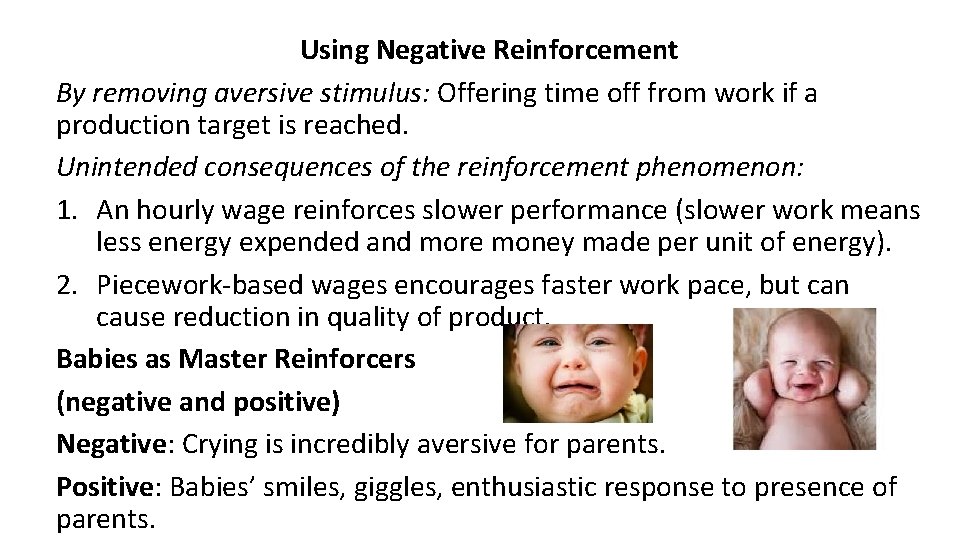
Using Negative Reinforcement By removing aversive stimulus: Offering time off from work if a production target is reached. Unintended consequences of the reinforcement phenomenon: 1. An hourly wage reinforces slower performance (slower work means less energy expended and more money made per unit of energy). 2. Piecework based wages encourages faster work pace, but can cause reduction in quality of product. Babies as Master Reinforcers (negative and positive) Negative: Crying is incredibly aversive for parents. Positive: Babies’ smiles, giggles, enthusiastic response to presence of parents.
Punishing Little Children and Bunnies Applied behavior analysis can provide gentle, loving methods to reduce the frequency of unwanted behaviors in vulnerable creatures. This is when it becomes important to keep in mind that punishment, defined as reducing the frequency of an unwanted behavior, need not involve electric shocks, pain, or any other aversive stimulus. A punisher is just something that reduces the frequency of a behavior it follows, by definition. The Punishment Trap The punishment trap occurs when stimuli intended as punishment instead function as reinforcers. How can you tell when something intended as punishment is functioning as reinforcement? Observe the frequency of the behavior. If the behavior becomes more frequent, the intended punisher is actually a reinforcer. Sometimes a child responds to "punishment" by doing more of the same misbehavior. If so, the parents are caught in the punishment trap.
What is the "punishment trap"? How could such a pattern occur? Consider these facts. The average parent is very busy, due in part to having children. The parent enjoys peace and quiet when children are being good or playing peacefully. Therefore, when children are well behaved, parents tend to ignore them. By contrast, when children misbehave, parents must give attention. Parents must break up fights, prevent damage to furniture or walls or pets, and respond to screams or crying. Most children are reinforced by attention. So there you have all the necessary ingredients for the punishment trap. Children learn to misbehave in order to get attention.
Catch Them Being Good "Catch Them Being Good" might be the single most effective parenting principle. The strategy is simple. Go out of your way to give sincere social rein forcement (love, attention, appreciation) to children when it is deserved. Do not wait for something bad to happen to give attention. When children are playing quietly or working on some worthy project, a parent should stop by to admire what they are doing. When they are creative, a parent should praise their products. When they invent a game, a parent should let them demonstrate it or play it with them. Sincere social reinforcement of desirable behavior has several positive conse quences. First, it encourages a set of behaviors that might be called sweetness. The technique could be called DRS (differential reinforcement of sweet behavior) With a child who is accustomed to being praised for praiseworthy behavior, an occasional reprimand or angry word is genuinely punishing. This reduces the overall level of punishment needed for day to day parenting to near zero.