
Chapter 5 Computer Software and Systems Company LOGO





- Slides: 43
Chapter 5 Computer Software and Systems Company LOGO Nursing Informatics
Software § Is the general term applied to the instructions that direct the computer’s hardware to perform work. § Its consist of instructions communicated electronically to the hardware. Nursing Informatics
Types of Software § System Software – boots up the computer system; controls input, output and storage; and controls the operations of the application software; consist of programs that controls the operation of the computer and its devices. § Application Software– includes the various programs that users require to perform day-today tasks. Nursing Informatics
Types of System Software § Operating System – a set of programs containing instructions that coordinate all the activities among computer hardware resources. “A computer cannot function without an operating system”. § Utilities/Utility Program – software that performs specific task, usually related to managing your computer, its devices, or its programs. Nursing Informatics
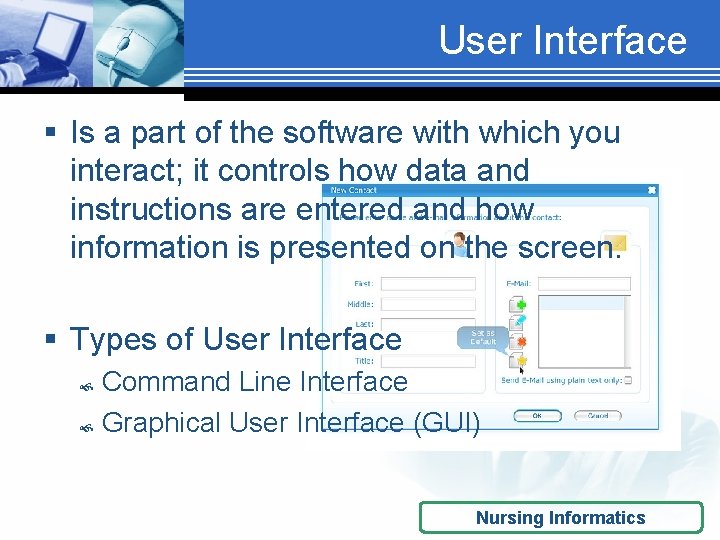
User Interface § Is a part of the software with which you interact; it controls how data and instructions are entered and how information is presented on the screen. § Types of User Interface Command Line Interface Graphical User Interface (GUI) Nursing Informatics
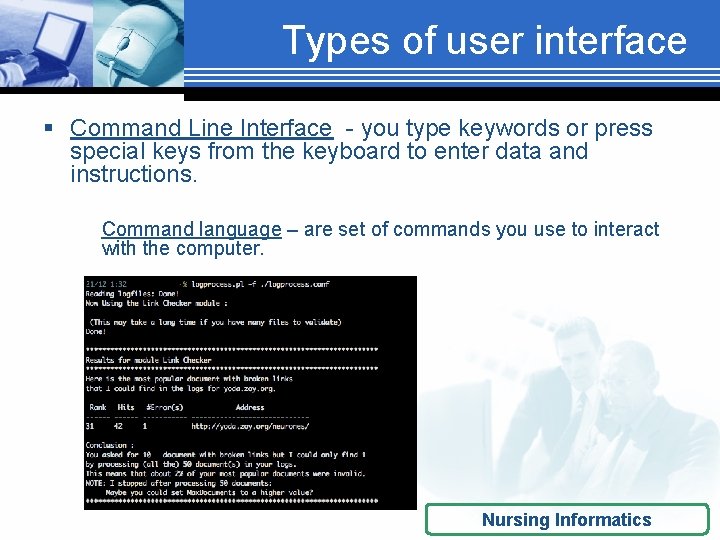
Types of user interface § Command Line Interface - you type keywords or press special keys from the keyboard to enter data and instructions. Command language – are set of commands you use to interact with the computer. Nursing Informatics
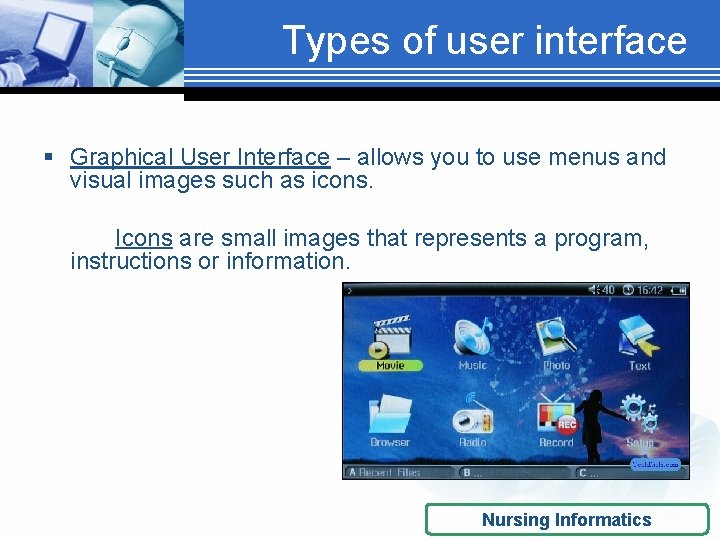
Types of user interface § Graphical User Interface – allows you to use menus and visual images such as icons. Icons are small images that represents a program, instructions or information. Nursing Informatics
Language Translation Utilities Translation programs are needed to convert instructions written in English-like language into binary. These translation programs are called assemblers, compilers or interpreters. Nursing Informatics
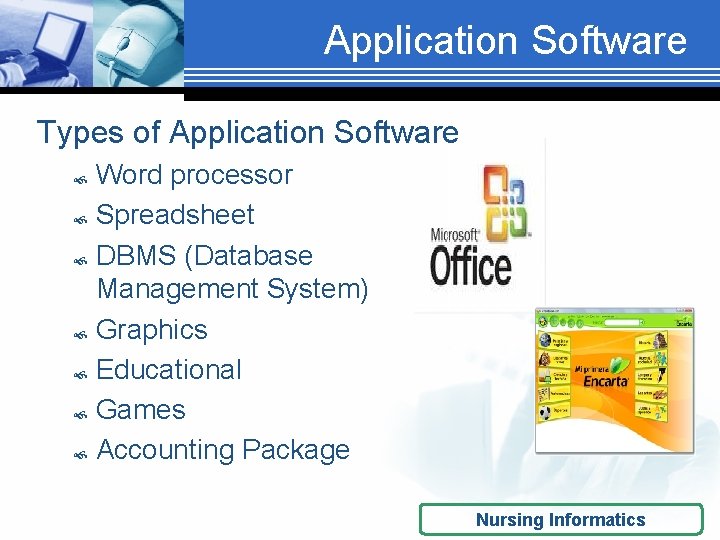
Application Software Types of Application Software Word processor Spreadsheet DBMS (Database Management System) Graphics Educational Games Accounting Package Nursing Informatics
Programming Language § Is a means of communicating with the computer. § Is a set of words, symbols, and codes that enables a programmer to communicate a solution algorithm to computer. Nursing Informatics
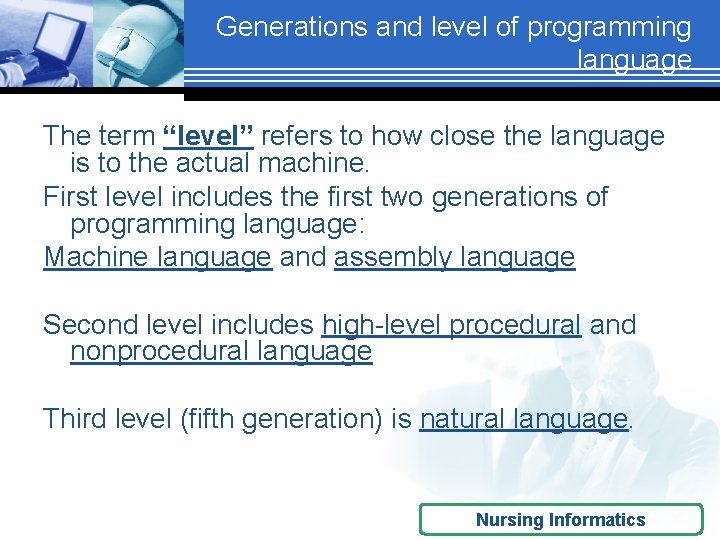
Generations and level of programming language The term “level” refers to how close the language is to the actual machine. First level includes the first two generations of programming language: Machine language and assembly language Second level includes high-level procedural and nonprocedural language Third level (fifth generation) is natural language. Nursing Informatics
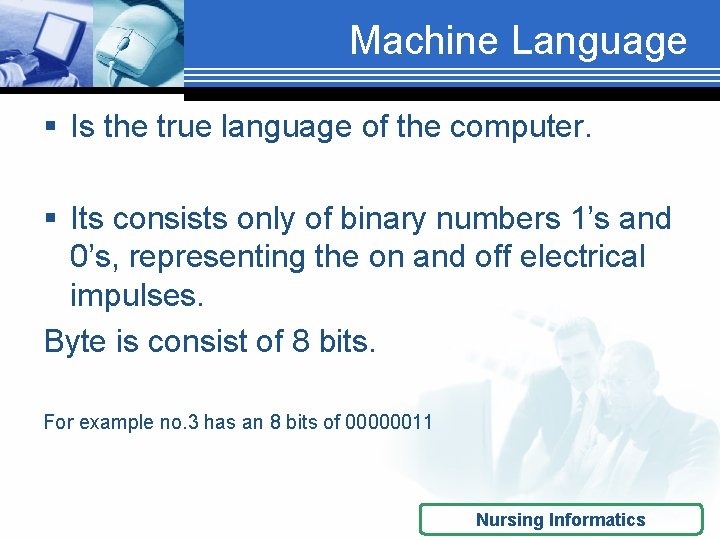
Machine Language § Is the true language of the computer. § Its consists only of binary numbers 1’s and 0’s, representing the on and off electrical impulses. Byte is consist of 8 bits. For example no. 3 has an 8 bits of 00000011 Nursing Informatics
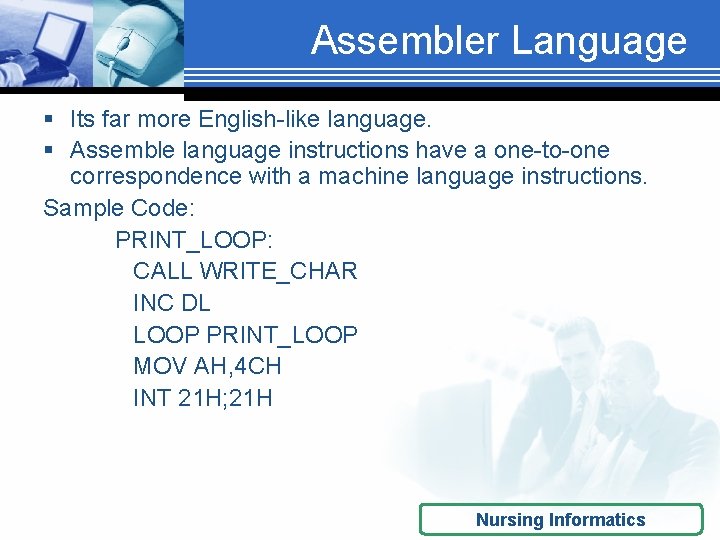
Assembler Language § Its far more English-like language. § Assemble language instructions have a one-to-one correspondence with a machine language instructions. Sample Code: PRINT_LOOP: CALL WRITE_CHAR INC DL LOOP PRINT_LOOP MOV AH, 4 CH INT 21 H; 21 H Nursing Informatics
Third Generation Language § Procedural language – requires the programmer to specify both what the computer is to do and the procedure on how to do it. Nursing Informatics
Fourth Generation Language § Specialized application programs that require more involvement of the user in directing the program to do necessary work. Nursing Informatics
Fifth Generation Language § Are also called natural language. § The user tells the machine what to do in the user’s own natural language or through use of a set of very English-like commands. Nursing Informatics
Software Packages § Package Software is designed to meet the needs of a wide variety of users, not just a single user or company. § Is sometimes called commercial-off-theshelf software. Nursing Informatics
Software Useful to Nurses § It includes : Admission, discharge and transfer (ADT) systems Medication administration record (MAR) software Charting Software Computerize acuity system Hospital email system Chat rooms Electronic bulletin boards Listservs Nursing Informatics
Computer Programming § Refers to the process of writing a computer program, which is a series of instructions written in proper sequence to solve a specific problem. § Program encompasses the program instructions and is generally written by a computer programmer. Nursing Informatics
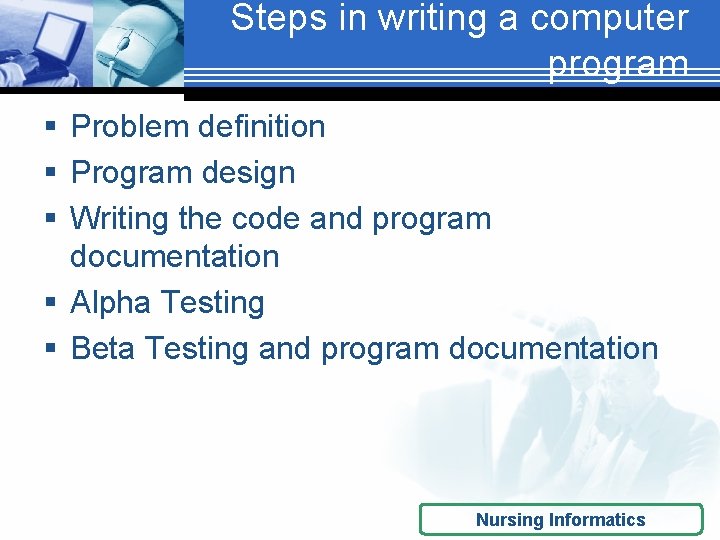
Steps in writing a computer program § Problem definition § Program design § Writing the code and program documentation § Alpha Testing § Beta Testing and program documentation Nursing Informatics
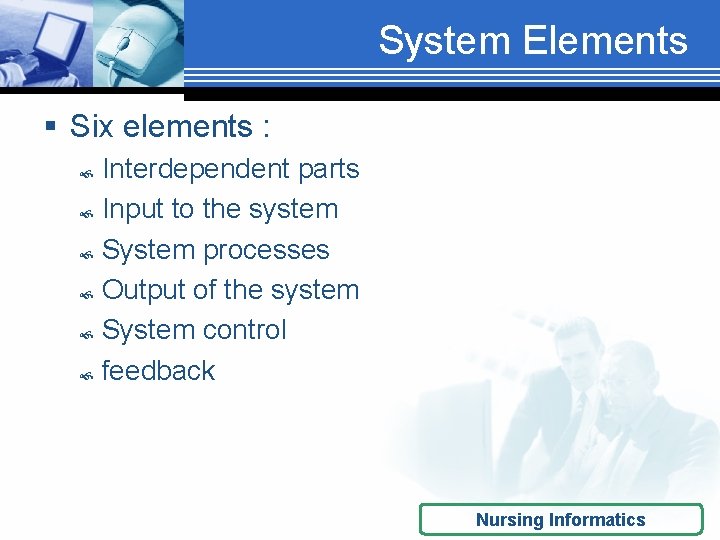
System Elements § Six elements : Interdependent parts Input to the system System processes Output of the system System control feedback Nursing Informatics
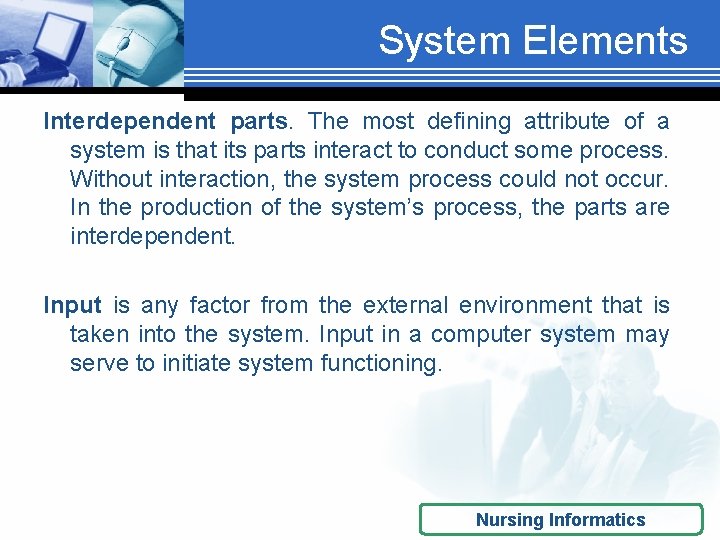
System Elements Interdependent parts. The most defining attribute of a system is that its parts interact to conduct some process. Without interaction, the system process could not occur. In the production of the system’s process, the parts are interdependent. Input is any factor from the external environment that is taken into the system. Input in a computer system may serve to initiate system functioning. Nursing Informatics
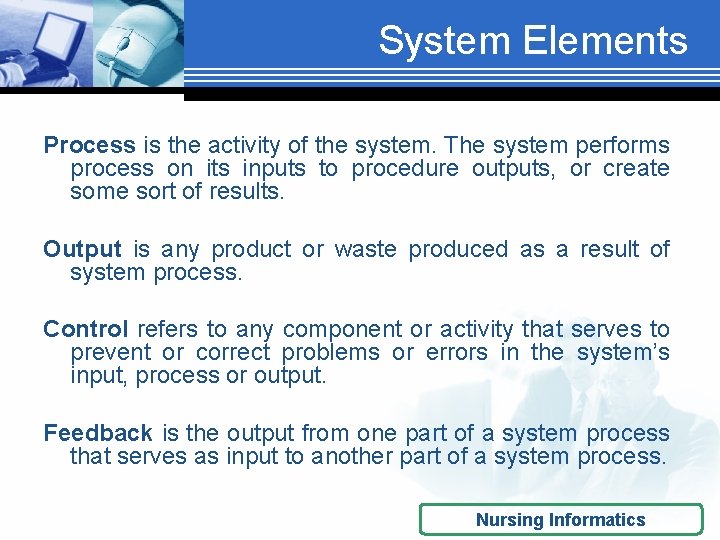
System Elements Process is the activity of the system. The system performs process on its inputs to procedure outputs, or create some sort of results. Output is any product or waste produced as a result of system process. Control refers to any component or activity that serves to prevent or correct problems or errors in the system’s input, process or output. Feedback is the output from one part of a system process that serves as input to another part of a system process. Nursing Informatics
Information System § Is the collection and integration of various pieces of hardware and software and the human resources that meet the data collection, storage, processing and report generation needs of an organization. § Are found almost everywhere in health care, including hospitals, clinics, community health agencies, research facilities, and educational institutions. Nursing Informatics
Information Systems § § § § § Management Information System (MIS) Bibliographic Retrieval System Stand-alone system Transaction system Physiologic monitoring system Decision support system Expert system Artificial Intelligence System Natural Language System Nursing Informatics
MIS § Provides managers information about their business operations. § Is defined as an organized system for managing the flow of information in an organization in a timely manner. § Have programs that support strategic planning, management control and operation support. § Strategic planning refers to the policy decisions made by the top-level team of administrators. Nursing Informatics
Bibliographic Retrieval Systems § Is a retrieval system that generally refers to bibliographic data, document information or literature. § Primarily used to store and retrieve data and not to conduct any computations per se. § Is designed to provide bibliographic data on journal articles, books, monographs and textual report. Nursing Informatics
Stand-alone systems § Is a special purpose system. § Is developed for a single application or set of functions. Nursing Informatics
Transaction Systems § Is used to process predefined transactions and produce predefined reports. § It is designed for repeated operations using a fixed list. Nursing Informatics
Physiologic Monitoring System § Are widely used in hospital patient care units, in surgery, and more commonly, in private homes. § Are being used more frequently to measure and monitor continuous automatic physiologic findings such as heart rate. Nursing Informatics
Decision Support System § Is a computer system that supports some aspects of the human decision-making process. § It works with the user to support, but not replace, human judgment in a decisionmaking situation. Nursing Informatics
Expert System § Is a computer system containing the information and decision-making strategies of an expert to assist non-experts in decision-making. § Is designed for a user to simulate the cause and effect reasoning that a expert would use if confronted with the same situation in real live environment. Nursing Informatics
Artificial Intelligence System § Is a system that attempts to a model human reasoning processes. § A true AI system can also track the accuracy of its predictions and judgments and alter its decision-making rules, based on new knowledge it generates for itself. Nursing Informatics
Natural Language System § Is a system that can understand process commands given in the user’s own natural, spoken language. § It requires the computer to understand a wide range of words, speech styles, syntax and sentence structure. Nursing Informatics
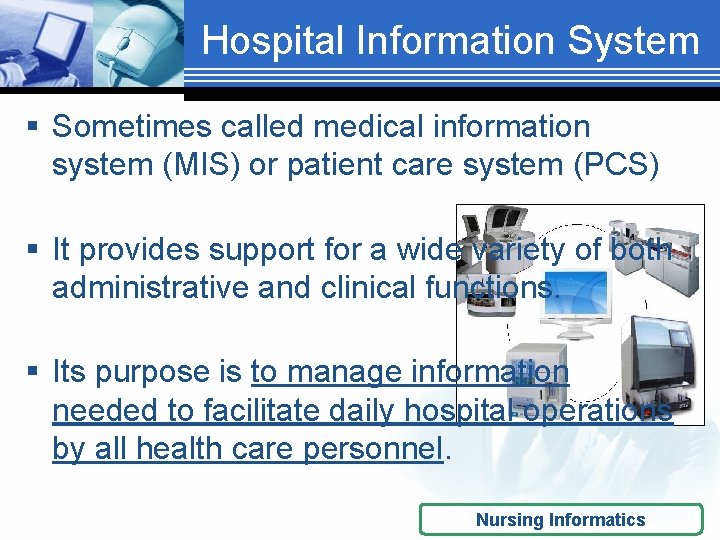
Hospital Information System § Sometimes called medical information system (MIS) or patient care system (PCS) § It provides support for a wide variety of both administrative and clinical functions. § Its purpose is to manage information needed to facilitate daily hospital operations by all health care personnel. Nursing Informatics
HIS Configurations § HIS can use several computer system configurations. § The most common uses mainframe computer with hardwired terminals or workstations. § Another configurations employs a LAN. § Many hospitals configuration include the dedicated IS for special purposes, such as nurse staffing, pharmacy or laboratory sysyems. Nursing Informatics
Program modules available in an HIS § Include a wide variety of administrative applications (modules) as: Admission and discharge Patient tracking Finance Payroll Billing Budgeting support Inventory Management reporting programs Nursing Informatics
Semiclinical modules § These both support administrative and clinical operations. ADT § Monitors and sometimes controls the flow of patients in a hospital from admission to discharge. § Automatically prepare the midnight census and activity reports. Order entry Nursing Informatics
Order-entry-result-reporting module § Means that the staff can enter laboratory, pharmacy, and radiology orders online. § Results reporting means that the lab, pharmacy and radiology can enter the results into the computer system and have those results available to the nursing unit. Nursing Informatics
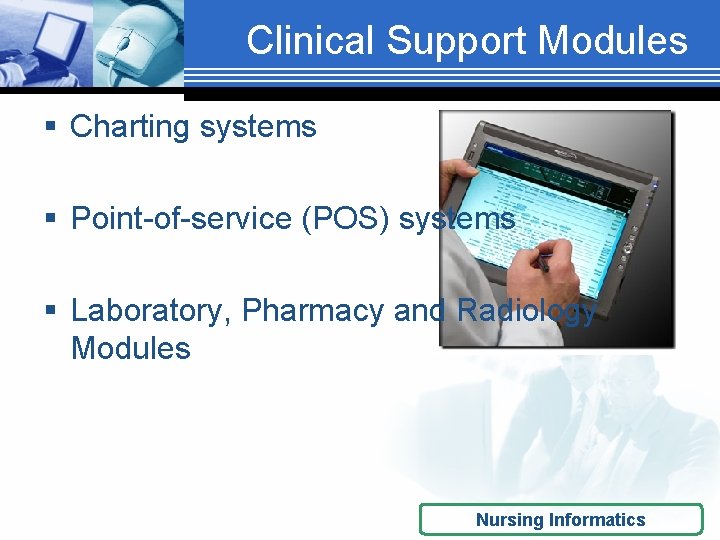
Clinical Support Modules § Charting systems § Point-of-service (POS) systems § Laboratory, Pharmacy and Radiology Modules Nursing Informatics
Charting Systems § Include : Medication administration reports Admission assessment Shift assessments Special assessments (neurologic assessment and labor records) Vital sign records Wound care Hygienic care records Nursing Informatics
Point-of-service (POS) system § Also known as point-of-care system. § Uses a hand-held or bedside PC to ensure that data are entered at the point at which they are collected. § Designed to save time by recording critical clinical data such as patient assessment, drug administration, vital signs. Nursing Informatics
Laboratory, Pharmacy & Radiology Modules § Are needed by all hospitals. § Laboratory system includes: Laboratory test request Generates the specimen labels Track the specimen Generates the result Communicates the findings to patient medical record. § Pharmacy systems track medication orders and changes in orders. Drug interaction warning programs Dosage calculators § Radiology systems are usually separate products develop by companies that specialize in diagnostic computer imaging systems. Nursing Informatics