
Chapter 5 Classes and objects Taufik Djatna taufikdjatnaipb
Chapter 5: Classes and objects Taufik Djatna taufikdjatna@ipb. ac. id 1
So far. . . : Executive summary ● ● Lecture 1: Variable, Expression, Assignment Lecture 2: Loops (for while do) Conditional structures (if else switch) Boolean predicate and connectors (|| &&) Loop escape break ● Lecture 3: functions (static) and recursion (terminal or not) ● Lecture 4: Objects 2
Indenting source code (. java) ● Increase code readibility Avoid mistyping bugs (matching { }) ● Source code formatter, pretty printer, beautifier Different conventions are possible (but choose one) Implemented more or less in Software (S/W) Nedit, JCreator, Jindent, etc. . . 3
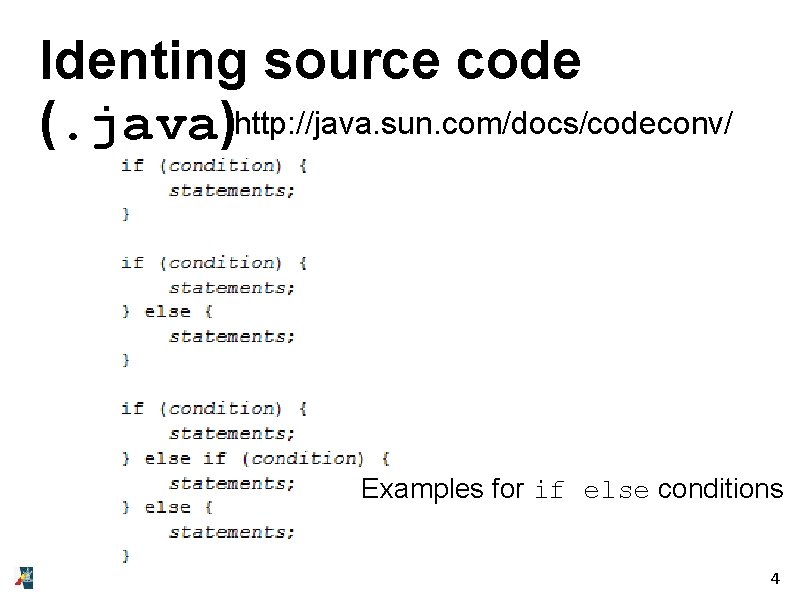
Identing source code (. java)http: //java. sun. com/docs/codeconv/ Examples for if else conditions 4
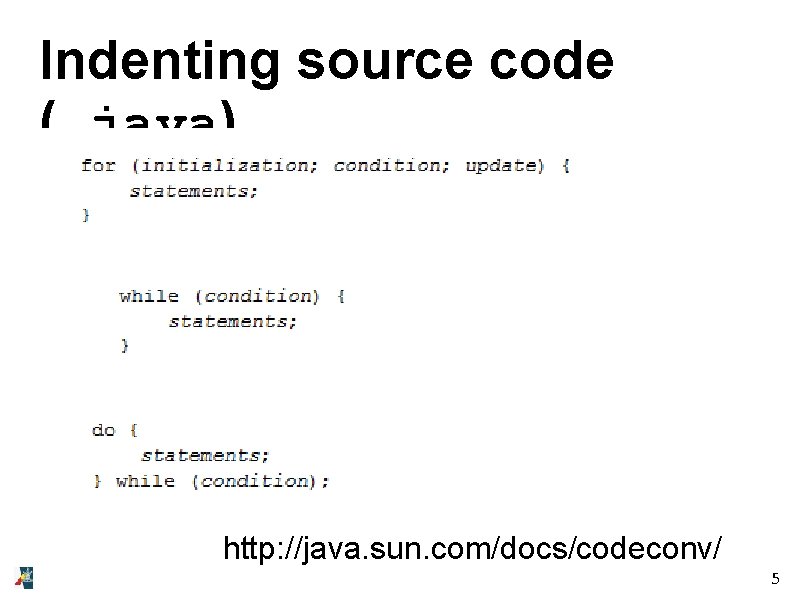
Indenting source code (. java) http: //java. sun. com/docs/codeconv/ 5
Indenting source code (. java) Bytecode size and indentation: ● Does not change fundamentally ● Bytecode is not human readable Demo Indent. java: Notepad, Net. Beans or JCreator & produced bytecode Indent. class open bytecode 6
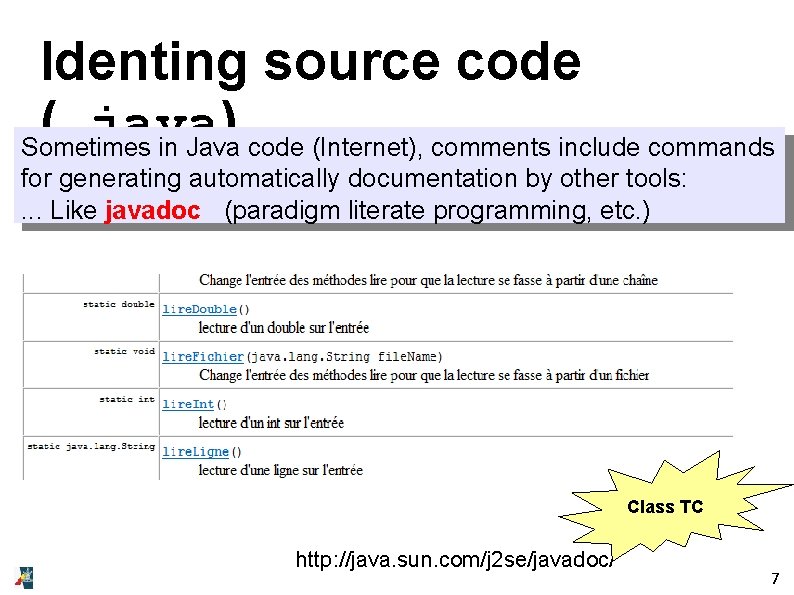
Identing source code (. java) Sometimes in Java code (Internet), comments include commands for generating automatically documentation by other tools: . . . Like javadoc (paradigm literate programming, etc. ) Class TC http: //java. sun. com/j 2 se/javadoc/ 7
Functions in Java Static functions that returns a type (eventually void) ● ● ● Functions are called inside the main procedure (or in other function body) Displaying and calling function are different (be not confused with Sci. Lab or Maple System. out. println(function()); ● Java is a compiled OO language , not an interpreter 8
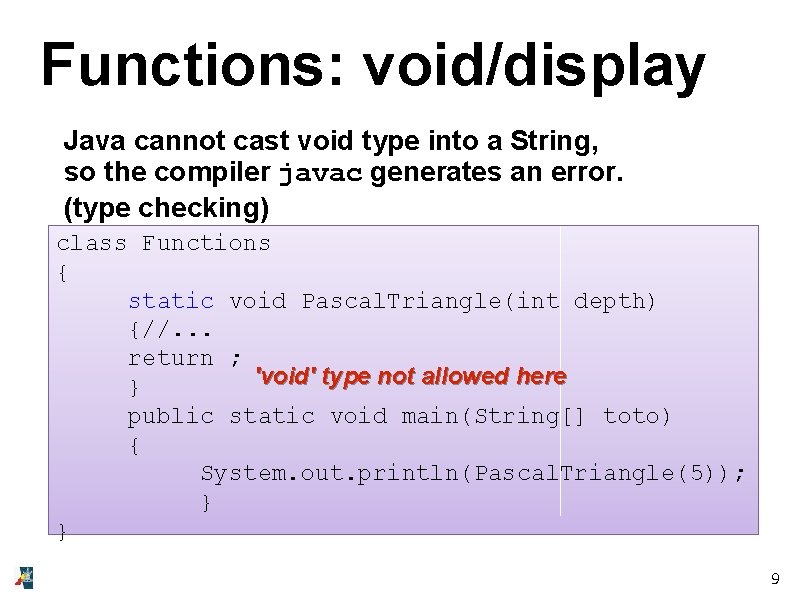
Functions: void/display Java cannot cast void type into a String, so the compiler javac generates an error. (type checking) class Functions { static void Pascal. Triangle(int depth) {//. . . return ; 'void' type not allowed here } public static void main(String[] toto) { System. out. println(Pascal. Triangle(5)); } } 9
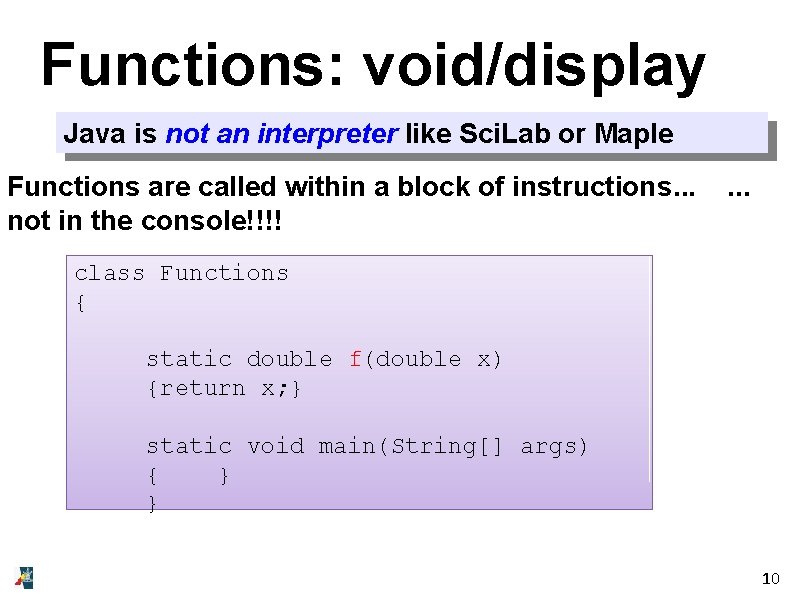
Functions: void/display Java is not an interpreter like Sci. Lab or Maple Functions are called within a block of instructions. . . not in the console!!!! . . . class Functions { static double f(double x) {return x; } static void main(String[] args) { } } 10
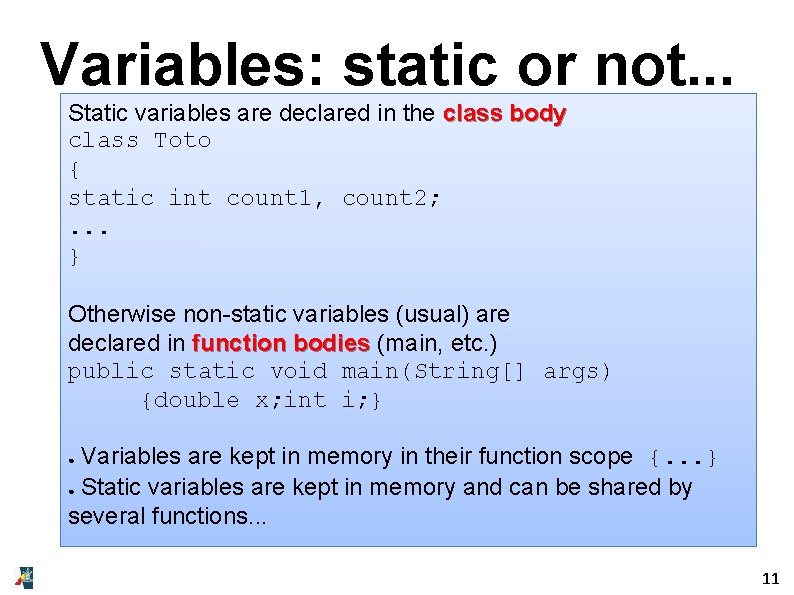
Variables: static or not. . . Static variables are declared in the class body class Toto { static int count 1, count 2; . . . } Otherwise non-static variables (usual) are declared in function bodies (main, etc. ) public static void main(String[] args) {double x; int i; } Variables are kept in memory in their function scope {. . . } ● Static variables are kept in memory and can be shared by several functions. . . ● 11
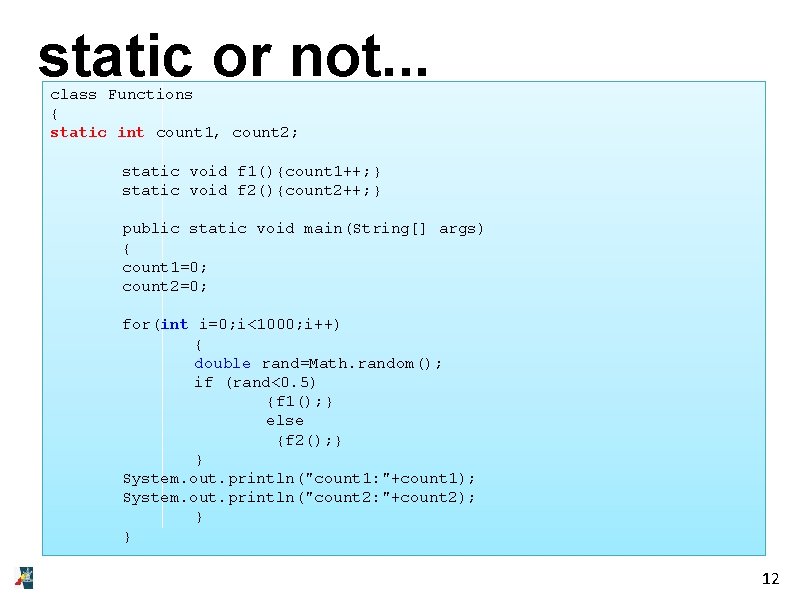
static or not. . . class Functions { static int count 1, count 2; static void f 1(){count 1++; } static void f 2(){count 2++; } public static void main(String[] args) { count 1=0; count 2=0; for(int i=0; i<1000; i++) { double rand=Math. random(); if (rand<0. 5) {f 1(); } else {f 2(); } } System. out. println("count 1: "+count 1); System. out. println("count 2: "+count 2); } } 12
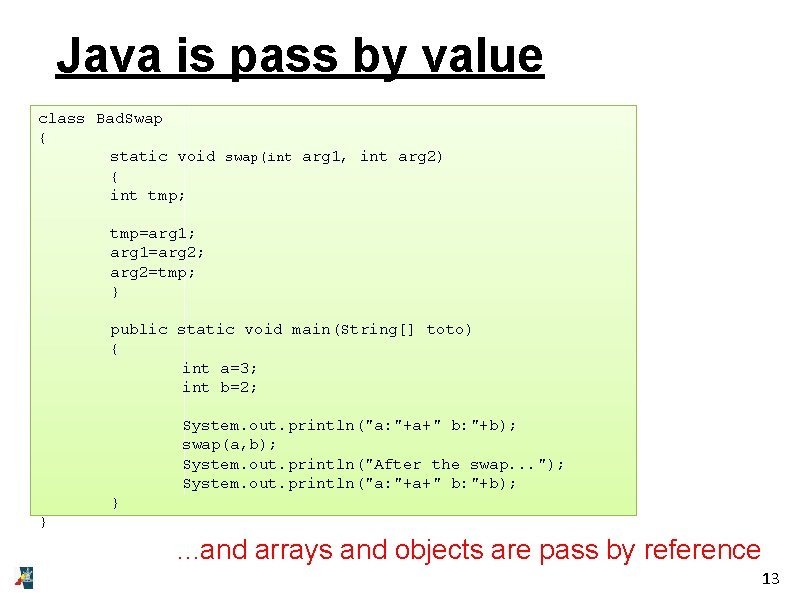
Java is pass by value class Bad. Swap { static void swap(int arg 1, int arg 2) { int tmp; tmp=arg 1; arg 1=arg 2; arg 2=tmp; } public static void main(String[] toto) { int a=3; int b=2; System. out. println("a: "+a+" b: "+b); swap(a, b); System. out. println("After the swap. . . "); System. out. println("a: "+a+" b: "+b); } } . . . and arrays and objects are pass by reference 13
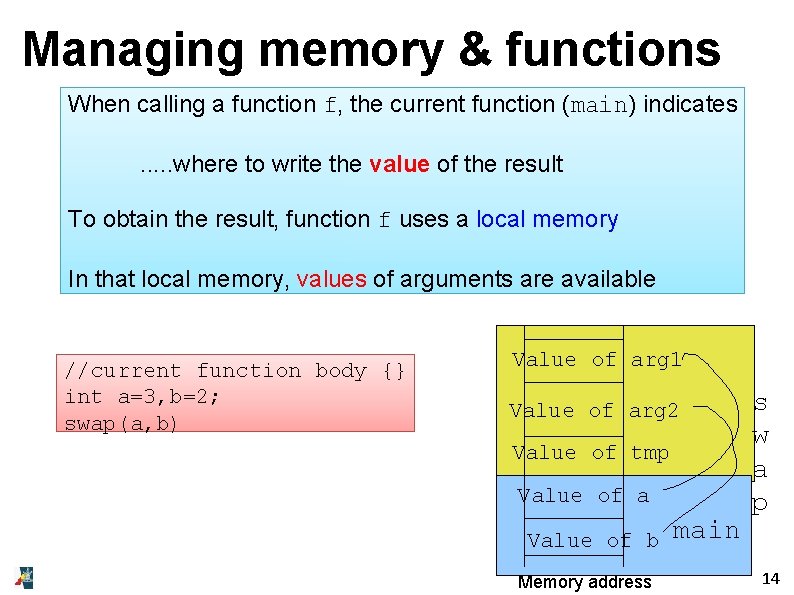
Managing memory & functions When calling a function f, the current function (main) indicates. . . where to write the value of the result To obtain the result, function f uses a local memory In that local memory, values of arguments are available //current function body {} int a=3, b=2; swap(a, b) Value of arg 1 Value of arg 2 Value of tmp Value of a Value of b Memory address main s w a p 14
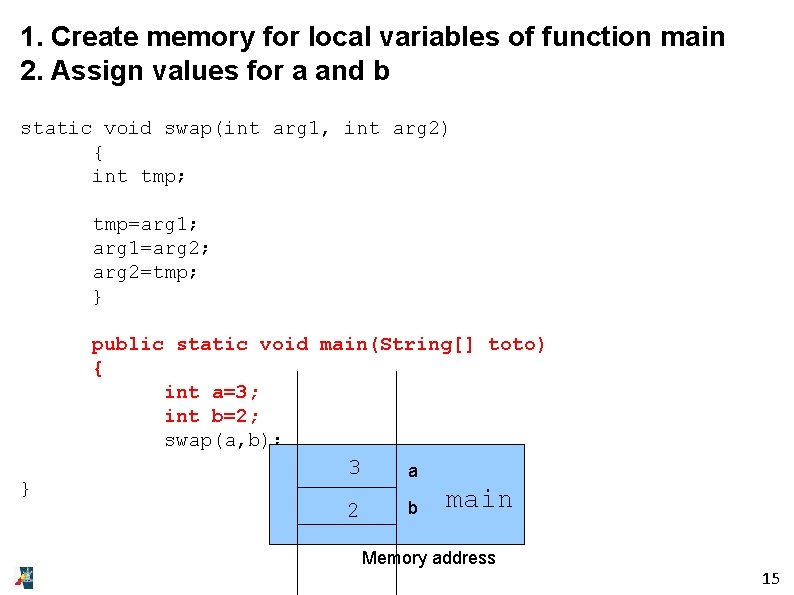
1. Create memory for local variables of function main 2. Assign values for a and b static void swap(int arg 1, int arg 2) { int tmp; tmp=arg 1; arg 1=arg 2; arg 2=tmp; } public static void main(String[] toto) { int a=3; int b=2; swap(a, b); } 3 a 2 b main Memory address 15
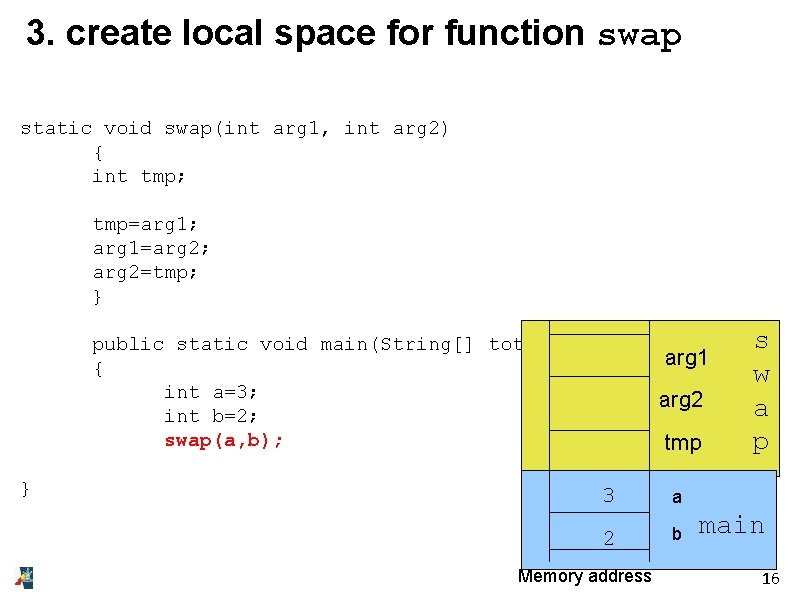
3. create local space for function swap static void swap(int arg 1, int arg 2) { int tmp; tmp=arg 1; arg 1=arg 2; arg 2=tmp; } public static void main(String[] toto) { int a=3; int b=2; swap(a, b); } arg 1 arg 2 tmp 3 a 2 b Memory address s w a p main 16
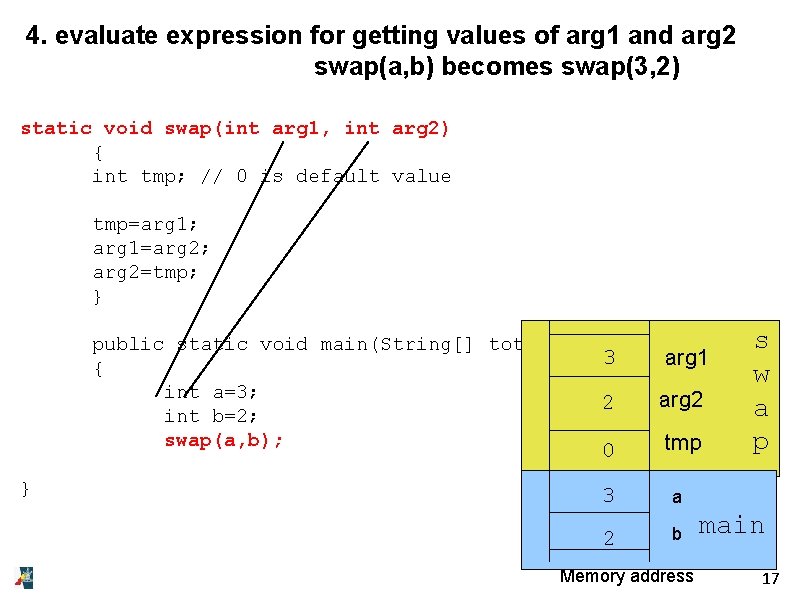
4. evaluate expression for getting values of arg 1 and arg 2 swap(a, b) becomes swap(3, 2) static void swap(int arg 1, int arg 2) { int tmp; // 0 is default value tmp=arg 1; arg 1=arg 2; arg 2=tmp; } public static void main(String[] toto) { int a=3; int b=2; swap(a, b); } 3 arg 1 2 arg 2 0 tmp 3 a 2 b Memory address s w a p main 17
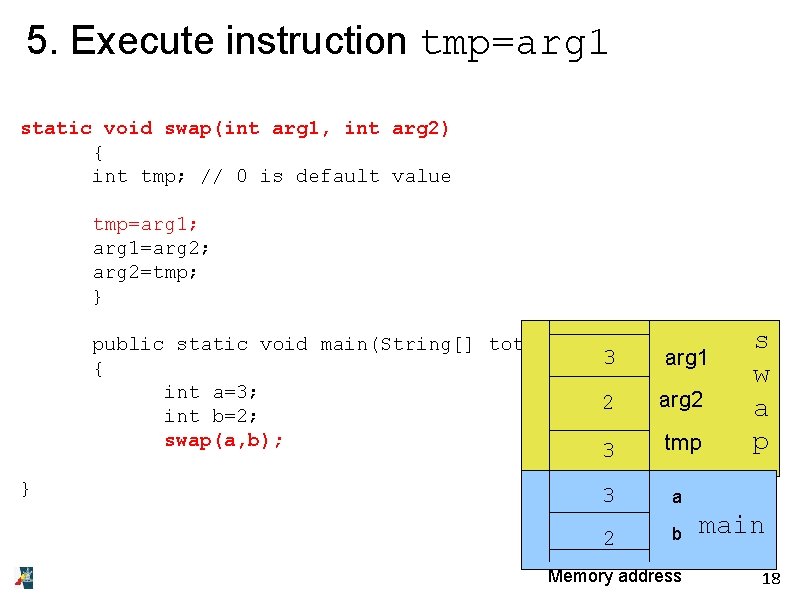
5. Execute instruction tmp=arg 1 static void swap(int arg 1, int arg 2) { int tmp; // 0 is default value tmp=arg 1; arg 1=arg 2; arg 2=tmp; } public static void main(String[] toto) { int a=3; int b=2; swap(a, b); } 3 arg 1 2 arg 2 3 tmp 3 a 2 b Memory address s w a p main 18
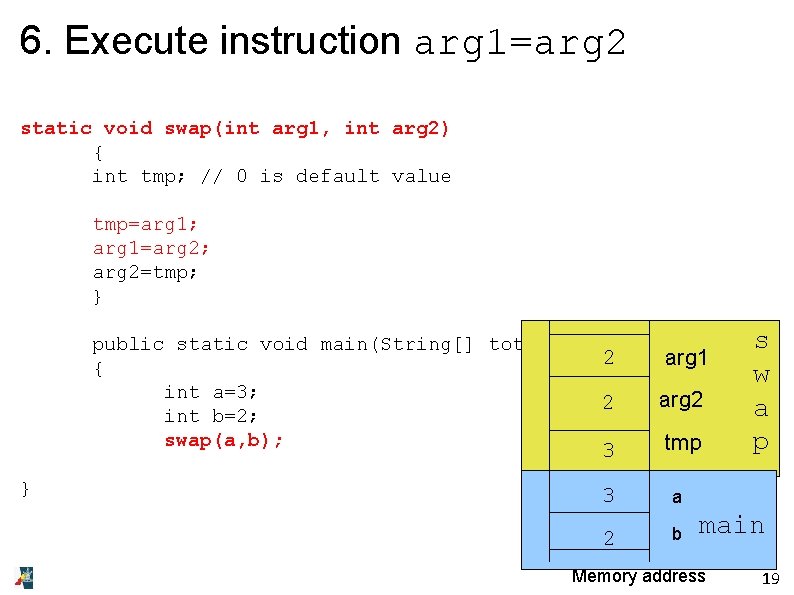
6. Execute instruction arg 1=arg 2 static void swap(int arg 1, int arg 2) { int tmp; // 0 is default value tmp=arg 1; arg 1=arg 2; arg 2=tmp; } public static void main(String[] toto) { int a=3; int b=2; swap(a, b); } 2 arg 1 2 arg 2 3 tmp 3 a 2 b s w a p main Memory address 19
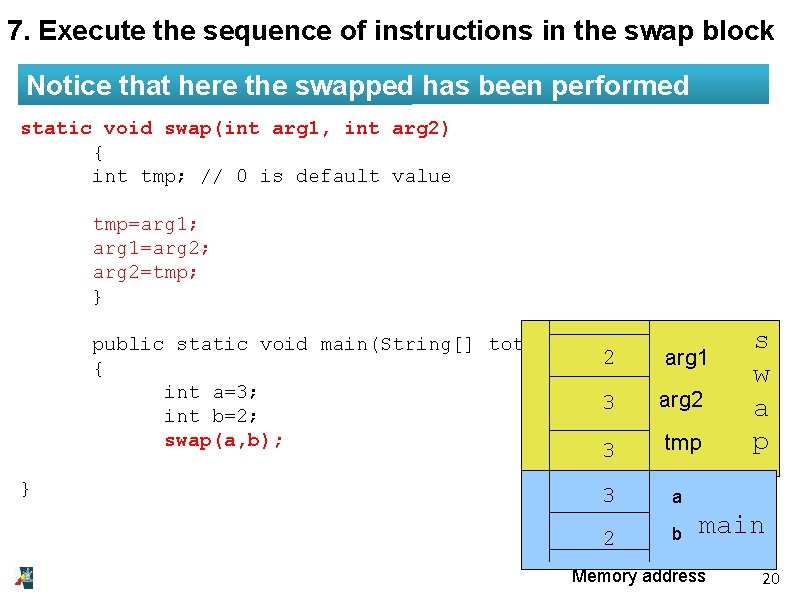
7. Execute the sequence of instructions in the swap block Notice that here the swapped has been performed static void swap(int arg 1, int arg 2) { int tmp; // 0 is default value tmp=arg 1; arg 1=arg 2; arg 2=tmp; } public static void main(String[] toto) { int a=3; int b=2; swap(a, b); } 2 arg 1 3 arg 2 3 tmp 3 a 2 b s w a p main Memory address 20
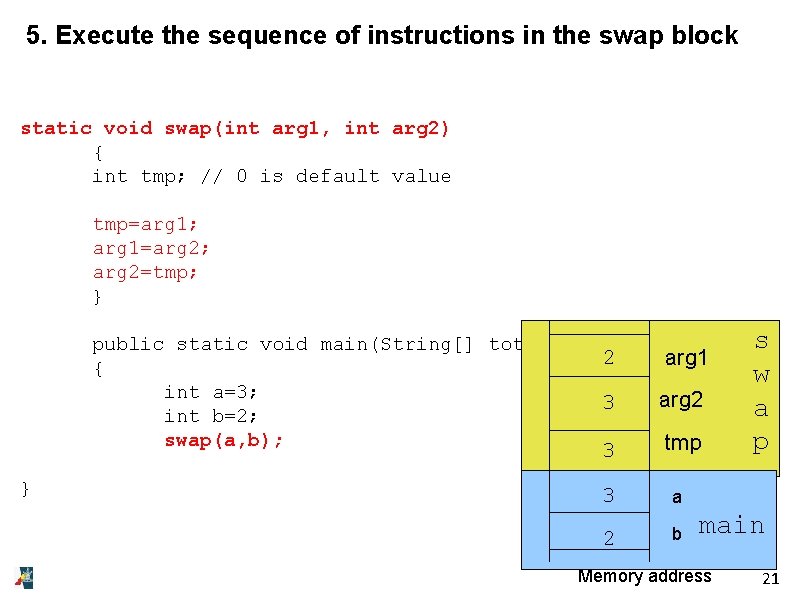
5. Execute the sequence of instructions in the swap block static void swap(int arg 1, int arg 2) { int tmp; // 0 is default value tmp=arg 1; arg 1=arg 2; arg 2=tmp; } public static void main(String[] toto) { int a=3; int b=2; swap(a, b); } 2 arg 1 3 arg 2 3 tmp 3 a 2 b s w a p main Memory address 21
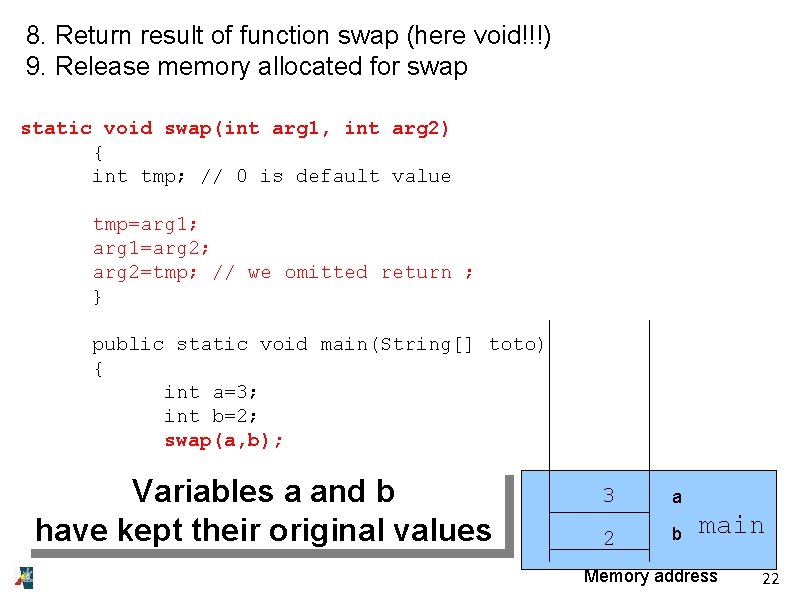
8. Return result of function swap (here void!!!) 9. Release memory allocated for swap static void swap(int arg 1, int arg 2) { int tmp; // 0 is default value tmp=arg 1; arg 1=arg 2; arg 2=tmp; // we omitted return ; } public static void main(String[] toto) { int a=3; int b=2; swap(a, b); } Variables a and b have kept their original values 3 a 2 b main Memory address 22
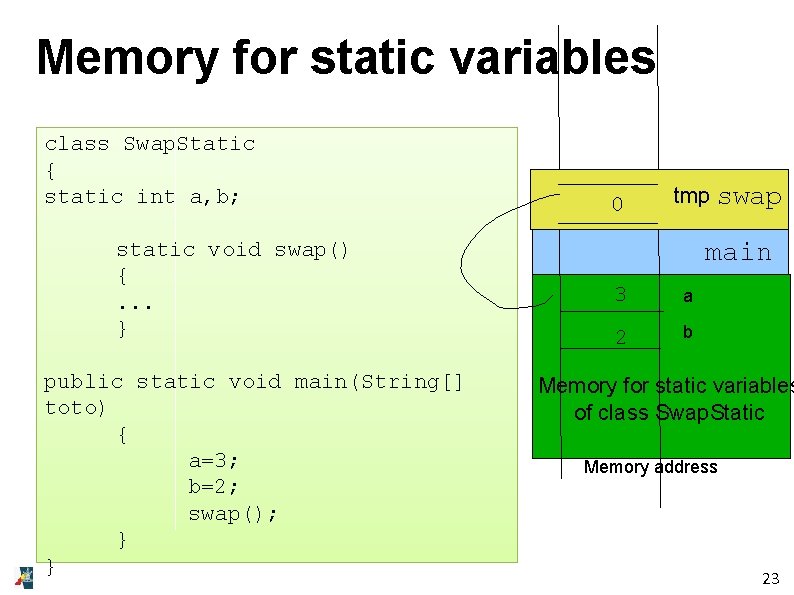
Memory for static variables class Swap. Static { static int a, b; static void swap() {. . . } public static void main(String[] toto) { a=3; b=2; swap(); } } 0 tmp swap main 3 a 2 b Memory for static variables of class Swap. Static Memory address 23
By passing using static class Swap. Static { static int a, b; static void swap() { int tmp; // ok not to be static tmp=a; a=b; b=tmp; } public static void main(String[] toto) { a=3; b=2; System. out. println("a: "+a+" b: "+b); swap(); System. out. println("After the swap. . . "); System. out. println("a: "+a+" b: "+b); } 24
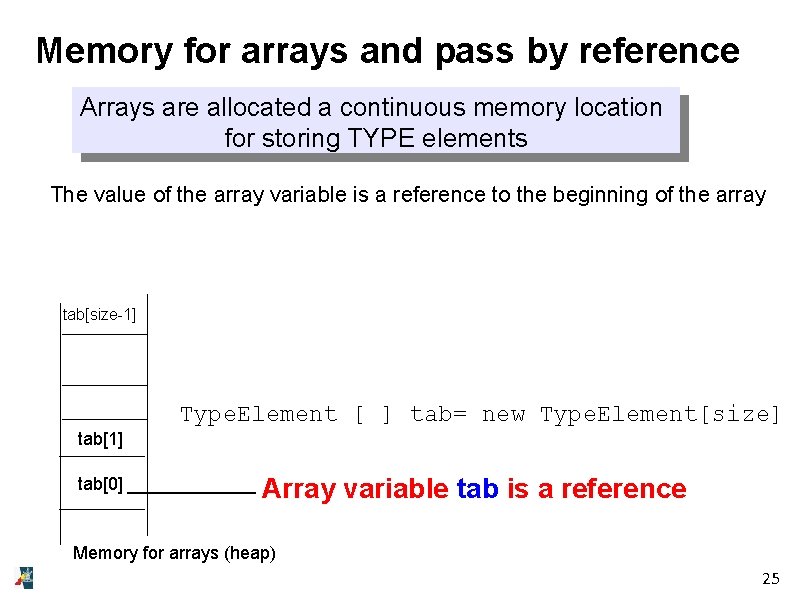
Memory for arrays and pass by reference Arrays are allocated a continuous memory location for storing TYPE elements The value of the array variable is a reference to the beginning of the array tab[size-1] Type. Element [ ] tab= new Type. Element[size] tab[1] tab[0] Array variable tab is a reference Memory for arrays (heap) 25
![Memory management using new Type [] tab=new Type[Expression]; ● ● Evaluate Expression to get](http://slidetodoc.com/presentation_image_h2/5660098dd6b4d7ceb54c88ba3800cfdb/image-26.jpg "Memory management using new Type [] tab=new Type[Expression]; ● ● Evaluate Expression to get")
Memory management using new Type [] tab=new Type[Expression]; ● ● Evaluate Expression to get an integer value. Arrays are stored not in the local function memory, but rather in the global program memory: heap A cell (array element) in the heap (program memory) is accessible by any function which has as a local (non-static) variable a reference to the array. ● 26
![class Array. Reference { public static void swap(int [] t, int i, int j)](http://slidetodoc.com/presentation_image_h2/5660098dd6b4d7ceb54c88ba3800cfdb/image-27.jpg "class Array. Reference { public static void swap(int [] t, int i, int j)")
class Array. Reference { public static void swap(int [] t, int i, int j) { int tmp; tmp=t[i]; t[i]=t[j]; t[j]=tmp; } public static void Display(int [] tab){. . . » public static void main(String[] args) { //int [] array=new int[10]; int [] array={0, 1, 2, 3, 4, 5, 6, 7, 8, 9}; Display(array); swap(array, 1, 2); Display(array); } } 0123456789 0213456789 27
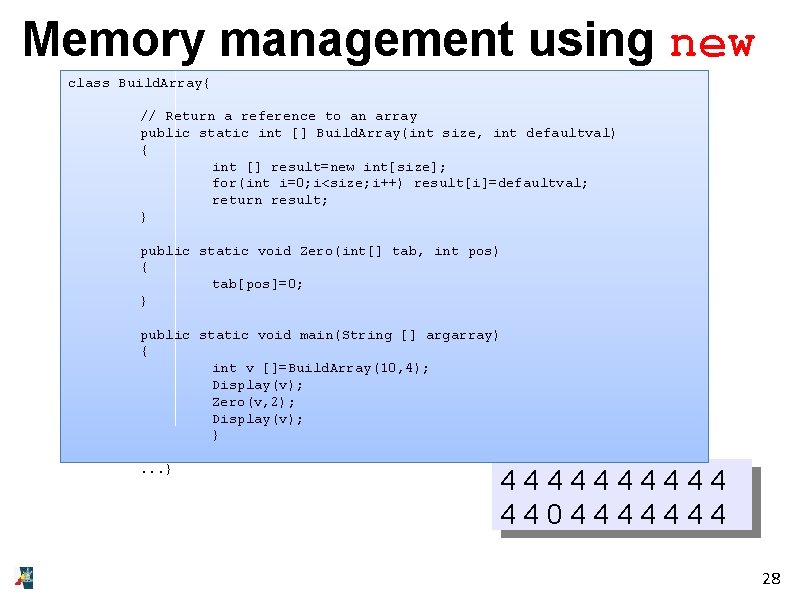
Memory management using new class Build. Array{ // Return a reference to an array public static int [] Build. Array(int size, int defaultval) { int [] result=new int[size]; for(int i=0; i<size; i++) result[i]=defaultval; return result; } public static void Zero(int[] tab, int pos) { tab[pos]=0; } public static void main(String [] argarray) { int v []=Build. Array(10, 4); Display(v); Zero(v, 2); Display(v); }. . . } 44444 4404444444 28
Synopsis of this lecture ● Objects and records (fields, enregistrements) ● Object constructors ● Class type variables: References ● Functions on objects: Methods ● Array of objects ● Examples 29
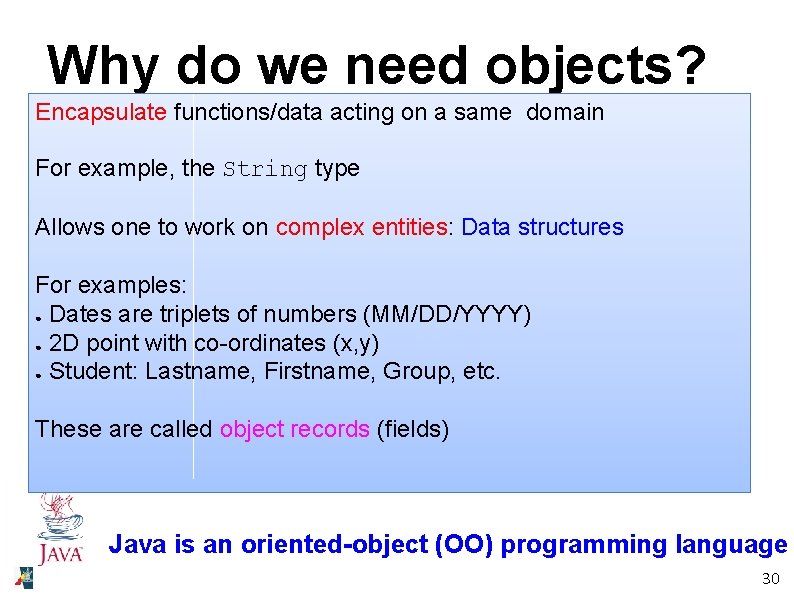
Why do we need objects? Encapsulate functions/data acting on a same domain For example, the String type Allows one to work on complex entities: Data structures For examples: ● Dates are triplets of numbers (MM/DD/YYYY) ● 2 D point with co-ordinates (x, y) ● Student: Lastname, Firstname, Group, etc. These are called object records (fields) Java is an oriented-object (OO) programming language 30
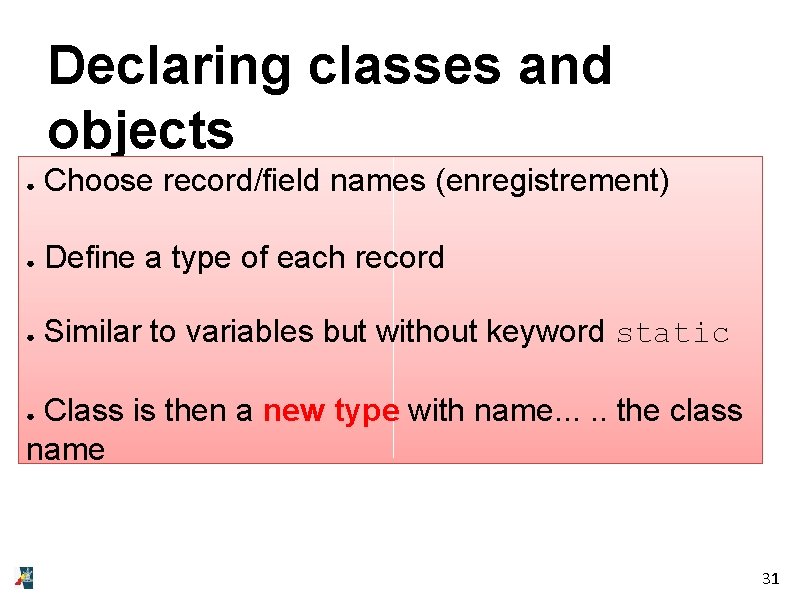
Declaring classes and objects ● Choose record/field names (enregistrement) ● Define a type of each record ● Similar to variables but without keyword static Class is then a new type with name. . . the class name ● 31
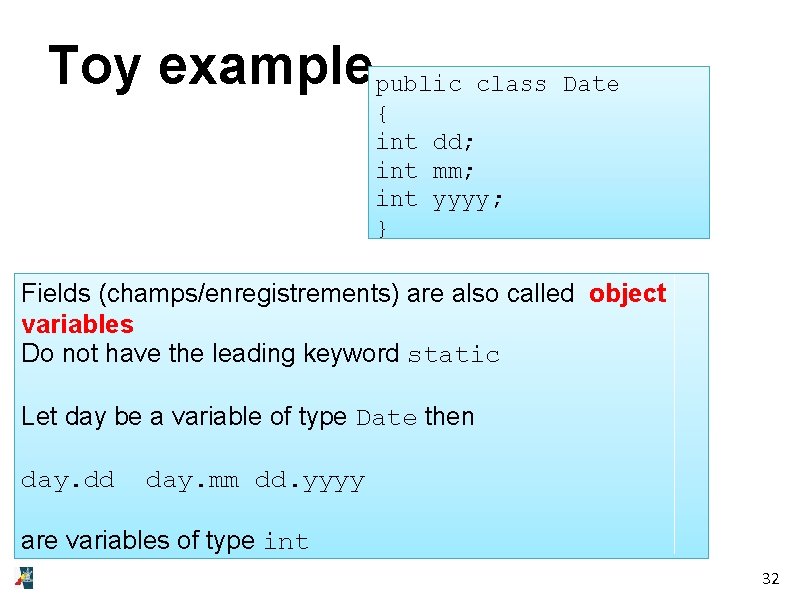
Toy examplepublic class Date { int dd; int mm; int yyyy; } Fields (champs/enregistrements) are also called object variables Do not have the leading keyword static Let day be a variable of type Date then day. dd day. mm dd. yyyy are variables of type int 32
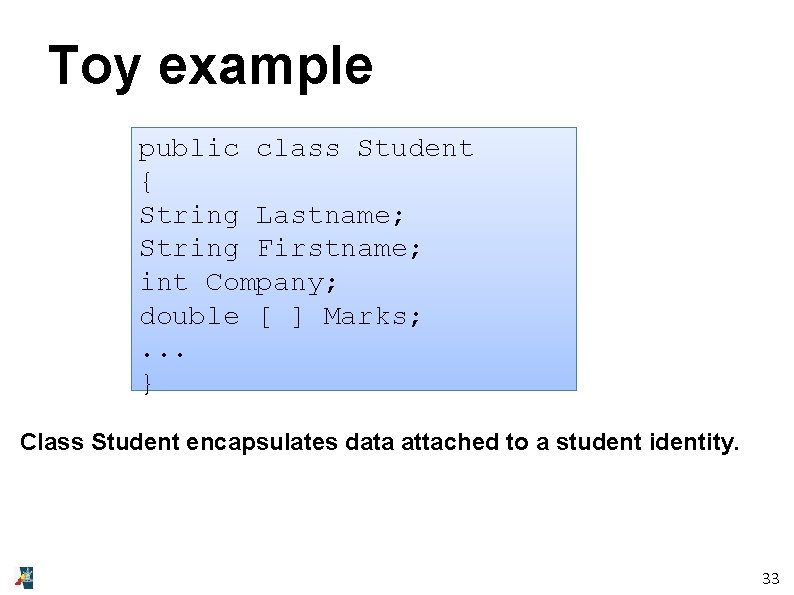
Toy example public class Student { String Lastname; String Firstname; int Company; double [ ] Marks; . . . } Class Student encapsulates data attached to a student identity. 33
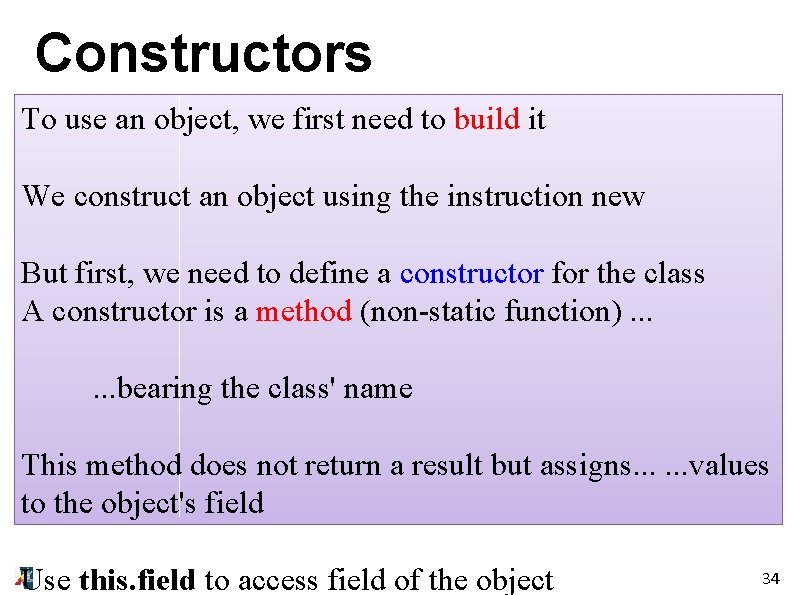
Constructors To use an object, we first need to build it We construct an object using the instruction new But first, we need to define a constructor for the class A constructor is a method (non-static function). . . bearing the class' name This method does not return a result but assigns. . . values to the object's field Use this. field to access field of the object 34
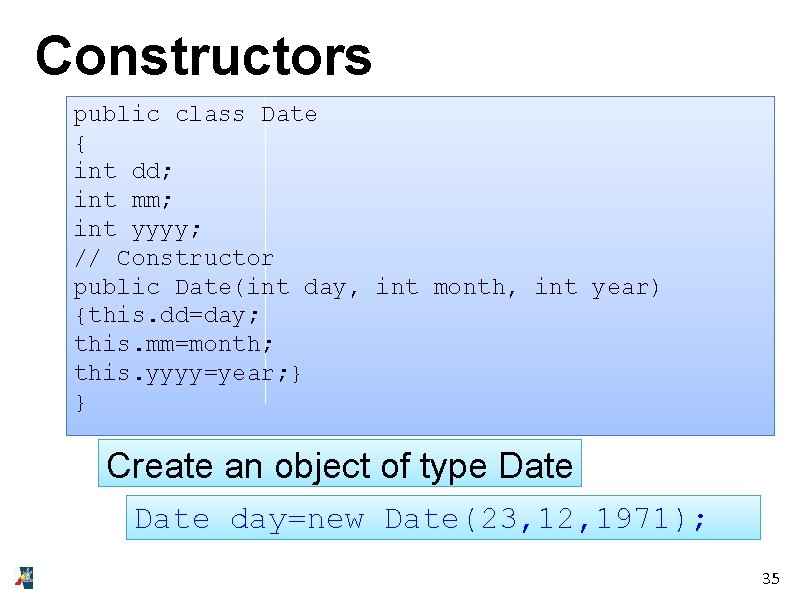
Constructors public class Date { int dd; int mm; int yyyy; // Constructor public Date(int day, int month, int year) {this. dd=day; this. mm=month; this. yyyy=year; } } Create an object of type Date day=new Date(23, 12, 1971); 35
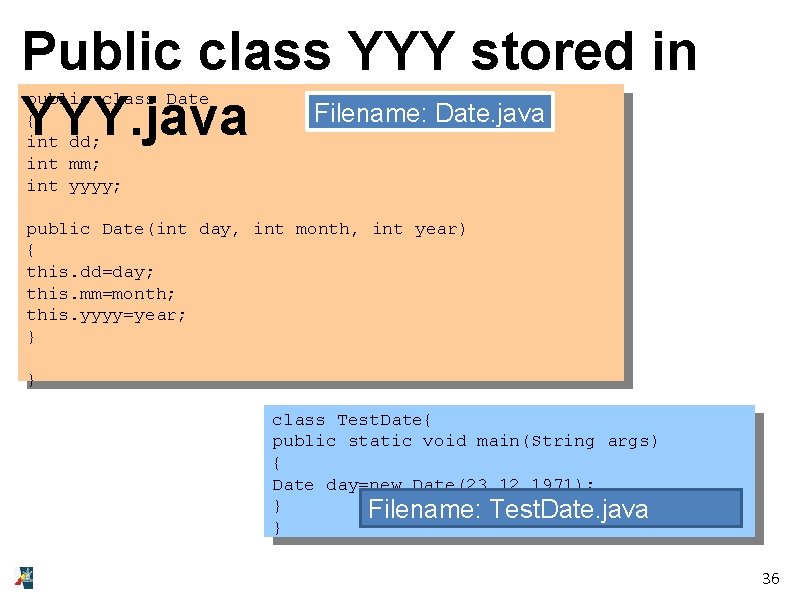
Public class YYY stored in YYY. java Filename: Date. java public class Date { int dd; int mm; int yyyy; public Date(int day, int month, int year) { this. dd=day; this. mm=month; this. yyyy=year; } } class Test. Date{ public static void main(String args) { Date day=new Date(23, 12, 1971); } Filename: Test. Date. java } 36
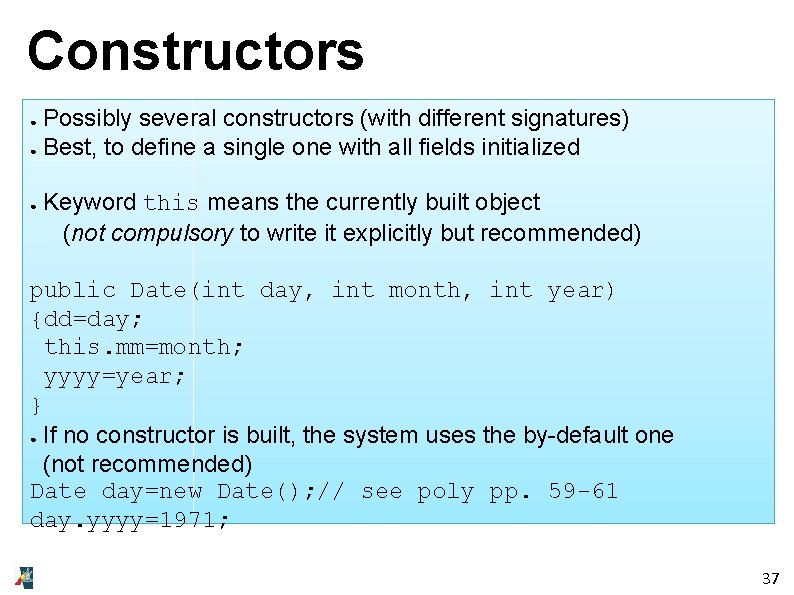
Constructors Possibly several constructors (with different signatures) ● Best, to define a single one with all fields initialized ● ● Keyword this means the currently built object (not compulsory to write it explicitly but recommended) public Date(int day, int month, int year) {dd=day; this. mm=month; yyyy=year; } ● If no constructor is built, the system uses the by-default one (not recommended) Date day=new Date(); // see poly pp. 59 -61 day. yyyy=1971; 37
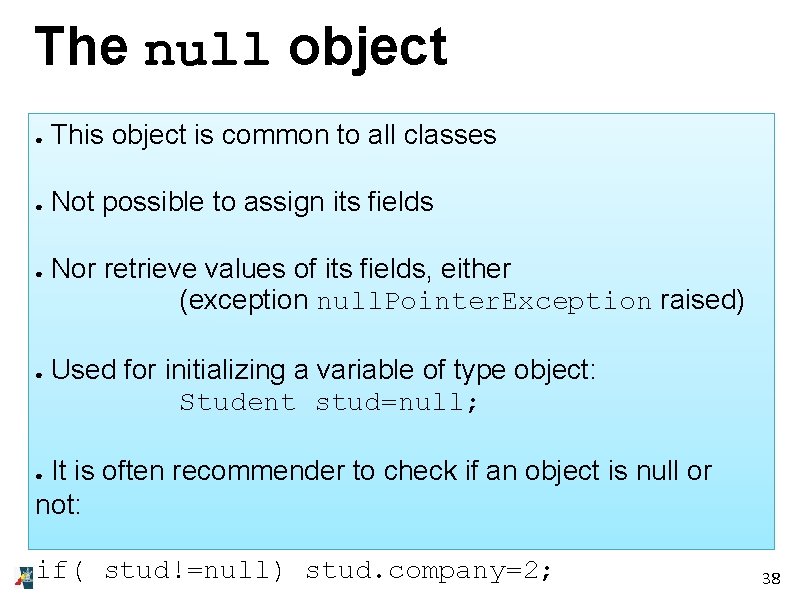
The null object ● This object is common to all classes ● Not possible to assign its fields ● ● Nor retrieve values of its fields, either (exception null. Pointer. Exception raised) Used for initializing a variable of type object: Student stud=null; It is often recommender to check if an object is null or not: ● if( stud!=null) stud. company=2; 38
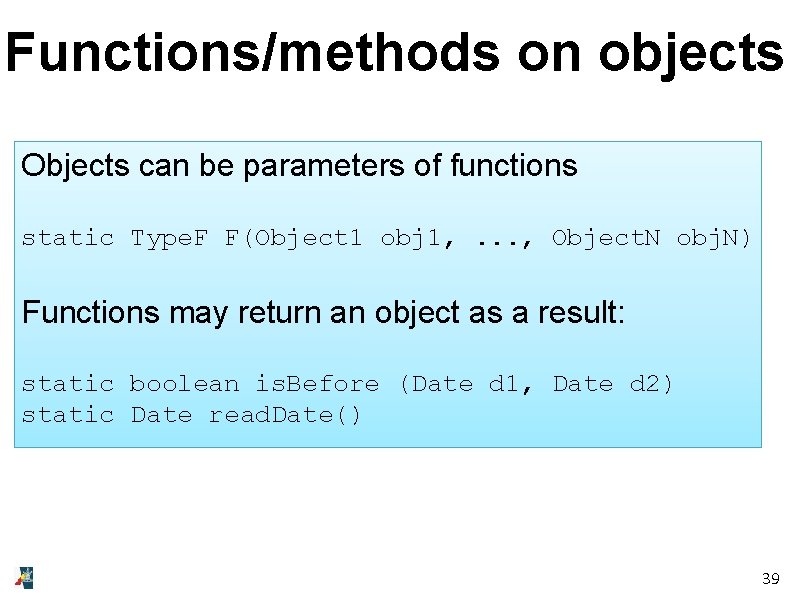
Functions/methods on objects Objects can be parameters of functions static Type. F F(Object 1 obj 1, . . . , Object. N obj. N) Functions may return an object as a result: static boolean is. Before (Date d 1, Date d 2) static Date read. Date() 39
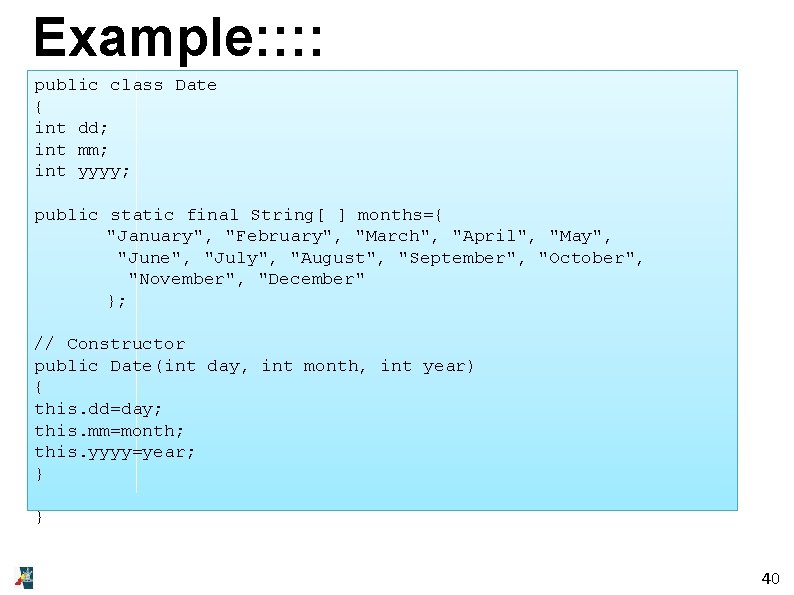
Example: : public class Date { int dd; int mm; int yyyy; public static final String[ ] months={ "January", "February", "March", "April", "May", "June", "July", "August", "September", "October", "November", "December" }; // Constructor public Date(int day, int month, int year) { this. dd=day; this. mm=month; this. yyyy=year; } } 40
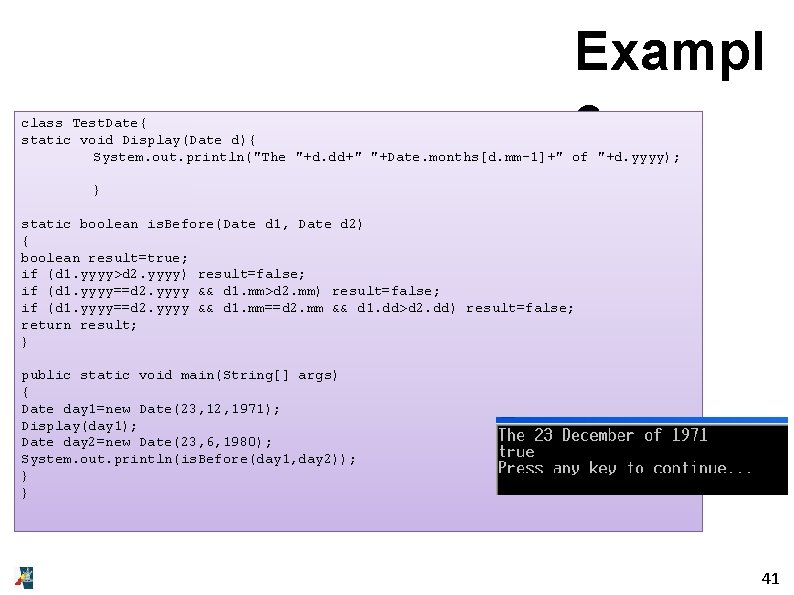
Exampl e class Test. Date{ static void Display(Date d){ System. out. println("The "+d. dd+" "+Date. months[d. mm-1]+" of "+d. yyyy); } static boolean is. Before(Date d 1, Date d 2) { boolean result=true; if (d 1. yyyy>d 2. yyyy) result=false; if (d 1. yyyy==d 2. yyyy && d 1. mm>d 2. mm) result=false; if (d 1. yyyy==d 2. yyyy && d 1. mm==d 2. mm && d 1. dd>d 2. dd) result=false; return result; } public static void main(String[] args) { Date day 1=new Date(23, 12, 1971); Display(day 1); Date day 2=new Date(23, 6, 1980); System. out. println(is. Before(day 1, day 2)); } } 41
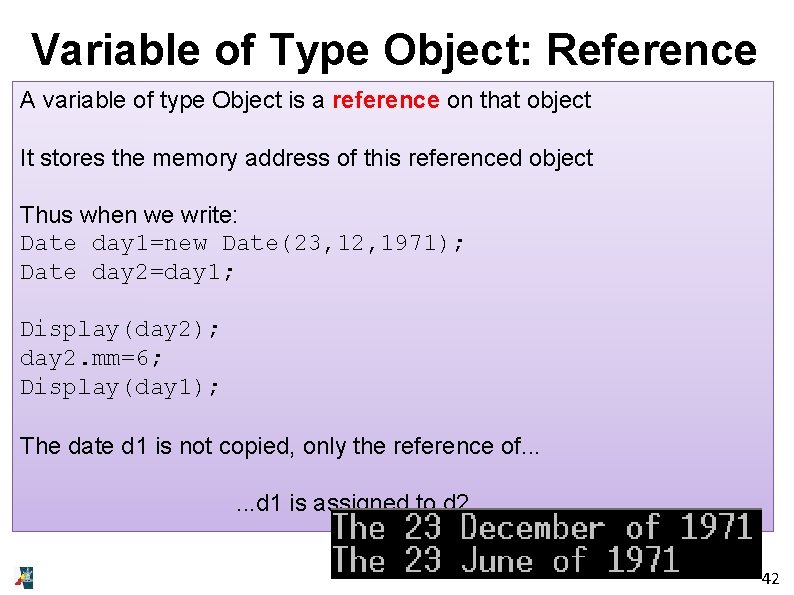
Variable of Type Object: Reference A variable of type Object is a reference on that object It stores the memory address of this referenced object Thus when we write: Date day 1=new Date(23, 12, 1971); Date day 2=day 1; Display(day 2); day 2. mm=6; Display(day 1); The date d 1 is not copied, only the reference of. . . d 1 is assigned to d 2 42
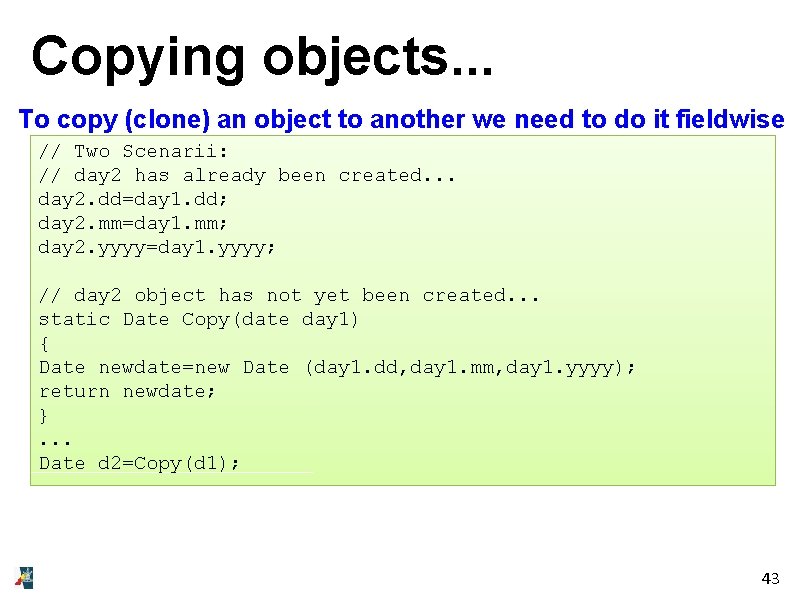
Copying objects. . . To copy (clone) an object to another we need to do it fieldwise // Two Scenarii: // day 2 has already been created. . . day 2. dd=day 1. dd; day 2. mm=day 1. mm; day 2. yyyy=day 1. yyyy; // day 2 object has not yet been created. . . static Date Copy(date day 1) { Date newdate=new Date (day 1. dd, day 1. mm, day 1. yyyy); return newdate; }. . . Date d 2=Copy(d 1); 43
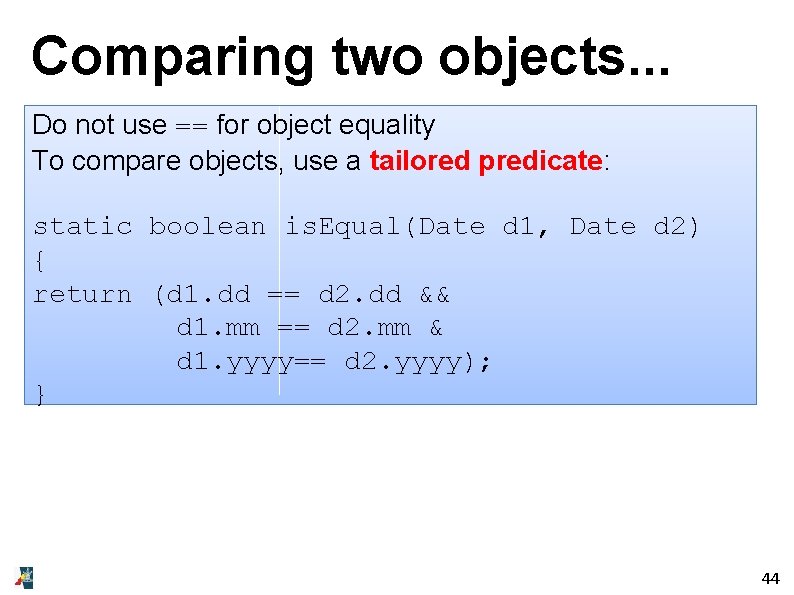
Comparing two objects. . . Do not use == for object equality To compare objects, use a tailored predicate: static boolean is. Equal(Date d 1, Date d 2) { return (d 1. dd == d 2. dd && d 1. mm == d 2. mm & d 1. yyyy== d 2. yyyy); } 44
![Comparing two objects. . . public static void main(String[] args) { Date day 1=new](http://slidetodoc.com/presentation_image_h2/5660098dd6b4d7ceb54c88ba3800cfdb/image-45.jpg "Comparing two objects. . . public static void main(String[] args) { Date day 1=new")
Comparing two objects. . . public static void main(String[] args) { Date day 1=new Date(23, 12, 1971); Date day 2=day 1; // beware not copying here. Just memory reference Date day 3=new Date(23, 12, 1971); System. out. println(is. Equal(day 1, day 3)); System. out. println(day 1); System. out. println(day 2); System. out. println(day 3); } Physical (memory) versus logical equality 45
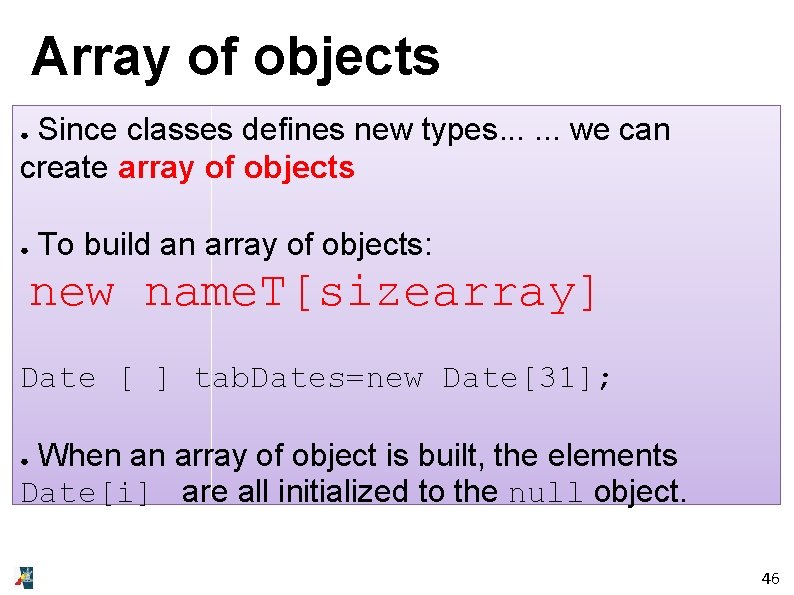
Array of objects Since classes defines new types. . . we can create array of objects ● ● To build an array of objects: new name. T[sizearray] Date [ ] tab. Dates=new Date[31]; When an array of object is built, the elements Date[i] are all initialized to the null object. ● 46
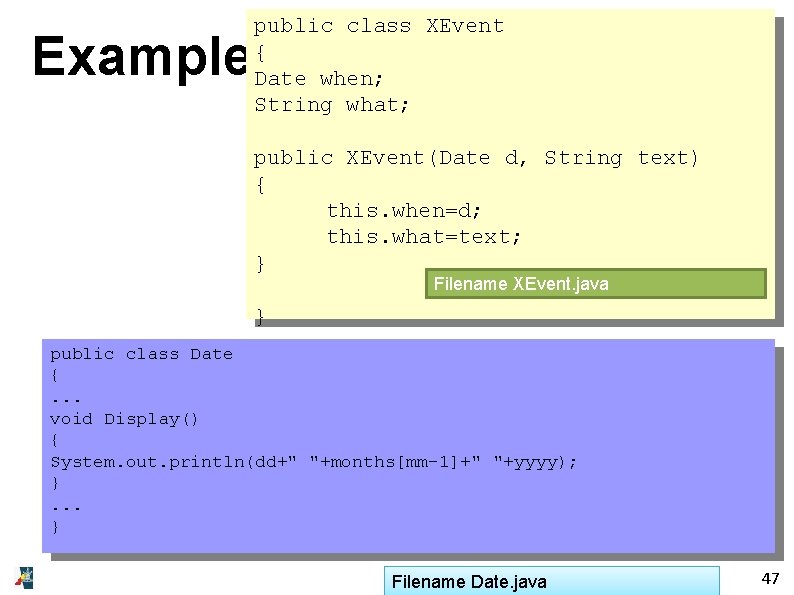
Example public class XEvent { Date when; String what; public XEvent(Date d, String text) { this. when=d; this. what=text; } Filename XEvent. java } public class Date {. . . void Display() { System. out. println(dd+" "+months[mm-1]+" "+yyyy); }. . . } Filename Date. java 47
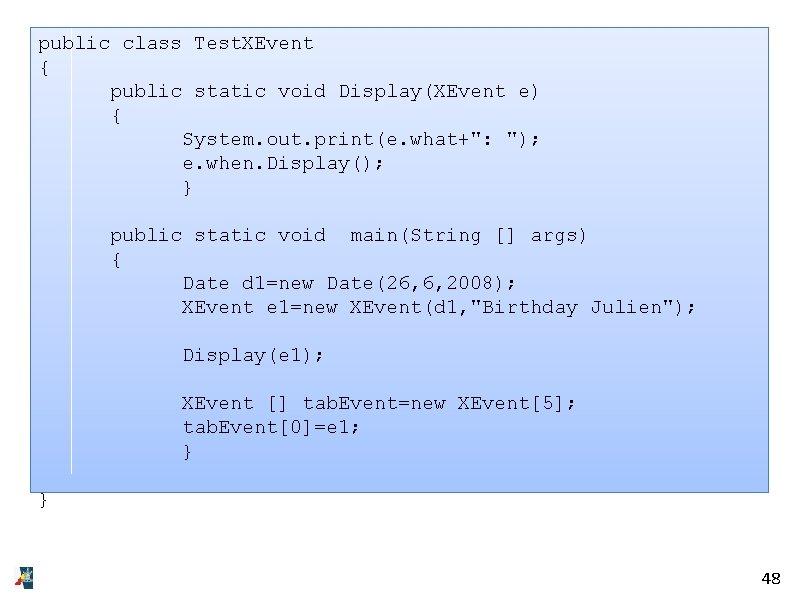
public class Test. XEvent { public static void Display(XEvent e) { System. out. print(e. what+": "); e. when. Display(); } public static void main(String [] args) { Date d 1=new Date(26, 6, 2008); XEvent e 1=new XEvent(d 1, "Birthday Julien"); Display(e 1); XEvent [] tab. Event=new XEvent[5]; tab. Event[0]=e 1; } } 48
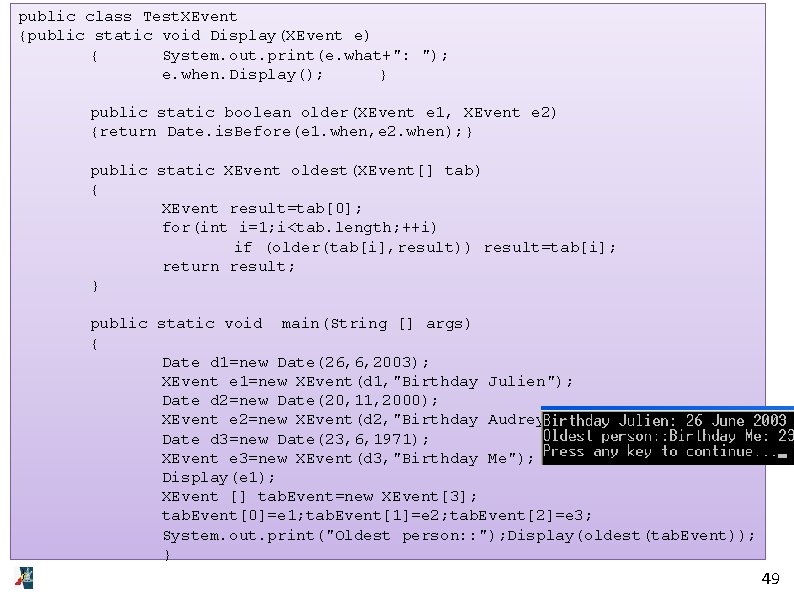
public class Test. XEvent {public static void Display(XEvent e) { System. out. print(e. what+": "); e. when. Display(); } public static boolean older(XEvent e 1, XEvent e 2) {return Date. is. Before(e 1. when, e 2. when); } public static XEvent oldest(XEvent[] tab) { XEvent result=tab[0]; for(int i=1; i<tab. length; ++i) if (older(tab[i], result)) result=tab[i]; return result; } public static void main(String [] args) { Date d 1=new Date(26, 6, 2003); XEvent e 1=new XEvent(d 1, "Birthday Julien"); Date d 2=new Date(20, 11, 2000); XEvent e 2=new XEvent(d 2, "Birthday Audrey"); Date d 3=new Date(23, 6, 1971); XEvent e 3=new XEvent(d 3, "Birthday Me"); Display(e 1); XEvent [] tab. Event=new XEvent[3]; tab. Event[0]=e 1; tab. Event[1]=e 2; tab. Event[2]=e 3; System. out. print("Oldest person: : "); Display(oldest(tab. Event)); } } 49
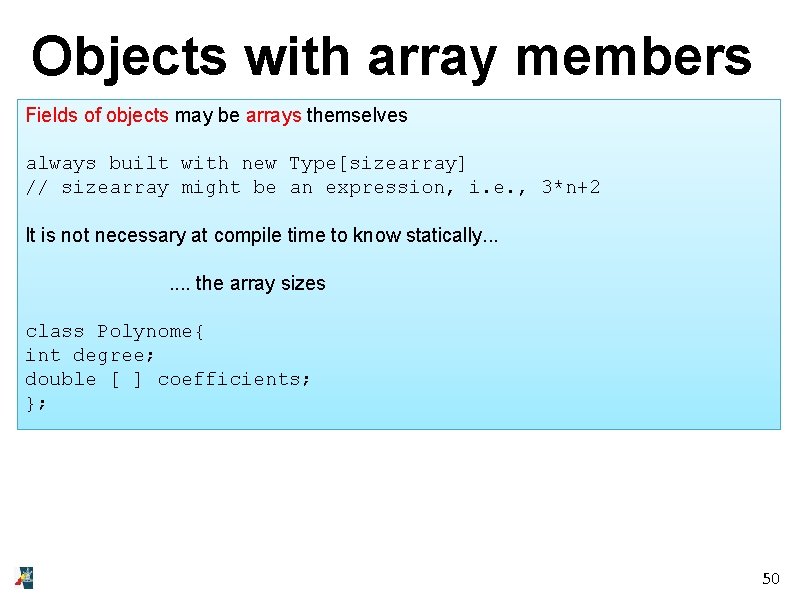
Objects with array members Fields of objects may be arrays themselves always built with new Type[sizearray] // sizearray might be an expression, i. e. , 3*n+2 It is not necessary at compile time to know statically. . . . the array sizes class Polynome{ int degree; double [ ] coefficients; }; 50
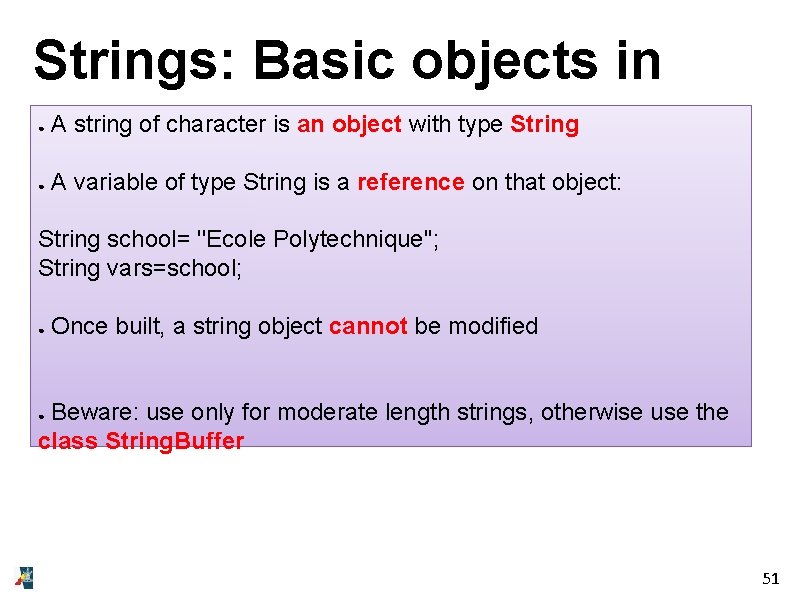
Strings: Basic objects in A string of character is an object with type String Java ● ● A variable of type String is a reference on that object: String school= ''Ecole Polytechnique''; String vars=school; ● Once built, a string object cannot be modified Beware: use only for moderate length strings, otherwise use the class String. Buffer ● 51
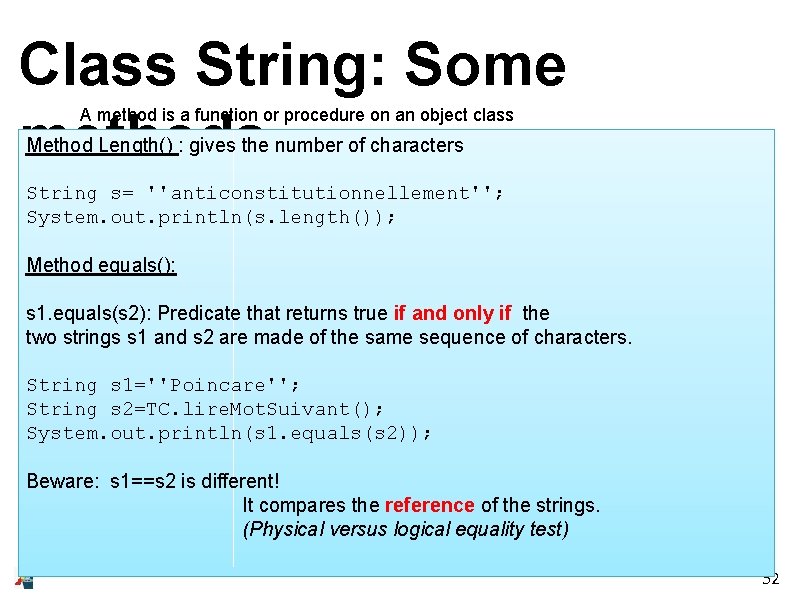
Class String: Some methods A method is a function or procedure on an object class Method Length() : gives the number of characters String s= ''anticonstitutionnellement''; System. out. println(s. length()); Method equals(): s 1. equals(s 2): Predicate that returns true if and only if the two strings s 1 and s 2 are made of the same sequence of characters. String s 1=''Poincare''; String s 2=TC. lire. Mot. Suivant(); System. out. println(s 1. equals(s 2)); Beware: s 1==s 2 is different! It compares the reference of the strings. (Physical versus logical equality test) 52
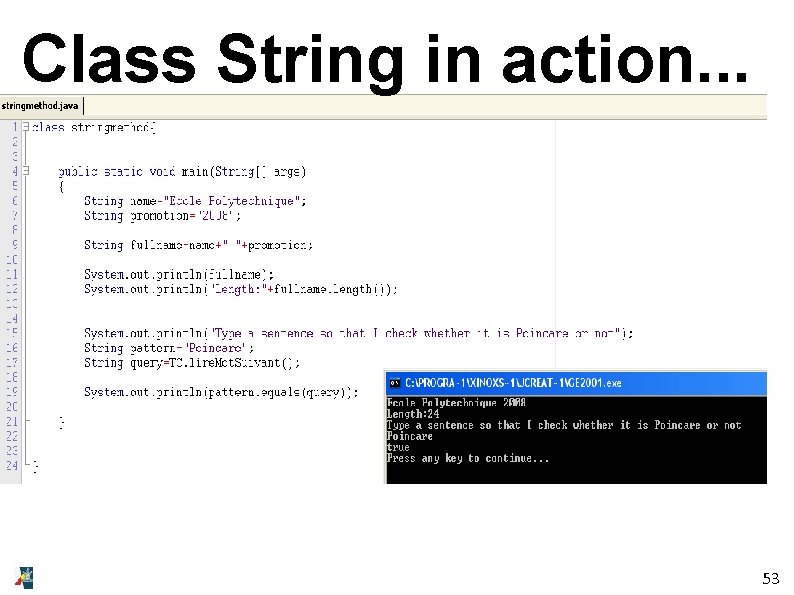
Class String in action. . . 53
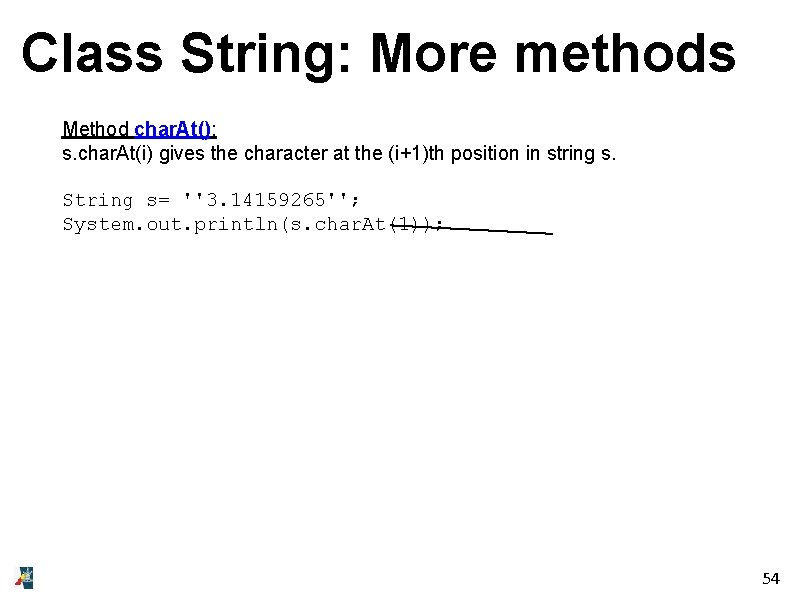
Class String: More methods Method char. At(): s. char. At(i) gives the character at the (i+1)th position in string s. String s= ''3. 14159265''; System. out. println(s. char. At(1)); 54
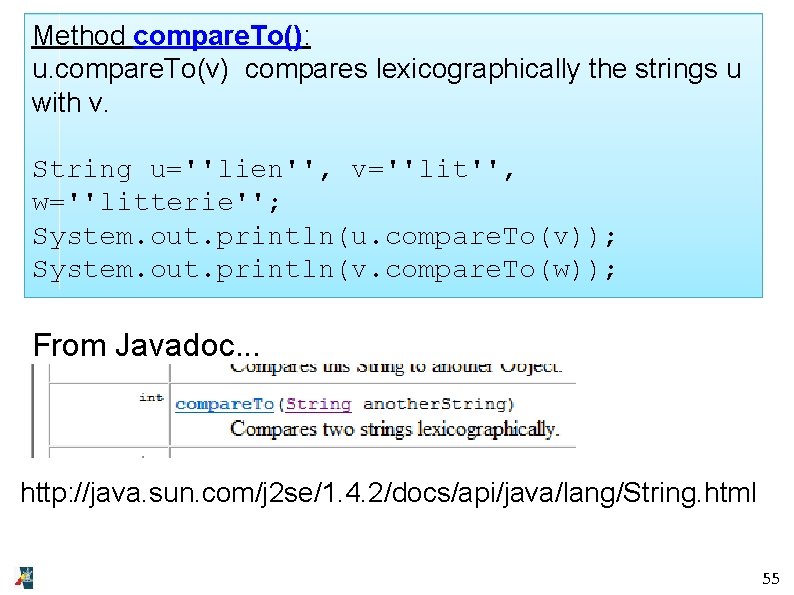
Method compare. To(): u. compare. To(v) compares lexicographically the strings u with v. String u=''lien'', v=''lit'', w=''litterie''; System. out. println(u. compare. To(v)); System. out. println(v. compare. To(w)); From Javadoc. . . http: //java. sun. com/j 2 se/1. 4. 2/docs/api/java/lang/String. html 55
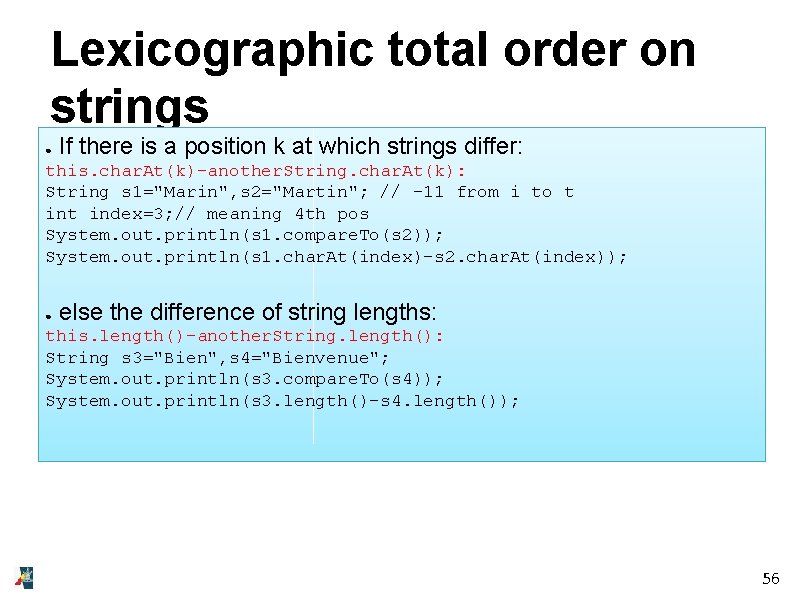
Lexicographic total order on strings ● If there is a position k at which strings differ: this. char. At(k)-another. String. char. At(k): String s 1="Marin", s 2="Martin"; // -11 from i to t index=3; // meaning 4 th pos System. out. println(s 1. compare. To(s 2)); System. out. println(s 1. char. At(index)-s 2. char. At(index)); ● else the difference of string lengths: this. length()-another. String. length(): String s 3="Bien", s 4="Bienvenue"; System. out. println(s 3. compare. To(s 4)); System. out. println(s 3. length()-s 4. length()); 56
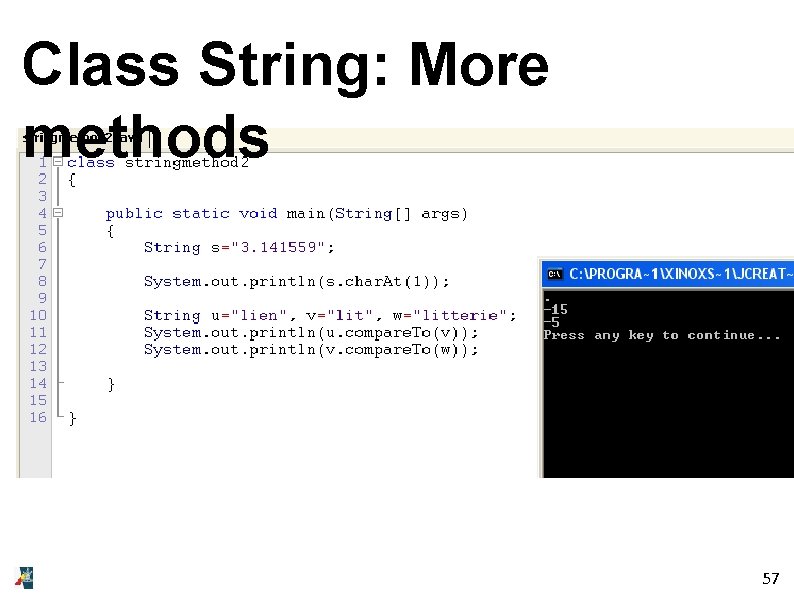
Class String: More methods 57
![Demystifying the main function class Class. Name { public static void main(String[ ] args)](http://slidetodoc.com/presentation_image_h2/5660098dd6b4d7ceb54c88ba3800cfdb/image-58.jpg "Demystifying the main function class Class. Name { public static void main(String[ ] args)")
Demystifying the main function class Class. Name { public static void main(String[ ] args) {. . . } } Function main has an array of string of characters as arguments These strings are stored in args[0], args[1], . . . when calling java main s 0 s 1 s 2 s 3 Use Integer. parse. Int() to convert a string into an integer 58
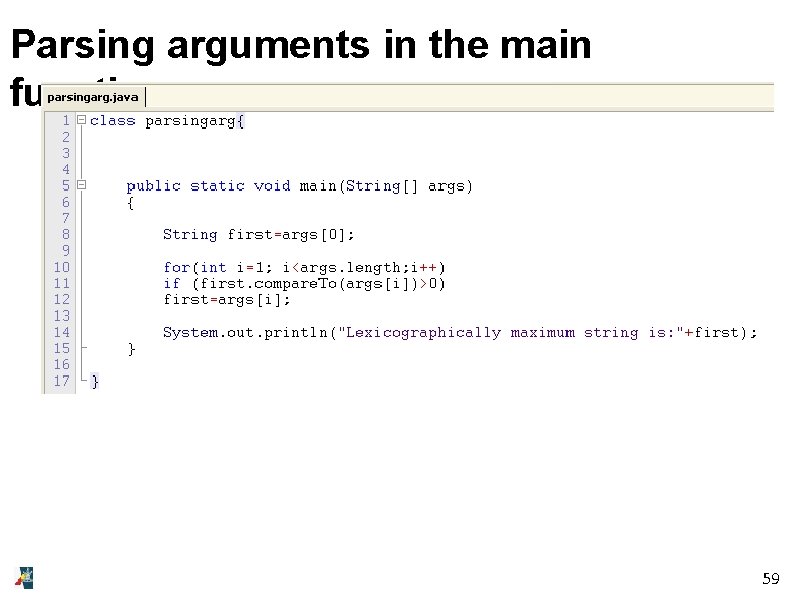
Parsing arguments in the main function 59
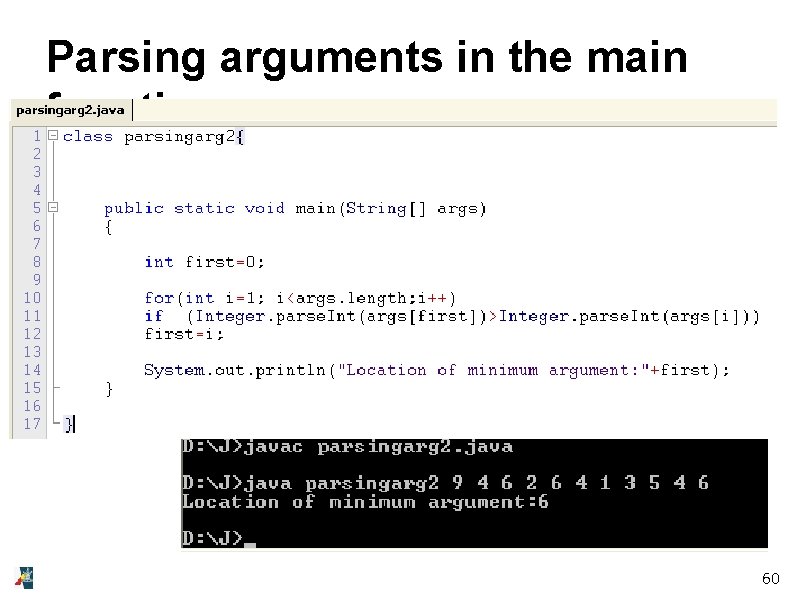
Parsing arguments in the main function 60
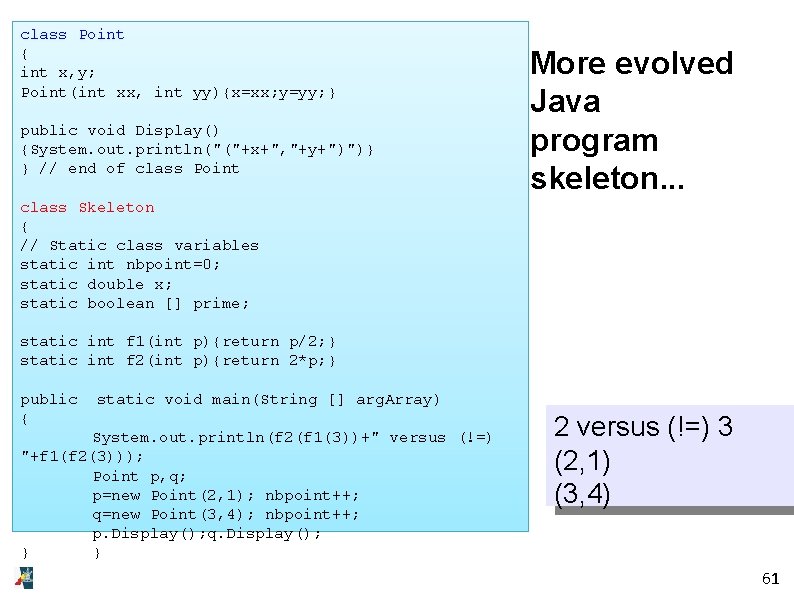
class Point { int x, y; Point(int xx, int yy){x=xx; y=yy; } public void Display() {System. out. println("("+x+", "+y+")")} } // end of class Point More evolved Java program skeleton. . . class Skeleton { // Static class variables static int nbpoint=0; static double x; static boolean [] prime; static int f 1(int p){return p/2; } static int f 2(int p){return 2*p; } public { static void main(String [] arg. Array) System. out. println(f 2(f 1(3))+" versus (!=) "+f 1(f 2(3))); Point p, q; p=new Point(2, 1); nbpoint++; q=new Point(3, 4); nbpoint++; p. Display(); q. Display(); } } 2 versus (!=) 3 (2, 1) (3, 4) 61
- Slides: 61