
Chapter 5 Chemical Bonding and States of Matter
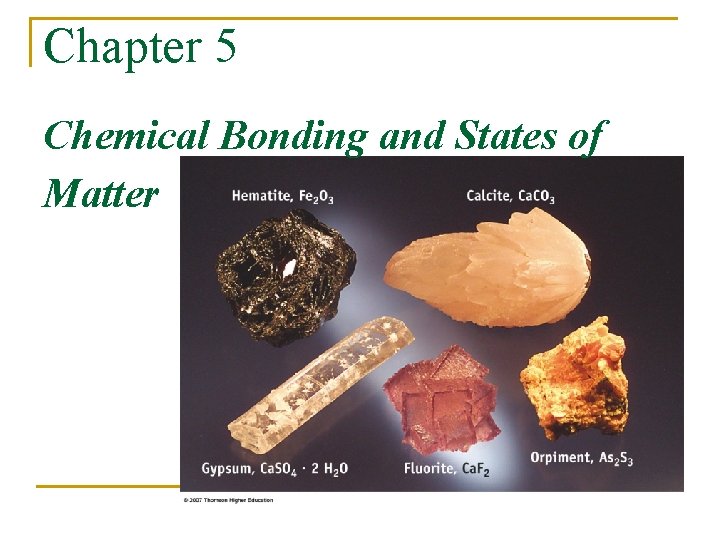
Chapter 5 Chemical Bonding and States of Matter
Chapter Learning Objectives n By the end of the chapter, you will recognize that a. Having eight valence electrons is particularly desirable (“the octet rule”). b. Atoms form bonds with other atoms to satisfy the octet rule. c. The two major types of chemical bonds are ionic and covalent.
Chapter Learning Objectives (cont) d. Electronegativity is the ability to attract shared electrons. e. The type of bond formed between two atoms depends on their difference in electronegativity. f. Ionic bonds form between atoms with a large difference in electronegativity (generally a metal and a nonmetal).
Chapter Learning Objectives (cont) g. Nonpolar covalent bonds form between atoms with little difference in electronegativity (generally two nonmetals). h. Polar covalent bonds form between atoms with intermediate difference in electronegativity. i. Like dissolves like. That is, polar solutes dissolve in polar solvents.
Chapter Learning Objectives (cont) j. Intermolecular forces hold the molecules of a material together in different states of matter. k. Stronger intermolecular forces lead to higher melting and boiling temperatures. l. The relative strengths of intermolecular forces generally follow the trend: hydrogen bonds > dipole-dipole interactions > London forces
Chapter Outline A. & B. q q q The Octet Rule The noble gases of Group VIIIA do not typically form compounds with other atoms. Atoms with eight valence electrons are particularly stable, an observation called the octet rule. Atoms form bonds with other atoms to achieve a valence octet.
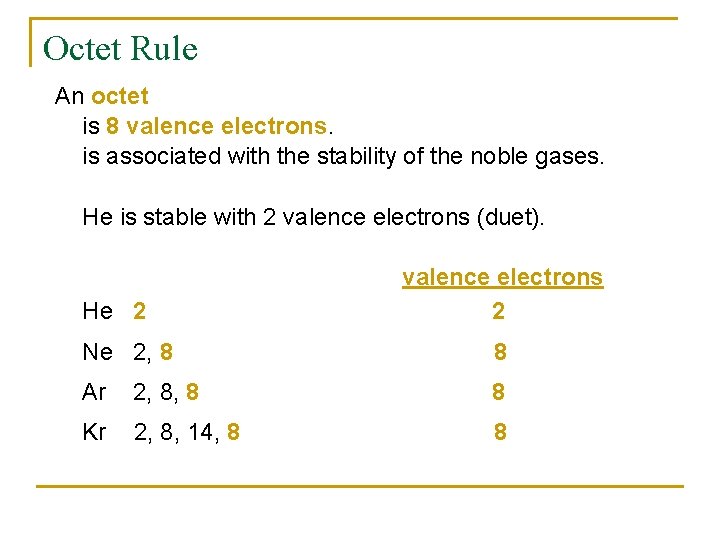
Octet Rule An octet is 8 valence electrons. is associated with the stability of the noble gases. He is stable with 2 valence electrons (duet). He 2 valence electrons 2 Ne 2, 8 8 Ar 2, 8, 8 8 Kr 2, 8, 14, 8 8
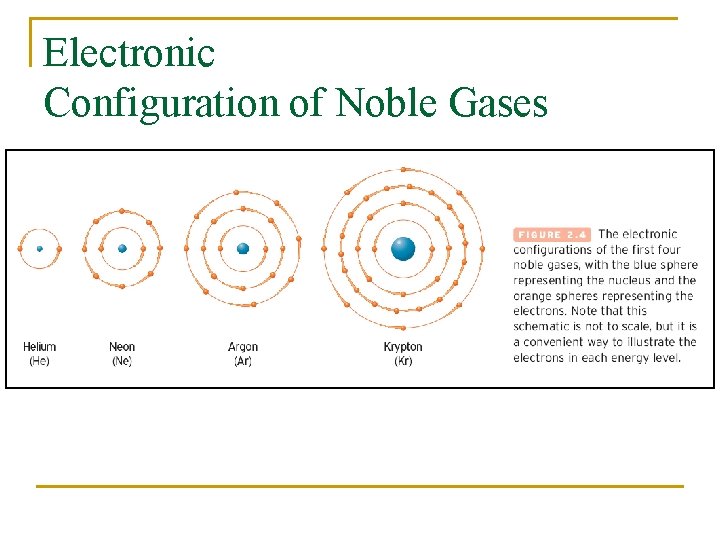
Electronic Configuration of Noble Gases
Chapter Outline Types of compounds C. Ionic 1. n Attractions between oppositely charged particles Covalent 2. n Atoms share electron pairs.
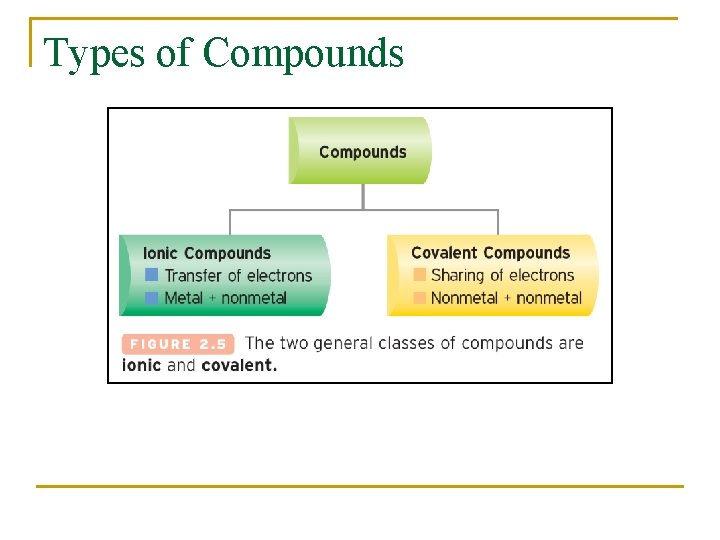
Types of Compounds
Chapter Outline n Lewis Dot Structures (Review) q q The number of valence electrons is equal to the group number for most of the main group elements. In Lewis dot structures, the chemical symbol represents the nucleus and the core electrons and dots represent the valence electrons.
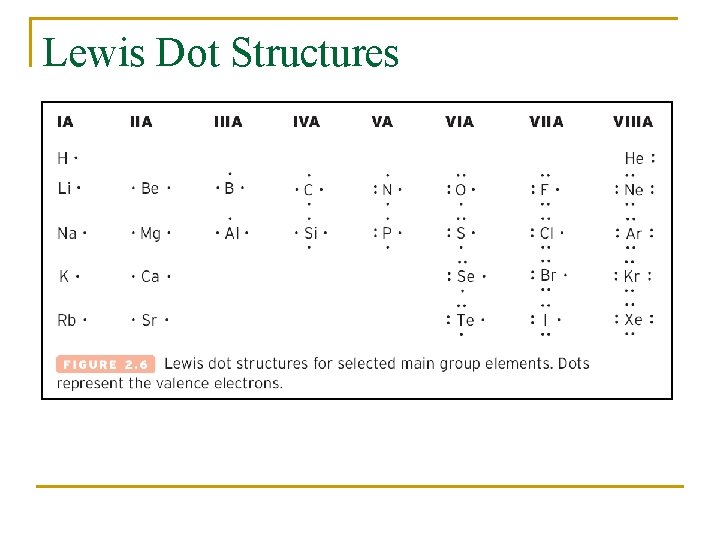
Lewis Dot Structures
Chapter Outline Ionic Bonds 1. q q Ionic compounds result from the loss of electrons by one atom (usually a metal) and the gain of electrons by another atom (usually a nonmetal). Ionic bonds arise from the attraction between particles with opposite charges (electrostatic forces); e. g. , Na+ Cl-.
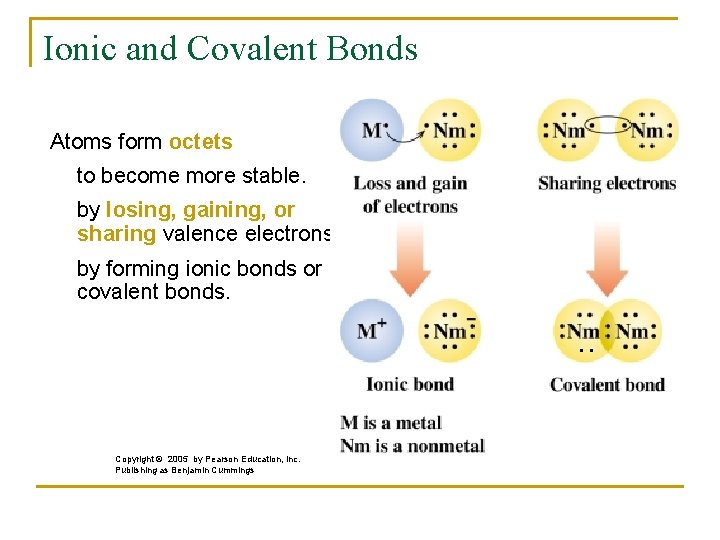
Ionic and Covalent Bonds Atoms form octets to become more stable. by losing, gaining, or sharing valence electrons. : by forming ionic bonds or covalent bonds. Copyright © 2005 by Pearson Education, Inc. Publishing as Benjamin Cummings
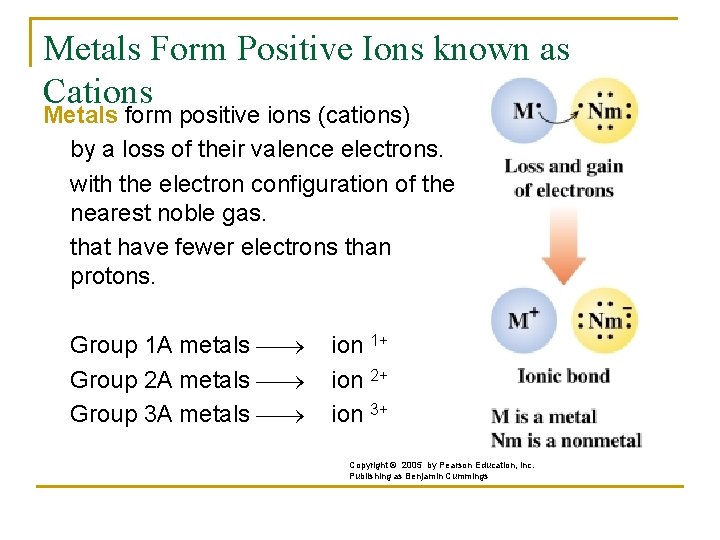
Metals Form Positive Ions known as Cations Metals form positive ions (cations) by a loss of their valence electrons. with the electron configuration of the nearest noble gas. that have fewer electrons than protons. Group 1 A metals Group 2 A metals Group 3 A metals ion 1+ ion 2+ ion 3+ Copyright © 2005 by Pearson Education, Inc. Publishing as Benjamin Cummings
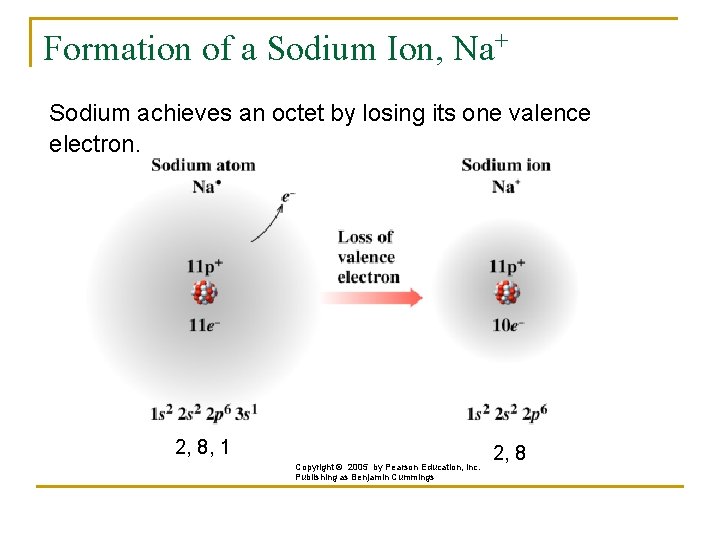
Formation of a Sodium Ion, Na+ Sodium achieves an octet by losing its one valence electron. 2, 8, 1 Copyright © 2005 by Pearson Education, Inc. Publishing as Benjamin Cummings 2, 8
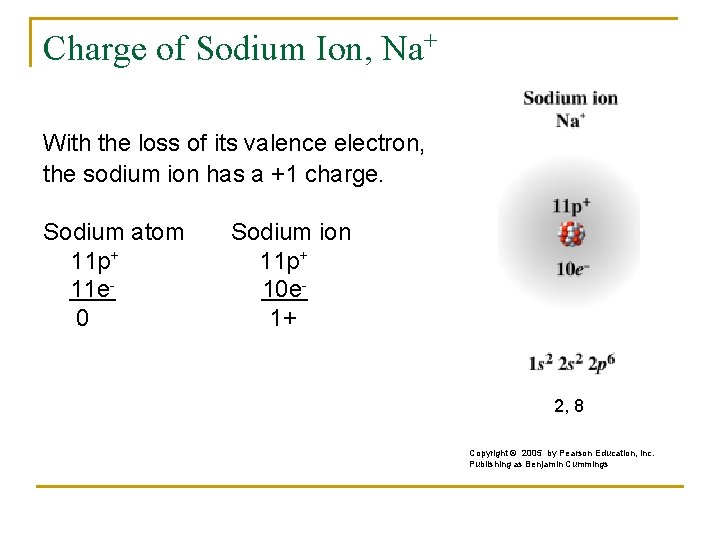
Charge of Sodium Ion, Na+ With the loss of its valence electron, the sodium ion has a +1 charge. Sodium atom 11 p+ 11 e 0 Sodium ion 11 p+ 10 e 1+ 2, 8 Copyright © 2005 by Pearson Education, Inc. Publishing as Benjamin Cummings
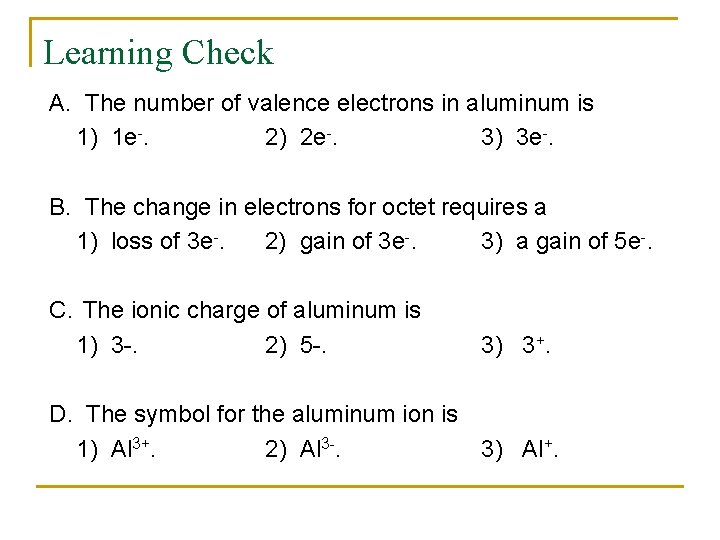
Learning Check A. The number of valence electrons in aluminum is 1) 1 e-. 2) 2 e-. 3) 3 e-. B. The change in electrons for octet requires a 1) loss of 3 e-. 2) gain of 3 e-. 3) a gain of 5 e-. C. The ionic charge of aluminum is 1) 3 -. 2) 5 -. 3) 3+. D. The symbol for the aluminum ion is 1) Al 3+. 2) Al 3 -. 3) Al+.
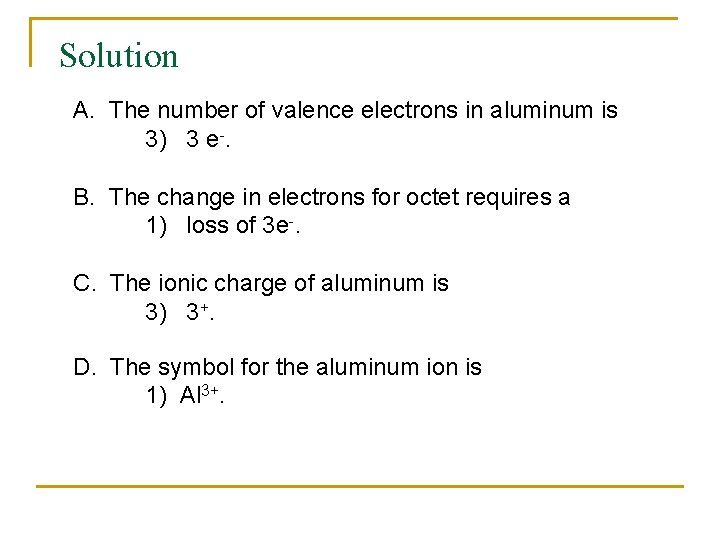
Solution A. The number of valence electrons in aluminum is 3) 3 e-. B. The change in electrons for octet requires a 1) loss of 3 e-. C. The ionic charge of aluminum is 3) 3+. D. The symbol for the aluminum ion is 1) Al 3+.
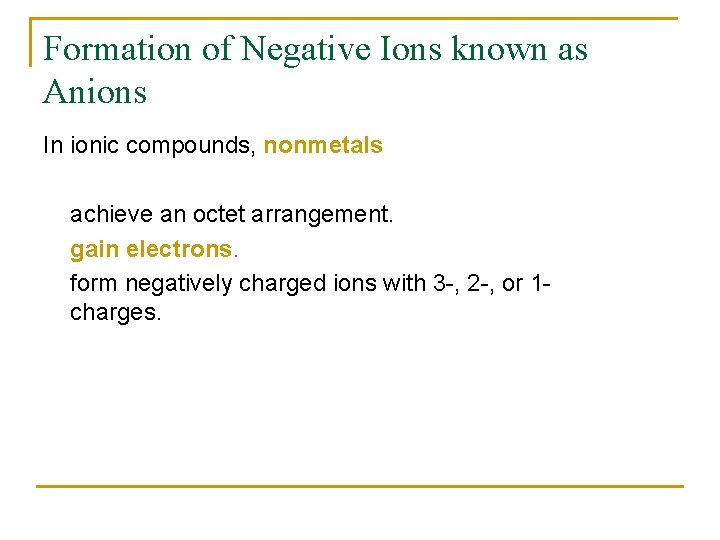
Formation of Negative Ions known as Anions In ionic compounds, nonmetals achieve an octet arrangement. gain electrons. form negatively charged ions with 3 -, 2 -, or 1 charges.
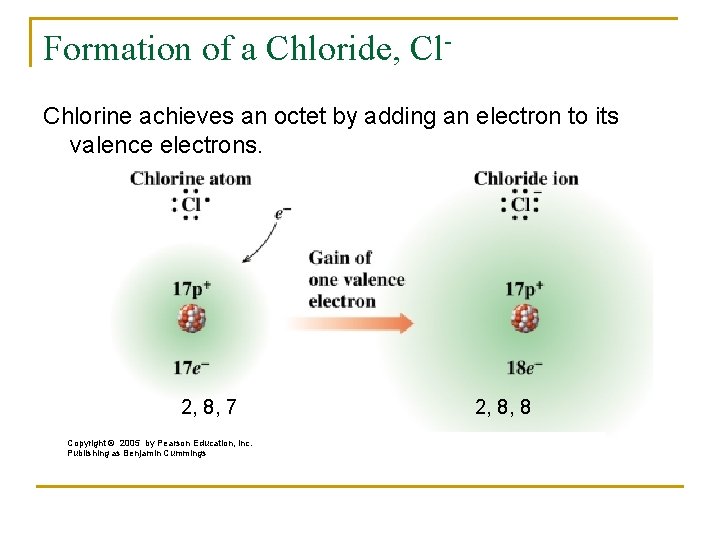
Formation of a Chloride, Cl. Chlorine achieves an octet by adding an electron to its valence electrons. 2, 8, 7 Copyright © 2005 by Pearson Education, Inc. Publishing as Benjamin Cummings 2, 8, 8
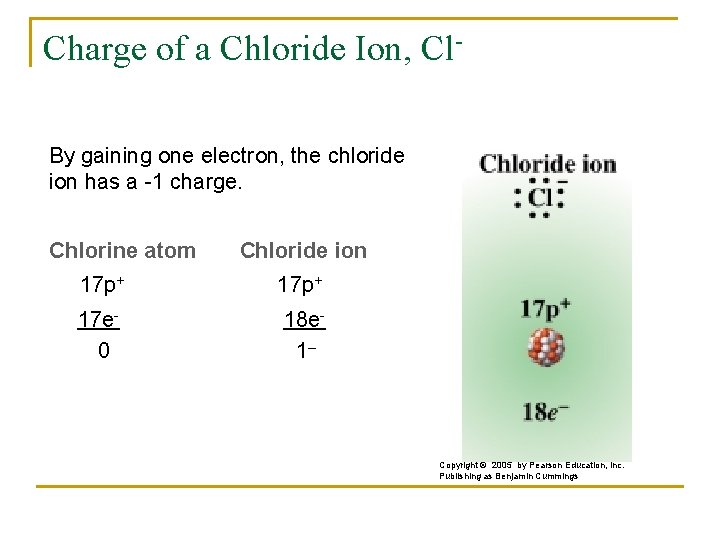
Charge of a Chloride Ion, Cl. By gaining one electron, the chloride ion has a -1 charge. Chlorine atom Chloride ion 17 p+ 17 e 0 18 e 1– Copyright © 2005 by Pearson Education, Inc. Publishing as Benjamin Cummings
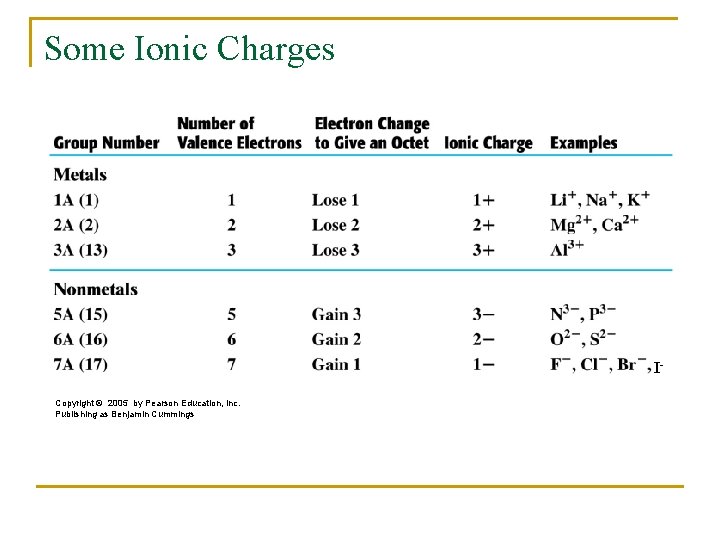
Some Ionic Charges ICopyright © 2005 by Pearson Education, Inc. Publishing as Benjamin Cummings
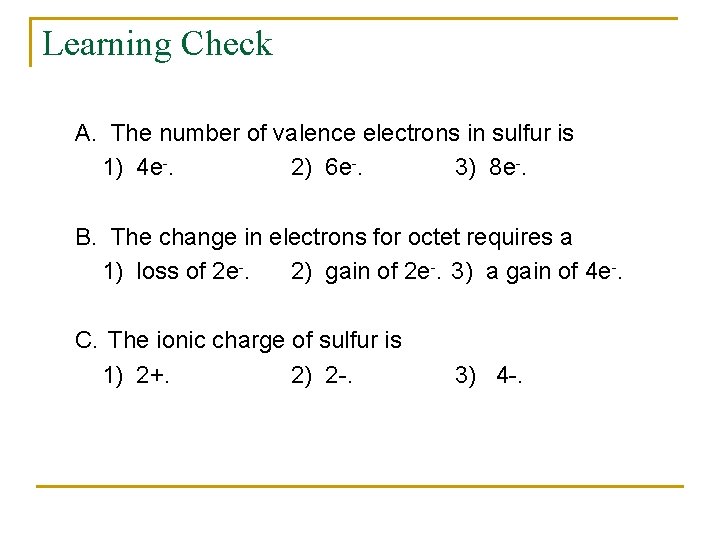
Learning Check A. The number of valence electrons in sulfur is 1) 4 e-. 2) 6 e-. 3) 8 e-. B. The change in electrons for octet requires a 1) loss of 2 e-. 2) gain of 2 e-. 3) a gain of 4 e-. C. The ionic charge of sulfur is 1) 2+. 2) 2 -. 3) 4 -.
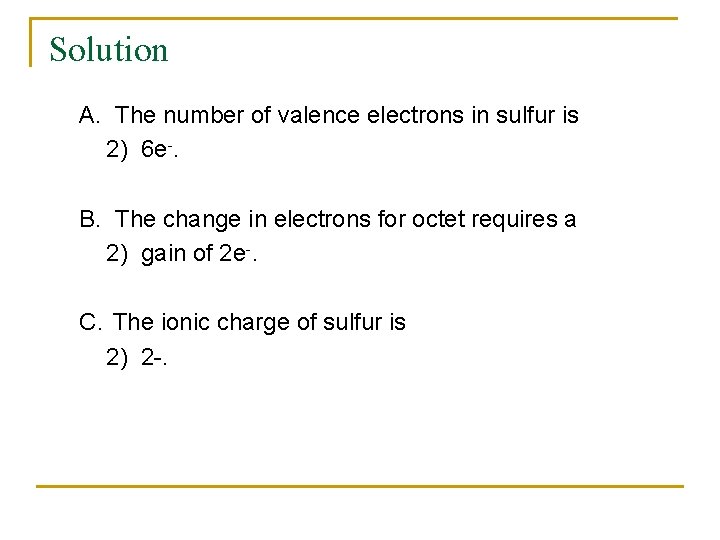
Solution A. The number of valence electrons in sulfur is 2) 6 e-. B. The change in electrons for octet requires a 2) gain of 2 e-. C. The ionic charge of sulfur is 2) 2 -.
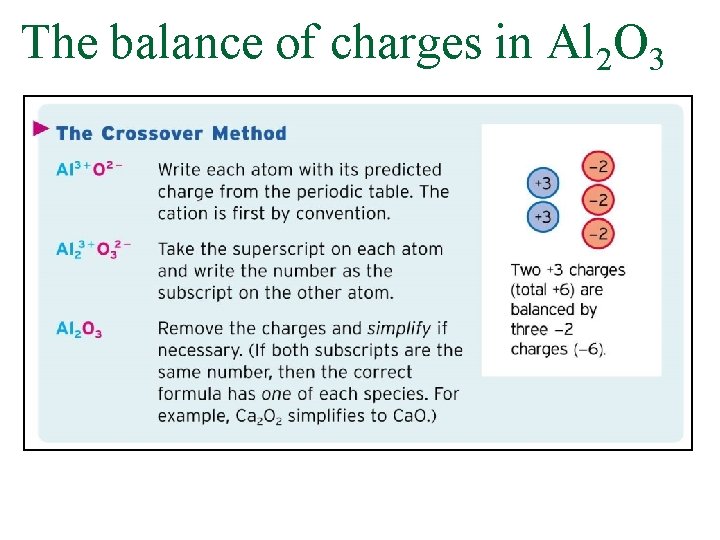
The balance of charges in Al 2 O 3
Run the following web animations/movies. 5. 1: Formation of Sodium Chloride 5. 2: Sodium Metal Reacting with Chlorine Gas 5. 3: Ion Formation
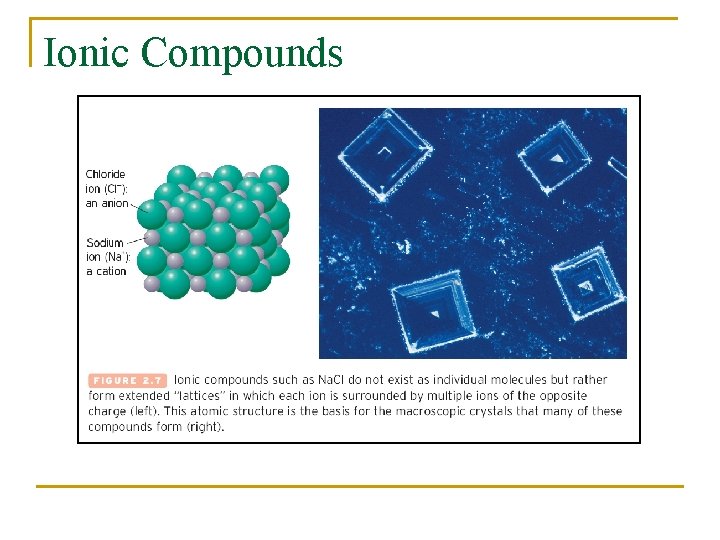
Ionic Compounds
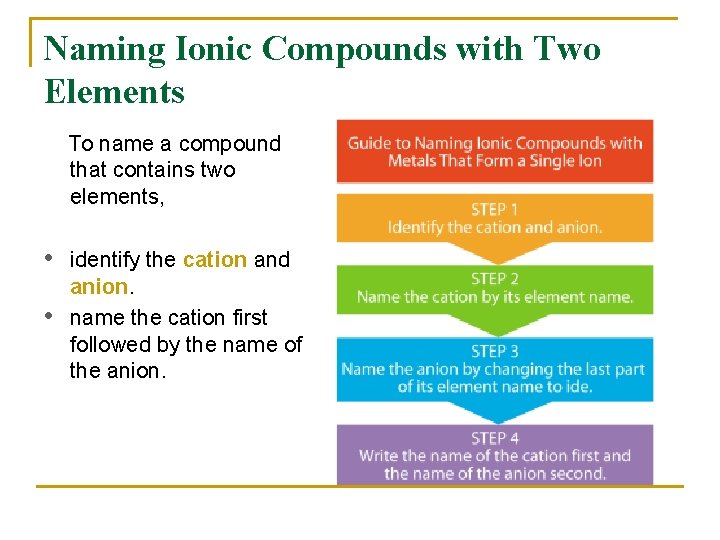
Naming Ionic Compounds with Two Elements To name a compound that contains two elements, • identify the cation and • anion. name the cation first followed by the name of the anion.
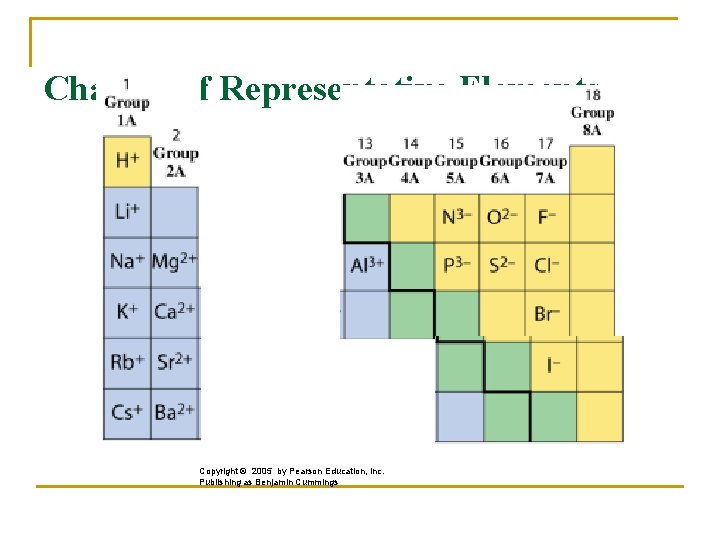
Charges of Representative Elements Copyright © 2005 by Pearson Education, Inc. Publishing as Benjamin Cummings
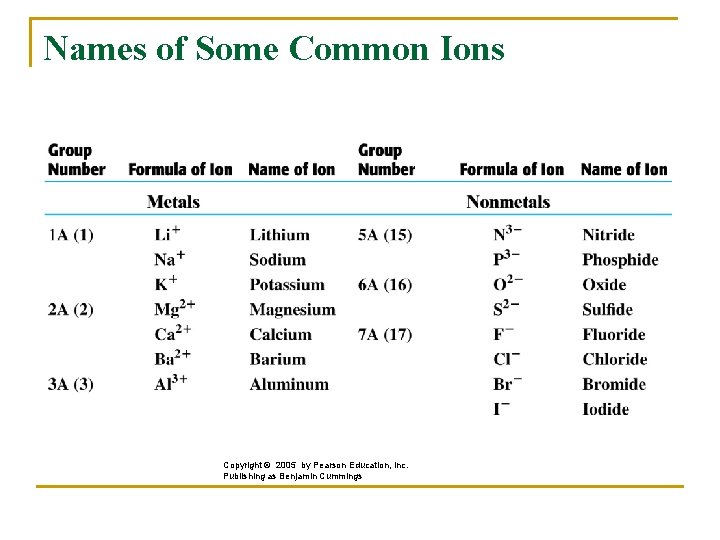
Names of Some Common Ions • Copyright © 2005 by Pearson Education, Inc. Publishing as Benjamin Cummings
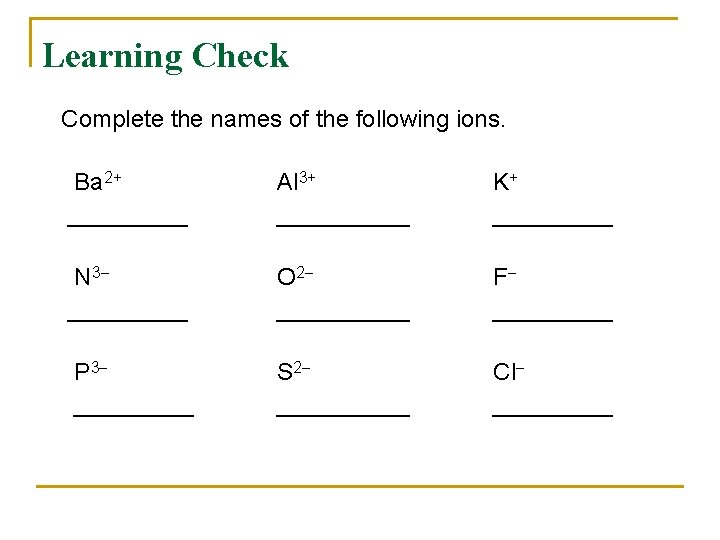
Learning Check Complete the names of the following ions. Ba 2+ _____ Al 3+ _____ K+ _____ N 3 _____ O 2 _____ F _____ P 3 _____ S 2 _____ Cl _____
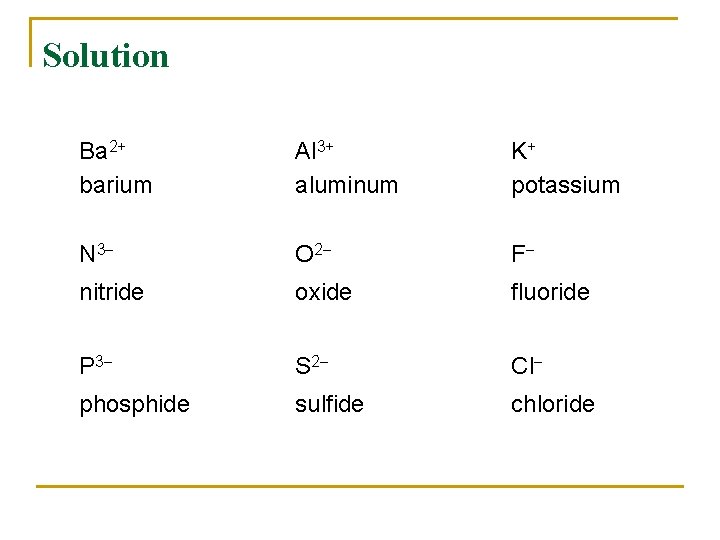
Solution Ba 2+ barium Al 3+ aluminum K+ potassium N 3 O 2 F nitride oxide fluoride P 3 S 2 Cl phosphide sulfide chloride
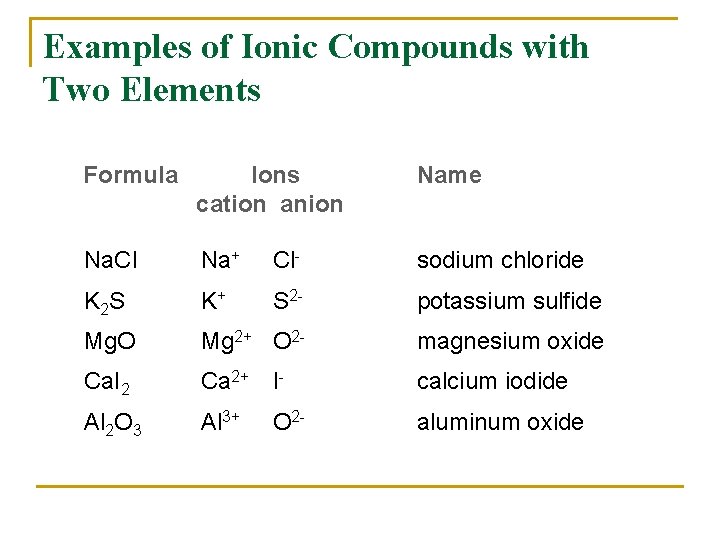
Examples of Ionic Compounds with Two Elements Formula Ions cation anion Name Na. Cl Na+ Cl- sodium chloride K 2 S K+ S 2 - potassium sulfide Mg. O Mg 2+ O 2 - magnesium oxide Ca. I 2 Ca 2+ I- calcium iodide Al 2 O 3 Al 3+ aluminum oxide O 2 -
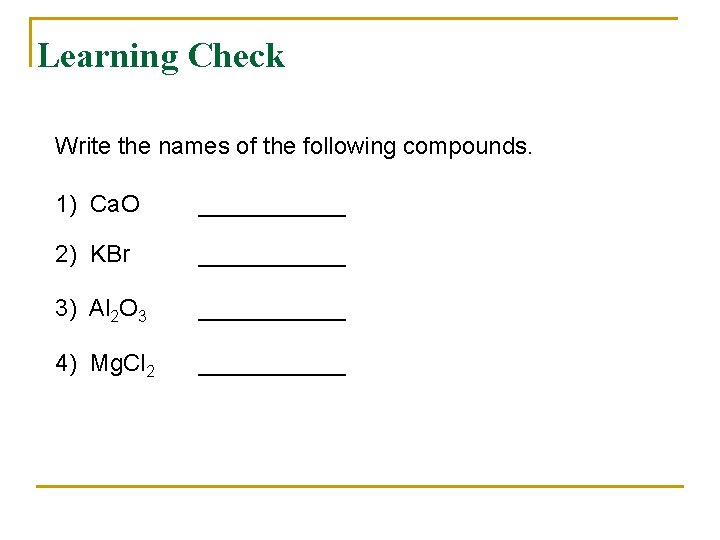
Learning Check Write the names of the following compounds. 1) Ca. O ______ 2) KBr ______ 3) Al 2 O 3 ______ 4) Mg. Cl 2 ______
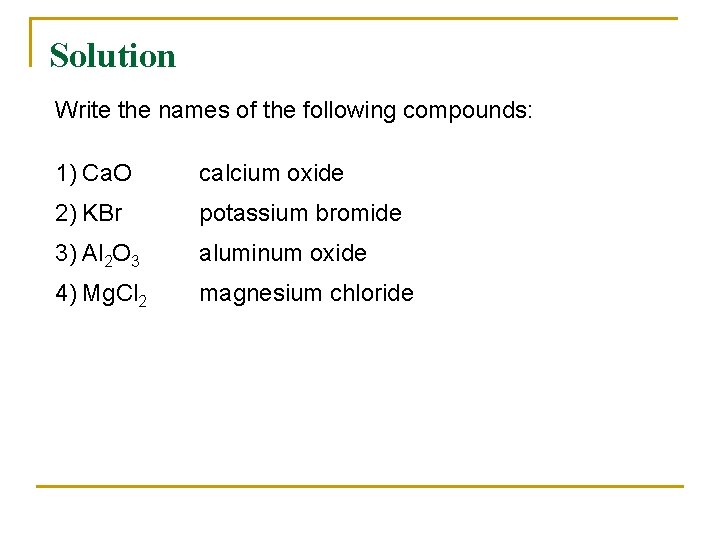
Solution Write the names of the following compounds: 1) Ca. O calcium oxide 2) KBr potassium bromide 3) Al 2 O 3 aluminum oxide 4) Mg. Cl 2 magnesium chloride
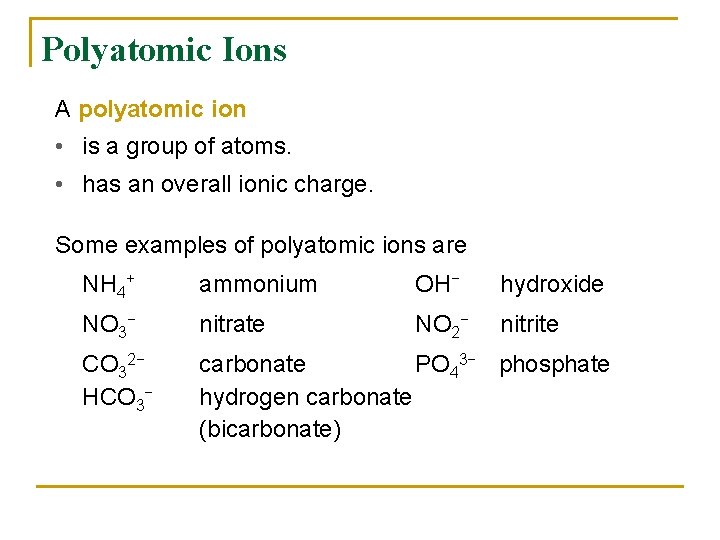
Polyatomic Ions A polyatomic ion • is a group of atoms. • has an overall ionic charge. Some examples of polyatomic ions are NH 4+ ammonium OH− hydroxide NO 3− nitrate NO 2− nitrite CO 32− HCO 3− carbonate PO 43− phosphate hydrogen carbonate (bicarbonate)

Some Compounds with Polyatomic Ions n Copyright © 2005 by Pearson Education, Inc. Publishing as Benjamin Cummings
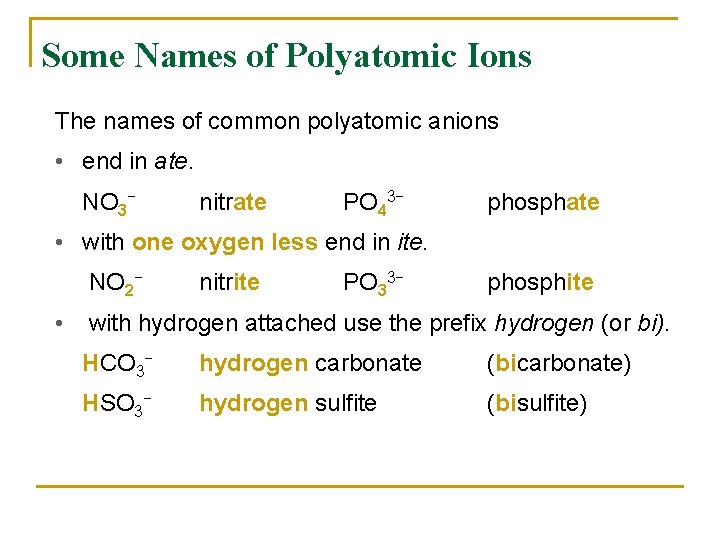
Some Names of Polyatomic Ions The names of common polyatomic anions • end in ate. NO 3− nitrate PO 43− phosphate • with one oxygen less end in ite. NO 2− • nitrite PO 33− phosphite with hydrogen attached use the prefix hydrogen (or bi). HCO 3− hydrogen carbonate (bicarbonate) HSO 3− hydrogen sulfite (bisulfite)
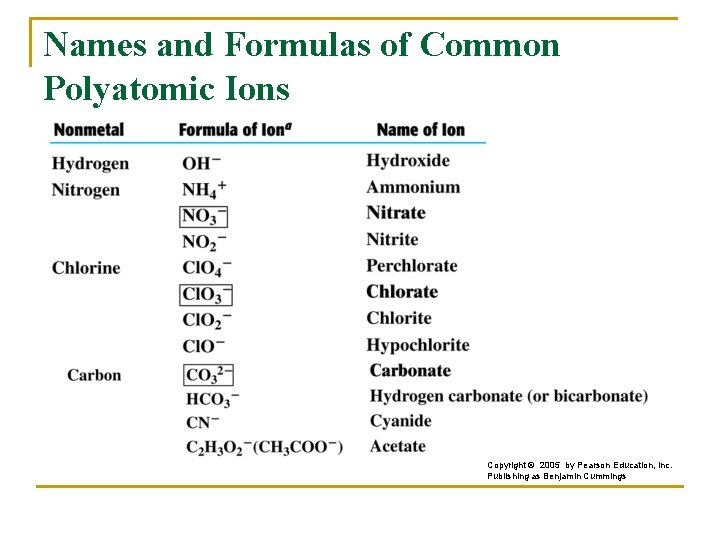
Names and Formulas of Common Polyatomic Ions Copyright © 2005 by Pearson Education, Inc. Publishing as Benjamin Cummings
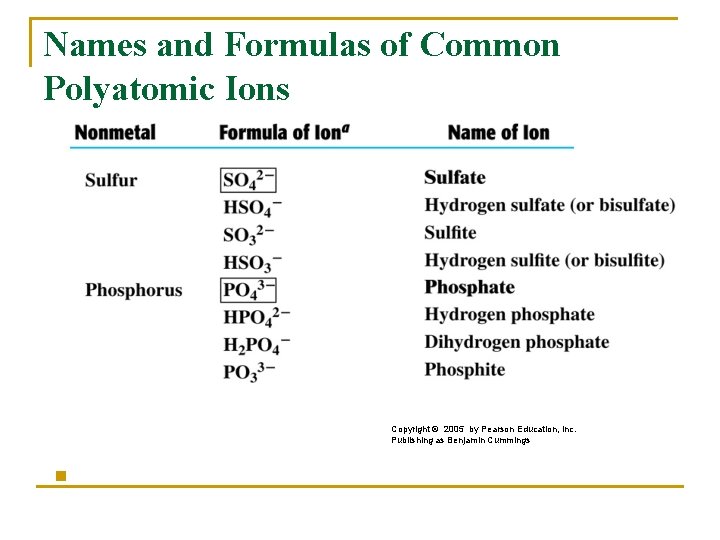
Names and Formulas of Common Polyatomic Ions Copyright © 2005 by Pearson Education, Inc. Publishing as Benjamin Cummings n
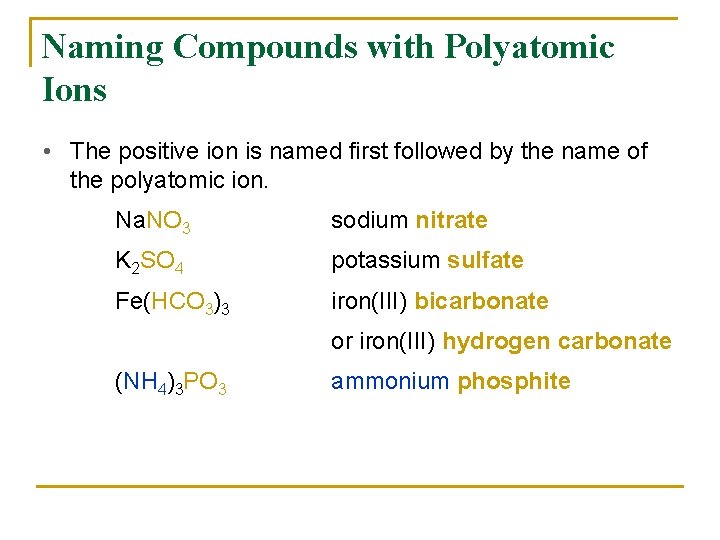
Naming Compounds with Polyatomic Ions • The positive ion is named first followed by the name of the polyatomic ion. Na. NO 3 sodium nitrate K 2 SO 4 potassium sulfate Fe(HCO 3)3 iron(III) bicarbonate or iron(III) hydrogen carbonate (NH 4)3 PO 3 ammonium phosphite
Chapter Outline Covalent Bonds 2. q q Covalent bonds are formed when two atoms share one or more electron pairs. A molecule is the fundamental unit of a covalent compound. When two atoms share one pair of electrons, the result is a single bond. Two shared pairs of electrons is a double bond; three is a triple bond.
Covalent Bonds Covalent bonds form • when atoms share electrons to complete octets. • between two nonmetal atoms. • between nonmetal atoms from Groups 4 A(14), 5 A(15), 6 A(16), and 7 A(17).
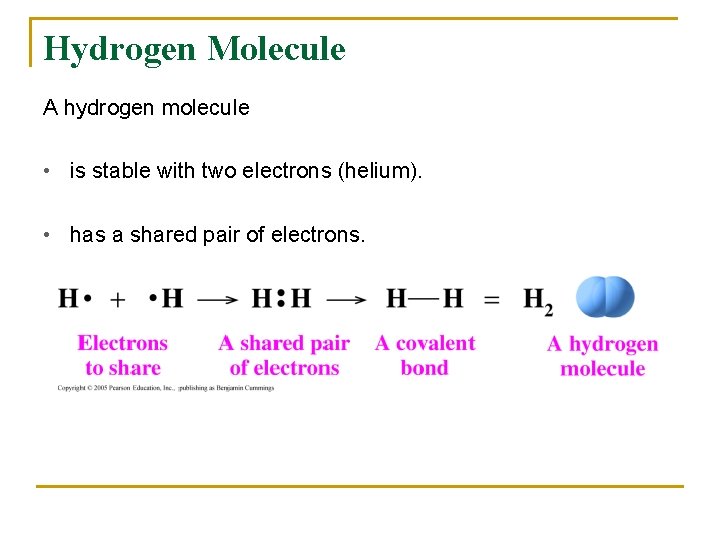
Hydrogen Molecule A hydrogen molecule • is stable with two electrons (helium). • has a shared pair of electrons.
Run the following web animations/movies. 5. 4: Bond Length and Energy 5. 5: Electrostatic Interactions Between Hydrogen Atoms
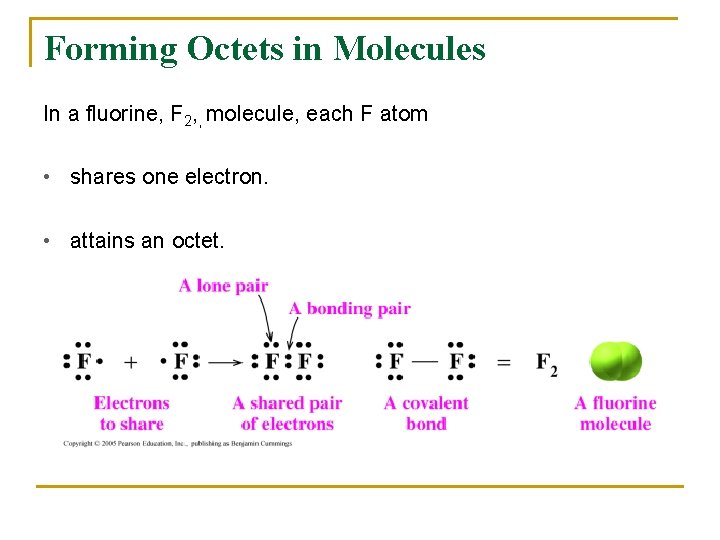
Forming Octets in Molecules In a fluorine, F 2, , molecule, each F atom • shares one electron. • attains an octet.
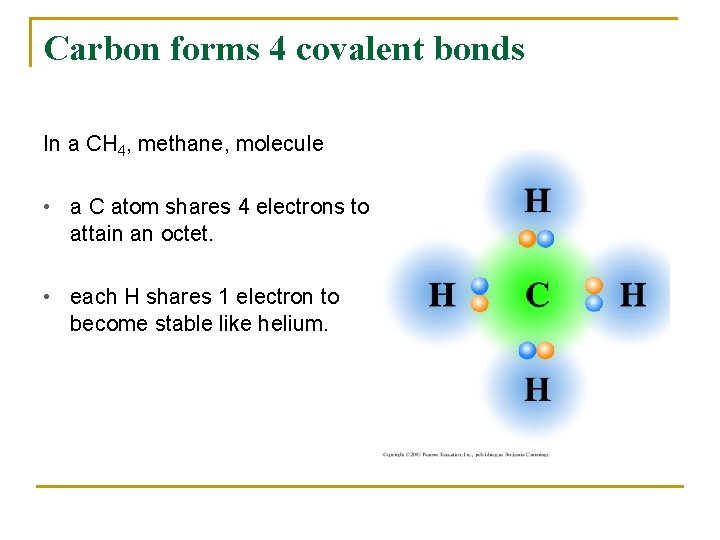
Carbon forms 4 covalent bonds In a CH 4, methane, molecule • a C atom shares 4 electrons to attain an octet. • each H shares 1 electron to become stable like helium.
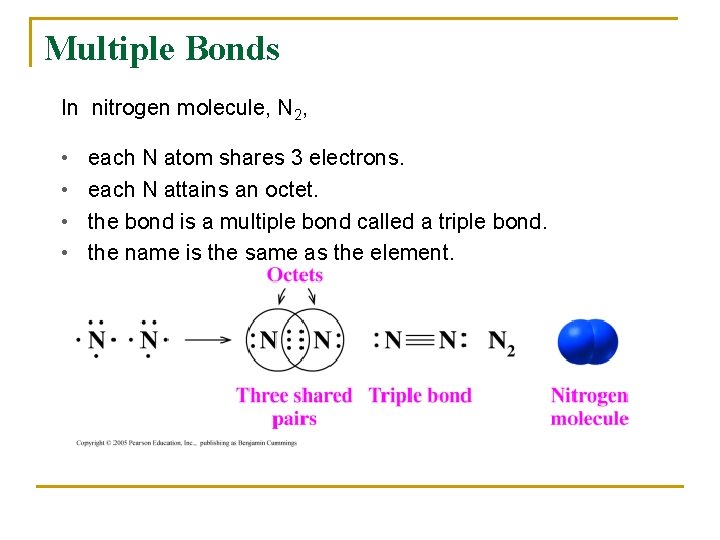
Multiple Bonds In nitrogen molecule, N 2, • • each N atom shares 3 electrons. each N attains an octet. the bond is a multiple bond called a triple bond. the name is the same as the element.
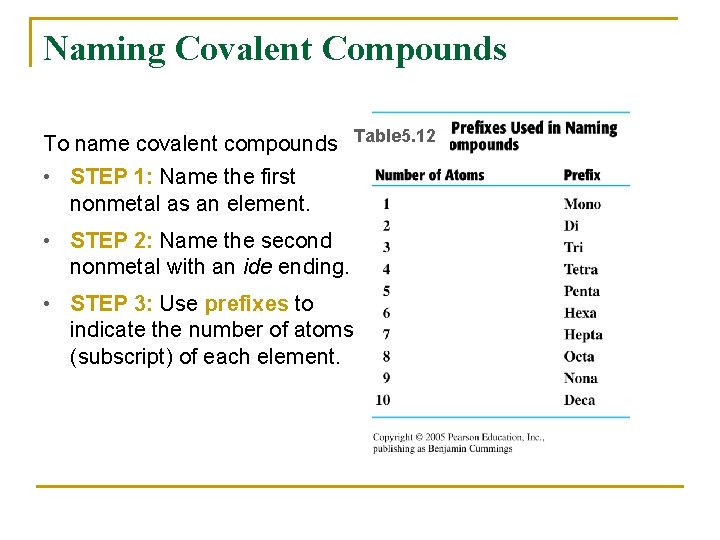
Naming Covalent Compounds To name covalent compounds Table 5. 12 • STEP 1: Name the first nonmetal as an element. • STEP 2: Name the second nonmetal with an ide ending. • STEP 3: Use prefixes to indicate the number of atoms (subscript) of each element.
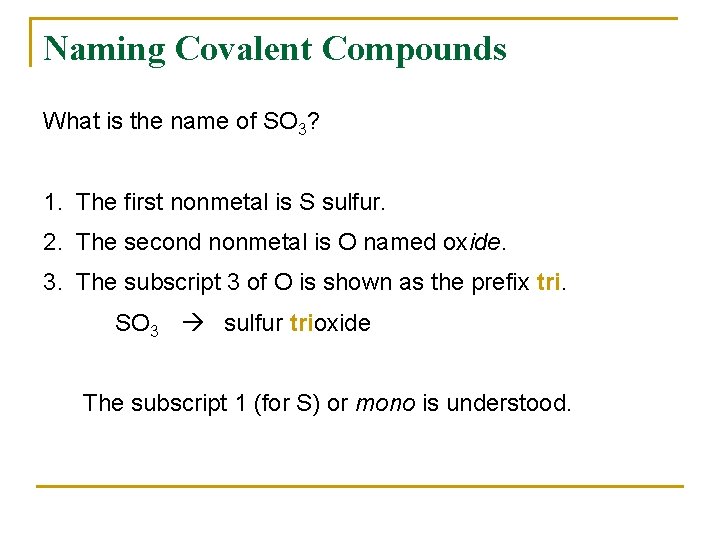
Naming Covalent Compounds What is the name of SO 3? 1. The first nonmetal is S sulfur. 2. The second nonmetal is O named oxide. 3. The subscript 3 of O is shown as the prefix tri. SO 3 sulfur trioxide The subscript 1 (for S) or mono is understood.
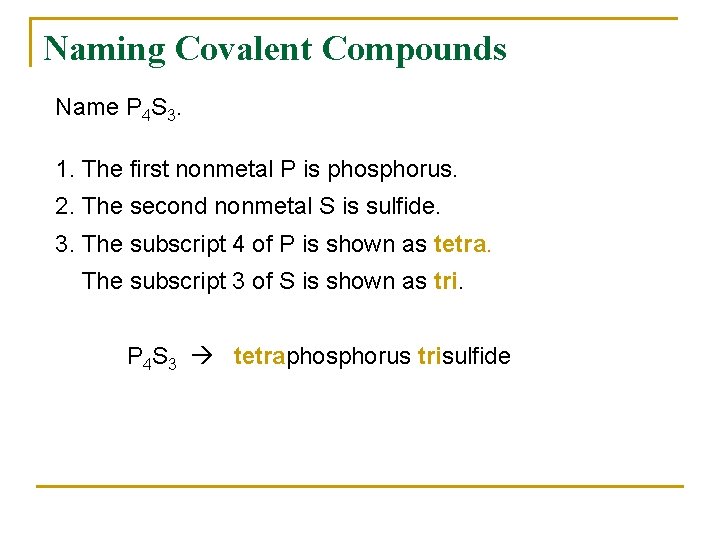
Naming Covalent Compounds Name P 4 S 3. 1. The first nonmetal P is phosphorus. 2. The second nonmetal S is sulfide. 3. The subscript 4 of P is shown as tetra. The subscript 3 of S is shown as tri. P 4 S 3 tetraphosphorus trisulfide
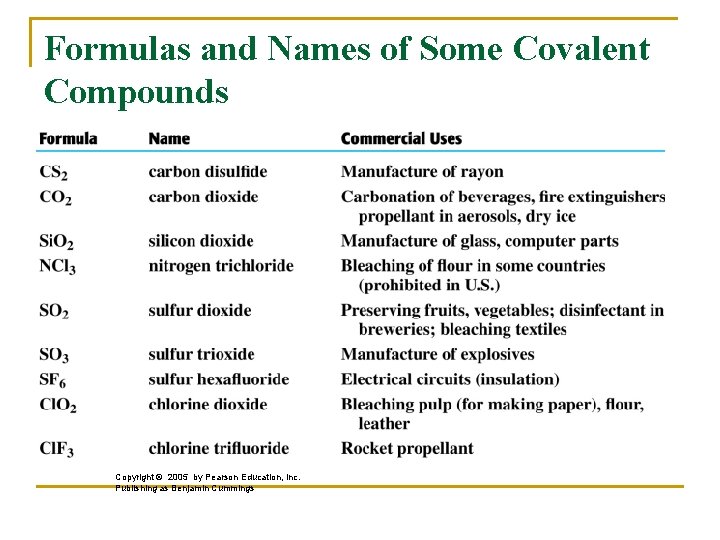
Formulas and Names of Some Covalent Compounds n Copyright © 2005 by Pearson Education, Inc. Publishing as Benjamin Cummings
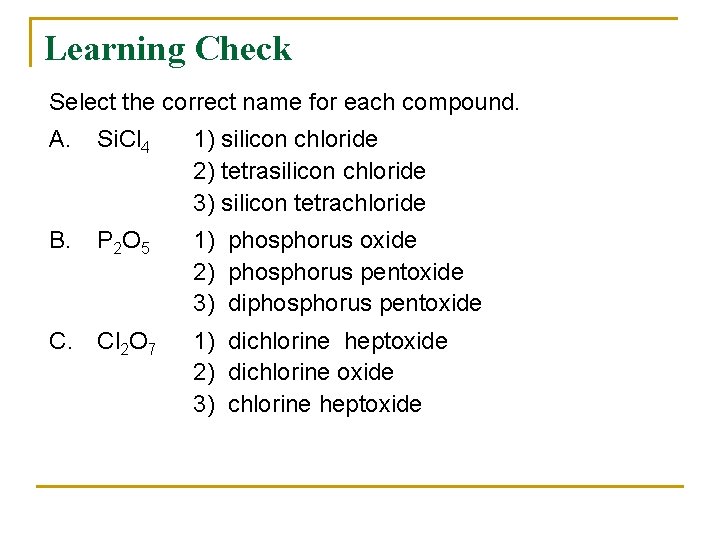
Learning Check Select the correct name for each compound. A. Si. Cl 4 1) silicon chloride 2) tetrasilicon chloride 3) silicon tetrachloride B. P 2 O 5 1) phosphorus oxide 2) phosphorus pentoxide 3) diphosphorus pentoxide C. Cl 2 O 7 1) dichlorine heptoxide 2) dichlorine oxide 3) chlorine heptoxide
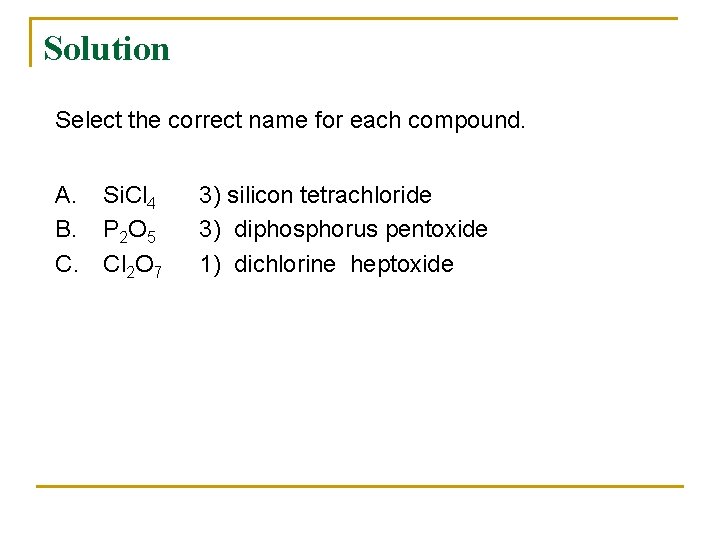
Solution Select the correct name for each compound. A. B. C. Si. Cl 4 P 2 O 5 Cl 2 O 7 3) silicon tetrachloride 3) diphosphorus pentoxide 1) dichlorine heptoxide
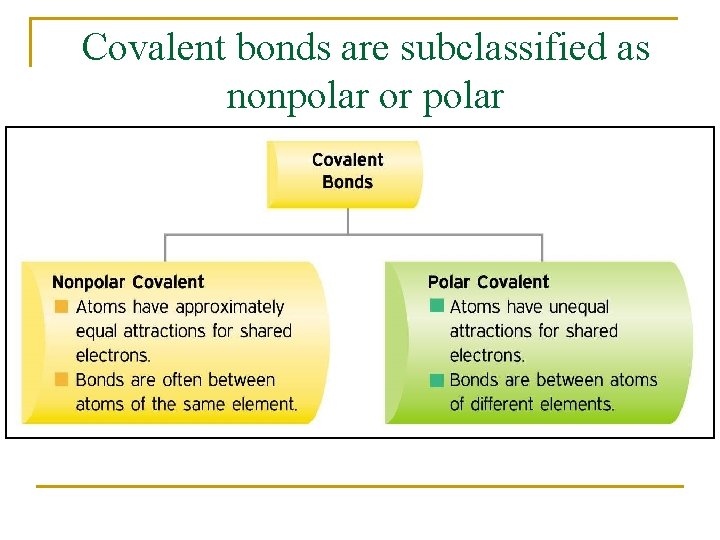
Covalent bonds are subclassified as nonpolar or polar
Predicting Compounds using Lewis Dot Structures n Going back to the idea of Lewis dot configuration as a good way to keep track of valence electrons for predicting structure of ionic/covalent compounds.
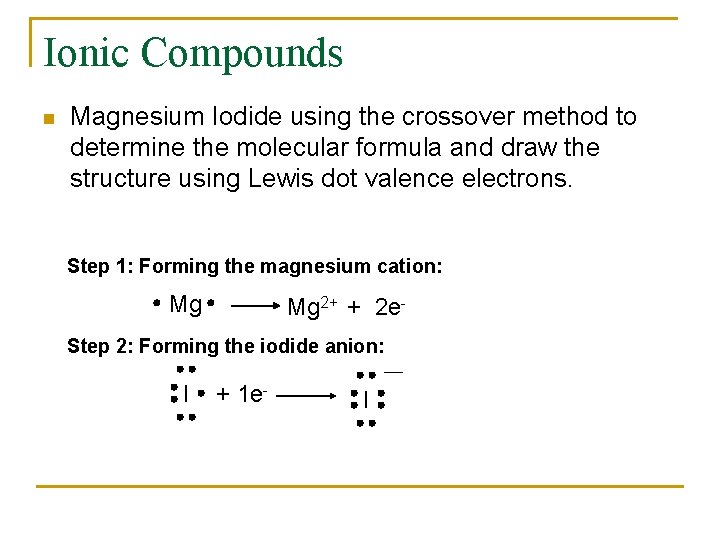
Ionic Compounds n Magnesium Iodide using the crossover method to determine the molecular formula and draw the structure using Lewis dot valence electrons. Step 1: Forming the magnesium cation: Mg Mg 2+ + 2 e- Step 2: Forming the iodide anion: I + 1 e- I
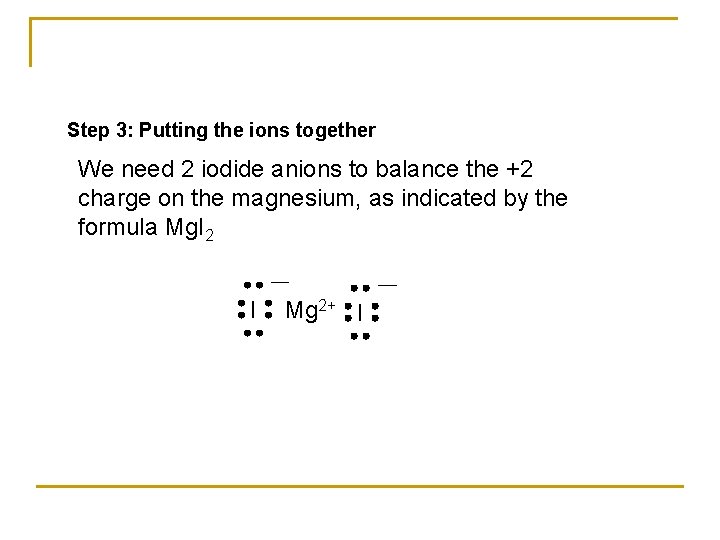
Step 3: Putting the ions together We need 2 iodide anions to balance the +2 charge on the magnesium, as indicated by the formula Mg. I 2 I Mg 2+ I
Covalent Compounds n Covalent compounds between oxygen and hydrogen Step 1: Determine how many bonds are formed by oxygen Step 2: Determine how many hydrogen atoms are in the chemical formula (hydrogen forms a single bond) Step 3: Draw the structure
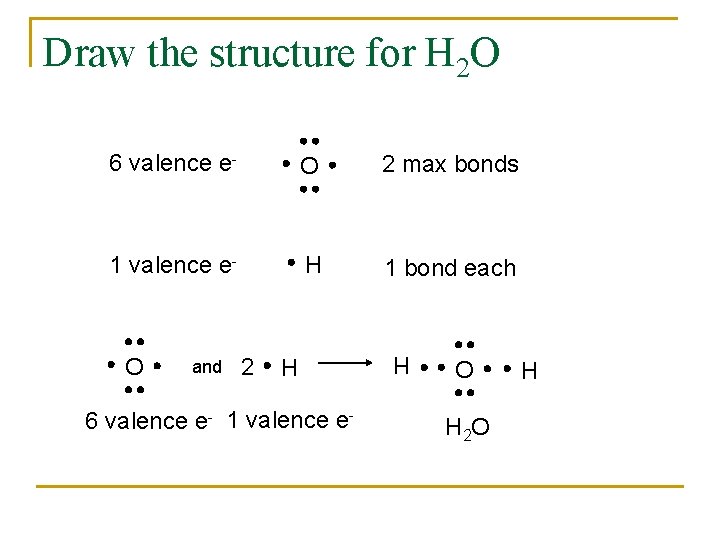
Draw the structure for H 2 O 6 valence e- O 2 max bonds 1 valence e- H 1 bond each and 2 H 6 valence e- 1 valence e- H O O H 2 O H
Covalent Compounds n Covalent compounds between carbon and hydrogen Step 1: Determine how many bonds are formed by carbon Step 2: Determine how many hydrogen atoms are in the chemical formula (hydrogen forms a single bond) Step 3: Draw the structure
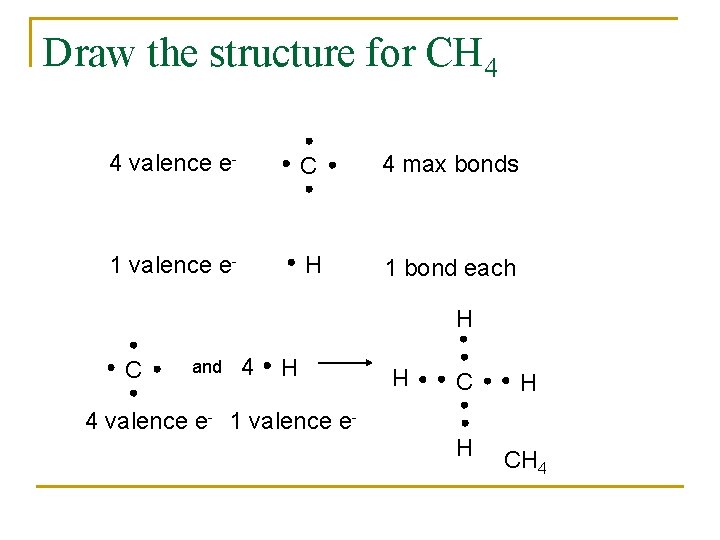
Draw the structure for CH 4 4 valence e- C 4 max bonds 1 valence e- H 1 bond each H and 4 H H C C H 4 valence e- 1 valence e. H CH 4
Chapter Outline Equal Sharing versus Unequal Sharing d. q q q When two different kinds of atoms are bonded, the electrons are usually shared unequally. When a bond exists between two identical kinds of atoms, the electrons are shared equally. An atom with greater electronegativity has a greater ability to attract shared electrons.
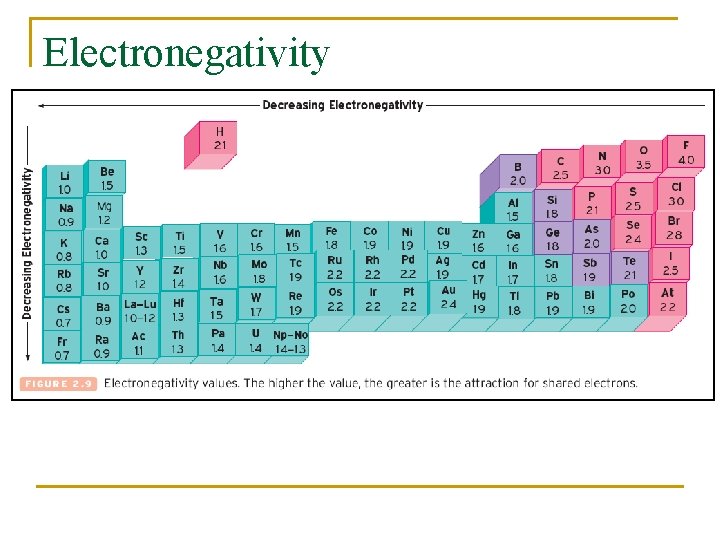
Electronegativity
Chapter Outline Equal Sharing versus Unequal Sharing (cont) d. q The greater the difference in electronegativity between two atoms that are covalently bonded, the more polar is the bond.
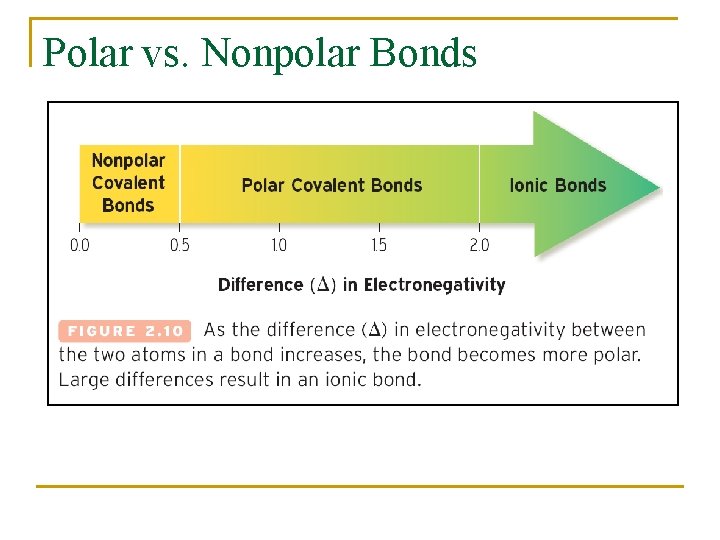
Polar vs. Nonpolar Bonds
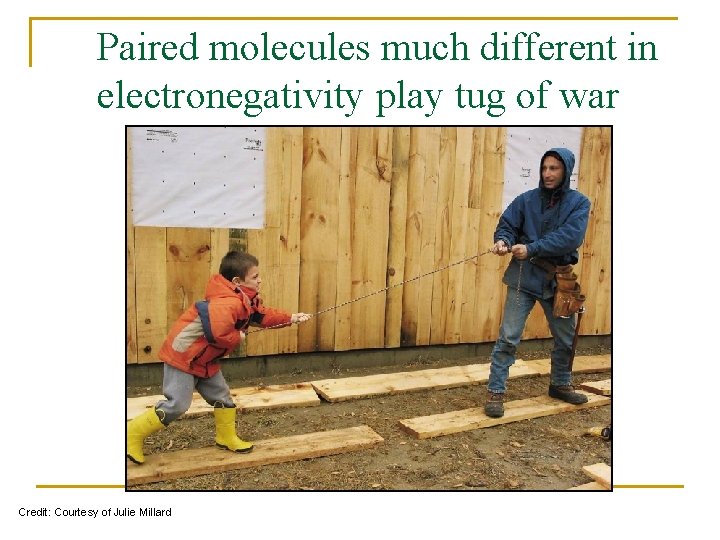
Paired molecules much different in electronegativity play tug of war Credit: Courtesy of Julie Millard
Chapter Outline States of Matter j. Review of Types of Bonds q 1. 2. 3. Chemical bonds (intramolecular forces) hold atoms together. The three types of chemical bonds are ionic, polar covalent, and nonpolar covalent. Intermolecular forces hold molecules together.
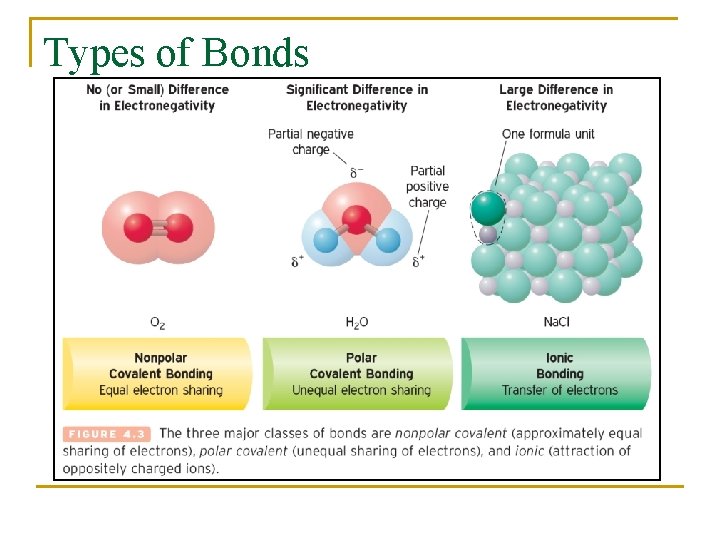
Types of Bonds
Chapter Outline States of Matter (cont) j. Particle Cohesion Determines Physical State q 1. In general, the relative strengths of intermolecular forces follows the trend: gases < liquids < solids Changes of State q n n Adding energy breaks intermolecular forces and causes molecules to change their state. The stronger the intermolecular forces of a compound, the higher are the melting and boiling points.
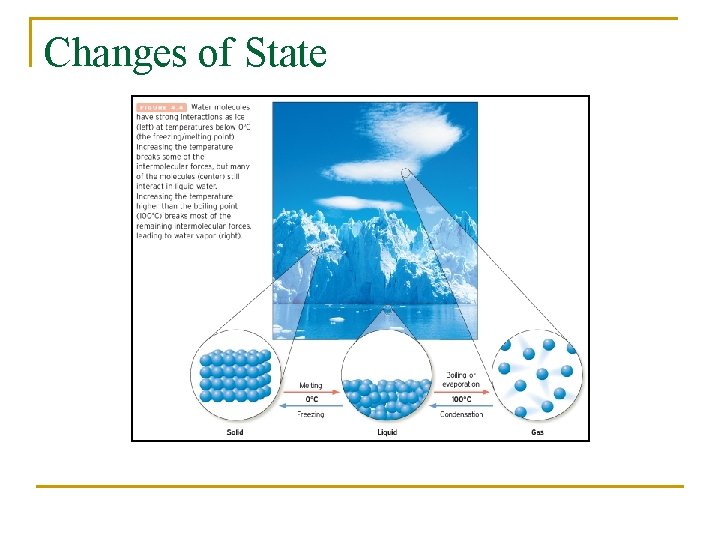
Changes of State
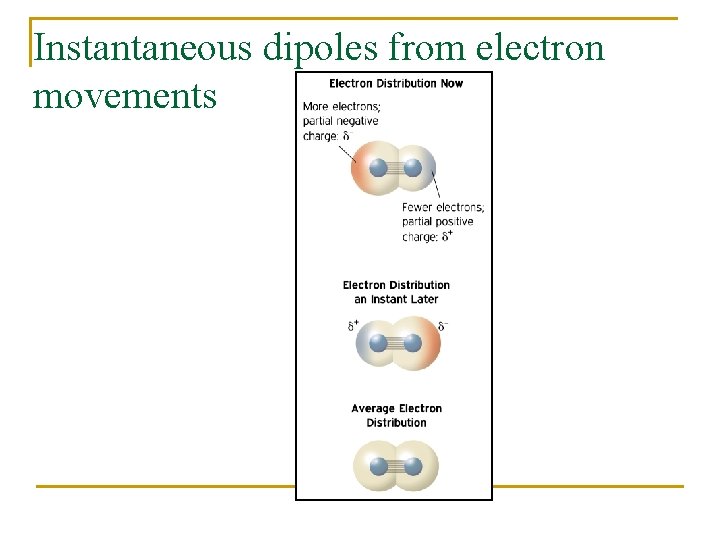
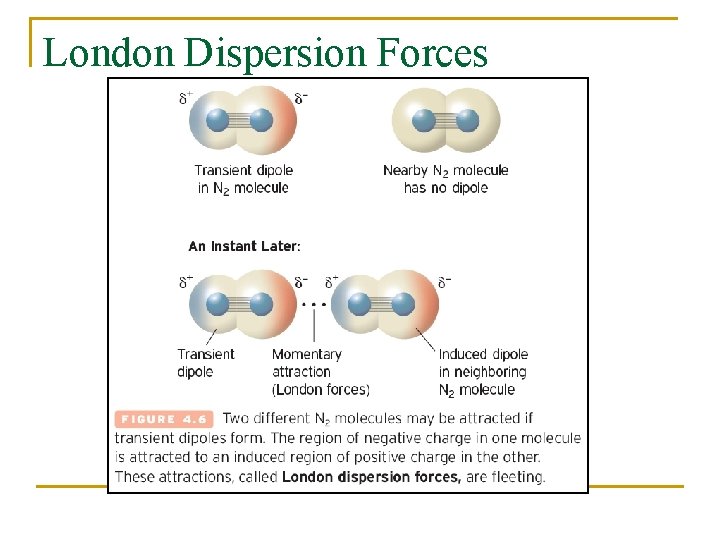
Chapter Outline Types of Intermolecular Forces within Pure Substances k. London dispersion forces q n n n A temporary dipole in one molecule can induce a dipole in a neighboring molecule. The negative end of one temporary dipole can attract the positive end of an induced dipole; these attractions are called London dispersion forces. London forces tend to be fairly weak.
Instantaneous dipoles from electron movements
London Dispersion Forces
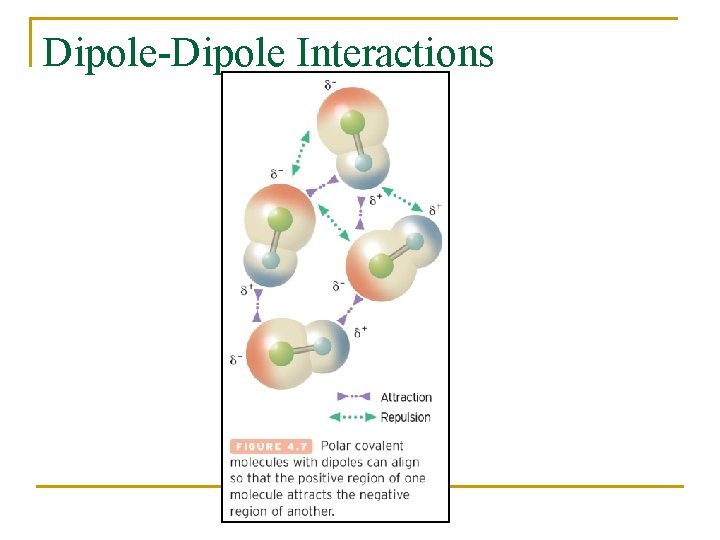
Chapter Outline n Types of Intermolecular Forces within Pure Substances (cont) q Dipole-dipole interactions n n Dipole-dipole interactions exist between molecules with polar covalent bonds. Dipole-dipole interactions are typically stronger than London dispersion forces.
Dipole-Dipole Interactions
Chapter Outline n Types of Intermolecular Forces within Pure Substances (cont) q Hydrogen Bonds n n n Hydrogen bonds are a special type of dipole-dipole interaction. Hydrogen bonds can occur when H is bonded to one of the highly electronegative atoms N, O, or F. An example is H 2 O. Hydrogen bonds are typically quite strong.
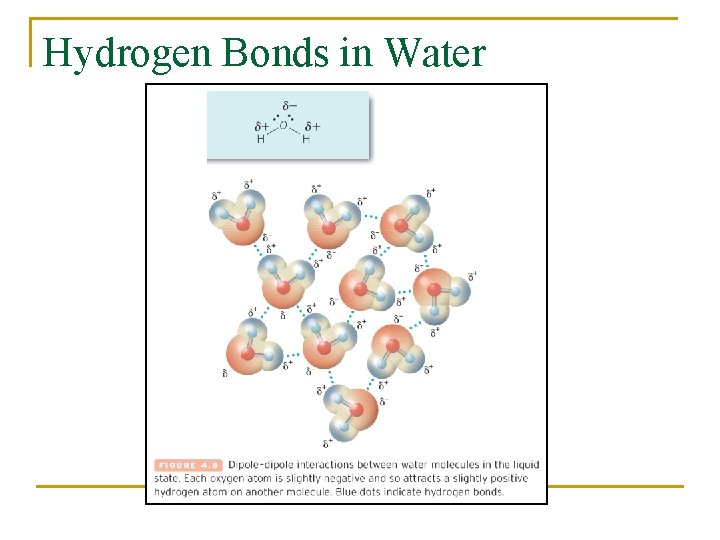
Hydrogen Bonds in Water
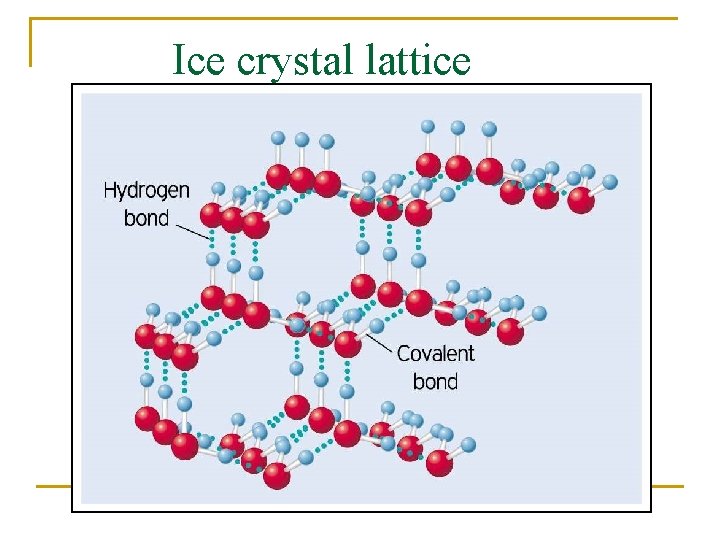
Ice crystal lattice
Run the following web animations/movies. 5. 6: Electric Current Conduction by Molten Salts 5. 8 a: Atomic Motion and Thermal Energy 5. 9: Atomic Properties of Solids, Liquids, and Gases
Chapter Outline Forming Solutions i. Like dissolves like q n n n Ionic solutes often dissolve in polar solvents; e. g. , Na. Cl dissolves in H 2 O. Polar solutes generally dissolve in polar solvents; e. g. , NH 3 in H 2 O. Nonpolar solutes generally do not dissolve well in polar solvents; e. g. , oil in H 2 O. Run the following web animations/movies. 5. 10: Like Dissolves Like Solubility
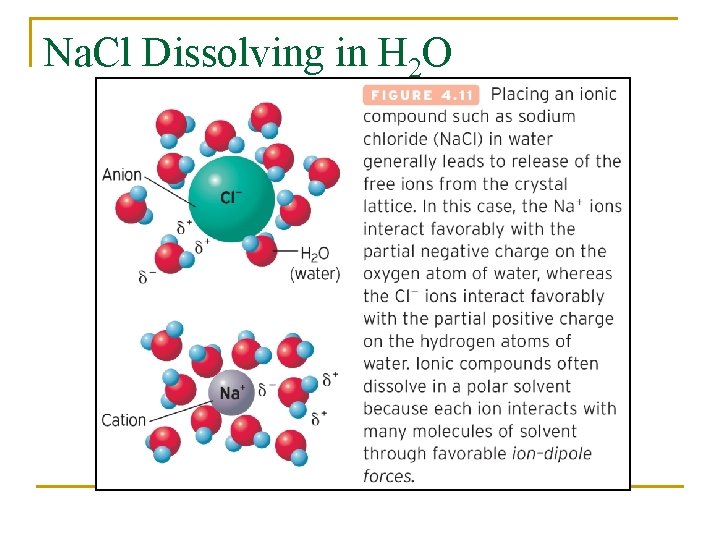
Na. Cl Dissolving in H 2 O
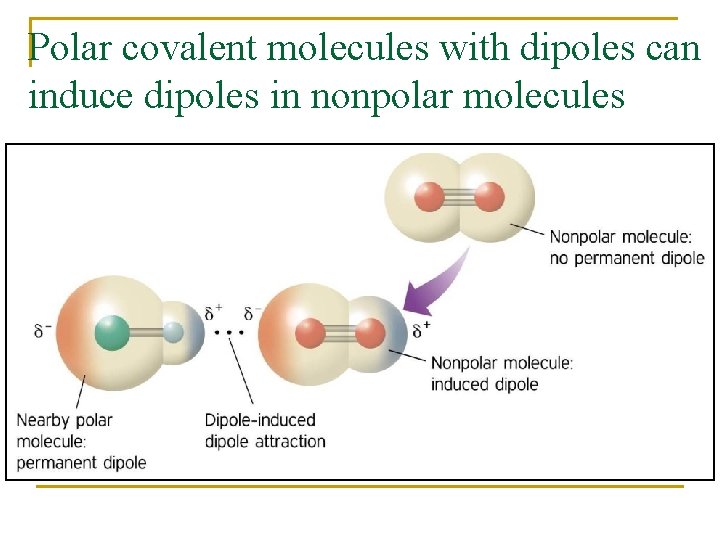
Polar covalent molecules with dipoles can induce dipoles in nonpolar molecules
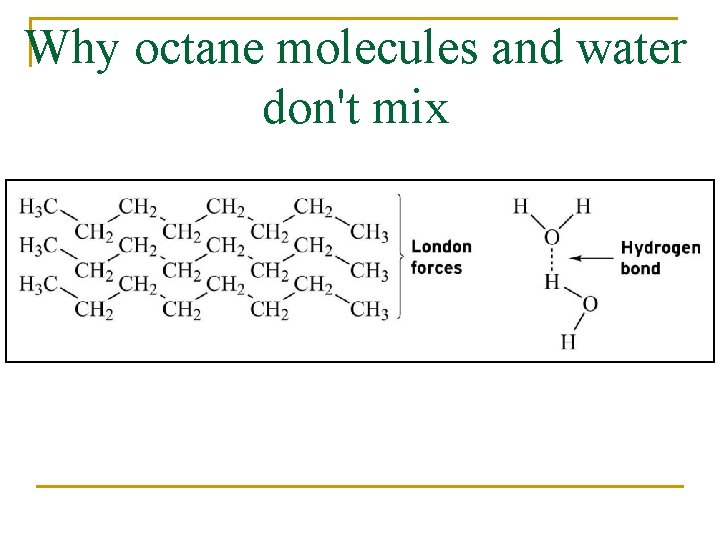
Why octane molecules and water don't mix
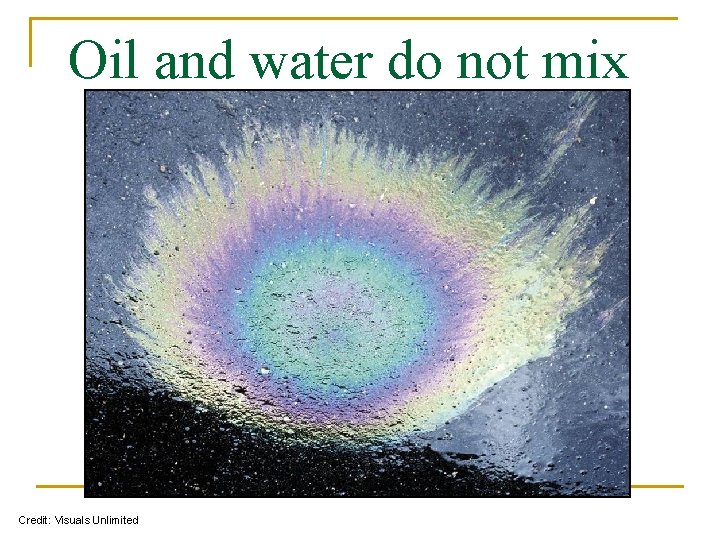
Oil and water do not mix Credit: Visuals Unlimited
Chapter Outline n Emulsions q q Emulsifying agents are molecules that contain a polar portion and a nonpolar region. Soap is an example of an emulsifying agent that can form a suspension of a nonpolar material in a polar solvent (an “emulsion”).
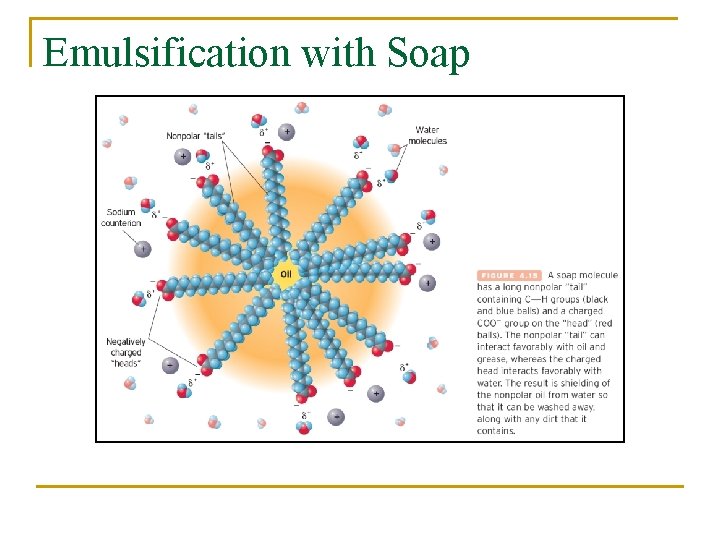
Emulsification with Soap
Chapter Outline Measuring Amounts in Solution l. Solubility q n The maximum amount of a solute that dissolves in a solvent Molarity q n n The amount of a solute dissolved in a solvent is its concentration. Concentration is often measured in moles/liter, also called molarity (M). Parts per million (ppm) q n The concentration of a dilute solution may be measured in parts per million (grams of solute per million grams solution).
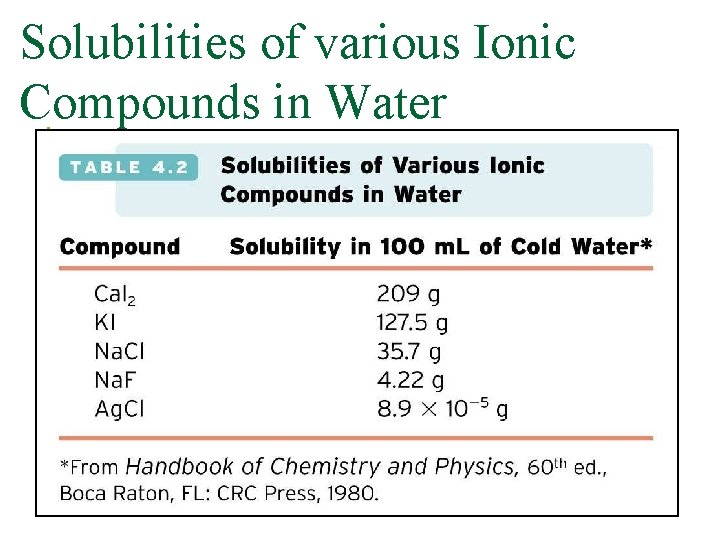
Solubilities of various Ionic Compounds in Water
Key Words n n n Chemical bonds Noble gases Octet rule Ionic compound Ion Covalent compound Lewis dot structures Core electrons Cation Anion Electrostatic forces n n n Chemical formula Lone pair Single bond Double bond Triple bond Isomers Nonpolar covalent bond Polar covalent bond Electronegativity Dipole Structure
Key Words n n n n Intermolecular forces London dispersion forces Dipole-dipole interactions Hydrogen bonds Solution Solute Solvent Aqueous solution n n n n Colloid Suspension Amphiphilic/ amphipathic Emulsion Solubility Concentration Molarity (M) Parts per million (ppm)
- Slides: 92