
Chapter 5 Carriermodulation for Passband Transmission Computer Networks
Chapter 5 Carrier-modulation for Passband Transmission Computer Networks 1
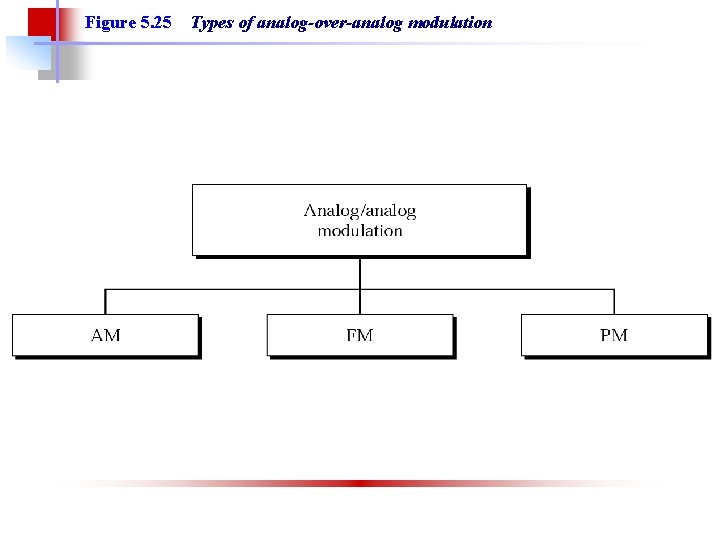
Figure 5. 25 Types of analog-over-analog modulation
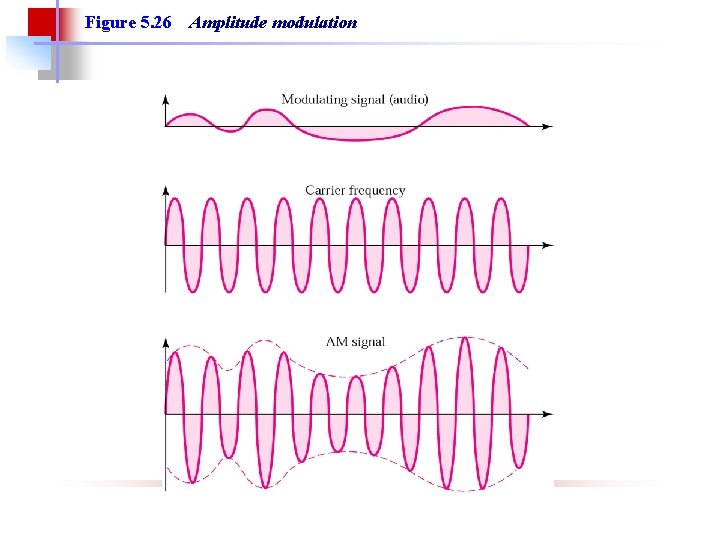
Figure 5. 26 Amplitude modulation
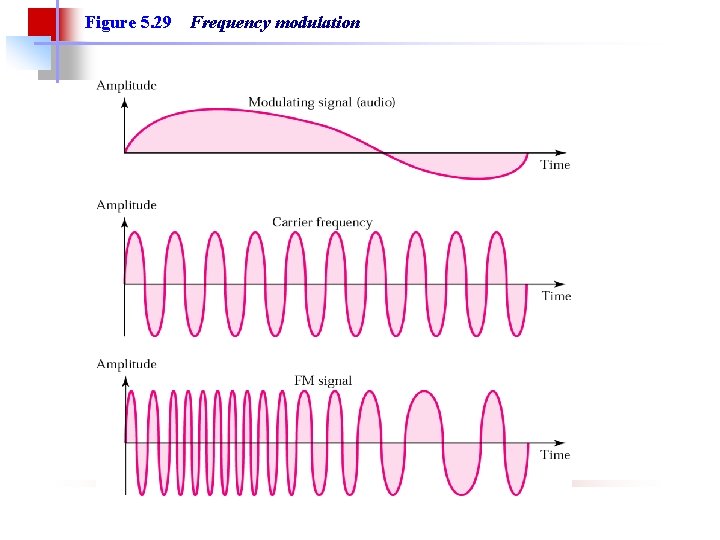
Figure 5. 29 Frequency modulation
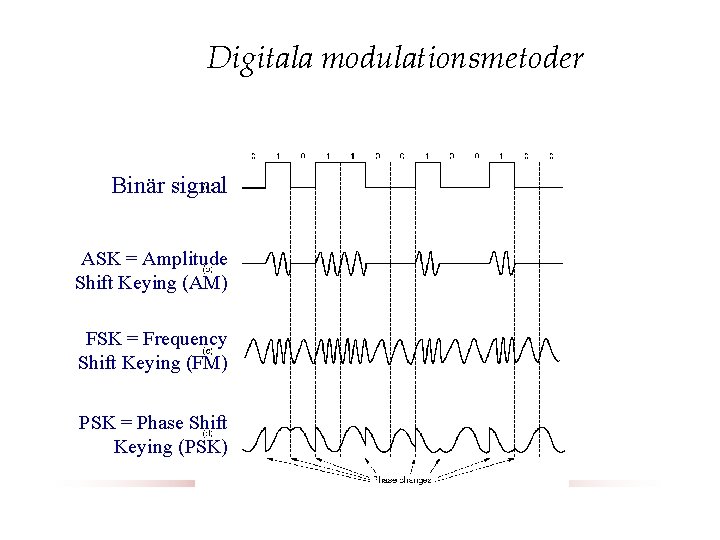
Digitala modulationsmetoder Binär signal ASK = Amplitude Shift Keying (AM) FSK = Frequency Shift Keying (FM) PSK = Phase Shift Keying (PSK)
Modulation och demodulation § Baudrate = antal symboler per sekund. Enhet: baud eller symboler/sekund. § Bitrate = datahastighet. Enhet: bps eller bit/s. § Vid många modulationsformer t. ex. s. k. ASK, PSK, och QAM är signalens bandbredd = symbolhastigheten. § Vid FSK är bandbredden vanligen större.
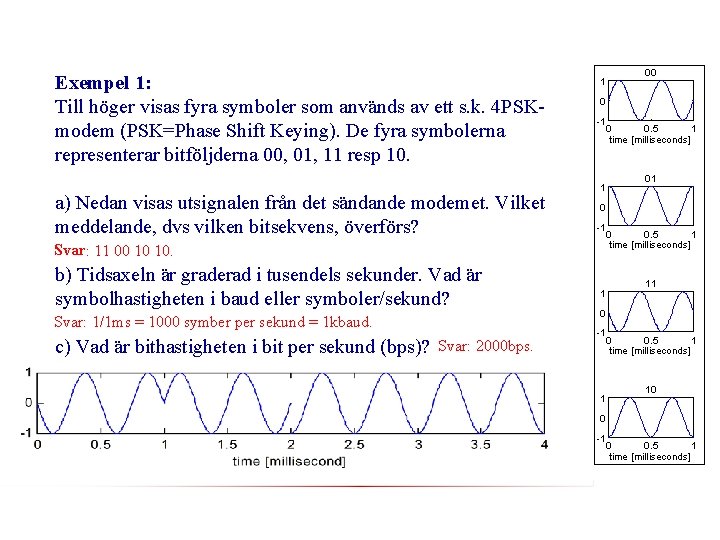
Exempel 1: Till höger visas fyra symboler som används av ett s. k. 4 PSKmodem (PSK=Phase Shift Keying). De fyra symbolerna representerar bitföljderna 00, 01, 11 resp 10. a) Nedan visas utsignalen från det sändande modemet. Vilket meddelande, dvs vilken bitsekvens, överförs? 1 0 -1 1 Svar: 1/1 ms = 1000 symber per sekund = 1 kbaud. c) Vad är bithastigheten i bit per sekund (bps)? Svar: 2000 bps. 0 0. 5 1 time [milliseconds] 01 0 -1 Svar: 11 00 10 10. b) Tidsaxeln är graderad i tusendels sekunder. Vad är symbolhastigheten i baud eller symboler/sekund? 00 1 0 0. 5 1 time [milliseconds] 11 0 -1 1 0 0. 5 1 time [milliseconds] 10 0 -1 0 0. 5 1 time [milliseconds]
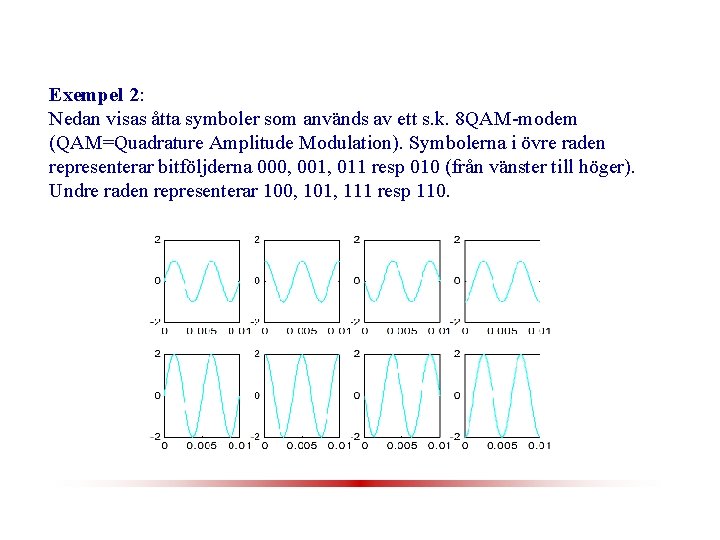
Exempel 2: Nedan visas åtta symboler som används av ett s. k. 8 QAM-modem (QAM=Quadrature Amplitude Modulation). Symbolerna i övre raden representerar bitföljderna 000, 001, 011 resp 010 (från vänster till höger). Undre raden representerar 100, 101, 111 resp 110.
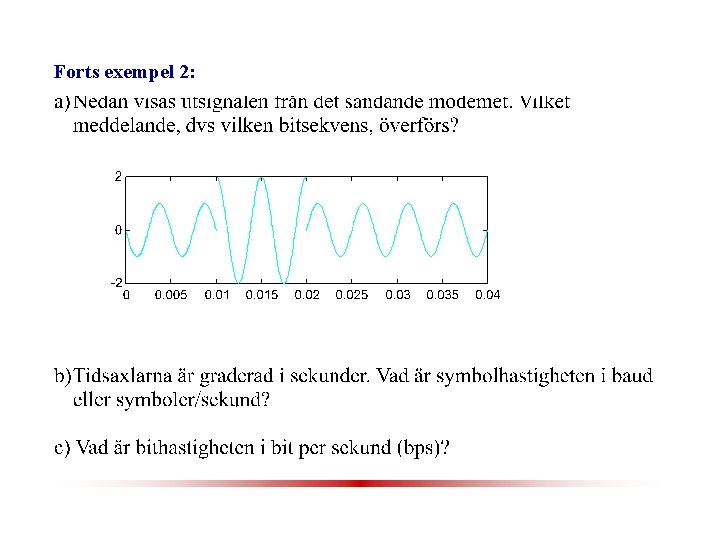
Forts exempel 2:
Example 1 An analog signal carries 4 bits in each signal unit. If 1000 signal units are sent per second, find the baud rate and the bit rate Solution Baud rate = 1000 bauds per second (baud/s) Bit rate = 1000 x 4 = 4000 bps
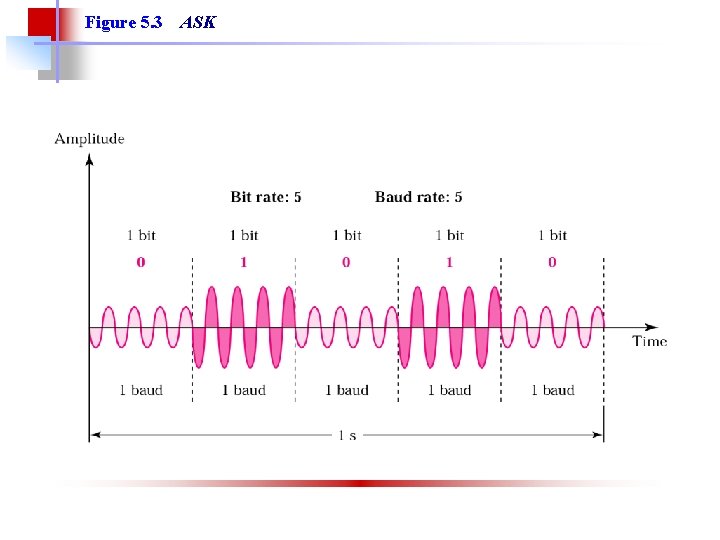
Figure 5. 3 ASK
Example 4 Given a bandwidth of 5000 Hz for an ASK signal, what are the baud rate and bit rate? Solution In ASK the baud rate is the same as the bandwidth, which means the baud rate is 5000. But because the baud rate and the bit rate are also the same for ASK, the bit rate is 5000 bps.
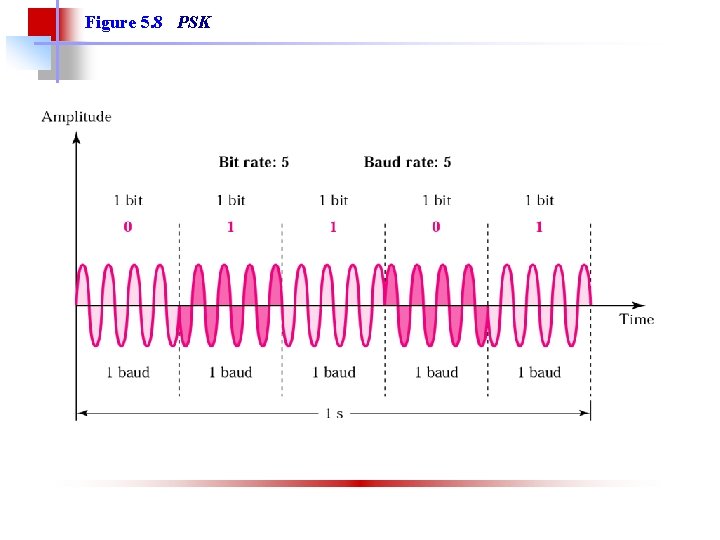
Figure 5. 8 PSK
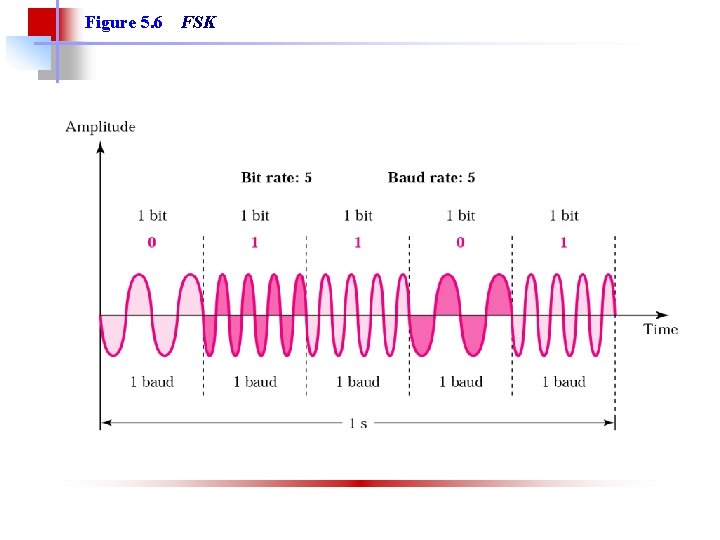
Figure 5. 6 FSK

Figure 5. 9 PSK constellation
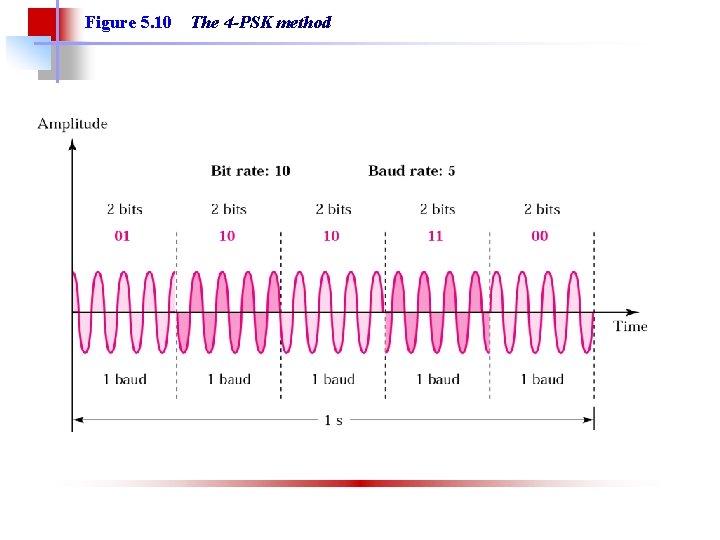
Figure 5. 10 The 4 -PSK method

Figure 5. 11 The 4 -PSK characteristics
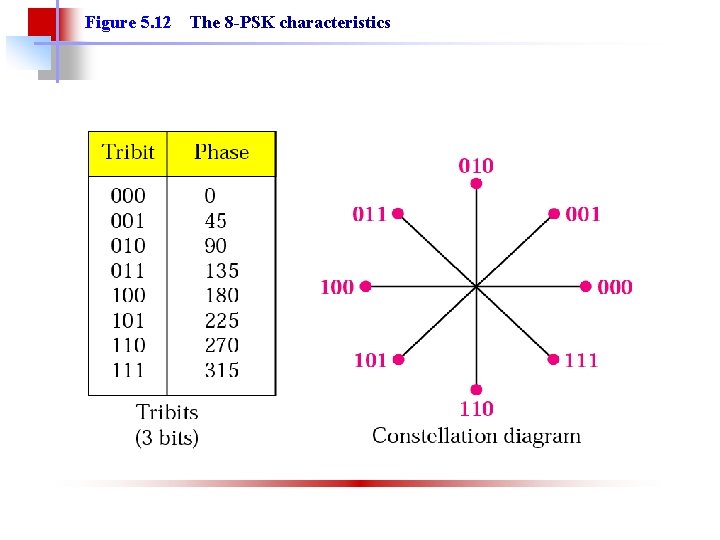
Figure 5. 12 The 8 -PSK characteristics
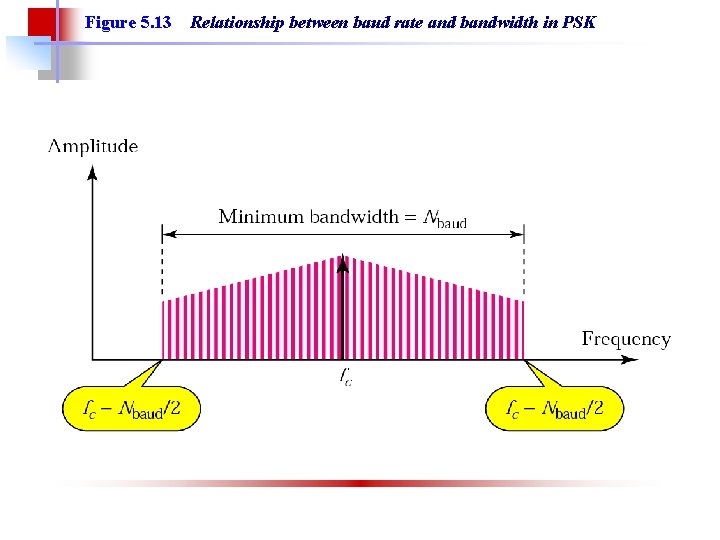
Figure 5. 13 Relationship between baud rate and bandwidth in PSK
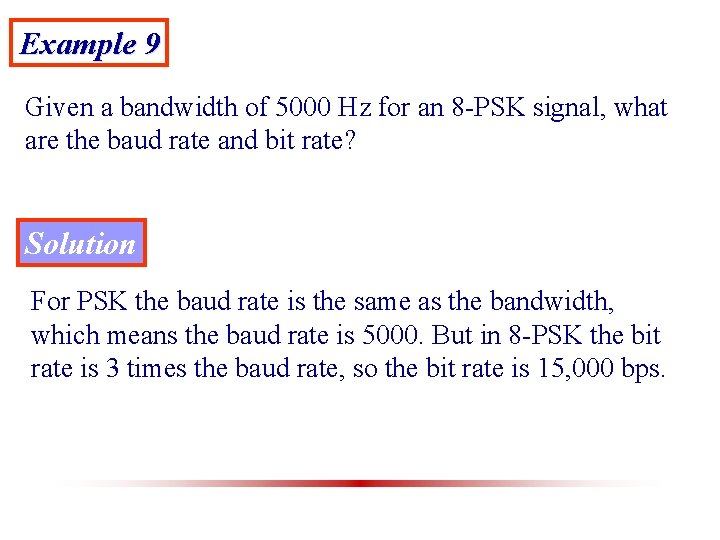
Example 9 Given a bandwidth of 5000 Hz for an 8 -PSK signal, what are the baud rate and bit rate? Solution For PSK the baud rate is the same as the bandwidth, which means the baud rate is 5000. But in 8 -PSK the bit rate is 3 times the baud rate, so the bit rate is 15, 000 bps.
Note: Quadrature amplitude modulation is a combination of ASK and PSK so that a maximum contrast between each signal unit (bit, dibit, tribit, and so on) is achieved.
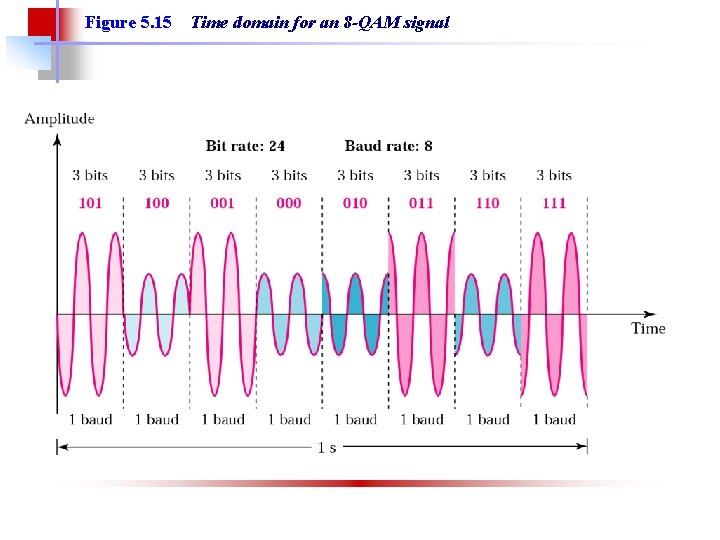
Figure 5. 15 Time domain for an 8 -QAM signal
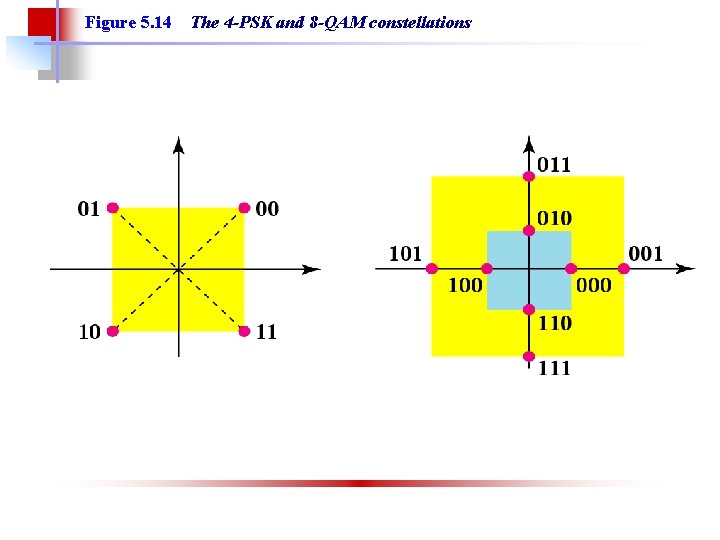
Figure 5. 14 The 4 -PSK and 8 -QAM constellations
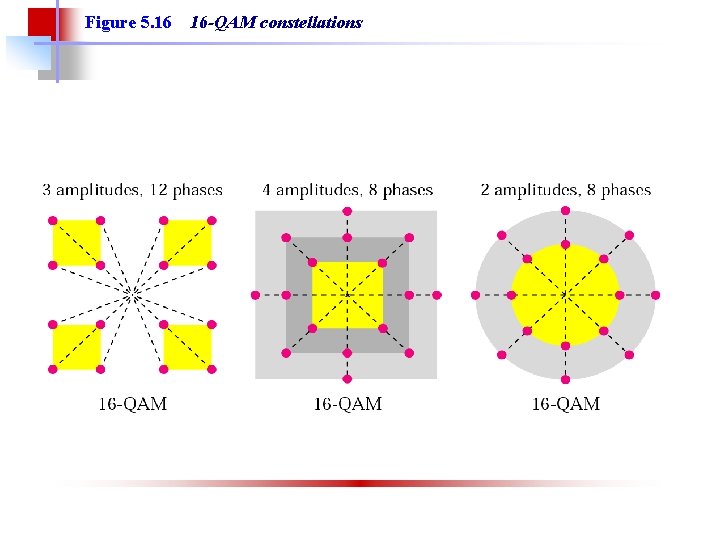
Figure 5. 16 16 -QAM constellations
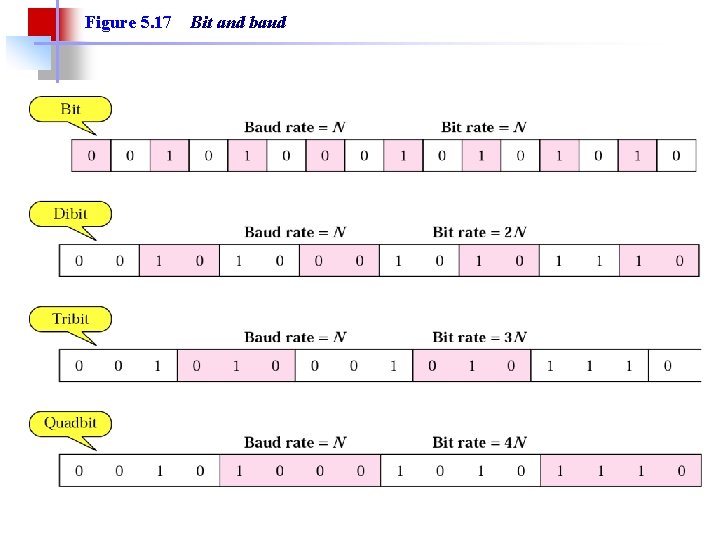
Figure 5. 17 Bit and baud
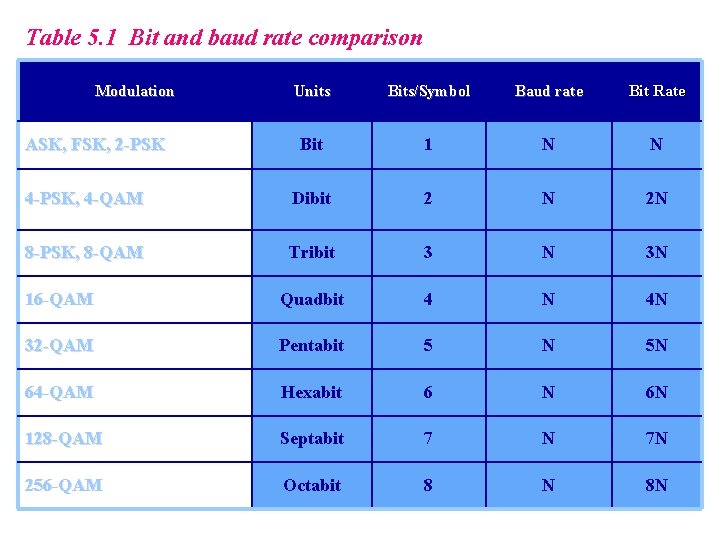
Table 5. 1 Bit and baud rate comparison Modulation Units Bits/Symbol Baud rate Bit Rate Bit 1 N N 4 -PSK, 4 -QAM Dibit 2 N 2 N 8 -PSK, 8 -QAM Tribit 3 N 3 N 16 -QAM Quadbit 4 N 4 N 32 -QAM Pentabit 5 N 5 N 64 -QAM Hexabit 6 N 6 N 128 -QAM Septabit 7 N 7 N 256 -QAM Octabit 8 N 8 N ASK, FSK, 2 -PSK
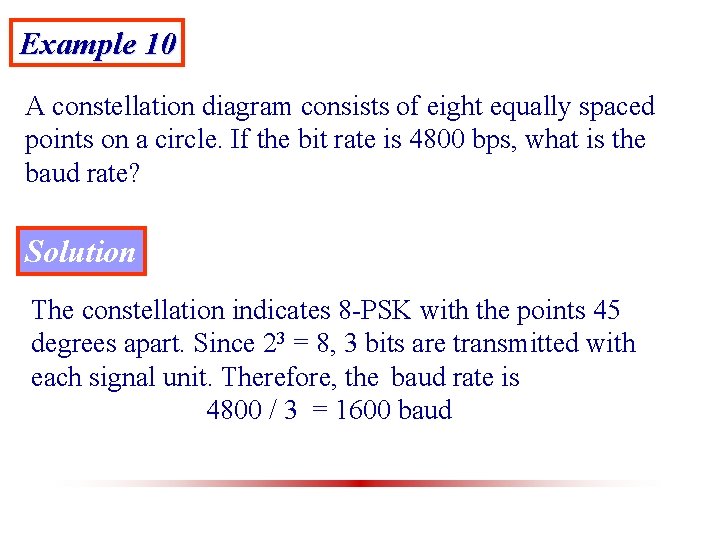
Example 10 A constellation diagram consists of eight equally spaced points on a circle. If the bit rate is 4800 bps, what is the baud rate? Solution The constellation indicates 8 -PSK with the points 45 degrees apart. Since 23 = 8, 3 bits are transmitted with each signal unit. Therefore, the baud rate is 4800 / 3 = 1600 baud
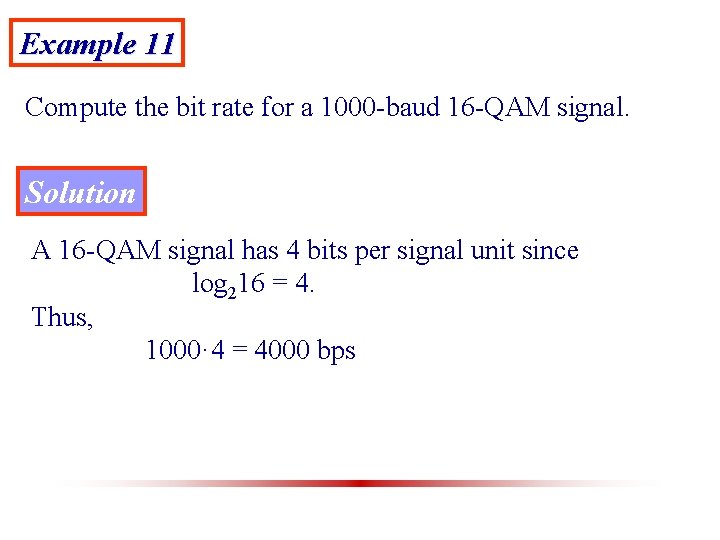
Example 11 Compute the bit rate for a 1000 -baud 16 -QAM signal. Solution A 16 -QAM signal has 4 bits per signal unit since log 216 = 4. Thus, 1000· 4 = 4000 bps
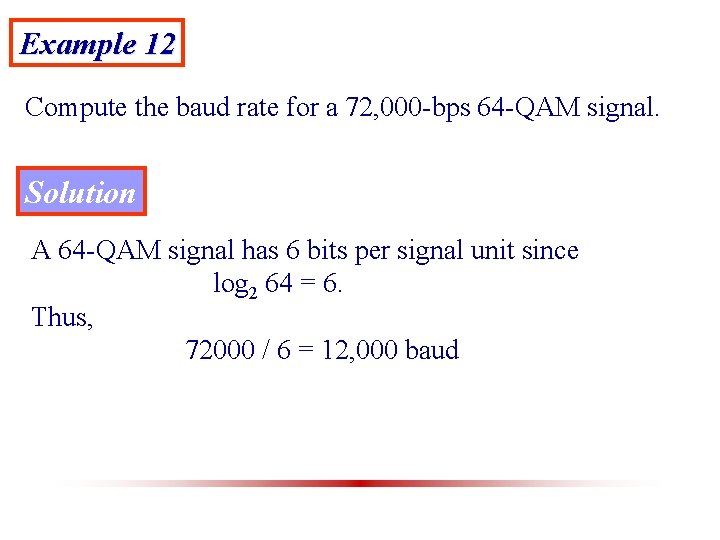
Example 12 Compute the baud rate for a 72, 000 -bps 64 -QAM signal. Solution A 64 -QAM signal has 6 bits per signal unit since log 2 64 = 6. Thus, 72000 / 6 = 12, 000 baud
5. 2 Telephone Modems Modem Standards
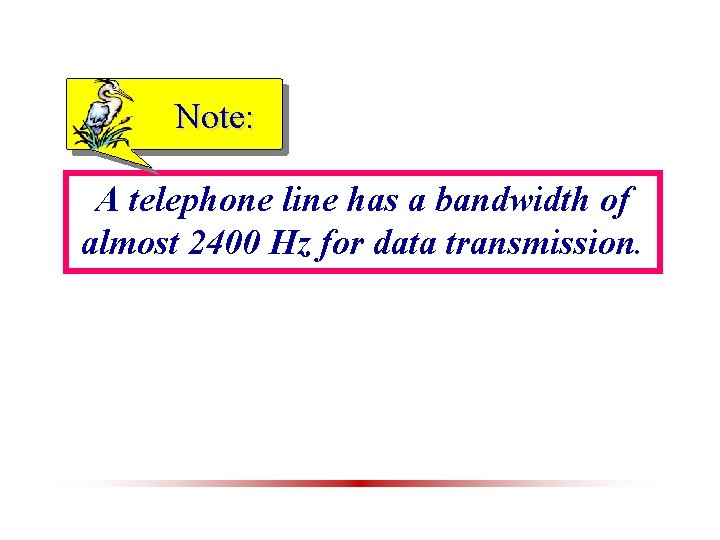
Note: A telephone line has a bandwidth of almost 2400 Hz for data transmission.
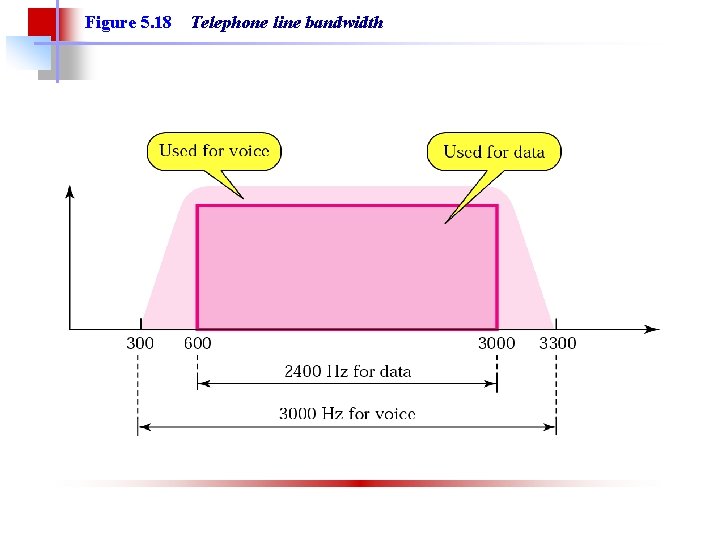
Figure 5. 18 Telephone line bandwidth
Note: Modem stands for modulator/demodulator.
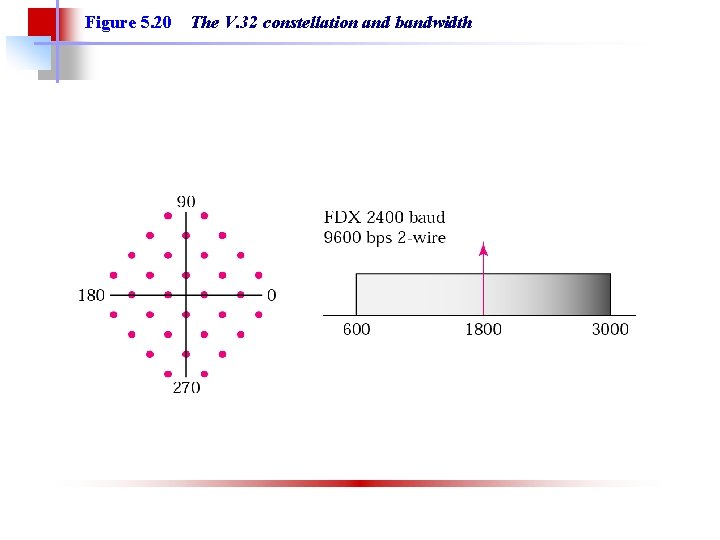
Figure 5. 20 The V. 32 constellation and bandwidth
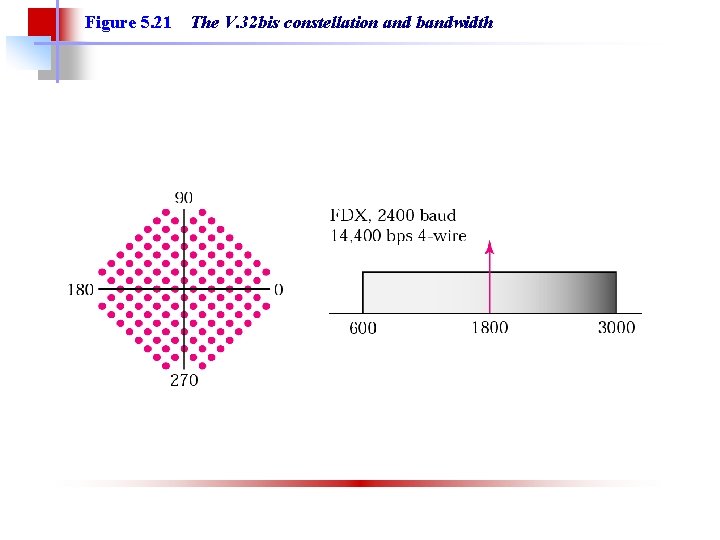
Figure 5. 21 The V. 32 bis constellation and bandwidth
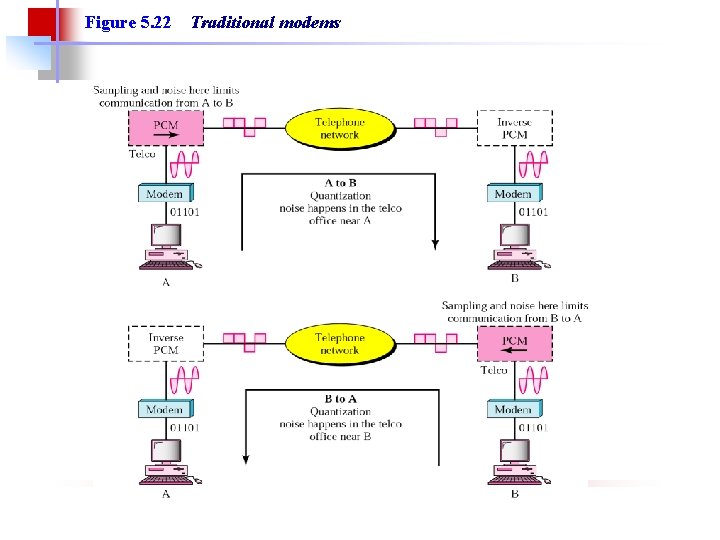
Figure 5. 22 Traditional modems
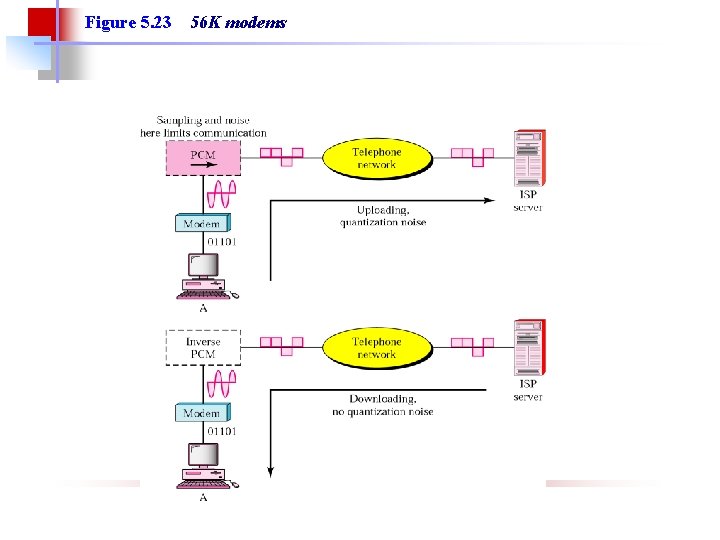
Figure 5. 23 56 K modems
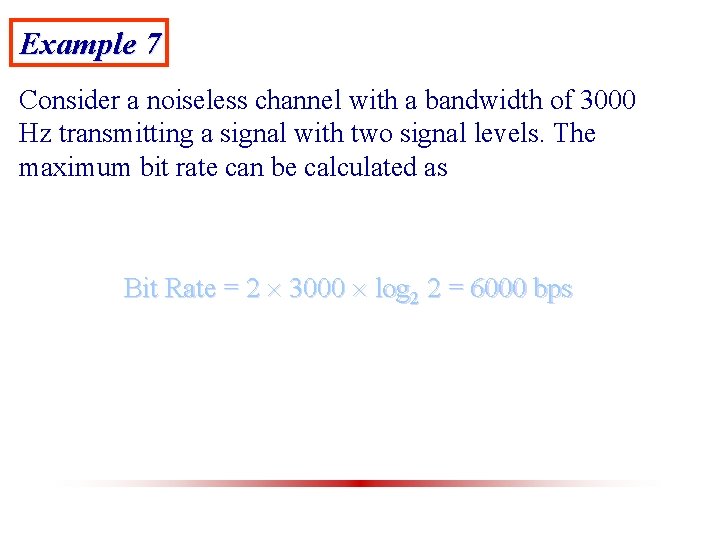
Example 7 Consider a noiseless channel with a bandwidth of 3000 Hz transmitting a signal with two signal levels. The maximum bit rate can be calculated as Bit Rate = 2 3000 log 2 2 = 6000 bps
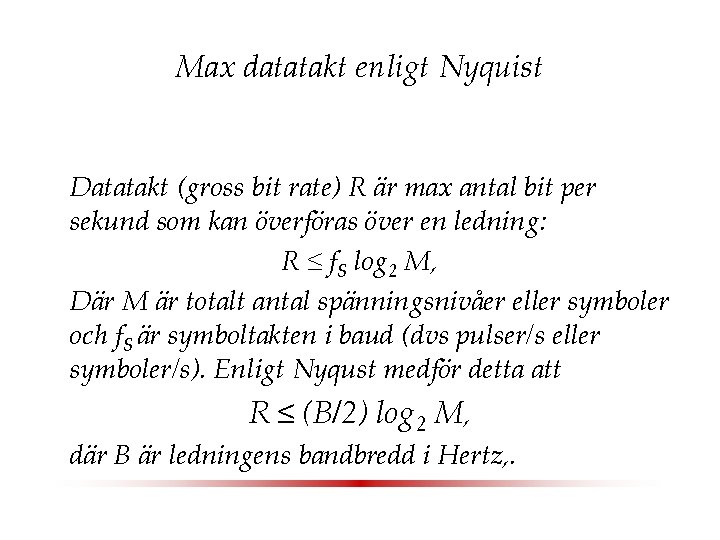
Max datatakt enligt Nyquist Datatakt (gross bit rate) R är max antal bit per sekund som kan överföras över en ledning: R ≤ f. S log 2 M, Där M är totalt antal spänningsnivåer eller symboler och f. S är symboltakten i baud (dvs pulser/s eller symboler/s). Enligt Nyqust medför detta att R ≤ (B/2) log 2 M, där B är ledningens bandbredd i Hertz, .
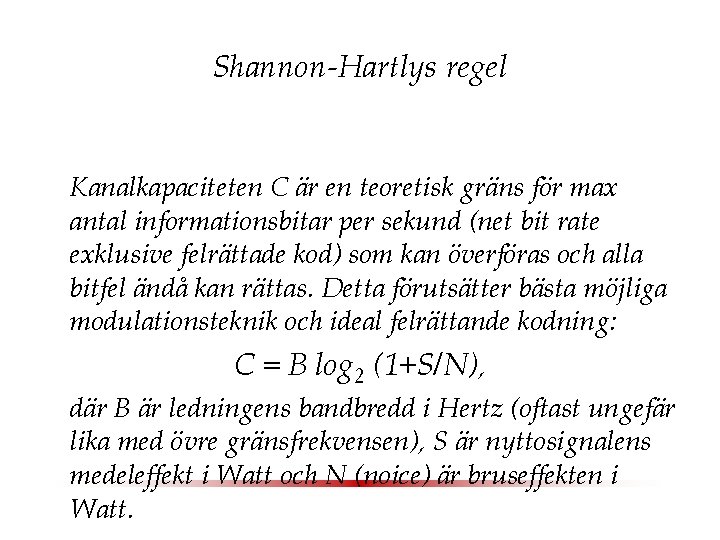
Shannon-Hartlys regel Kanalkapaciteten C är en teoretisk gräns för max antal informationsbitar per sekund (net bit rate exklusive felrättade kod) som kan överföras och alla bitfel ändå kan rättas. Detta förutsätter bästa möjliga modulationsteknik och ideal felrättande kodning: C = B log 2 (1+S/N), där B är ledningens bandbredd i Hertz (oftast ungefär lika med övre gränsfrekvensen), S är nyttosignalens medeleffekt i Watt och N (noice) är bruseffekten i Watt.
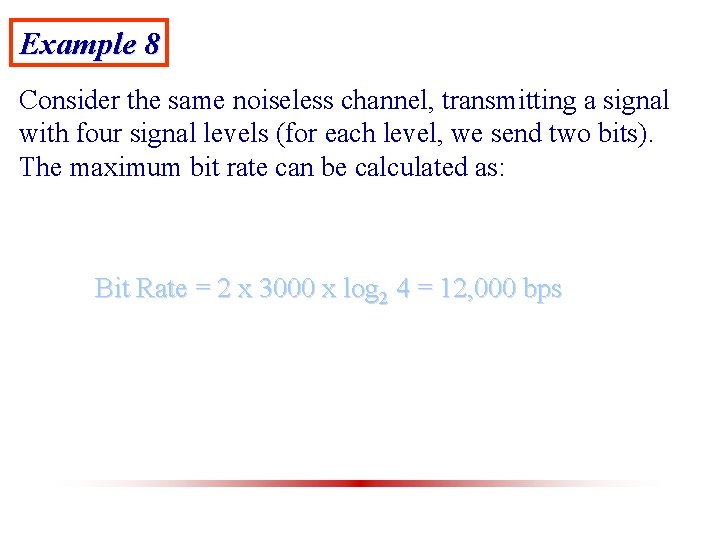
Example 8 Consider the same noiseless channel, transmitting a signal with four signal levels (for each level, we send two bits). The maximum bit rate can be calculated as: Bit Rate = 2 x 3000 x log 2 4 = 12, 000 bps
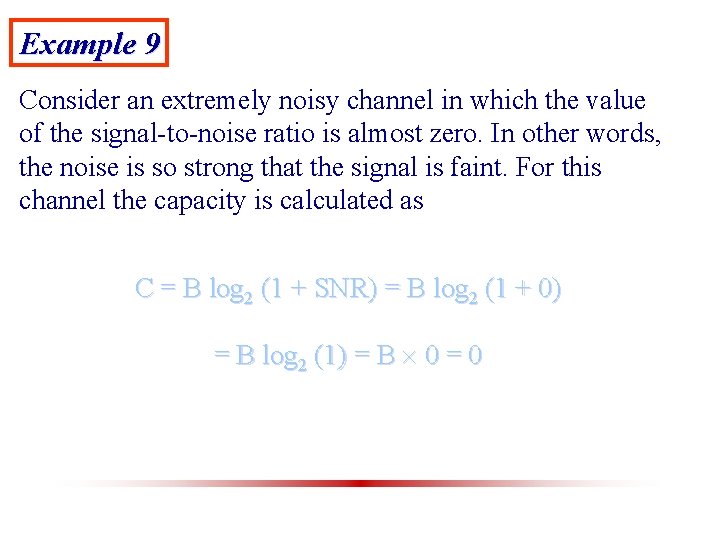
Example 9 Consider an extremely noisy channel in which the value of the signal-to-noise ratio is almost zero. In other words, the noise is so strong that the signal is faint. For this channel the capacity is calculated as C = B log 2 (1 + SNR) = B log 2 (1 + 0) = B log 2 (1) = B 0 = 0
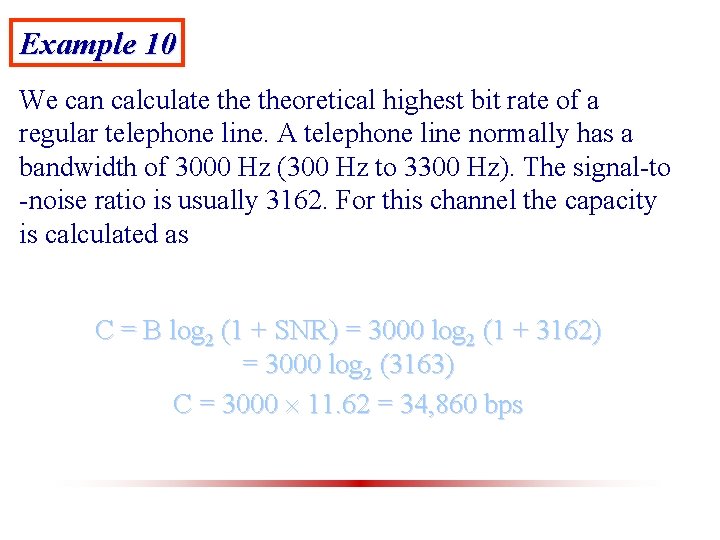
Example 10 We can calculate theoretical highest bit rate of a regular telephone line. A telephone line normally has a bandwidth of 3000 Hz (300 Hz to 3300 Hz). The signal-to -noise ratio is usually 3162. For this channel the capacity is calculated as C = B log 2 (1 + SNR) = 3000 log 2 (1 + 3162) = 3000 log 2 (3163) C = 3000 11. 62 = 34, 860 bps
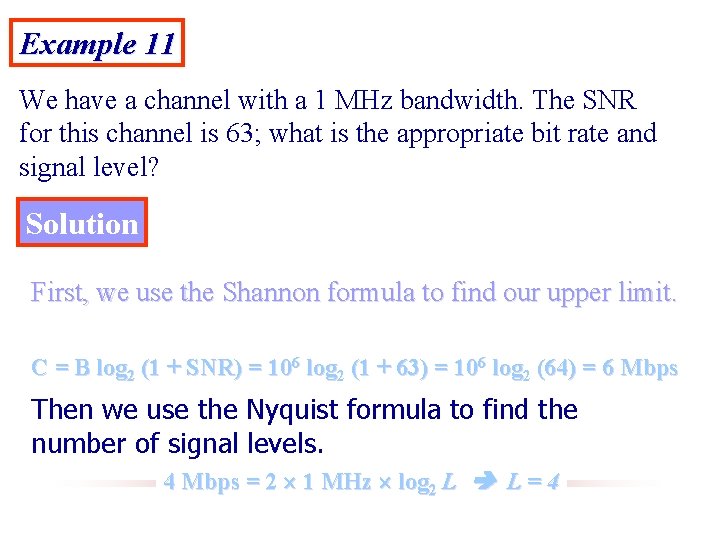
Example 11 We have a channel with a 1 MHz bandwidth. The SNR for this channel is 63; what is the appropriate bit rate and signal level? Solution First, we use the Shannon formula to find our upper limit. C = B log 2 (1 + SNR) = 106 log 2 (1 + 63) = 106 log 2 (64) = 6 Mbps Then we use the Nyquist formula to find the number of signal levels. 4 Mbps = 2 1 MHz log 2 L L = 4
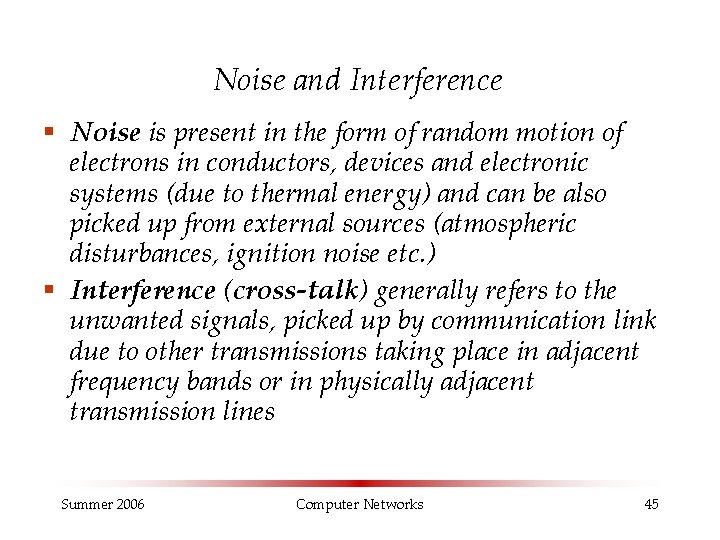
Noise and Interference § Noise is present in the form of random motion of electrons in conductors, devices and electronic systems (due to thermal energy) and can be also picked up from external sources (atmospheric disturbances, ignition noise etc. ) § Interference (cross-talk) generally refers to the unwanted signals, picked up by communication link due to other transmissions taking place in adjacent frequency bands or in physically adjacent transmission lines Summer 2006 Computer Networks 45
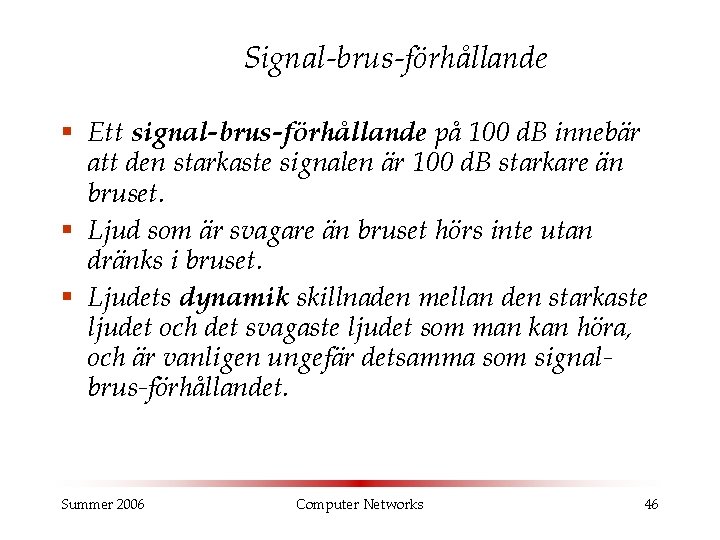
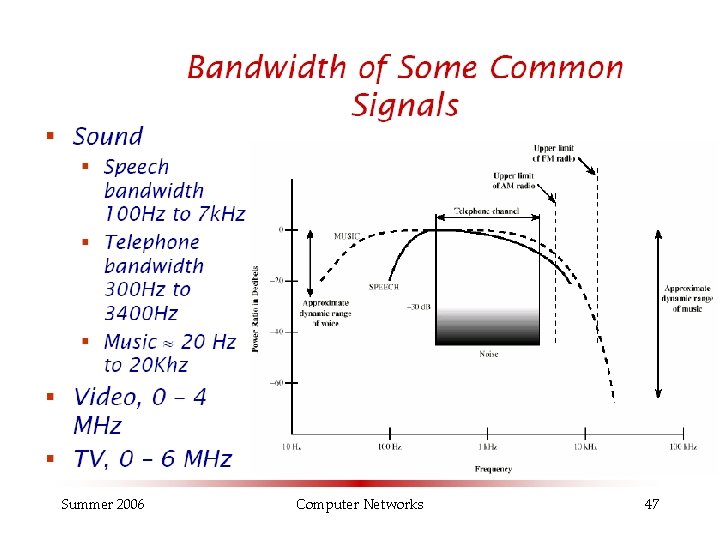
Signal-brus-förhållande § Ett signal-brus-förhållande på 100 d. B innebär att den starkaste signalen är 100 d. B starkare än bruset. § Ljud som är svagare än bruset hörs inte utan dränks i bruset. § Ljudets dynamik skillnaden mellan den starkaste ljudet och det svagaste ljudet som man kan höra, och är vanligen ungefär detsamma som signalbrus-förhållandet. Summer 2006 Computer Networks 46
Summer 2006 Computer Networks 47
Delay (Time, Latency) § When data are sent from one node to next node (without intermediate points), two types of delays are experienced: § transmission time (Paketsändningstid) § propagation delay (Utbredningsfördröjning) § When data pass through intermediate nodes four types of delay (latency) are experienced: § § transmission time propagation delay queue time processing time Summer 2006 Computer Networks 48
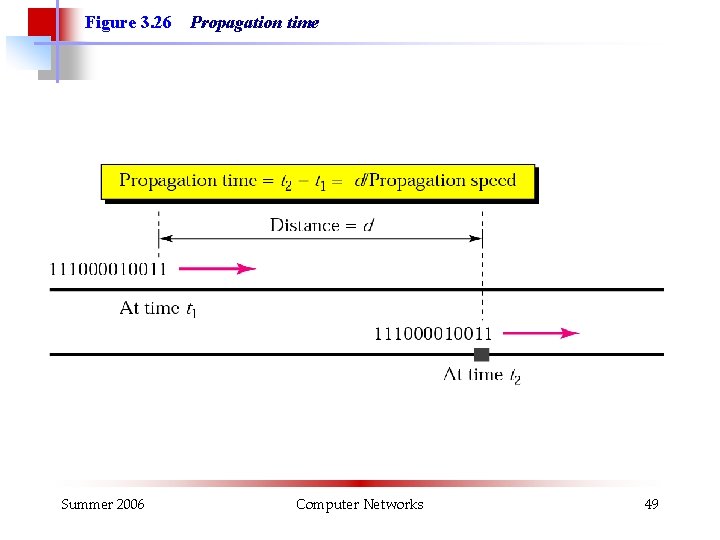
Figure 3. 26 Summer 2006 Propagation time Computer Networks 49
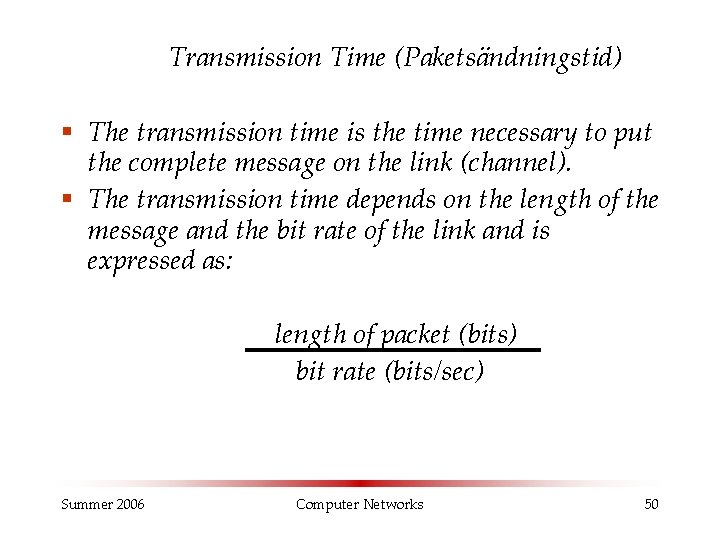
Transmission Time (Paketsändningstid) § The transmission time is the time necessary to put the complete message on the link (channel). § The transmission time depends on the length of the message and the bit rate of the link and is expressed as: length of packet (bits) bit rate (bits/sec) Summer 2006 Computer Networks 50
Propagation Delay (Time) § The propagation delay is the time needed for the signal to propagate (travel) from one end of a channel to the other. § The transmition time depends on the distance between the two ends and the speed of the signal and is expressed as distance (m) / speed of propagation (m/s) § Through free space signals propagate at the speed of light which is 3 * 108 m/s § Through wires signals propagate at the speed of 2 * 108 m/s Summer 2006 Computer Networks 51
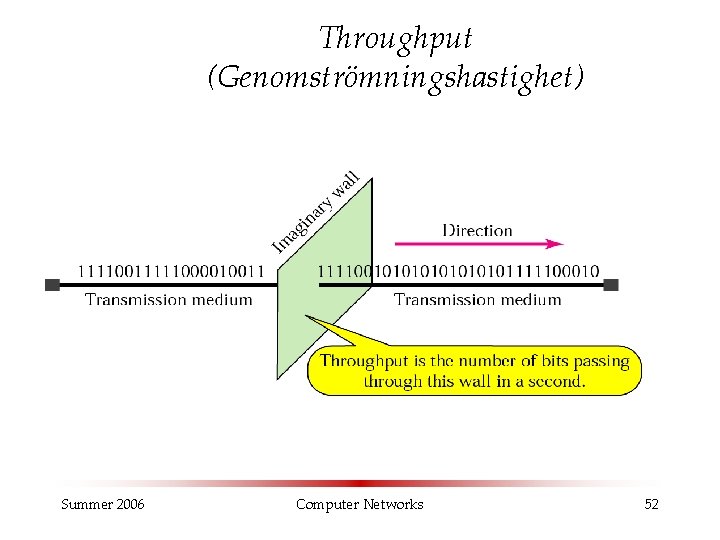
Throughput (Genomströmningshastighet) Summer 2006 Computer Networks 52
- Slides: 52