
Chapter 5 Capacity and Bottlenecks z Outline y
Chapter 5. Capacity and Bottlenecks z. Outline y. Bottlenecks, near bottlenecks, and non bottlenecks x. Identifying Bottlenecks y. Working with bottlenecks x. Theory of constraints basics y. Modeling a simplified process: Queuing Theory x. Tradeoffs of queuing theory MAN 3504 - Chapter 5 x. Characteristics of a queuing system 1
Bottlenecks, Near Bottlenecks, Non Bottlenecks z. Bottleneck: a resource which has a demand requirement greater than capacity. Planned utilization > 100% y. Given process variability, even if utilization is less than 100%, a resource/activity can become a process bottleneck. z Near bottleneck: a resource with a planned utilization of close to 100%, but where there are other resources with a higher utilization. MAN 3504 - Chapter 5 2
Working with Bottlenecks z. Recognizing bottlenecks is important in order to minimize their effect. z. Critical message is: time lost in the bottleneck is lost production time and thus lost output (profits? ). Time lost on a near bottleneck or on a non bottleneck has (in most cases) no effect on the output. z. Operations improvement should then focus on MAN 3504 - Chapter 5 ythe improvement of capacity on the 3
Working with bottlenecks: Theory of Constraints z. Basic Steps 1. Identify the system constraints. (No improvement is possible unless the constraint or weakest link is found. ) 2. Decide how to exploit the system constraint. (Make the constraints as effective as possible. ) 3. Subordinate everything else to that decision. (Align every other part of the system to support the constraints even if this reduces 4 MAN 3504 - Chapter 5
Working with bottlenecks: Theory of Constraints z. Basic Steps 4. Elevate the system constraints. (If output is still inadequate, acquire more of this resource so it no longer becomes a constraint. ) 5. If, in the previous steps, the constraints have been broken, go back to step 1, but do not let the inertia become the system constraint. (After this constraint problem is solved, go back to the beginning and start over. ) MAN 3504 - Chapter 5 5
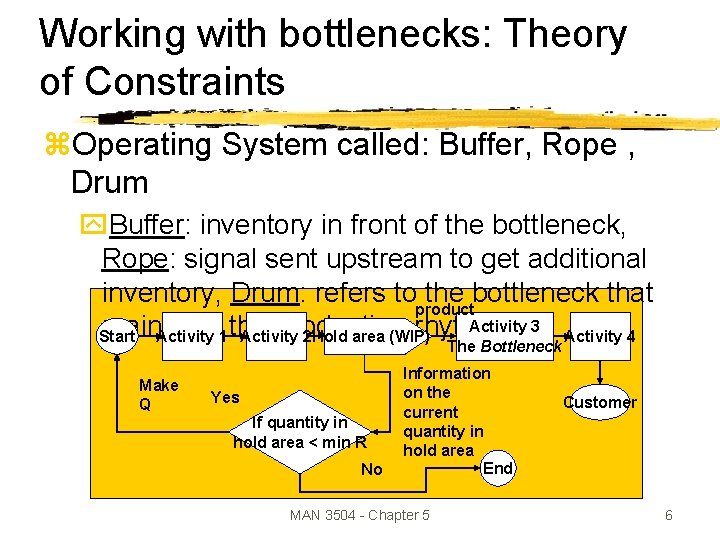
Working with bottlenecks: Theory of Constraints z. Operating System called: Buffer, Rope , Drum y. Buffer: inventory in front of the bottleneck, Rope: signal sent upstream to get additional inventory, Drum: refers toproduct the bottleneck that Activity 3 maintains production rhythm Start Activity 1 the Activity 2 Hold area (WIP) Activity 4 The Bottleneck Make Q Yes If quantity in hold area < min R No Information on the current quantity in hold area End MAN 3504 - Chapter 5 Customer 6
Queuing Theory and its tradeoffs z. Body of knowledge that analyzes waiting lines z. QT answers question related to the size of the line (queue) time waiting in line, the tradeoffs costs MAN 3504 - Chapter 5 7
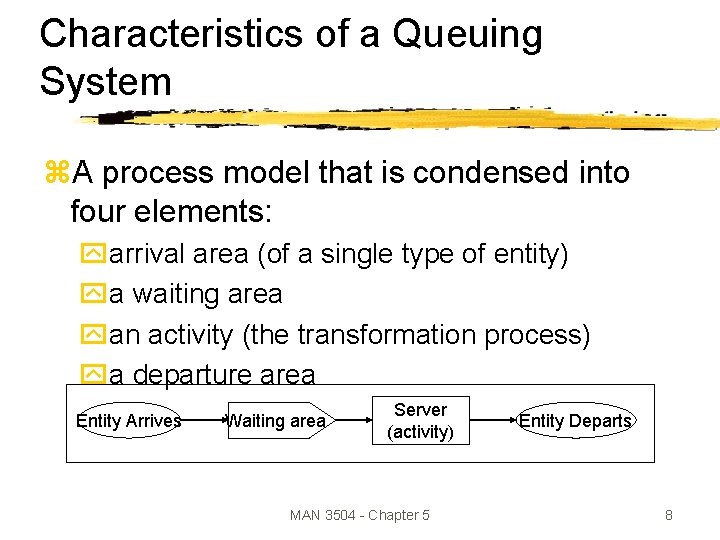
Characteristics of a Queuing System z. A process model that is condensed into four elements: yarrival area (of a single type of entity) ya waiting area yan activity (the transformation process) ya departure area Entity Arrives Waiting area Server (activity) MAN 3504 - Chapter 5 Entity Departs 8
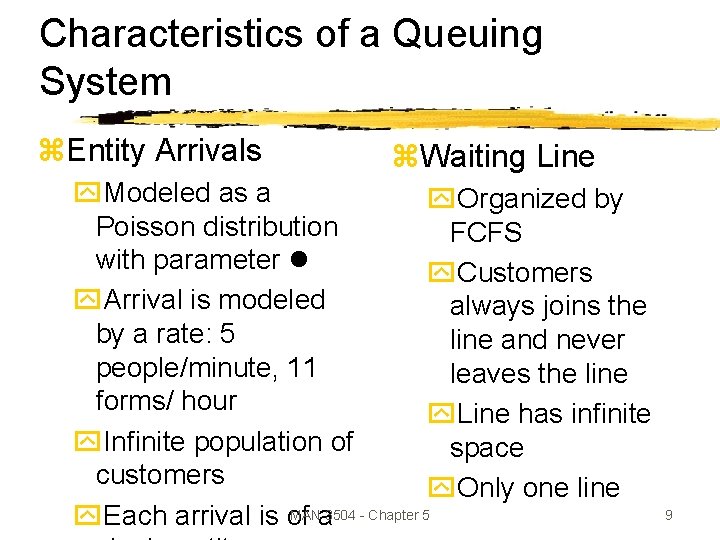
Characteristics of a Queuing System z. Entity Arrivals z. Waiting Line y. Modeled as a y. Organized by Poisson distribution FCFS with parameter y. Customers y. Arrival is modeled always joins the by a rate: 5 line and never people/minute, 11 leaves the line forms/ hour y. Line has infinite y. Infinite population of space customers y. Only one line MANa 3504 - Chapter 5 y. Each arrival is of 9
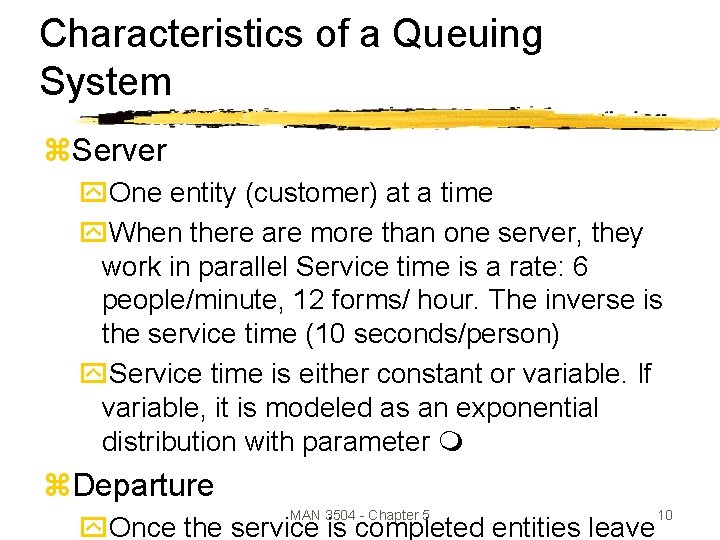
Characteristics of a Queuing System z. Server y. One entity (customer) at a time y. When there are more than one server, they work in parallel Service time is a rate: 6 people/minute, 12 forms/ hour. The inverse is the service time (10 seconds/person) y. Service time is either constant or variable. If variable, it is modeled as an exponential distribution with parameter z. Departure MAN 3504 - Chapter 5 y. Once the service is completed entities leave 10
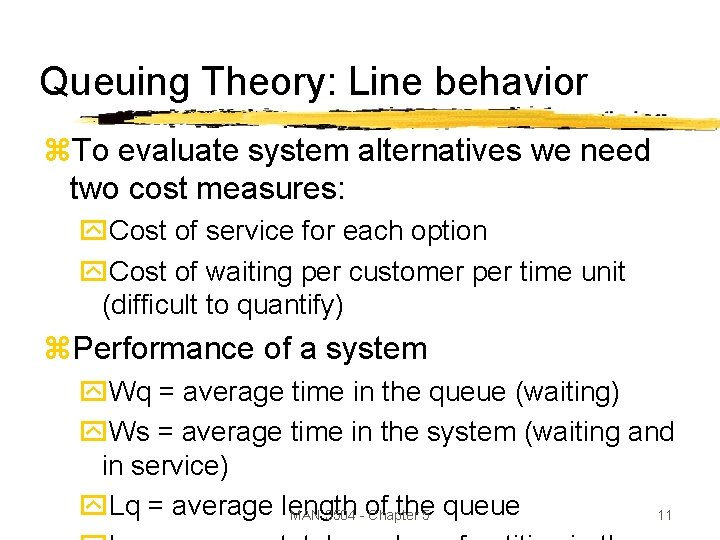
Queuing Theory: Line behavior z. To evaluate system alternatives we need two cost measures: y. Cost of service for each option y. Cost of waiting per customer per time unit (difficult to quantify) z. Performance of a system y. Wq = average time in the queue (waiting) y. Ws = average time in the system (waiting and in service) y. Lq = average length the 5 queue MAN 3504 - of Chapter 11
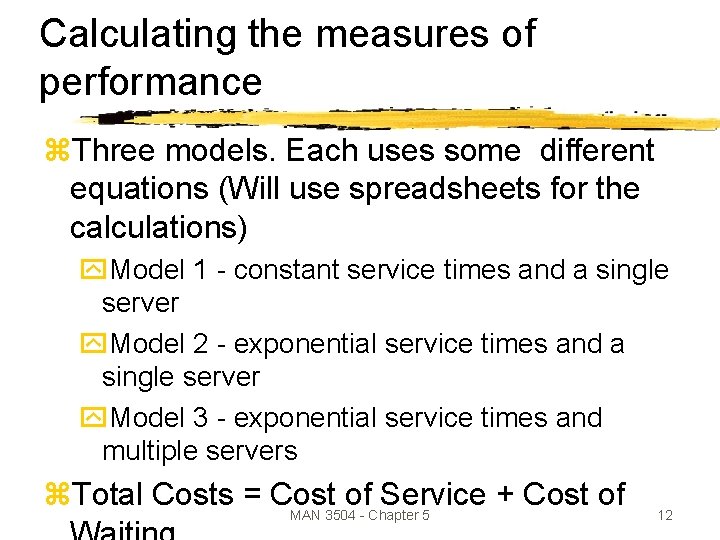
Calculating the measures of performance z. Three models. Each uses some different equations (Will use spreadsheets for the calculations) y. Model 1 - constant service times and a single server y. Model 2 - exponential service times and a single server y. Model 3 - exponential service times and multiple servers z. Total Costs = Cost of Service + Cost of MAN 3504 - Chapter 5 12
- Slides: 12