
CHAPTER 5 BUSINESS ORGANIZATION SECTION 5 1 BUSINESS
CHAPTER 5 BUSINESS ORGANIZATION
SECTION 5 -1 BUSINESS IN THE U. S. ECONOMY
5 -1 BUSINESS IN THE U. S. ECONOMY The Changing U. S. Job Market Employment Data • 2008: 138 million people held non-farm jobs • 2009: Recession resulted in 775, 000 jobs lost • 2011: Wave of retirement from baby boomers • 2020: Average of U. S. worker will be 50 • 2018: Asian, Hispanic, African-American workers will grow roughly 4% • 2018: 47% of all jobs will be held by women
5 -1 BUSINESS IN THE U. S. ECONOMY The Changing U. S. Job Market Pressures on Employees • Economic stress has led to downsizing • Companies streamlined production and implemented other cost-cutting procedures • Businesses required employees to take on new tasks and work extra hours • Full-time jobs were reduced to part-time • Wage rates decreased • Increased use of contingent workers – no explicit or implicit contract for long-term employment
5 -1 BUSINESS IN THE U. S. ECONOMY Business and the Economy Size of U. S. Businesses In 2009, all businesses worldwide produced more than $70 TRILLION of goods and services The U. S. is responsible for 20% of that production
5 -1 BUSINESS IN THE U. S. ECONOMY Business and the Economy Size of U. S. Businesses • 19. 5 million businesses have no employees other than the owner • 6. 5 million businesses employ fewer than 20 people • 182, 000 businesses employ 100 or more workers • 890 businesses employ more that 10, 000 workers
5 -1 BUSINESS IN THE U. S. ECONOMY Business and the Economy Role of Business • Make and distribute products and services needed by consumers, government and other businesses • Provide employment • Pay taxes (local, state, and federal)
5 -1 BUSINESS IN THE U. S. ECONOMY Business and the Economy Impact on a Community • Pays wages to workers • Buys goods and services from other businesses • Successful businesses contribute to more jobs, more income, and a thriving economy
5 -1 BUSINESS IN THE U. S. ECONOMY Business and the Economy Business Activities • Generating Ideas – A business begins with an idea for a product or service – Businesses must improve and develop new ideas to remain competitive – Research & Development teams discover new product, service and operating ideas • Raising Capital – Businesses need financial resources to operate – Capital is obtained through loans, investors and reinvested profits
5 -1 BUSINESS IN THE U. S. ECONOMY Business and the Economy Business Activities • Employing and Training Personal – Businesses need human resources – They pay wages, benefits, and employment taxes – Employees receive training in order to preform their jobs correctly • Buying Good & Services – Businesses use purchases for their own operations – Other purchases are resold
5 -1 BUSINESS IN THE U. S. ECONOMY Business and the Economy Business Activities • Marketing Goods & Services – Activities directed at providing the goods and services wanted by customers – They must satisfy customers who usually can choose to buy from competitors • Maintain Business Records – Owners use records to track performance and make decisions – Customers need information about orders and payments – Businesses are required by government to keep records and submit information
5 -1 BUSINESS IN THE U. S. ECONOMY Types of Businesses Producers • Create the products and services used by individuals and other businesses – Extractors – pump oil, mine coal, cut timber – Farmers – cultivate land use other natural resources to grow crops and raise livestock – Manufacturers - get supplies from other producers and convert them into products

5 -1 BUSINESS IN THE U. S. ECONOMY Types of Businesses Intermediaries • Businesses involved in selling the goods and services of producers to consumers and other businesses • The most common type of intermediaries are wholesalers and retailers
5 -1 BUSINESS IN THE U. S. ECONOMY Types of Businesses Service Businesses • Carries out activities that are consumed by its customers • They offer something intangible (no physical qualities) • Fastest growing part of the U. S. economy • More than 60% of all U. S. employment is in service-producing businesses
SECTION 5 -2 Forms of Business Ownership
5 -2 FORMS OF BUSINESS OWNERSHIP Business Ownership Proprietorship • A business owned and run by one person • It is the easiest form of business to start and end • 71. 53% of all business (2012, U. S. Census)
5 -2 FORMS OF BUSINESS OWNERSHIP Business Ownership Partnership • A business owned and controlled by two or more people who have entered into an agreement • Each partner is liable for all of the debts • 9. 55% of all business (2012, U. S. Census)
5 -2 FORMS OF BUSINESS OWNERSHIP Business Ownership Corporation • A separate legal entity • Owned by one or more shareholders and managed by a board of directors • 18. 93% of all business (2012, U. S. Census)
5 -2 FORMS OF BUSINESS OWNERSHIP Other Forms Ownership Specialized Partnerships and Corporations • Limited liability partnership – investors who cannot lose more than the amount of their investment, but they are not allowed to participate in the day-to-day management of the business. • Joint venture – A business organized by two or more other businesses for a limited time for a specific project. • S Corporation – all income is passed through to the owners based on their investment and is taxed on their individual tax return.
5 -2 FORMS OF BUSINESS OWNERSHIP Other Forms Ownership Specialized Partnerships and Corporations • Limited liability company – Provides liability protection for owners. It has a simpler set of organizing and operations requirements than a corporation.
5 -2 FORMS OF BUSINESS OWNERSHIP Other Forms Ownership Specialized Partnerships and Corporations • A Limited Liability Company (LLC) is a hybrid business entity having certain characteristics of both a corporation and a partnership or sole proprietorship (depending on how many owners there are). • An LLC, although a business entity, is a type of unincorporated association and is not a corporation. The primary characteristic an LLC shares with a corporation is limited liability, and the primary characteristic it shares with a partnership is the availability of pass-through income taxation. • It is often more flexible than a corporation, and it is wellsuited for companies with a single owner.
5 -2 FORMS OF BUSINESS OWNERSHIP Other Forms Ownership Specialized Partnerships and Corporations • Nonprofit corporation – a group of people who join to do some activity that benefits the community.
5 -2 FORMS OF BUSINESS OWNERSHIP Other Forms Ownership Cooperatives and Franchises • Cooperative – Owned by its members, serves their needs, and is managed in their interest. Members form a consumer cooperative so that they can purchase goods and services more cheaply as a group. • Franchise – a written contract granting permission to operate a business to sell products and services in a set way. – Franchiser – the company that owns the product or service and grants the rights to another business – Franchisee – The company purchasing the rights to run the business
SECTION 5 -3 Organizational Structure for Business
5 -3 ORGANIZATIONAL STRUCTURE FOR BUSINESS Designing an Effective Business Organization Setting Direction • Mission Statement – A short specific, written statement of the reason a business exists and what it wants to achieve. • Goal – A precise statement of results the business expects to achieve. • Policies – Guidelines used in making consistent decisions. • Procedures – Descriptions of the way work is to be done.
5 -3 ORGANIZATIONAL STRUCTURE FOR BUSINESS Designing an Effective Business Organization Principles of Effective Organization • Responsibility– The obligation to complete specific work • Authority – The right to make decisions about how responsibilities should be accomplished • Accountability – Taking responsibility for the results achieved
5 -3 ORGANIZATIONAL STRUCTURE FOR BUSINESS Designing an Effective Business Organization Principles of Effective Organization • Unity of Command– A clear reporting relationship for all staff of a business • Span of Control – The number of employees who are assigned to a particular work task and manager
5 -3 ORGANIZATIONAL STRUCTURE FOR BUSINESS Types of Organizational Structures • Organizational Chart – A diagram that shows the structure of an organization, classification of work and jobs, and the relationship among those classifications.
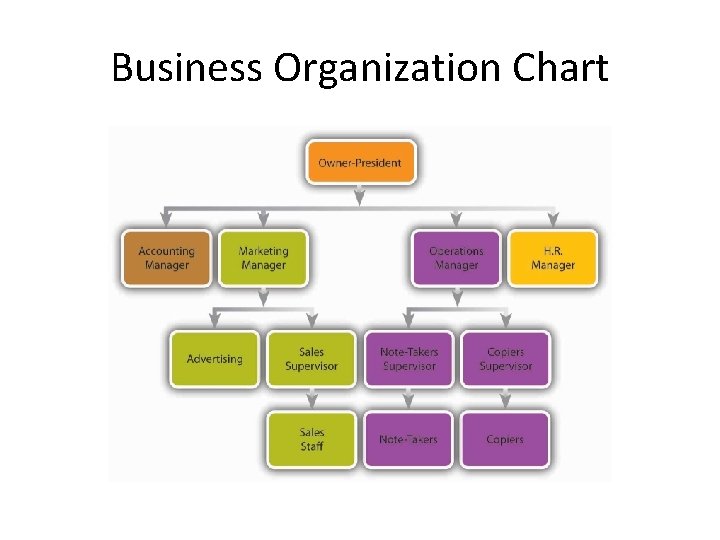
Business Organization Chart
5 -3 ORGANIZATIONAL STRUCTURE FOR BUSINESS Types of Organizational Structures • Functional Organization Structure – Work is arranged within main business functions such as production, operations, marketing, and human resources. – People work with others who have the same skills – People become more focused on their specific function that on the success of the whole business
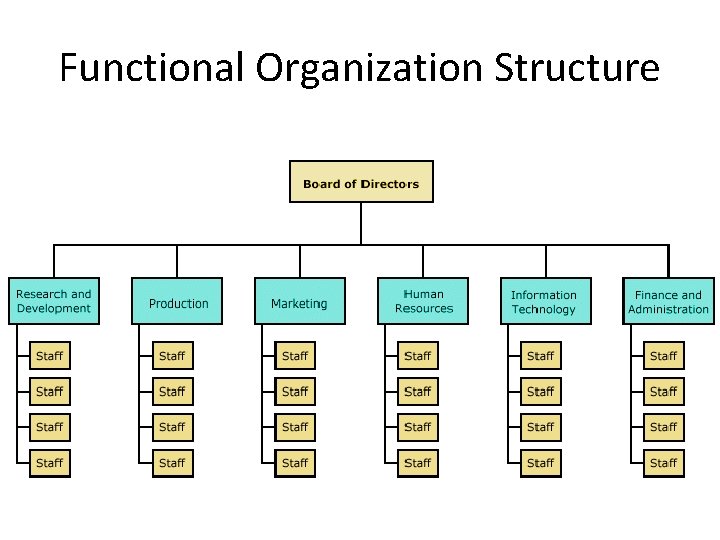
Functional Organization Structure
5 -3 ORGANIZATIONAL STRUCTURE FOR BUSINESS Types of Organizational Structures • Matrix Organization Structure – Work is structured around specific projects, products, or customer groups. – Can be interesting and motivating as employees work with many different people – Can be confusing and inefficient without effective leadership and communication
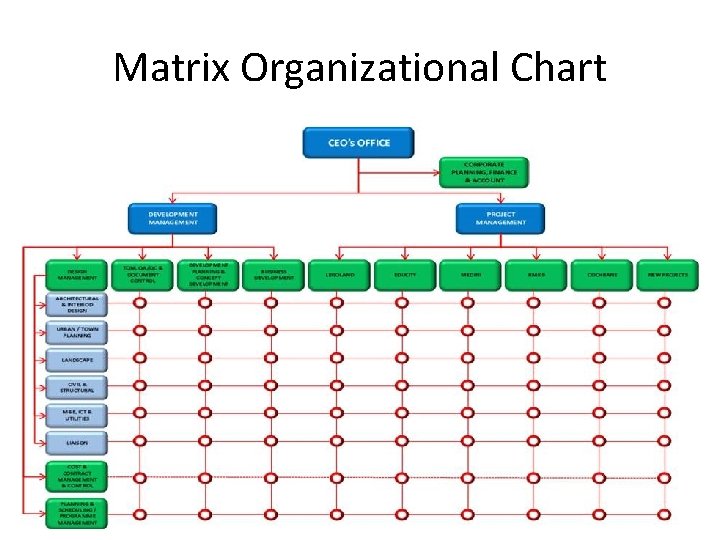
Matrix Organizational Chart
- Slides: 33