
CHAPTER 5 Business Organization 5 1 Business in
CHAPTER 5 Business Organization 5. 1 Business in the U. S. Economy 5. 2 Forms of Business Ownership 5. 3 Organizational Structure for Businesses © 2017 Cengage Learning®. May not be scanned, copied or duplicated, or posted to a publicly accessible website, in whole or in part. Principles of Business, 9 e
CHAPTER 5. 1 5 SLIDE 2 Business in the U. S. Economy Learning Outcomes 5. 1. 1 Describe the changing status of U. S. employment. 5. 1. 2 Discuss the role of business in the U. S. economy. 5. 1. 3 Describe three major types of businesses. © 2017 Cengage Learning®. May not be scanned, copied or duplicated, or posted to a publicly accessible website, in whole or in part. Principles of Business, 9 e
CHAPTER KEY TERMS 5 SLIDE 3 ● contingent worker ● intermediaries ● service business © 2017 Cengage Learning®. May not be scanned, copied or duplicated, or posted to a publicly accessible website, in whole or in part. Principles of Business, 9 e
THE CHANGING U. S. JOB MARKET CHAPTER 5 SLIDE 4 ● Employment data ● Pressures on employees © 2017 Cengage Learning®. May not be scanned, copied or duplicated, or posted to a publicly accessible website, in whole or in part. Principles of Business, 9 e
CHAPTER 5 SLIDE 5 Checkpoint List several groups that will increase as a percentage of the total U. S. workforce in the next decade. ● Younger workers (16– 24 years of age) ● Asian-, Hispanic-, African-American groups ● Women © 2017 Cengage Learning®. May not be scanned, copied or duplicated, or posted to a publicly accessible website, in whole or in part. Principles of Business, 9 e
BUSINESS AND THE ECONOMY CHAPTER 5 SLIDE 6 ● Size of U. S. businesses ● 21. 7 million businesses with no employees ● 5. 8 million with less than 20 employees ● 526, 000+ with 20– 99 employees ● 109, 000 with 100 or more employees, 981 of these with more than 10, 000 employees © 2017 Cengage Learning®. May not be scanned, copied or duplicated, or posted to a publicly accessible website, in whole or in part. Principles of Business, 9 e
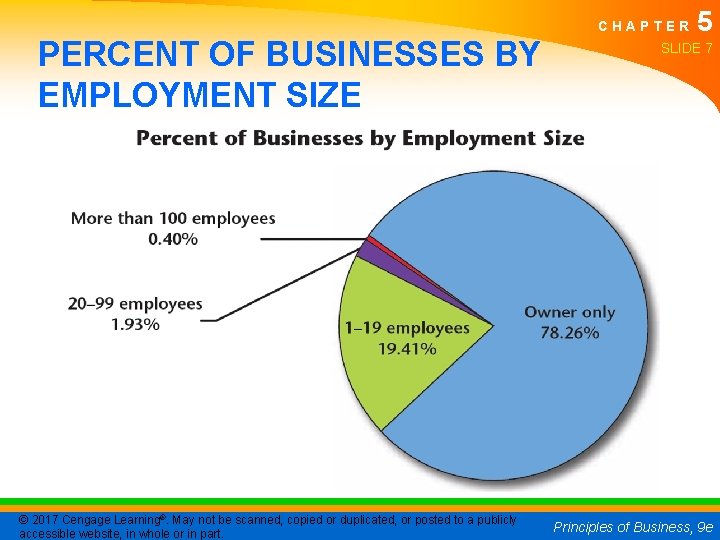
CHAPTER PERCENT OF BUSINESSES BY EMPLOYMENT SIZE © 2017 Cengage Learning®. May not be scanned, copied or duplicated, or posted to a publicly accessible website, in whole or in part. 5 SLIDE 7 Principles of Business, 9 e
CHAPTER 5 SLIDE 8 ROLES OF BUSINESS ● Make and distribute products for consumers, government, and other businesses ● Provide employment for people © 2017 Cengage Learning®. May not be scanned, copied or duplicated, or posted to a publicly accessible website, in whole or in part. Principles of Business, 9 e
CHAPTER IMPACT ON A COMMUNITY 5 SLIDE 9 ● Money introduced to a community ● Taxes for the community to support community services ● More jobs ● More income © 2017 Cengage Learning®. May not be scanned, copied or duplicated, or posted to a publicly accessible website, in whole or in part. Principles of Business, 9 e
CHAPTER BUSINESS ACTIVITIES 5 SLIDE 10 ● Generating ideas ● Raising capital ● Employing and training personnel ● Buying goods and services ● Marketing goods and services ● Maintaining business records © 2017 Cengage Learning®. May not be scanned, copied or duplicated, or posted to a publicly accessible website, in whole or in part. Principles of Business, 9 e
CHAPTER 5 SLIDE 11 Checkpoint What are the six basic activities completed by all businesses? ● Generating ideas ● Raising capital ● Employing and training personnel ● Buying goods and services ● Marketing goods and services ● Maintaining business records © 2017 Cengage Learning®. May not be scanned, copied or duplicated, or posted to a publicly accessible website, in whole or in part. Principles of Business, 9 e
CHAPTER TYPES OF BUSINESSES 5 SLIDE 12 ● Producers ● Extractors ● Farmers ● Manufacturers ● Intermediaries ● Service businesses © 2017 Cengage Learning®. May not be scanned, copied or duplicated, or posted to a publicly accessible website, in whole or in part. Principles of Business, 9 e
CHAPTER 5 SLIDE 13 Checkpoint How does a manufacturer differ from an extractor? ● An extractor takes natural resources, such as oil or timber, for direct consumption or for use in developing other products. ● A manufacturer takes resources supplied by others and converts them into useable products. © 2017 Cengage Learning®. May not be scanned, copied or duplicated, or posted to a publicly accessible website, in whole or in part. Principles of Business, 9 e
CHAPTER 5. 2 5 SLIDE 14 Forms of Business Ownership Learning Outcomes 5. 2. 1 Understand the three major forms of business ownership. 5. 2. 2 Determine when each form of business ownership is most appropriate. 5. 2. 3 Recognize other specialized business ownership forms. © 2017 Cengage Learning®. May not be scanned, copied or duplicated, or posted to a publicly accessible website, in whole or in part. Principles of Business, 9 e
CHAPTER KEY TERMS 5 SLIDE 15 ● proprietorship ● partnership ● corporation ● partnership agreement ● articles of incorporation ● franchise © 2017 Cengage Learning®. May not be scanned, copied or duplicated, or posted to a publicly accessible website, in whole or in part. Principles of Business, 9 e
CHAPTER BUSINESS OWNERSHIP 5 SLIDE 16 ● Proprietorship ● Business owned and run by just one person ● Partnership ● Business owned and controlled by two or more people ● Corporation ● Separate legal entity formed by documents filed with a state © 2017 Cengage Learning®. May not be scanned, copied or duplicated, or posted to a publicly accessible website, in whole or in part. Principles of Business, 9 e
CHAPTER 5 SLIDE 17 Checkpoint What are the differences between the three main forms of business ownership? ● Business forms differ in the ways in which decision making and investments are made and to whom liabilities are distributed. © 2017 Cengage Learning®. May not be scanned, copied or duplicated, or posted to a publicly accessible website, in whole or in part. Principles of Business, 9 e
CHOOSING A FORM OF BUSINESS OWNERSHIP CHAPTER 5 SLIDE 18 ● Choosing a proprietorship ● Choosing a partnership ● Partnership agreement is a written agreement among all owners. ● Choosing a corporation ● Articles of incorporation is a written legal document that defines ownership and operating procedures and conditions for the business. © 2017 Cengage Learning®. May not be scanned, copied or duplicated, or posted to a publicly accessible website, in whole or in part. Principles of Business, 9 e
CHAPTER 5 SLIDE 19 Checkpoint Which form of business ownership is the most complex and difficult to form? ● The corporation is more complex to begin than other business forms. ● Forming a corporation requires much more bureaucracy, is more subject to government regulations, requires the organization of a board, and necessitates the establishment of clearly defined bylaws. © 2017 Cengage Learning®. May not be scanned, copied or duplicated, or posted to a publicly accessible website, in whole or in part. Principles of Business, 9 e
OTHER FORMS OF OWNERSHIP CHAPTER 5 SLIDE 20 ● Specialized partnerships and corporations ● Limited liability partnership ● Joint venture ● S corporation ● Limited liability company ● Nonprofit corporation ● Cooperatives and franchises © 2017 Cengage Learning®. May not be scanned, copied or duplicated, or posted to a publicly accessible website, in whole or in part. Principles of Business, 9 e
CHAPTER 5 SLIDE 21 Checkpoint What are the other specialized forms of business ownership? ● Limited liability partnership ● Joint venture ● S corporation ● Limited liability company ● Nonprofit corporation © 2017 Cengage Learning®. May not be scanned, copied or duplicated, or posted to a publicly accessible website, in whole or in part. Principles of Business, 9 e
CHAPTER 5. 3 Organizational Structure for Businesses 5 SLIDE 22 Learning Outcomes 5. 3. 1 Understand important principles in designing an effective organization. 5. 3. 2 Compare alternative organizational structures for businesses. © 2017 Cengage Learning®. May not be scanned, copied or duplicated, or posted to a publicly accessible website, in whole or in part. Principles of Business, 9 e
CHAPTER KEY TERMS 5 SLIDE 23 ● mission statement ● goal ● policies ● procedures ● organization chart © 2017 Cengage Learning®. May not be scanned, copied or duplicated, or posted to a publicly accessible website, in whole or in part. Principles of Business, 9 e
CHAPTER DESIGNING AN EFFECTIVE BUSINESS ORGANIZATION 5 SLIDE 24 ● Setting direction ● Mission statement ● Goals ● Policies and procedures ● Principles of effective organization ● Responsibility, authority, and accountability ● Unity of command ● Span of control © 2017 Cengage Learning®. May not be scanned, copied or duplicated, or posted to a publicly accessible website, in whole or in part. Principles of Business, 9 e
CHAPTER 5 SLIDE 25 Checkpoint What is the difference between a mission statement and a goal? ● A mission statement communicates the purpose of existence for a business and what it hopes to achieve. ● A goal is a more specific statement of what a business expects to achieve and may be used to measure a business’ success. © 2017 Cengage Learning®. May not be scanned, copied or duplicated, or posted to a publicly accessible website, in whole or in part. Principles of Business, 9 e
CHAPTER TYPES OF ORGANIZATIONAL STRUCTURES 5 SLIDE 26 ● Functional organization structure ● Work is arranged within main business functions such as production, operations, marketing, and human resources. ● Matrix organizational structure ● Work is structured around specific projects, products, or customer groups. © 2017 Cengage Learning®. May not be scanned, copied or duplicated, or posted to a publicly accessible website, in whole or in part. Principles of Business, 9 e
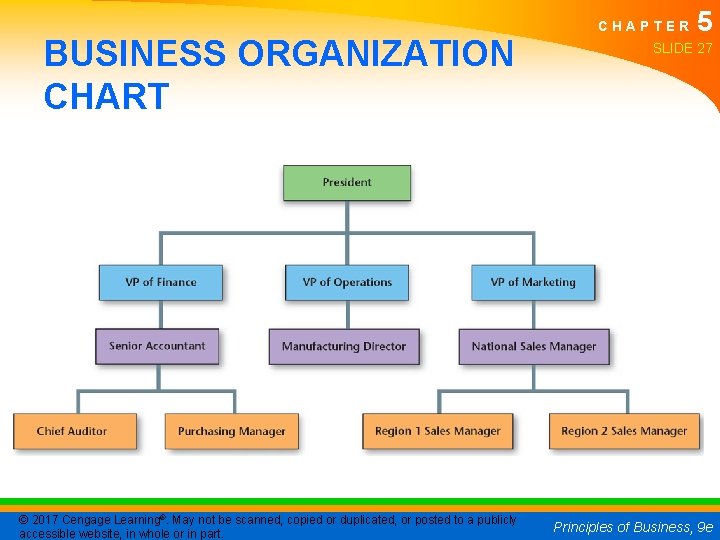
BUSINESS ORGANIZATION CHART © 2017 Cengage Learning®. May not be scanned, copied or duplicated, or posted to a publicly accessible website, in whole or in part. CHAPTER 5 SLIDE 27 Principles of Business, 9 e
CHAPTER Checkpoint 5 SLIDE 28 What problems can result from the use of a functional organizational structure? ● Employees in a functional organizational structure may tend to lose sight of overall corporate goals. ● Workers tend to be limited to specific duties and may not see their relationship to the organization as a whole. ● This can result in lack of interest and motivation over time. © 2017 Cengage Learning®. May not be scanned, copied or duplicated, or posted to a publicly accessible website, in whole or in part. Principles of Business, 9 e
- Slides: 28